
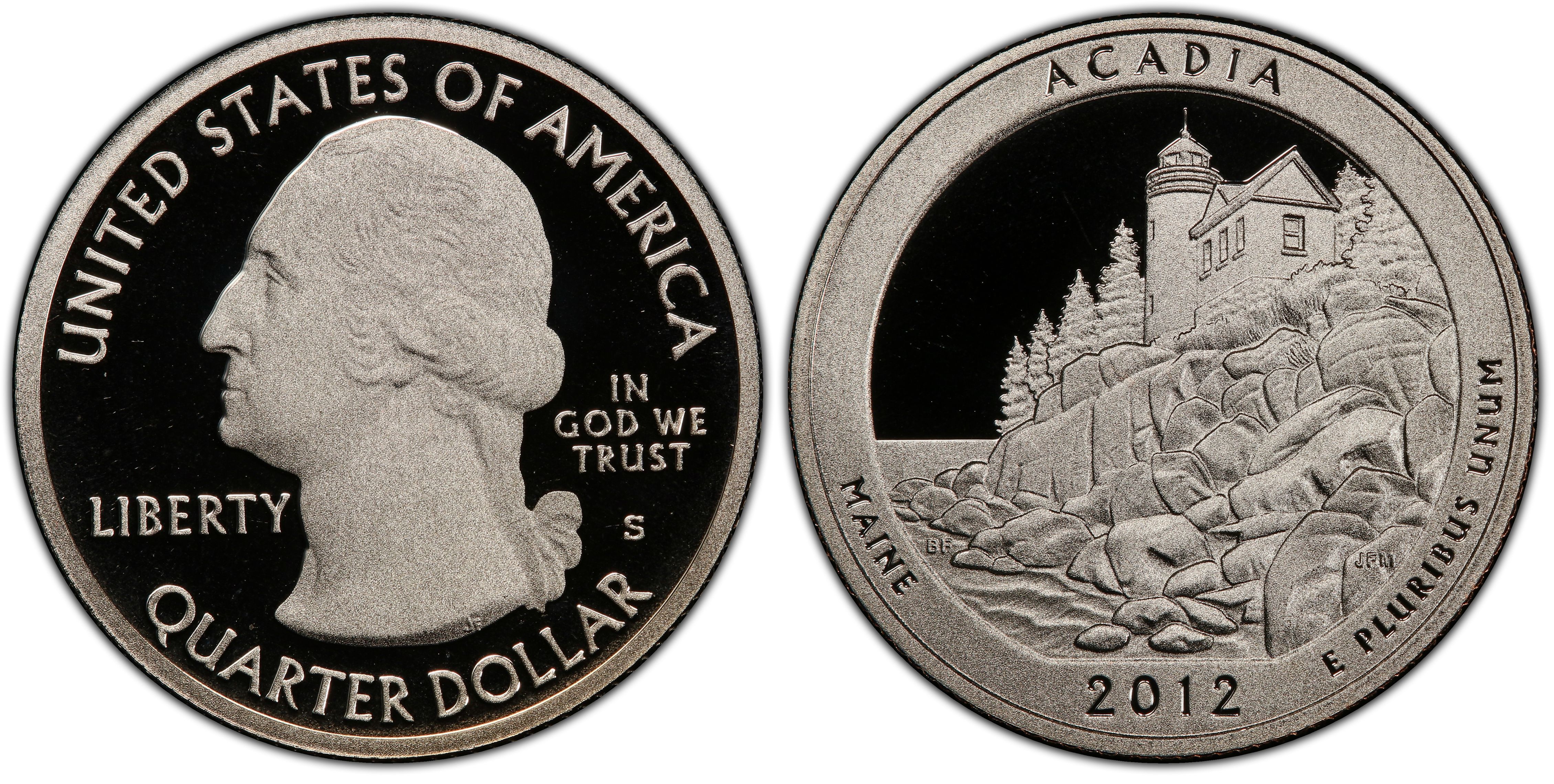
PCGS PR70DCAM
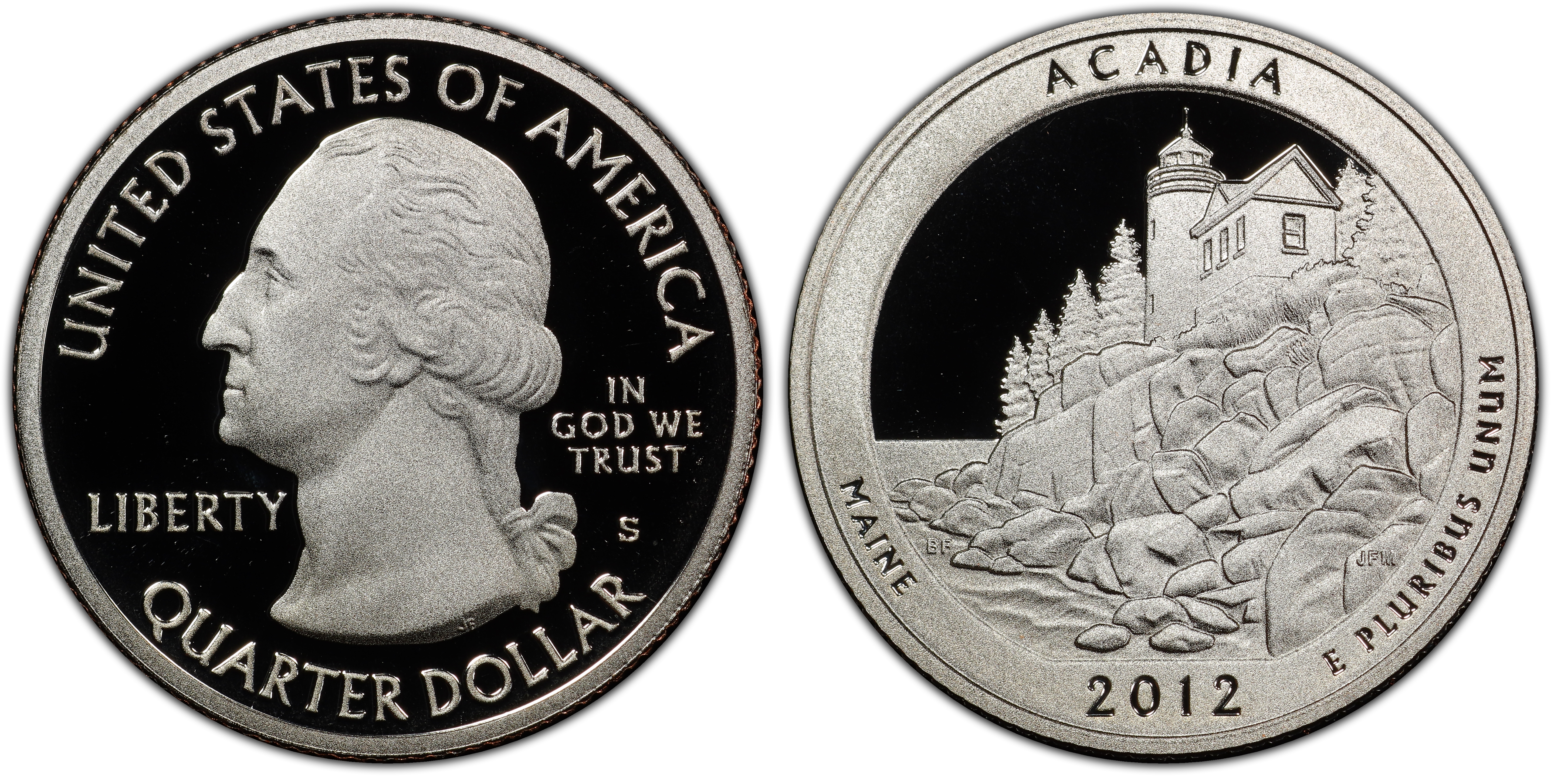
PCGS PR70DCAM
- PCGS #:
- 510084
- Designer:
- John Flanagan/Barbara Fox
- Edge:
- Reeded
- Diameter:
- 24.30 millimeters
- Weight:
- 5.67 grams
- Mintage:
- 962,038
- Mint:
- San Francisco
- Metal:
- 75% Copper, 25% Nickel over a pure Copper center
- Auction Record:
- $43 • PR70DCAM • 11-29-2022 • eBay
Major Varieties
- 2012-S 25C Acadia NP, DCAM
The 2012-S Acadia National Park Quarter Clad Proof
The 2012-S Acadia National Park Quarter Clad Proof is the base metal Proof coin that was struck at the San Francisco Mint and sold to collectors as part of the Mint's annual Proof offerings. Similar in design to the Silver Proof version, the Clad Proof was struck in the same metal composition as the circulating version.
The Acadia Quarter features a stunning reverse design of the Bass Harbor Head Lighthouse perched atop the rocky Maine coastline. Designed by Barbara Fox and sculpted by Joseph Menna, the design includes the inscriptions ACADIA, MAINE, 2012, and E PLURIBUS UNUM.
Acadia National Park
Managed by the National Park Service (NPS), Acadia National Park protects significant portions of Mount Desert Island, its rugged shoreline, several outlying islands, and the Schoodic Peninsula on the Maine mainland. Established in 1919, Acadia holds the historic distinction of being the first national park created east of the Mississippi River.
The park encompasses 48,419 acres of diverse ecosystems, including beaches, dunes, old-growth forests, and pristine lakes. At its heart lies Cadillac Mountain, which, at 1,530 feet, is the highest point on the U.S. Atlantic seaboard.
With over three million annual visitors, Acadia is a premier destination for hiking (with 120 miles of trails), cycling, and coastal activities. Beyond its natural beauty, the park preserves vital historical landmarks, including the Bass Harbor Head Lighthouse and Sieur de Monts Spring, the park's original settlement site.
The 2012-S Acadia National Park Quarter Clad Proof Was Part of the 2012 Clad Proof Set
The 2012 United States Mint Clad Proof Set represents the base-metal version of the Mint’s annual Proof offering. Struck entirely at the San Francisco Mint, using polished planchets and Proof dies, the set features 14 coins, each bearing the “S” mintmark. These sets were issued in three protective lenses, housed in a brown-themed outer box with a certificate of authenticity.
Set Composition:
Five America the Beautiful Quarters: Honoring El Yunque, Puerto Rico (#510076), Chaco Culture, New Mexico (#510080), Acadia, Maine (#510084), Hawai’i Volcanoes, Hawai'i (#510088), and Denali, Alaska (#510092).
Four Presidential Dollars: Featuring Chester Arthur (#512426), Grover Cleveland (first #512427, and second terms #512428), and Benjamin Harrison (#512429).
One Native American Dollar: Highlighting 17th-century trade routes (#512844).
Core Denominations: The Kennedy Half Dollar (#511877), Roosevelt Dime (#511873), Jefferson Nickel (#511871), and Lincoln Cent (RD DCAM #511252).
Collecting the 2012-S Acadia National Park Quarter Clad Proof
Released on May 7, 2012, for $31.95, this set marked a significant turning point in the Mint's annual Proof program. Final sales reached only 794,002 units—a nearly 30% drop from 2011. This was the first time since 1959 that annual Proof Set sales fell below the one-million mark, signaling a cooling in collector interest that has made the 2012 issues relatively scarce compared to their predecessors.
Given the escalating value of silver, the 2012-S Acadia National Park Quarter Clad Proof remains the affordable option for collectors seeking to build a complete set of America the Beautiful Proofs. While the initial surge of grading occurred shortly after release, new examples continue to surface. The vast majority of certified specimens achieve the elite grades of PCGS PR69DCAM or PR70DCAM. All examples feature heavy frosting, with mirrored fields dominating the obverse and the frosted coastal design commanding the reverse.
* * *