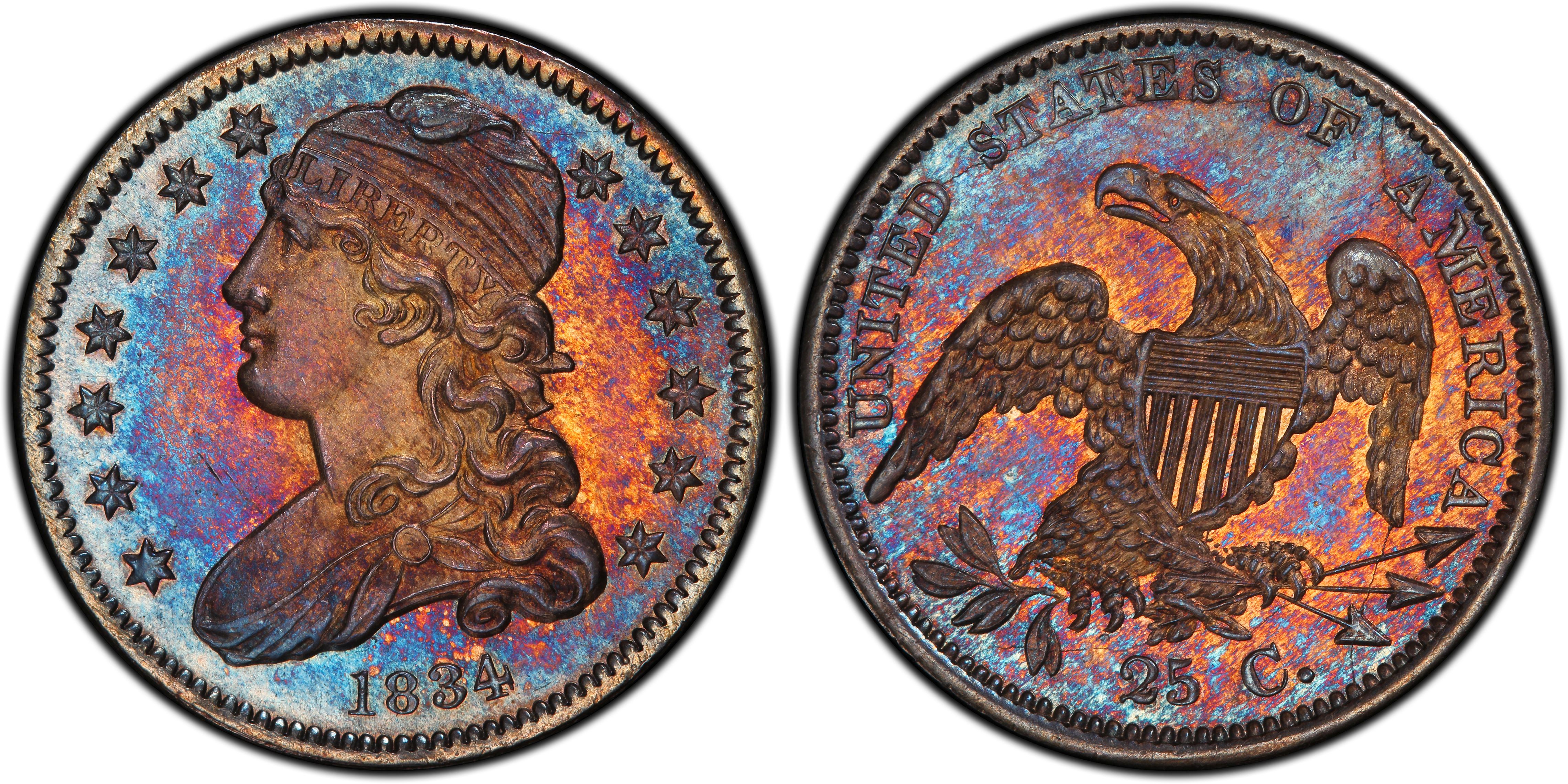
1834 25C (Regular Strike)
Series: Capped Bust Quarters 1815-1838

PCGS MS66
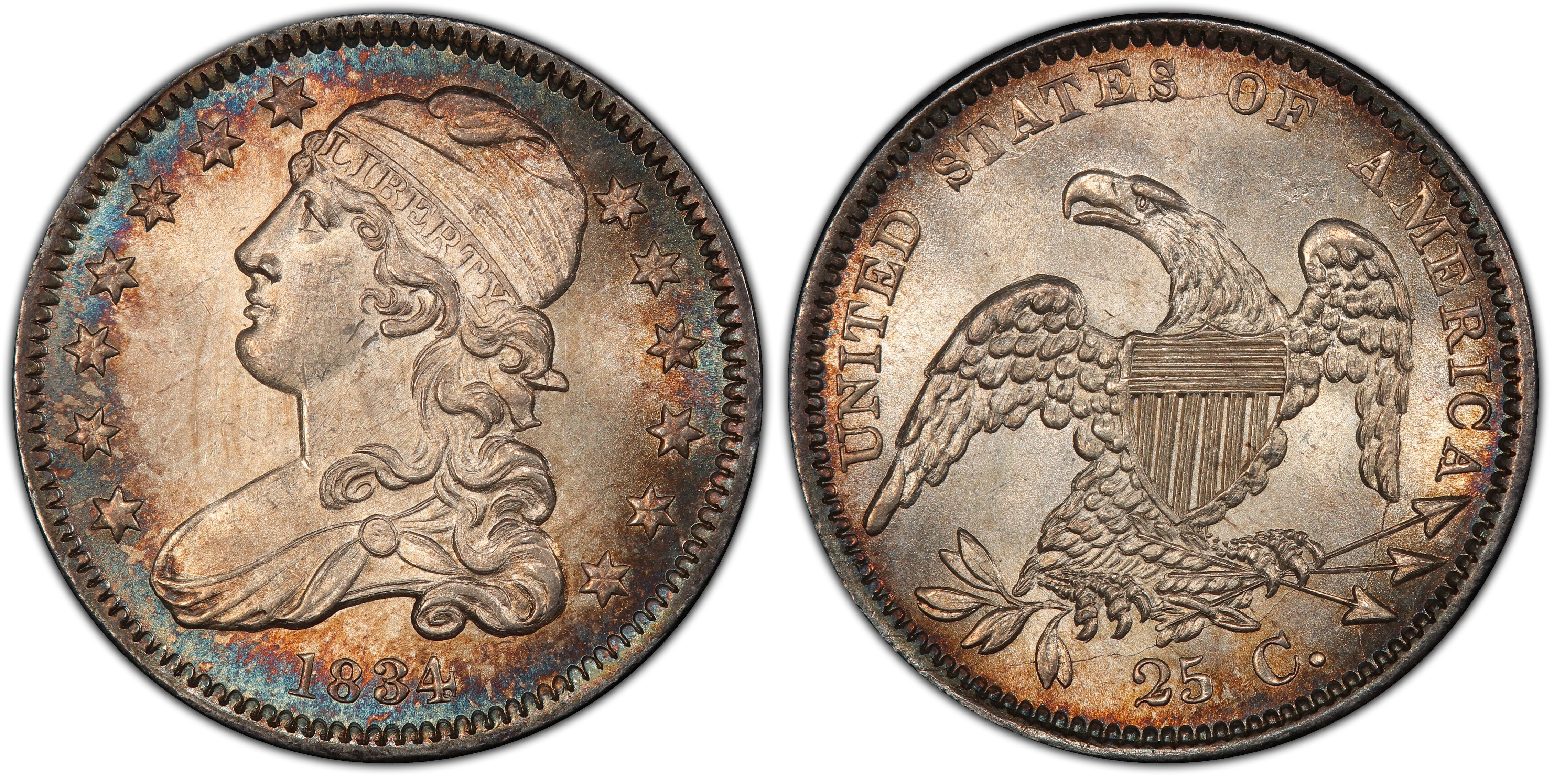
PCGS MS66
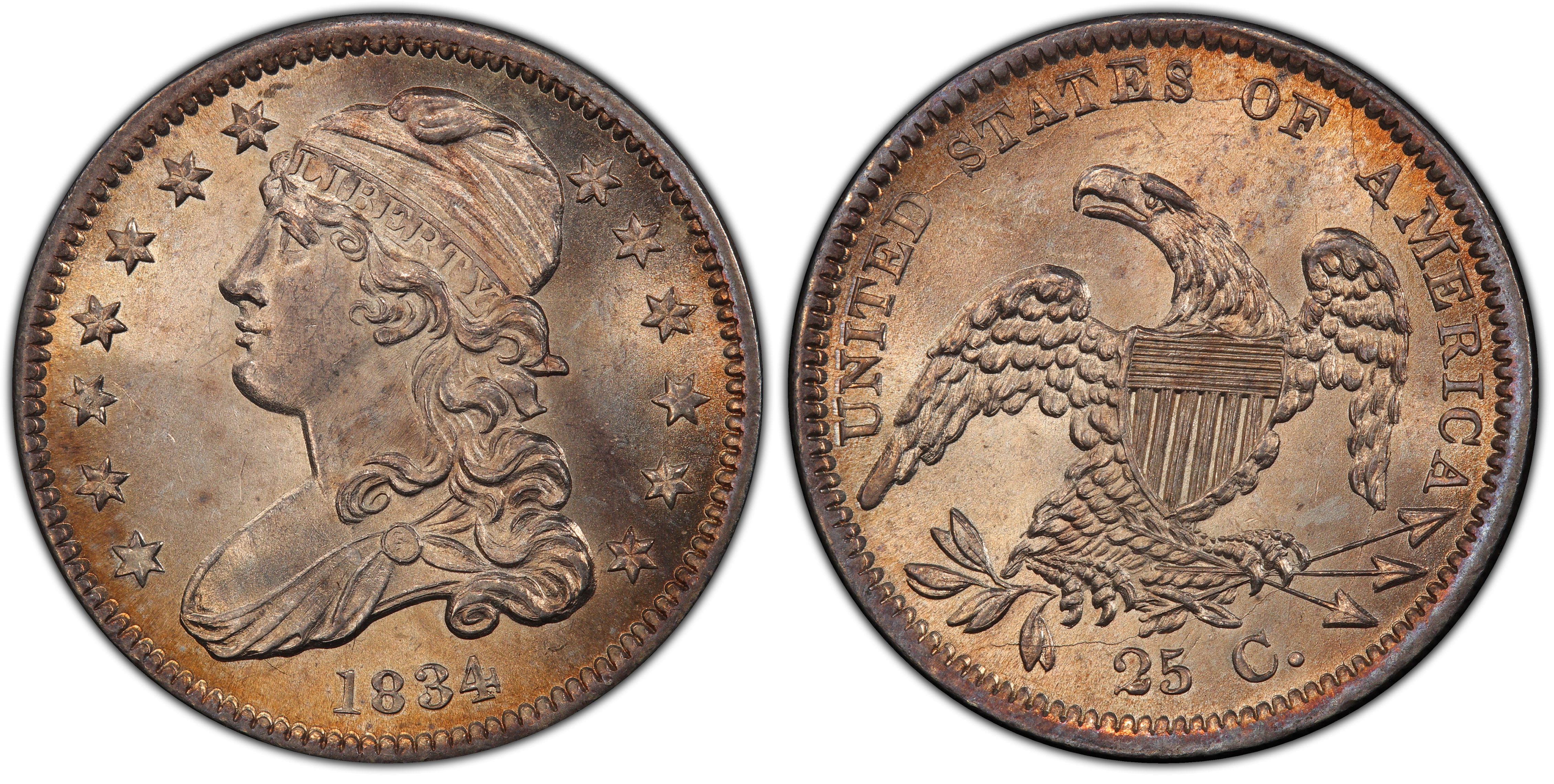
PCGS MS66
- PCGS #:
- 5353
- Designer:
- John Reich
- Edge:
- Reeded
- Diameter:
- 24.30 millimeters
- Weight:
- 6.74 grams
- Mintage:
- 286,000
- Mint:
- Philadelphia
- Metal:
- 89.2% Silver, 10.8% Copper
- Auction Record:
- $72,000 • MS67 • 06-21-2024 • Stack's Bowers
Rarity and Survival Estimates Learn More
| Survival Estimate | |
|---|---|
| All Grades | 4,125 |
| 60 or Better | 82 |
| 65 or Better | 9 |
| Numismatic Rarity | |
|---|---|
| All Grades | R-4.1 |
| 60 or Better | R-8.1 |
| 65 or Better | R-9.6 |
| Relative Rarity By Type All Specs in this Type | |
|---|---|
| All Grades | 8 / 9 |
| 60 or Better | 7 / 9 |
| 65 or Better | 6 / 9 TIE |
| Relative Rarity By Series All Specs in this Series | |
|---|---|
| All Grades | 22 / 24 TIE |
| 60 or Better | 20 / 24 |
| 65 or Better | 15 / 24 TIE |
Condition Census What Is This?
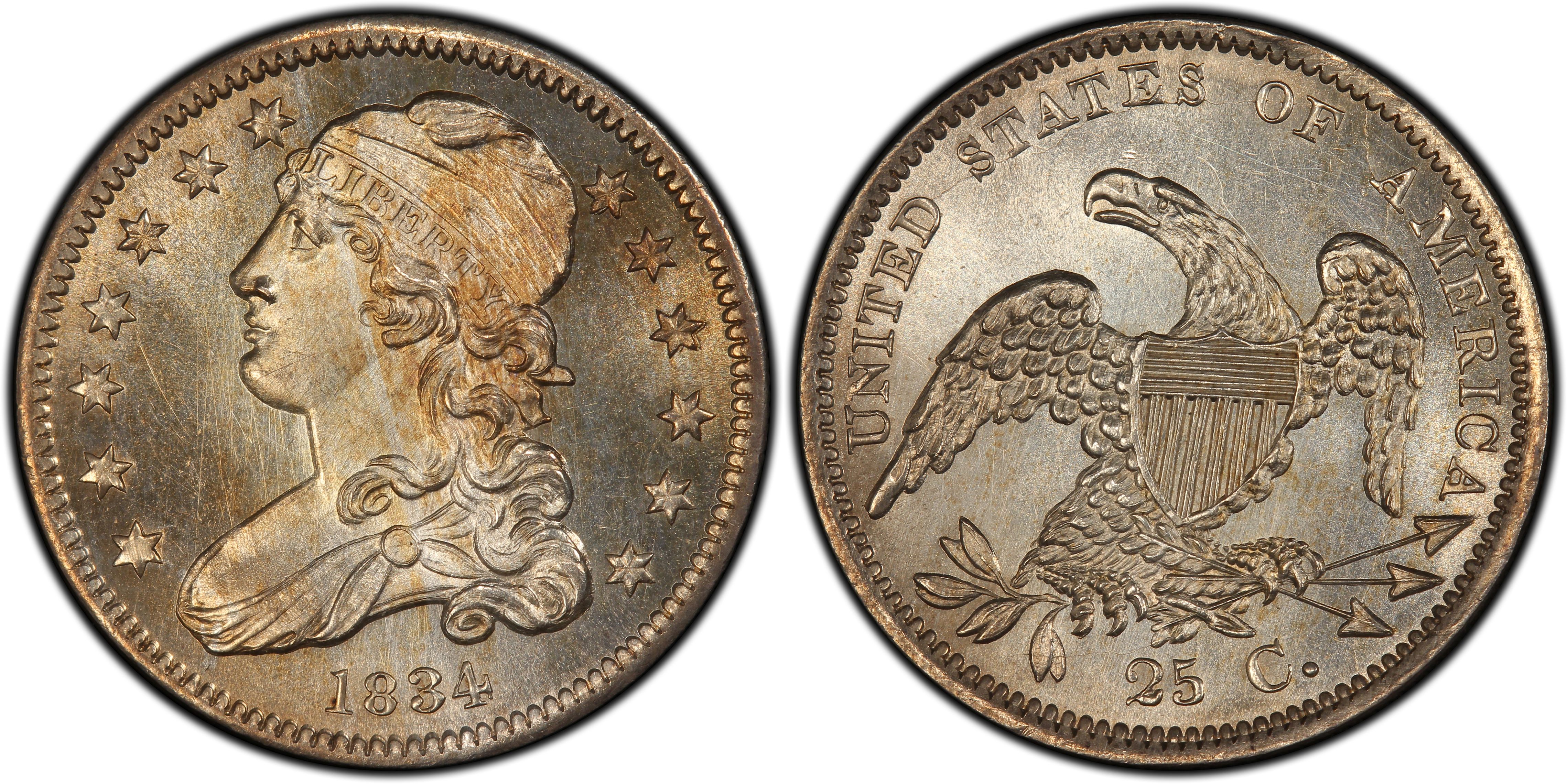 #1 MS66 PCGS grade
D. Brent Pogue Collection - Stack’s/Bowers & Sotheby’s 5/2015:1087, $58,750 - Dr. Charles Link Collection |
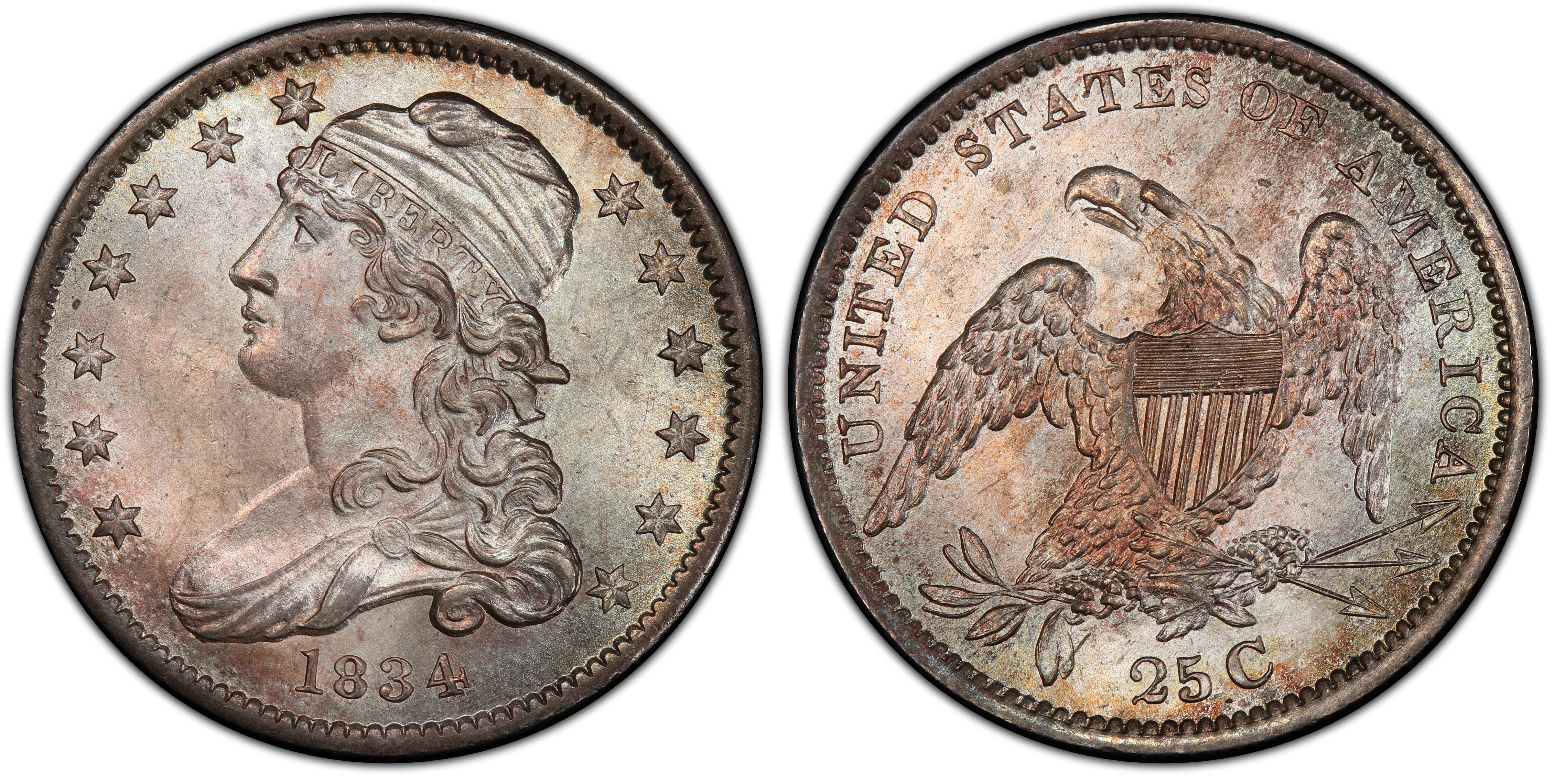 #2 MS66 PCGS grade
Rod Sweet Collection - Bowers & Merena 4/2005:3364, $29,900 |
 #2 MS66 estimated grade
Heritage 4/2012:5086, $26,450 - Heritage 4/2014:5578, $70,500 - Heritage 1/2016:5331, $64,625 |
|
#2 MS66 estimated grade
Superior 8/1990:1078, $110,000 |
|
#5 MS65+ PCGS grade
Heritage 9/2010:3911, $18,400 - Legend Rare Coin Auctions 12/2013:85, $34,500 - Legend Rare Coin Auctions 7/2017:166, $35,250 |
 #6 MS65 PCGS grade
Heritage 4/2015:4096, $11,163 |
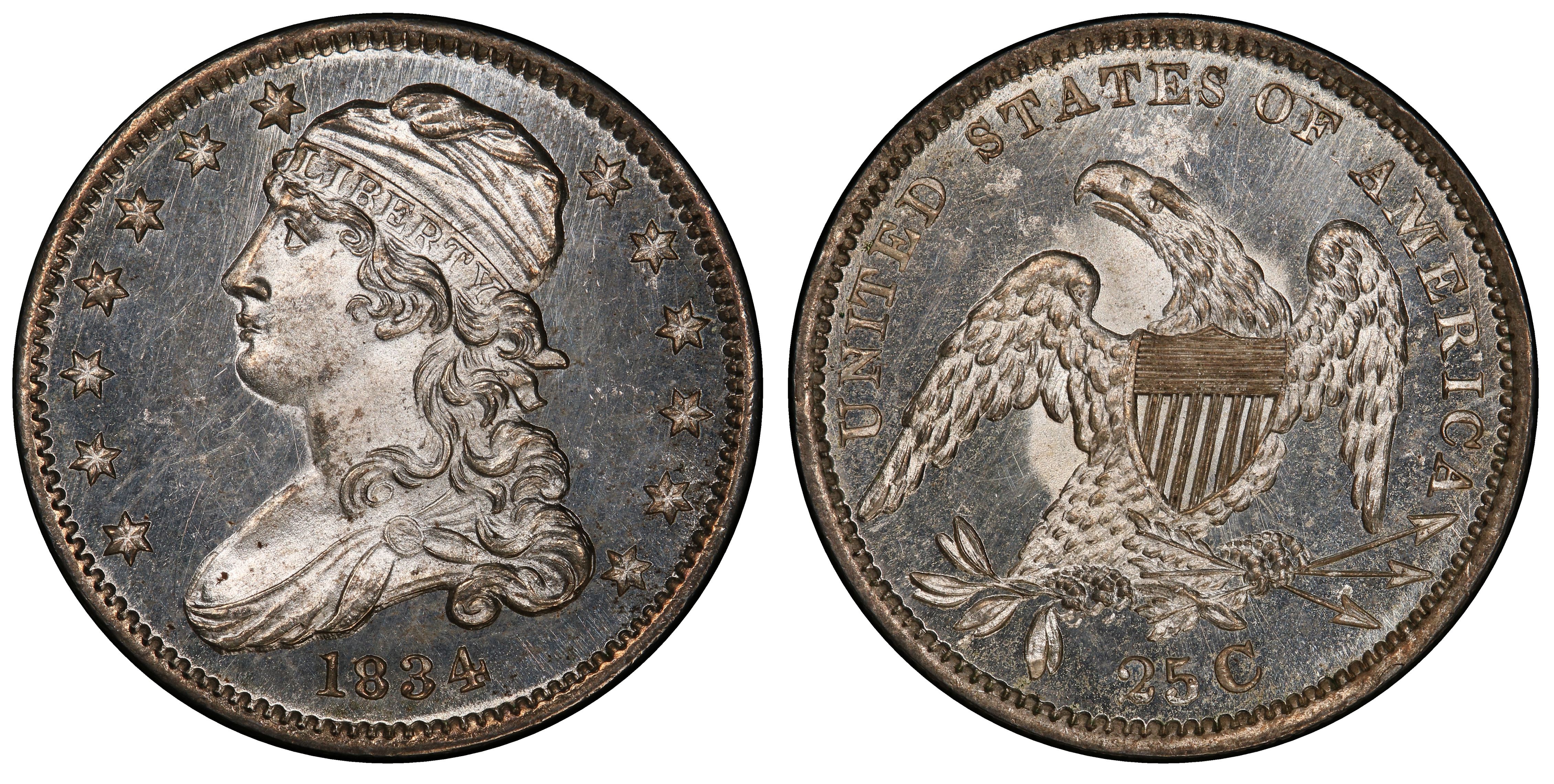 #6 MS65 PCGS grade
Heritage 1/2009:3733, $29,900 - Heritage 1/2015:4084, $28,200 |
 #6 MS65 PCGS grade
Rare Coins of New Hampshire, sold privately in 4/2007 - Eugene H. Gardner Collection, Part I - Heritage 6/2014:30354, $24,675 |
|
#6 MS65 PCGS grade
Stack's/Bowers 5/2016:22, $23,500 - Legend Rare Coin Auctions 1/2018:148, $24,675 - Heritage 1/2020:4160 |
|
#6 MS65 PCGS grade
Heritage 1/2003:6642, $14,950 |
Browning-1 re-uses the reverse from 1833 B-2 with two lines in each shield stripe and no period after the denomination. It is often known as “O/F Reverse” as the reverse legend was re-punched, a strong, second F appears in the space between OF, and the top of an extra A shows between OF and AMERICA. However, the B-1 dies were lapped, producing a late die state of B-1 with these extra letters no longer visible. We could have called B-1 the "No Period" variety, the "Two Line Stripes" variety, or the "Recut Legend" variety. Any way we look at it, it's time to drop the “O/F” notation.
The Browning-2 dies were used to strike most of the known Proof Quarters of 1834, including the King of Siam coin, before they were pressed into regular service. Additionally, we know that the B-2 die pair was put into service before B-1, as the shared obverse developed a bisecting die crack during its time with the B-1 reverse. In his groundbreaking Early United States Quarters 1796-1838 (2008), Steve Tompkins describes the differences in this B-2 reverse - the shape of the wings, the angled shield stripes - arguing that this die was the work of Christian Gobrecht, made specifically to strike quarters for inclusion in the 1804/1834 presentation sets.