



aj5831's Coin Album
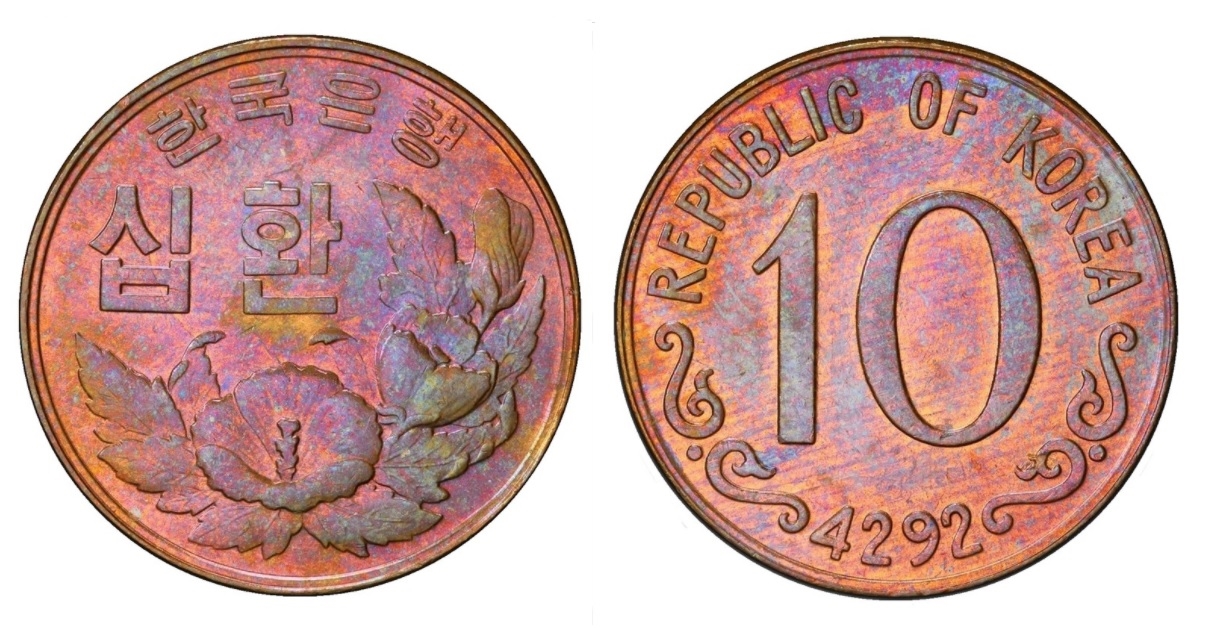
This coin was issued by the Bank of Korea during the early post-Korean War era when the Hwan was the official currency of South Korea. Struck in high mint-state condition, pieces like this are sought-after by world coin collectors focusing on mid-20th-century Asian numismatics or type sets of the Korean Hwan coinage.
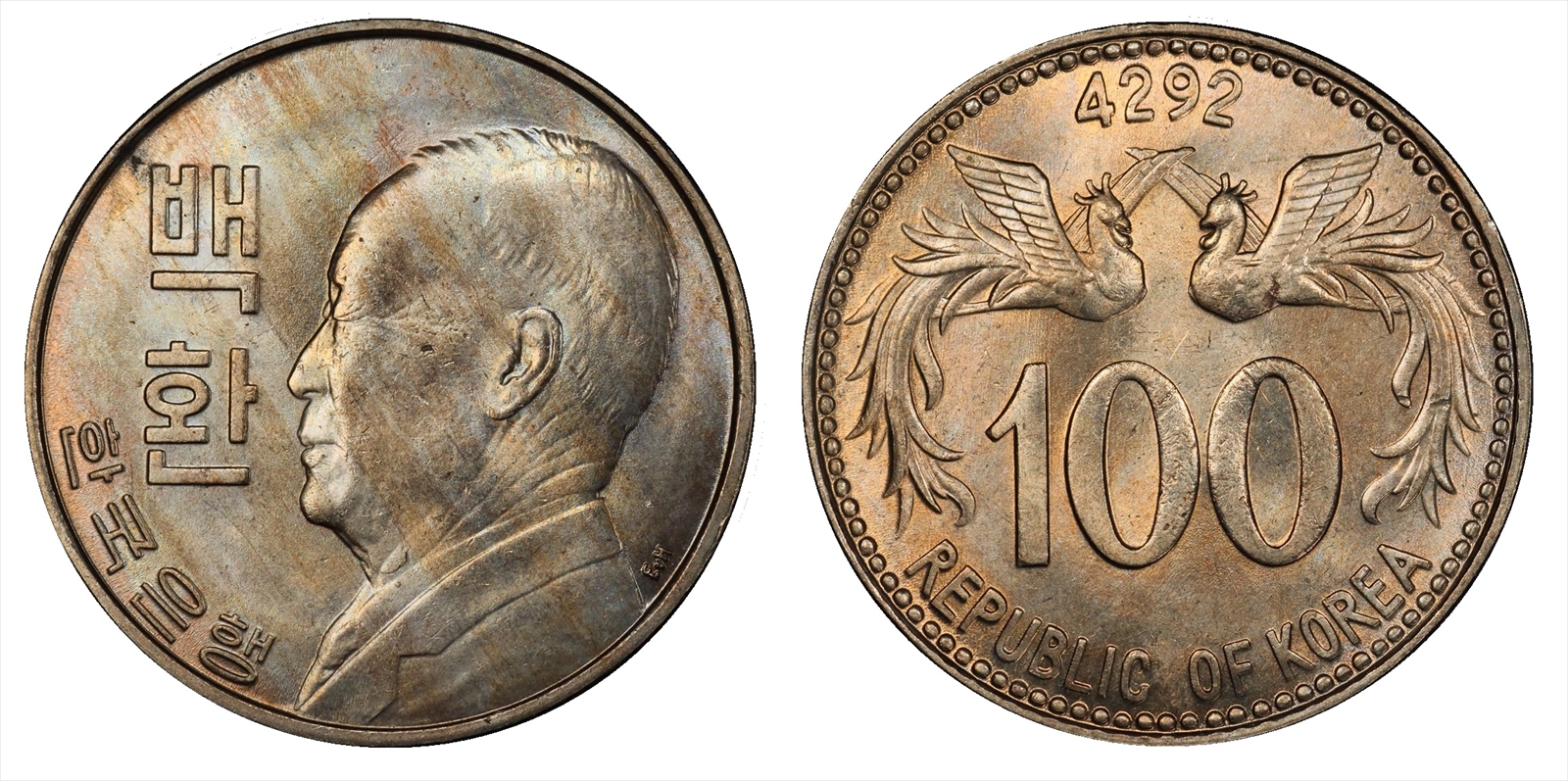
Dated KE4292 (in the Dangi calendar, which is 1959 in the western calendar), the obverse features President Syngman Rhee. These coins were minted at the Philadelphia Mint and carry strong numismatic value for a mid-century East Asian type coin.
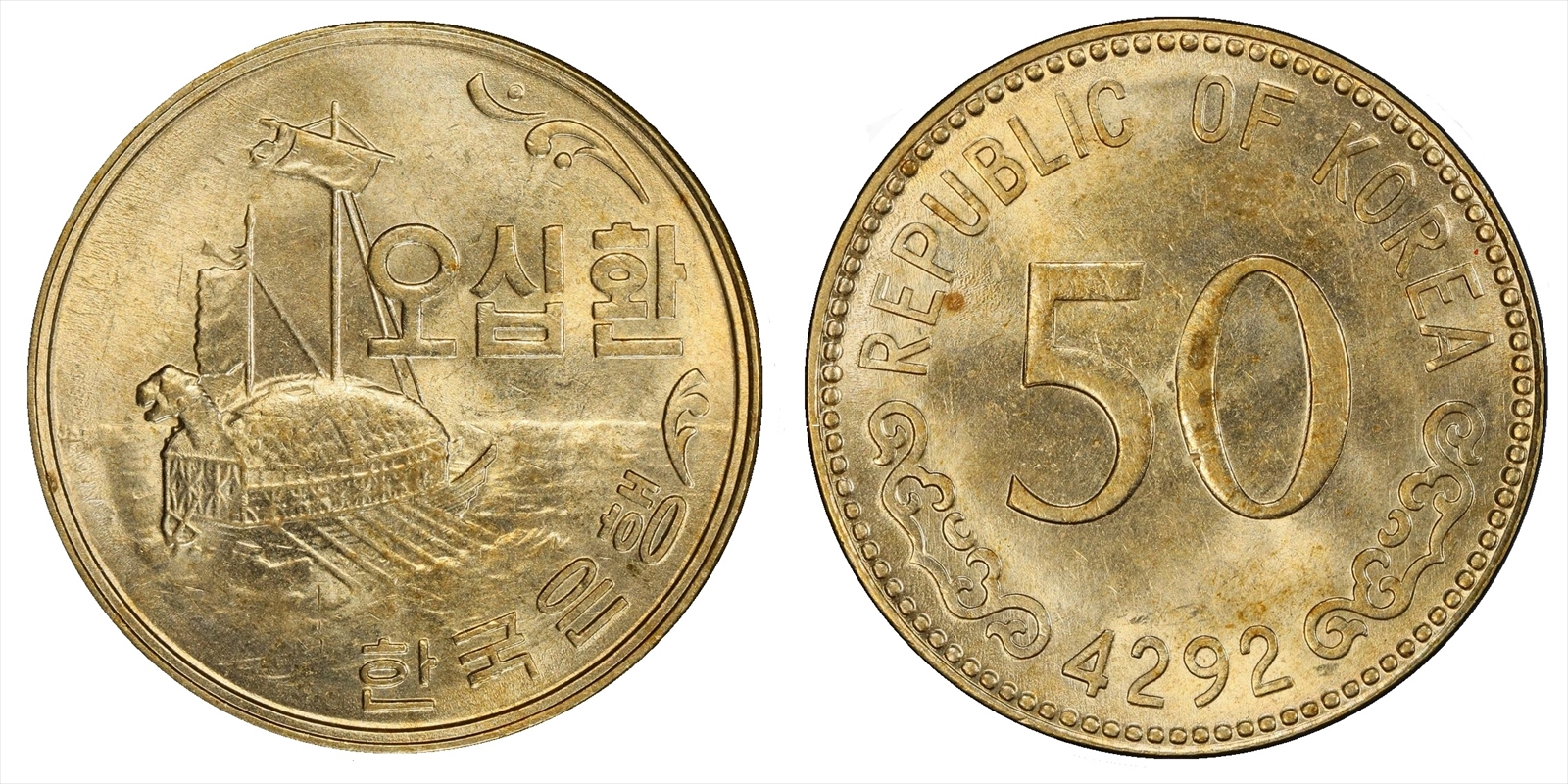
Issued by the Bank of Korea, cataloged as KM-2, featuring the famous Turtle Ship (Geobukseon). Issue date is KE4292 (1959).
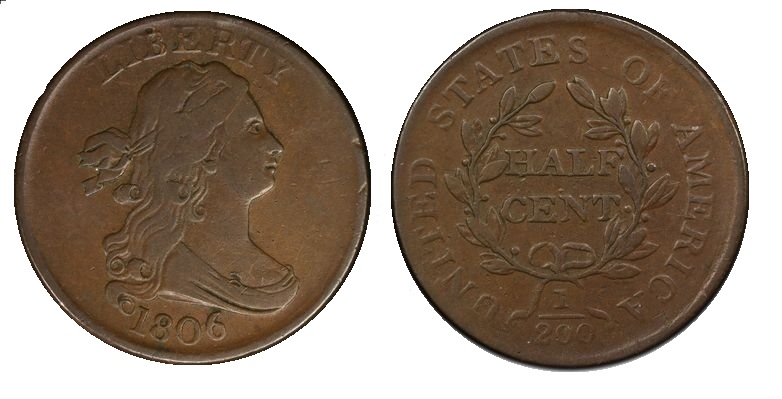
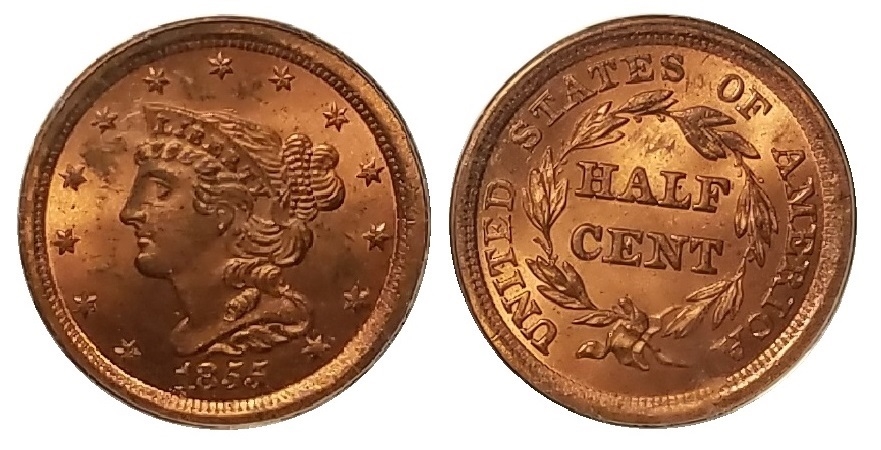
The number "6" in the date is completely separated from Liberty's bust (unlike the Large 6 variety, where the 6 is embedded in the drapery). The reverse laurel wreath entirely lacks stems extending below the ribbon bow.
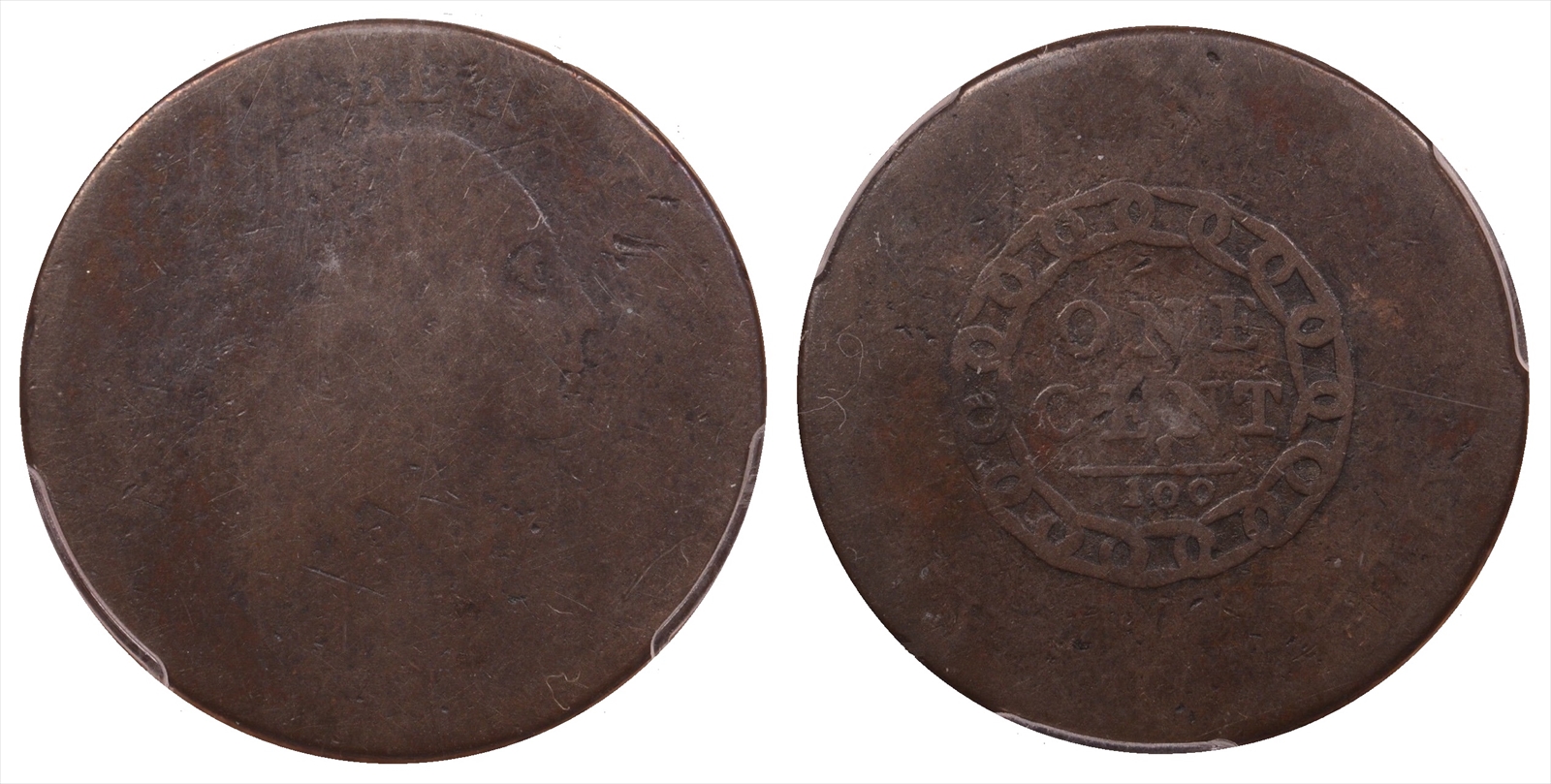
The 1793 Chain Cent in AG3 is far more interesting than its low grade suggests. In fact, AG3 is one of the most revealing and historically rich grades for this coin, because the wear exposes the raw, primitive character of the earliest U.S. Mint work. 1. It is the first regular‑issue U.S. coin ever struck for circulation: The Chain Cent was part of the March 1, 1793 delivery, the first day the U.S. Mint issued coins for public use. It was “the first regular‑issue one‑cent coin produced by the United States Mint” and “the first federal coin struck for circulation”. 2. The design was controversial — and AG3 shows the controversy clearly. The reverse chain was meant to symbolize unity, but the public hated it. Contemporary quotes were critical: The chain was seen as “a bad omen for liberty”. Liberty was described as “in a fright”. In AG3, the chain links are often still visible even when Liberty is heavily worn, making the symbolism easy to appreciate. 3. The coin was made with hand‑cut dies, and AG3 preserves the “primitive” look. Early Mint engravers cut dies by hand, leading to quirky, irregular features. Wide or close date spacing depending on variety. The LIBERTY letters are misaligned (especially the leaning R on S‑3). Staggered date numerals are punched at uneven heights. Even in AG3, these handmade characteristics often remain visible, and collectors love them. 4. The mintage was tiny — only 36,103 coins. Exact daily deliveries total only 36,103 pieces. For comparison, modern cents are minted by the billions (at least through 2025, but that's another story). An AG3 Chain Cent is rare simply because so few were made and even fewer survived heavy circulation. 5. The coin’s wear tells a story. AG3 means the coin circulated hard — likely for decades. This is historically meaningful because: - Chain Cents were used during the Washington administration; - They passed through the hands of early Americans when the nation was brand new; - Many were lost, damaged, or destroyed, making survivors special regardless of grade; - A well‑worn Chain Cent is a physical artifact of everyday life in the 1790s. 6. The S-2 variety is the scarcest of the four main varieties (excluding the ultra-rare NC-1). It features the wide date and the first use of the fully-spelled "AMERICA" reverse. Even in AG3, variety matters, and this is a desirable variety. 7. AG3 is an affordable entry into a coin that becomes extremely expensive in higher grades. Looking at the "sweet spot": - AG3: ~$5250 (recent auction) - VF25: $36,000 - XF45: $66,000 - $87,000 - MS65: $950,000+ AG3 is the "sweet spot" where collectors can own this historic coin without six-figure cost. Staggered date numerals punched at uneven heights Even in AG3, these handmade characteristics often remain visible — and collectors love them. Even in AG3, you are holding the earliest chapter of U.S. coinage history.

1793 S-13, PCGS Genuine. Ron Guth: "The 1793 Liberty Cap is one of the most desired types among early U.S. Large Cents. The typical example is low-grade, usually with one or more problems (corrosion, surface damage, cleaning, heavy marks, poor strike, etc.), so nice, problem-free examples command a significant premium. PCGS has identified only two examples with legitimate claims to the Mint State grade. No Red-Brown or Red examples exist. The finest example has a long pedigree going back to the late 1800's and includes names such as Thomas Cleaney, William H. Woodin, and Louis Eliasberg. It's current grade is PCGS MS64BN and it is part of the incredible High Desert Collection in the PCGS Set Registry."

1812 S-289 Large Cent, MS64 Brown, Large Date, Beautiful Toning, B-4, R.1, MS64 Brown PCGS. Ex: Joshua and Ally Walsh. Breen Die State II, with multiple sets of clash marks visible in the reverse field. Deep golden-brown in color, the obverse in addition features hints of gunmetal-blue toning. Sharply struck on the major devices, the stars are also crisp although the fields are flowlined near the rims, due to the die state. The reverse is gorgeously undisturbed. The obverse is also extremely clean, with only two faint slide marks near the nose and a couple of minute flecks of aqua verdigris on the neck, though this has improved significantly since its 1993 appearance. Just one finer Large Date certification exists at PCGS, Bland provided an EAC grade of AU55 in 2000, tying it for CC #3, and Noyes assigned AU50 (AU50) Average in 2015, tying it for CC #6. PCGS Population (all Large Date varieties): 7 in 64, 1 finer (5/26). Ex: Public Auction Sale (Stack's, 1/1993), lot 1169; Lee J. Bellisario; potential unknown intermediaries; May 29, 30, 1995 Auction (Superior, 5/1995), lot 2031 (as MS64 NGC); The Greenwald and Jackson Collections sale (Bowers and Merena, 9/1995), lot 1139; unknown intermediaries; The Joshua and Ally Walsh Collection of United States Cents / FUN Signature (Heritage, 1/2006), lot 3031; Continuous Internet Auction (Heritage, 2/2006), lot 23007, $24,150; The ESM Collection (Stack's Bowers, 8/2020), lot 1063, $14,400; Long Beach Signature (Heritage, 2/2023), lot 3692, $15,000.. From The Fairfax Type Set of U.S. Coins.

1853 1C N-25, R.1, MS65 Red PCGS. Die State b, typical of high-end Red hoard coins. Newcomb-25 is identified in part by the re-punching visible at the base and peak of the 1 in 1853. Attractive, brilliant copper luster adorns this example, and only a handful of non-detrimental marks are present, with carbon faint. The strike is sharp along Liberty and the wreath, though the stars appear flat which is expected of the issue. Amongst all varieties, the issue is scarcely seen finer in Red with just 20 seen by PCGS (7/26). Ex: Regency Auction XXI (Legends, 5/2017), lot 100; August Premier (Legends, 8/2017), lot 7; November Premier (Legends, 11/2017), lot 2. Coin Index Numbers: (NGC ID# 226K, Variety PCGS# 403925, Base PCGS# 1903, GSID# 241227) Metal: 100% Copper Weight: 13.48 grams Weight: 0.47549oz Mintage: 6,641,131
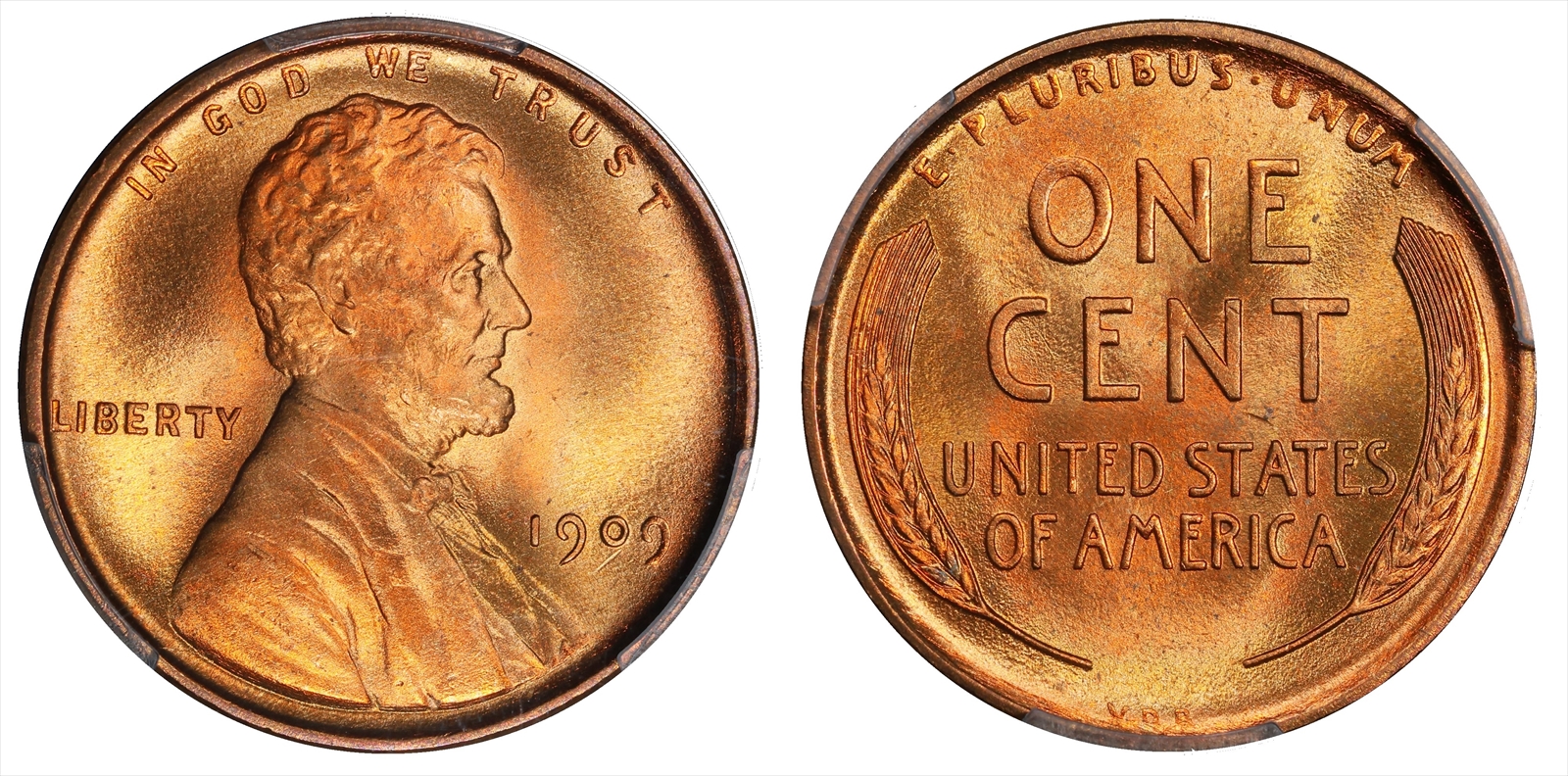
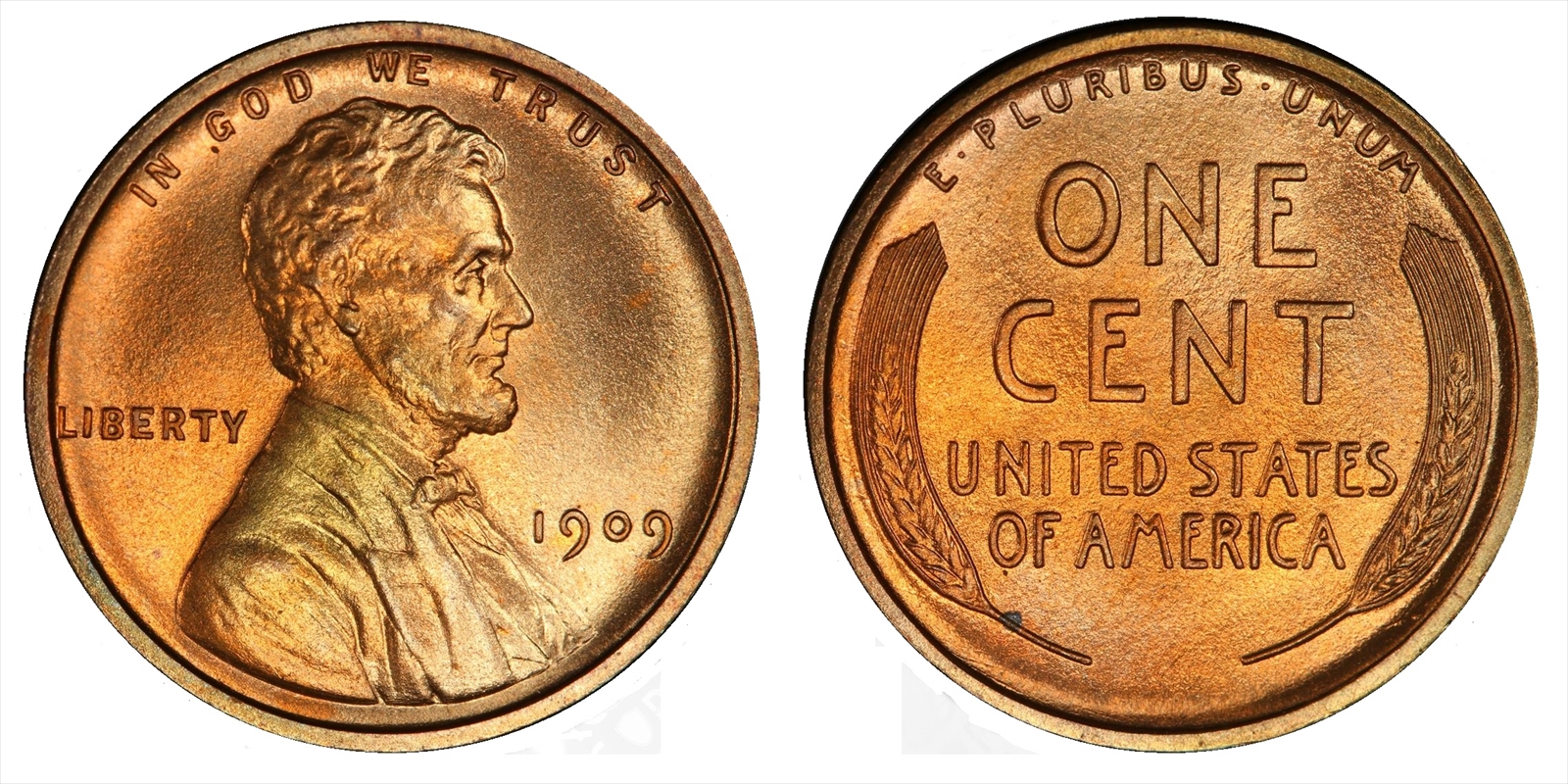
Top Pop. GC 11/24, 1909 1C VDB MS68 Red PCGS. First coin to include Designer's initials and to gain acceptance of that as a new standard device. Collectors today, as they did in August 1909, recognize the uniqueness of the 1909 VDB cent and the historical significance it represents. Because the coin was struck in large quantities (nearly 28 million pieces) before it was discontinued, examples are readily available today.
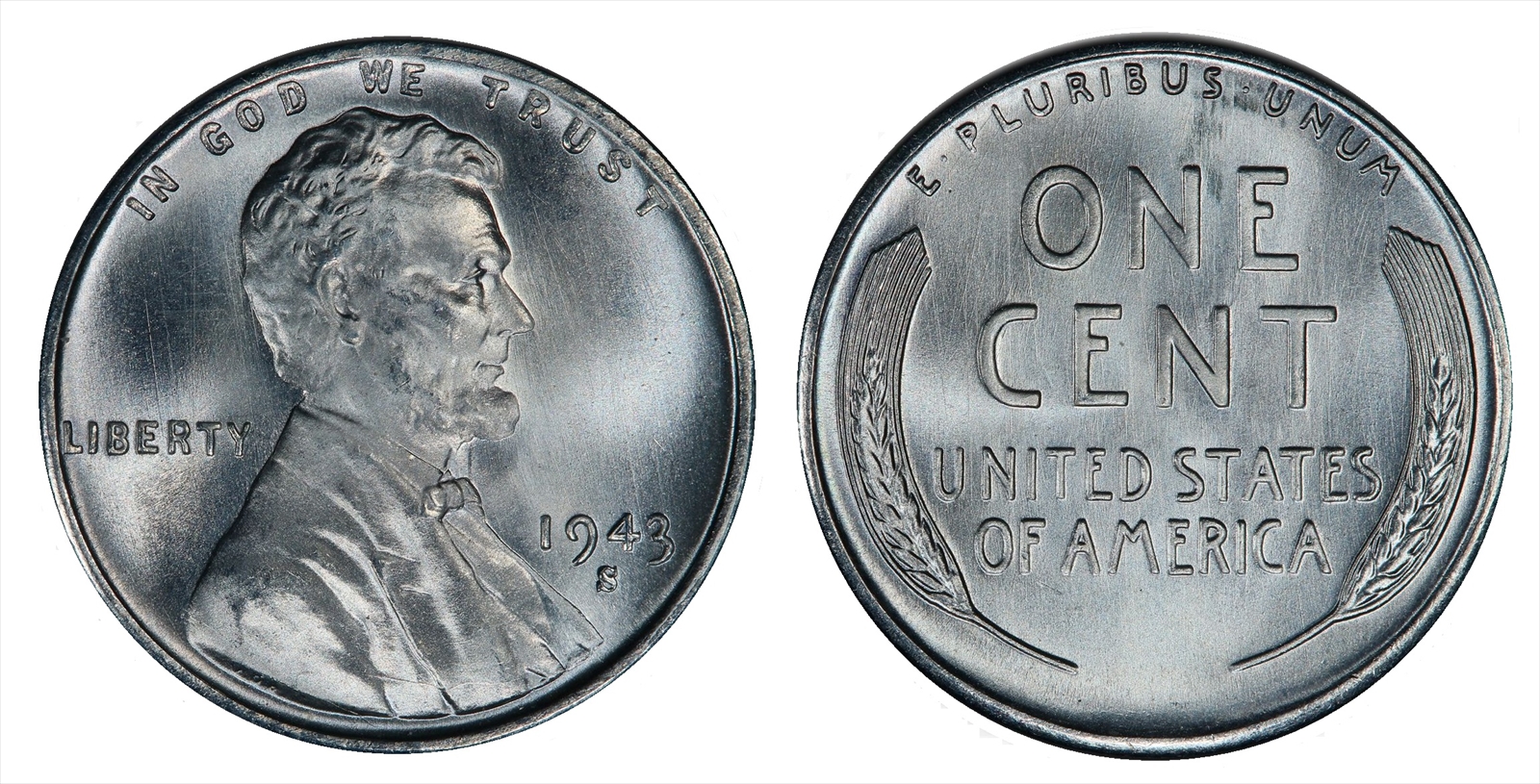
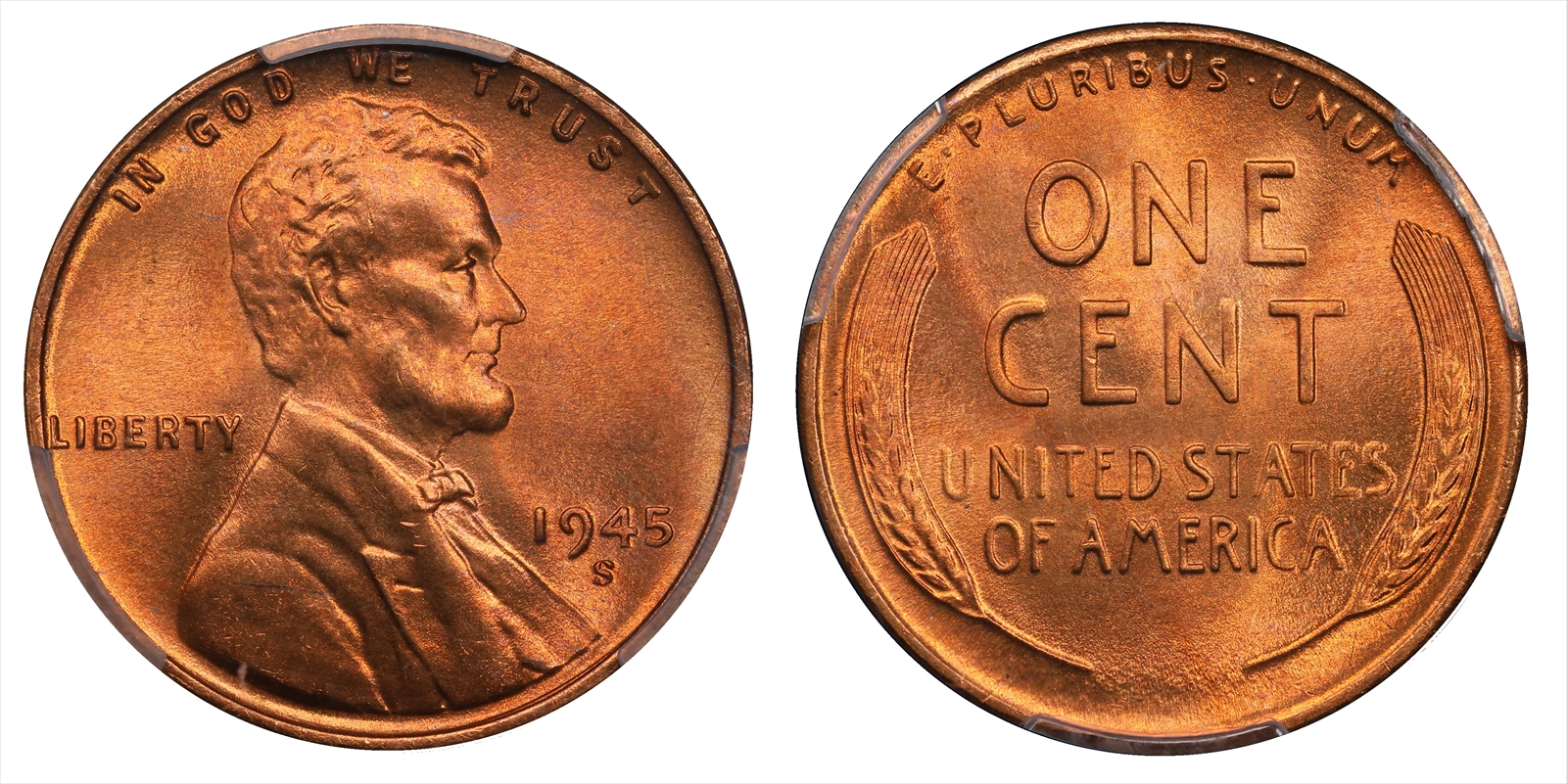
1945-S Lincoln Cent PCGS MS-68 RD, from the Lincoln Collection of Lincoln Cents. From the auction notes: "GreatCollections was proud to have presented "The Lincoln Collection of Lincoln Cents" in our auctions from Sunday, November 17, 2024 through Sunday, December 7, 2025. There were 337 PCGS, and seven NGC certified coins offered, with 91 approved by CAC. 12,788 bids were received, and the items were tracked by 9,317 users. One of the highlights from the collection was the 1944-S Lincoln Cent Steel PCGS MS-66 (CAC Green) (Simpson Collection), which sold for $490,500." I over-bid on the chance that this fire-engine red coin might earn a plus, but that hasn't happened (yet).
Andy Skrabalak/Angel Dees, Woodbridge VA (4/20). A gorgeous coin, Andy bought it thinking that it could upgrade to PR68, but the carbon spot on the reverse left stem apparently is holding it back to PR67+.

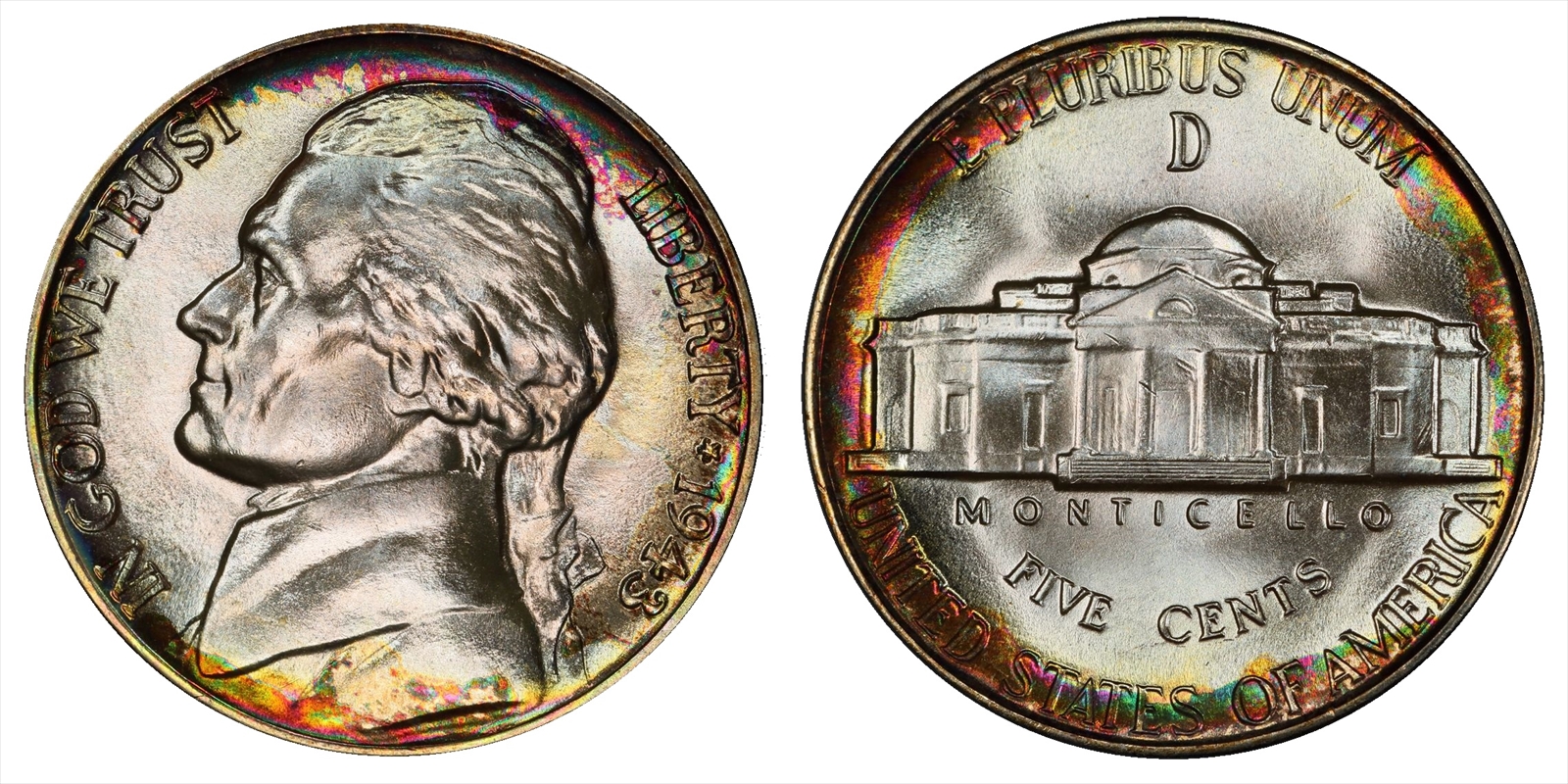
Breathtaking Superb Proof 1913 Type I Buffalo Nickel. Top pop/CAC. Tied for Finest Certified at PCGS; 1913 Buffalo Nickel. Type I. Proof-68 (PCGS). CAC. SB (3/21). This enchanting specimen really needs to be handled to be fully appreciated. Halos of rich reddish-orange, salmon-pink and cobalt blue peripheral toning frame powder blue centers. The strike is full throughout the design, as befits the method of manufacture, and the satin-finish surfaces are as smooth and unblemished as the day the coin emerged from the dies. The first Proof issue of its type, the 1913 Type I was ordered in large numbers by contemporary Americans seeking a high-quality example of the newly introduced design. Even so, survivors from a mintage of 1,520 pieces are not as plentiful as one might expect. Given that the satin finish of this issue was less dramatic than the brilliant and cameo finish used for Proof Liberty Head nickels, many examples were later spent or otherwise mishandled. Today, high quality pieces such as this are exceedingly rare and eagerly sought by astute collectors.
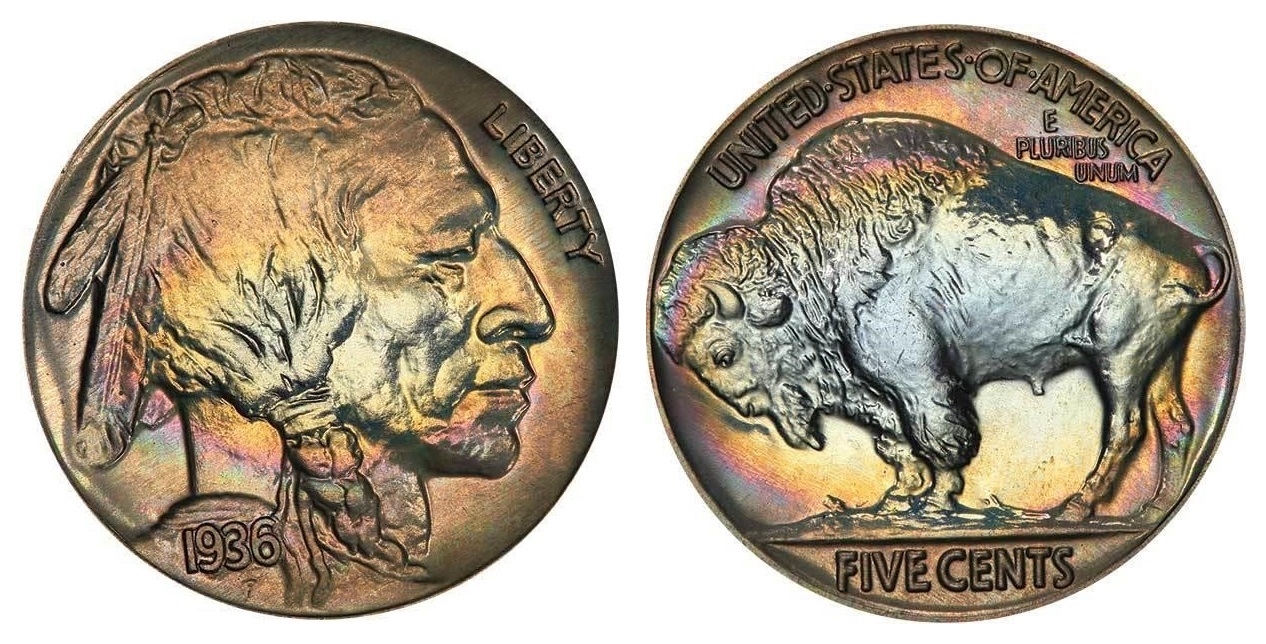
Legend (9/19) -- ULTRA HIGH END and totally amazing everything. Now this IS Legend quality! This coin is more then worthy of being the second FINEST known fore the date. Hard to believe PCGS actually has graded a PR69 (in the monster #1 Forsythe Collection). Sensational satin surfaces are smooth and are remarkably clean. Even using a microscope you will find NO impairments. A really strong luster boldly illuminates the neon like and totally original colors Mother Nature has spread out all over. You start with electric rings of gold/violet/pale green that open into bold lilac centers. You do NOT have to tilt this coin to see the color (and the colors are NOT dusky). Every detail is pinpoint sharp in strike., The eye appeal is wild! PCGS 39, NGC 28, CAC 13. Yes, you can buy average PR68’s (and they certainly will not have the color like this one) for less. This coin always will be a premium value because of its monster eye appeal. Being the ONLY PR68+, there is no auction record. We do not know how Collectors Universe came up with its $14,500.00 number. We believe if this coin were in major auction, it would sell for much more-be glad we want to place it and are not greedy! If you are really picky or want real wild colors, then this is your coin! ----------- LOT 180 5C 1936 BRILLIANT. PCGS PR68+ This is a STUNNING Brilliant 1936 Proof Buffalo, among the VERY FINEST KNOWN examples, the only one in PR68+ and just two PR69s graded higher. This beauty is truly spectacular in every way. An AMAZING and totally original SUPERB GEM. Exceptionally bold, brilliant, reflective mirrors beam from all over on both sides. The surfaces are evenly toned with soft pastel iridescent toning that, especially on the reverse, really pops when rotated in a light. Shades of rose-gold, peach, opal, and vivid pink hues really delight the eye. The smooth mirrors are PRISTINE; sleek and clean, with an awesome eye appeal. AMAZING! PCGS 1, NGC 1. Unpriced in PR68+, but PCGS does list a value of $17,500 in PR68 and $45,000 in PR69. This monster Buffalo nickel should be seen to be fully appreciated and is worthy of a prominent spot in any collection. We know bidding will be as intense as the mirrors when it crosses the block. PCGS# 3995 | ESTIMATE: $25,000+
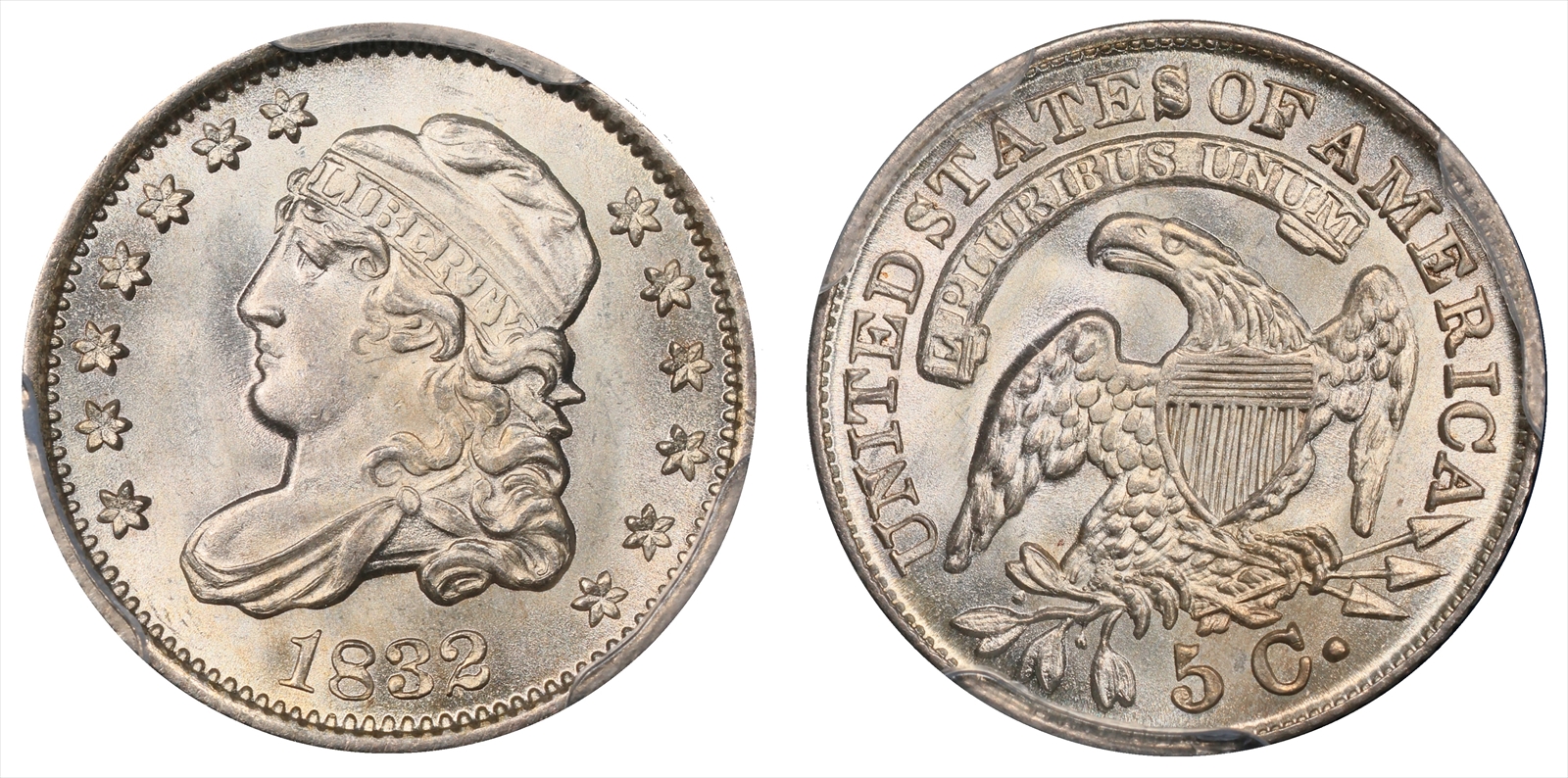
Pop 3/2. 1832 Capped Bust Half Dime, LM-5, V-8, Exceptional High-Grade Type Coin 1832 H10C V-8, LM-5, R.1, MS67+ PCGS. This is a brilliant, intensely lustrous example of the LM-5 variety, struck from a late die state with several filled letters throughout the reverse legend and radial die cracks joining the legend to the scroll. Traces of die clashing remain on both sides. The LM-5 die marriage is always a favorite choice for type, available through the Premium Gem level but only on occasion as a Superb Gem. The present coin displays thickly frosted surfaces that show only one or two tiny marks. The strike lacks sharpness on only a few of Liberty's curls, as well as at the upper-left shield border and the eagle's brow. Eye appeal is exceptional. Few 1832 half dimes are finer regardless of variety. Last sold on Apr 23, 2020 for $10,200.00. PCGS population (all varieties combined): 15 in 67 (2 in 67+), 2 finer (3/20).
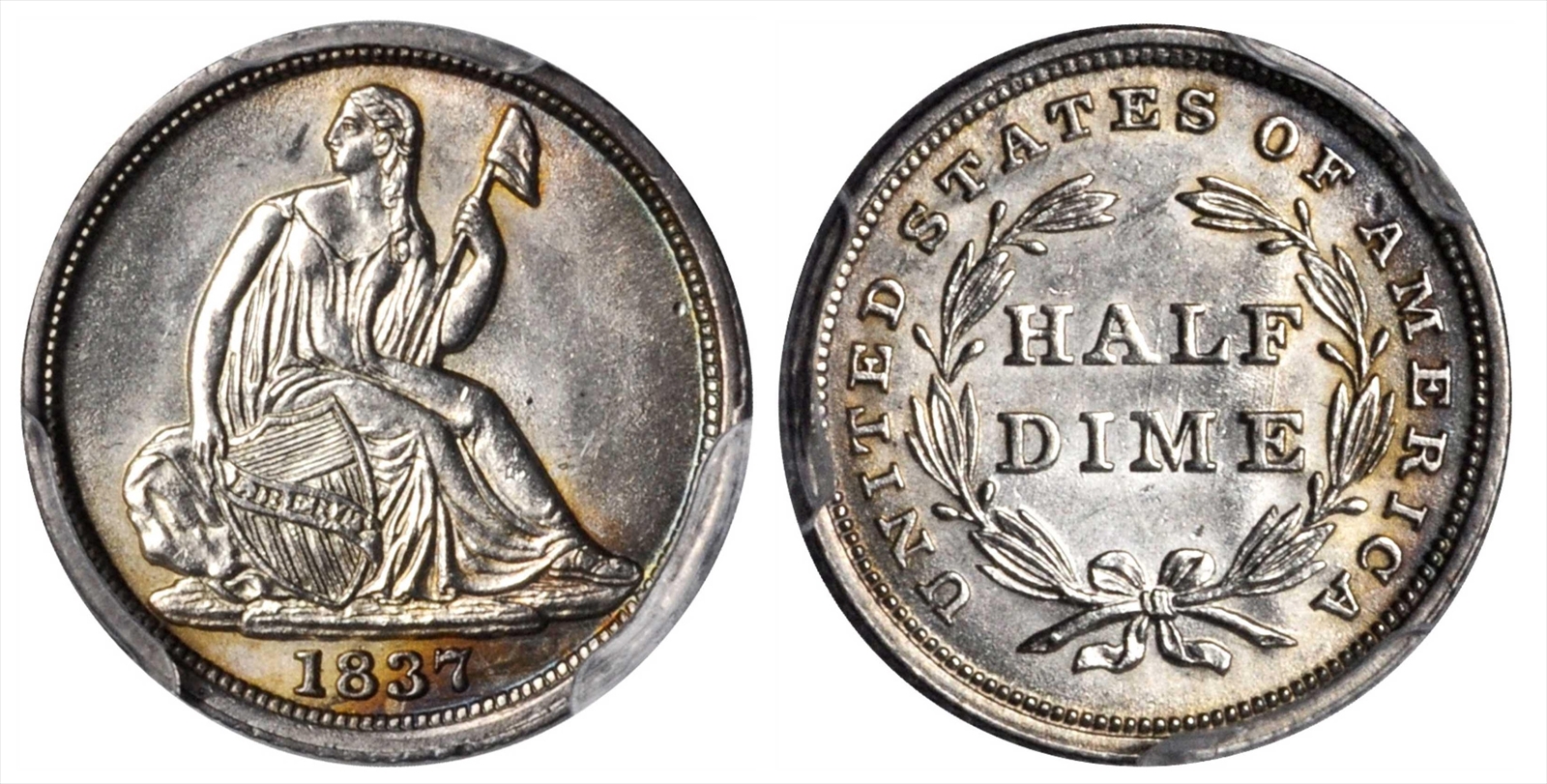
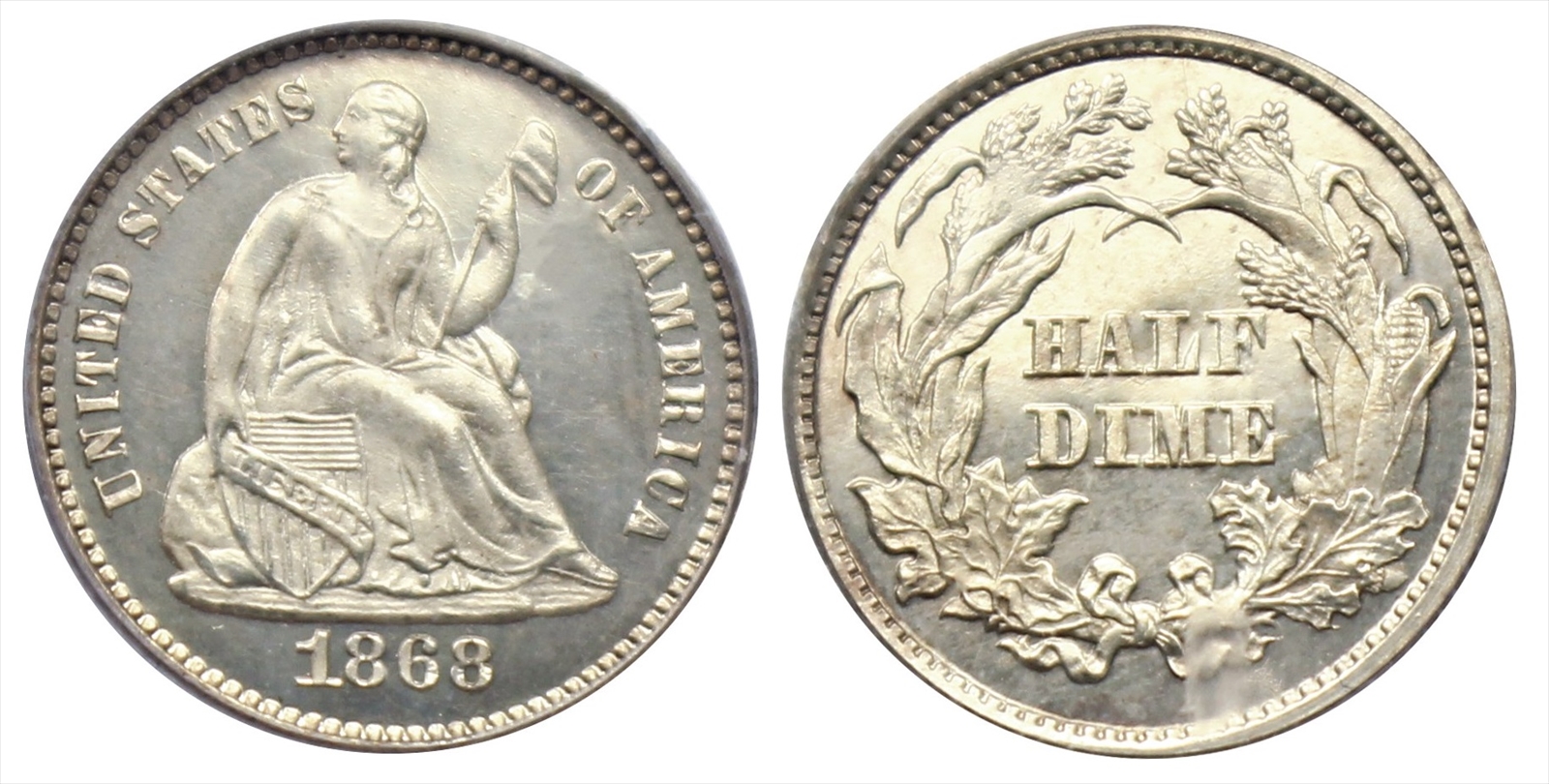
Lightly toned around the peripheries, this satiny and sharply struck example makes a lovely impression in all regards. The premier Liberty Seated half dime and one of just two issues of the No Stars design, the 1837 is always in demand for type purposes.
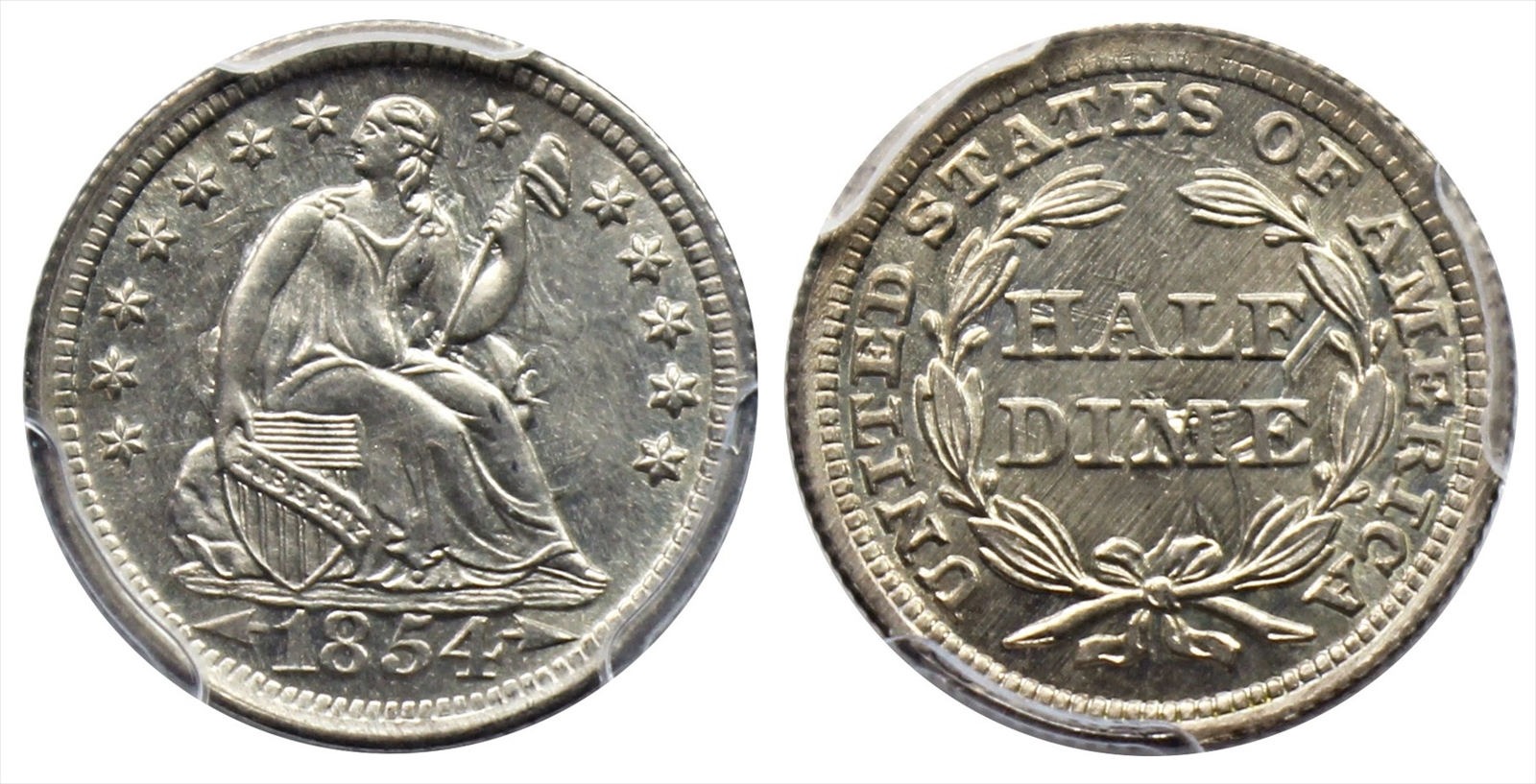
Popular and desirable with-arrows type coin issued for just two years (1854-1855). Pretty type coin.


Among the Finest at PCGS. An Early Die State, Vividly Toned. 1834 JR-5 Bust Dime, Large 4, JR-5, R.1, MS67 PCGS. CAC. Ex: Bender Collection. Among the Finest at PCGS. An Early Die State, Vividly Toned. A pointed stub of the crossbar on an oversized 4 identifies the JR-5 variety, a readily available die marriage among 1834 dimes, but nonetheless rare in Superb Gem condition, such as this colorfully toned example. Dappled beige-gold accents enliven the overall vivid turquoise-blue toning. The coin is sharply struck from an early die state, with a light crack through STATES and a trio of light cracks through the date. Later JR-5 die states show a cascade of heavy reverse die cracks and cuds through multiple, more advanced die stages. The 635,000-piece mintage required seven varieties, making 1834 dimes interesting for specialists by the early and late die states. Among Large 4 varieties, this vibrant and sharply struck example offers tremendous eye appeal supported by CAC-endorsement. A Superb Gem, it is tied for numerical finest at PCGS, with a single Plus-graded example marginally finer. Population (all Large 4 varieties): 3 in 67, 0 finer. CAC: 4 in 67, 0 finer (11/22). -- Ex: Kennywood Collection (ANR, 1/2005), lot 349; Richard C. Jewell Collection (Stack's Bowers, 8/2011), lot 7274; August Signature (Heritage, 8/2022), lot 3746. Coin Index Numbers: (NGC ID# 237E, Variety PCGS# 38877, Base PCGS# 4526, Greysheet# 213118)

The 1844 is a key date in the Seated Dime series, featuring a low mintage of just 72,500 coins from the Philadelphia Mint.
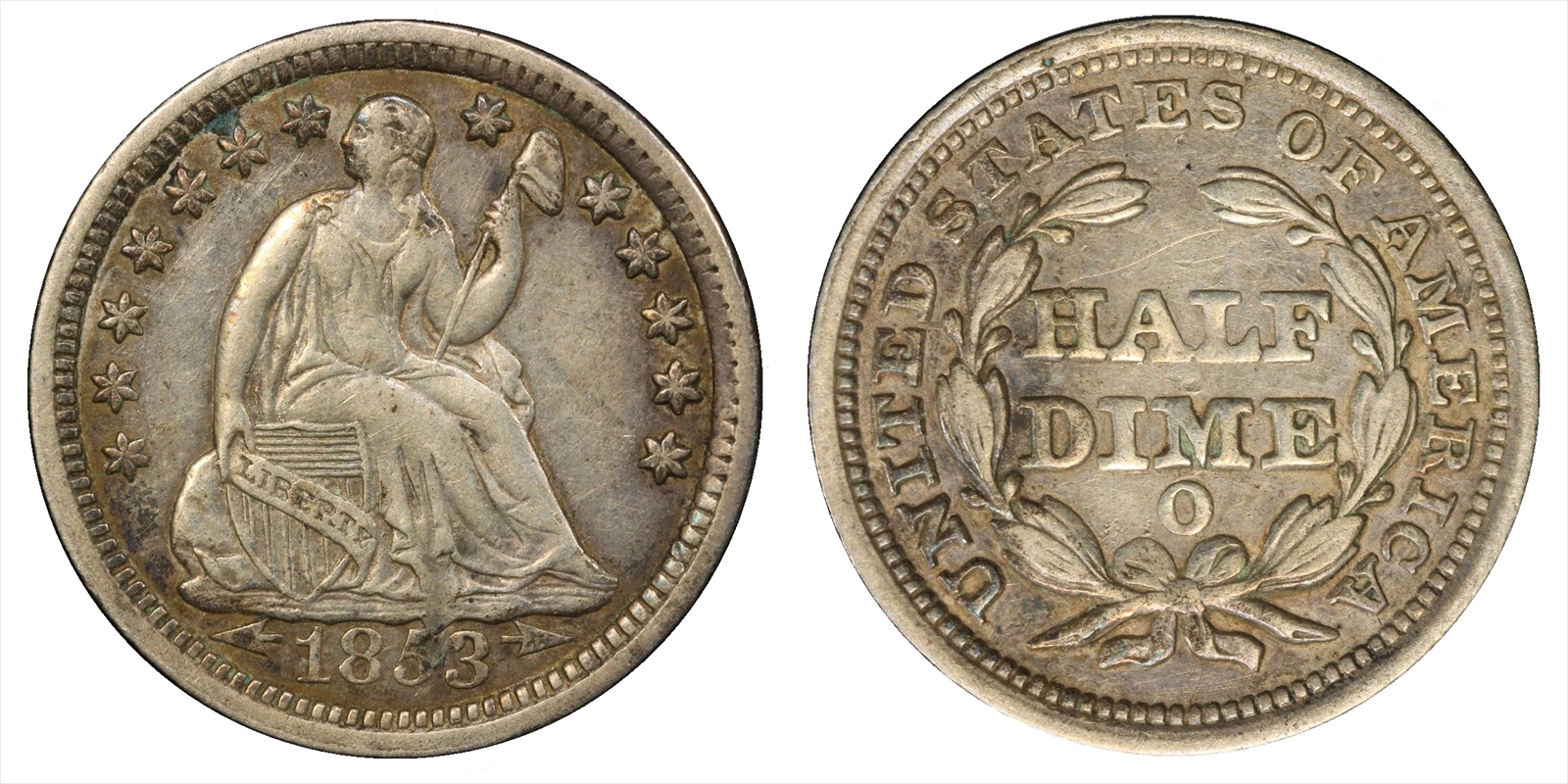
The arrows were added to the sides of the 1853 date to mark a Congressional reduction in the coin's weight from 2.67 grams to 2.49 grams to prevent hoarding. The N1 likely designates an old cleaning.
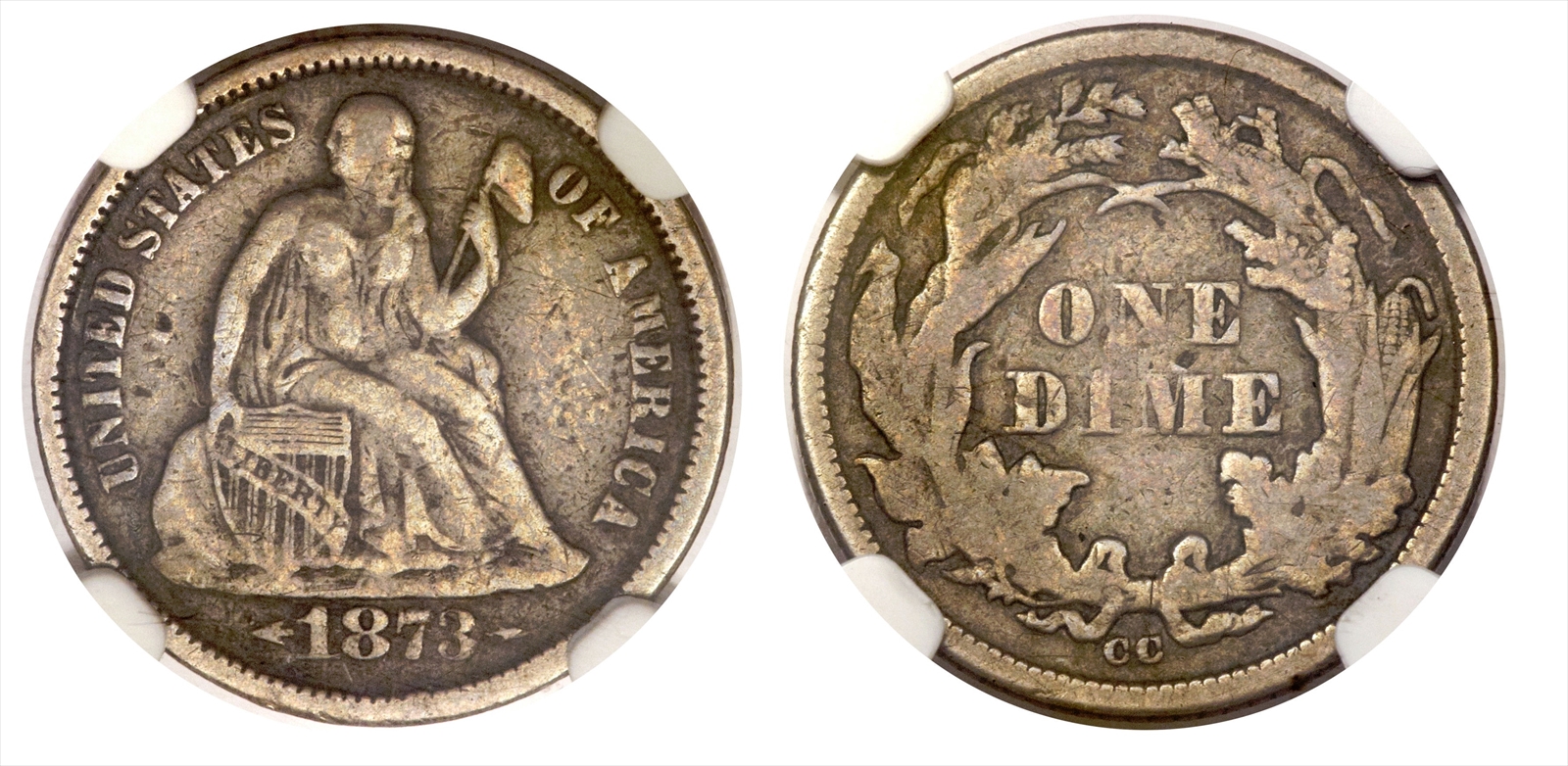
Purchased as NGC 149831-016; crossed from NGC to PCGS soon after purchase. 1873-CC 10C Arrows Fine 12 NGC. A key issue in the Seated dime series, the 1873-CC is always actively sought with problem-free surfaces in any grade. This Fine 12 example is such a coin, free of major marks and merely showing extensive wear consistent with the grade. The surfaces range from charcoal-gray in the fields to lighter silver-gray on the devices, and the major types are all clear and well-impressed, including the arrows at the date and the crucial mintmark. (Registry values: N2998) (NGC ID# 23BH, PCGS# 4666)
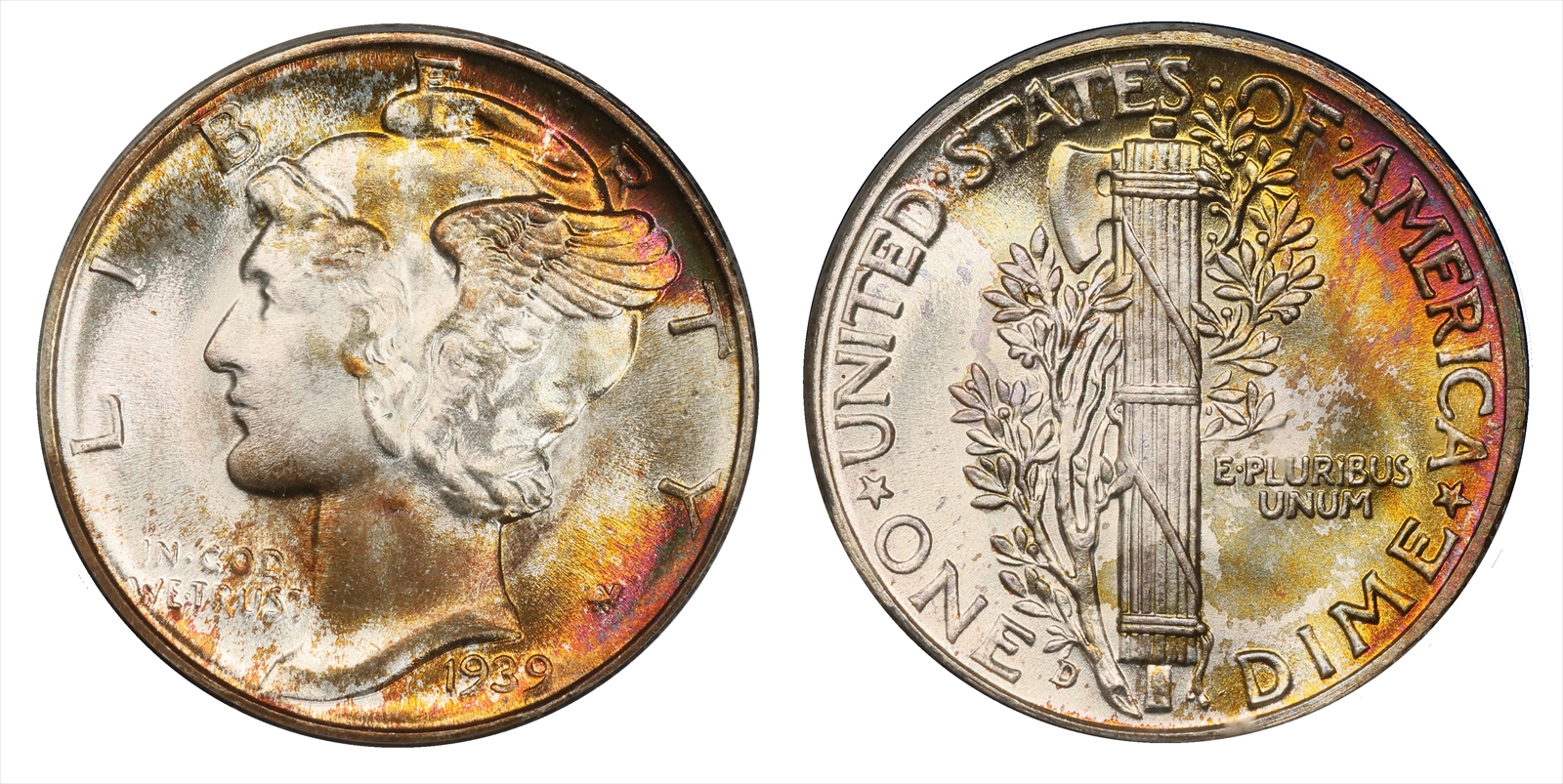
This 1939-D Mercury dime, Lot 215 at Legend Rare Coin’s 34th Regency Auction held Sept. 26, 2019, at the Bellagio in Las Vegas, Nev., in conjunction with the PCGS Members Only Show., commanded $42,300. Graded MS-69 FB, it brought $42,300 on an estimate of $30,000-$35,000. I purchased from GC 5 years later.
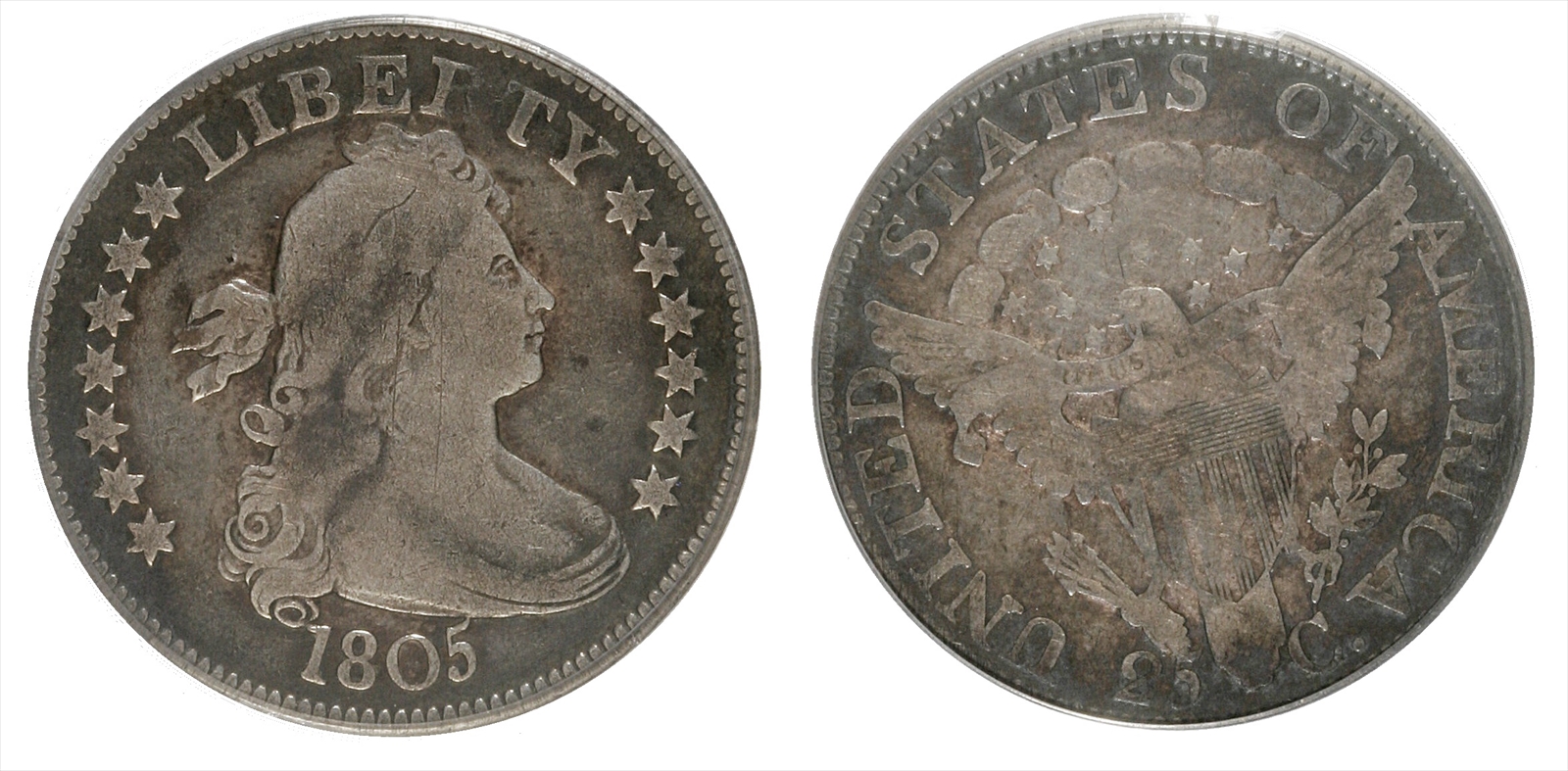
This scarce, nicely toned 1805 Quarter Dollar has light devices over darker fields creating an almost cameo effect. The devices are pale beige and the fields are medium gray. The lower drapery lines are strong, and the hair is well outlined with some detail down the neck. Aside from some light slide marks on the obverse, the surfaces are clean and original.
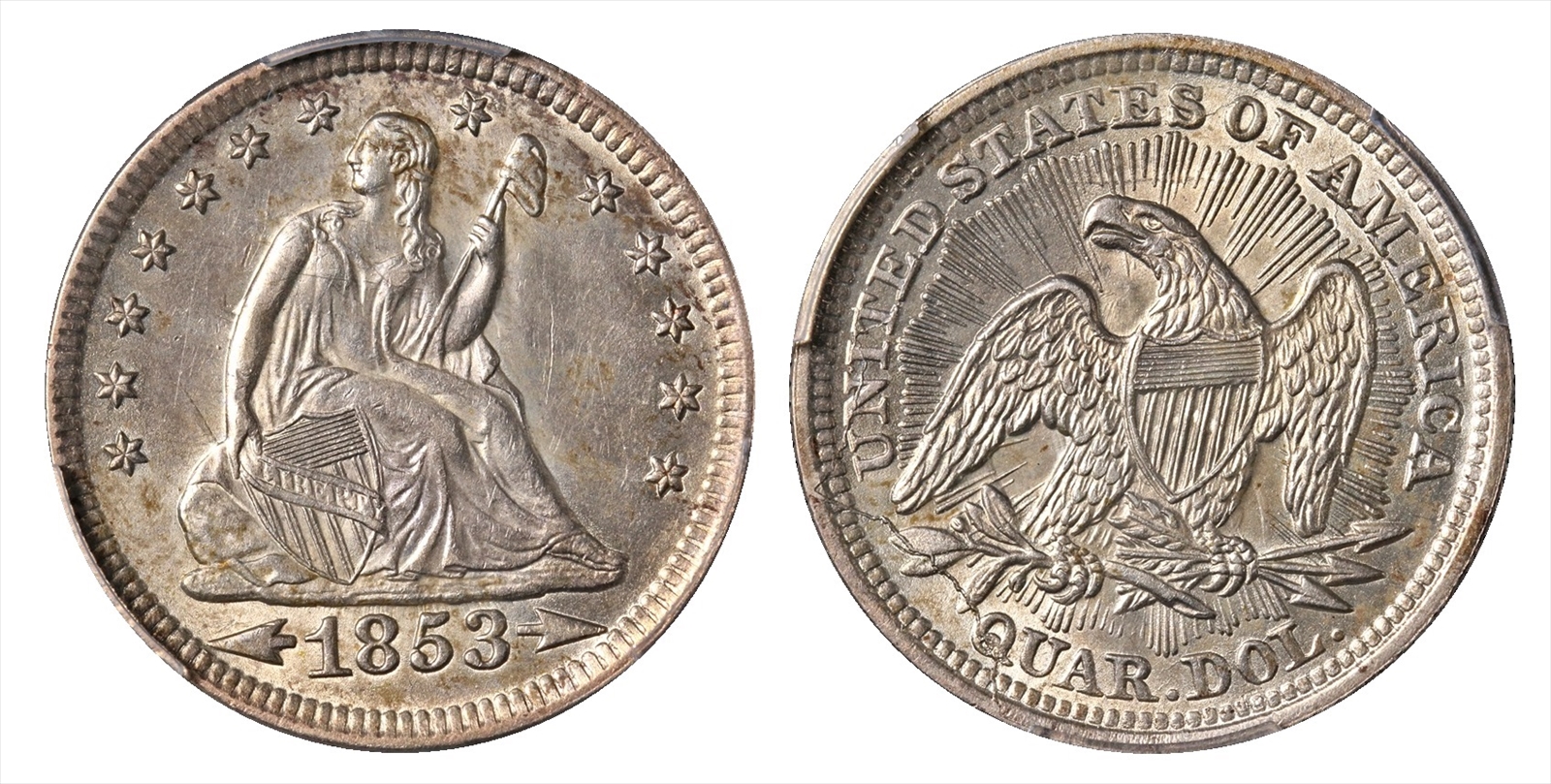
A nice uncirculated example of the with-Rays type. Die break on the reverse actually seems to add some character to the piece.

1873-CC Arrows Quarter, VG Details - obverse damage; a problem-free collector coin. This rare Carson City quarter comes from a mintage of just 12,462 pieces. Most survivors are well-worn, and auction appearances are few and far between. This smoothly worn example has a small but noticeable old dig near Liberty's left (facing) elbow. It is hardly a distraction on this example, which retains solid VG details. We note a few light abrasions and hairlines, yet pleasing medium-gray toning deepens at the borders and only slight merging of the reverse legend exists. For the 1873-CC Arrows, this is a perfectly acceptable and desirable example of the issue. From The Poulos Family Collection, Part II.
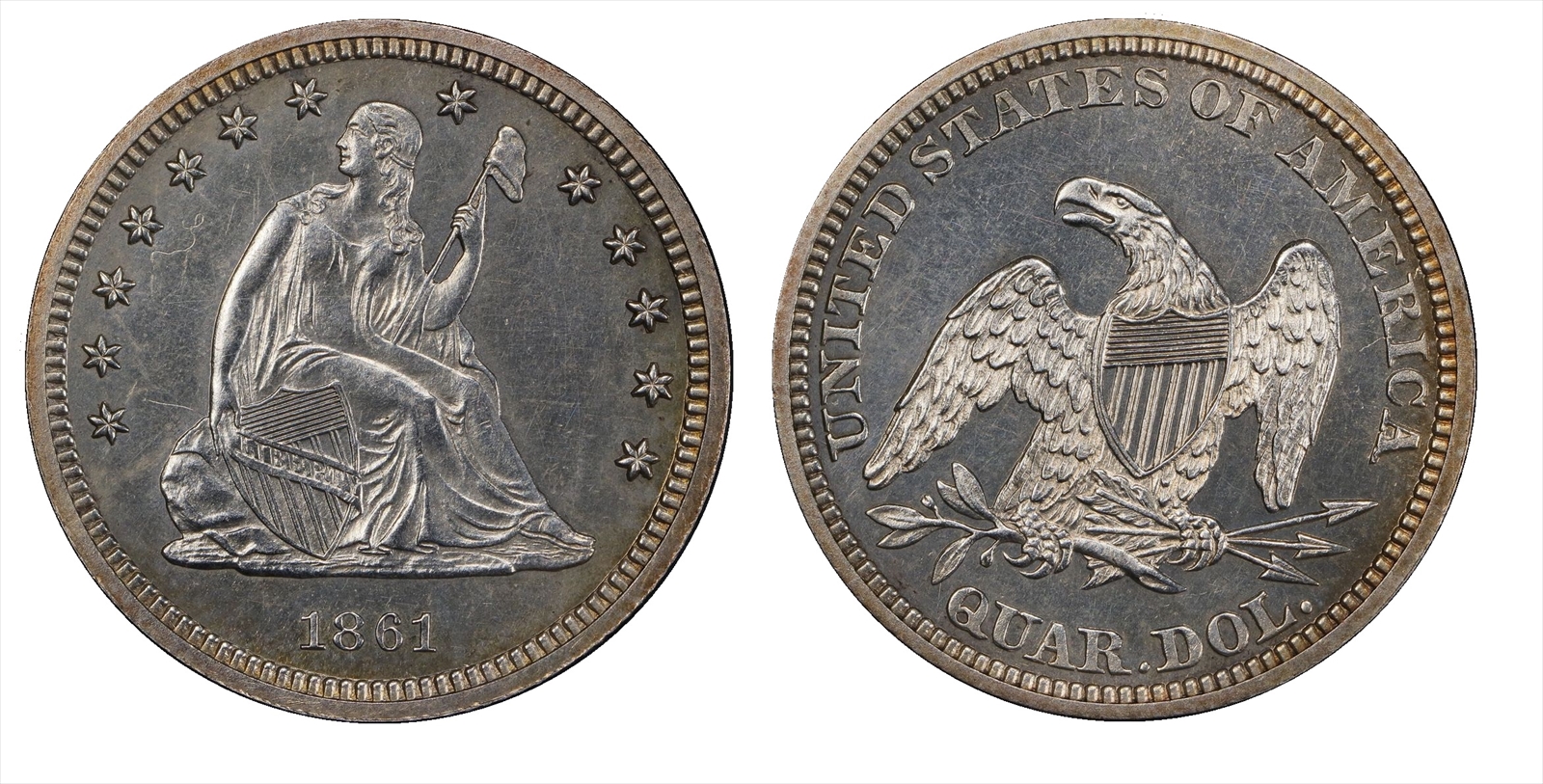
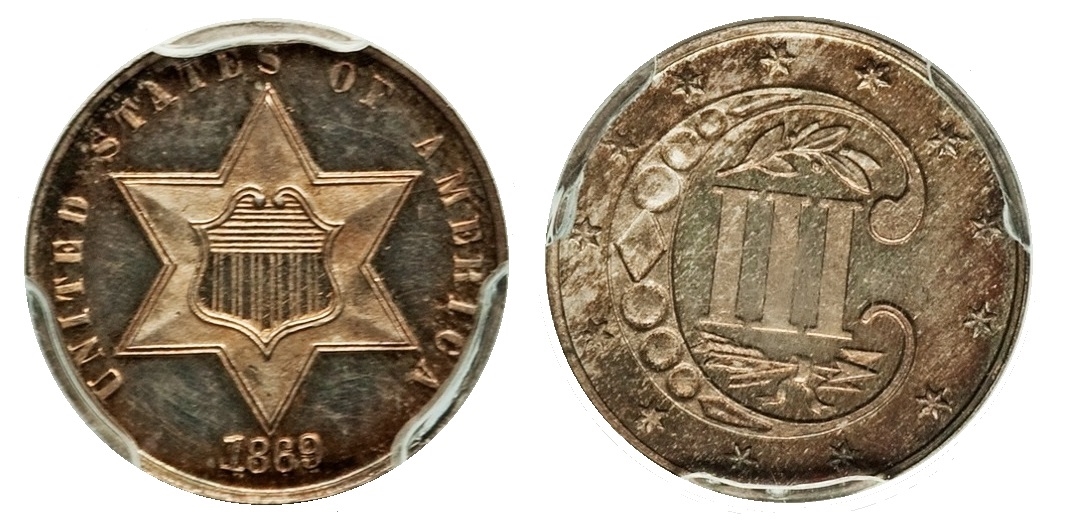
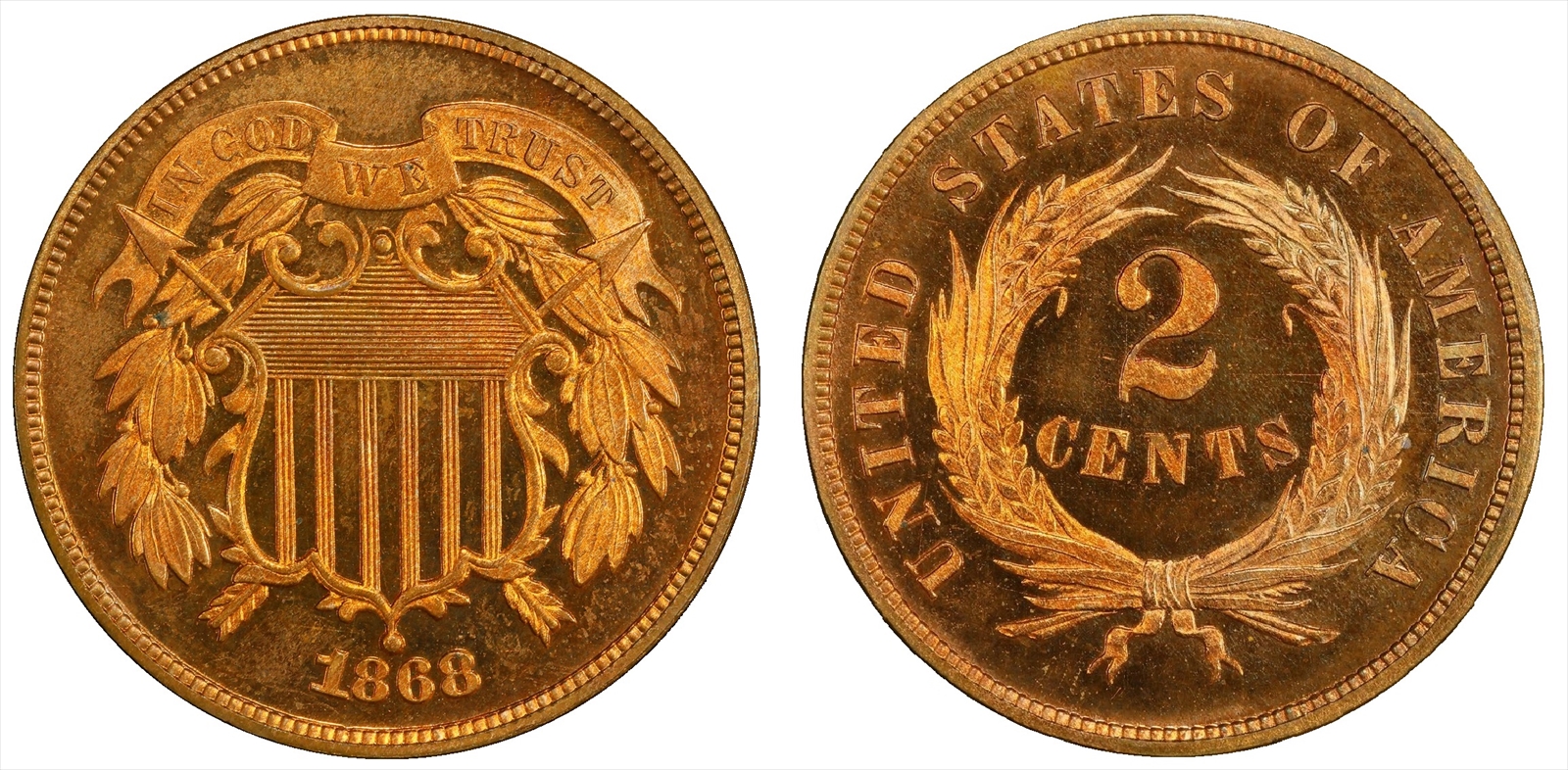
A nice proof piece from early in the Civil War. With great strike and great mirrors; this coin is only a few hairlines away from gem.

1917 25C Type One MS67+ Full Head PCGS. CAC. The Type One design was only issued in 1916 and 1917, being modified by Hermon MacNeil in the latter year after the designer made formal objections to the Mint's rendering of his models. Characteristically bold detail and uncommonly vibrant luster deliver exceptional eye appeal on this Superb Gem. The surfaces are completely untoned and radiant, with no bothersome abrasions. This issue is often heralded for its reliable quality and availability, which is true in most cases, but pieces this fine are seldom encountered. Population: 5 in 67+ Full Head, 0 finer (11/15).(Registry values: N2998).

1917 25C Type One MS67+ Full Head PCGS. CAC. The Type One design was only issued in 1916 and 1917, being modified by Hermon MacNeil in the latter year after the designer made formal objections to the Mint's rendering of his models. Characteristically bold detail and uncommonly vibrant luster deliver exceptional eye appeal on this Superb Gem. The surfaces are completely untoned and radiant, with no bothersome abrasions. This issue is often heralded for its reliable quality and availability, which is true in most cases, but pieces this fine are seldom encountered. Population: 5 in 67+ Full Head, 0 finer (11/15).(Registry values: N2998).
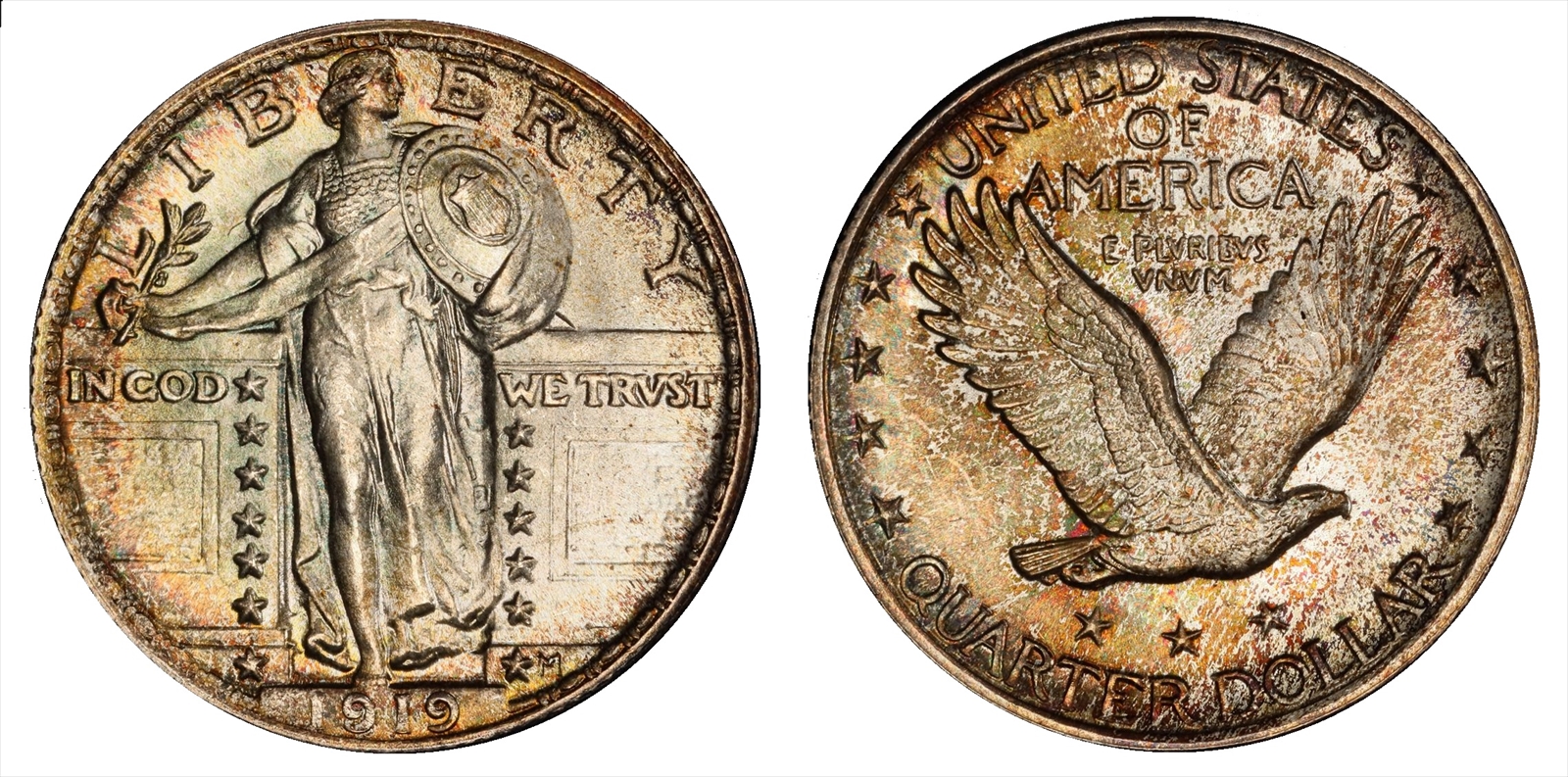
Ex-Just Having Fun (Steve Heller). I purchased from GC 25 Jun 23 after Steve's passing. Superb Gem Full Head 1919 Standing Liberty Quarter 1919 Standing Liberty Quarter. MS-67+ FH (PCGS). CAC. An exceptional example from this early Type II issue with a dusting of faint pinkish tones across each side. The strike is impressively sharp, rendering the surfaces with fine satiny luster and intricate design elements. Virtually untouched and enchanting to experience in-hand. Though minted to a generous quantity of 11.3 million pieces, the 1919 quarter remains rare in grades above MS-67. Further consideration for Full Head definition presents an even greater challenge. The present example is one of the finest survivors of this issue, with just 2 coins certified finer by PCGS. PCGS Population: 2; 2 finer. PCGS# 5729. NGC ID: 243B.

CAC. From the Mystic River (CT) Collection of Standing Liberty Quarters.

50C 1827 O-114 R.3 Square Base 2, MS64+, SB (6/17), HA lot 3852 (7/16), HA lot 4971 (8/15). "Satiny luster is comprehensive and imparts a truly angelic complexion." A condition census specimen of the Overton 114 marriage, this stunning near-Gem remains brilliant and virtually untoned throughout. The devices are nicely bold across each side despite evidence of die fatigue most apparent in the peripheries. Lacking in notable imperfections of any sort, the satiny luster is comprehensive and imparts a truly angelic complexion.
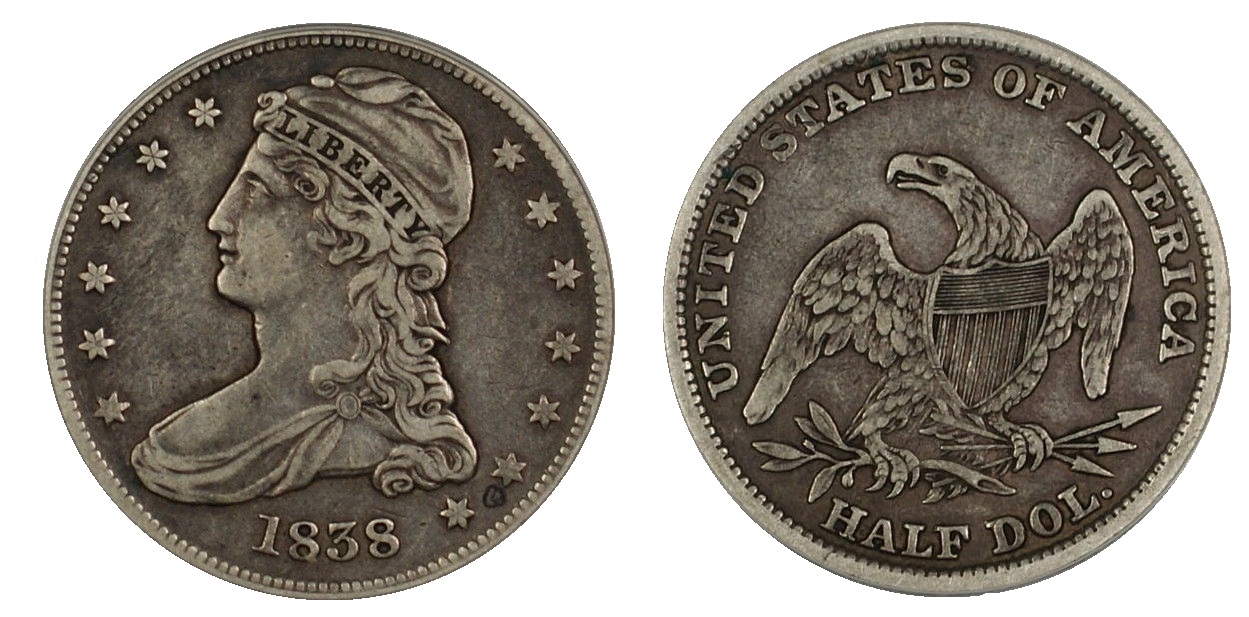
In VF30 condition, this coin shows light to moderate wear on Liberty's cap, hair, and shoulder. On the reverse, the eagles breast feathers, wing tips, and the motto ribbon display wear, though the separation of feathers is still intact.
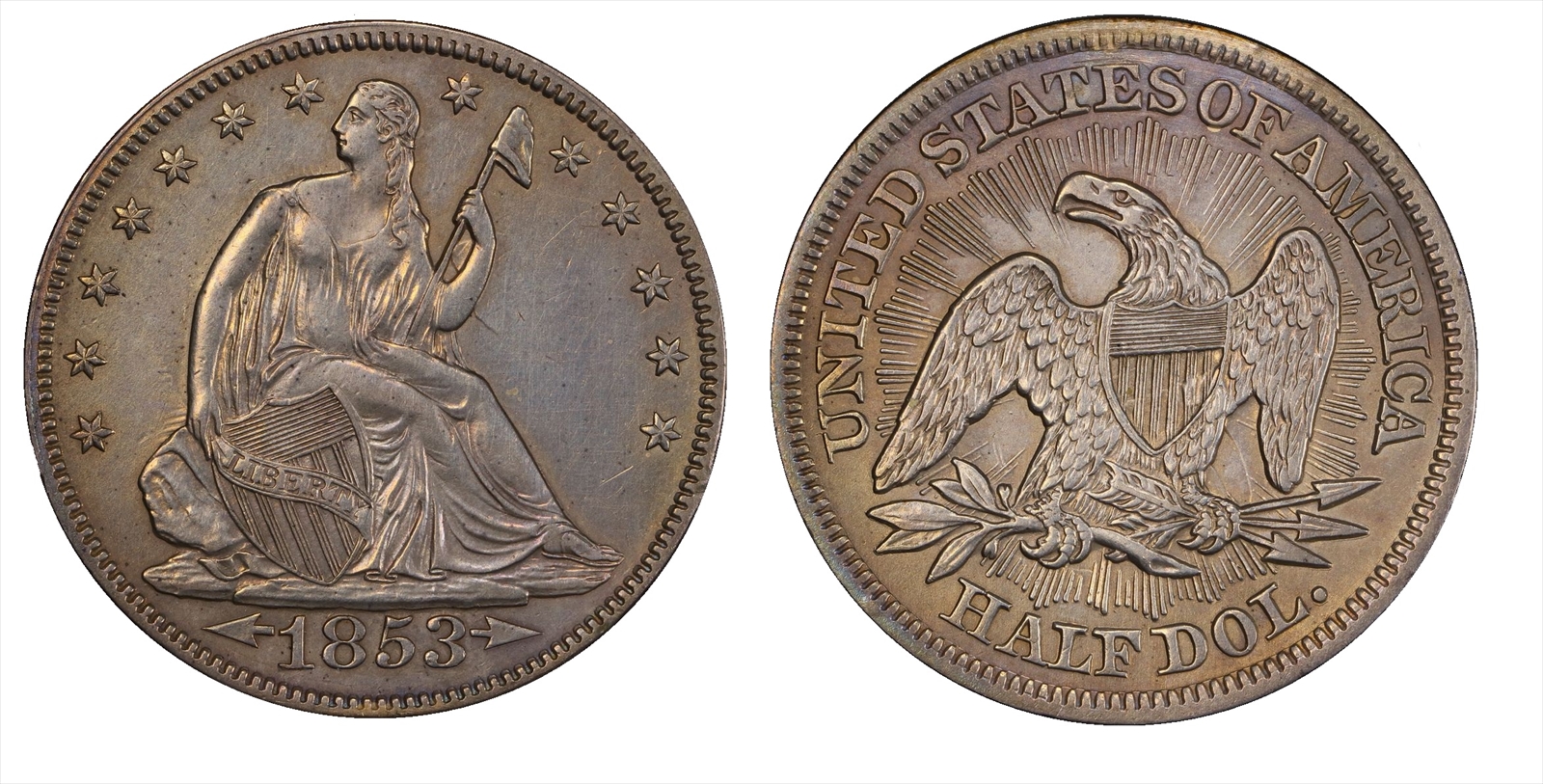
This coin sure looks good at first look, but magnification shows cleaning in the obverse right field.
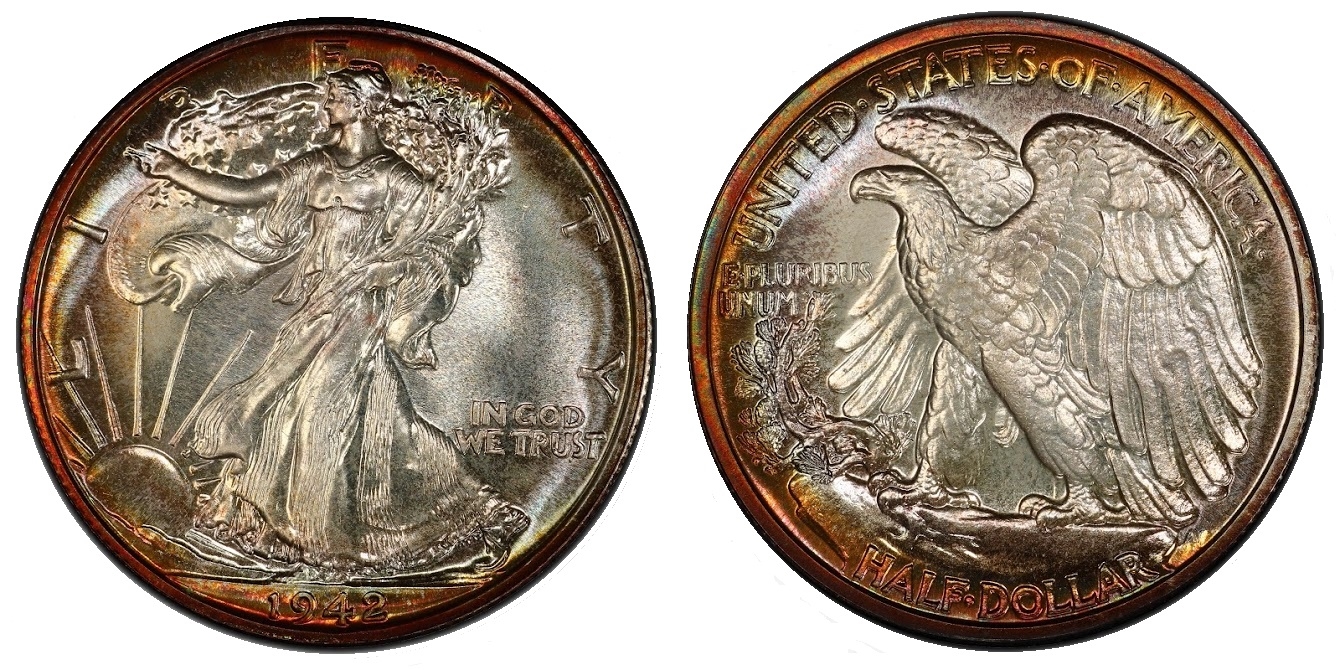
GC (9/19), CAC. A magnificent Ultra Gem offering spectacular eye appeal and surface quality. The pearly silver patina is accented by rich tones of reddish-orange iridescence in isolated peripheral areas. Sharply struck with strong reflectivity in the fields and virtually no signs of handling even when viewed under a glass. The Proof 1942 Walking Liberty half dollar is an historic issue struck at the dawn of the United States official entry into World War II. It represents not only the final Proof issue of the Walking Liberty series, but the last Proof half dollar struck until 1950 when the Franklin series was already underway. 21,120 Proof halves were struck in 1942, though only about half of them survive in grades of Proof-65 or higher. The present PCGS/CAC Proof-68+ is among the most exceptional known and is deserving of the strongest bids. PCGS Population: 11; with a single Proof-69 finer.


1795 Flowing Hair Dollar, VF25, Collectible B-5, BB-27, R.1, Three Leaves Example, Bowers Die State II. The line from the tip of the left stem travels toward the rim. This obverse, featuring the diagnostic raised bar behind the hair curls, was only used to strike BB-27 dollars. Comparable representatives are often found in collectors' type sets given the relative collectability of the variety and the desirability of the Flowing Hair type. This example retains crisp detail on the stars, legends, and most of the dentilation. Rich violet-gray patina includes glints of iridescent blue and green. Smooth with superficial wisps and a couple of tiny ticks near the eye and chin.

1799/8 $1 15 Stars Reverse, B-3, BB-141, R.3, MS62 PCGS. Ex: Friend. Bowers Die State III. BB-141 is the first and among the best known 1799-dated early dollar die marriages. An unused obverse die made in 1798 with an obsolete star count was overdated for use the following year, and paired with a blundered reverse die. Heraldic Eagle reverses should have 13 stars on the field above the eagle, but the diesinker inadvertently entered 15 stars. The error was noticed, and the first and last clouds were expanded to size to encompass two of the stars. Nonetheless, their telltale star points protrude from the enlarged clouds. Both dies were used on other 1799-dated marriages, but paired together only on BB-141. This highly desirable representative is free from wear, and marks are absent save for a few faint lines above the right shield point. Tan-brown, sea-green, and powder-blue toning confirms the originality. The lower right obverse shows minor flan striations, as coined. From The Frost Collection.
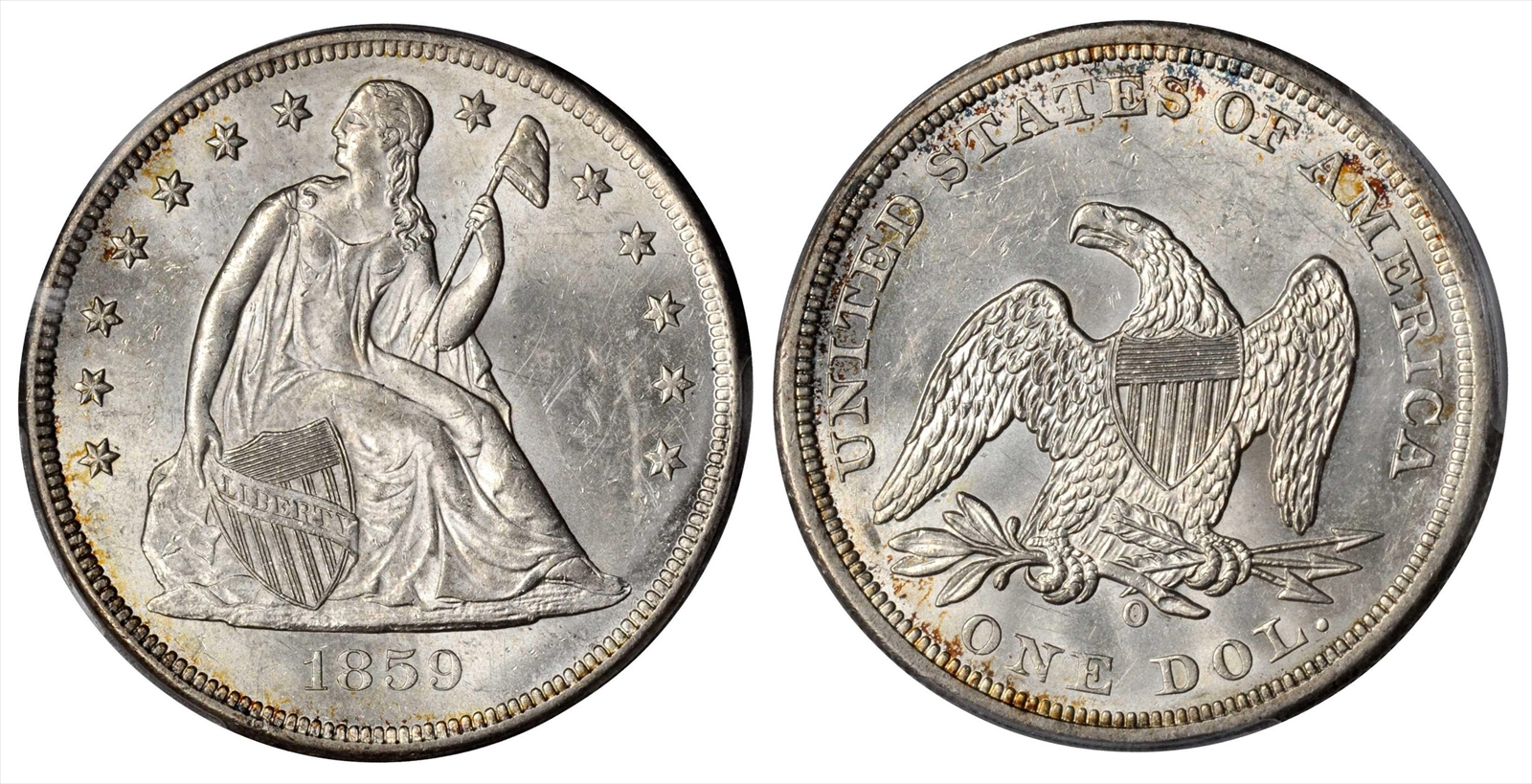
Brilliant apart from a few speckles of vivid peripheral toning, this boldly struck, highly lustrous example is sure to have no difficulty finding its way into a Mint State type set. Almost certainly from the Treasury Department silver dollar releases of 1962 to 1964, which source yielded up to three 1,000-coin bags of Uncirculated examples of the 1859-O. Along with the 1860-O, also widely represented in the Treasury Department releases, this is the most plentiful issue of the No Motto Liberty Seated design type in Mint State.
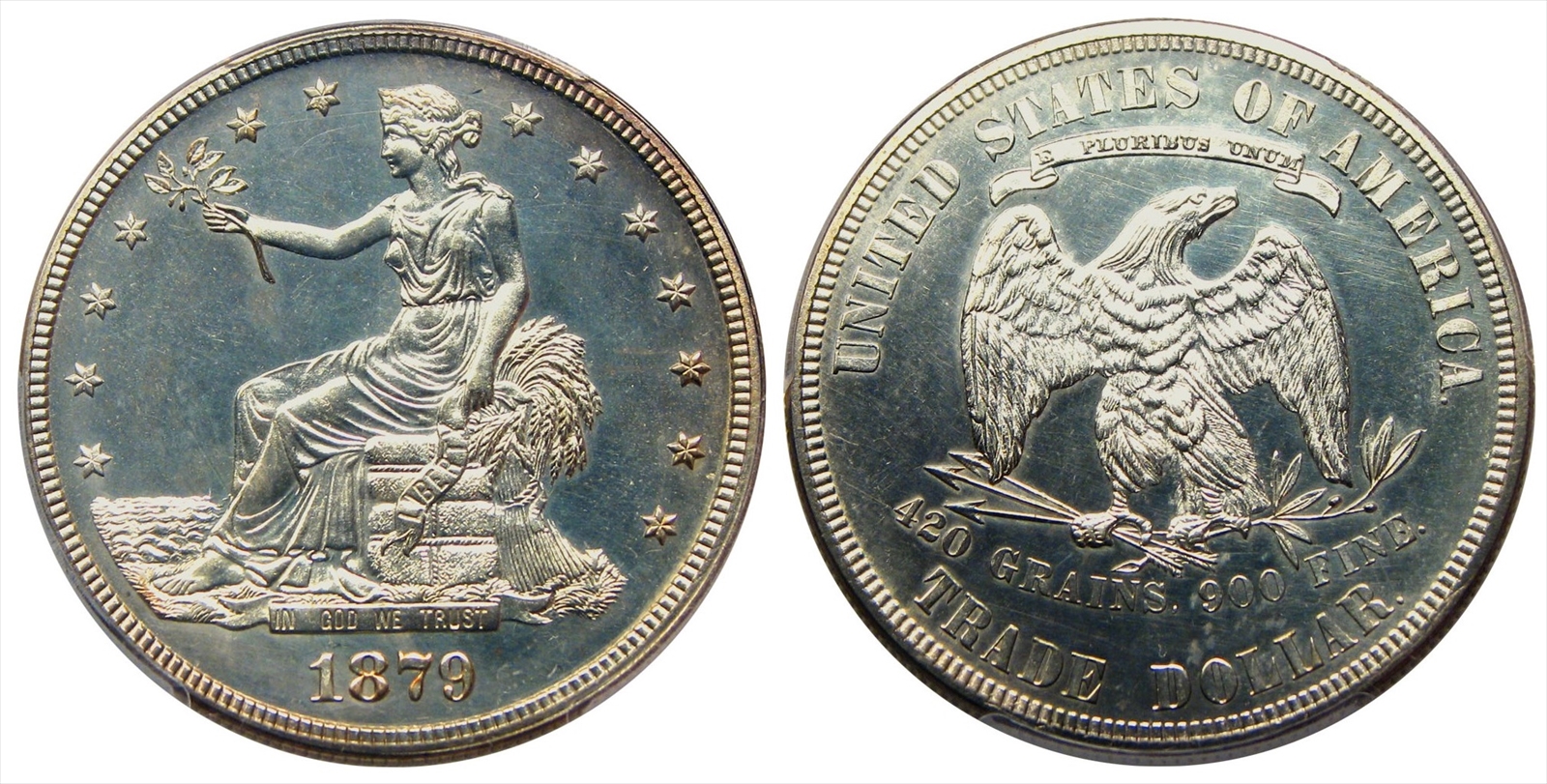
Proof-only date and a great type coin with a mintage of just 1,541 coins struck overall.
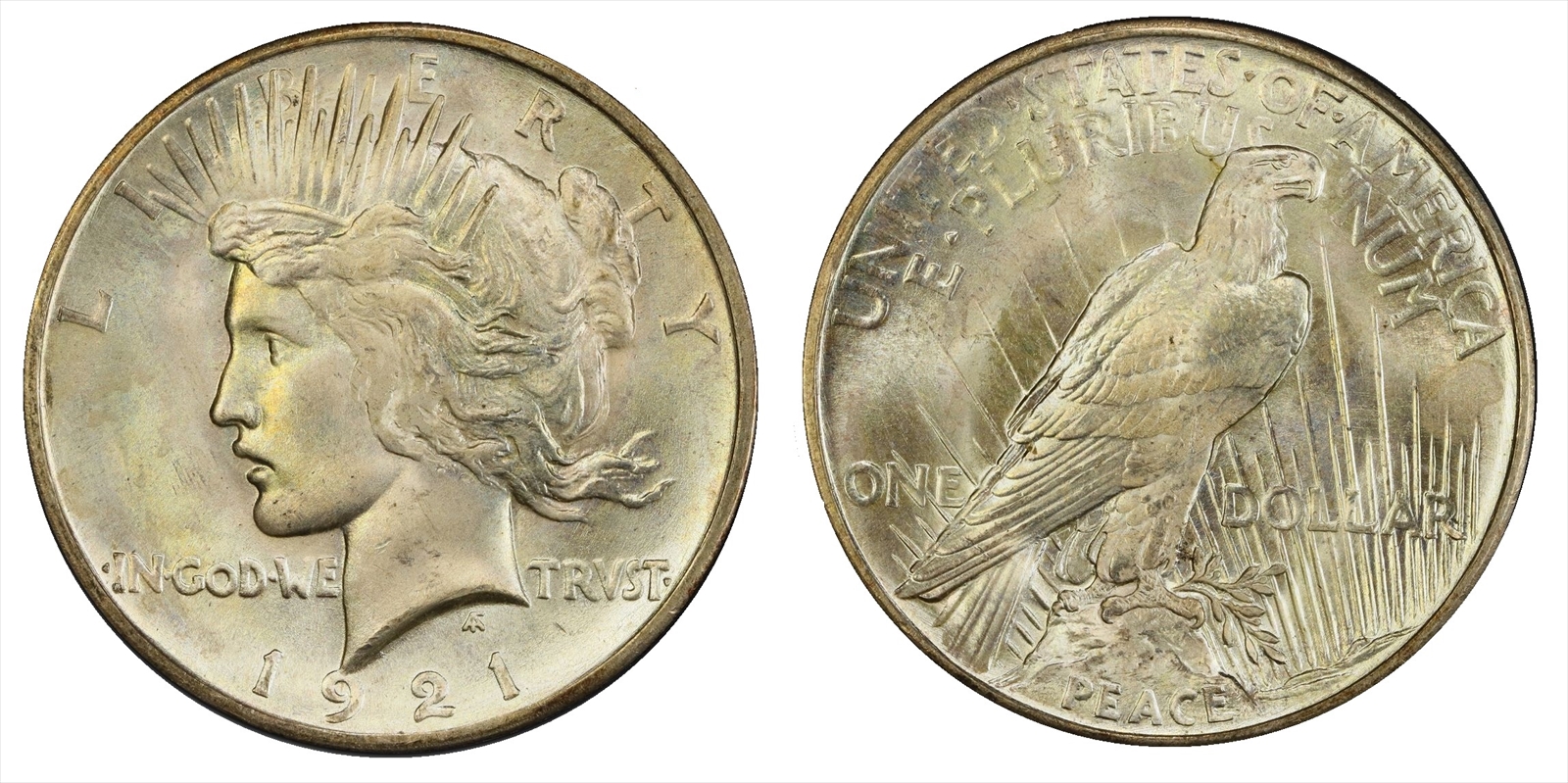
Ex The Corinth Collection. Originally in an NGC GEN 2.1 “fatty” holder with the white tag, as 107336/121223002, CAC Gold. PCGS 1,565, NGC 1,264, CAC GOLD 1. Crossed to PCGS as MS66+ in 2023. A fantastic GEM example of this one year only High Relief type. This coin is as fresh as fresh can be! It is also CONSERVATIVELY GRADED. This is the ONLY 1921 Peace dollar in MS65 with a GOLD CAC sticker and the HIGHEST grade to have been awarded one. The devices are extremely sharp in definition and stand out in full, HIGH RELIEF against the dished fields. Liberty's hair curls stand out boldly from the surrounding surfaces. The luster is bold, brilliant, and satiny with splashes of iridescent pastel toning in the fields. As you rotate the surfaces, shades of pale blue, soft rose, and the clearest gold appear, giving the ultra-clean surfaces a great look. There are a couple of tiny ticks, but we have seen worse on coins graded way higher. The eye appeal is truly stunning. Formerly NGC Cert. Number 121223002. PCGS # 7356. Sold 25 May 23, Lot # 21 - $1 1921 HGH RLIEF PEACE NGC MS65 CAC GOLD GEN 2.1, Price Realized: 29,375.00 USD, Legend Rare Coin Auctions.
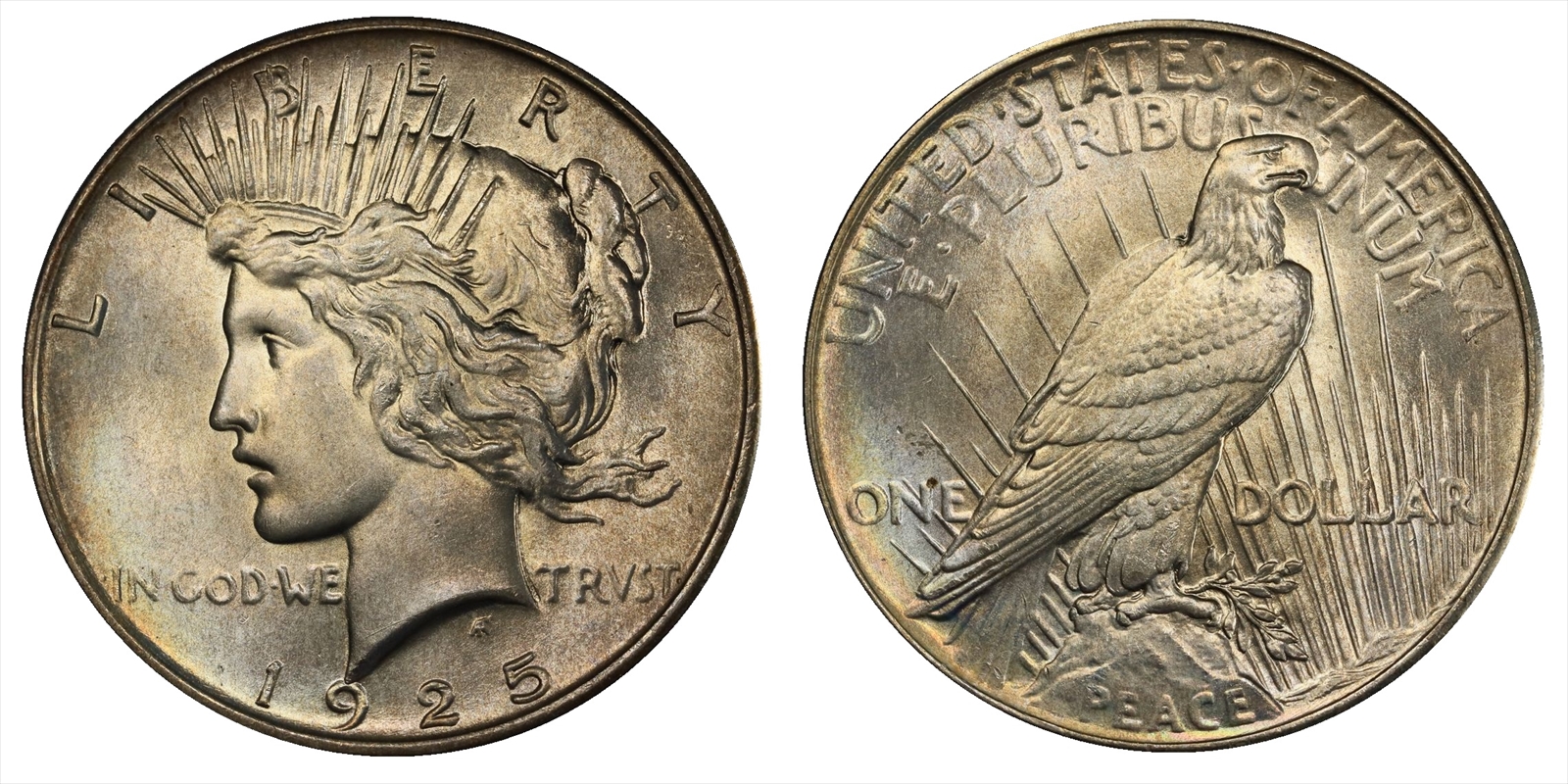
GC $18,910.13, 25 June 2023 - This is a lovely and conditionally rare example of what many collectors consider to be the most beautiful design ever used on a regular issue U.S. Mint silver dollar. Fully struck with softly frosted luster, both sides are further enhanced by delicate toning in iridescent gold and, at the borders, powder blue. Remarkably well preserved for a Peace dollar of any issue, and supremely attractive in all regards. Previously sold for $7500 at Stack's Bowers June Showcase Auction, Lot 3136. The Peace dollar as a type is much rarer than its Morgan dollar predecessor of 1878 to 1921 in Superb Gem Uncirculated. Not only were far fewer Peace dollars produced, but poor striking quality, inferior luster and/or heavily abraded surfaces confine most Mint State survivors to lower grades through MS-65. Here, then, is a significant piece for the quality conscious bidder - a coin that would make an impressive addition to a high grade type set or specialized Peace dollar collection. PCGS Population: 29; with a single MS-68 finer. PCGS# 7365. NGC ID: 257L.

A perfect modern strike with no imperfections even at 5x magnification. Valued for its pristine aesthetic and long-term liquidity. Also my eldest son's birth year coin.
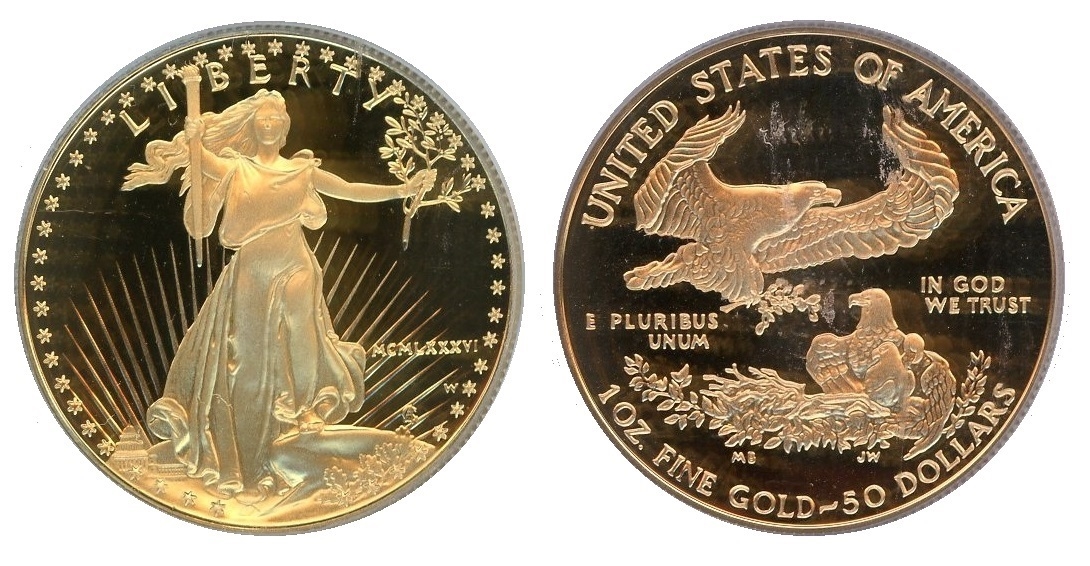
I maintain a birth set of my two son's birthdates; this is part of my elder son's. And as bullion, it doubles as a mini-hedge.
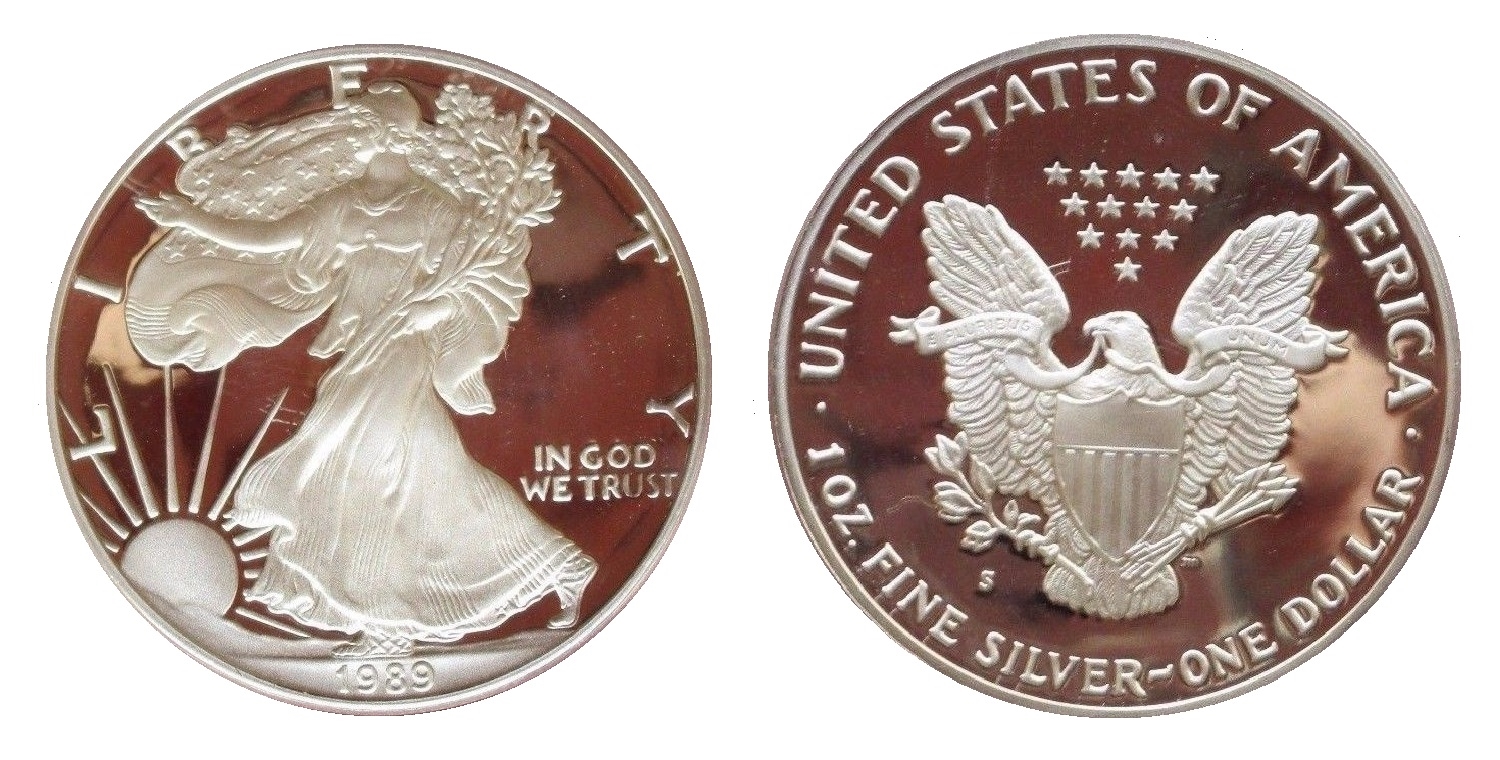
A perfect modern strike with no imperfections even at 5x magnification. With mirrors so clear, you can see the reflection of the photographer's hand. Valued for its pristine aesthetic and long-term liquidity. Also my younger son's birth year coin.
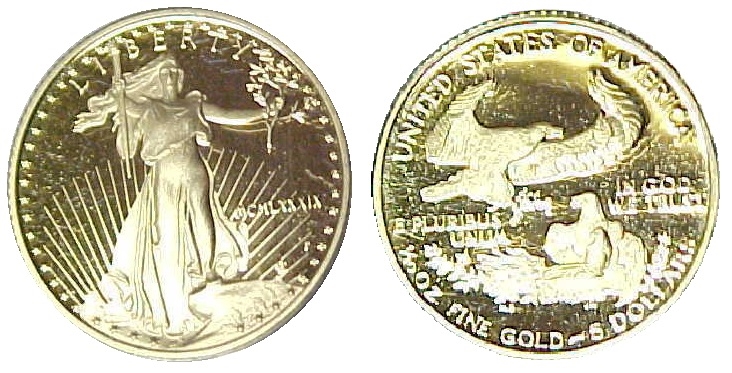
Top Pop 758/0 for the year. 24% of all coins minted are PR70DCAM.
A perfect proof gold numismatic piece that doubles as a bullion hedge.
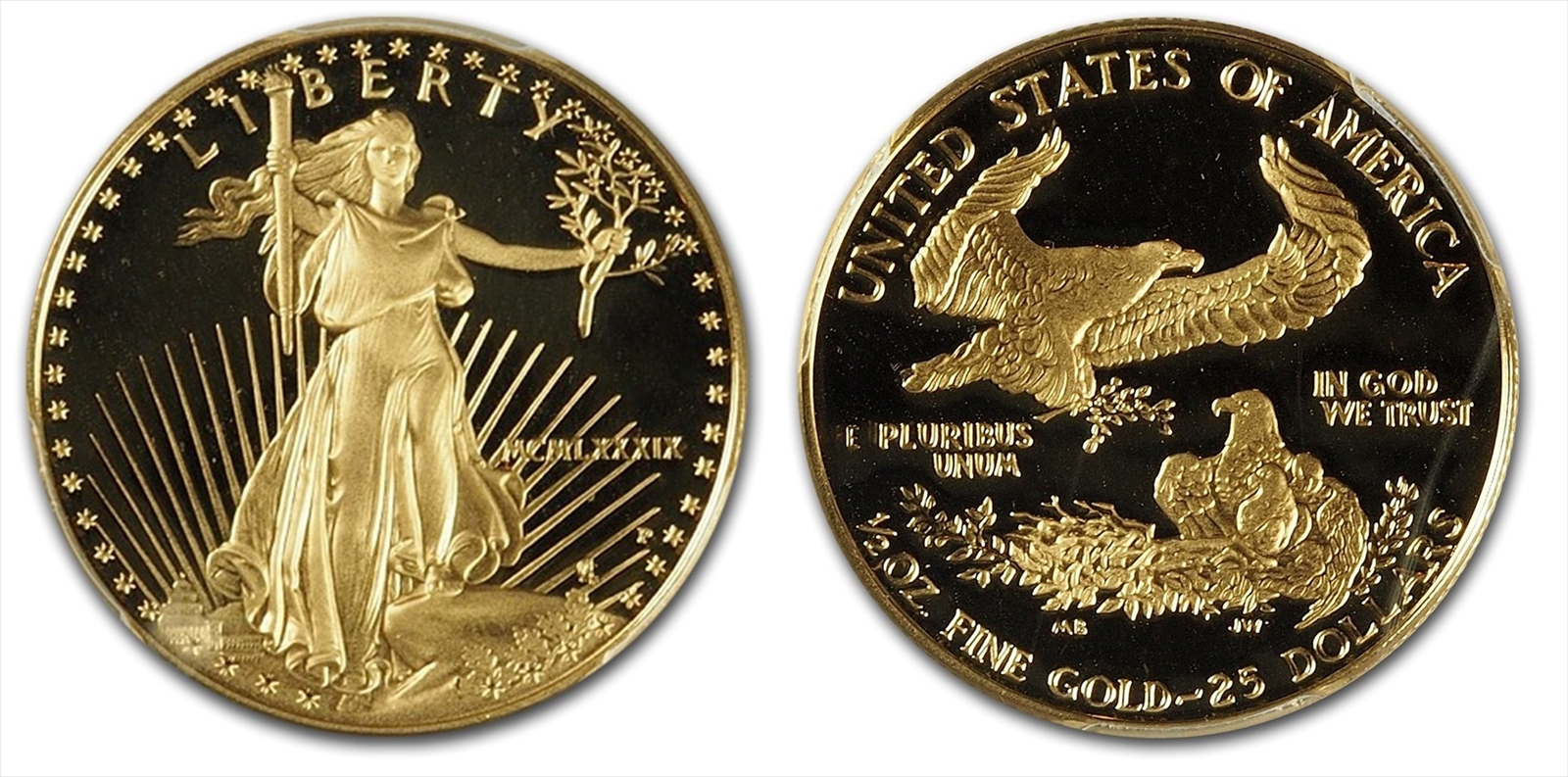

Bullion coin for modern gold sets. Value tracks the bullion price.
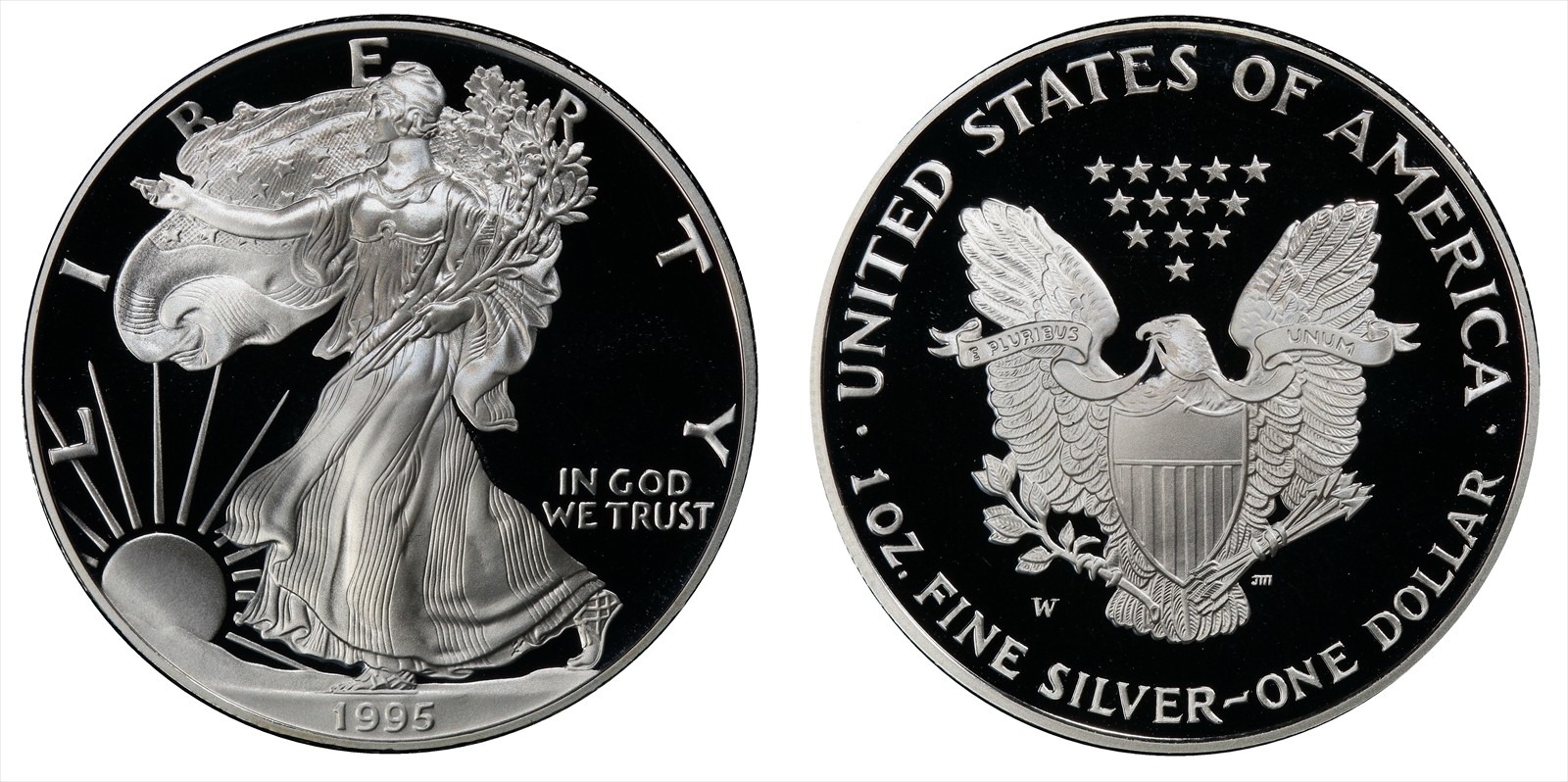
The 1995-W $1 Silver Eagle PR70 Deep Cameo has been a modern rarity. Looking back, one wonders how only 30,125 of the 45,000 10th Anniversary proof sets made available in 1995 were sold. Granted, the $999 was prohibitive for many collectors, but what a bargain that seems like today. The 1995-W Silver Eagle proof is a classic modern rarity. Examples are surprisingly scarce in flawless PR70 Deep Cameo condition, and they are always in high demand from Registry collectors and others who specialize in this popular series. Each side is boldly contrasted as always, but this piece lacks the single nick that usually keeps these coins from attaining the ultimate grade level.

In 2006, the United States Mint added a second gold bullion coin to its precious metals portfolio. Authorized by the Presidential $1 Coin Act of 2005, the American Gold Buffalo was the Mint’s first .9999 fine gold coin. Just as the American Eagle Gold coin adapted a venerated design from the Mint’s past, the American Buffalo brought back James Earle Fraser’s iconic Buffalo Nickel design. While no new program is guaranteed to succeed, the Mint had reasons to believe that the Gold Buffalo would be well received after a 2001 silver commemorative coin bearing Fraser’s work sold out of its authorized 500,000 coin mintage in just 15 days. The first American Buffalo gold coins rolled off the press on June 20, 2006, at the West Point Mint and were available for purchase on June 22. Demand for the new design was markedly higher than demand for that year’s American Gold Eagle. For the 2006-W American Buffalo Gold Proof, the Mint set a mintage limit of 250,000. The final mintage of 246,267 represents that total minus returns. As a collectible, the 2006-W American Buffalo Gold Proof has the highest mintage of any Proof issue in the series and should be considered a common date.

S-9, Pop 3/61. Both sides have smooth surfaces and pleasing mahogany-brown color. Good facial detail remains.


Newcomb 13 in MS65RB is a scarce and highly sought die variety of the Coronet cent. The N-13 variety features medium letters and the Head of 1936, which distinguishes it from other 1837 large cent varieties.

1831 25C Small Letters, B-4, R.1, MS66 PCGS. CAC. Tompkins Die State 2/5. A magnificent Capped Bust type coin. Golden-brown toning visits the fields and congregates along the borders. The crisply struck surfaces teem with luster. Only a few minor obverse grazes preclude perfection. Browning-4 is the usually encountered 1831 variety. Relative to B-5 to B-7, B-4 has small letters in the reverse legend. The arrowheads are narrow, the period after 25 C is egg-shaped, and a radial crack passes through the C in 25 C. This Premium Gem is surpassed within our auction archives by only a single B-4 example, the MS66+ PCGS CAC Simpson specimen. Ex: Regency Auction 53 (Legend, 7/2022), lot 173.
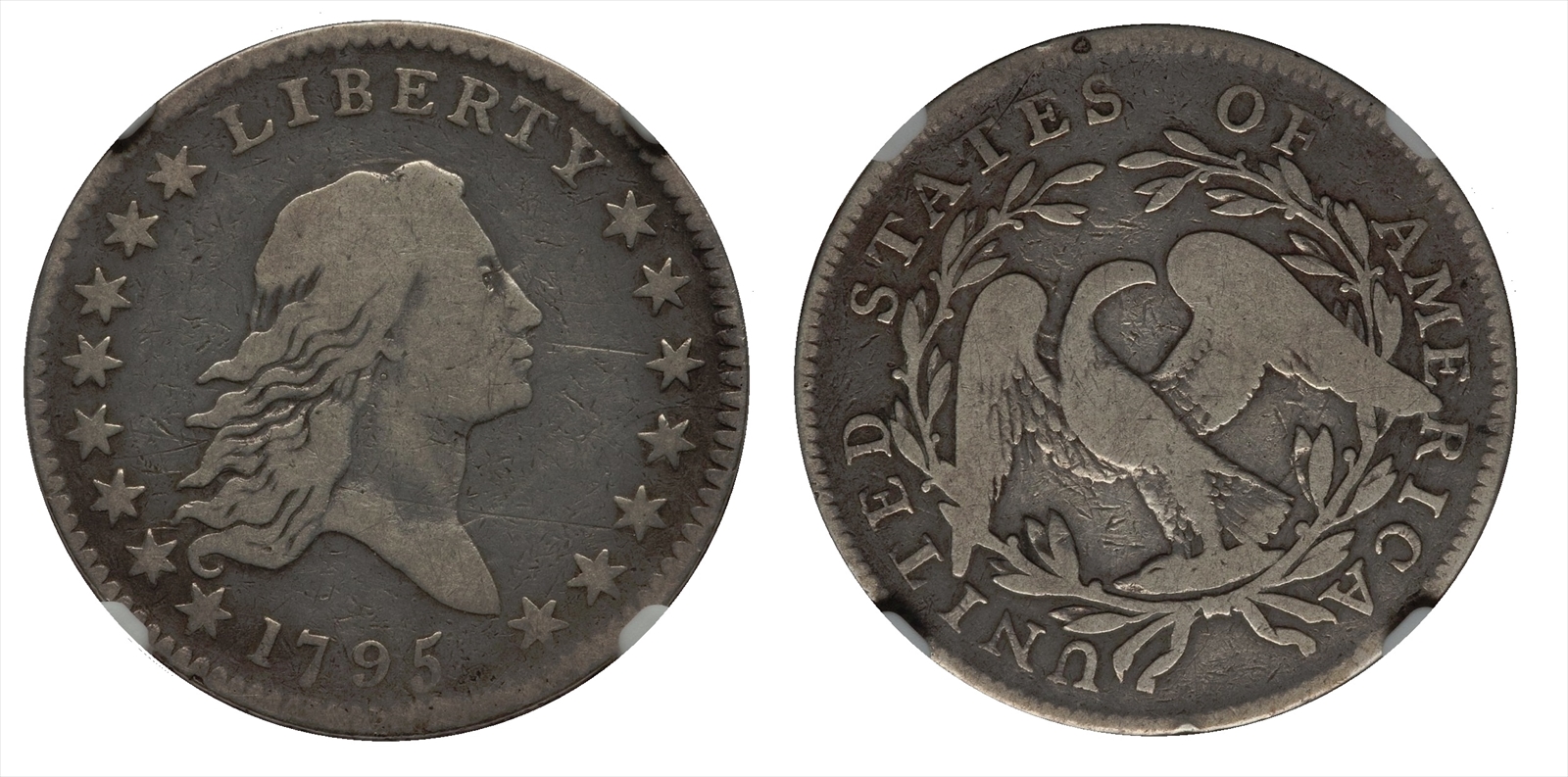
1795 2 Leaves, O-110, T-21, PCGS# 39228, Base PCGS# 6052., R.3, VG10. Crossed from NGC 4253976-010 (4/15), PCGS Population: (2/15). NGC ID# 24E7, In Whitman 9435.

The BB-61 is the most common and available die variety of the year, with an estimated surviving population of 1,250 to 2,000.
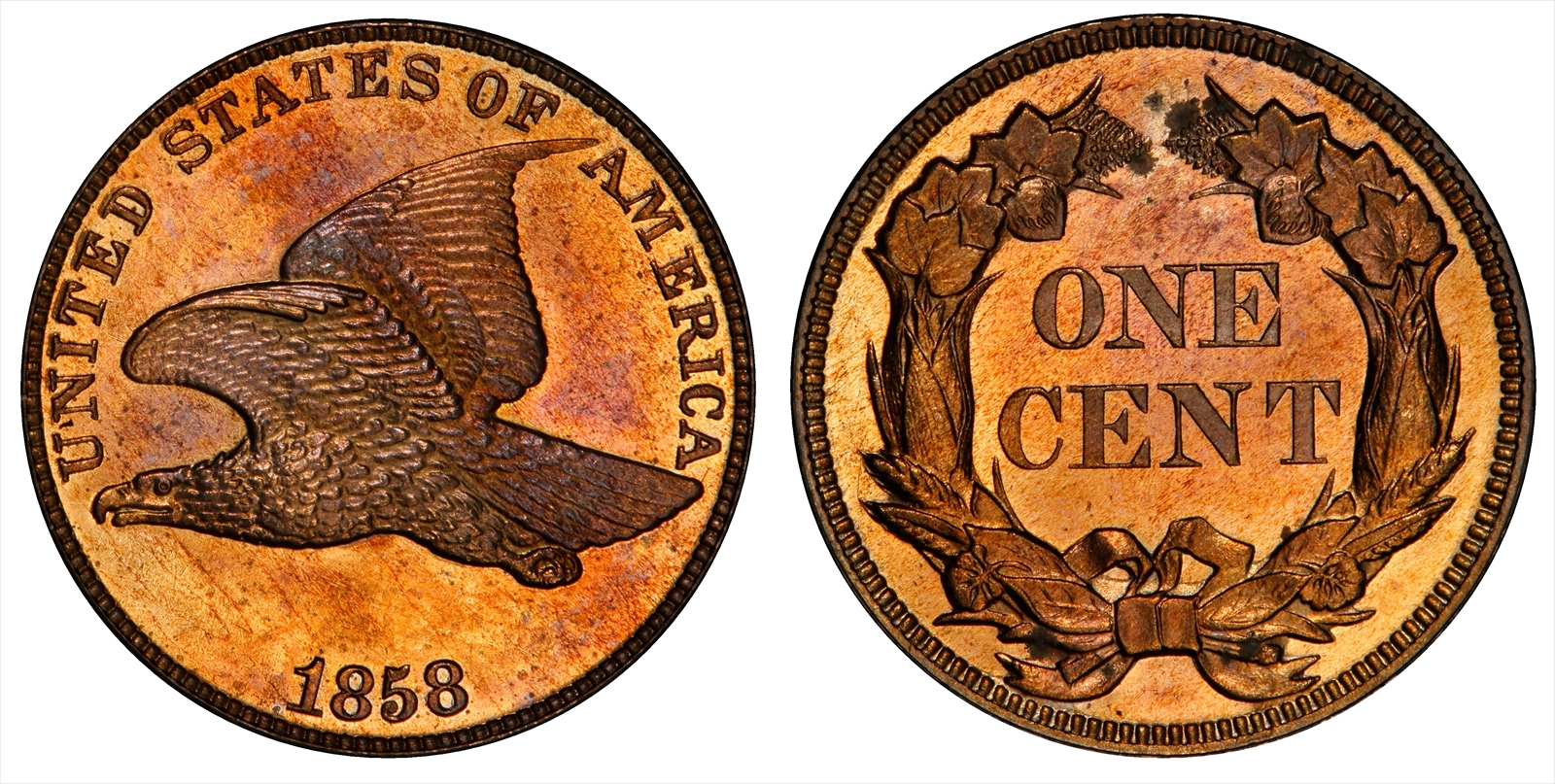
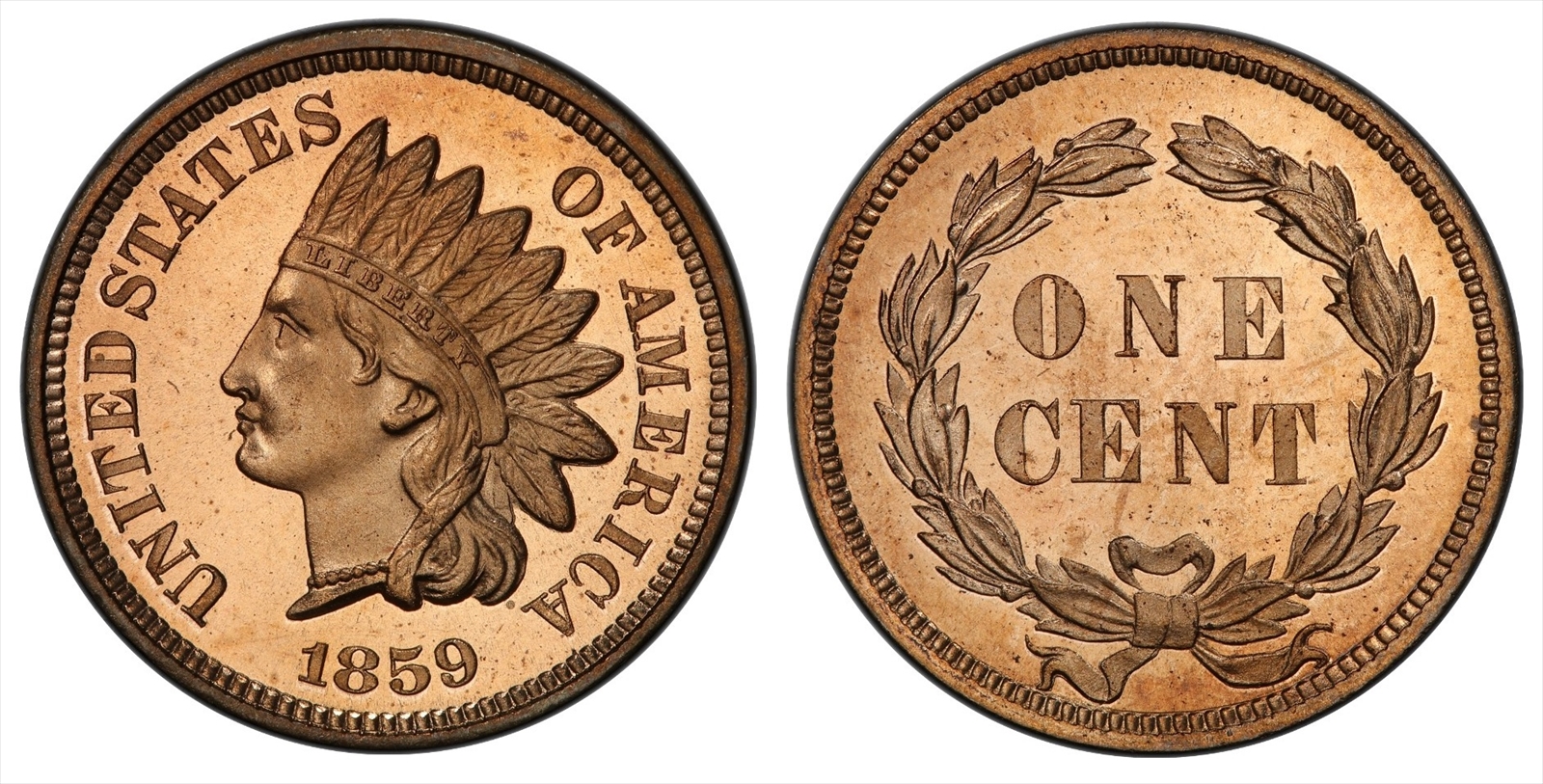
HA #1341 Orlando (1/22), ex-Palm Beach Collection; ex-Bob R. Simpson Collection. 1858 Flying Eagle Cent, PR65+ Cameo Snow-PR1, Large Letters. A single die pair is known for the 1858 proof Flying Eagle cent. This issue is scarce in all grades and seldom seen as a Cameo in Gem condition. In The Flying Eagle & Indian Cent Attribution Guide, third edition, Rick Snow writes: “The estimated mintage of 100 is derived from the 80 silver sets reportedly sold plus a small mintage of pattern sets, no more than 20. The number of survivors seems to fit these figures and serve as a reasonable starting point. I would estimate that about 50 examples exist today.” The Simpson coin is a Plus-graded Gem with attractive field device contrast. Razor-sharp definition complements reflective fields and rich copper-orange and violet toning. No distracting contact marks are seen, and there are just a few minor flecks beneath a loupe. Population: 7 in 65 (3 in 65+) Cameo, 2 finer (11/21). NGC ID# 227C, PCGS# 82042
Thank you to Rick and EERC (1/19). Rick listed this lovely one-year type on his site just before the Whitman/Baltimore show, I saw it and knew it could be gone before I could react, so I purchased it early that morning before departing, and chatted with him about the coin the next day at the show. He wouldn't say much beyond that the seller was moving in a new direction. Rick asked if I had seen the (only) PR67 -- I had not -- and related that it lacked eye appeal and that this coin was much more appealing.
_original.jpg)
Top Pop/CAC. LRCA (1/20). Thank you to Greg/LRCA for recognizing the upgrade potential to CAM from PR67+RD. An EXTRAORDINARY wonder coin! From the catalog: "This stunning SUPERB GEM is the FINEST KNOWN for the date at PCGS and quite possible for the DATE. The quality is unbelievable! Bottomless mirrors are clean, clear and deep and reflect back incredibly rich, golden fiery orange and electrifying pink hues! Thick frost graces the needle sharp design elements which contrast boldly against the amazing mirrored fields. The eye appeal is simply STUNNING in every way! PCGS 1, NGC 1, CAC 1. There are NO auction records for a PR67 or 67+ graded coin. This piece is the pioneer! To put things in perspective, we sold a PCGS PR66 RD CAMEO in our Regency Auction 34 for the staggering sum of $23,500! Dare we suggest that if you bill yourself a PERFECTIONIST you will be kicking yourself for life if you let this incredible coin get away. Don’t put the bidding paddle down until you own it! We anticipate this coin will set a record price! Cert. Number 38305005 PCGS # 82392.00PCGS # 82392.00."
Ex-Hanson/DLRC. A stunning gem example of this low mintage proof issue, one of just 600 coins struck! Precious few are known with any remaining cameo effect, and none are known in DCAM. PCGS reports just a single example finer! Bright orange-gold and rich mint red coloration is on a gorgeous display across virtually flawless surfaces. Fully struck and terrifically preserved, the satiny devices stand out nicely against the beautifully reflective fields. A significant condition rarity and a registry quality piece more than worthy of the advanced specialist!

Top Pop (3/0). Previously auctioned by a previous owner at HA 4/23/20 as PCGS 39237646 Pop 3/0 in CAM, for $3840, I purchased this out of a Coast-to-Coast Coins (Columbia MD, 12/20) catalog(!).
This is one of the two top pop MS-68 Full Steps that Ron Guth cites in his Expert Comments (and this is actually a 68+).
Beautiful milky surfaces with gorgeous eye appeal. Low mintage proof issue with just 600 coins struck.
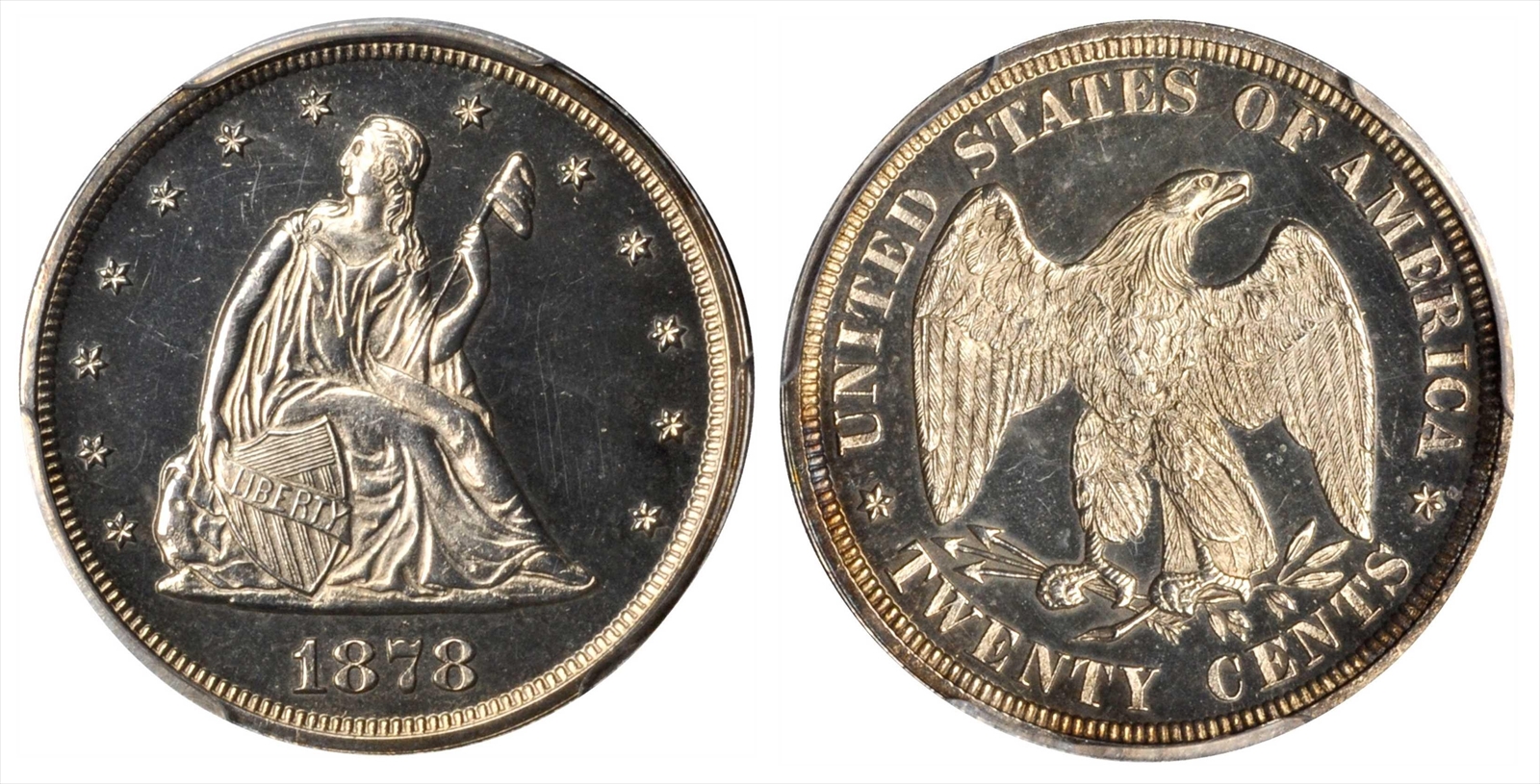
A fully struck, nicely cameoed specimen adorned with delicate golden iridescence. The final twenty-cent issue, the scarce and eagerly sought 1878 is a Proof-only affair with just 600 coins struck. Originally part of B. Max Mehl's Gold Jubilee Sale of 1950, this coin is accompanied by not only the original lot tag, but also a copy of the Golden Jubilee Sale catalog, a B. Max Mehl envelope with provenance and other notes, and the original Mehl mailing box for the catalog. The box is somewhat tattered with some tears and the name of the original recipient obscured, but it is complete. Historic auction mementos such as this are rare, especially when they have been kept alongside one of the coins offered therein. The supporting items are available to the winning bidder upon request to Stack's Bowers Galleries at the close of the auction. (Total: 1 coin; 4 additional items) Provenance: Ex Jerome Kern; B. Max Mehl's Golden Jubilee Sale, May 1950, lot 1644. Original catalog, lot tag, Mehl envelope and Mehl mailing box included. PCGS Population: 34; 12 finer in this category (Proof-67 Cameo finest).
_original.jpg)
Thank you to Steven Contursi and RCW (3/19). Previously changed hands at Heritage Orlando FUN $5980 (1/03), but very likely there were other owners in between.

There are only 3 coins graded PR69DCAM over the entire wheat cent series, with none graded higher; this is one of the three.

There are only 3 coins graded PR69DCAM over the entire wheat cent series, with none graded higher; this is one of the three.
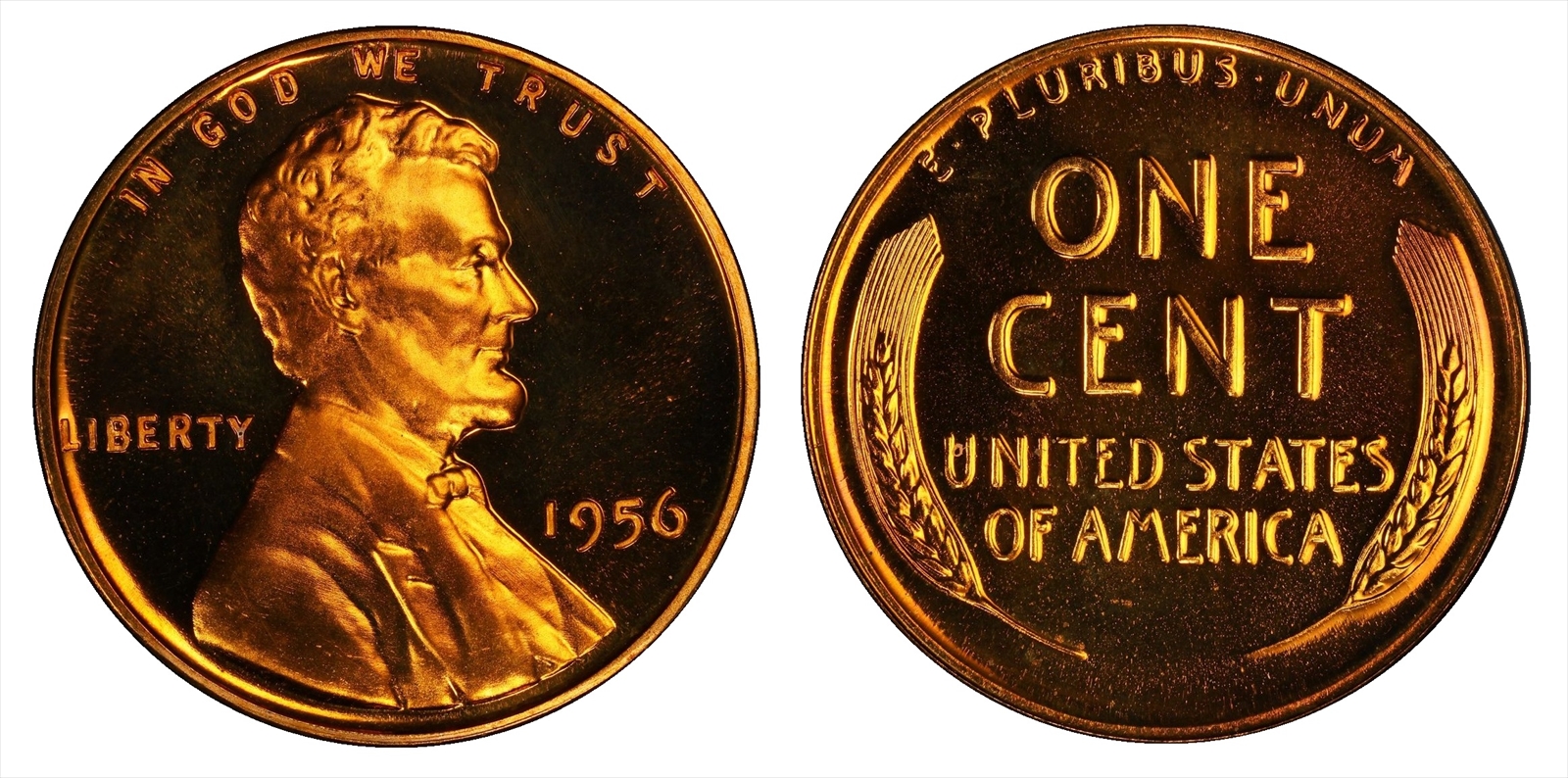
Owner sold because he beat me out for 1C 1955 PCGS PR69DCAM and 1C 1958 PCGS PR69 DCAM, at $51K each.
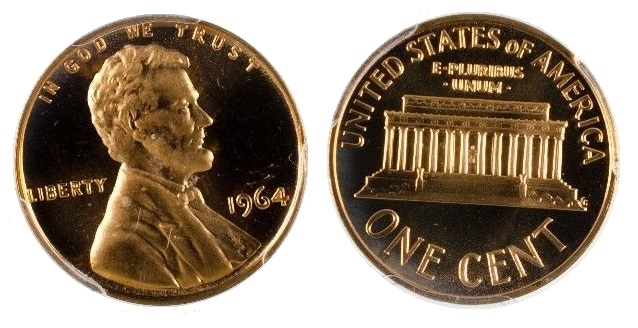
With nearly 4 million proofs minted, only a tiny fraction - about 6.3% - exhibit the the highly frosted DCAM contrast. This coin is one of those.

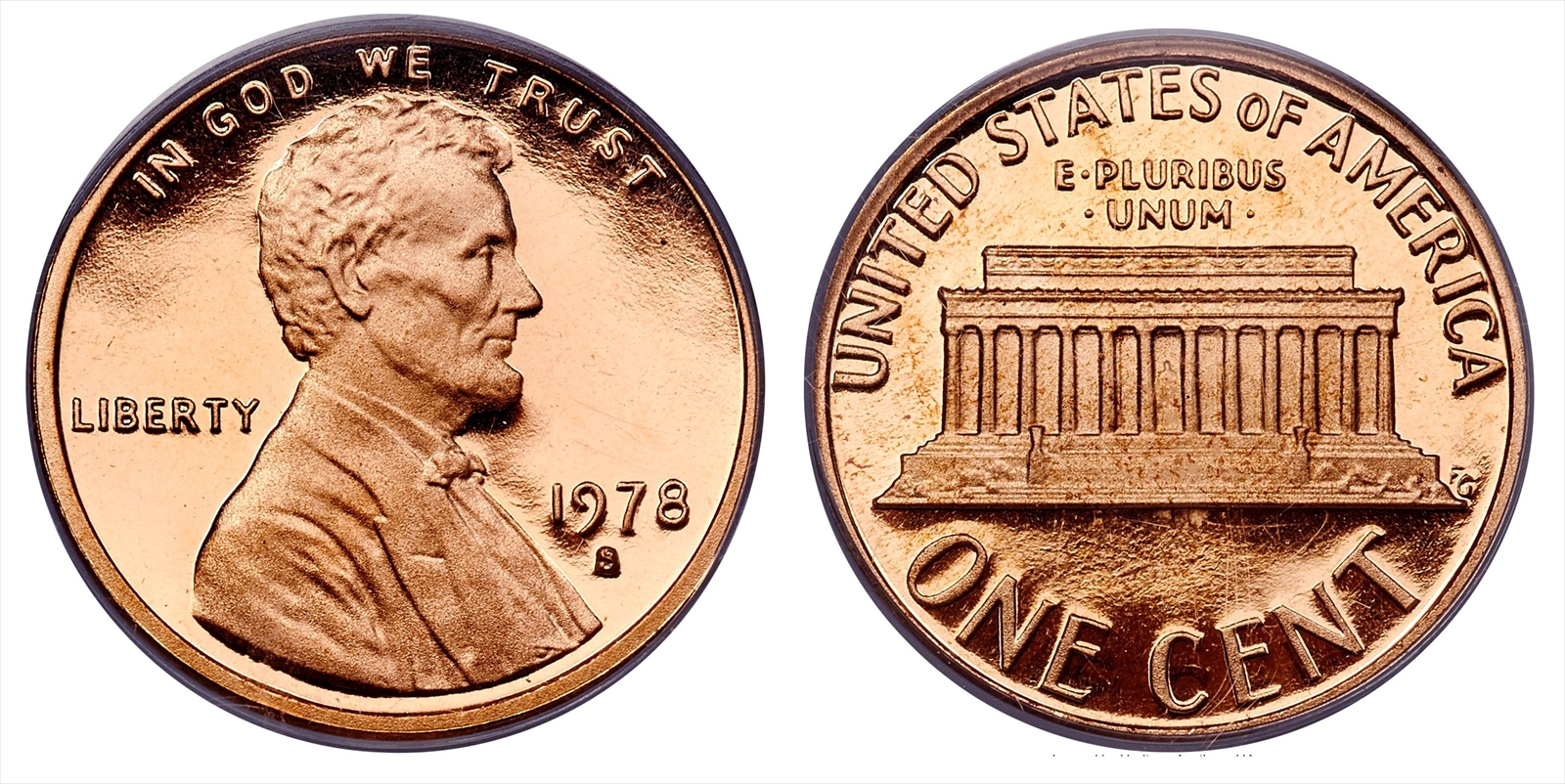
Ex-Newman, part of his 1978 date set, Heritage (1/18). Pristine and starkly contrasted with original copper,red color. Under a loupe, a dusting of microscopic cherry-red flecks are visible on the reverse. The cent is rare in this grade at PCGS (only 13 so,graded at that service). (11/17)
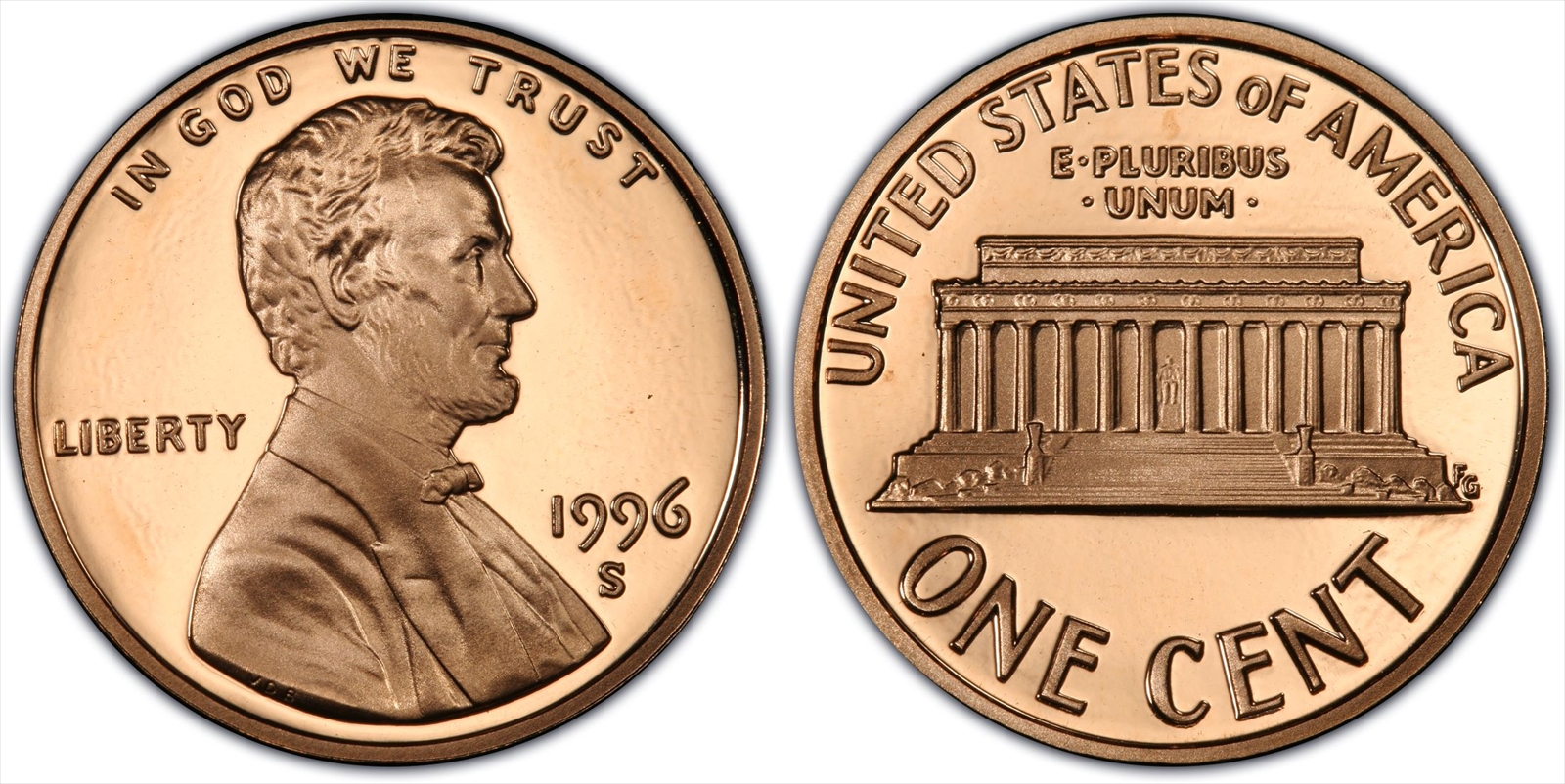
A perfect modern strike with no imperfections even at 5x magnification. Valued for its pristine aesthetic and long-term liquidity.

I acquired from GC (1/23). Top pop: 3/0 across all dates; 1/0 as an 1880 PCGS PR67+DCAM. ChatGPT analysis suggests: "The evidence best supports this narrative: A premium cameo/deep cameo 1880 proof Shield nickel sat for years in an older PCGS holder at a lower grade or lower designation. As grading standards and registry competition evolved, the coin was resubmitted and eventually recognized as PR67+ DCAM. After receiving CAC approval, it entered the market through Great Collections in 2023 as arguably the finest certified example known. That would explain: - the mismatch versus older CoinFacts census language, - the absence of long auction history, - and the dramatic rarity of the assigned grade."

I acquired from GC (1/23). Top pop: 3/0 across all dates; 1/0 as an 1880 PCGS PR67+DCAM. ChatGPT analysis suggests: "The evidence best supports this narrative: A premium cameo/deep cameo 1880 proof Shield nickel sat for years in an older PCGS holder at a lower grade or lower designation. As grading standards and registry competition evolved, the coin was resubmitted and eventually recognized as PR67+ DCAM. After receiving CAC approval, it entered the market through Great Collections in 2023 as arguably the finest certified example known. That would explain: - the mismatch versus older CoinFacts census language, - the absence of long auction history, - and the dramatic rarity of the assigned grade."

I acquired from GC (1/23). Top pop: 3/0 across all dates; 1/0 as an 1880 PCGS PR67+DCAM. ChatGPT analysis suggests: "The evidence best supports this narrative: A premium cameo/deep cameo 1880 proof Shield nickel sat for years in an older PCGS holder at a lower grade or lower designation. As grading standards and registry competition evolved, the coin was resubmitted and eventually recognized as PR67+ DCAM. After receiving CAC approval, it entered the market through Great Collections in 2023 as arguably the finest certified example known. That would explain: - the mismatch versus older CoinFacts census language, - the absence of long auction history, - and the dramatic rarity of the assigned grade."

I acquired from GC (1/23). Top pop: 3/0 across all dates; 1/0 as an 1880 PCGS PR67+DCAM. ChatGPT analysis suggests: "The evidence best supports this narrative: A premium cameo/deep cameo 1880 proof Shield nickel sat for years in an older PCGS holder at a lower grade or lower designation. As grading standards and registry competition evolved, the coin was resubmitted and eventually recognized as PR67+ DCAM. After receiving CAC approval, it entered the market through Great Collections in 2023 as arguably the finest certified example known. That would explain: - the mismatch versus older CoinFacts census language, - the absence of long auction history, - and the dramatic rarity of the assigned grade."
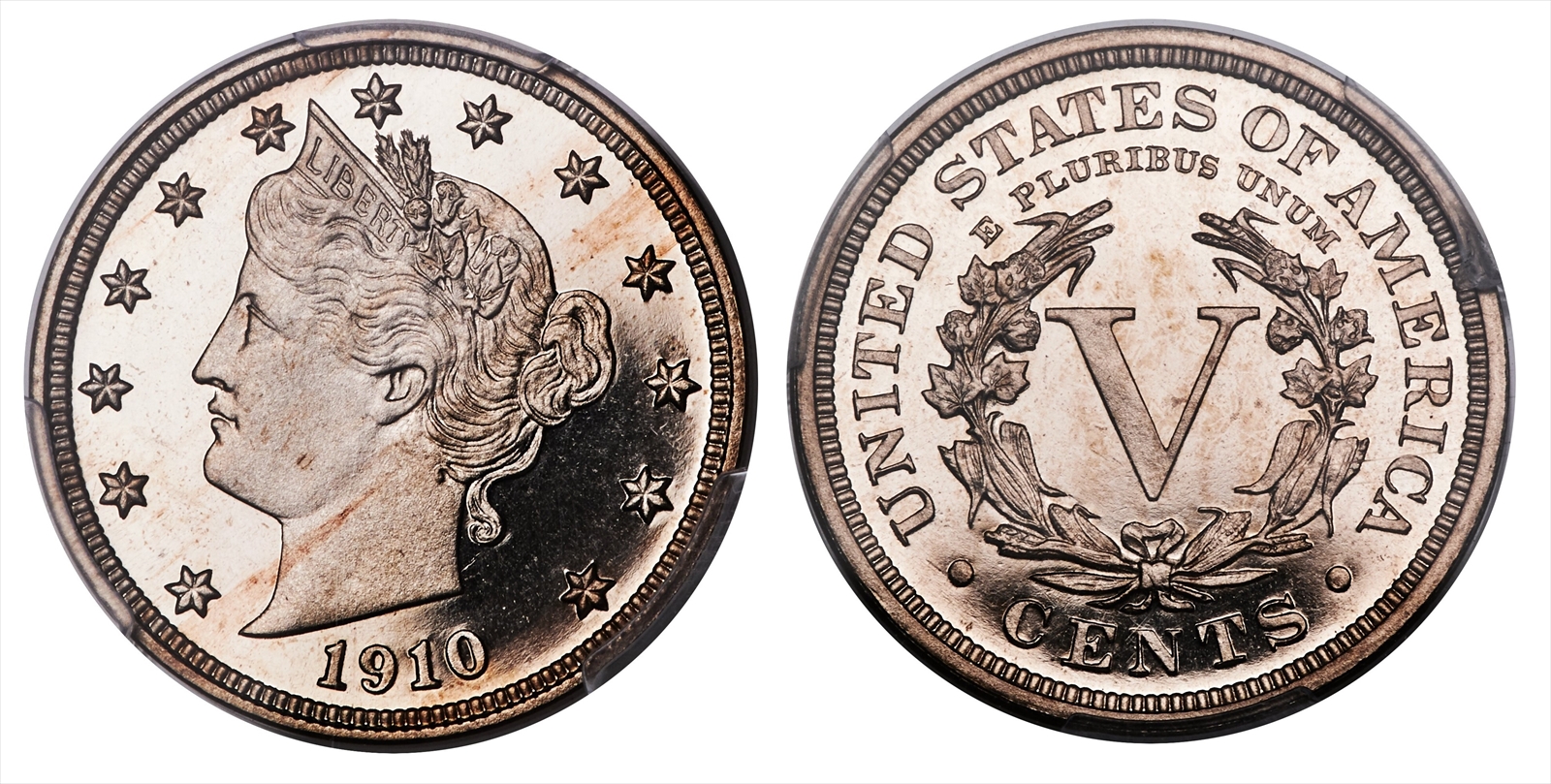
Heritage (10/20) -- 1910 Liberty Nickel, PR68 Deep Cameo; Tied With One Other for Finest Known Deep Cameo Liberty Nickel; The Registry Set Collector's Dream Coin. The age of Registry Sets has dramatically changed the landscape for high-grade coins in series not otherwise heavily collected in those grades. Collector demand for "Registry-grade" examples of many common dates in the proof Liberty nickel series not only creates repeated record auction prices realized for many coins, but also draws newfound recognition among the numismatic community at large regarding just how rare some of these dates are in the finest-known condition. In our June 2018 Long Beach Signature sale, a new milestone was reached when a PR68 Deep Cameo 1910 Liberty nickel sold for $84,000, becoming the single most valuable proof Liberty nickel not dated 1913. At the time, it was the only proof Liberty nickel of any date graded PR68 Deep Cameo, with none finer. That stunning coin now resides in the all-time finest PCGS Registry Set of proof Liberty nickels, and for good reason. However, it actually has a twin, a coin that has only recently been recognized in this grade by PCGS. The present piece is the only other proof Liberty nickel of any date awarded the seemingly untouchable grade of PR68 Deep Cameo at PCGS (9/20). This piece showcases stunning reflectivity and contrast, accentuated by the thick frost of the devices and their razor-sharp definition, which includes even the border stars and the troublesome corn ear to the left of the wreath bow. Wisps of amber-gold toning are faintly visible on each side, giving this piece a slightly warmer appearance compared to the icy starkness of its twin from our 2018 auction. The quality of this piece is simply unsurpassed, and the eye appeal that goes along with that is matched only by this coin's twin. This coin embodies the stunning quality demanded of coins going into the finest Registry Sets, and its rarity in this condition -- nearly unique -- reveals the incredible challenge that Registry Set builders encounter and why coins like this have become so popular in recent years. Population: 2 in 68 Deep Cameo, 0 finer (9/20).(Registry values: P1)
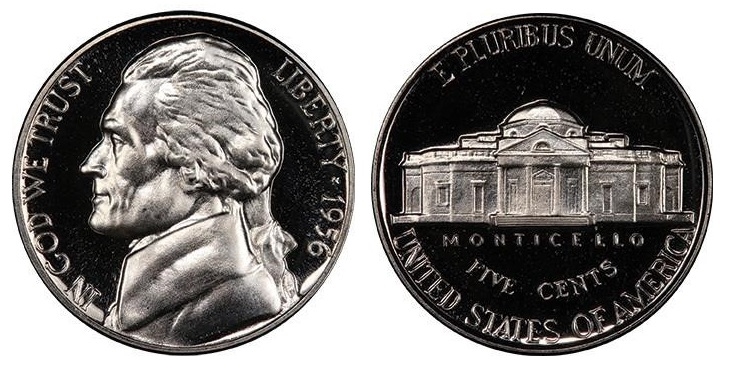
Ex-Blue Ocean. THE BLUE OCEAN #1 REGISTRY SET PERFECT! FINEST graded DCAM proof at PCGS and possible FINEST KNOWN. Surfaces are flawless with deep mirrors and contrasting devices. As pristine as the day it was issued. PCGS 1, NGC 3, CAC 0. None finer. The PCGS price guide value is listed as $12,500. This superb PCGS DCAM Proof has not previously appeared at auction and is likely to generate strong interest for anyone attempting to complete a #1 set. Cert. Number 81623042, PCGS # 94188.00.

Because of 1964 proofs were minted in nearly flawless condition with deep cameo contrast, this coin is common in top grades. There are 235 in PR69DCAM and 8 in PR70, but none in PR70CAM or PR70DCAM at the time of this writing.
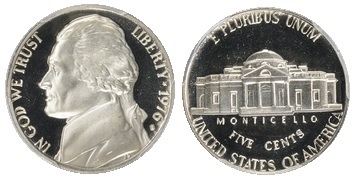
With 230 PR70 DCAM and over 15K in 69 DCAM, it could be a good idea to save any PR70 DCAMs that you come across.

Ex-Newman, part of his 1978 date set, Heritage (1/18). A flawless proof with picturesque contrast and needle-sharp devices.

A perfect modern strike with no imperfections even at 5x magnification. Valued for its pristine aesthetic and long-term liquidity.

A perfect modern strike with no imperfections even at 5x magnification. Valued for its pristine aesthetic and long-term liquidity.
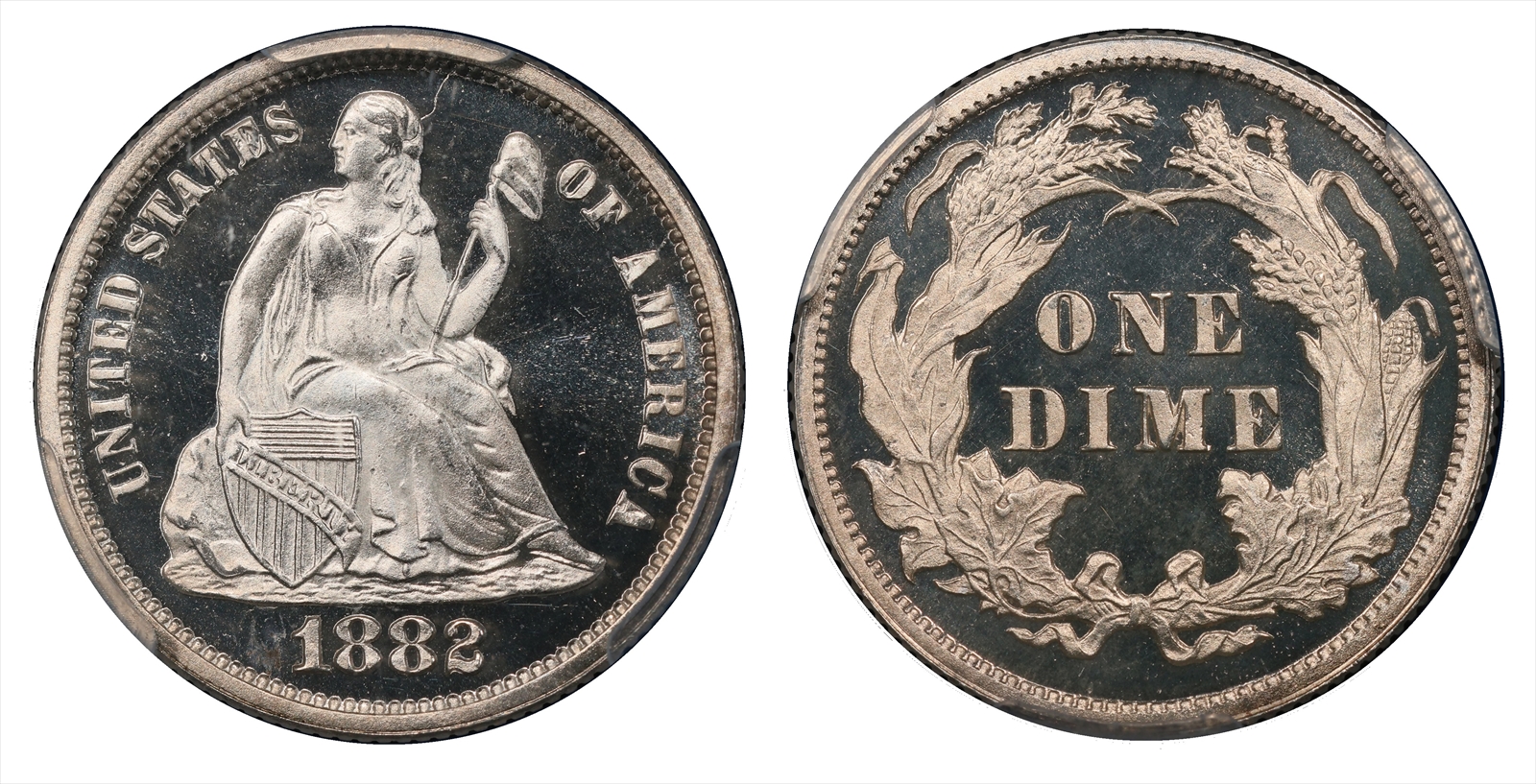
Before GC, was purchased by previous owner at HA 2021 June 17-20 U.S. Coins Signature Auction #1331. PR67 Deep Cameo, White-on-Black Contrast. From that sale: 1882 10C PR67 Deep Cameo PCGS. F-101, R.3. Proof 1882 dimes with Deep Cameo contrast are rare. As of (5/21), PCGS has certified only eight pieces as such. NGC has graded only seven coins as Ultra Cameo, with none above the PR66 level. The present Superb Gem is essentially as made, with glassy fields and frosty legends and motifs. A full strike contributes further to the quality. Population: 2 in 67 Deep Cameo, 0 finer (5/21).
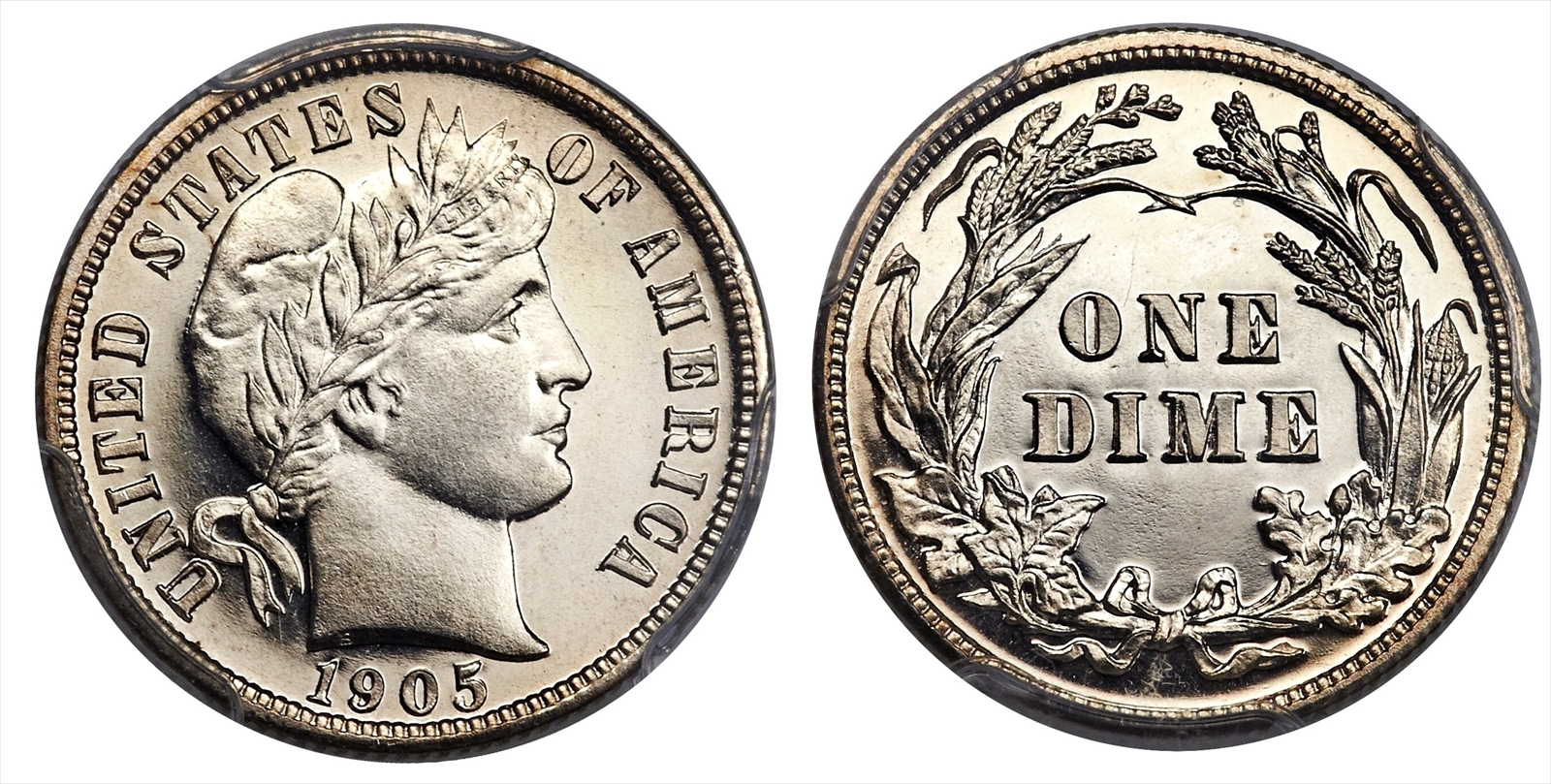
1905 Dime, PR67 Deep Cameo; Sole Deep Cameo Certified. 1905 10C PR67 Deep Cameo PCGS. With 727 pieces struck, the 1905 proof Barber dime is available in the absolute sense, but Cameos are scarce. This Superb Gem holds down top spot as the only Deep (or Ultra) Cameo submission certified by either PCGS or NGC (10/21). Faint tinges of golden color accent the deep mirrors and frosty devices, while sharp design definition and impeccable preservation heighten the visual appeal. Ex: Long Beach Signature (Heritage, 1-2/2015), lot 3087. From The Phyllis Norman Collection.
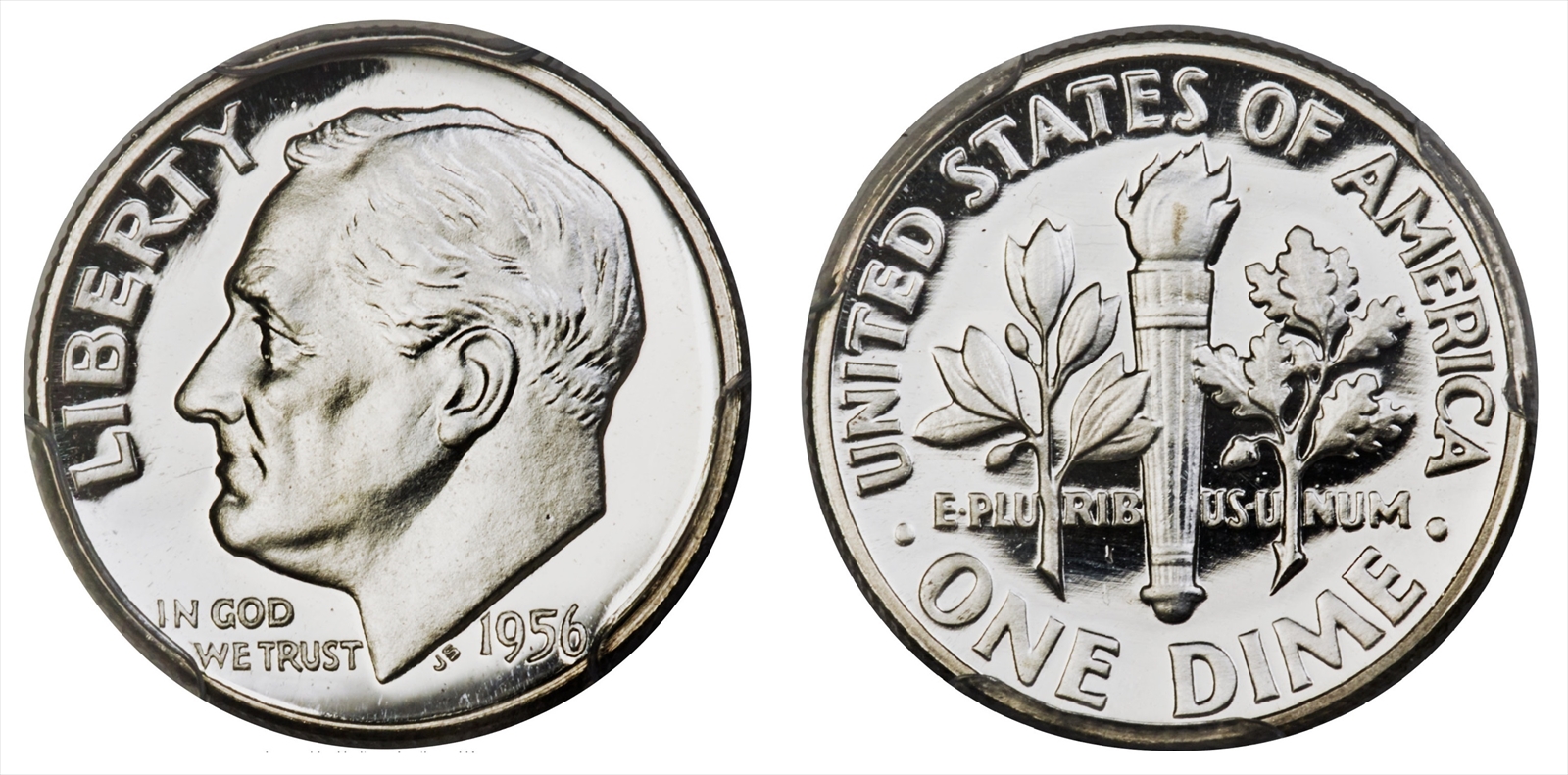
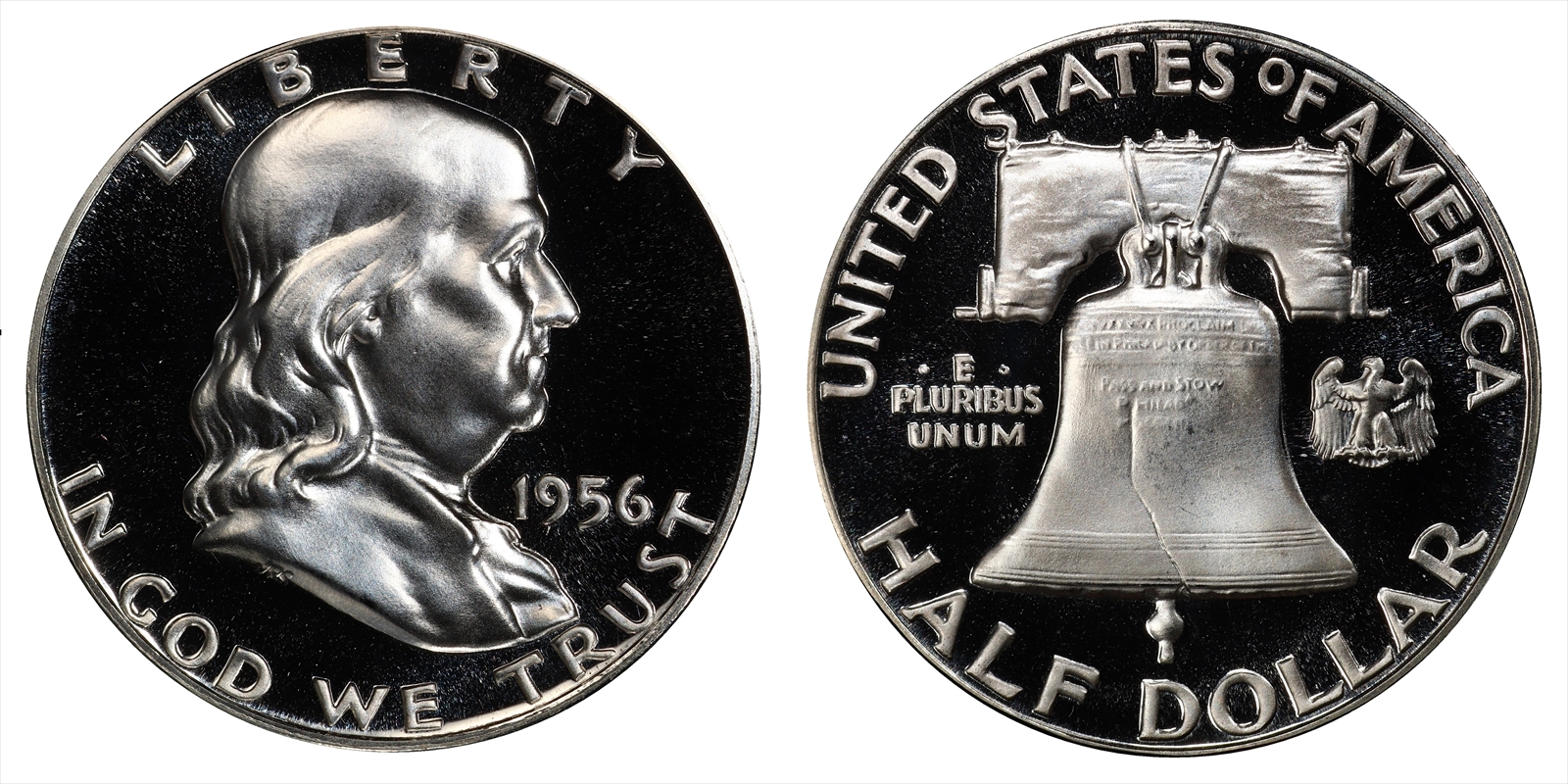
1956 10C PR69 Deep Cameo PCGS. Pop 7/0; tied for Finest Known. In his 1991 reference on 1950-1970 era proof coinage, Rick Tomaska made the observation that still holds true today: -- "Because heavily frosted 1956 Franklin halves are not terribly difficult to locate, many collectors assume the same must be true for the other denominations. This is simply not the case." A glance at the population numbers verifies this statement. The 1956 dime with Deep Cameo contrast and at the PR69 grade level is a rarity. Only two other Deep Cameos have been so graded by PCGS (10/18). The strike is full, and both sides exhibit stark white-on-black contrast with no sign of toning. The preservation is unsurpassed at both services. This is a must-have item for the Registry Set collector of proof Roosevelt dimes. A major condition rarity this fine, the present 1956 proof dime is tied with two other Deep Cameos as the finest at PCGS (11/16). The strike is full, and both sides exhibit stark white-on-black contrast with no sign of toning.
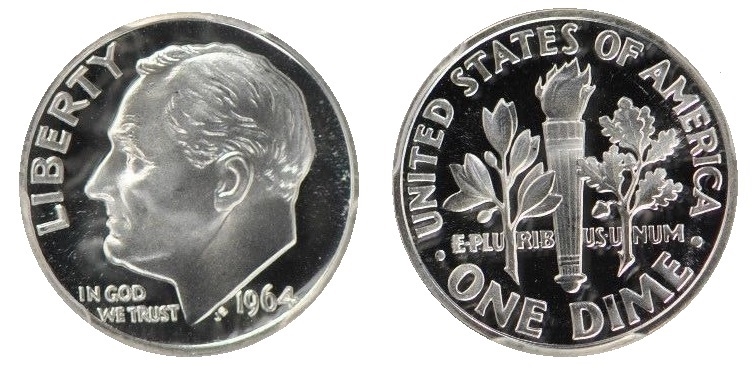
Many collectors actively hunt down high-grade, cameo specimens of this 1964 Philadelphia issue because the older proof dies often wore down, making DCAM contrasts for this year very scarce.
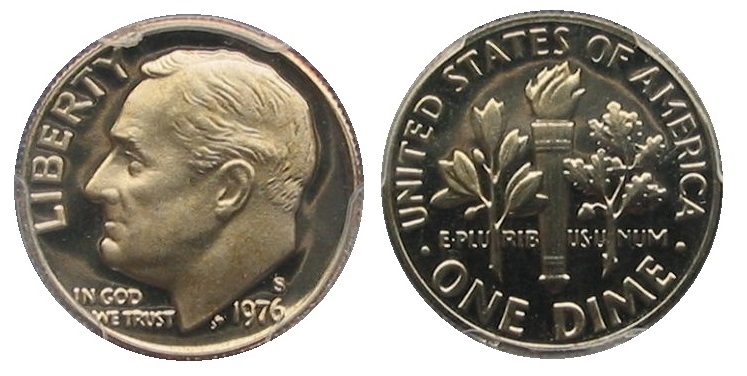
A perfect modern strike with no imperfections even at 5x magnification. Valued for its pristine aesthetic and long-term liquidity.
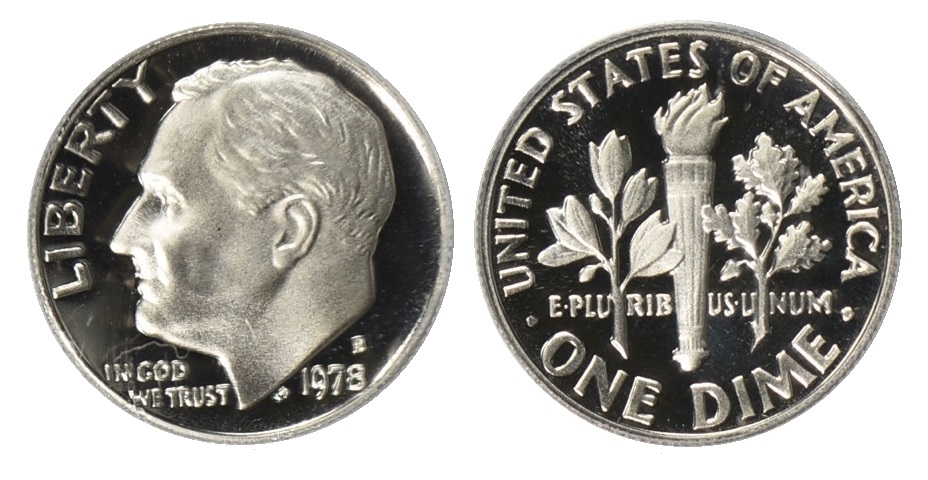
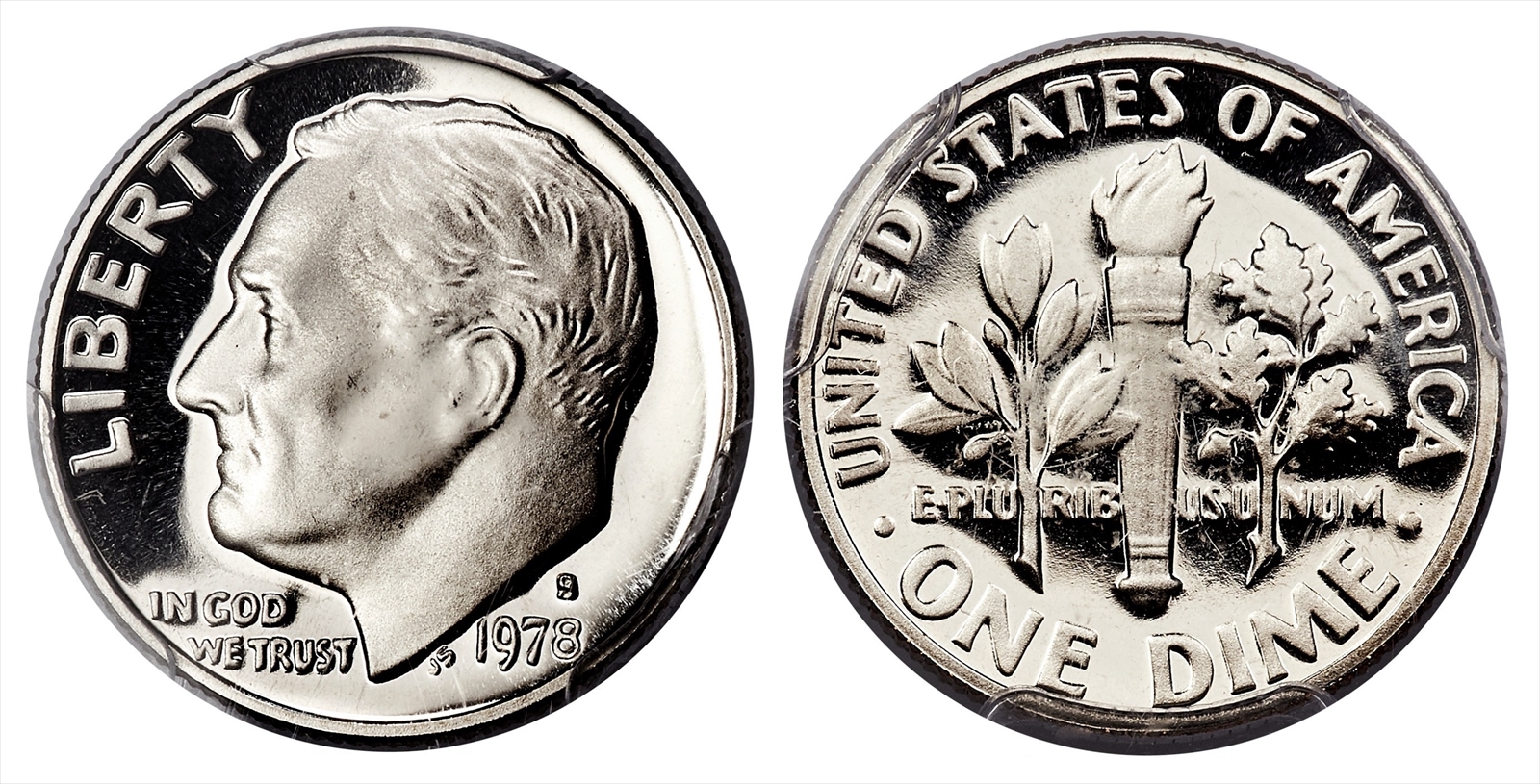
Ex-Newman, part of his 1978 date set, Heritage (1/18). The strike is full, and dramatic cameo contrast easily rivals that of the nickel.

A perfect modern strike with no imperfections even at 5x magnification. Valued for its pristine aesthetic and long-term liquidity.
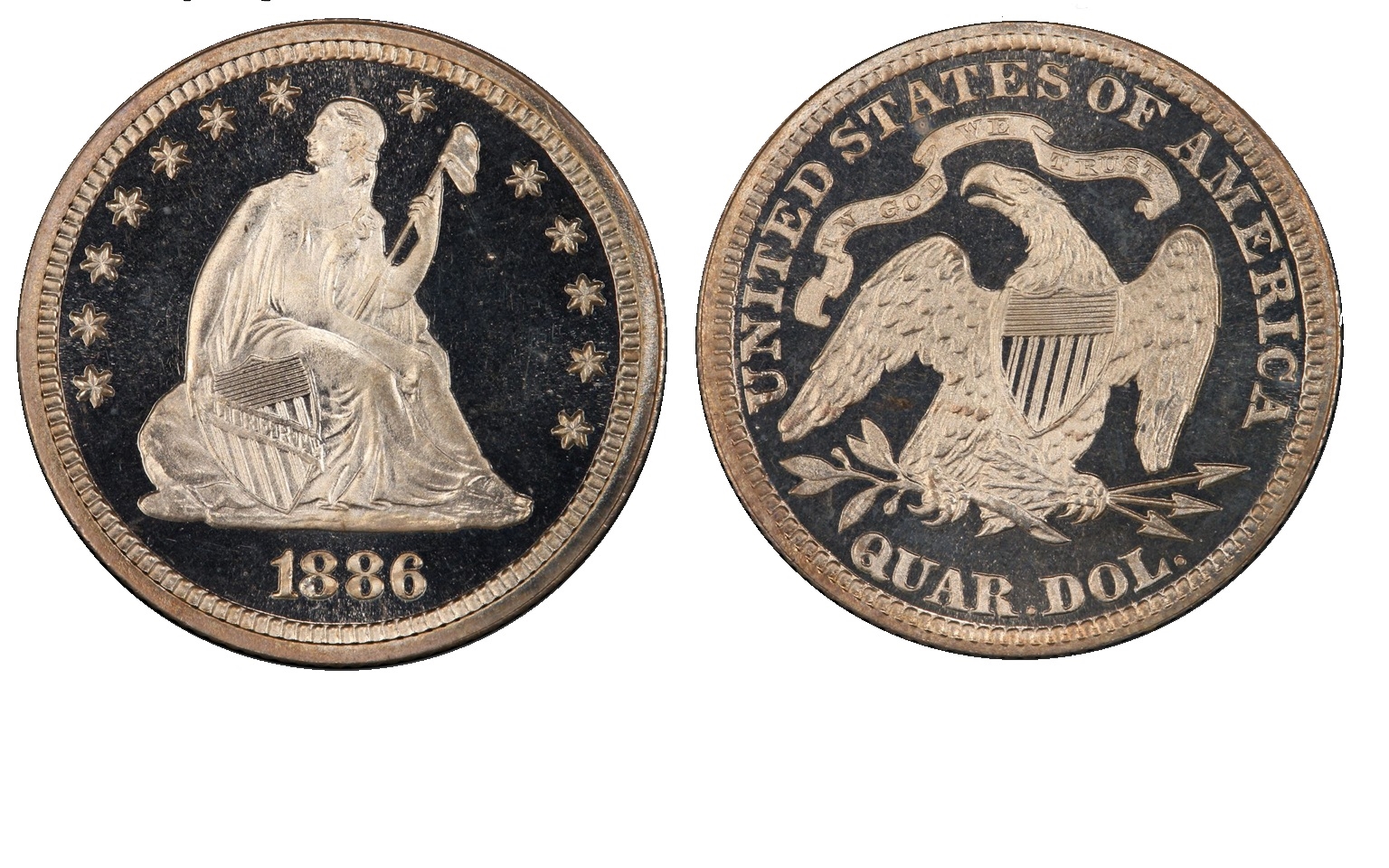
An outstanding coin with deep cameo contrast and a prestigious collector pedigree. There were 886 total 1886 proofs struck; 9 survive in 67DCAM, and only 2 are rated higher.

LRCA (Lot 289, 3/19) - 25C 1911 PCGS PR68 DCAM CAC; FROM THE INTENSE CAMEO COLLECTION This mega MONSTER has some serious ju ju! It’s impossible not to love it. We see no reason why PCGS did not + it (we make no promises). Exceedingly deep mirrors blast away from all over. The mirrors also show extreme clarity and cleanliness. When you twirl the coin, the dramatic intense flash nearly blinds you from seeing the watery rolling mirrors. There is no toning and the contrast is stunning. Miss Liberty and the details are pinpoint sharp in strike and are fully struck. The eye appeal is gonzo incredible! ONLY 543 minted. There are NO records for any PCGS CAC PR68 DCAM ever selling in auction. A PR67+ DCAM CAC sold for $16,100 way back in 2011. The current Collectors Universe Value is $18,500. We see this date far more in regular cameo in PR67+ and 68. This piece certainly will be a prize for any SUPERB GEM Quarter or Type set. We expect really strong bidding here-be ready and good luck! Cert. Number 82911582, PCGS # 95697

This is an incredible coin, nearly perfect in every respect. Pristine surfaces display thickly frosted, sharp motifs that seem to float atop the watery mirroring of the fields. An untoned coin, unsurpassed both technically and aesthetically. Population: 43 in 69 Deep Cameo, 0 finer (8/15).

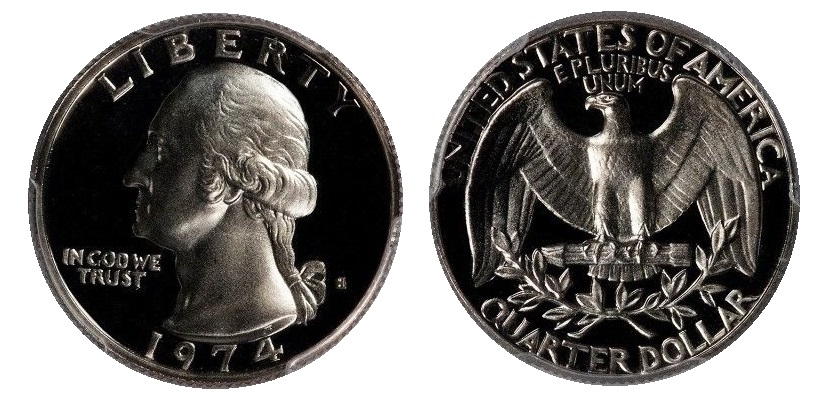
Only pop 138/0 for the date, but pop 32,962/0 for the series. So this is probably a good date to hold on to in PR70DCAM for the long run.
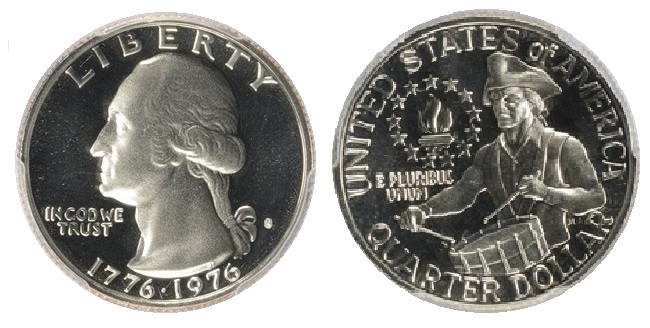
A perfect modern strike with no imperfections even at 5x magnification. Valued for its pristine aesthetic and long-term liquidity.

A perfect modern strike with no imperfections even at 5x magnification. Valued for its pristine aesthetic and long-term liquidity.
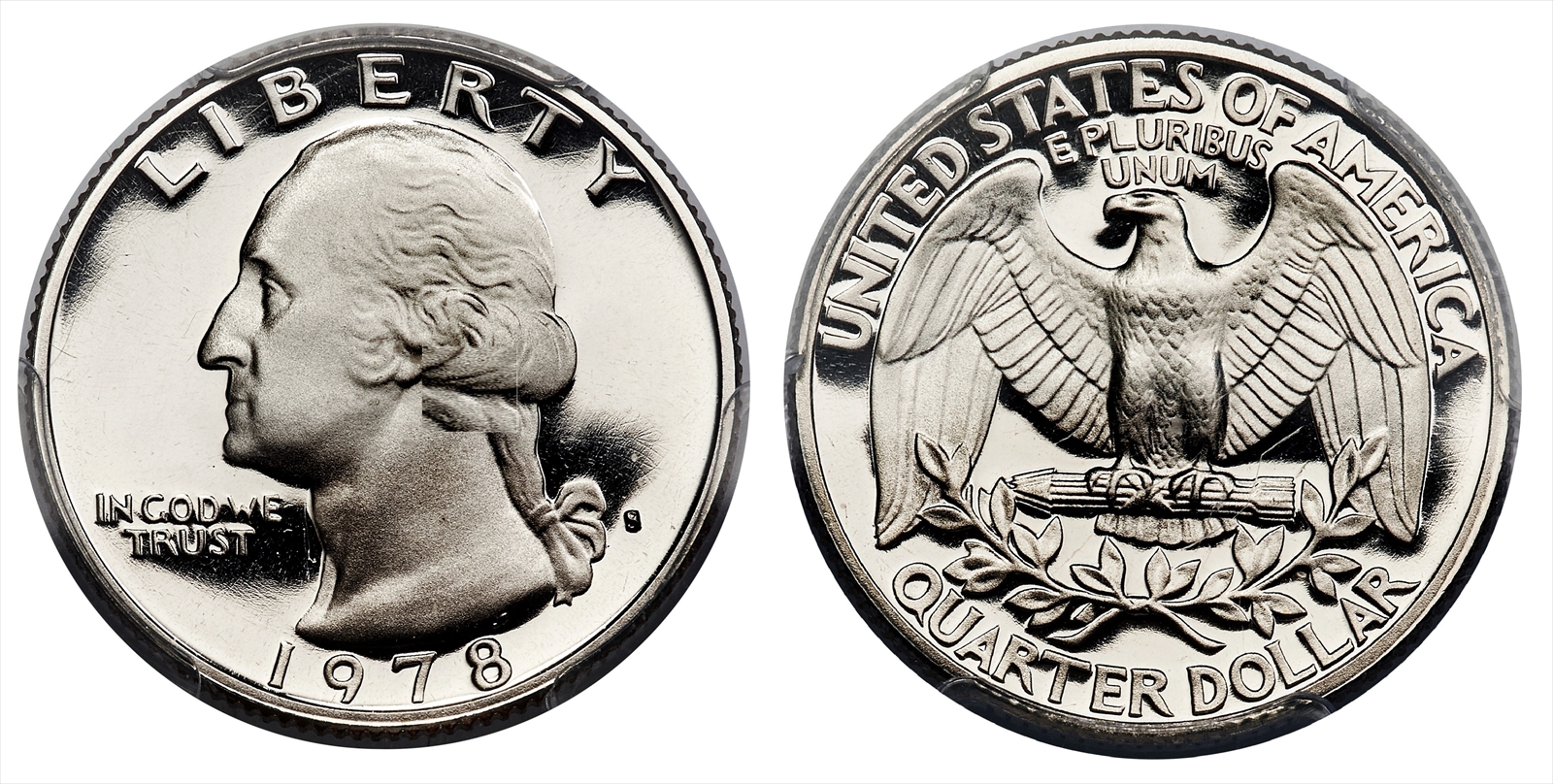
Ex-Newman, part of 1978 date set, Heritage (1/18). Frost-white on the devices and liquid-like in the fields, without even a trace of toning.

A perfect modern strike with no imperfections even at 5x magnification. Valued for its pristine aesthetic and long-term liquidity.

A perfect modern strike with no imperfections even at 5x magnification. Valued for its pristine aesthetic and long-term liquidity.

Top Pop. HA (7/22), Long Beach Expo/Summer FUN US Coins Signature Auction #1347 / Lot #3109. 1866 5C Rays PR67 Deep Cameo PCGS. An incredibly eye-appealing example of this short-lived Rays type, showing brilliant surfaces characterized by deep reflectivity in the fields and satiny luster on the devices. Cameo contrast is readily apparent on both sides, complementing pristine preservation. The 1866 Rays Shield nickel is a great rarity in Deep Cameo quality, with only four pieces so designated at PCGS. This example is the sole finest of those. The ultimate Registry Set candidate, in a class by itself. Population: 1 in 67 Deep Cameo, 0 finer (3/22). Ex: Just Having Fun Collection (Stack's Bowers, 11/2013), lot 2012. I was in the auction for another coin and bought this impromptu.
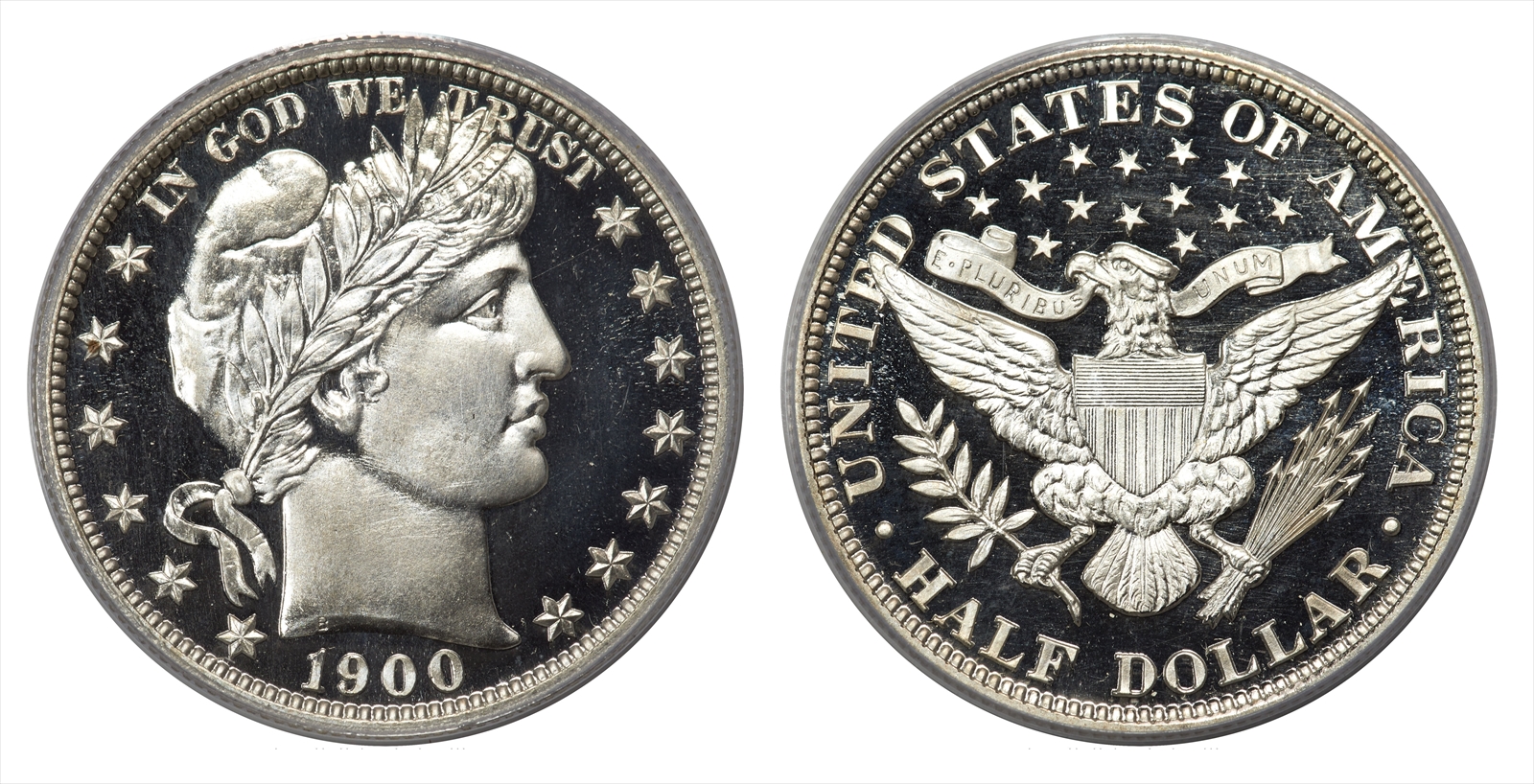
Top pop, CAC. HA Lot 4478 (5/24). As one of just two Deep Cameo examples certified by PCGS as PR68 with none numerically finer (3/24), this 1900 half dollar has to rank as one of the most desirable proofs of its issue. No numeric grade is needed, however, to tell the viewer that the coin in his or her hand is special. Intense contrast between glassy silver-black mirrors and sharply defined, thickly frosted devices tells the entire story. A tiny die-polished hollow is noted under Liberty's ear, as usual for the issue, but the preservation is impressive and spotting is minimal. Superb visual appeal. The top-grade Deep Cameo population for this issue has not increased in more than a decade, firmly establishing the current coin's conditional rarity. Ex: Central States Signature (Heritage, 4/2011), lot 5203. From The Palm Beach Gardens Collection.

Top pop; 179/0 in PR69DCAM. Velvety smooth, untoned surfaces immediately draw the viewer's attention.
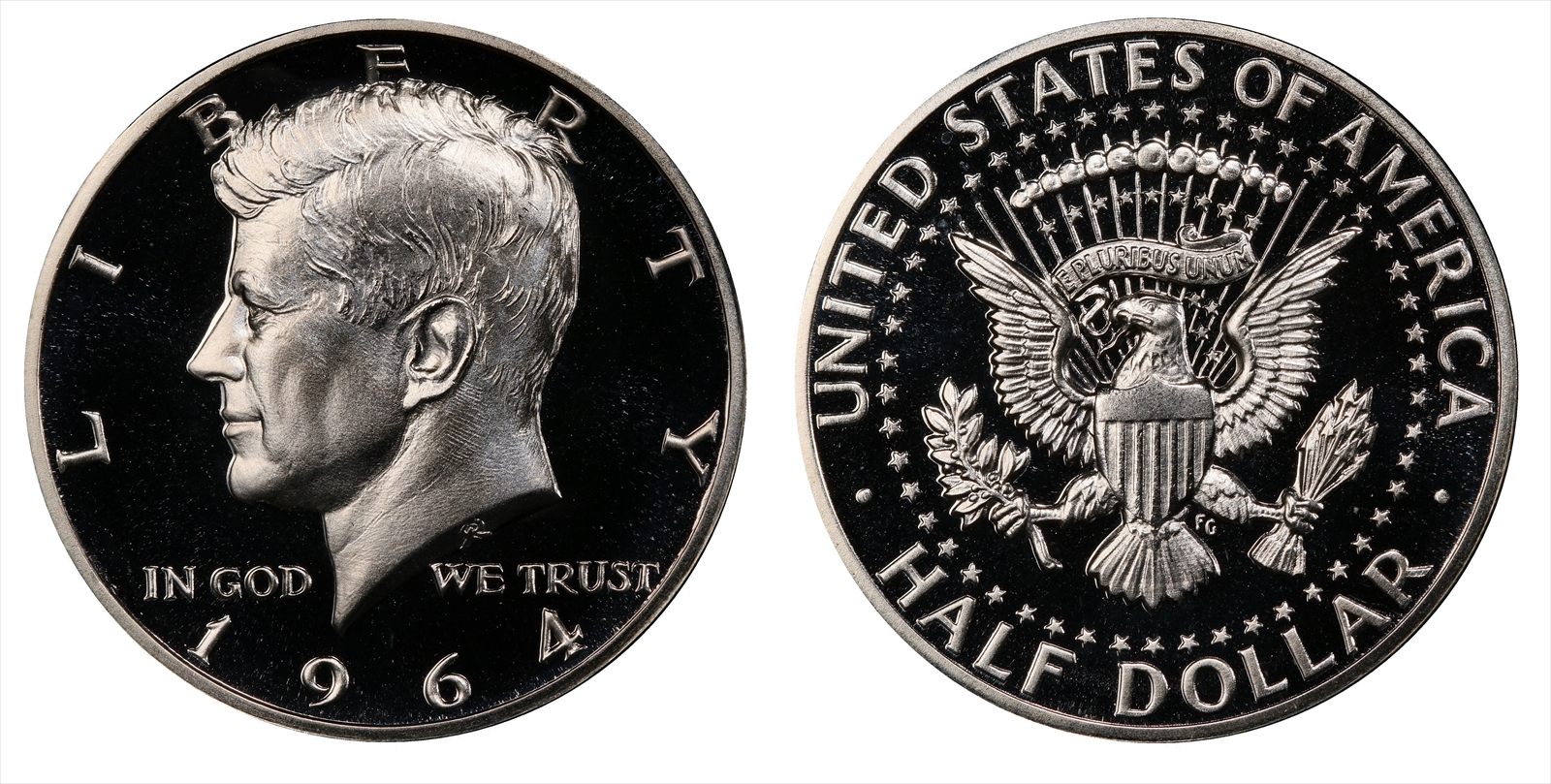
GC $43,312.50 (12/22) - 1964 50C Accented Hair, FS-401, PR69 Deep Cameo PCGS. Extra detailing appears in Kennedy's hair on this variety, and a broken left foot on the I in LIBERTY confirms the attribution. This condition rarity is tied for the finest known example of the variety (1/25). Brilliant, liquidlike mirrors complement frosty devices and a sharp strike, with overall outstanding visual appeal. The PR69 grade means virtually flawless preservation, and the Deep Cameo designation denotes virtually flawless production quality. We last handled an Accented Hair piece in this grade in our January 2024 Signature, which realized $46,800. Population: 6 in 69 Deep Cameo, 0 finer (1/25).
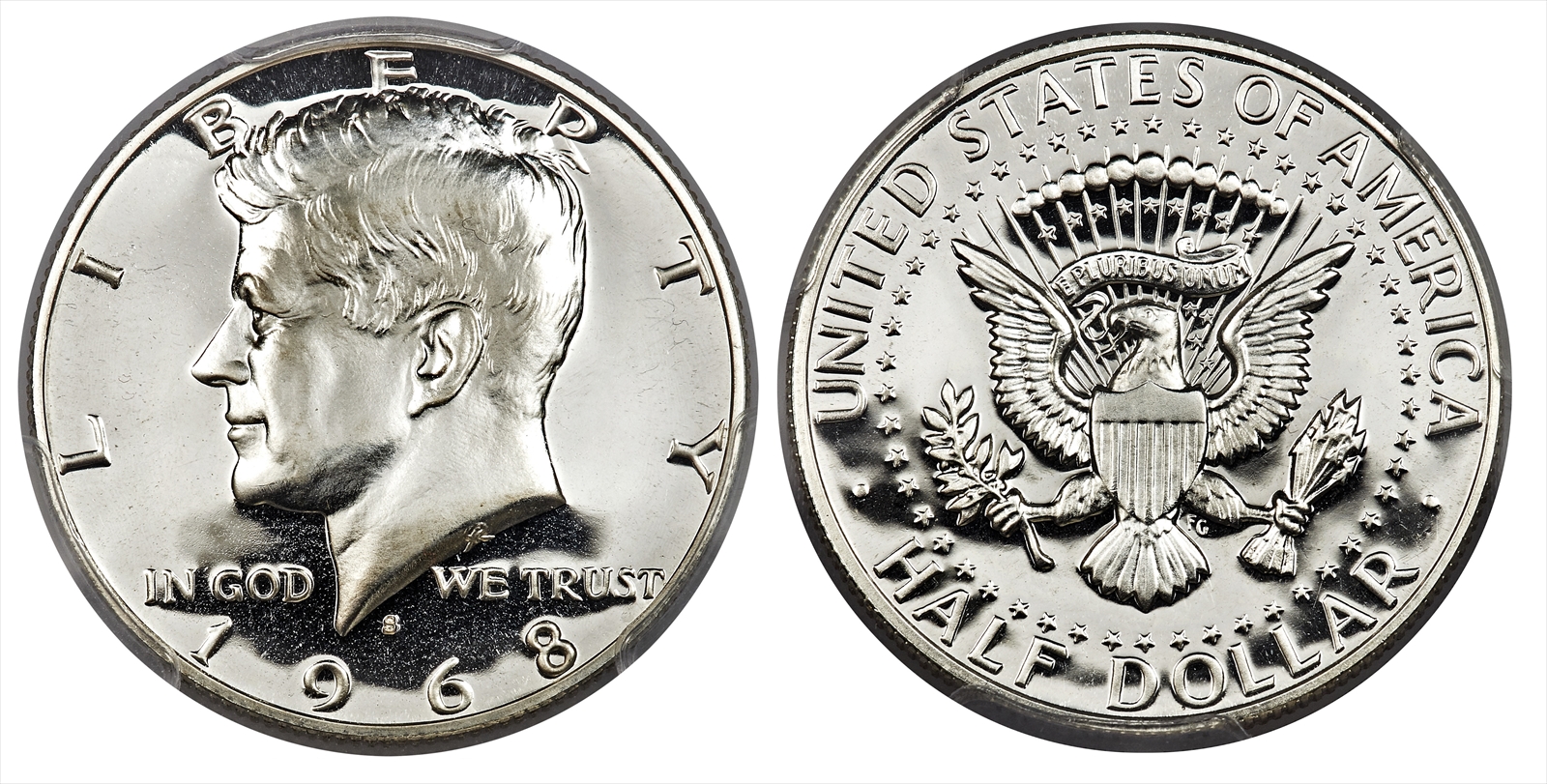
1968-S 50C PR70 Deep Cameo PCGS. The 1968-S proof Kennedy half dollar is a great rarity in PR70 Deep Cameo. PCGS lists only 16 coins so fine, and none are comparable at NGC (9/17). This piece is fully struck and brilliant with stark white-on-black contrast. The surfaces are perfect. Registry Set collectors should give this coin close consideration as the finest obtainable. Heritage (11/17)
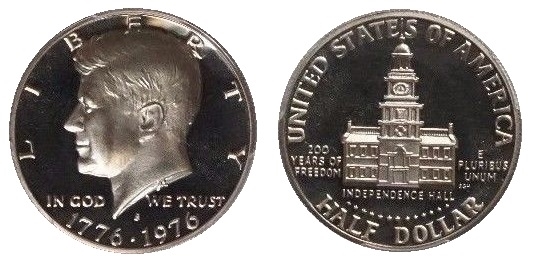
A perfect modern strike with no imperfections even at 5x magnification. Valued for its pristine aesthetic and long-term liquidity.

A perfect modern strike with no imperfections even at 5x magnification. Valued for its pristine aesthetic and long-term liquidity.


Ex-Newman, part of his 1978 date set, Heritage (1/18). Easily the equal of the other silver pieces in this set both visually and technically.
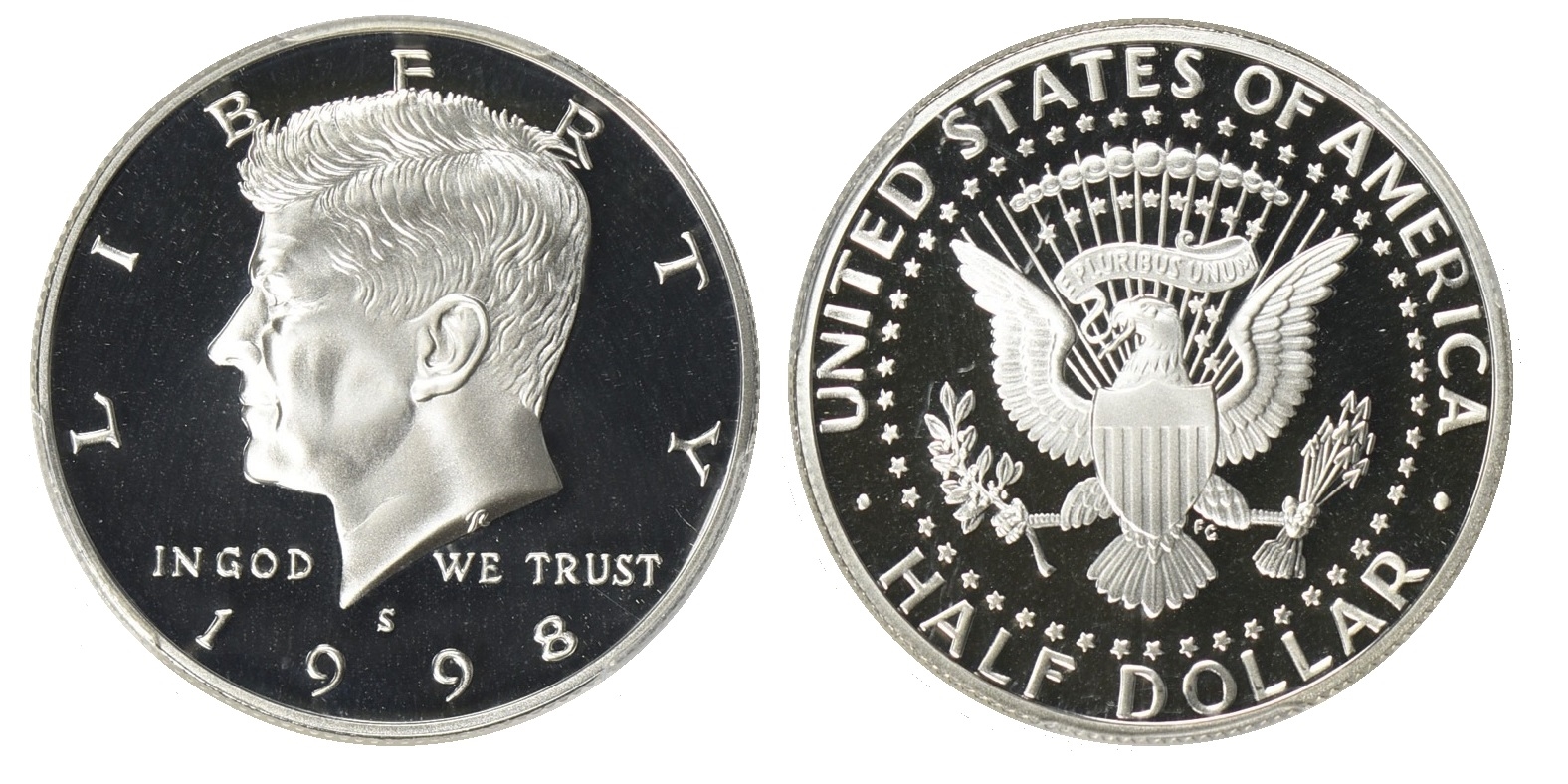
A perfect modern strike with no imperfections even at 5x magnification. Valued for its pristine aesthetic and long-term liquidity.

1881 Trade Dollar, PR67 Deep Cameo PCGS. Ex: Simpson. Beautifully Toned, Tied for Finest at PCGS. The 1881 Trade dollar was only struck in proof format, to the extent of 960 pieces. This is a well-made issue, often showing sharp strikes and strong contrast, and therefore it is popular as a type coin. Nonetheless, the date is conditionally rare in grades finer than the Gem level, and Superb Gems are almost never seen, regardless of the degree of cameo contrast. Eye appeal abounds, with stark contrast on each side warmed by golden interior toning. Vivid violet and blue border hues add to the appeal. Population: 2 in 67 Deep Cameo, 0 finer (11/25). Ex: US Coins Signature (Heritage, 2/2021), lot 3073.(Registry values: N7079).

CAC. Ex-Paul Taylor. Two PR68 DCAMs are higher. Won it over Perfection (who went on to collect both of the two 1900 PR68's). Reholdered 27 Jul 22; previous cert 90033899. Following even-handed assessment of the coin is provided by the dealer: "WOW. WOW. WOW! What an icy ULTRA BLACK AND WHITE SUPERB GEM! It borders full PR68 DCAM quality! Exceedingly deep mirrors beam with sun-like intensity all over. The mirrors are perfectly clear, have NO marks, and are so highly reflective you need sun glasses when you look at them. The contrast is out of this world! If you twirl this coin your mind will blow up. There is a hint of pale auburn around the reverse rims. Miss and the details are needle sharp in strike and thick silver white frost. The eye appeal can’t be any more stunning! PCGS 3, NGC 2, CAC 1. The last time this coin sold in auction it brought $41,125 in December 2017. The owner changed directions, but came really close to NOT letting it go. You can NOT buy coins looking this ULTRA black and white in a PCGS holder any more. The demand for Proof Morgans unquestionably has grown since this coin last sold. We assure you, this coin is NOT overpriced. Main point-good luck finding real DCameo of ANY date! For us, this coin was love at first and every sight. It is the real deal. NOTE: there is a tiny scuff on the holder on the obverse. Cert. Number 90033899 PCGS # 97335"
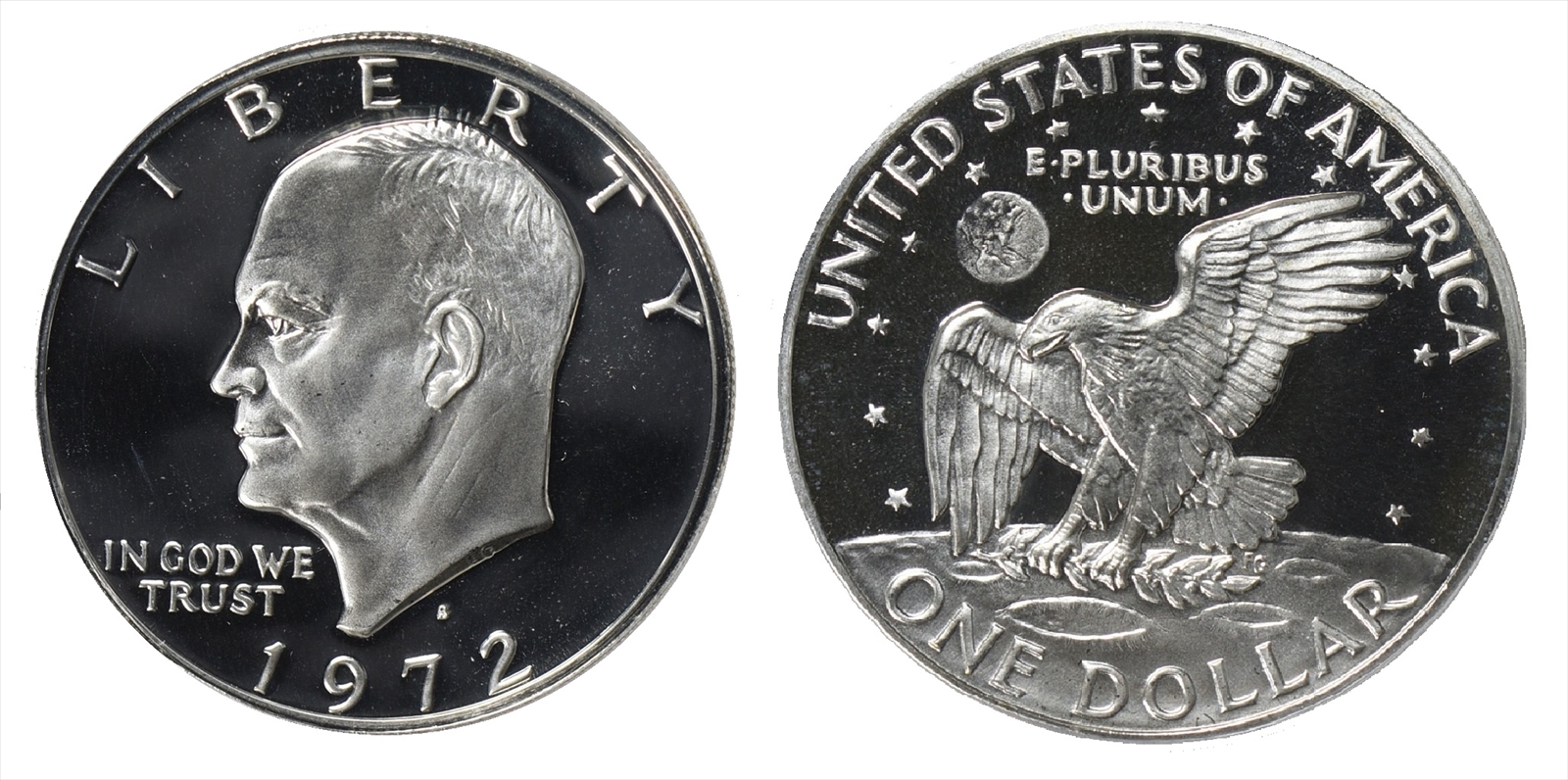
Pop 972/0 is true but not the whole story. There were coins 33,707 struck in Silver PR69 DCAM, which makes the PR70 DCAM less than 3% as common and so much harder to find.


All three types, Clad types 1 and 2 and the Silver type, are plentiful up to PR69DCAM, but become relatively rare in PR70 DCAM. To illustrate, the census identifies 20,511 coins in PR69DCAM, but only 45 in PR70DCAM.

1976-S $1 Clad, Type Two, PR70 Deep Cameo PCGS. A technically perfect specimen of the popular Type Two issue, with slender letters in the reverse legend. This coin exhibits razor-sharp design elements and deeply reflective fields that contrast profoundly with the frosty devices. Population: 25 in 70 Deep Cameo (8/17).(Registry values: N1793)

The 1976-S is a one-year type coin, and can be identified quickly by its distinct silver edge rather than a copper-nickel clad layer. This example is a perfect PR70DCAM Silver.

The flagship coin in the year set is technically flawless and visually captivating. The obverse is brilliant, while a faint trace of golden color appears on the reverse. Also my graduation year from West Point.

A perfect modern strike with no imperfections even at 5x magnification. Valued for its pristine aesthetic and long-term liquidity.

A perfect modern strike with no imperfections even at 5x magnification. Valued for its pristine aesthetic and long-term liquidity.

A perfect modern strike with no imperfections even at 5x magnification. Valued for its pristine aesthetic and long-term liquidity.

A perfect coin. Bimetallic; top pop 682/0.

Bullion coin for modern gold sets. Value tracks the bullion price.

This coin is a normal, "perfect", issue. Normal examples of the 2007-W platinum coins show the word FREEDOM (on the reverse) as polished, brilliant letters in contrast with the frosted, unpolished ribbon. In February 2011, a collector, Jason Fishman, reported finding an example of the $100 denomination with frosted, unpolished letters.
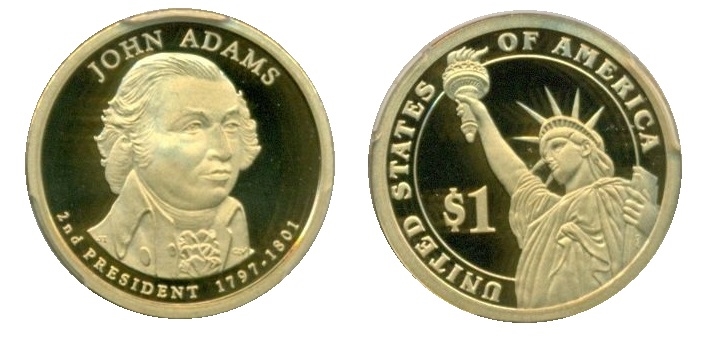
A perfect modern strike with no imperfections even at 5x magnification. Valued for its pristine aesthetic and long-term liquidity.

Dolley Madison is a great representative for the First Ladies Series. Beyond being a perfect strike, she epitomizes intelligence and charm in ways that contribute to the diplomatic mission.

A perfect modern strike with no imperfections even at 5x magnification. Valued for its pristine aesthetic and long-term liquidity.
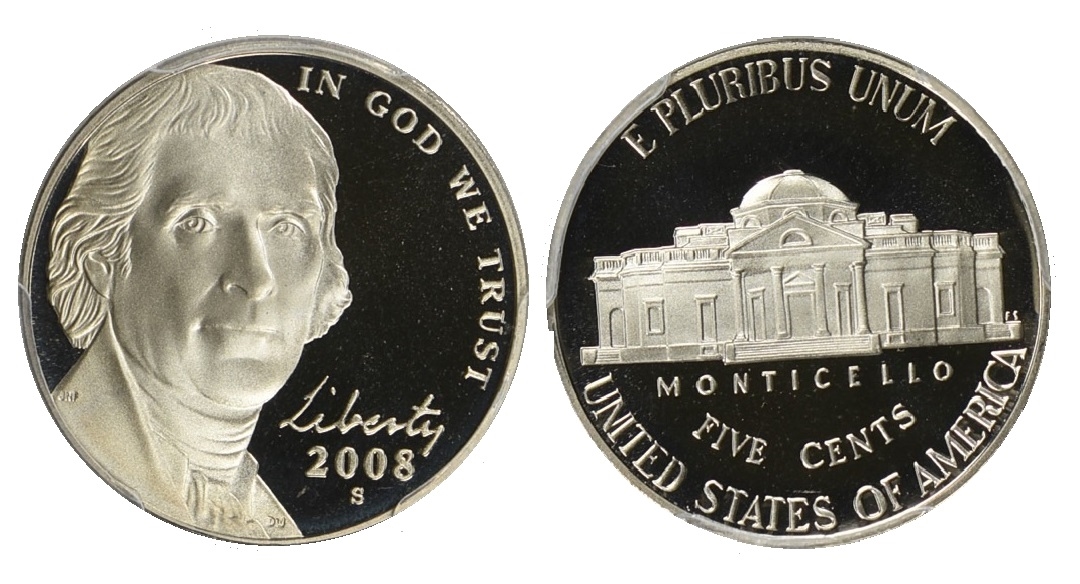
A perfect modern strike with no imperfections even at 5x magnification. Valued for its pristine aesthetic and long-term liquidity.

A perfect modern strike with no imperfections even at 5x magnification. Valued for its pristine aesthetic and long-term liquidity.

Beautiful white mirrors with fantastic eye appeal. Mintage of only 950 coins in proof. CAC approved for quality and eye appeal.

A perfect modern strike with no imperfections even at 5x magnification. Valued for its pristine aesthetic and long-term liquidity.

A perfect modern strike with no imperfections even at 5x magnification. Valued for its pristine aesthetic and long-term liquidity.

A perfect modern strike with no imperfections even at 5x magnification. Valued for its pristine aesthetic and long-term liquidity.

A perfect modern strike with no imperfections even at 5x magnification. Valued for its pristine aesthetic and long-term liquidity.

A perfect modern strike with no imperfections even at 5x magnification. Valued for its pristine aesthetic and long-term liquidity.

A perfect modern strike with no imperfections even at 5x magnification. A terrific job of artwork. Valued for its pristine aesthetic and long-term liquidity.

Satin finish coins were not released directly into circulation, but were sold in mint sets only. All Satin finish coins were struck on special sandblasted planchets, under higher pressure than circulation strike coins. Only 27K collector versions were struck.

2009 MMIX Ultra High Relief $20 Gold PCGS MS-70 PL. A top-pop, high-relief, proof-like, bullion coin that reprises the high relief coin of 1907.

The Medal of Honor is considered to be the highest personal decoration among military personnel. The 2011-W Medal of Honor coin was struck at the West Point Mint to commemorate the Medal of Honor Medal itself (not the coin), which has been awarded to fewer than 3,500 individuals since its inception in 1861.

A perfect modern strike with no imperfections even at 5x magnification. Valued for its pristine aesthetic and long-term liquidity.

A perfect modern strike with no imperfections even at 5x magnification. Valued for its pristine aesthetic and long-term liquidity.

A perfect modern strike with no imperfections even at 5x magnification. Valued for its pristine aesthetic and long-term liquidity.

A perfect modern strike with no imperfections even at 5x magnification. Valued for its pristine aesthetic and long-term liquidity.

A perfect modern strike with no imperfections even at 5x magnification. Valued for its pristine aesthetic and long-term liquidity.
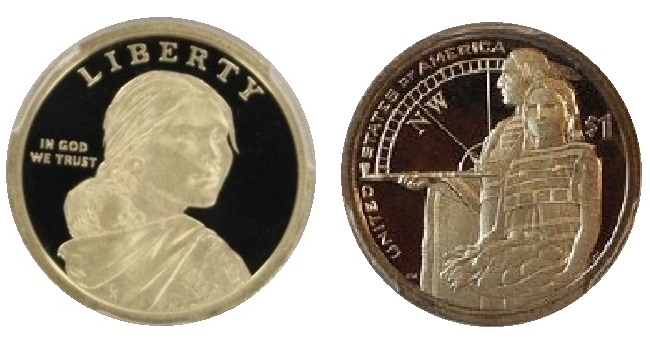
Beautiful white mirrors with fantastic eye appeal. Mintage of only 950 coins in proof. CAC approved for quality and eye appeal.

6951 of 10,189 (68%) of the entire population are graded perfect DCAM.

A perfect modern strike with no imperfections even at 5x magnification. Valued for its pristine aesthetic and long-term liquidity.

Comparatively rare in PL (145/11,393 as of 2026).

Recent market range for the coin has been from $759 to $995, though special labels, early releases, specific signer labels, or ultra-low populations can push values to $1,400 to $9,800.

With 49,039 coins in 70 and 6372 in 69, 87% of the population is perfect.

Jaime Hernandez: The 2016-W Standing Liberty Gold Quarter originally went on sale on September 8, 2016. The original issue price of the 2016-W Standing Liberty Quarter when purchased directly from the U.S. Mint was set at $485 each. Its maximum authorized mintage was set at 125,000 coins. Each coin contains one-fourth ounce of pure 24 karat gold. The coins have a reeded edge with a beautiful Standing Liberty design. From September 8 to September 20, the ordering limit was set at one coin per household. The coins were well received by collectors, dealers and the public. In the secondary market, there were a few dealers trying to buy them in large quantities, even offering premiums ranging from about $50 - $100 over the U.S. Mint issue price per coin. However, on September 21, the U.S. Mint threw a curve ball when it raised the household ordering limit from one coin per household to an unlimited ordering limit per household. This was an unanticipated move for many collectors, speculators and dealers, as it affected prices of the coins. By September 28, the U.S. Mint had already sold a little over 75,000 coins, from the maximum authorized mintage of 100,000. In other words, approximately three-fourths of the coins have been sold so far. In 2016 the U.S. Mint introduced three different 2016 Centennial Gold coins to celebrate the 100th Anniversary of the Mercury Silver Dime, Standing Liberty Silver Quarter and Walking Liberty Silver Half Dollars. The U.S. Mint already offered the Gold Mercury Dimes and the Gold Standing Liberty Quarter earlier in the year and offered the Gold Walking Liberty Half Dollars later in the year. All three coin designs were originally introduced in 1916, but were composed of 90% silver as opposed to 24 karat pure gold.

The 2017-W Gold $100 American Liberty High Relief 225th Anniversary is one of the most historically significant modern U.S. Mint gold issues, and a PCGS Proof-70 DCAM First Day of Issue example represents the highest grade with a coveted release designation. Why this coin matters: -- It is the first modern Liberty portrait of an African American woman. The coin marked a major departure from traditional Liberty depictions. The obverse by Justin Kunz portrays Liberty as an African American woman wearing a crown of stars, intended to represent the diversity of modern America. The design generated significant discussion both inside and outside the numismatic community. -- it celebrates the U.S. Mint's 225th anniversary. The coin was issued in 2017 to commemorate the founding of the United States Mint in 1792. The edge carries the inscription "225th ANNIVERSARY", a feature unique to this issue. -- It is the first proof high-relief coin struck by the U.S. Mint. The Mint describes it as its first high-relief coin with a proof finish. The dramatic sculpting gives the portrait and eagle exceptional depth and visual impact. -- It is an award-winning design. The coin received international recognition, winning Best Gold Coin in the 2019 Coin of the Year Awards.
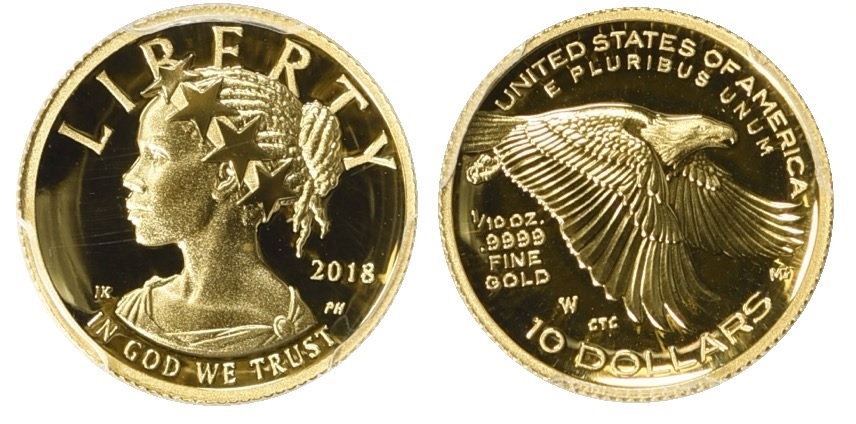
One of the high relief gold coins now being collected/marketed in a modern series. Grade is not an issue. It will be interesting to see if/how these evolve into a coherent series.

Ordered from Mint and then sent for grading. Pop 5,879/0.

The first United States patent was signed by President George Washington. Issued on July 31, 1790, it was awarded to Samuel Hopkins for a new, highly efficient process for making potash (a key ingredient in fertilizer, soap, and glassmaking). Because the U.S. patent system was brand new, the document was also personally signed by two other members of the first Patent Board: Secretary of State Thomas Jefferson, and Attorney General Edmund Randolph. For historical context, before the United States established this federal process, the very first patent in North America was granted in 1641 by the Massachusetts General Court to Samuel Winslow for a salt-making process.
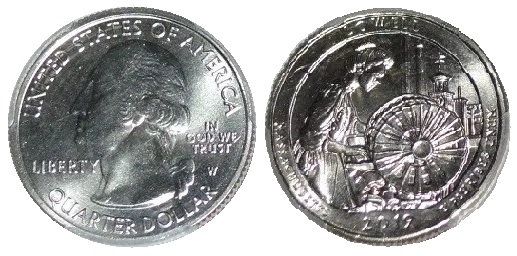
PCGS 2019 Quarter Quest 2019-Present: The U.S. Mint struck 2 million 2019 Lowell quarters at the West Point Mint, as part of an initiative to introduce collectible coins into circulation. This is the first time the U.S. Mint struck quarters that bare a "W" mint mark for circulation. With the "W" mint mark, pop is 131/5.
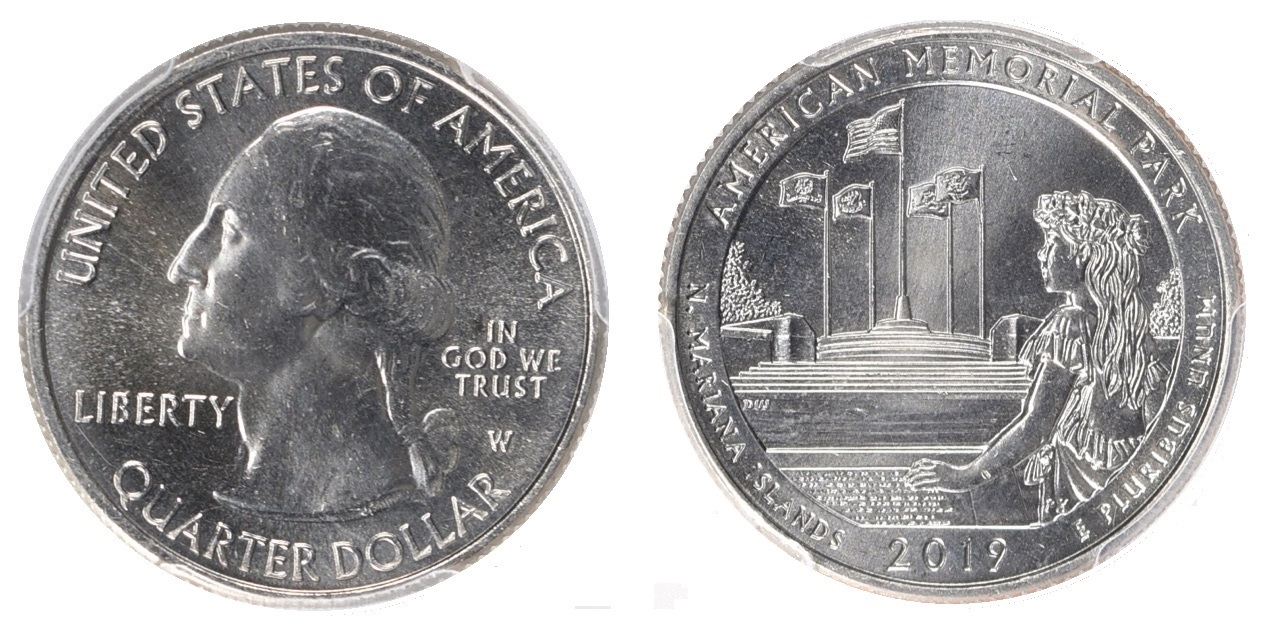
2019-W America the Beautiful Quarter American Memorial National Park PCGS First Week of Discovery PCGS MS-67. FWOD status is valuable in the West Point 2019 Quarter Quest.

The "First Week of Discovery" designation was a special promotional pedigree awarded by PCGS to the first batch of these quarters found in circulation and submitted for grading. The first submitted, then those submitted with one week, receive higher scores in the set registry than those submitted later. This is another instance where the score/value of the coin is at least partially determined by the holder and not just the coin.

The 2019-W First Week of Discovery quarter is a rare and desirable find. There was a lot of publicity about searching for these quarters as soon as released into circulation, mixed with Philadelphia and Denver strikes, and submitting them quickly for grading not just for the grade, but to beat other seekers in submitting "First", "First Week", or "Early". Those three category submissions were documented on the insert, and received extra points and recognition toward standing in the West Point Set". This is one of the (hopefully) rare instances where the slab is valued over the coin.

The Frank Church River of No Return National Park quarter was struck at the West Point Mint with a mintage of 2M. This is one of the four that tied as "First Discovery" coin.

A perfect modern strike with no imperfections even at 5x magnification. Valued for its pristine aesthetic and long-term liquidity.
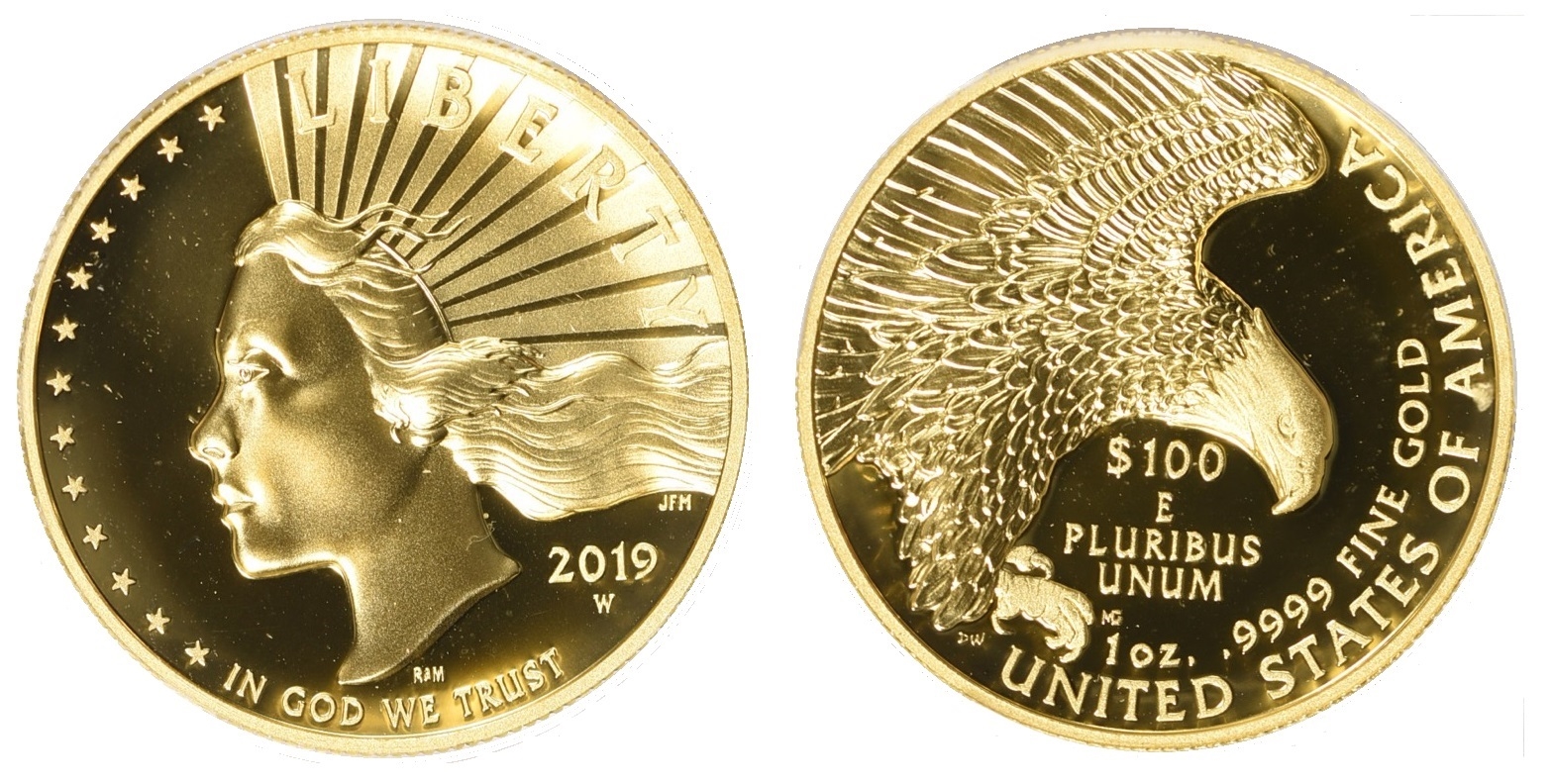
This 2019-W $100 American High Relief Gold Coin is graded SP70 DMPL at PCGS. This version features an enhanced uncirculated finish with DMPL designation. It was struck with an initial limit of 50,000, but with an actual final mintage of 24,609.

A perfect modern strike with no imperfections even at 5x magnification. Valued for its pristine aesthetic and long-term liquidity.

A perfect modern strike with no imperfections even at 5x magnification. Valued for its pristine aesthetic and long-term liquidity.
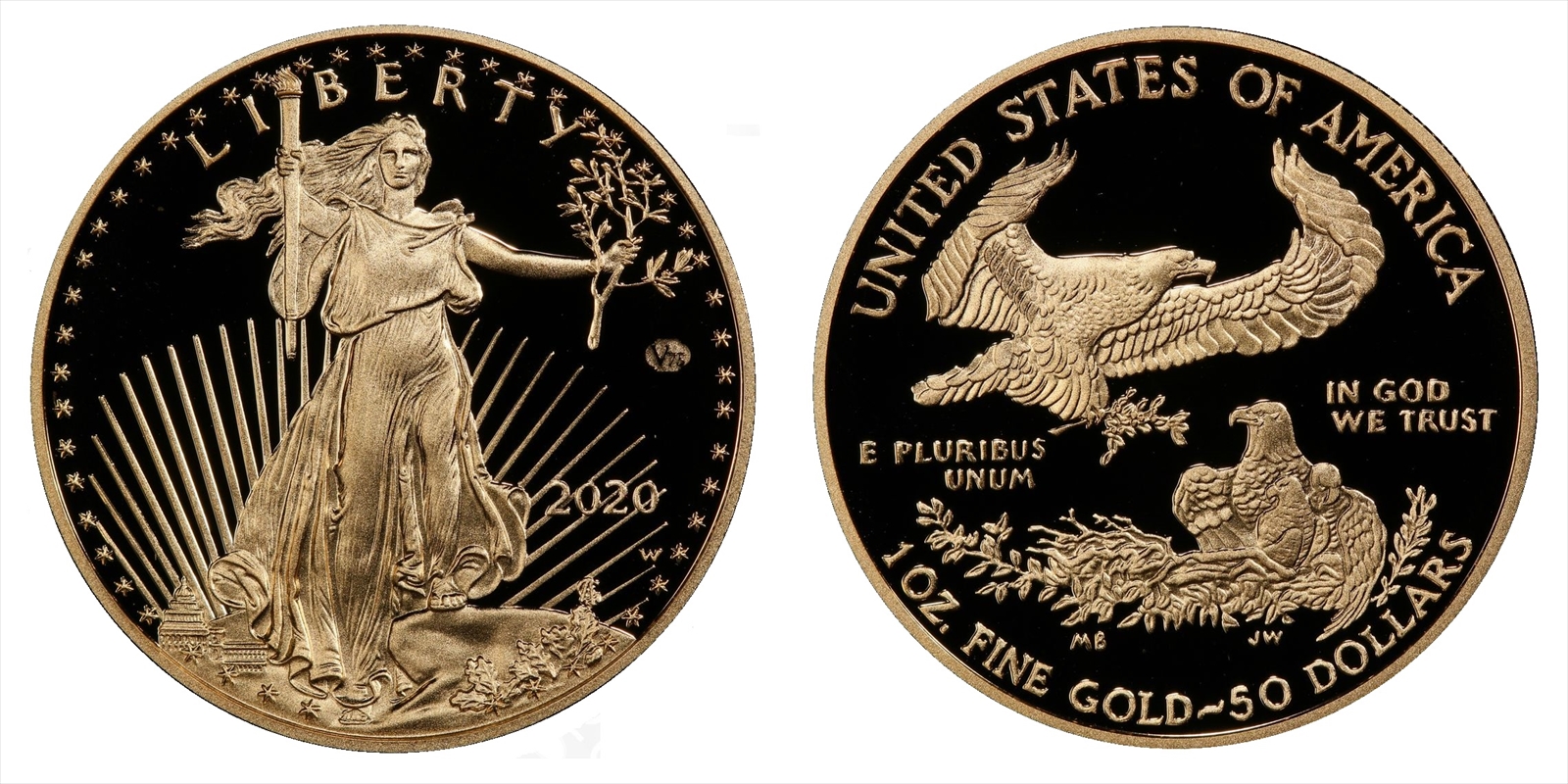
v75 Privy, 1 of 1945 struck on the 75th anniversary of the end of WW2. That truly was the greatest generation; I was honored to not just meet General of the Army Omar Bradley but was tasked to brief him (Congress passed an act to allow him to remain on active duty indefinitely, and he felt obligated to make unit visits regularly) as a 2LT at Ft Bliss in 1979 -- leadership thought he would get a kick out of that, and he did. First Strike, PR70 DCAM.
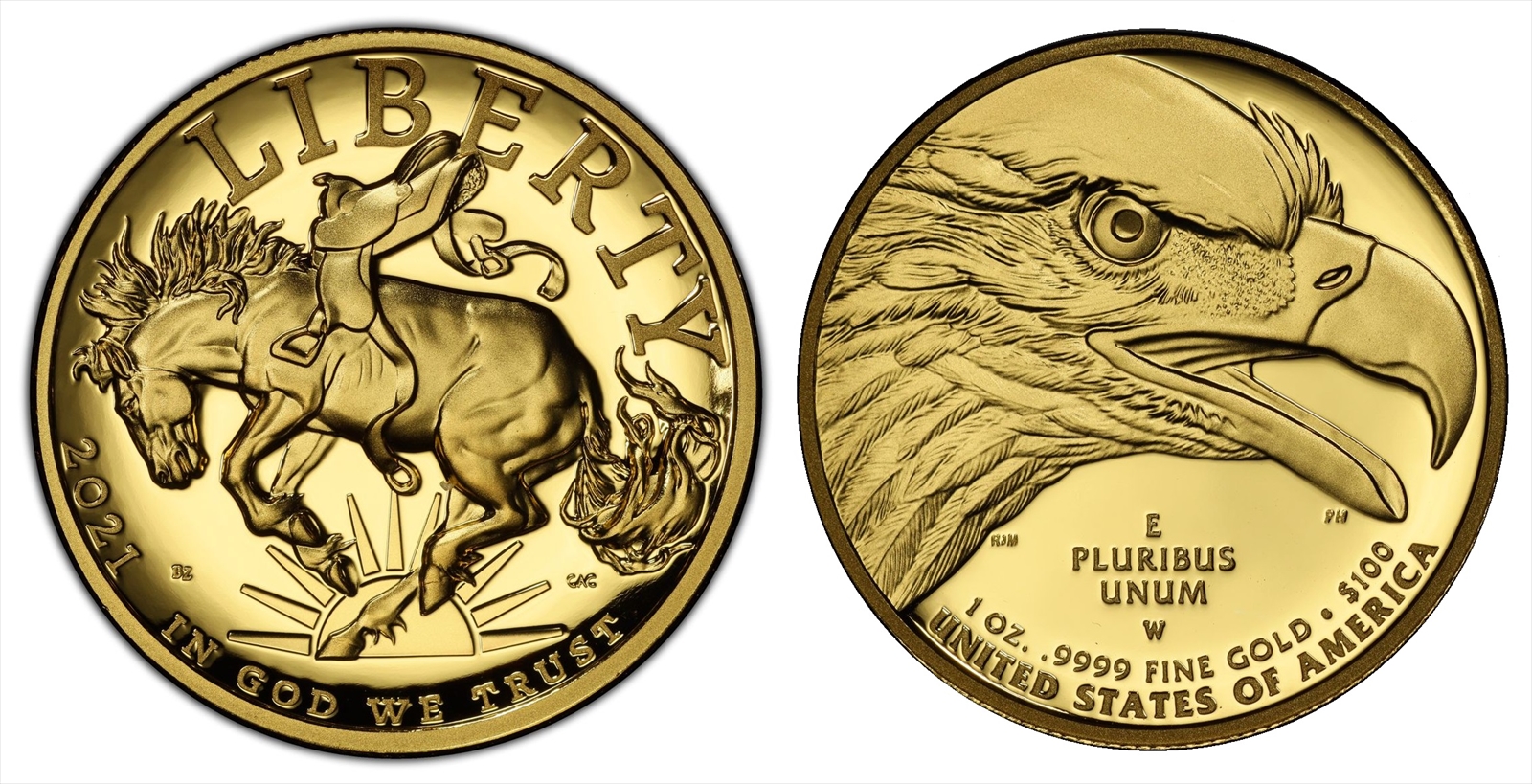
This coin was purchased directly from the U.S. Mint during the August 2021 release and submitted to PCGS within the First Strike eligibility window. It has become one of the most sought-after modern U.S. Mint gold issues because of the low mintage (limited to 12,500 pieces), and for its controversial and highly regarded Mustang Liberty design. Many collectors appear to hold rather than sell these, reducing market availability and increasing its desirability. In the 5 years since initial issue, market price has tripled.


A perfect modern strike with no imperfections even at 5x magnification. Valued for its pristine aesthetic and long-term liquidity.

Due to modern, high quality minting processes, these coins are widely available in the highest condition, as you can see in this specimen.

A perfect modern strike with no imperfections even at 5x magnification. Valued for its pristine aesthetic and long-term liquidity.

A perfect modern strike with no imperfections even at 5x magnification. Valued for its pristine aesthetic and long-term liquidity.

Not many people can collect coins of their Alma Mater. I spent 4 years as a cadet and 20 years as faculty at West Point. I paraded endless times on the pictured parade field, quartered for my senior (Firstie) year in the first floor/third room from the left (as shown on the coin) with Jeff Benchich, and field/road marched countless times past the West Point Mint at the bottom of the ski slope (near the hills on the right). My younger son was born in the West Point hospital (Keller Army Hospital), both attended on-post and local schools (and both graduated from MIT), and my wife died at West Point and is buried in the West Point Cemetery, about a mile from the mint, saving me a spot.

A perfect modern strike with no imperfections even at 5x magnification. Valued for its pristine aesthetic and long-term liquidity.

The 2023-W $100 American Liberty High Relief gold coin graded PCGS PR70 DCAM First Day of Issue contains 1 oz of .9999 fine gold, features a bristlecone pine and a young bald eagle, has a low mintage of 12,500, and currently trades for roughly $8,600 to $10,400.
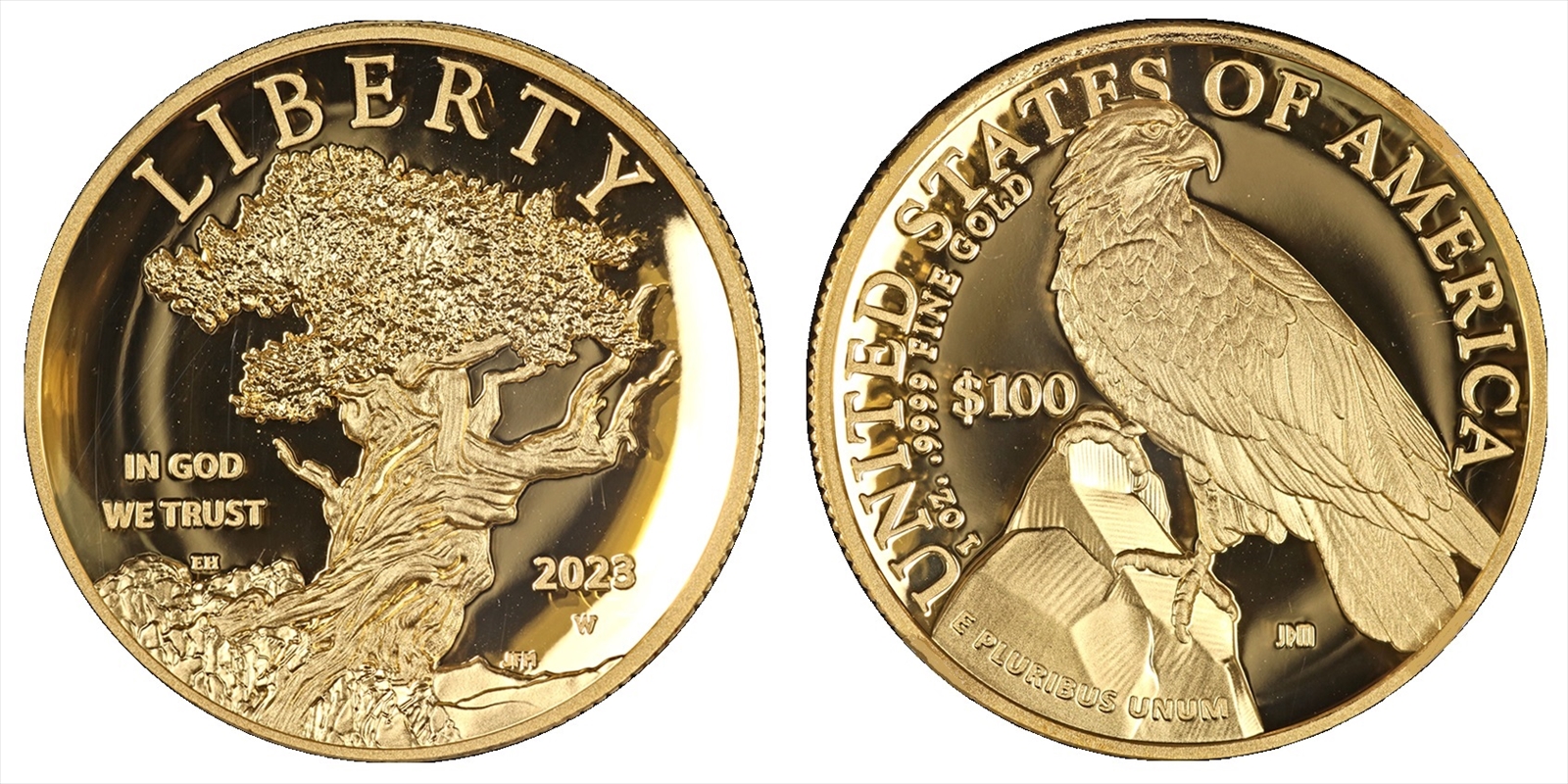
The 2023-W $100 American Liberty High Relief gold coin graded PCGS PR70 DCAM First Day of Issue contains 1 oz of .9999 fine gold, features a bristlecone pine and a young bald eagle, has a low mintage of 12,500, and currently trades for roughly $8,600 to $10,400.

The 2025-W $100 American Liberty gold coin features a sunflower and bee motif, struck at the West Point Mint with a limited mintage of 1966, of which nearly 90% are PR70 DCAM.

The 2025-W $100 American Liberty gold coin features a sunflower and bee motif, struck at the West Point Mint with a limited mintage of 1966, of which nearly 90% are PR70 DCAM.