



Wayne's Morgans Coin Album
Flashy olive and golden toned obverse and reverse of this CAC graded Morgan dollar.
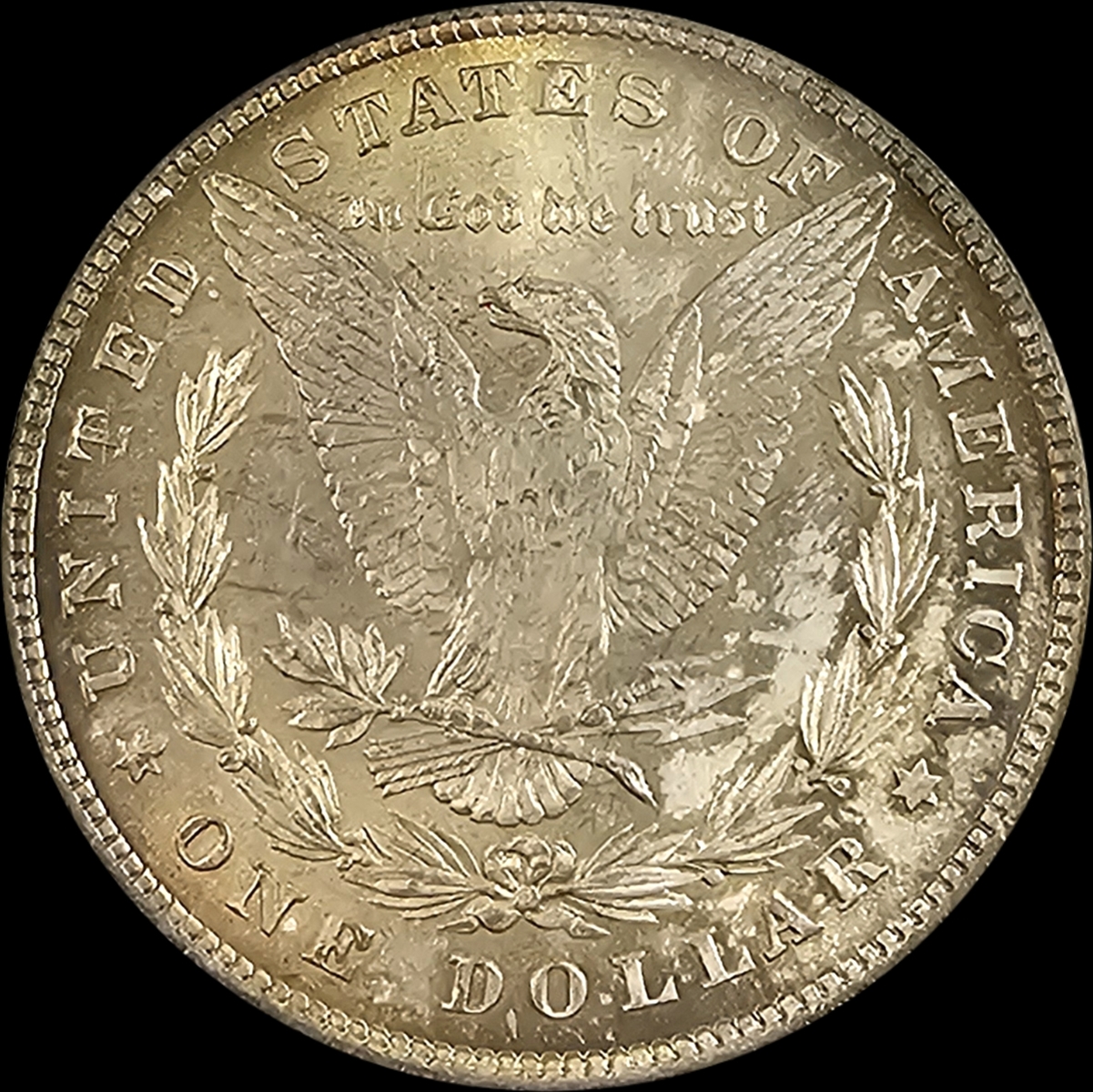
Flashy olive and golden toned obverse and reverse of this CAC graded Morgan dollar.
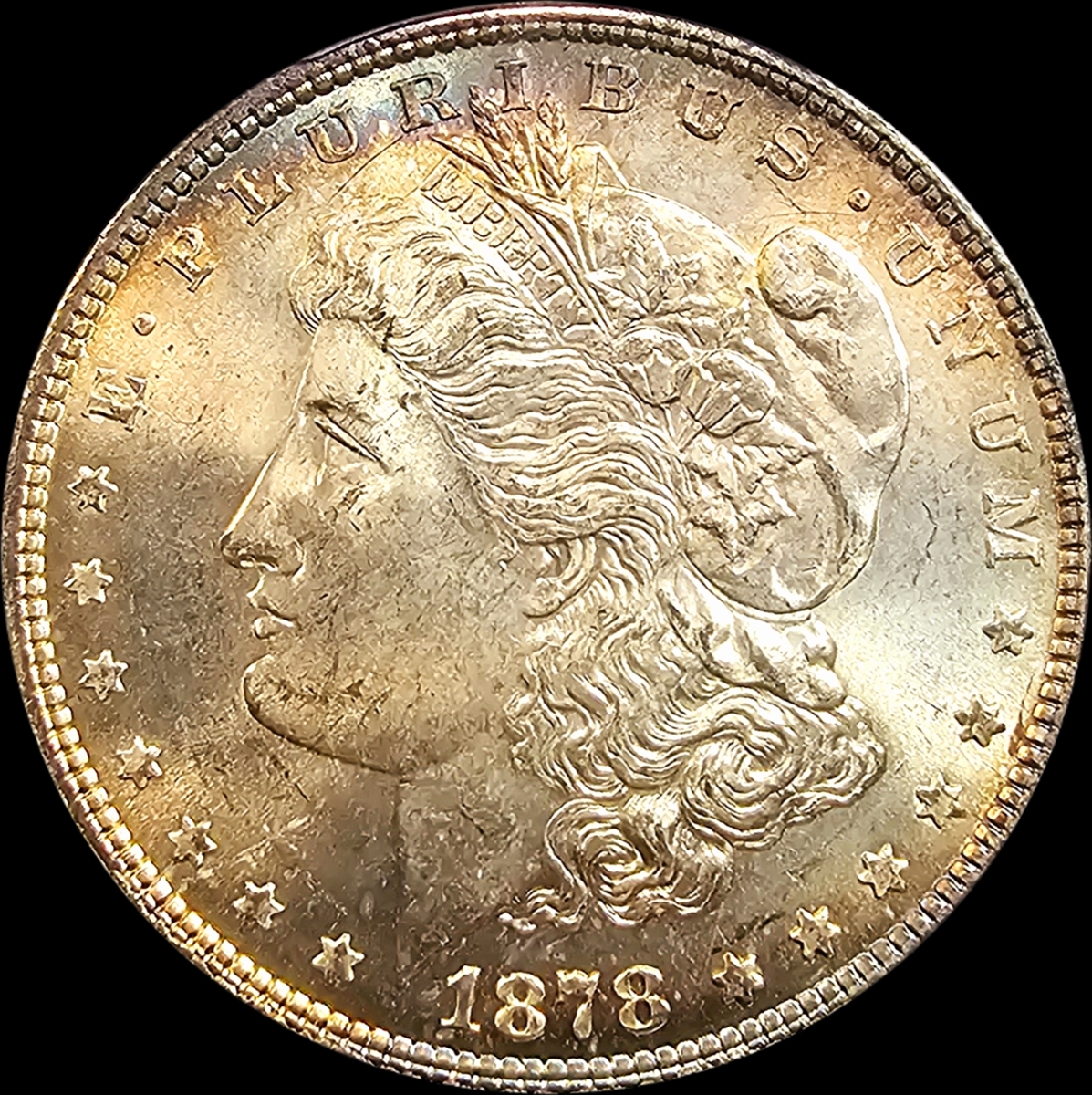
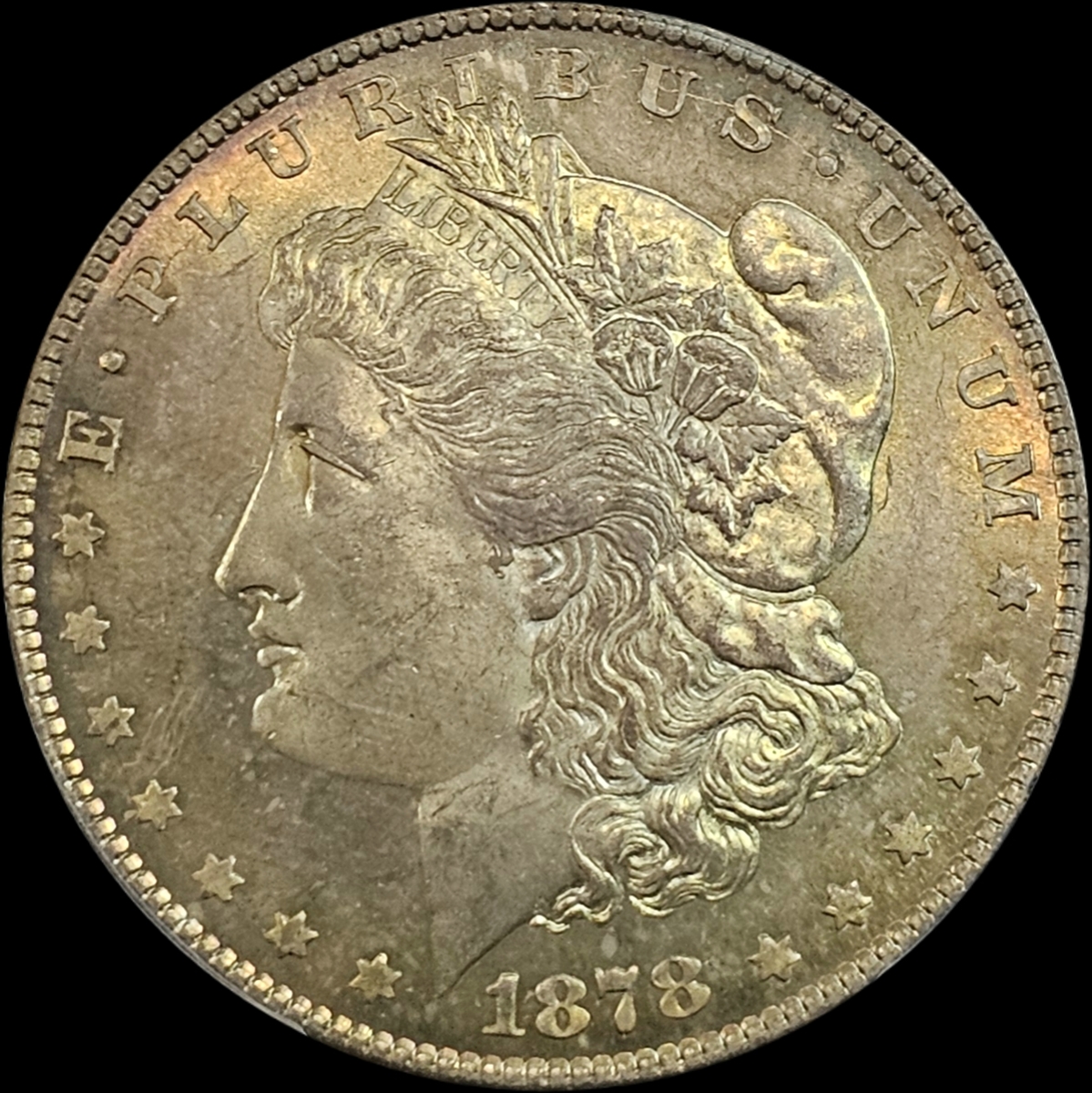
Formerly in ANACS holder, this 1878 7 tail feathers dollar possesses elegant periphery toning in steel-blue and reddish-apricot which yields to lighter golden and silver in the center of the obverse. The bolder reverse is richly patinated throughout in a blend of steel-olive, reddish-gold, powder blue and salmon-pink. Crisply impressed, fully lustrous and exceptionally vivid near-gem Mint State preservation is found in this example of the desirable final design of 1878, the first year of Morgan dollar coinage.
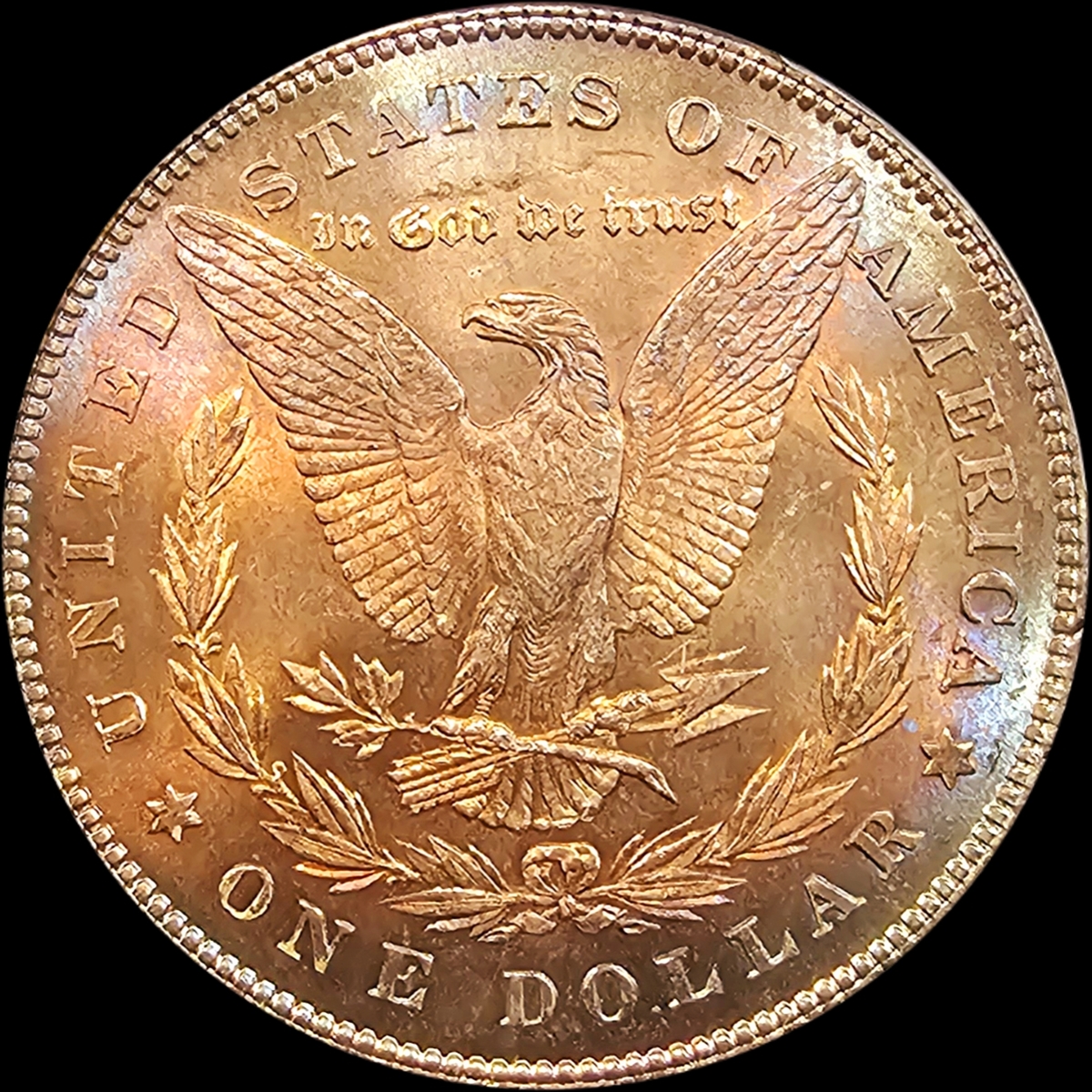
Formerly in ANACS holder, this 1878 7 tail feathers dollar possesses elegant periphery toning in steel-blue and reddish-apricot which yields to lighter golden and silver in the center of the obverse. The bolder reverse is richly patinated throughout in a blend of steel-olive, reddish-gold, powder blue and salmon-pink. Crisply impressed, fully lustrous and exceptionally vivid near-gem Mint State preservation is found in this example of the desirable final design of 1878, the first year of Morgan dollar coinage.
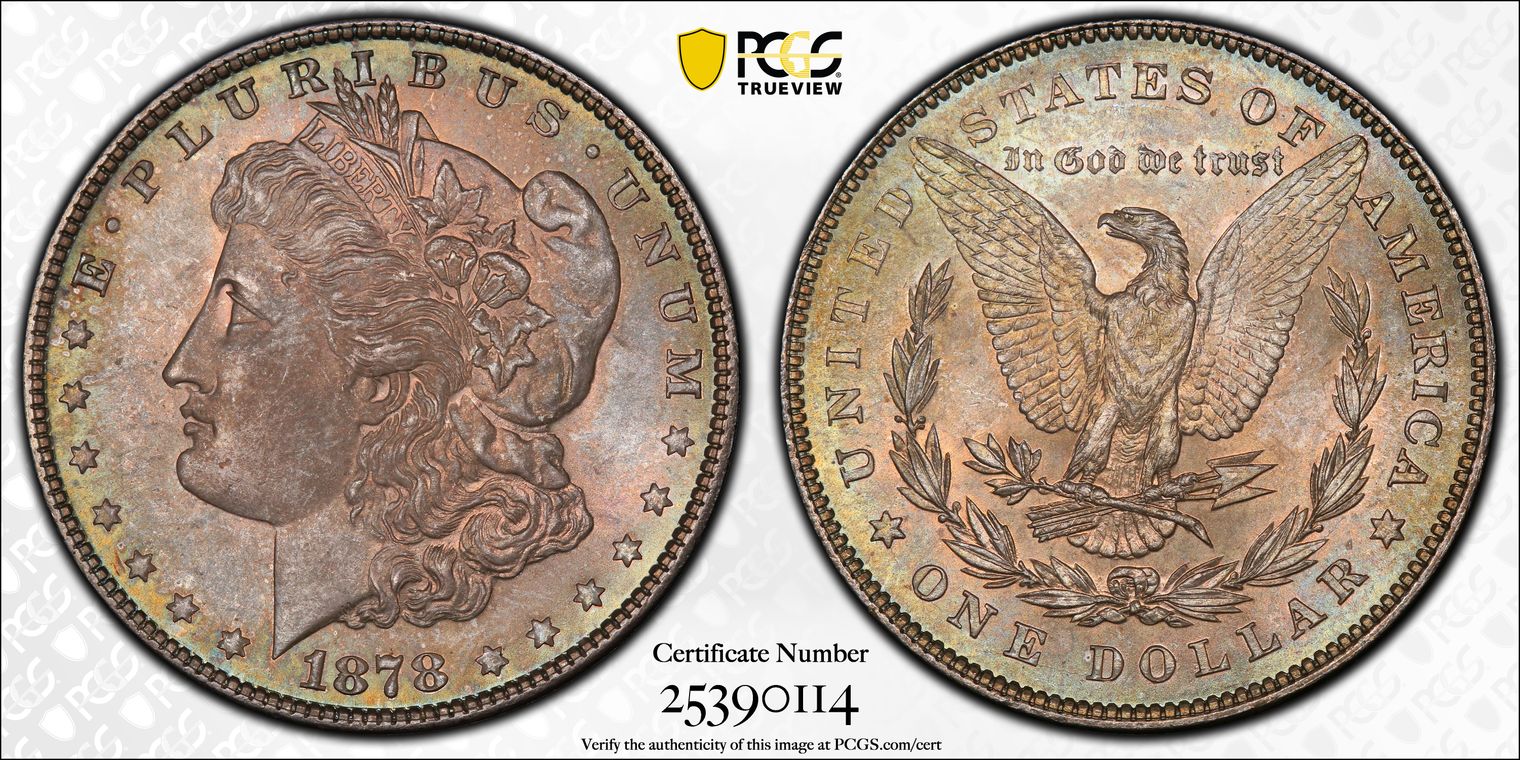
An exceptionally attractive near-Gem representative of the famous 7 Over 8 Tail Feathers variety, combining remarkable originality, softly glowing satiny-frosted luster, and beautifully matured antique toning. The obverse is enveloped in a harmonious blanket of warm dove-gray overlaid with rich cinnamon, chestnut, and pale rose patina. Delicate peripheral accents of olive-gold, cobalt, and lavender emerge near the borders, while the central portrait retains enough translucence to reveal the underlying frost. The color has developed evenly across the surface, producing an appearance of considerable maturity without sacrificing vibrancy or detail. The reverse offers a complementary presentation, displaying warm champagne-gray fields infused with subtle copper, pale blue, and soft amber iridescence. The peripheral toning delicately frames the eagle while preserving outstanding visibility of the celebrated 7-over-8 tail feather diagnostics. The overall appearance is remarkably cohesive, with every element contributing to an impression of complete originality. Strike quality is excellent. Liberty's hair is boldly rendered throughout, with strong definition in the forehead curls, cotton blossoms, and wheat leaves. The reverse eagle displays crisp feather detail extending through the wings and breast, while the wreath and lettering remain sharply impressed. Every major design element reflects the high production standards characteristic of early Philadelphia Morgan dollars. The luster is particularly appealing. Rather than exhibiting brilliant, icy flash, the surfaces display a rich satiny frost that glows beneath the natural patina with unusual depth. As the coin rotates beneath light, the cartwheel remains vibrant yet softened by the mature toning, producing a velvety visual texture that enhances rather than competes with the color. The result is a sophisticated, almost understated brilliance that rewards prolonged examination. CAC approved.
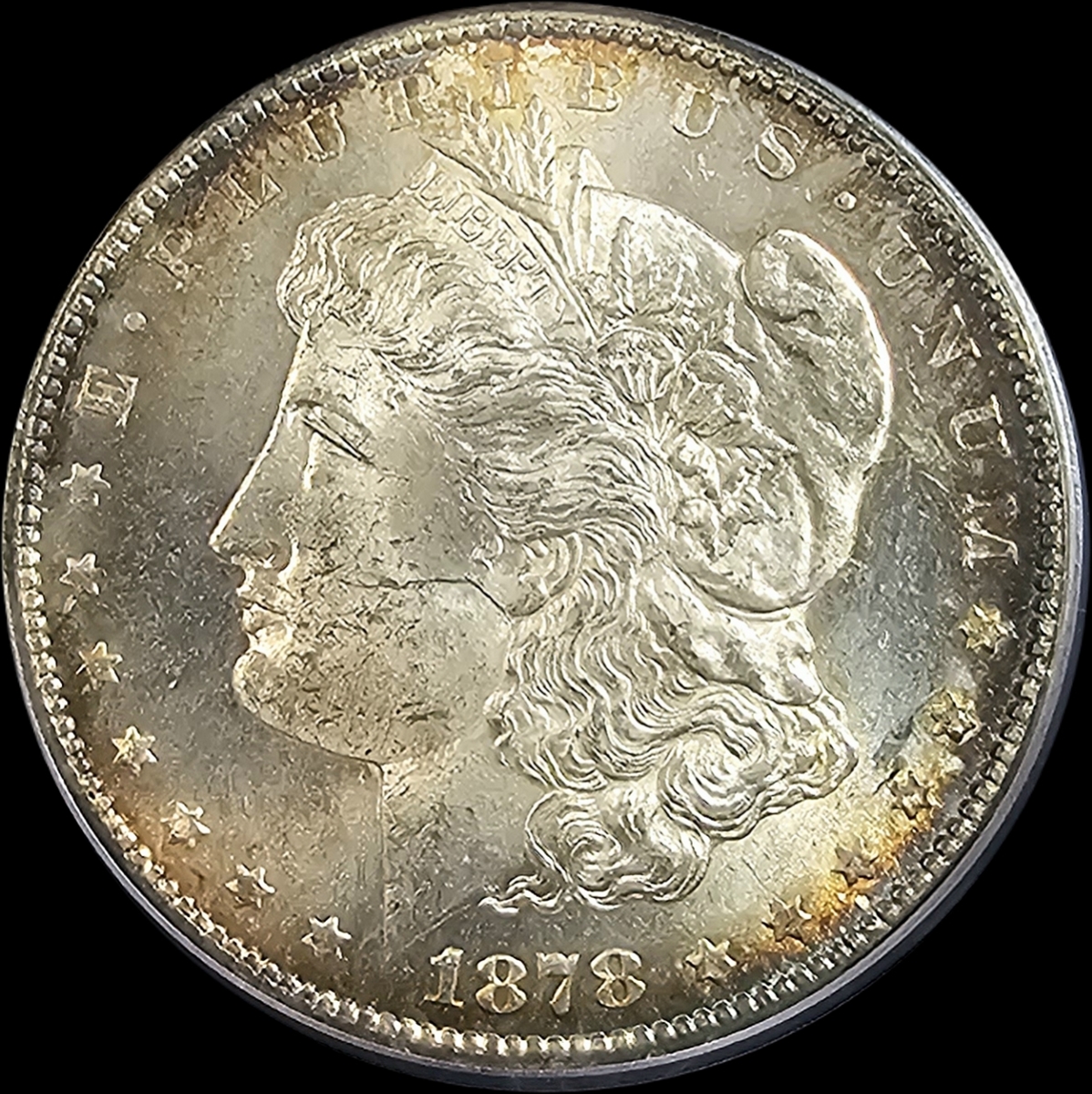
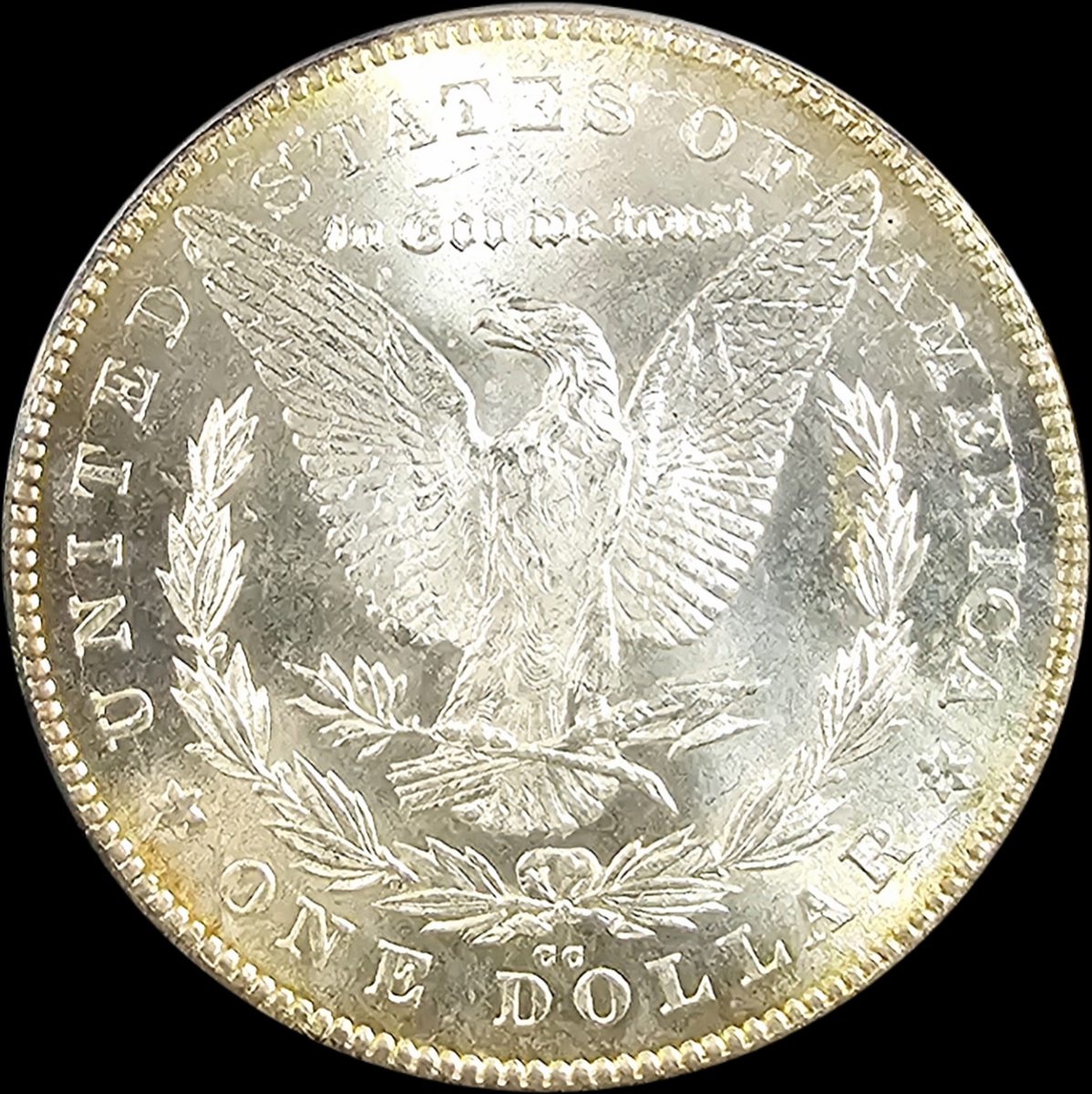
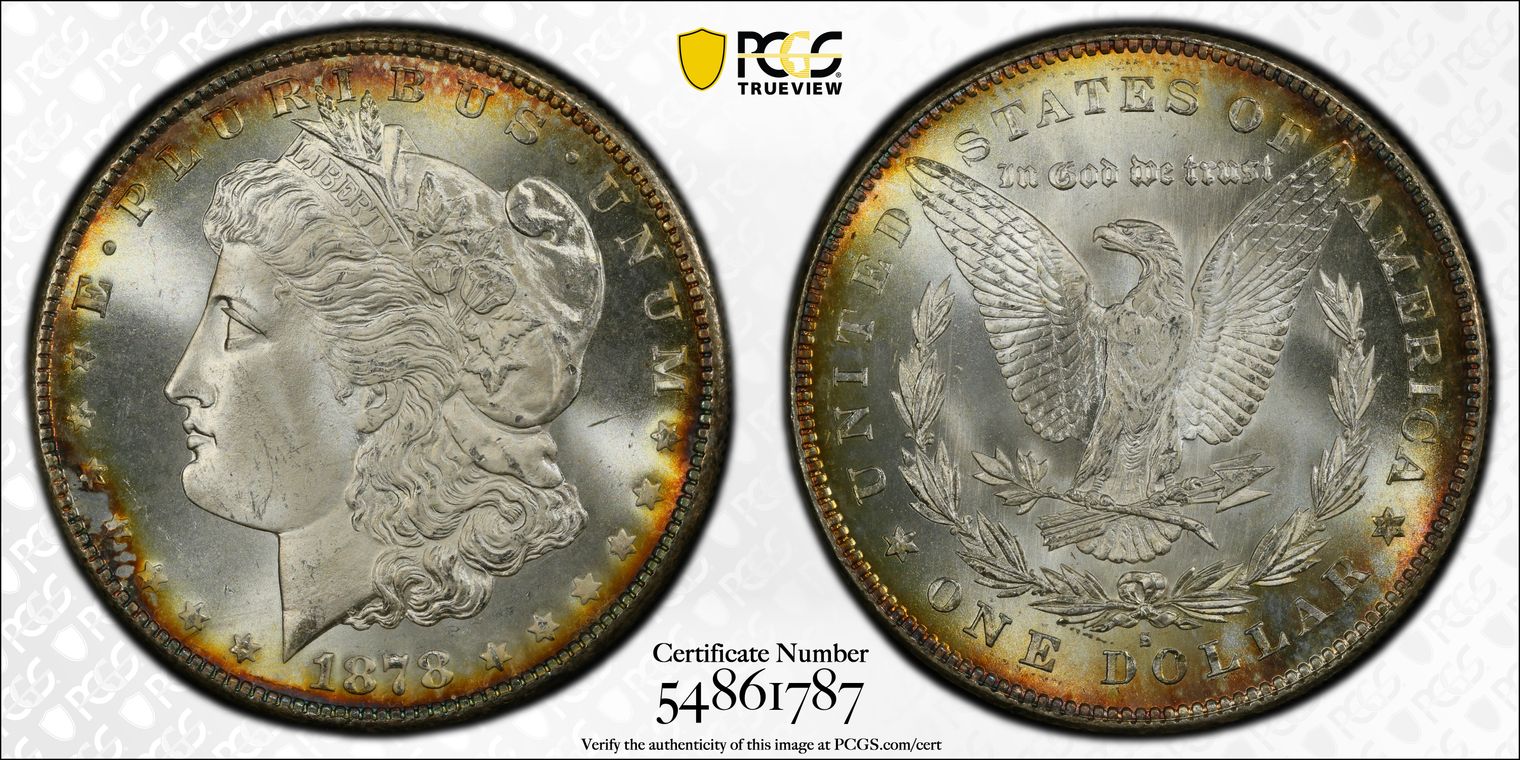
An outstanding Premium Gem whose brilliant frosted centers, vividly toned peripheries, and exceptional cartwheel luster combine to create a Morgan dollar of remarkable visual distinction. Possessing extraordinary balance and originality, this handsome first-year San Francisco issue exemplifies the artistry and technical excellence that established the mint's enduring reputation for producing superb silver dollars. The obverse presents an arresting composition in which luminous silver-white central devices are dramatically framed by concentric bands of antique gold, amber, burnt orange, olive, and charcoal-gray concentrated around the borders. The peripheral toning forms an elegant natural vignette, allowing Liberty's portrait to emerge with almost sculptural brilliance against the darker rim. Hints of cobalt and crimson appear intermittently near the denticles, adding subtle complexity to an already harmonious palette. The reverse is equally compelling. Broad expanses of brilliant satiny frost dominate the central eagle, while richly matured rings of golden amber, cinnamon, olive, and smoky charcoal embrace the outer design. The peripheral toning is remarkably even, creating exceptional symmetry without appearing contrived. Together, the obverse and reverse produce one of the most visually balanced presentations one could hope to encounter on the issue. Strike quality is outstanding throughout. Liberty's hair displays crisp separation in every major curl, while the cotton blossoms and leaves are boldly impressed. The reverse eagle exhibits exceptional feather detail extending across the breast and wings, with sharply rendered wreath elements and lettering completing a strike fully worthy of the San Francisco Mint's reputation for excellence. Luster is magnificent. Powerful frosty cartwheel brilliance radiates uninterrupted across both sides, remaining vibrant beneath the natural peripheral patina. As the coin rotates beneath light, the luminous central fields appear almost illuminated, while the darker peripheral toning enhances the sense of depth and contrast. The interaction between brilliant frost and mature color creates a visual presentation of unusual energy and refinement.
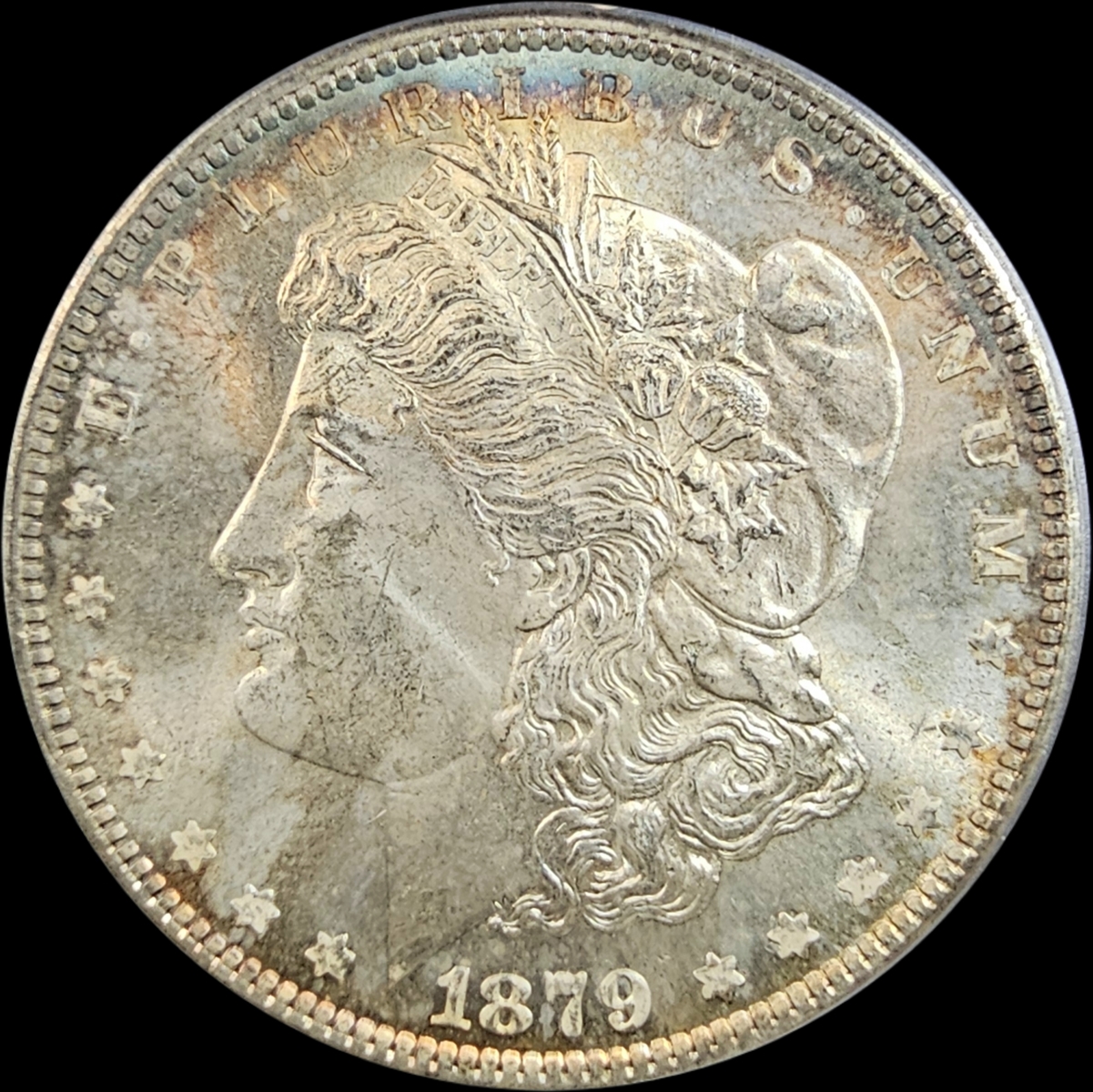
Pleasing surfaces with warm russet and blue tone at the obverse rim and eye appealing red and golden at the reverse rim. The overall surfaces are particularly attractive for their luster.
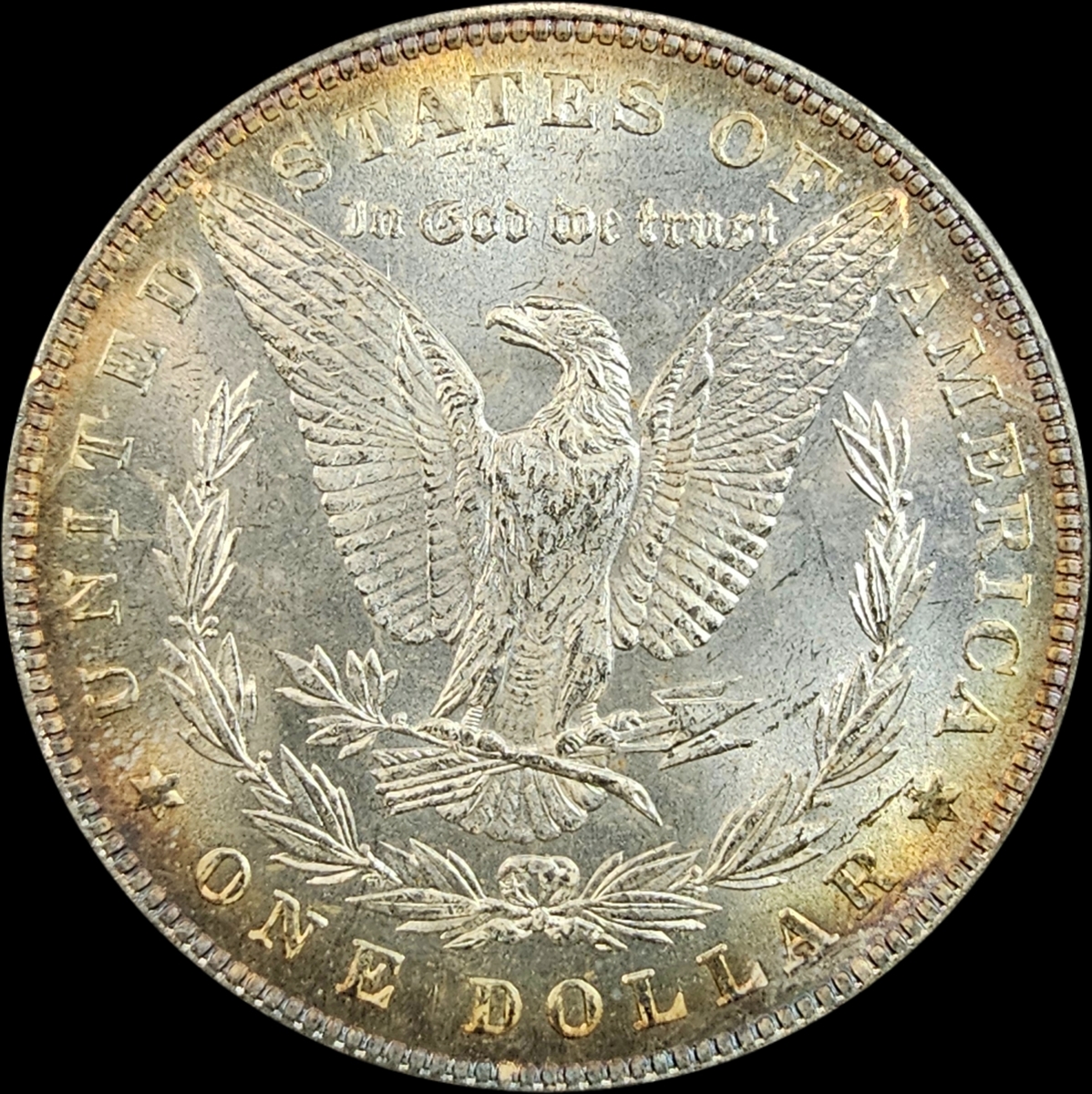
Pleasing surfaces with warm russet and blue tone at the obverse rim and eye appealing red and golden at the reverse rim. The overall surfaces are particularly attractive for their luster.
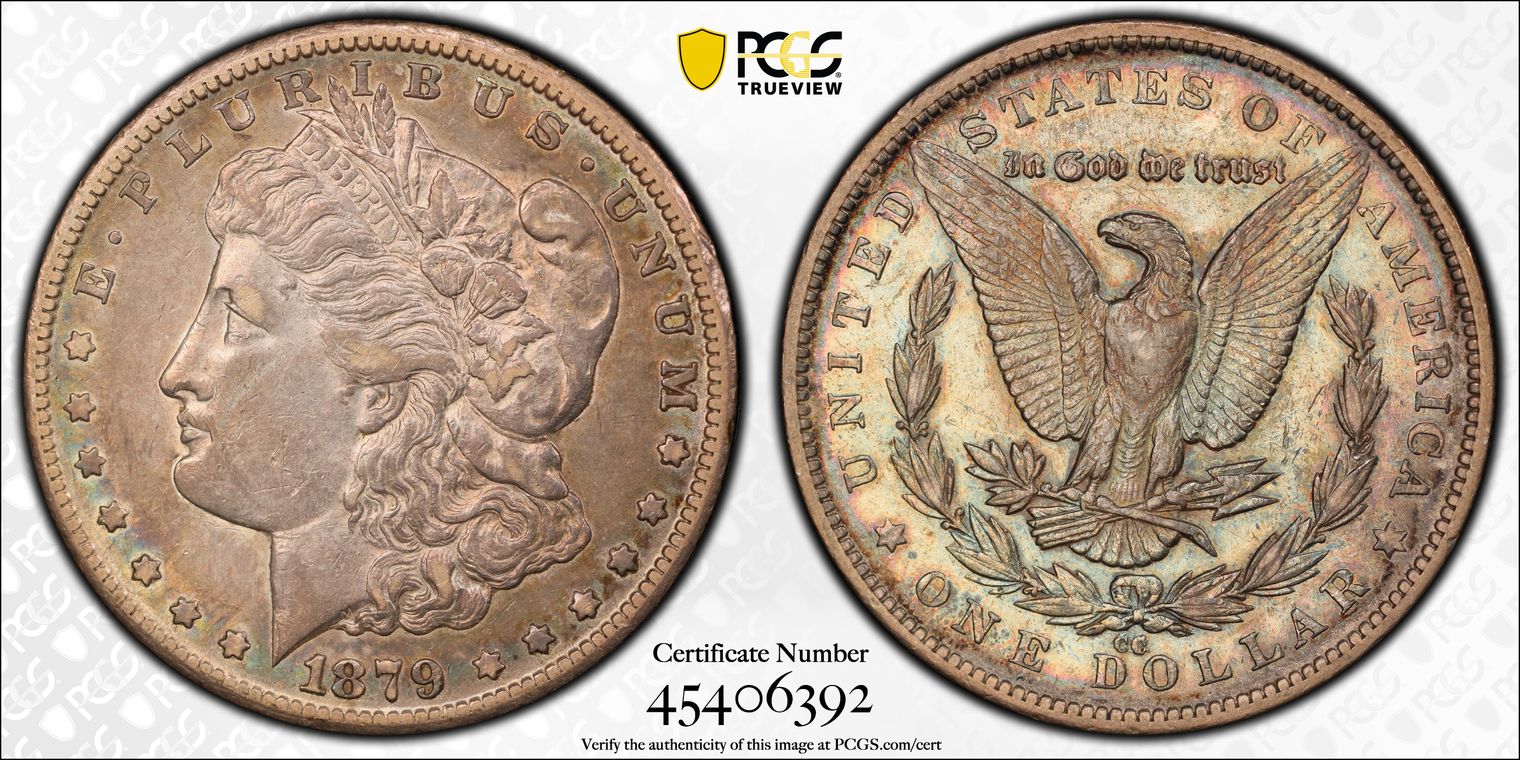
A thoroughly original Extremely Fine representative of one of the Carson City Mint's most desirable early Morgan dollar issues. Handsomely preserved with remarkably honest wear, softly glowing original patina, and exceptional visual harmony, this attractive survivor demonstrates the enduring appeal of a coin that spent a brief but dignified period in commerce before being carefully preserved for generations. The obverse presents warm silver-gray surfaces delicately overlaid with champagne, pale rose, and light olive-gold patina. The color remains remarkably even, allowing Liberty's portrait to retain excellent definition while imparting the mellow appearance so highly prized among original circulated silver dollars. Faint peripheral accents of blue and amber emerge along portions of the rim, providing subtle visual interest without disturbing the coin's understated elegance. The reverse is especially captivating. Rich pastel shades of gold, soft aqua, lavender, and warm russet mingle naturally across the fields, creating an appearance that is both original and remarkably vibrant for a circulated Carson City dollar. The toning remains completely transparent, preserving full visibility of the underlying detail while imparting an unmistakable sense of age and authenticity. Strike quality is excellent. Liberty's hair retains bold central detail despite honest circulation, while the cotton leaves and blossoms remain sharply outlined. The reverse eagle displays strong feather definition throughout the wings and legs, with the wreath and lettering boldly impressed. The quality of the original strike remains readily apparent beneath the modest wear. Wear is entirely consistent with the assigned Extremely Fine grade, confined primarily to the highest points of Liberty's hair, cheek, and the eagle's breast and upper legs. Importantly, the circulation has been even and undisturbed, producing smooth transitions between the worn and protected areas rather than the uneven appearance frequently encountered on heavily handled examples. Significant remnants of original mint luster remain nestled within the protected recesses, particularly around the lettering, stars, and interior devices, lending the coin a pleasing sense of vitality.
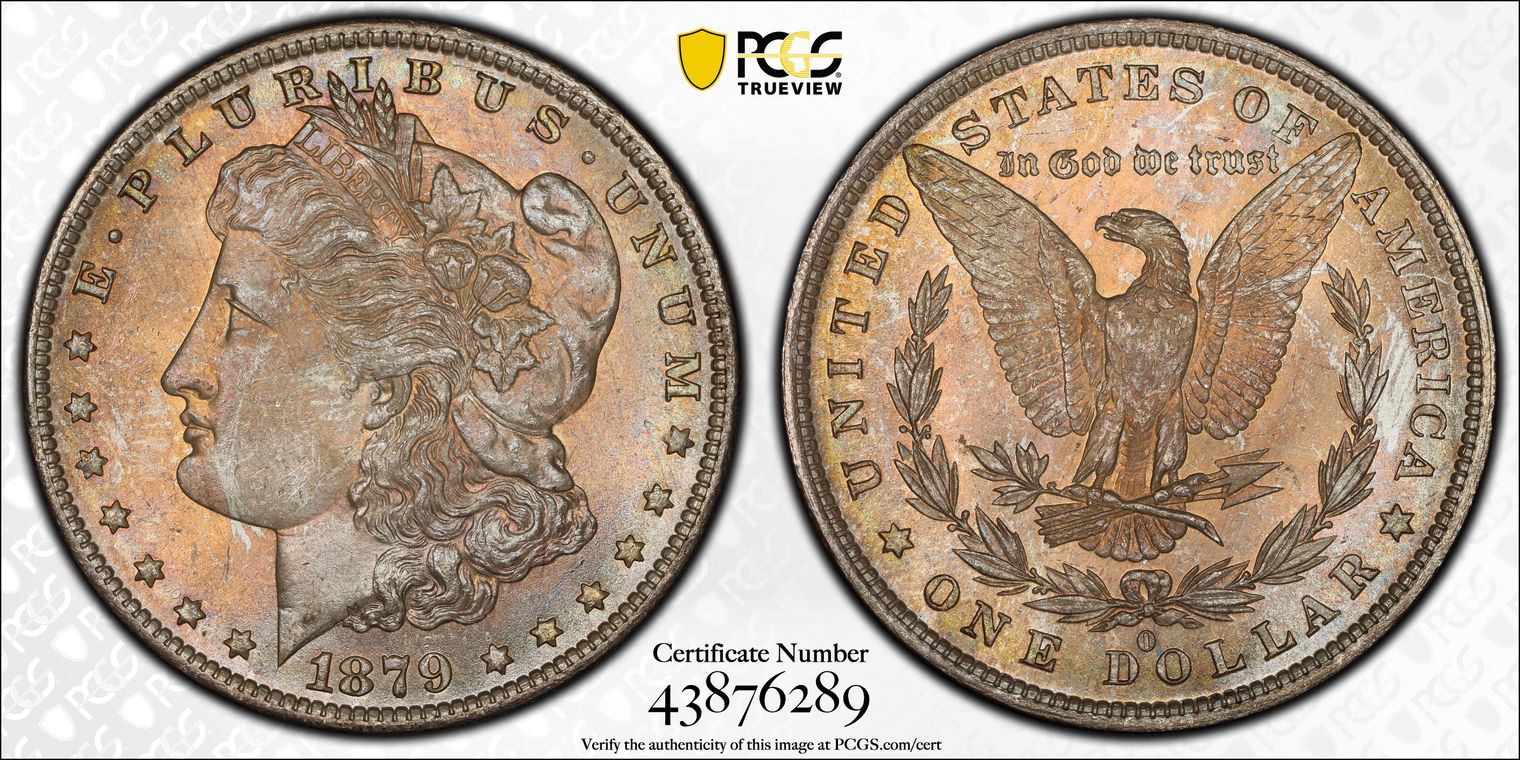
One of the more visually appealing examples of this challenging New Orleans issue, this 1879-O Morgan dollar displays an attractive blanket of natural album toning in warm honey-gold, champagne, copper-rose, and pale amber shades over satiny silver surfaces. Delicate hints of pastel blue and olive-gray are visible near portions of the periphery, lending additional complexity without obscuring underlying luster. The strike is noticeably stronger than typically encountered for the issue. This issue has long been recognized as one of the more difficult early New Orleans Morgans to locate with both a sharp strike and clean surfaces. Many survivors display weak central detail, extensive bagmarks, or impaired surfaces from decades of Treasury storage. Consequently, premium-quality Mint State examples such as this, with attractive originality command considerable collector interest. CAC approved.
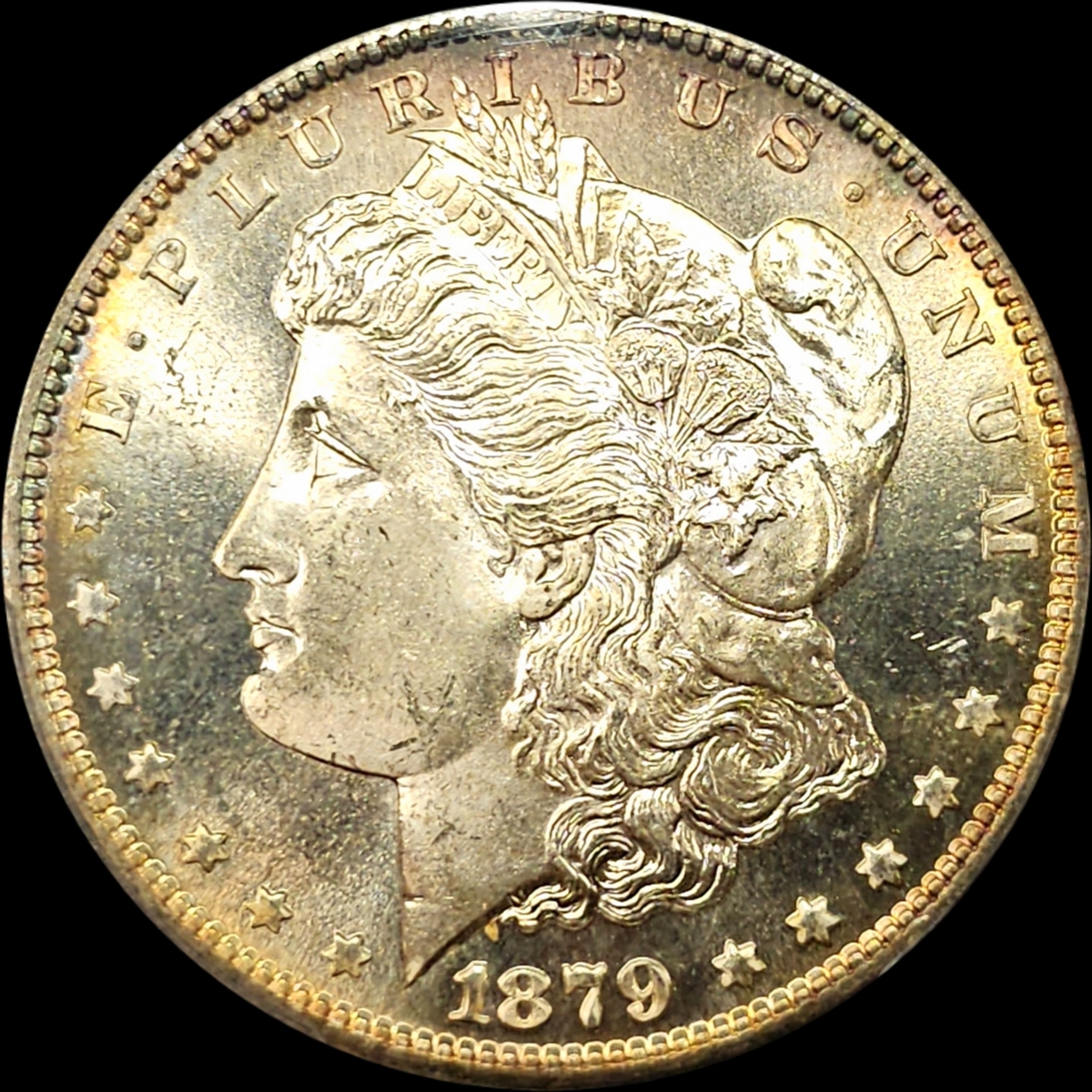
A flashy gem, rim toned in blue and purple, this Morgan was a crossover from an older ANACS holder.
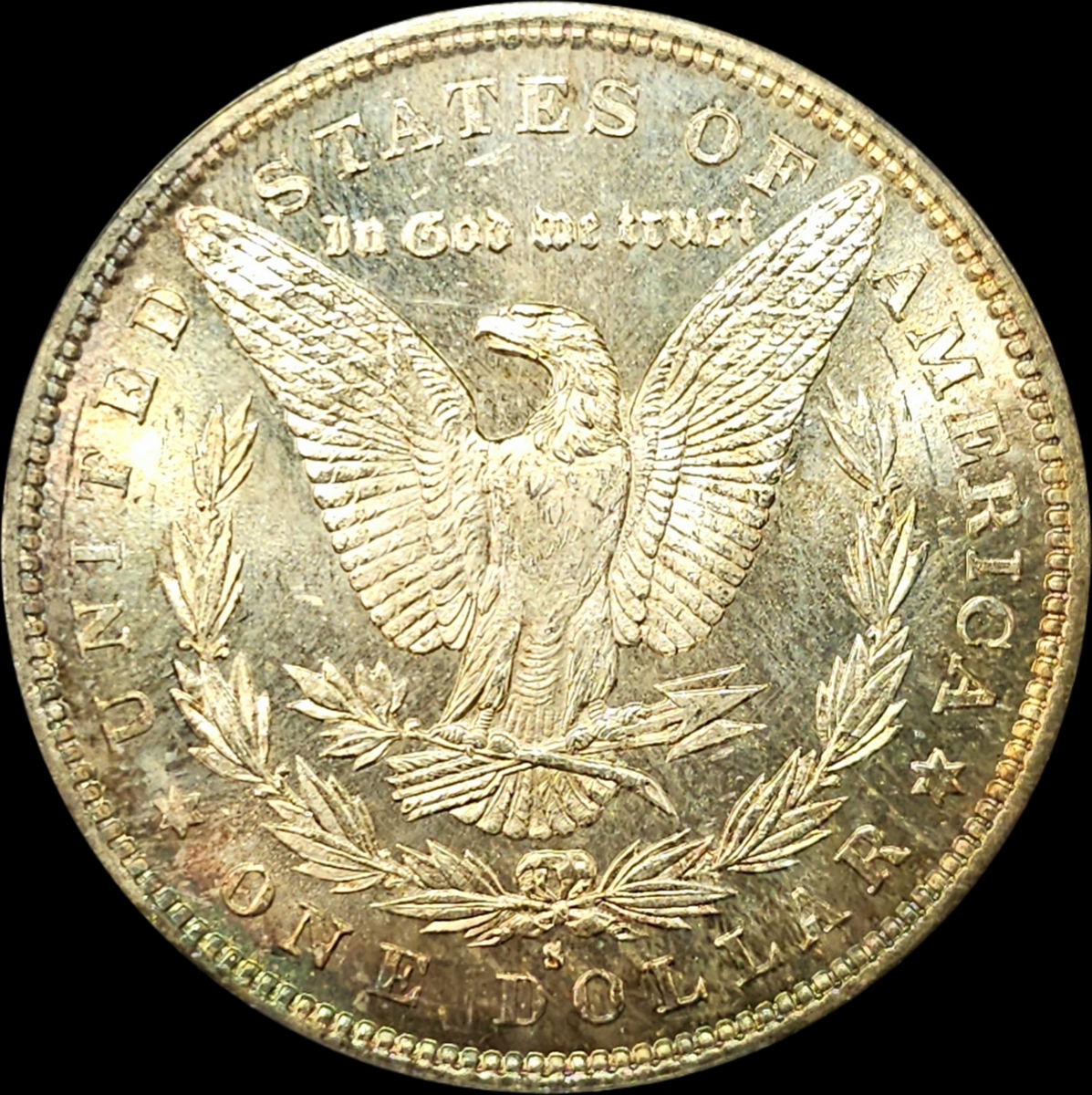
A flashy gem, rim toned in blue and purple, this Morgan was a crossover from an older ANACS holder.
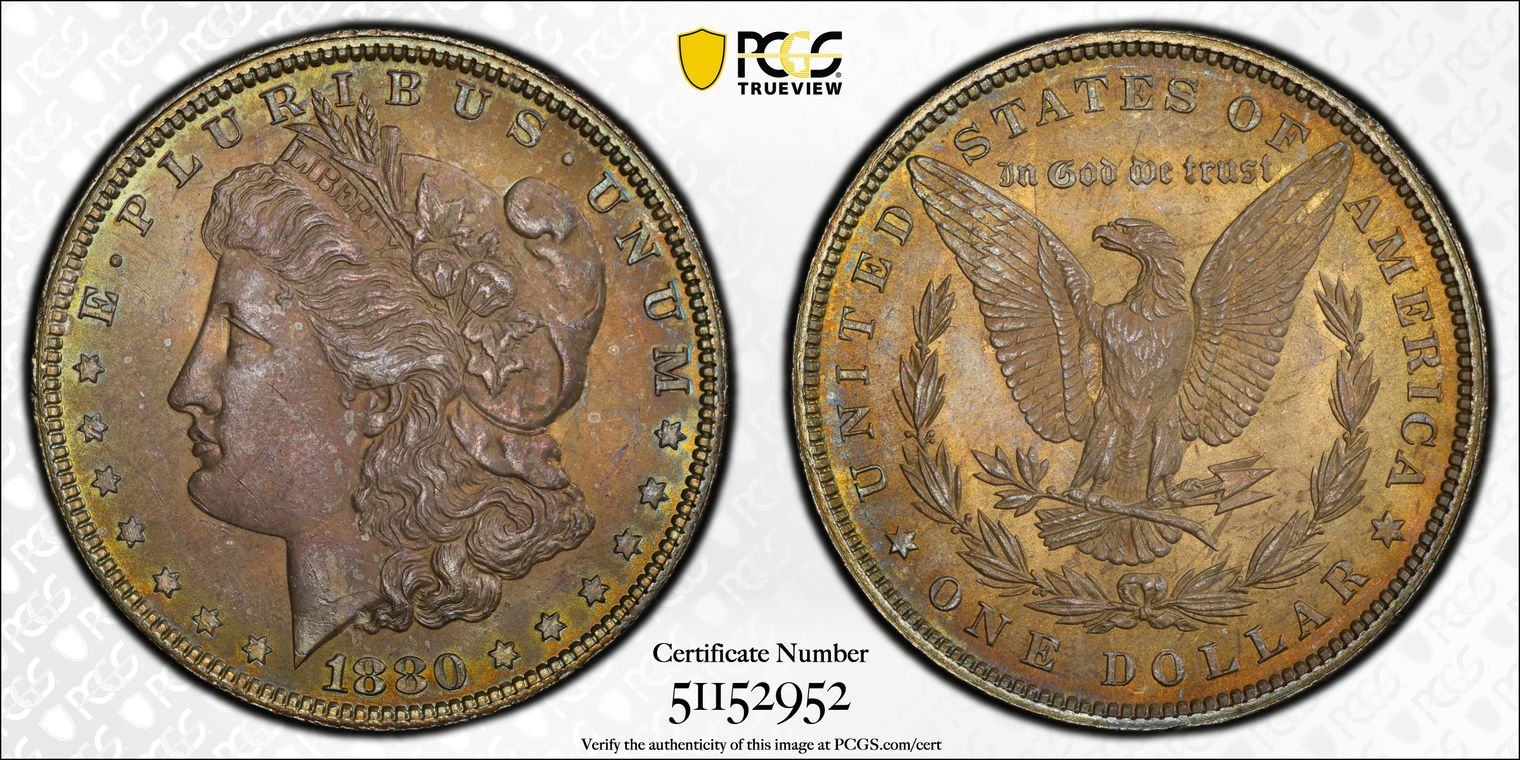
A richly original Gem whose appeal is founded upon exceptional surface preservation and deeply matured cabinet patina. Unlike the brilliant, frosty examples often encountered for this Philadelphia issue, the present specimen offers a more subdued aesthetic, its satiny luster residing beneath decades of natural oxidation that has produced an even blanket of warm golden-brown color. The obverse is evenly toned in shades of olive-gold, bronze, and light chestnut, with subtle charcoal accents gathering near the borders and protected recesses. The patina is uniform yet transparent, allowing the underlying design to remain fully appreciable while imparting an unmistakably original appearance. Similar coloration extends across the reverse, where warm amber and golden hues blanket the fields and devices in harmonious fashion. The continuity of color between both sides suggests long, uninterrupted storage under stable conditions. Strike quality is comfortably above average for the issue. Liberty's hair exhibits pleasing separation through the forehead and above the ear, while the cotton blossoms and leaves retain strong definition. On the reverse, the eagle's breast displays solid feather detail, and the wings, wreath, and legends are crisply rendered. Although not among the most razor-sharp Philadelphia strikes, the overall impression is one of balanced and complete detail. Luster is satiny and somewhat restrained, as expected beneath the extensive original patina. The underlying cartwheel remains evident but is softened by the mature toning, producing a quiet glow rather than a brilliant flash. This subdued character enhances the coin's antique appearance without sacrificing its originality.
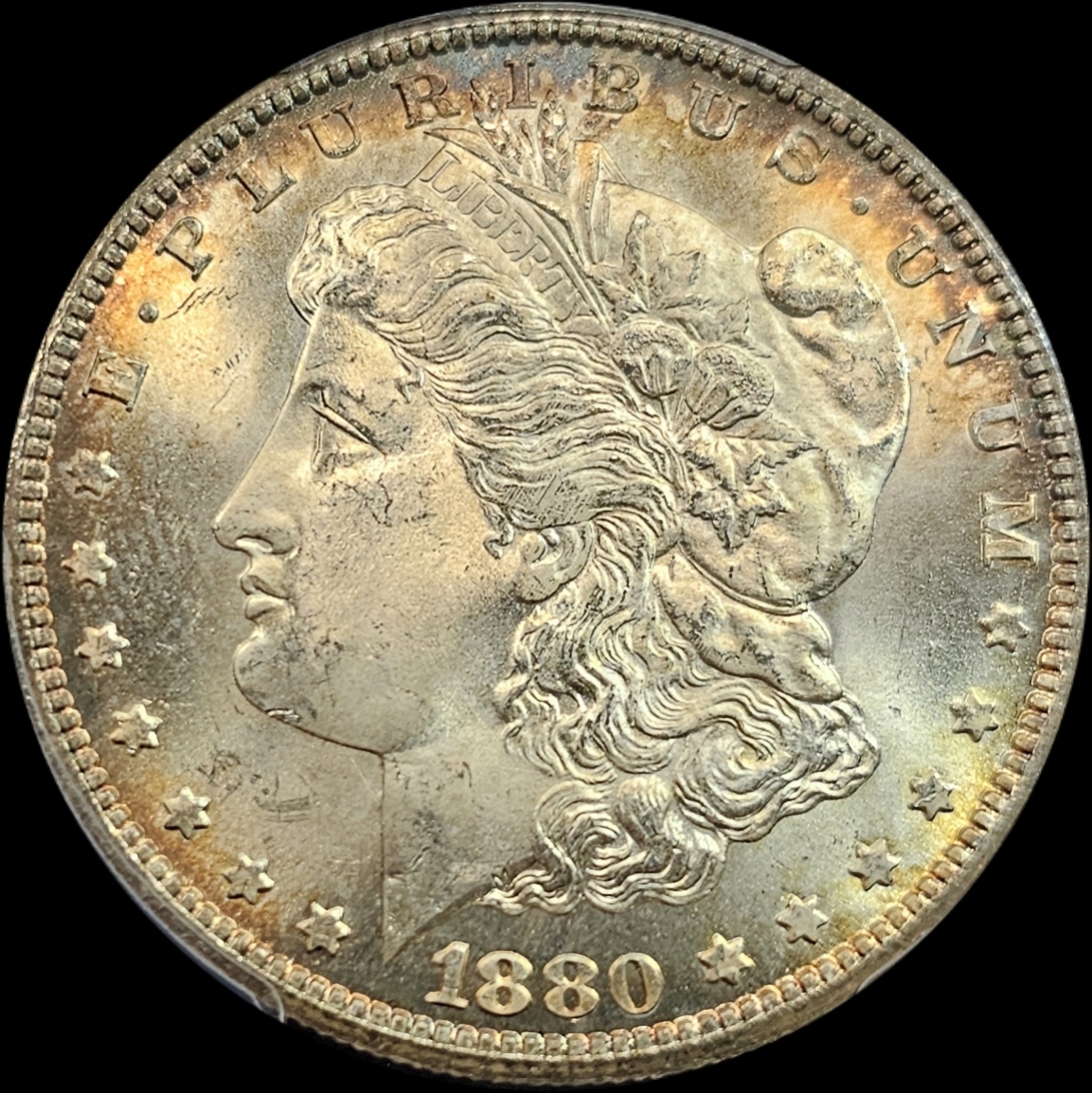
Nicely struck with heavy luster on the devices. Rings of blue and orange rim both the obverse and reverse.
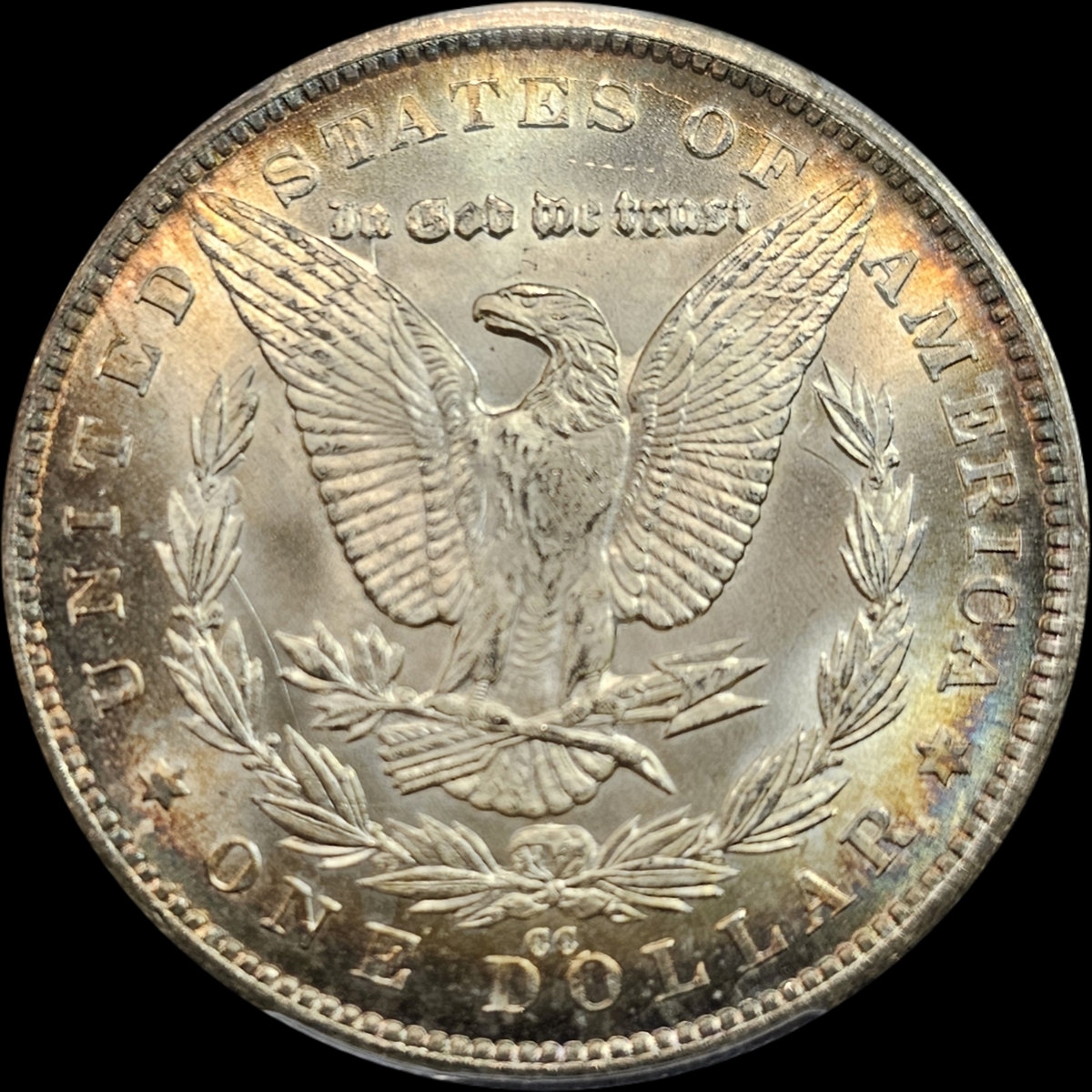
Nicely struck with heavy luster on the devices. Rings of blue and orange rim both the obverse and reverse.
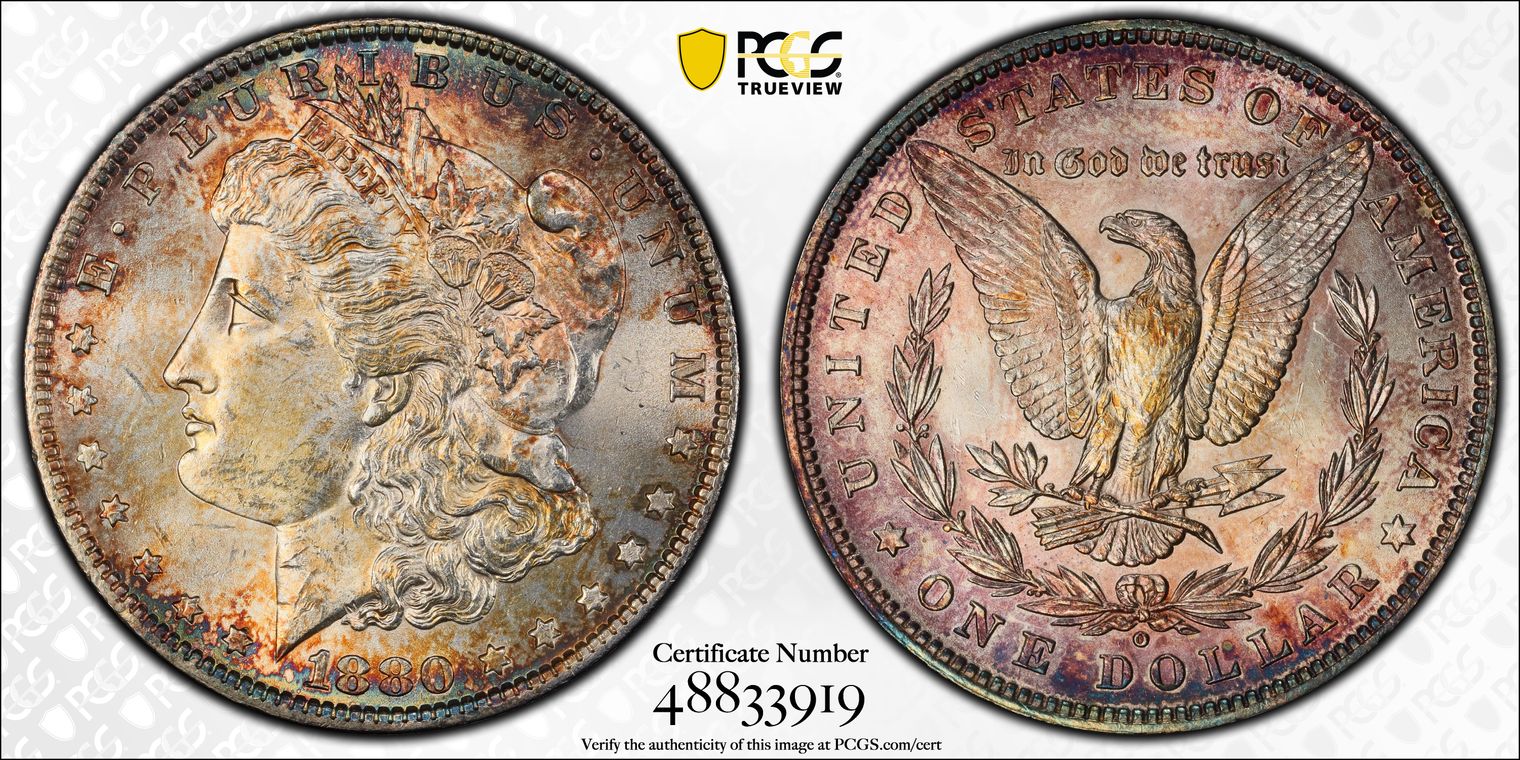
A thoroughly original Choice Mint State representative of this New Orleans issue, distinguished by richly matured peripheral patina, pleasing satiny luster, and the honest field abrasions characteristic of long-term Treasury storage. The coin's appeal rests not in technical perfection, but in its convincing originality and balanced overall presentation. The obverse displays softly luminous silver-gray centers framed by warm amber, chestnut, russet, and cobalt toning concentrated along the borders. The peripheral color remains translucent, allowing the underlying mint frost to show through while imparting a distinctly original appearance. Scattered patches of deeper russet and charcoal toning within the upper obverse suggest prolonged contact with adjacent coins during storage, contributing to the coin's authentic "cabinet skin." The reverse exhibits complementary coloration, with warm champagne and pale silver centers surrounded by concentric bands of golden-orange, rose, violet, and deep blue at the rims. The peripheral patina frames the eagle naturally without overpowering the design, while the central surfaces retain an appealing softness beneath the mature toning. Strike quality is typical of the issue, though slightly better than average. Liberty's hair retains respectable separation through the forehead and above the ear, while the cotton blossoms and leaves display satisfactory definition despite modest central softness. The reverse eagle exhibits partial breast feather detail with well-defined wings and wreath elements, producing a balanced if not fully complete impression. Luster is satiny and somewhat restrained beneath the extensive original patina. Broad cartwheel movement remains visible, though softened by decades of natural oxidation. Rather than exhibiting brilliant flash, the coin presents a quiet, even glow that complements its mature surfaces.
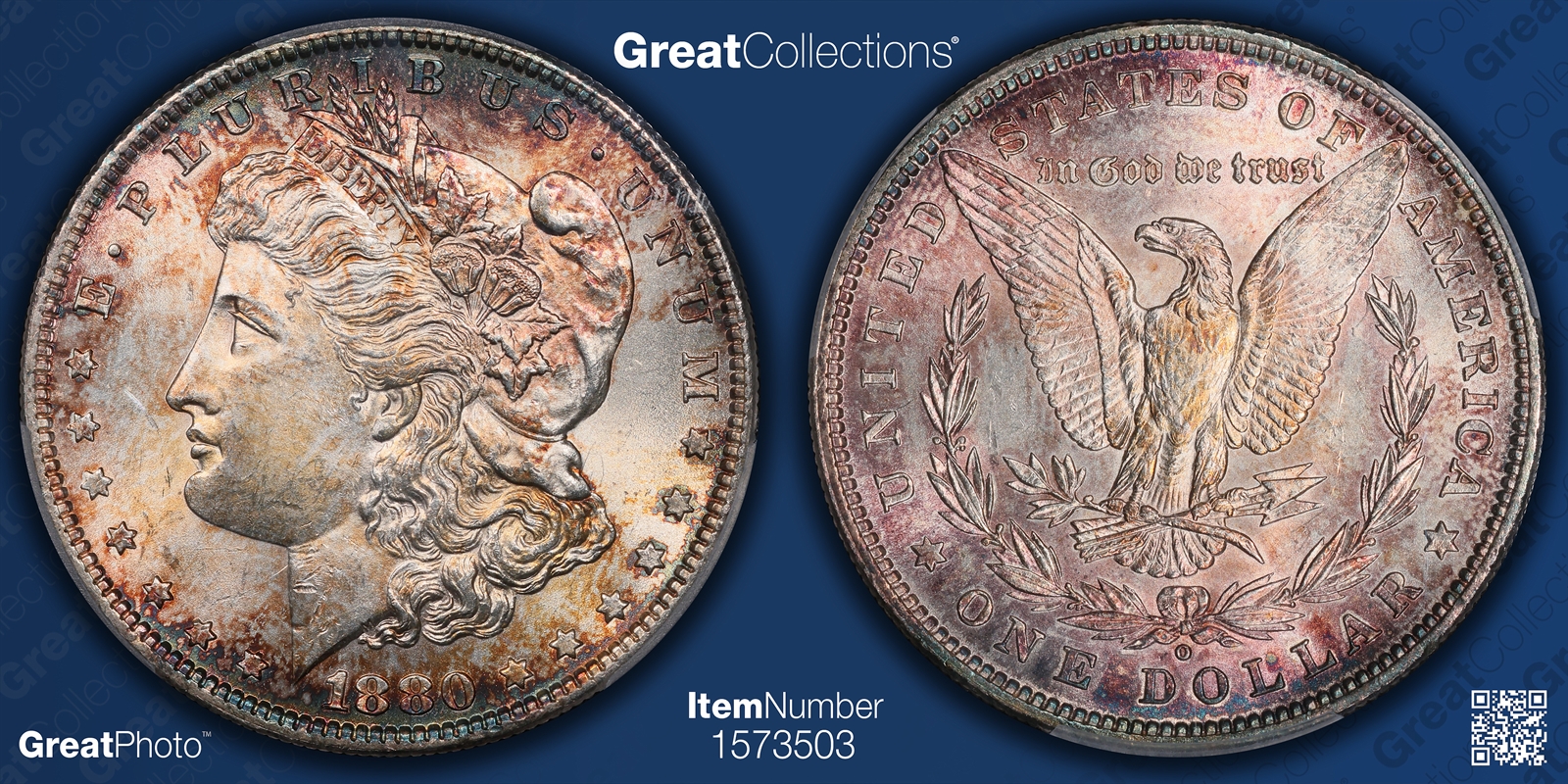
A thoroughly original Choice Mint State representative of this New Orleans issue, distinguished by richly matured peripheral patina, pleasing satiny luster, and the honest field abrasions characteristic of long-term Treasury storage. The coin's appeal rests not in technical perfection, but in its convincing originality and balanced overall presentation. The obverse displays softly luminous silver-gray centers framed by warm amber, chestnut, russet, and cobalt toning concentrated along the borders. The peripheral color remains translucent, allowing the underlying mint frost to show through while imparting a distinctly original appearance. Scattered patches of deeper russet and charcoal toning within the upper obverse suggest prolonged contact with adjacent coins during storage, contributing to the coin's authentic "cabinet skin." The reverse exhibits complementary coloration, with warm champagne and pale silver centers surrounded by concentric bands of golden-orange, rose, violet, and deep blue at the rims. The peripheral patina frames the eagle naturally without overpowering the design, while the central surfaces retain an appealing softness beneath the mature toning. Strike quality is typical of the issue, though slightly better than average. Liberty's hair retains respectable separation through the forehead and above the ear, while the cotton blossoms and leaves display satisfactory definition despite modest central softness. The reverse eagle exhibits partial breast feather detail with well-defined wings and wreath elements, producing a balanced if not fully complete impression. Luster is satiny and somewhat restrained beneath the extensive original patina. Broad cartwheel movement remains visible, though softened by decades of natural oxidation. Rather than exhibiting brilliant flash, the coin presents a quiet, even glow that complements its mature surfaces.
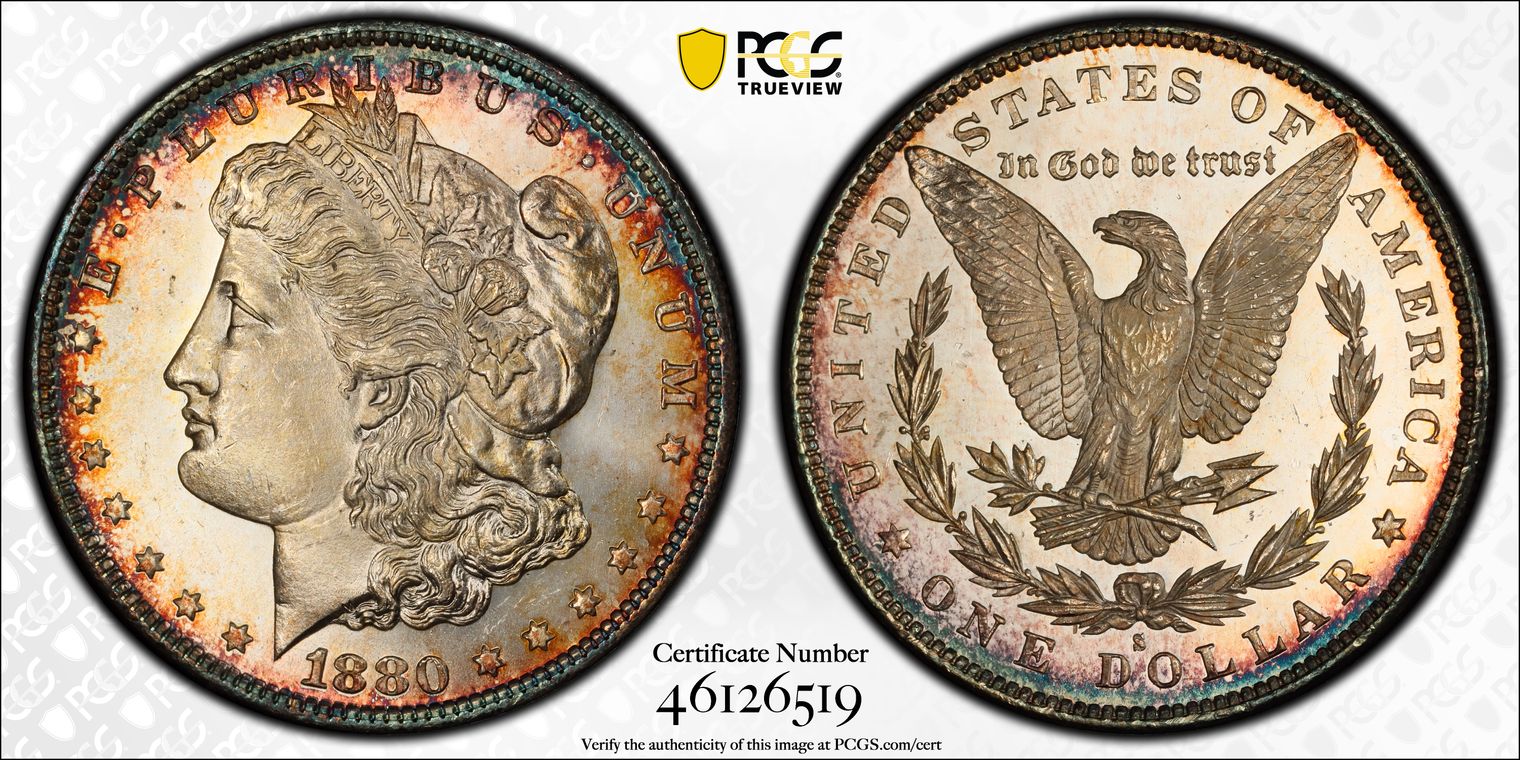
A spectacular Gem Mint State representative of this perennially popular San Francisco issue, distinguished by radiant frosted luster, beautifully framed peripheral toning, and exceptional overall visual harmony. Although the date is readily available in high grades, examples combining this level of originality with such elegant natural coloration remain decidedly elusive. The obverse displays brilliant silver-white centers surrounded by a magnificent wreath of naturally developed peripheral color. Warm amber and golden-orange transition effortlessly into crimson, cobalt, emerald, and charcoal along the denticled borders, producing an almost stained-glass effect that frames Liberty's portrait without overwhelming it. The central devices remain luminous beneath the transparent patina, preserving the coin's frosty character while adding remarkable visual depth. The reverse presents an equally attractive companion. Brilliant satiny fields dominate the central eagle, while concentric bands of golden honey, rose, lavender, cobalt, and deep olive embrace the periphery in nearly symmetrical fashion. The coloration is neither excessive nor muted, but instead perfectly balanced to emphasize the bold central devices. The result is a reverse of exceptional compositional strength. Strike quality is virtually complete. Liberty's hair is boldly detailed throughout, with crisp definition in every major curl, cotton blossom, and wheat leaf. The reverse eagle exhibits razor-sharp feather detail across the breast and wings, while the wreath and lettering reflect the outstanding striking quality for which the San Francisco Mint became renowned during this period. Luster is abundant and highly expressive. Bright frosty cartwheels roll freely beneath the translucent toning, illuminating the brilliant centers while interacting beautifully with the richly colored borders. The contrast between the vibrant white interiors and the naturally toned rims produces exceptional dimensionality, lending the coin an appearance that is both energetic and remarkably refined.
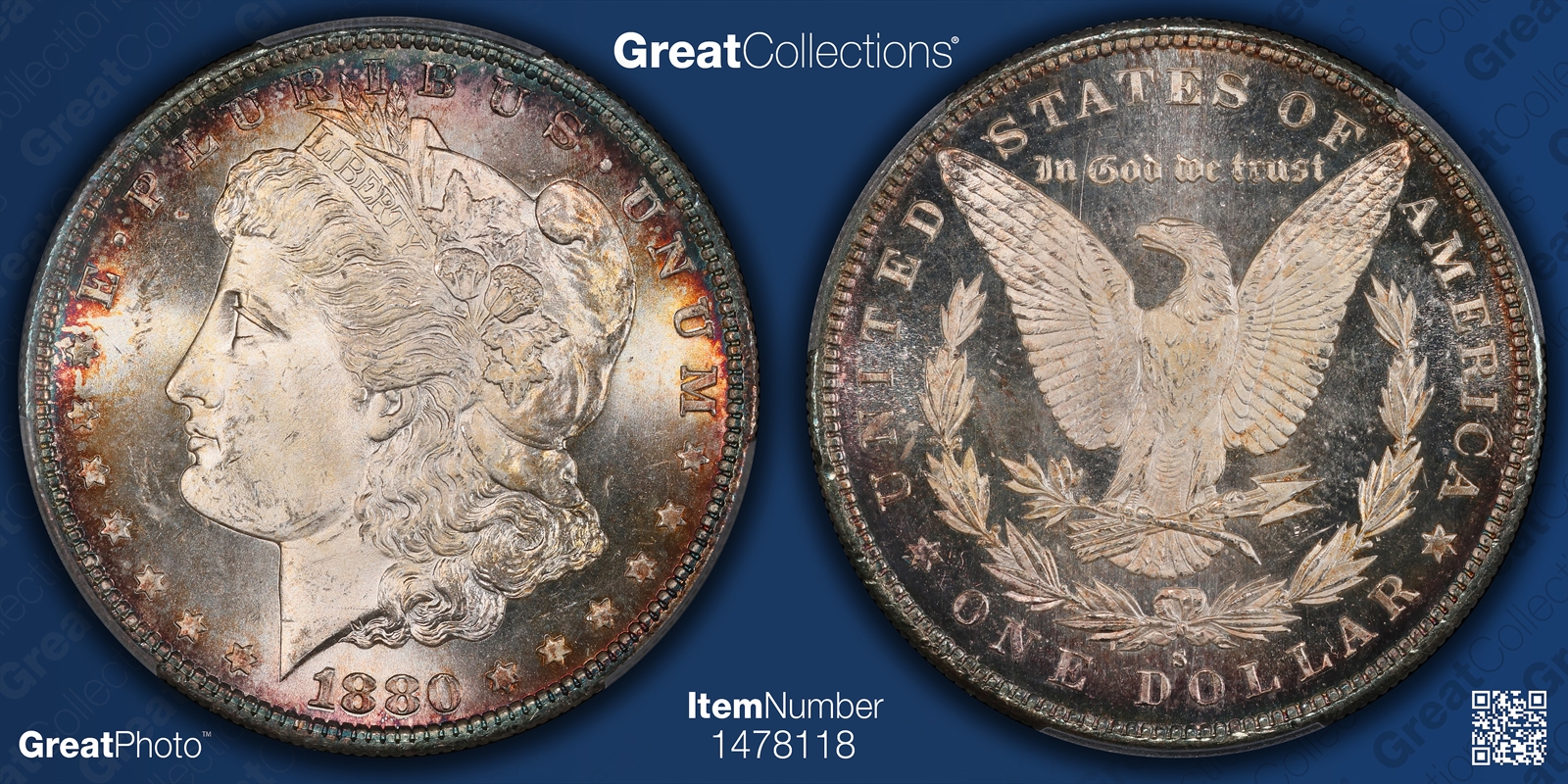
A spectacular Gem Mint State representative of this perennially popular San Francisco issue, distinguished by radiant frosted luster, beautifully framed peripheral toning, and exceptional overall visual harmony. Although the date is readily available in high grades, examples combining this level of originality with such elegant natural coloration remain decidedly elusive. The obverse displays brilliant silver-white centers surrounded by a magnificent wreath of naturally developed peripheral color. Warm amber and golden-orange transition effortlessly into crimson, cobalt, emerald, and charcoal along the denticled borders, producing an almost stained-glass effect that frames Liberty's portrait without overwhelming it. The central devices remain luminous beneath the transparent patina, preserving the coin's frosty character while adding remarkable visual depth. The reverse presents an equally attractive companion. Brilliant satiny fields dominate the central eagle, while concentric bands of golden honey, rose, lavender, cobalt, and deep olive embrace the periphery in nearly symmetrical fashion. The coloration is neither excessive nor muted, but instead perfectly balanced to emphasize the bold central devices. The result is a reverse of exceptional compositional strength. Strike quality is virtually complete. Liberty's hair is boldly detailed throughout, with crisp definition in every major curl, cotton blossom, and wheat leaf. The reverse eagle exhibits razor-sharp feather detail across the breast and wings, while the wreath and lettering reflect the outstanding striking quality for which the San Francisco Mint became renowned during this period. Luster is abundant and highly expressive. Bright frosty cartwheels roll freely beneath the translucent toning, illuminating the brilliant centers while interacting beautifully with the richly colored borders. The contrast between the vibrant white interiors and the naturally toned rims produces exceptional dimensionality, lending the coin an appearance that is both energetic and remarkably refined.
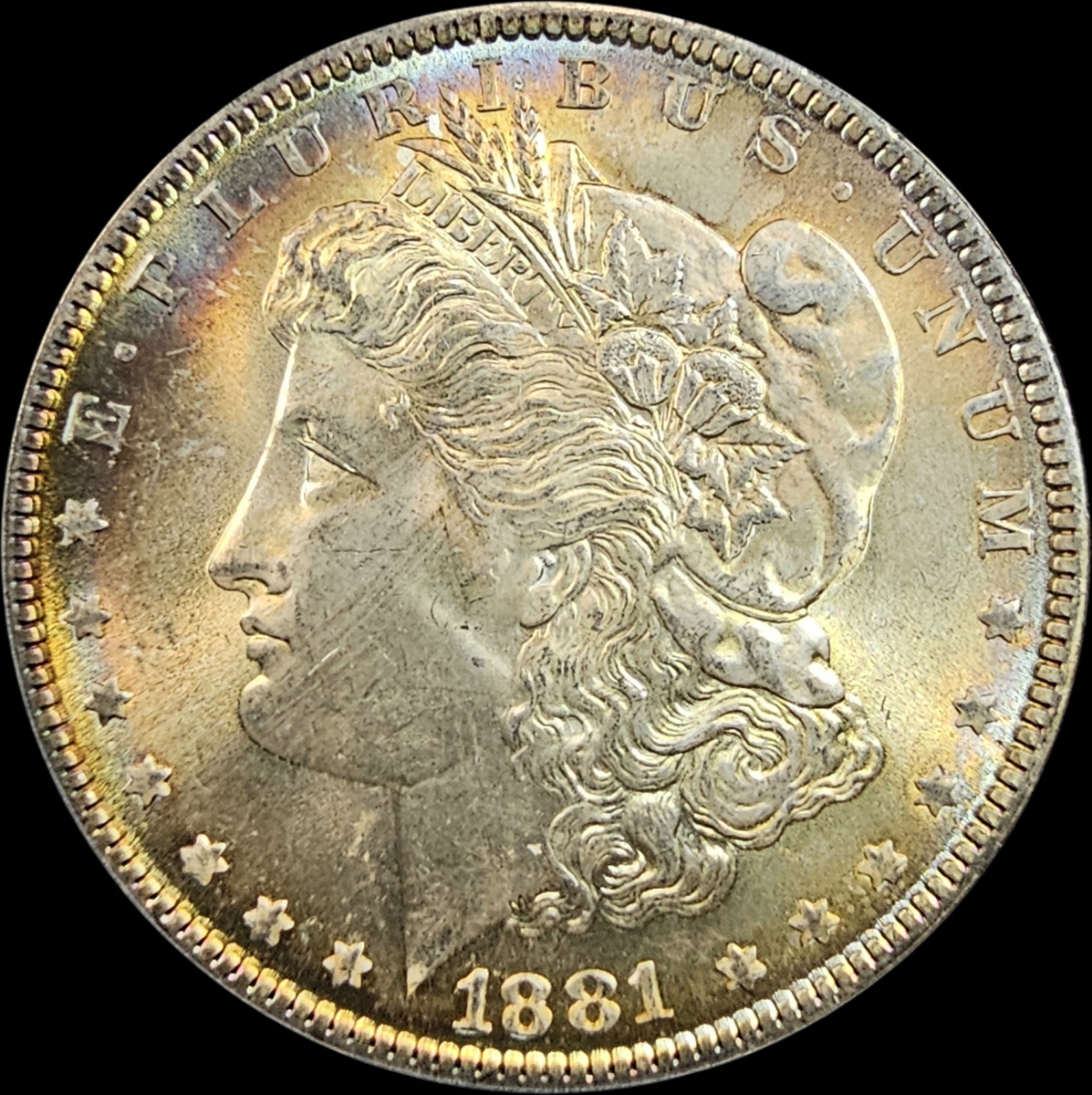
Wonderful wisps of silver stretch across predominantly orange-grey centers on the obverse, while concentric bands of red, orange, yellow, green, and blue radiate from the peripherals of this coin.
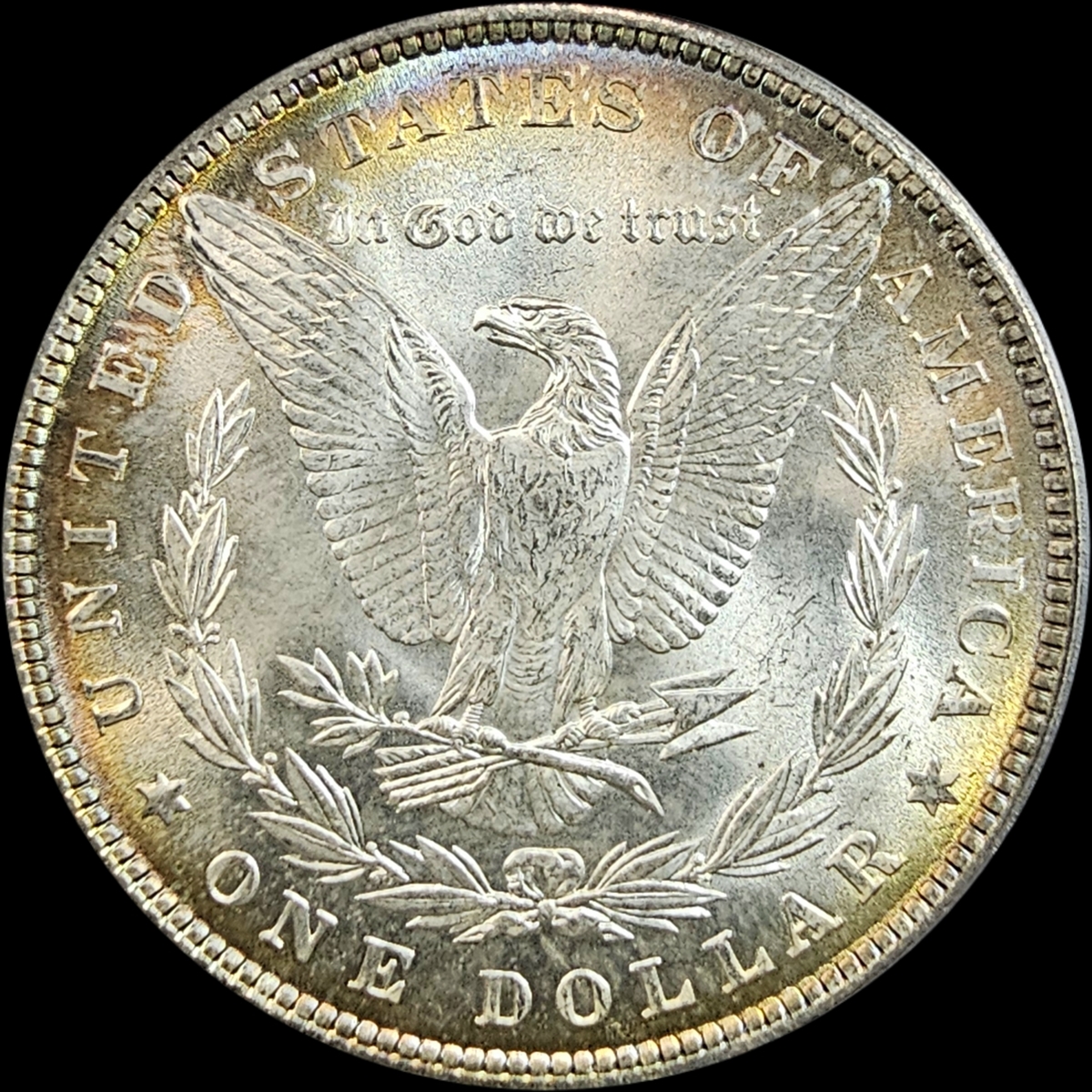
Wonderful wisps of silver stretch across predominantly orange-grey centers on the obverse, while concentric bands of red, orange, yellow, green, and blue radiate from the peripherals of this coin.
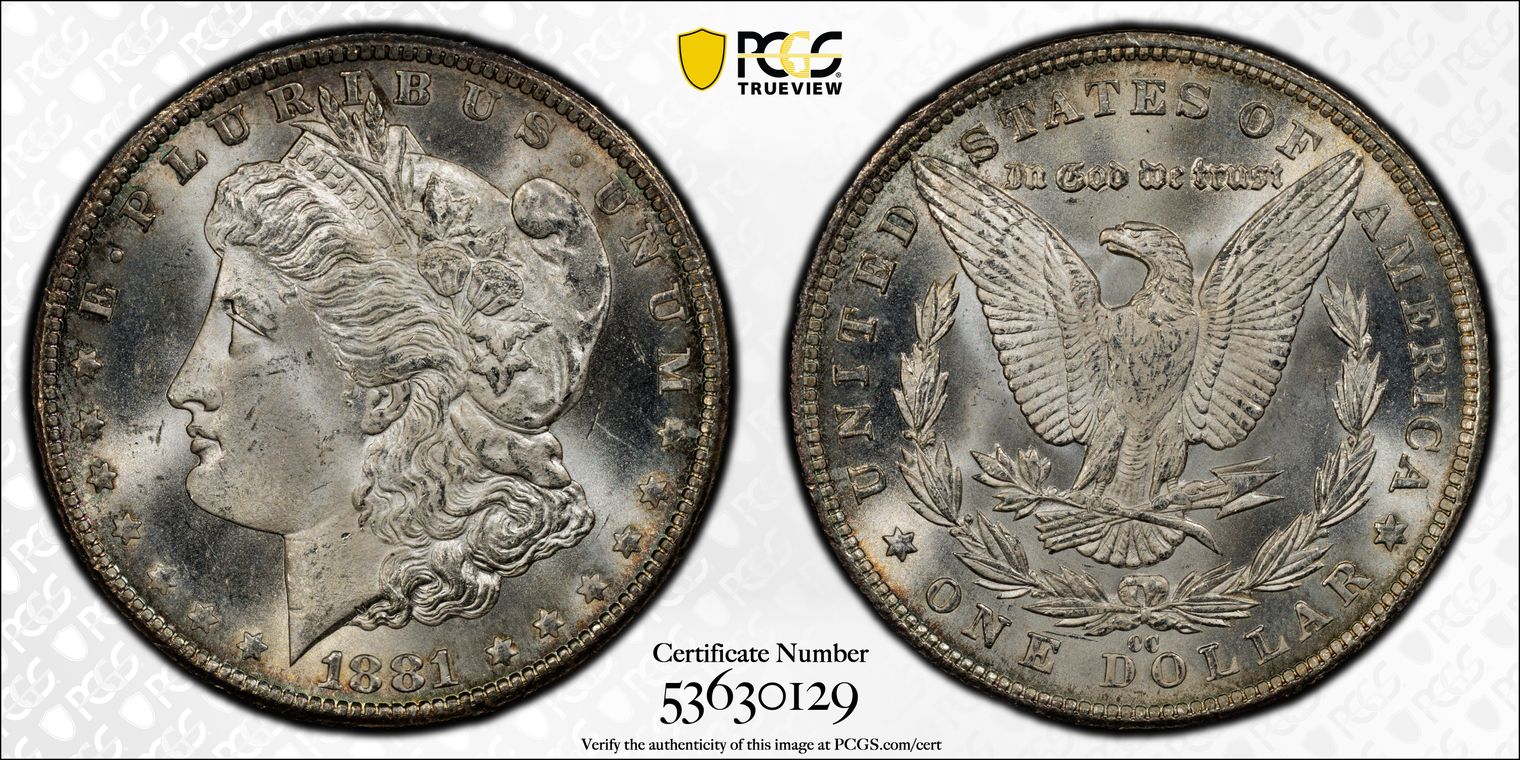
Fully struck and crisp, this brilliant gem also sports bright mint luster on impressively smooth surfaces. A lovely example of his perennially popular, low mintage issue among CC-Mint Morgan dollars, only 296,000 coins were minted. Largely brilliant on the obverse with wisps of blue-orange rim toning, the reverse is also awash in warm apricot rim patina that speaks volumes about the coin's originality.
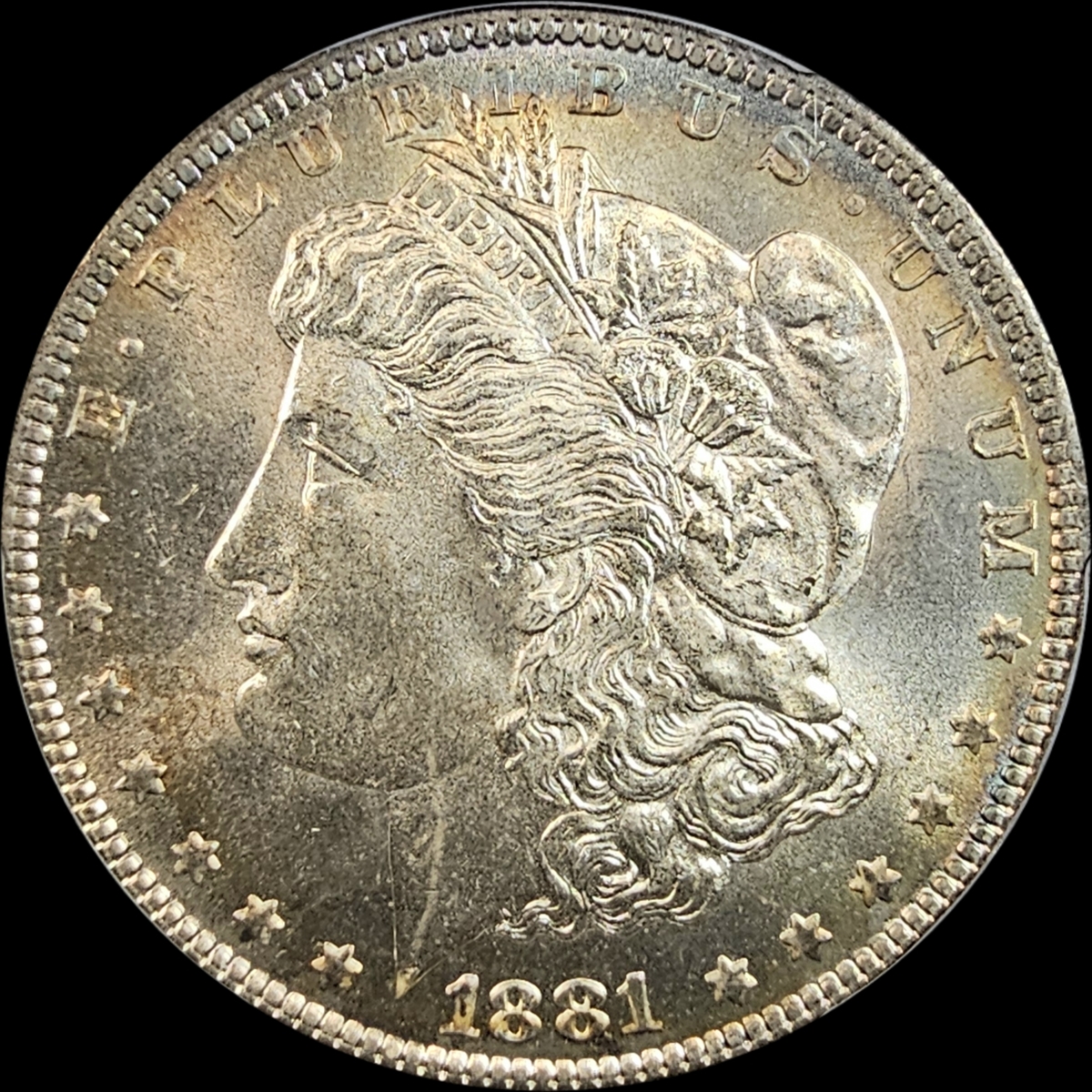
Formerly in ANACS holder, this coin has some blue, silver and orange toning around the edges of the obverse and reverse.
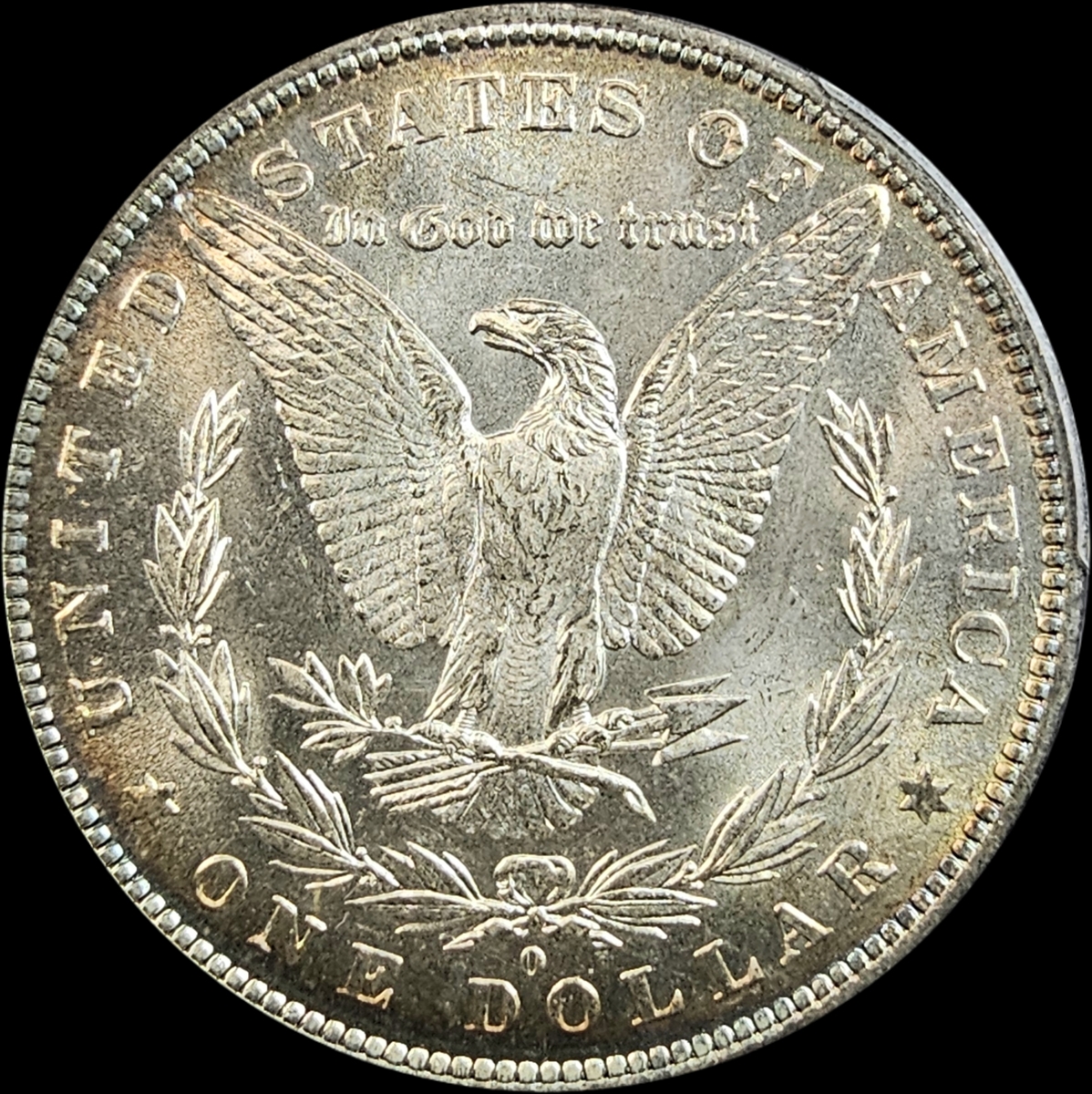
Formerly in ANACS holder, this coin has some blue, silver and orange toning around the edges of the obverse and reverse.
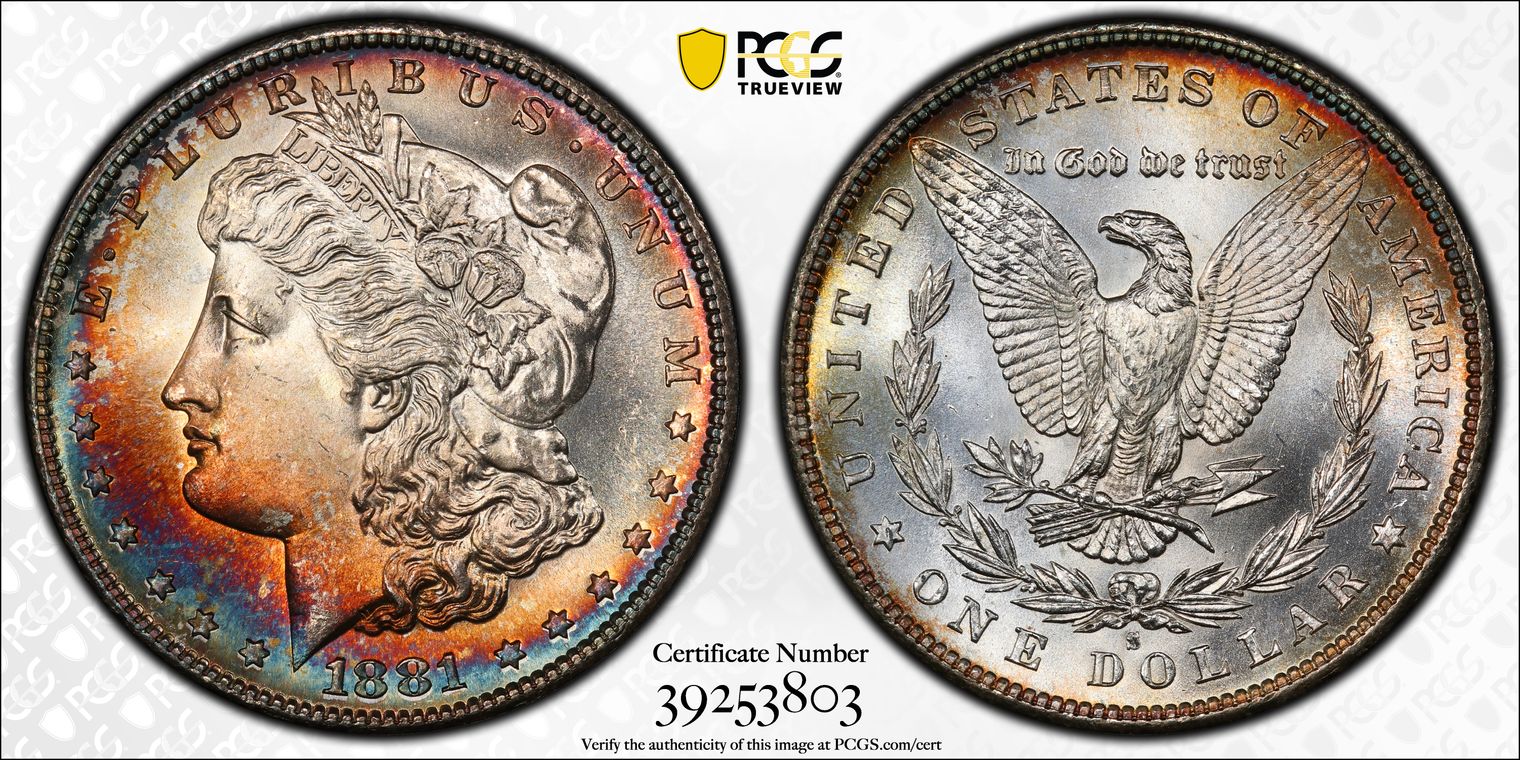
A breathtaking Superb Gem that exemplifies the extraordinary quality for which the San Francisco Mint is renowned, this 1881-S Morgan dollar combines razor-sharp striking definition with radiant satiny luster and magnificent crescent peripheral toning. The result is a coin whose visual presence immediately commands attention. The obverse is framed by a vivid band of original album color progressing through fiery amber, burnt orange, magenta, cobalt blue, and emerald-green hues along the left and lower borders. These richly saturated colors gradually transition into brilliant frosty silver across Liberty's portrait, producing dramatic contrast without overwhelming the underlying mint brilliance. The reverse displays a more restrained yet equally attractive ring of sunset gold, crimson, and violet concentrated around the upper and outer periphery, while the central devices remain largely brilliant. Strike quality is virtually complete throughout, precisely as collectors expect from the finest San Francisco emissions of the early 1880s.
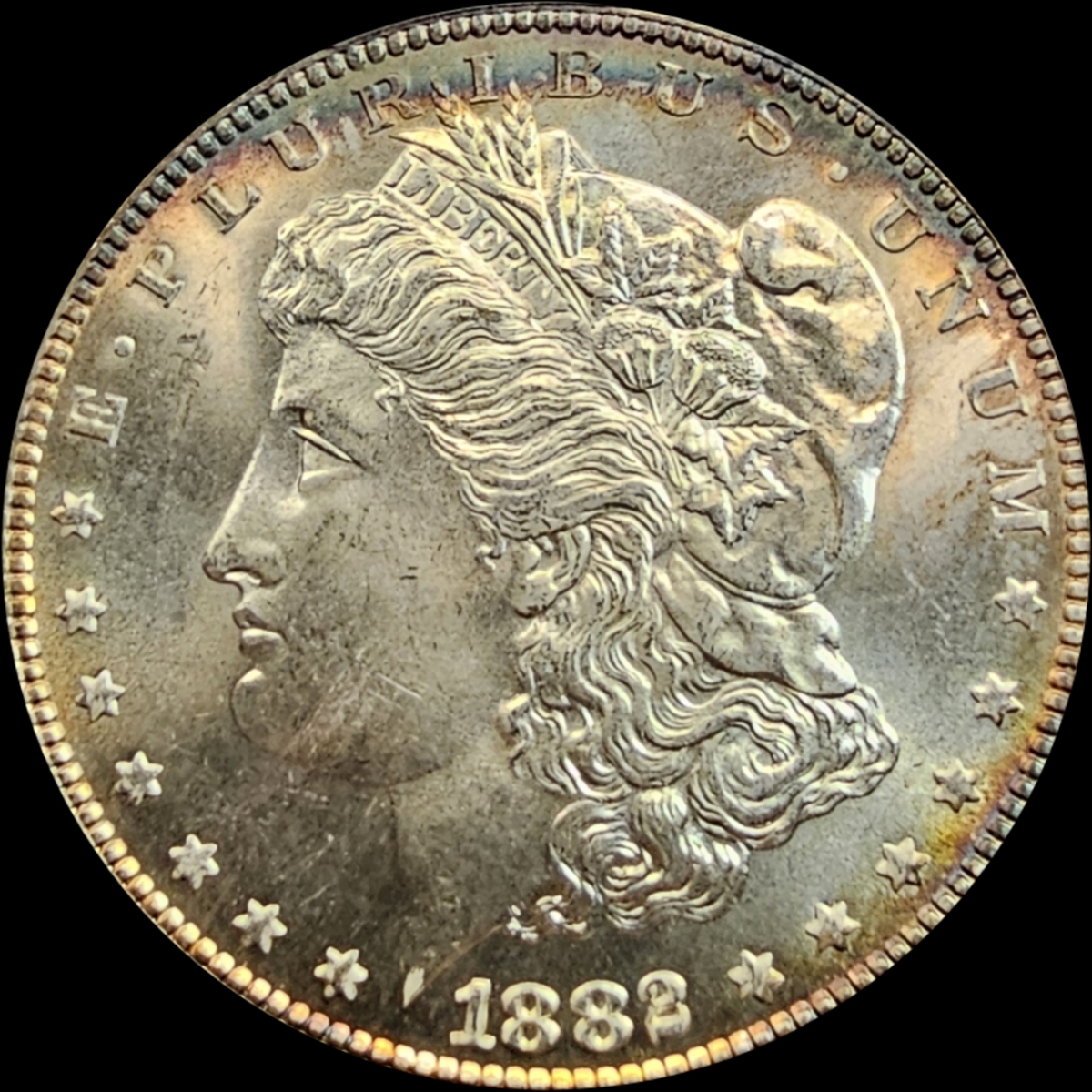
A flashy gem, rim toned in blue and purple on the obverse and PL on the reverse, this Morgan was a crossover from an older ANACS holder.
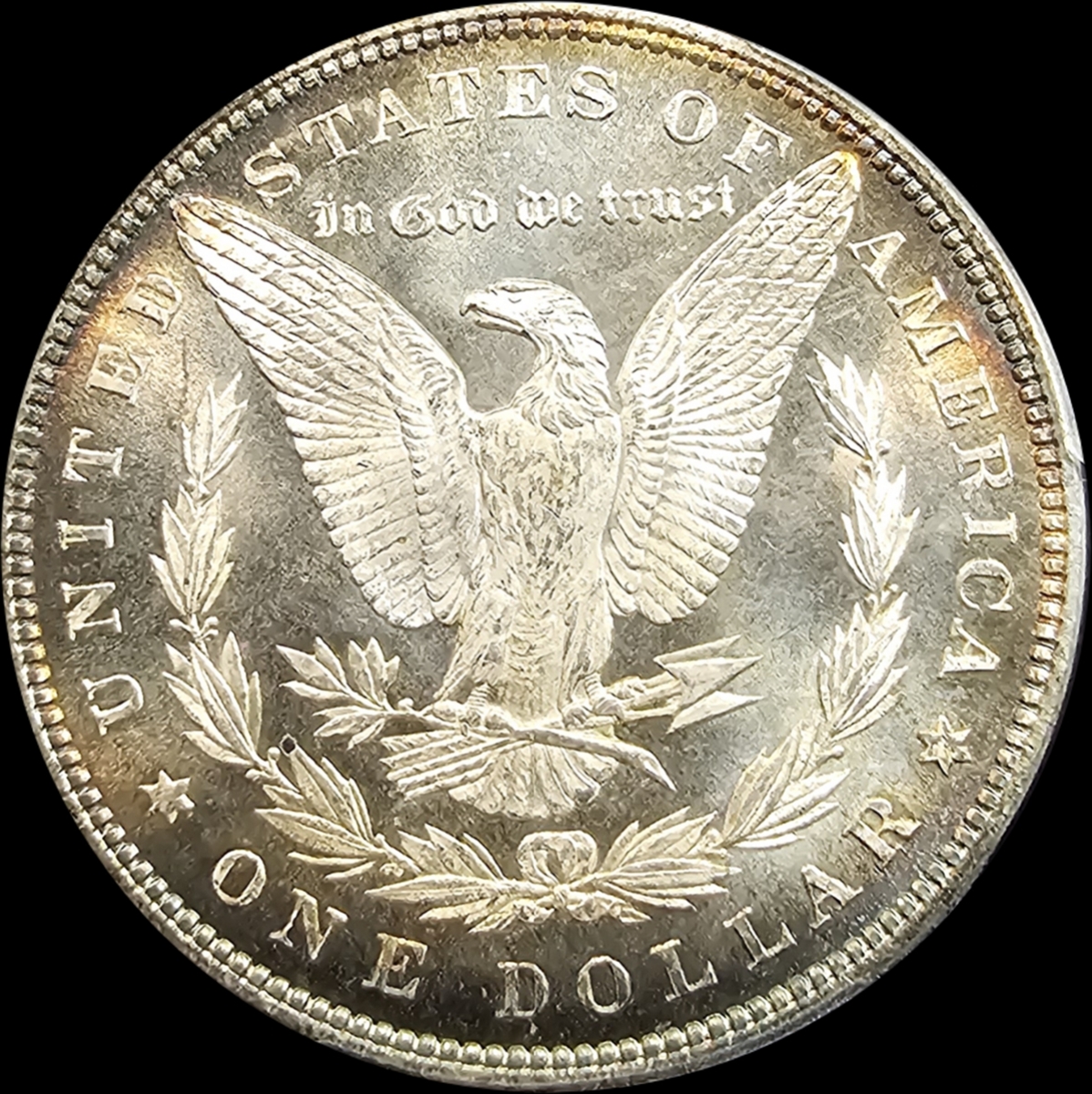
A flashy gem, rim toned in blue and purple on the obverse and PL on the reverse, this Morgan was a crossover from an older ANACS holder.
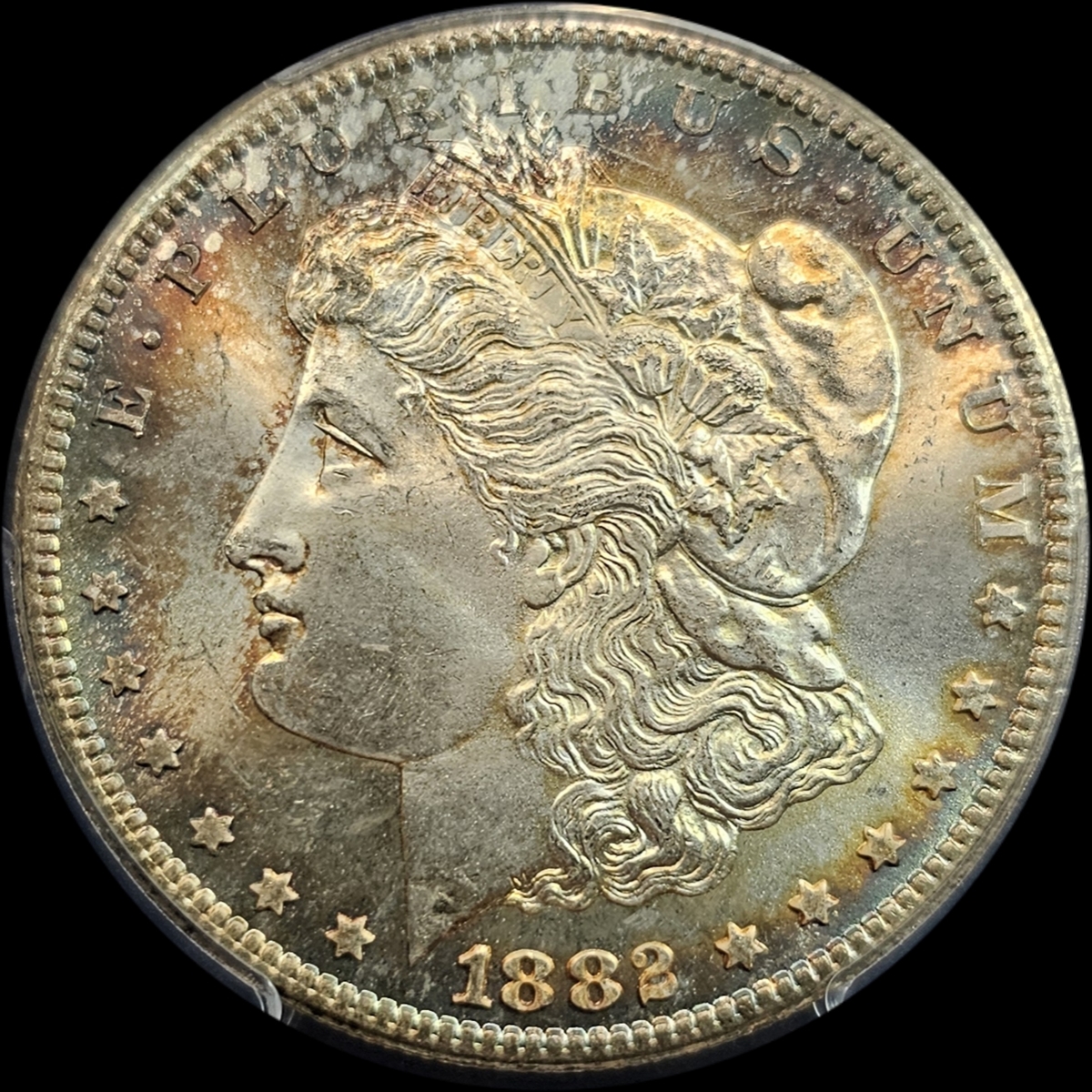
Album rim toning encircles the obverse and reverse in shades of blue and yellow.
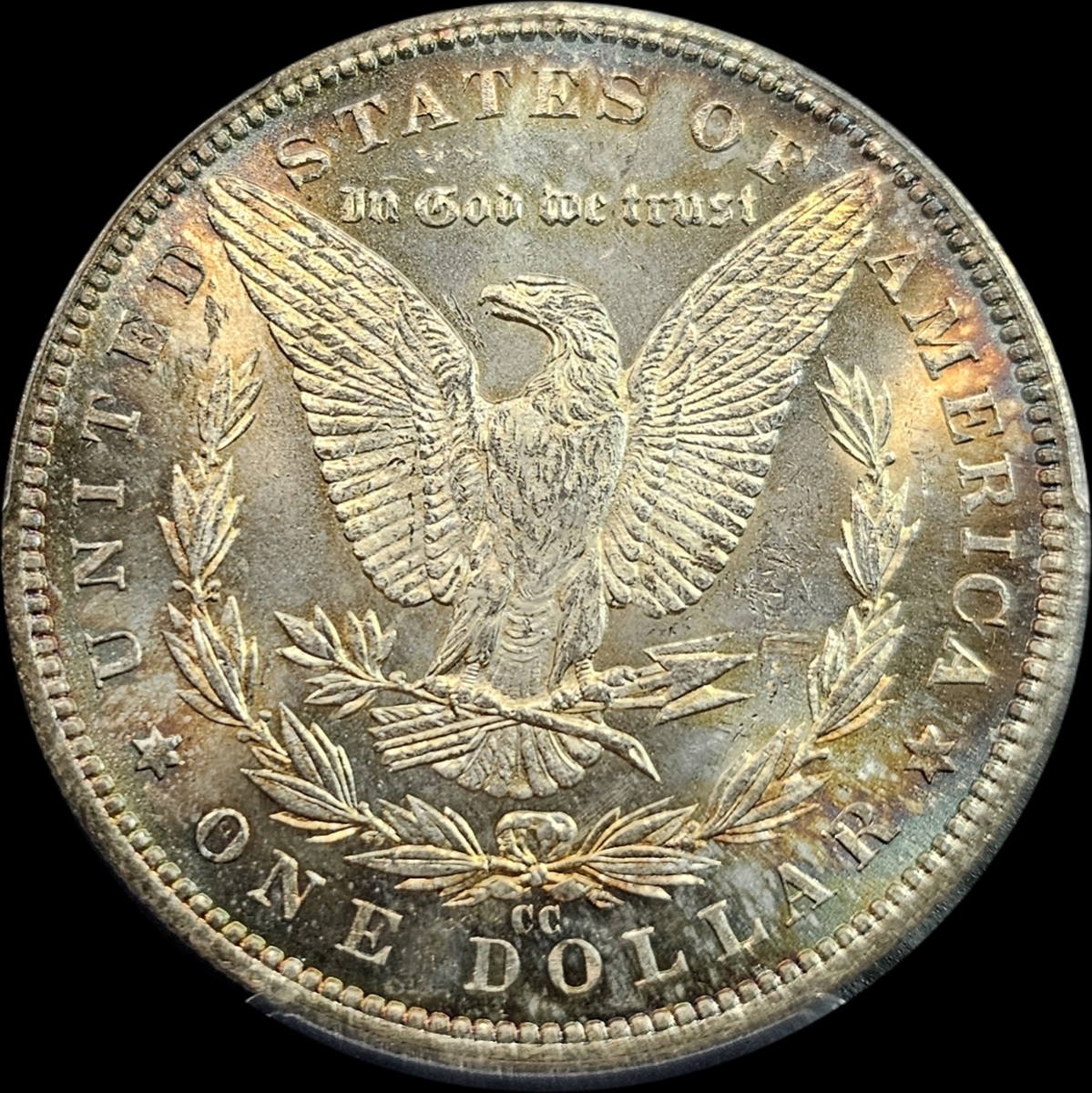
Album rim toning encircles the obverse and reverse in shades of blue and yellow.
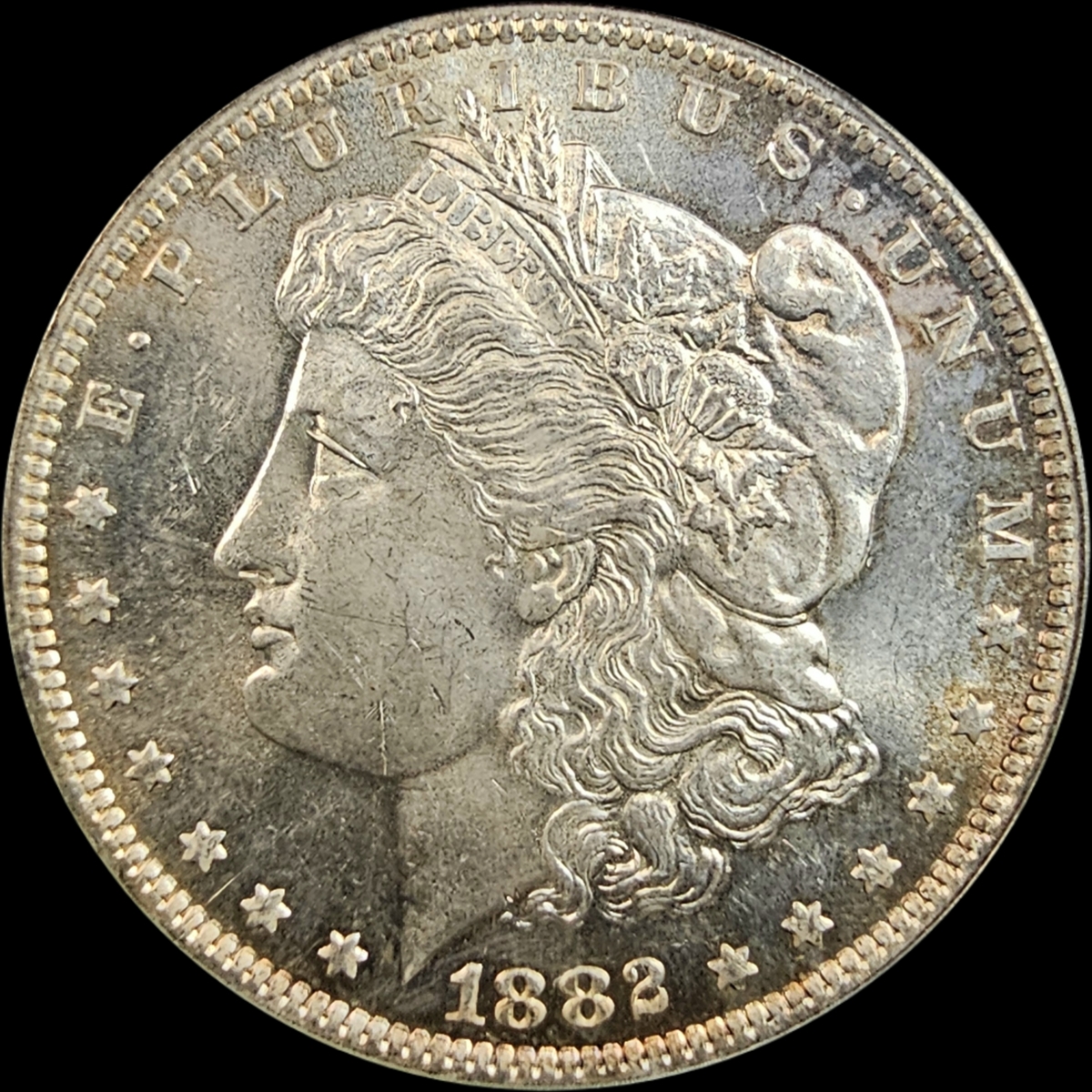
Bright, clean obverse, lustrous reverse. Some edge toning on both sides frames the devices of this nicely struck New Orleans issue. The 1882-O Silver Dollar is a common date but, because it comes from the New Orleans Mint, it is difficult to locate in Gem condition. The typical Mint State grade for an 1882-O Morgan Dollar is this grade, MS-63, reflective of the typical poor strike associated with this mint.
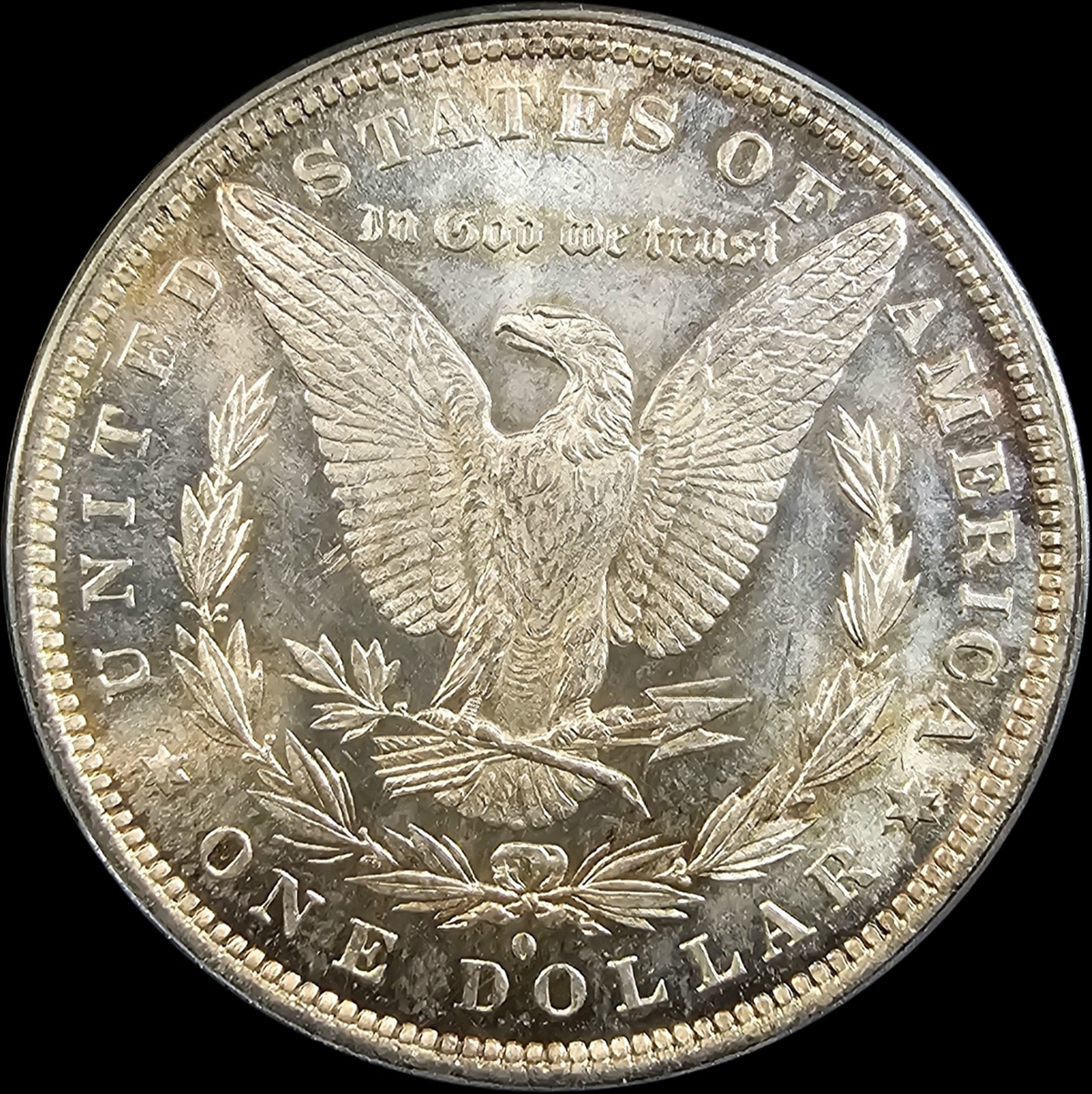
Bright, clean obverse, lustrous reverse. Some edge toning on both sides frames the devices of this nicely struck New Orleans issue. The 1882-O Silver Dollar is a common date but, because it comes from the New Orleans Mint, it is difficult to locate in Gem condition. The typical Mint State grade for an 1882-O Morgan Dollar is this grade, MS-63, reflective of the typical poor strike associated with this mint.
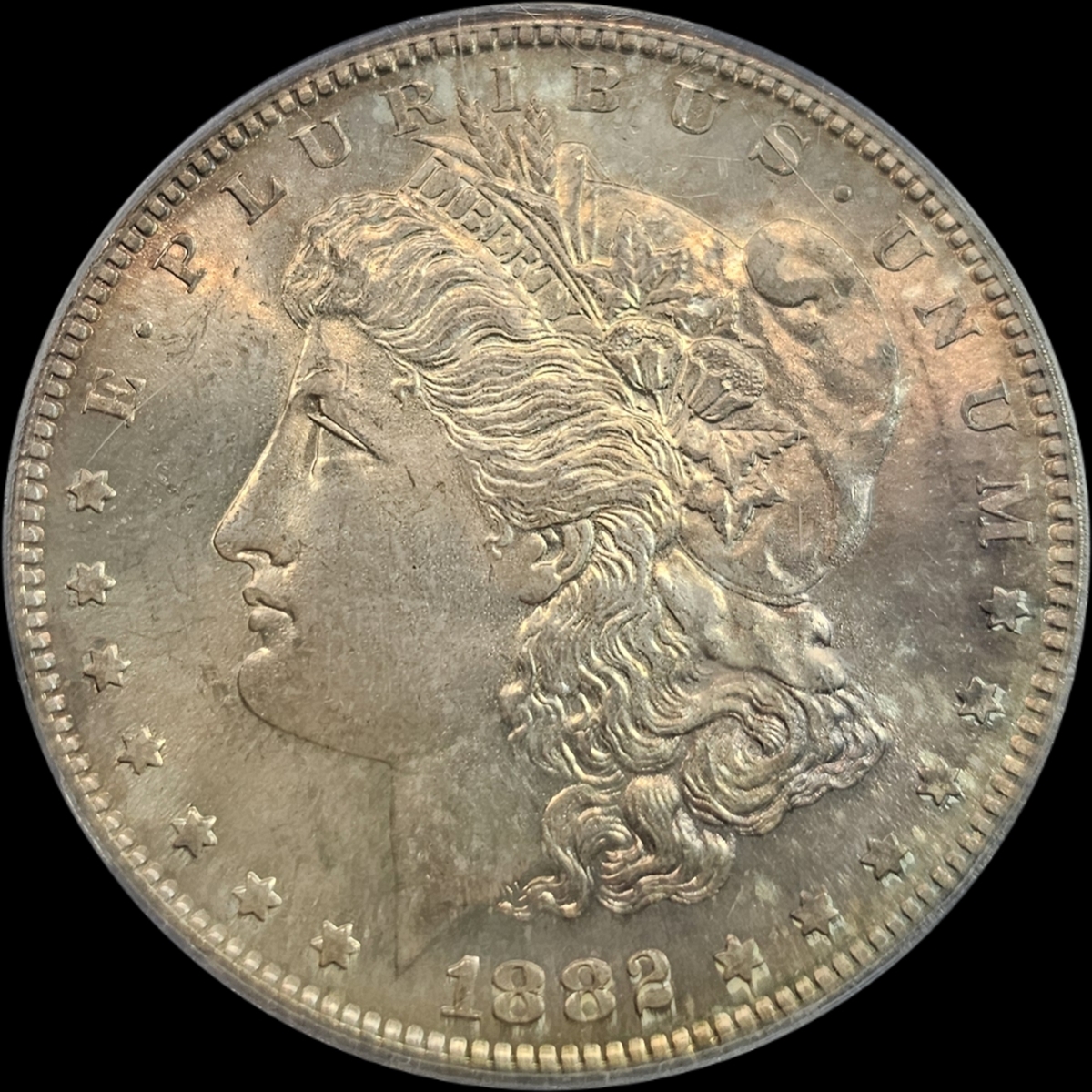
Lavender & orange toned areas on the obverse accent a clean, mark-free Liberty. The reverse is white.
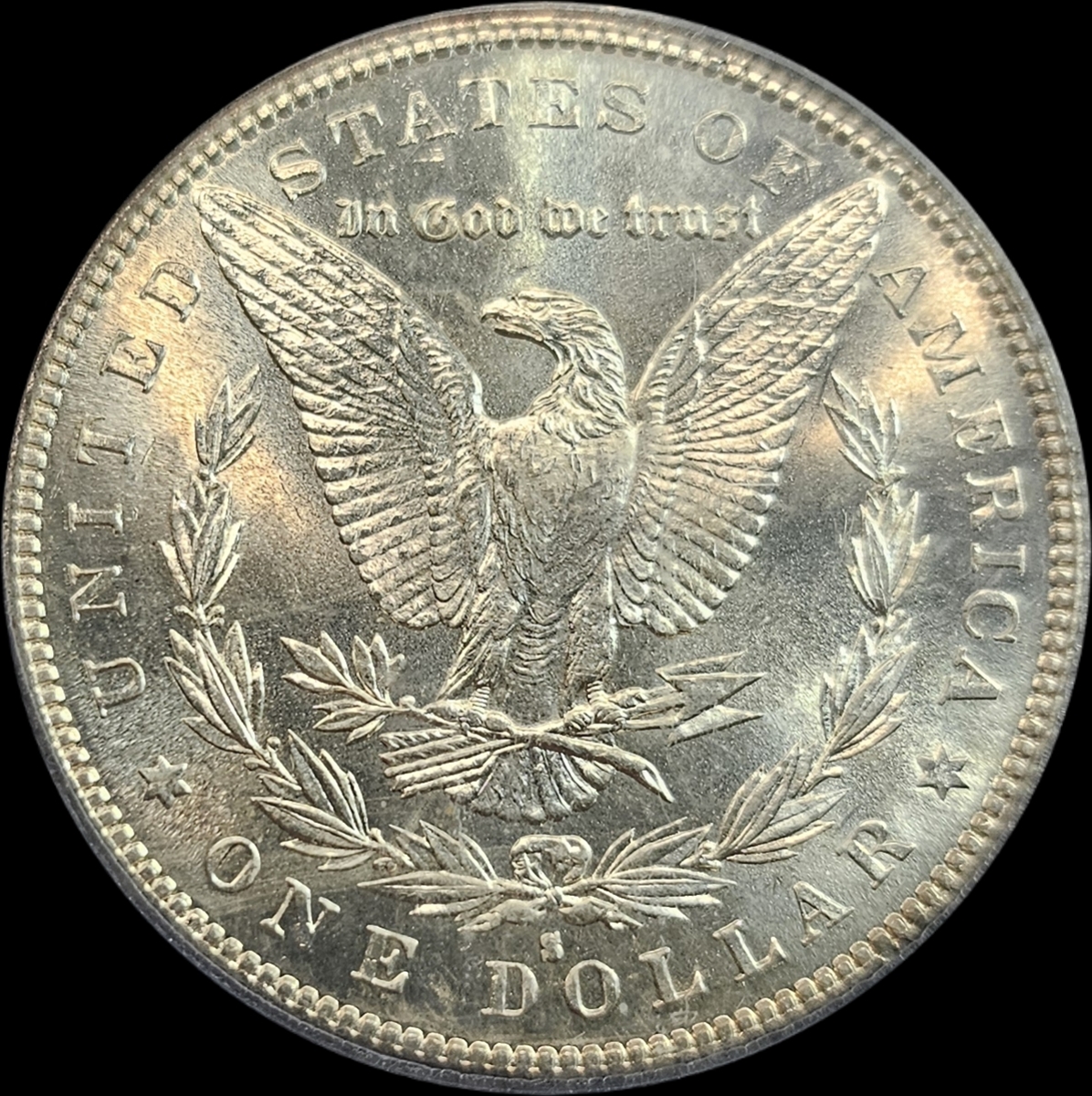
Lavender & orange toned areas on the obverse accent a clean, mark-free Liberty. The reverse is white.
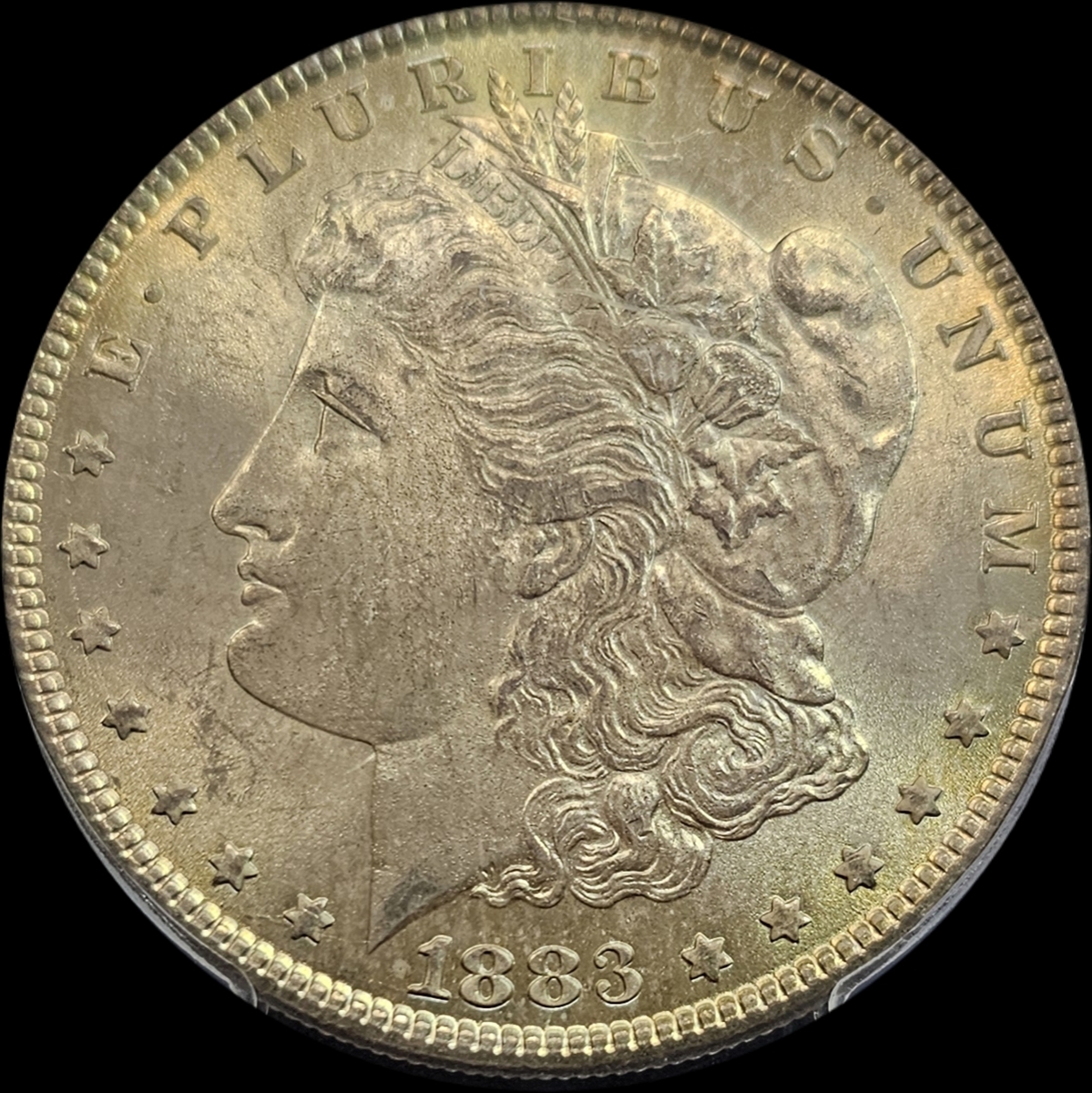
Described as "oyster shell" toning, this Morgan dollar has consistent golden and lavender toning on both the obverse and reverse giving it a skin of muted luster.
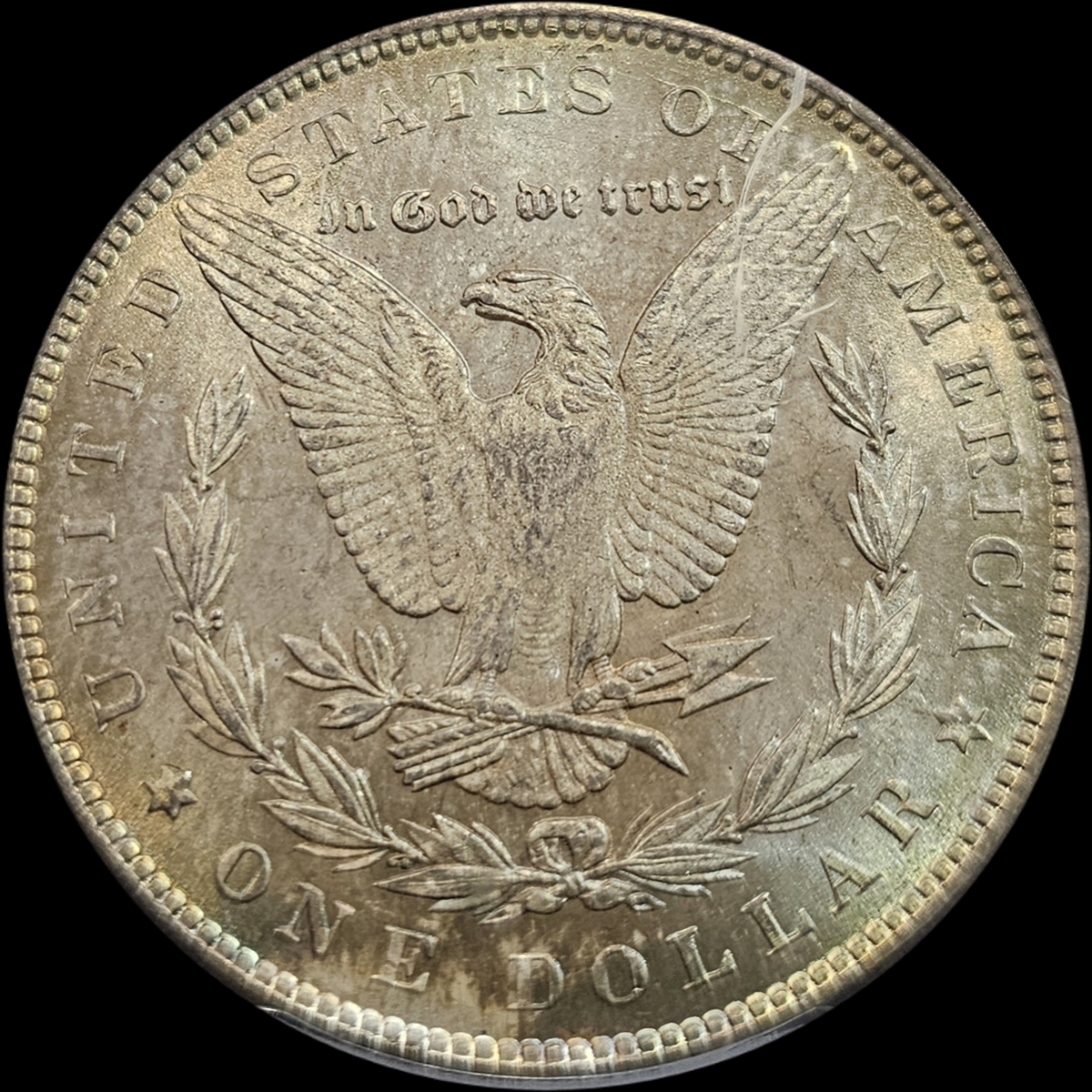
Described as "oyster shell" toning, this Morgan dollar has consistent golden and lavender toning on both the obverse and reverse giving it a skin of muted luster.
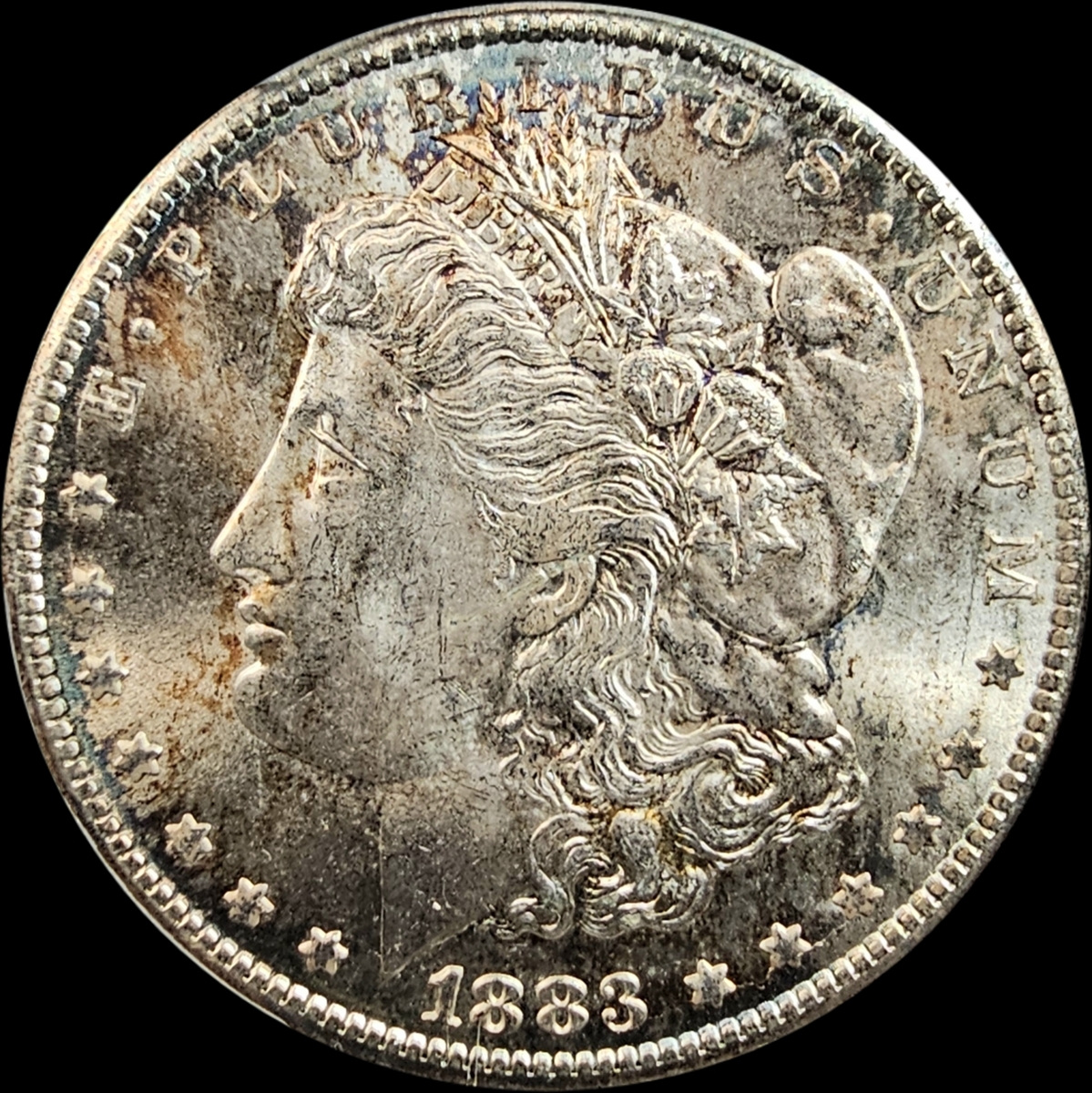
Blotchy, discontinuous toning on the reverse and obverse on this upgraded coin from MS64 ANACS to PCGS MS64+.
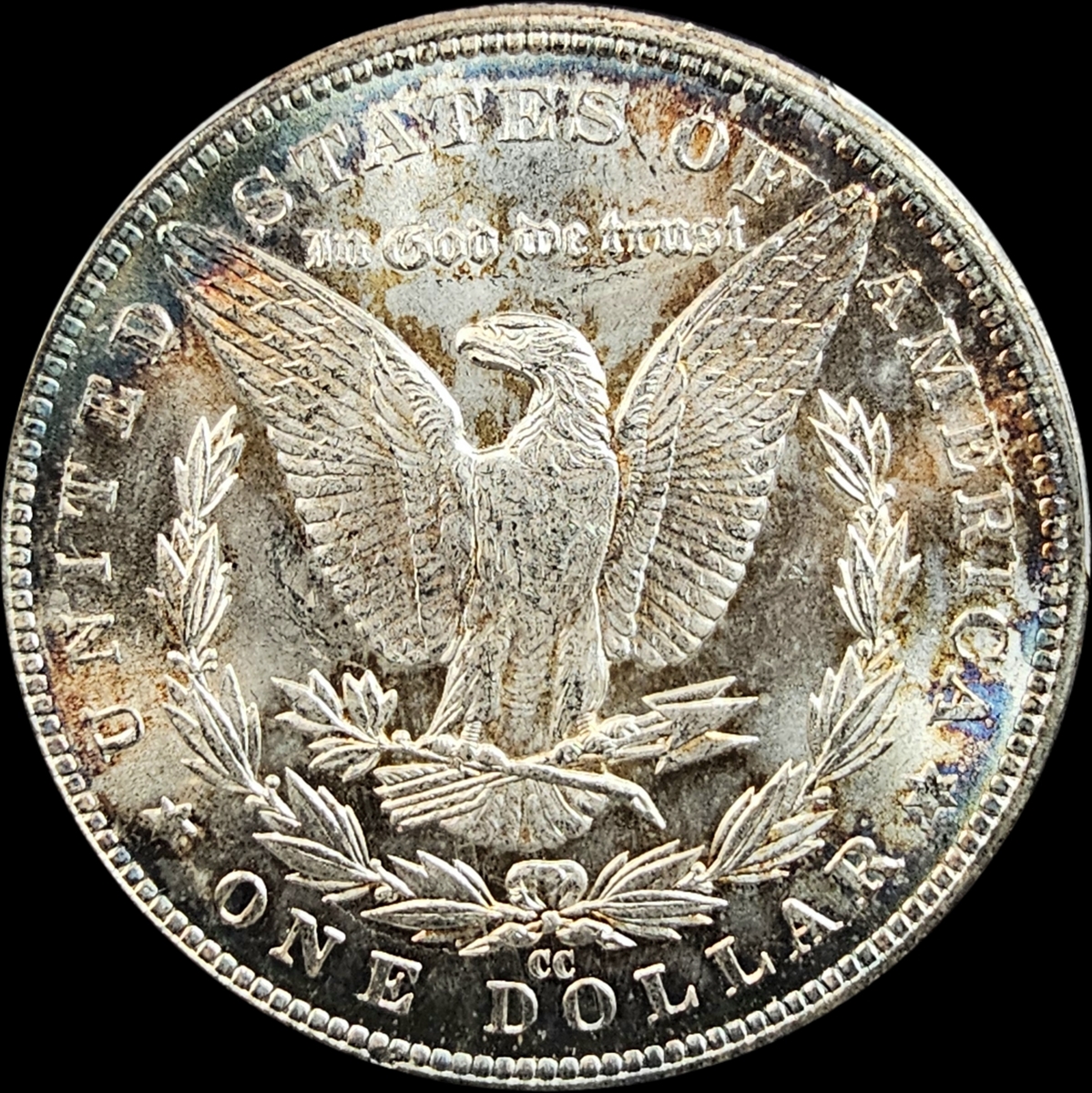
Blotchy, discontinuous toning on the reverse and obverse on this upgraded coin from MS64 ANACS to PCGS MS64+.
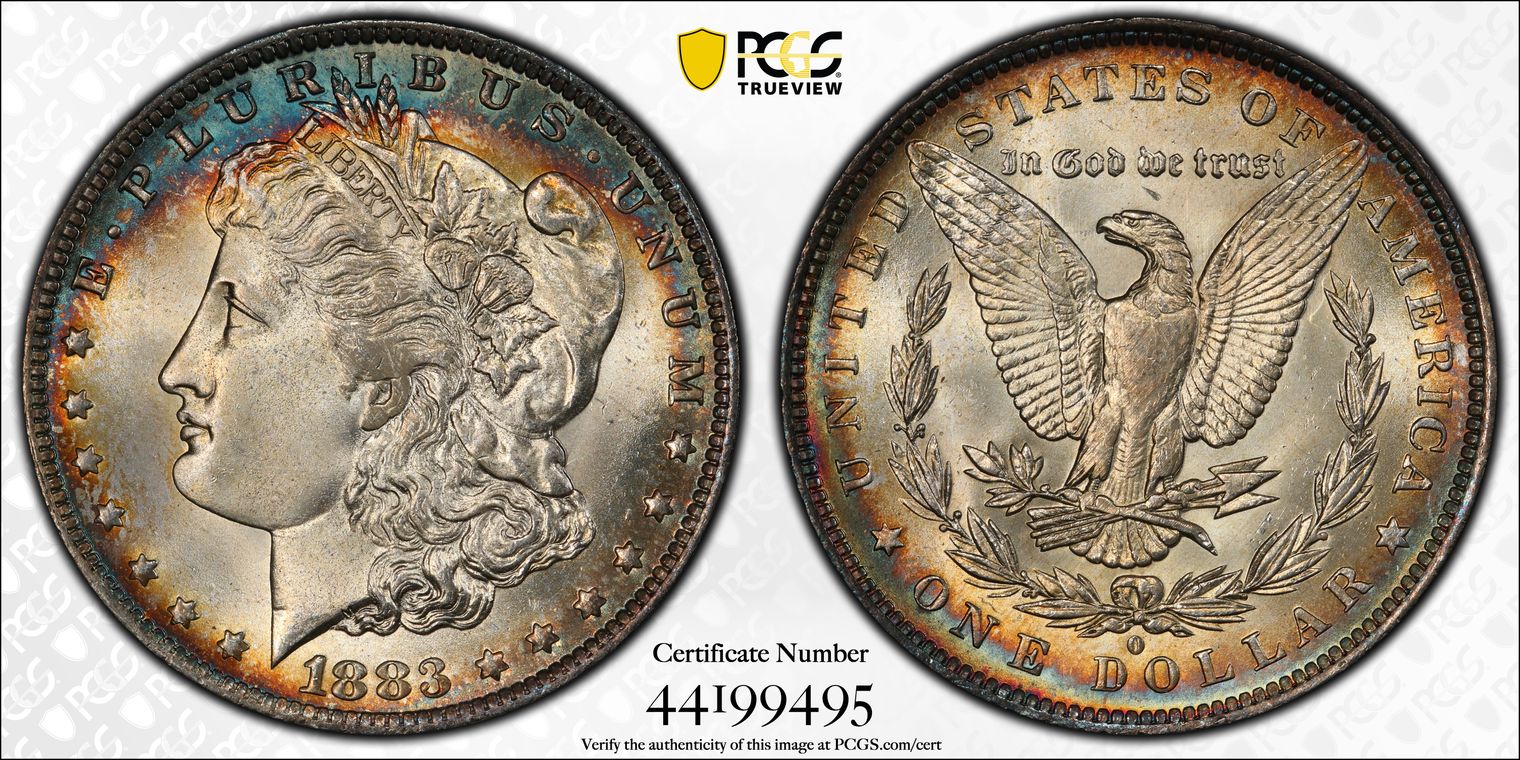
A highly attractive Premium Gem distinguished by vibrant satiny luster, carefully balanced peripheral color, and unusually clean surfaces, though with the central striking softness characteristic of many New Orleans Morgan dollars. The coin’s appeal rests principally in its preservation, originality, and visual composition rather than in exceptional design definition. The obverse displays largely brilliant silver-gray centers surrounded by an appealing border of teal-blue, amber, russet, rose, and deeper charcoal tones. The color is strongest across the upper border and along the lower left periphery, creating a broad natural frame around Liberty. The transitions are somewhat irregular rather than perfectly concentric, lending the toning an organic appearance. Despite the depth of the border color, the central surfaces remain open and luminous. The reverse is similarly attractive, with predominantly brilliant centers framed by warm gold, copper-orange, blue, and burgundy accents. The color is especially vivid along the lower border and at the upper rim, while the eagle remains largely silver-white. Obverse and reverse are well matched in overall character, though the obverse carries the greater visual drama. The strike is typical of the issue rather than exceptional. Liberty’s hair above the ear is softly defined, with several curls merging together and lacking the crisp separation seen on sharply struck San Francisco dollars. Additional softness is evident through portions of the cotton leaves and central hair detail. Subtle roller marks cross the central obverse, most readily visible over Liberty’s cheek and adjacent portrait area. These are mint-made planchet characteristics rather than post-striking abrasions, but they affect the smoothness and completeness of the central presentation. The reverse eagle also exhibits characteristic New Orleans weakness. The breast is broadly flat, with only limited feather delineation, while portions of the upper legs and adjoining central detail remain shallow. The wing feathers, wreath, lettering, and peripheral elements are much more sharply rendered, producing a strong outer impression around a softer center. Luster is one of the coin’s principal strengths. Broad, satiny cartwheels move readily across both sides, with the peripheral toning remaining sufficiently translucent to allow the underlying mint bloom to show through. The texture is softer and silkier than the hard, crystalline frost often encountered on early San Francisco Morgans. The light rolls across the fields rather than flashing sharply from them, giving the coin a warm and inviting appearance.
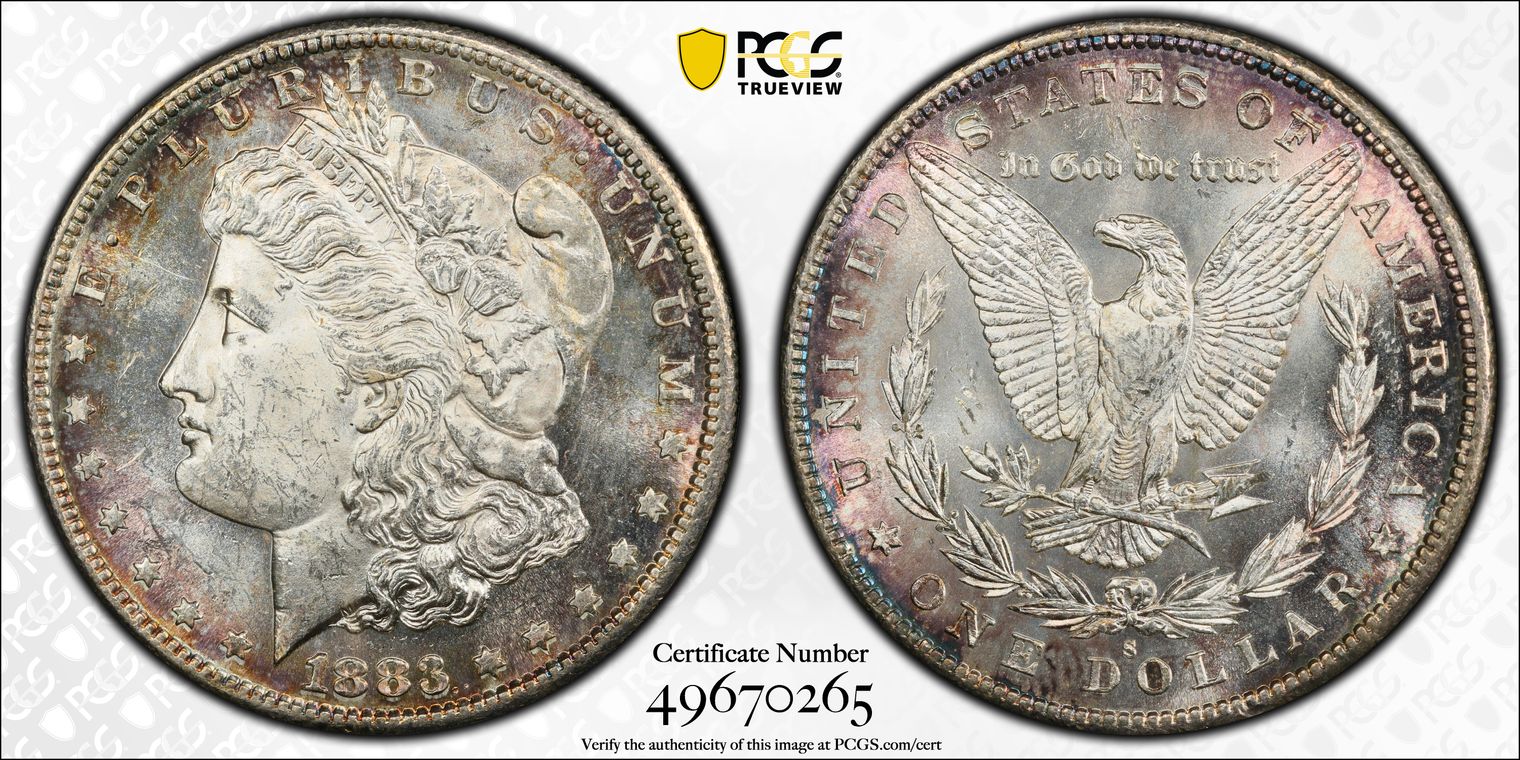
Although assigned a modest numeric Mint State grade, this 1883-S occupies an entirely different collecting landscape from the common San Francisco issues of the early 1880s. Its significance lies not in absolute technical perfection, but in the remarkable fact that it escaped the heavy commercial use that claimed the overwhelming majority of its contemporaries. Brilliant satiny surfaces are complemented by delicate peripheral iridescence in shades of dove gray, pale gold, lavender, and soft cobalt, particularly evident around the obverse and reverse borders. The toning remains light and entirely natural, imparting just enough color to frame the design while allowing the vibrant underlying luster to dominate the presentation. Unlike heavily patinated examples, this coin retains an unmistakably fresh Mint State appearance. Strike quality is exceptional, as expected from the San Francisco Mint during this period. Liberty's hair is sharply defined throughout, with crisp detail in the cotton blossoms, leaves, and cap folds. The reverse eagle is equally bold, displaying strong breast feather definition, sharply impressed wings, and fully articulated wreath details. Luster is unquestionably among the coin's greatest strengths. Vibrant cartwheel brilliance rolls energetically across both sides, exhibiting the lively, frosty character that advanced Morgan collectors prize. The delicate peripheral toning serves only to accentuate the brilliance beneath, creating a dynamic interplay of light and color as the coin is rotated. Surface preservation reflects the realities of the assigned grade. Several noticeable contact marks and scattered abrasions are present in the obverse fields and across Liberty's cheek, while the reverse exhibits additional bagmarks consistent with long-term storage among large quantities of silver dollars at the Treasury. Importantly, these marks are entirely consistent with a Mint State designation and do little to diminish the coin's overall visual appeal. Indeed, for this celebrated rarity, the opportunity to acquire such vibrant luster and fully original surfaces often outweighs the pursuit of incremental technical refinement.
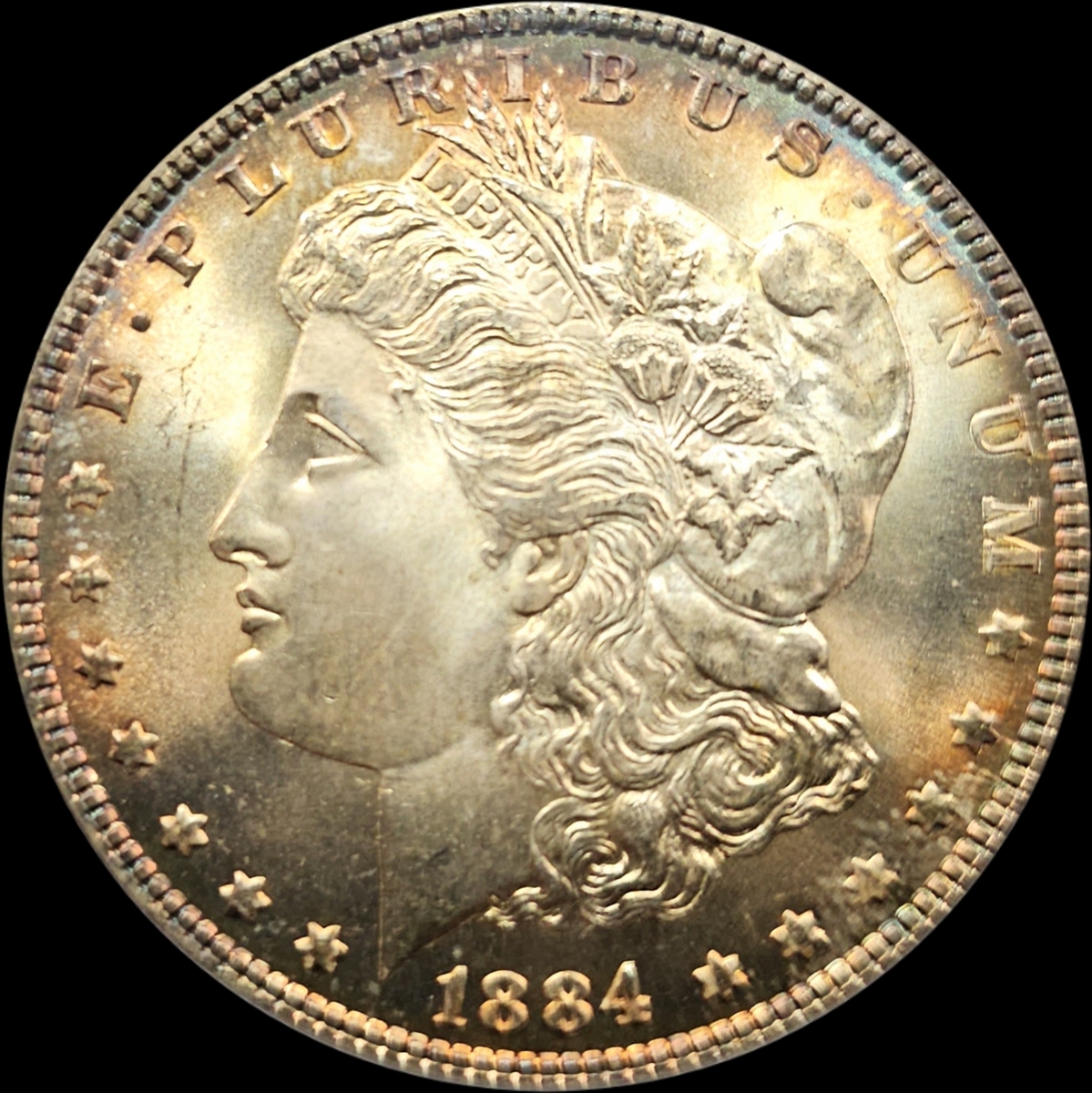
Blue and russet album toning encircle the obverse and reverse exactly the way it should.
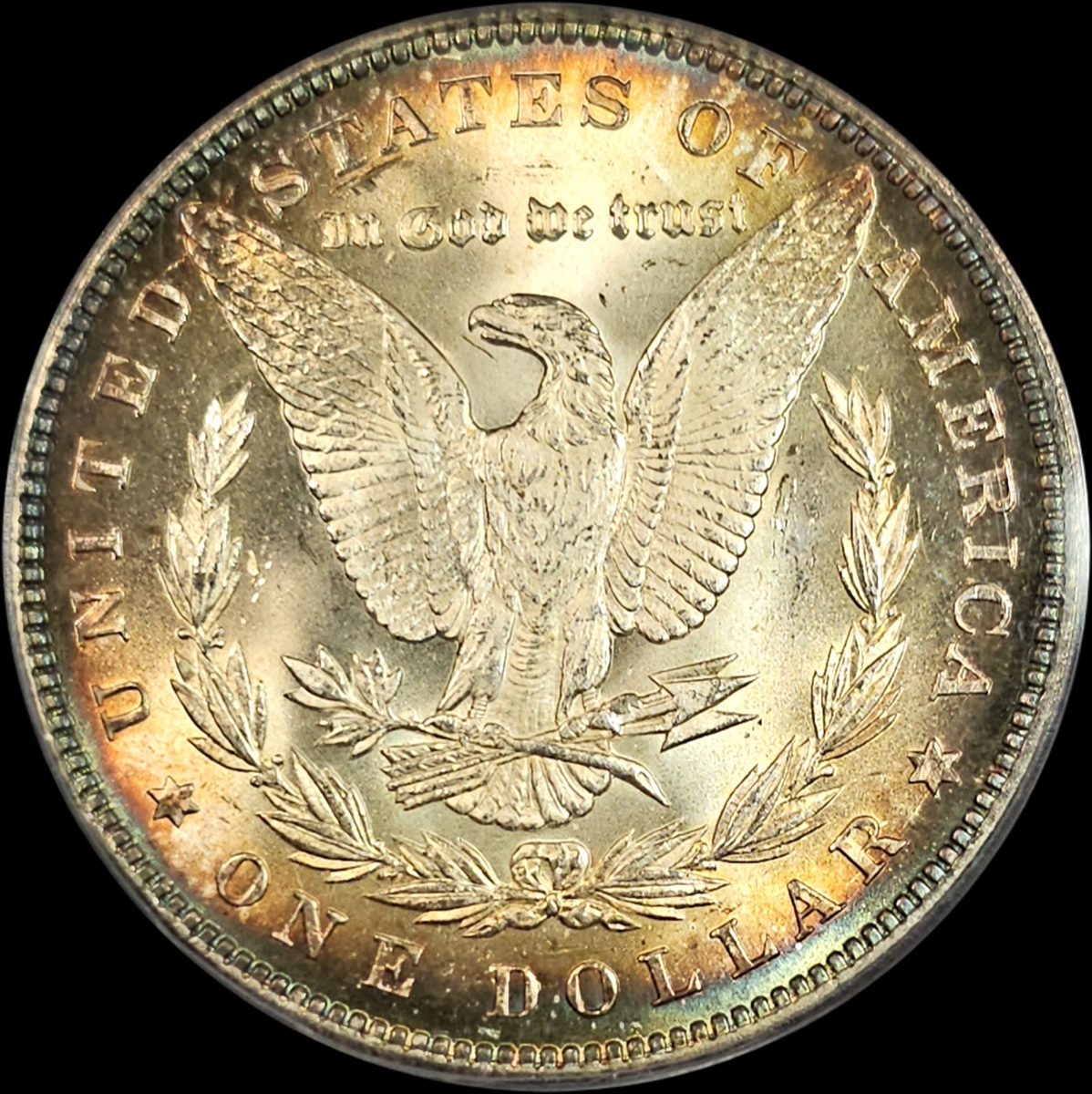
Blue and russet album toning encircle the obverse and reverse exactly the way it should.
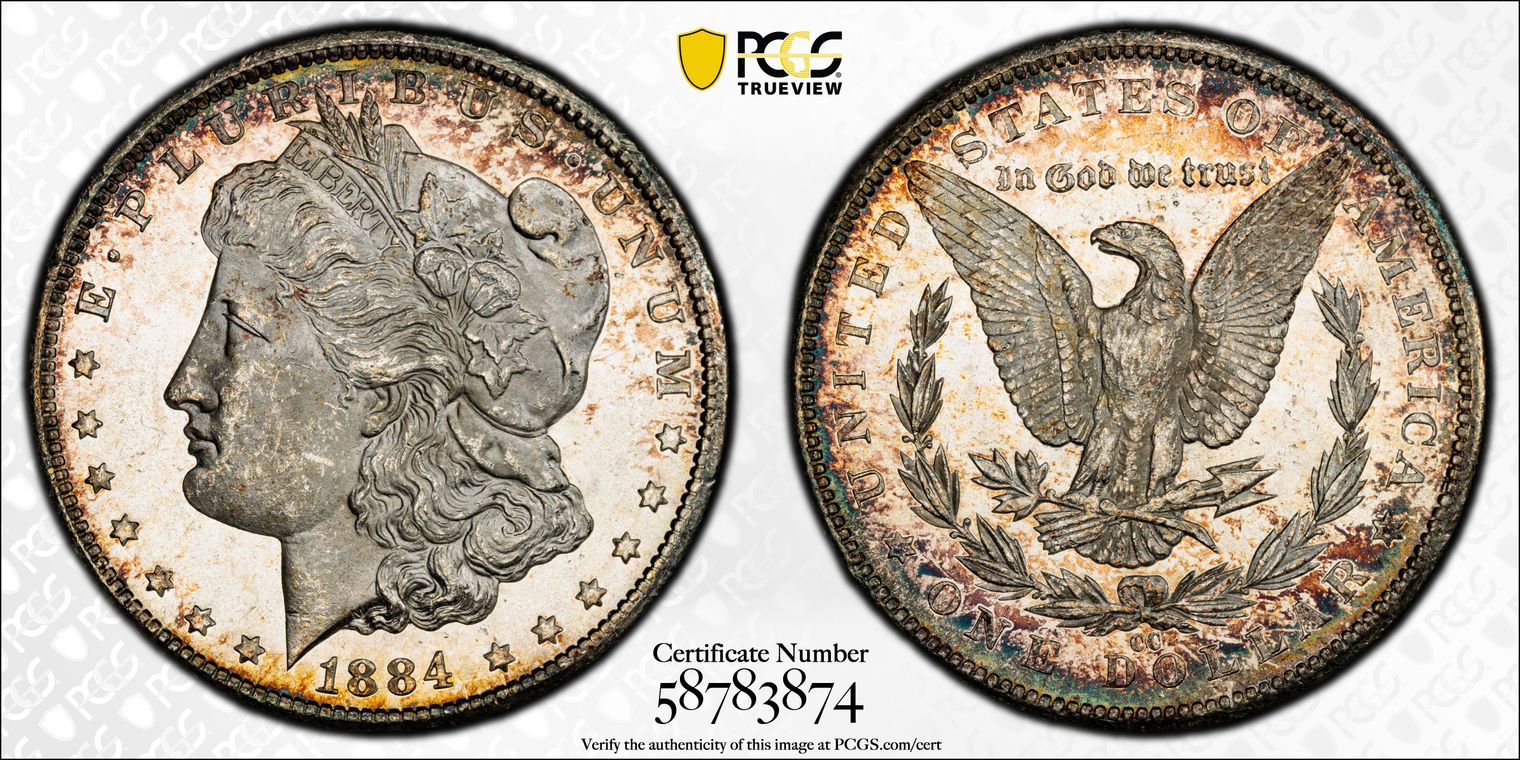
A magnificent gem Carson City Morgan whose extraordinary originality, booming cartwheel luster, and dramatic natural toning combine to produce an example of exceptional visual distinction. The softly contrasted obverse presents an almost cameo-like appearance, while the richly textured reverse displays the kind of complex peripheral patina that has made beautifully preserved Carson City dollars perennial favorites among advanced collectors. The obverse immediately commands attention through its striking interplay of brilliant silver frost and deeply matured peripheral color. Liberty's portrait remains largely brilliant, standing in bold relief against a surrounding frame of charcoal-gray, chestnut, amber, cobalt, and olive patina concentrated along the borders and within portions of the legend. The effect is almost cameo-like, with the luminous central portrait emerging from a naturally darkened frame. Delicate russet and golden accents scattered throughout the fields contribute additional warmth without disrupting the remarkable balance of the composition. The reverse is equally compelling, though markedly different in character. Here the original patina develops as an intricate tapestry of warm amber, mahogany, violet, olive, and deep cobalt concentrated around the rim and interspersed through the fields in an organic, almost mineral-like pattern. The colorful oxidation frames the boldly struck eagle while preserving vibrant underlying brilliance, resulting in exceptional visual depth and unmistakable originality. Strike quality is outstanding throughout. Liberty's hair is crisply rendered from forehead to ear, the cotton blossoms and leaves exhibit bold definition, and the reverse eagle displays sharp breast feather detail with fully articulated wings and wreath. Every major design element reflects the excellent die preparation and striking quality for which many surviving Carson City Morgan dollars are admired. Luster is unquestionably among the coin's defining attributes. Powerful frosty cartwheel brilliance radiates across both sides, remaining vibrant despite the extensive natural toning. Unlike coins whose color suppresses reflectivity, this specimen retains tremendous vitality beneath its original patina, creating a dynamic interaction between light and color that continuously changes as the coin is rotated.
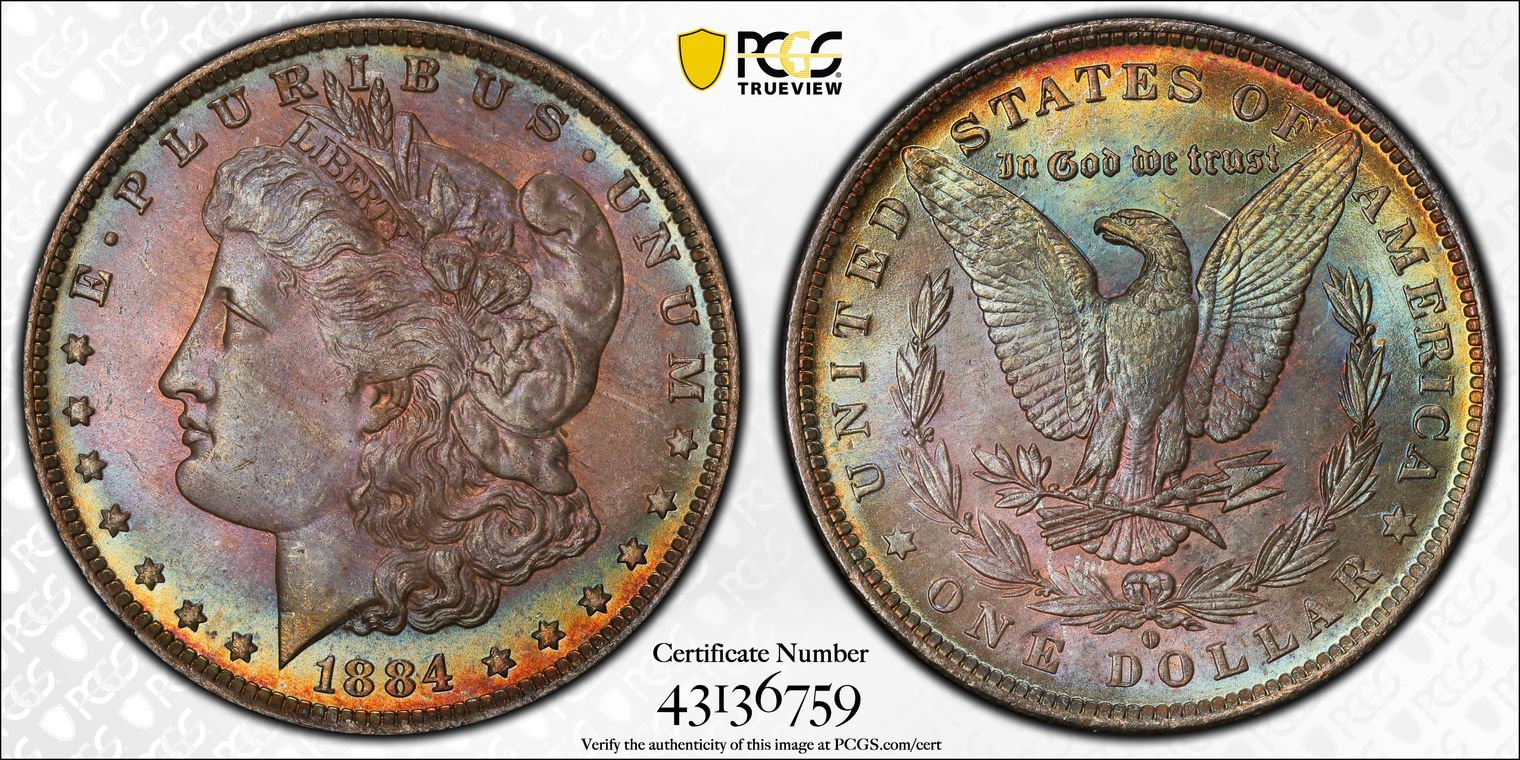
This Superb Gem 1884-O is enveloped in an exceptionally even mantle of iridescent antique patina that transforms what is already one of the finest-produced New Orleans issues into a coin of extraordinary visual sophistication. Both obverse and reverse are adorned with richly blended shades of lavender, rose, champagne-gold, olive, and soft turquoise, accented by warmer amber and burnt-orange highlights concentrated near portions of the periphery. Unlike the dramatic crescent toning so often encountered on Morgan dollars, the color here has developed with striking uniformity across nearly the entire surface, producing a harmonious palette that shifts subtly as light moves across the fields. The toning remains sufficiently translucent to reveal vibrant underlying mint frost, preserving every nuance of the original surfaces. The strike is outstanding for the issue. Liberty's hair above the forehead and ear is boldly rendered, with crisp separation throughout the curls, cotton leaves, and floral devices. The reverse eagle displays unusually sharp breast definition for an 1884-O, while the wings, wreath, and arrow shafts are all fully impressed. The eagle is washed in soft aqua, pale violet, and warm gold that seem to radiate outward from the center. There's a painterly quality to it that reminds one of the atmospheric backgrounds in late-19th-century American landscape paintings.
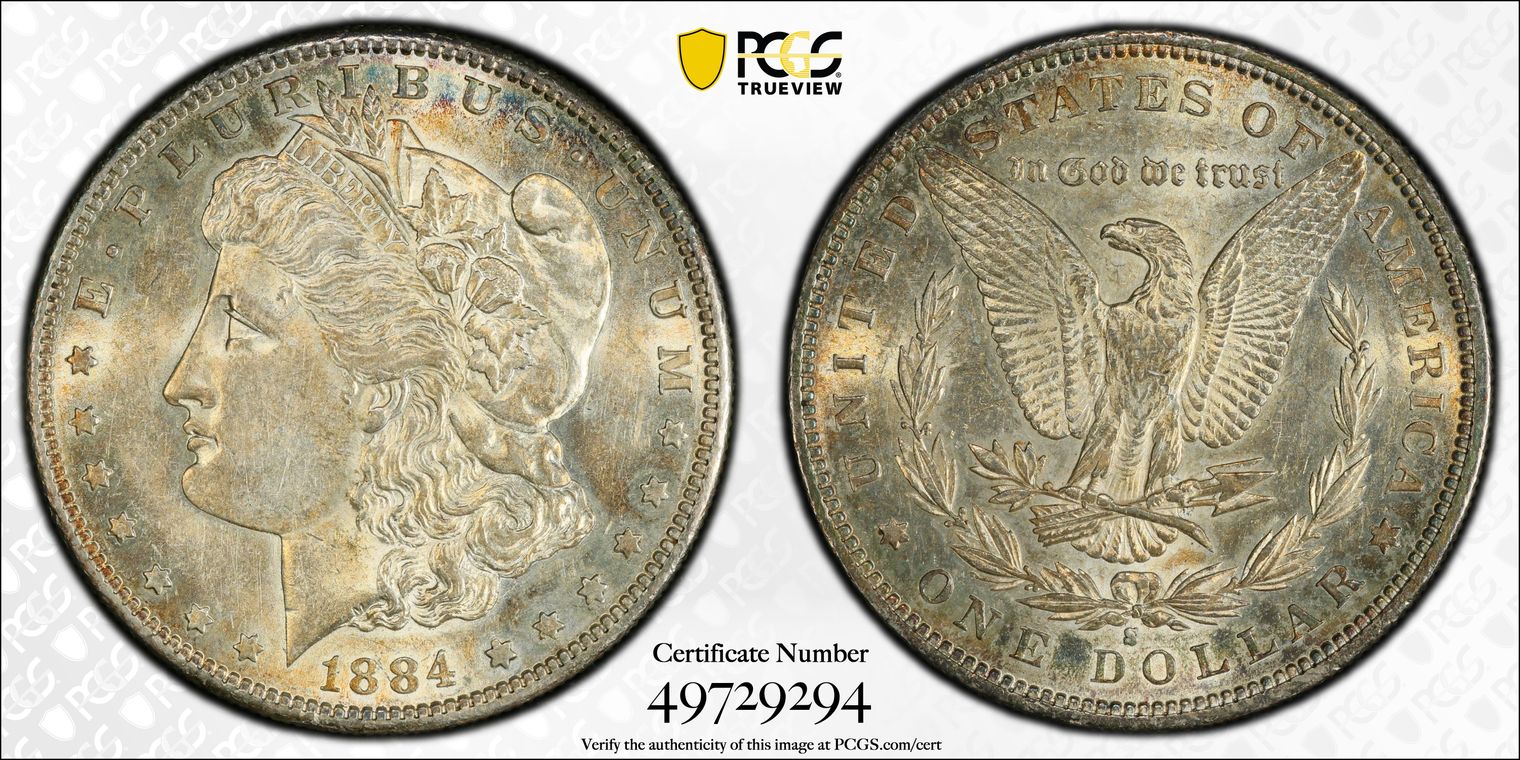
A remarkably attractive About Uncirculated survivor of one of the Morgan dollar series' most celebrated condition rarities. Distinguished by exceptional originality, softly glowing satiny luster, and honest circulation confined primarily to the highest points, this handsome 1884-S possesses the unmistakable character of a coin that narrowly escaped the fate shared by nearly every other example of the issue. The obverse displays a warm silver-gray complexion accented by delicate champagne-gold and pale olive overtones that have developed naturally through decades of careful preservation. The fields remain remarkably fresh, while subtle peripheral warmth lends depth without distracting from the overall harmony of the surfaces. The reverse presents complementary shades of antique silver with faint golden and blue-gray highlights concentrated near the borders, preserving the coin's original appearance without the need for dramatic color. Strike quality is fully consistent with the superior standards of the San Francisco Mint. Liberty's hair remains sharply detailed throughout, the cotton blossoms and leaves are boldly impressed, and the reverse eagle displays crisp feather definition, particularly within the wings and wreath. Even after modest circulation, the coin retains the bold architectural quality that distinguishes well-struck San Francisco Morgan dollars. Perhaps the most compelling feature is the surviving luster. The obverse retains a remarkably rich satiny bloom that gathers within the protected contours of Liberty's portrait, creating a soft, almost bowl-like movement of light across the design. Rather than exhibiting the vibrant flash of a Mint State example, the luster has mellowed into a refined glow that beautifully complements the lightly worn surfaces. The reverse preserves somewhat livelier cartwheel characteristics, though similarly softened by decades of careful handling and natural oxidation. Together they create a remarkably balanced visual presentation that speaks more to originality than brilliance. Wear is limited principally to the highest points of Liberty's hair, cheek, and the eagle's breast and legs, leaving the overwhelming majority of the design fully intact. The surfaces remain pleasingly free of significant distractions, exhibiting only the scattered marks expected from brief commercial service. Importantly, the coin has avoided the harsh cleaning, dipping, or impairment that so often afflicts circulated survivors of this rarity.
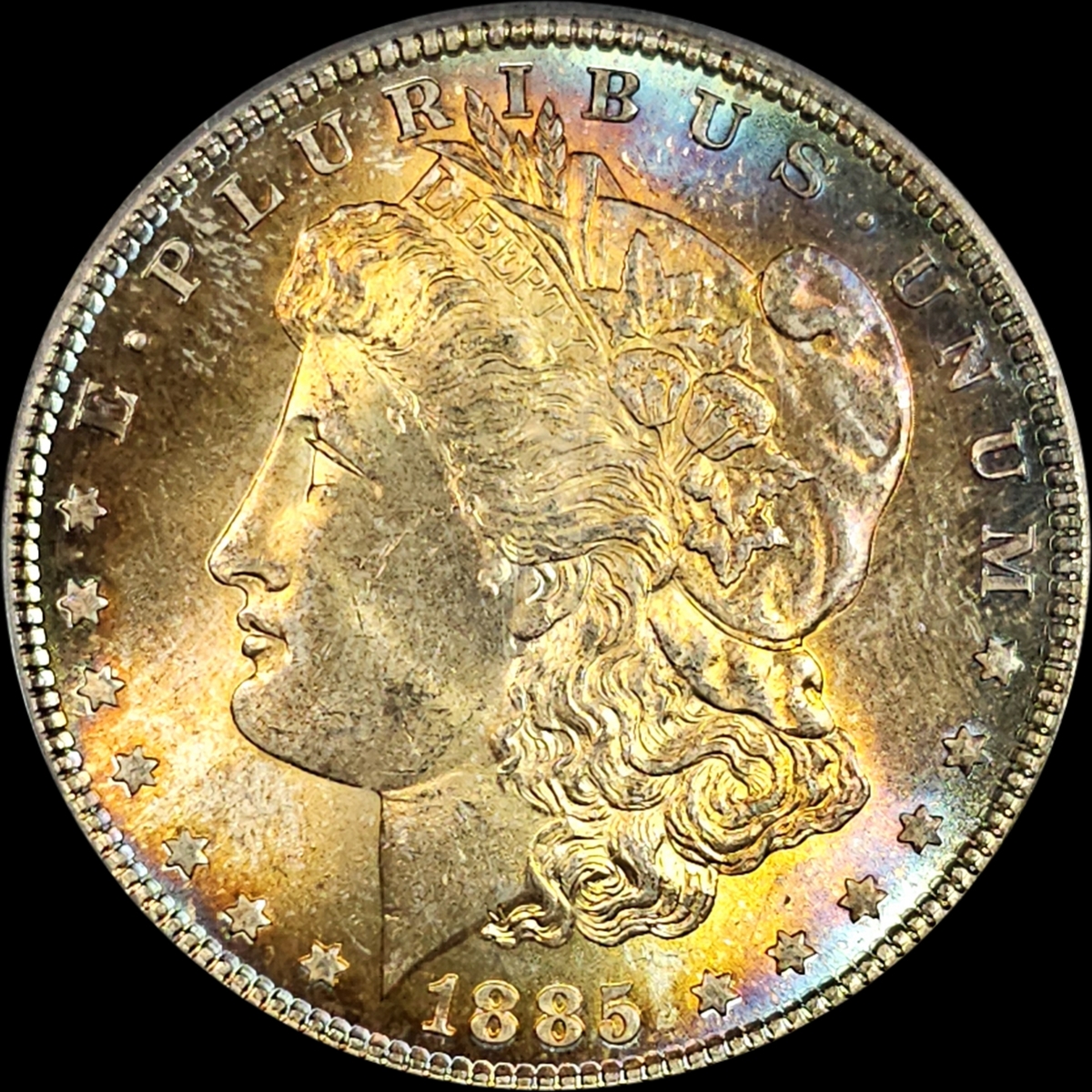
Full rainbow of colors on the obverse starting at the rim and toward the center while a muted rainbow rims the reverse of this flashy dollar.
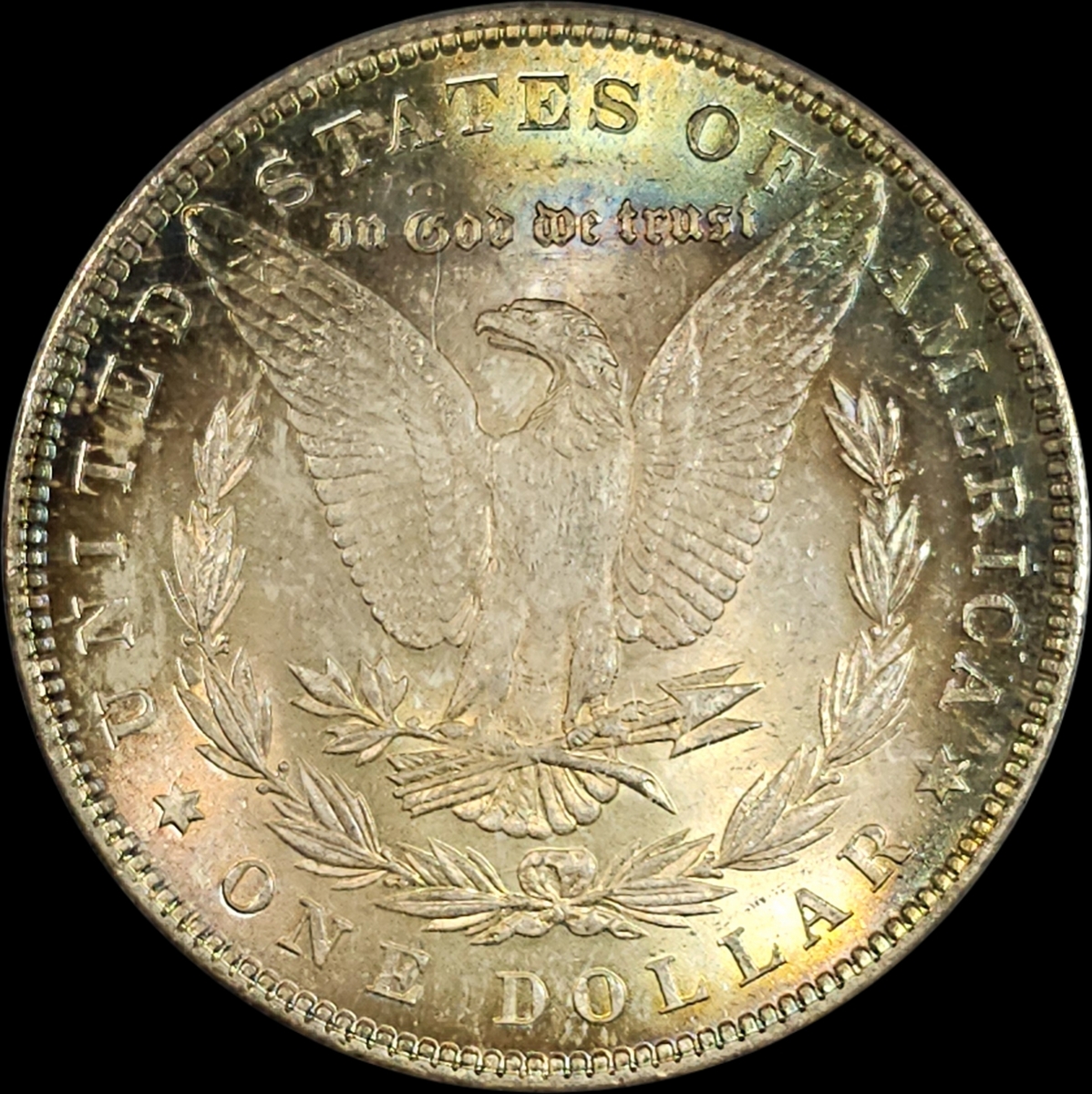
Full rainbow of colors on the obverse starting at the rim and toward the center while a muted rainbow rims the reverse of this flashy dollar.
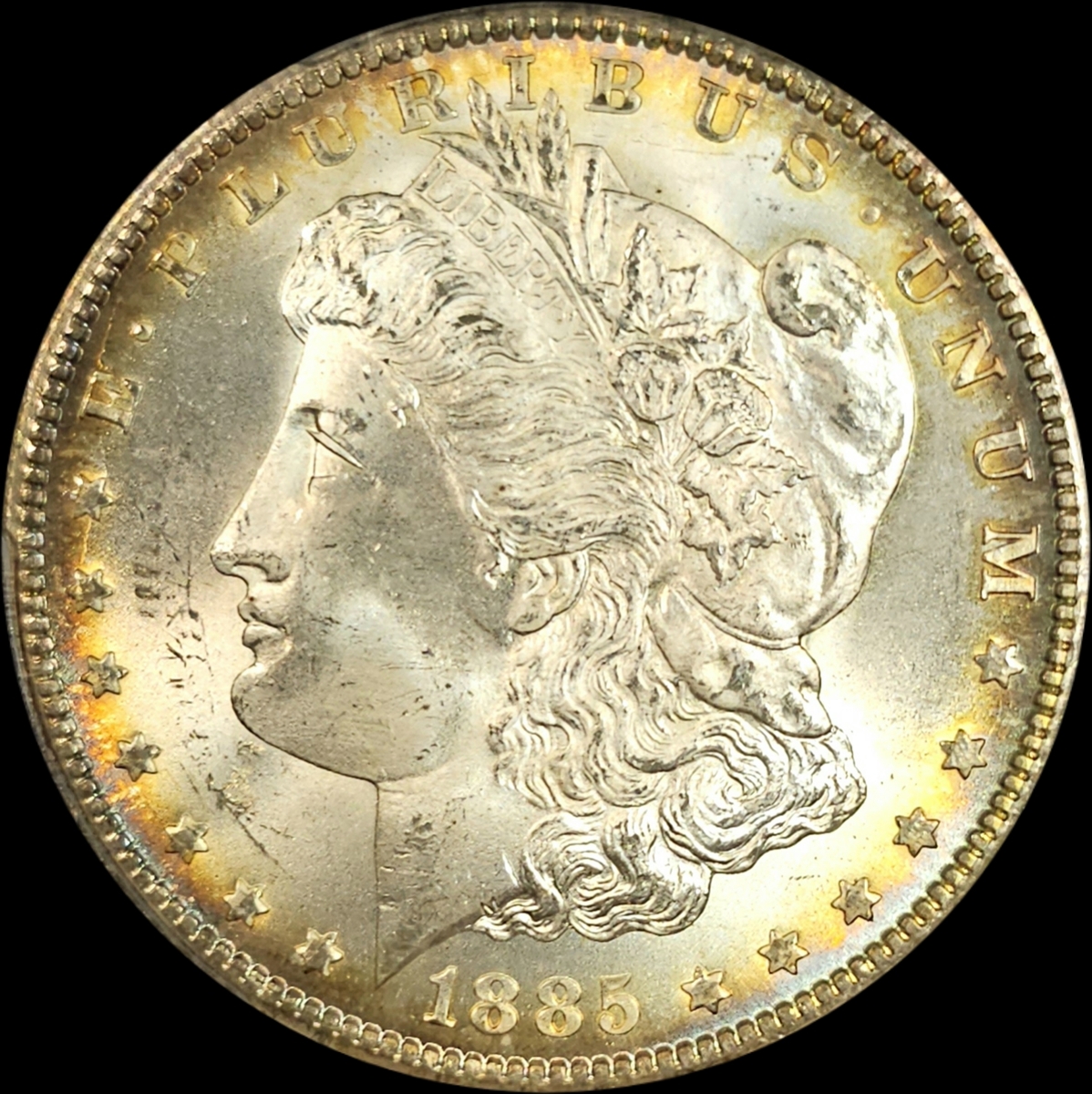
Frosty gem Morgan dollar with a ring of gold on the obverse and a full rainbow of purple and orange glinting on the reverse.
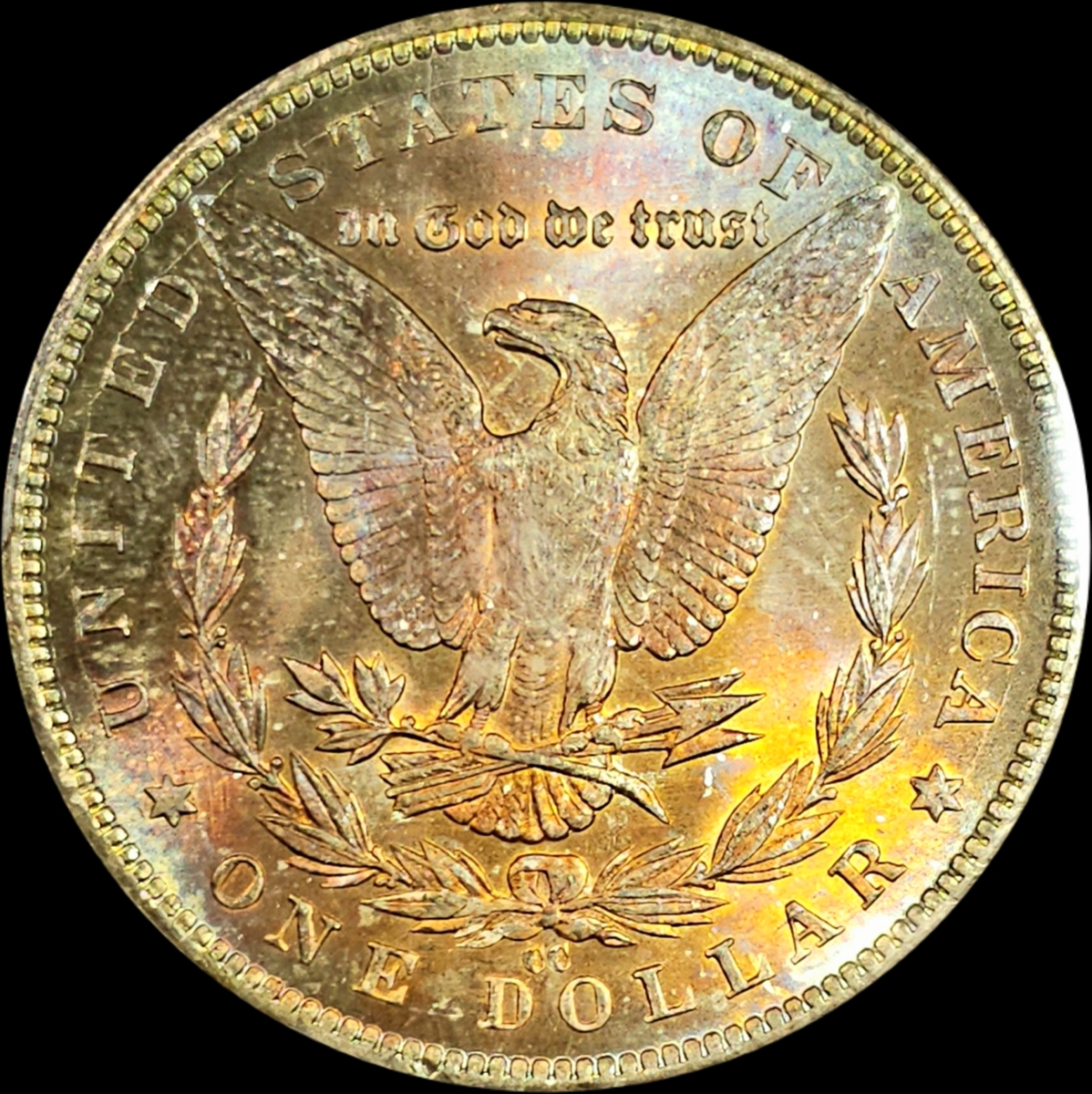
Frosty gem Morgan dollar with a ring of gold on the obverse and a full rainbow of purple and orange glinting on the reverse.
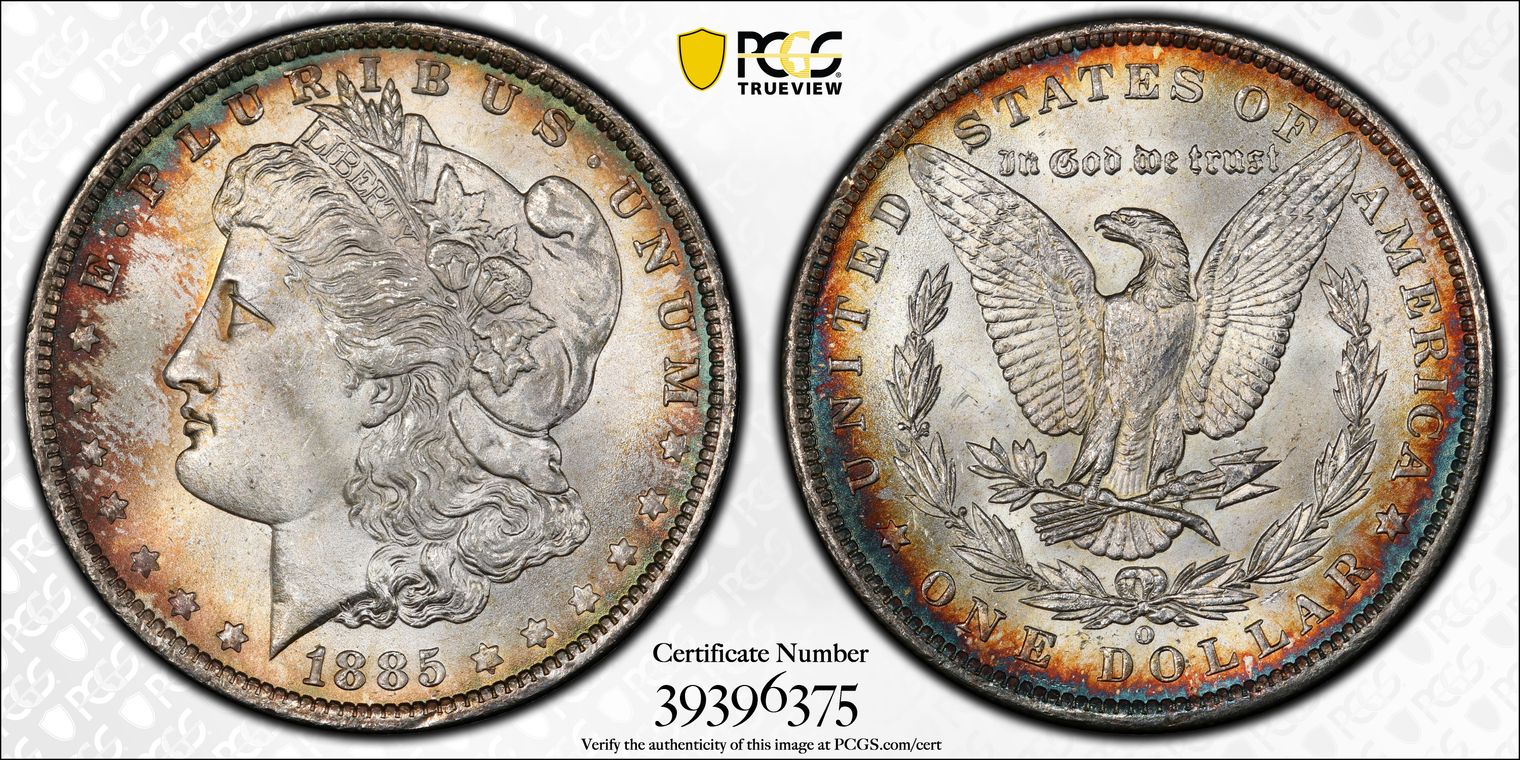
An exceptionally well-preserved Superb Gem representative of this popular New Orleans issue, displaying beautifully original peripheral toning, remarkably clean surfaces, and refined satiny luster. While not possessing the razor-sharp strike or booming frost associated with the finest San Francisco productions, this specimen demonstrates how superior preservation and harmonious originality can elevate an issue whose technical production characteristics are more modest. The obverse presents brilliant silver-white centers framed by richly developed peripheral patina in shades of honey-gold, burnt orange, russet, cobalt, and deep teal. The color follows the rim naturally, with slightly irregular transitions that suggest long-term envelope or album storage rather than dramatic end-roll toning. The central portrait remains largely brilliant, while the colorful border provides a handsome frame without overwhelming the design. The reverse offers an equally attractive counterpart. Warm silver-gray centers give way to concentric bands of amber, crimson, cobalt, and charcoal concentrated along the lower and right borders. The toning is particularly effective in framing the eagle, producing excellent visual contrast while preserving the transparency of the underlying surfaces. Strike quality is better than typically encountered for the issue, though not exceptional in an absolute sense. Liberty's hair above the ear exhibits noticeably more separation than seen on many contemporary New Orleans dollars, yet several central curls remain softly blended when compared to the crisp definition characteristic of San Francisco issues. The cotton leaves are reasonably well formed but lack complete sharpness in their highest details. The reverse displays similar characteristics. The eagle's breast retains definition, yet still falls short of full feather articulation. The wings, wreath, legends, and peripheral elements are considerably stronger than the central breast, creating the familiar pattern of New Orleans striking where the outer design is more completely rendered than the center. Luster is best described as satiny and subdued rather than explosive. Broad cartwheel movement remains evident beneath the peripheral toning, but the frost lacks the crystalline brilliance associated with the finest San Francisco Morgan dollars. Instead, the surfaces exhibit a quieter, almost creamy texture that complements the originality of the coin without demanding attention through sheer flash.
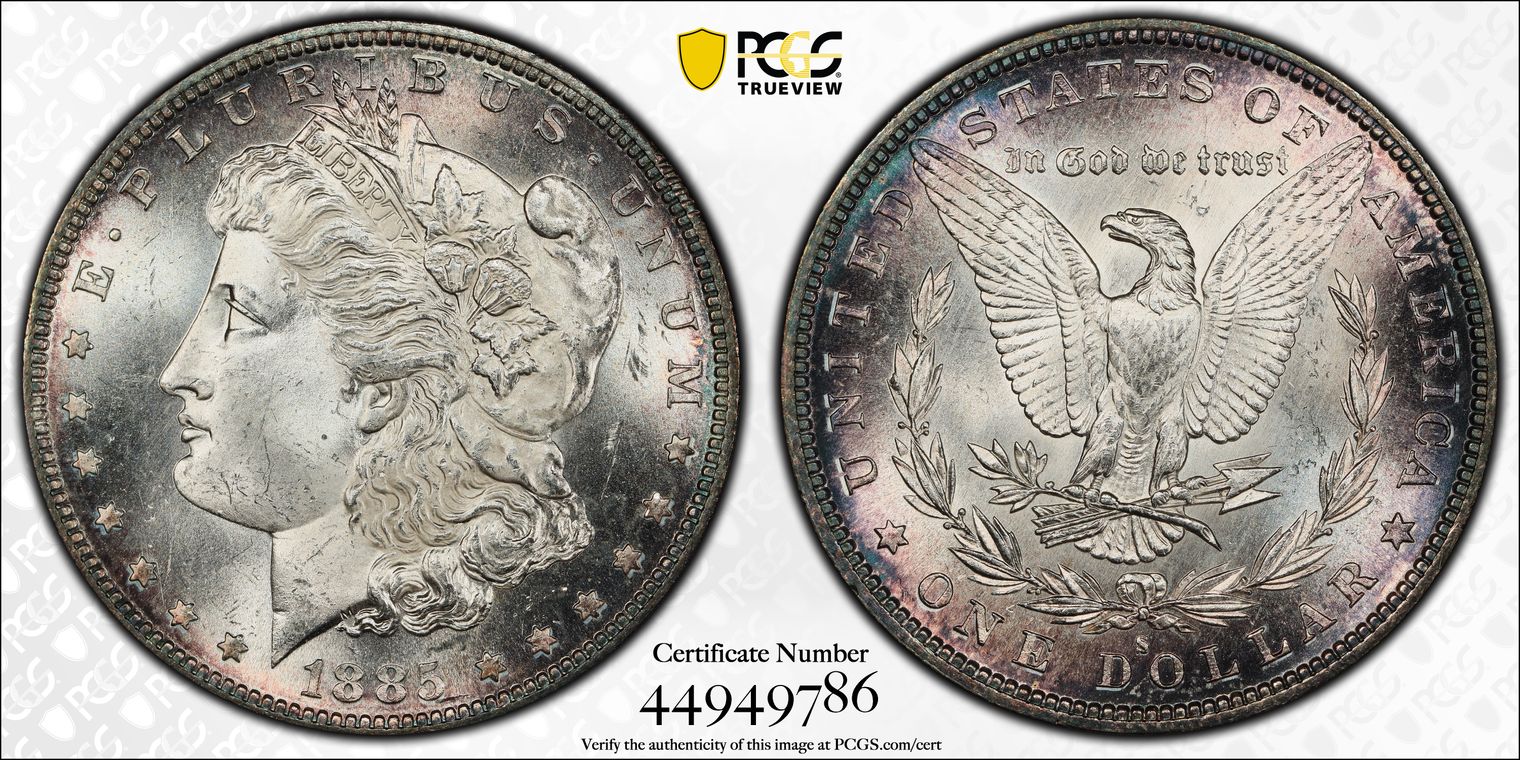
A pleasing Choice Mint State example of this San Francisco issue, displaying an above-average strike, frosty mint luster, and delicately toned original surfaces. The coin combines strong technical quality with understated visual appeal, offering the appearance of a carefully preserved survivor whose originality has remained intact through decades of storage. The obverse is largely brilliant with soft silver-white centers accented by pale champagne, honey-gold, and faint lavender peripheral toning. Subtle blue-gray highlights gather near portions of the rim, lending the surfaces depth without obscuring the underlying frost. The reverse displays similarly restrained coloration, with delicate rose, gold, and pale blue hues framing the eagle while preserving bright central devices. Strike quality is one of the coin's principal strengths. Liberty's hair is boldly defined throughout, particularly above the ear and across the forehead curls, while the cotton blossoms and leaves exhibit pleasing sharpness. The reverse eagle displays solid breast feather definition and crisp wing detail, accompanied by well-defined wreath elements and lettering. Overall definition exceeds that seen on many contemporary Morgan dollars and reflects the consistently high production standards associated with the San Francisco Mint. Luster remains vibrant beneath the light peripheral patina. Frosty mint bloom extends across both sides, producing lively cartwheel reflectivity while maintaining the soft appearance expected of original surfaces. The delicate toning enhances rather than suppresses the underlying brilliance. CAC approved.
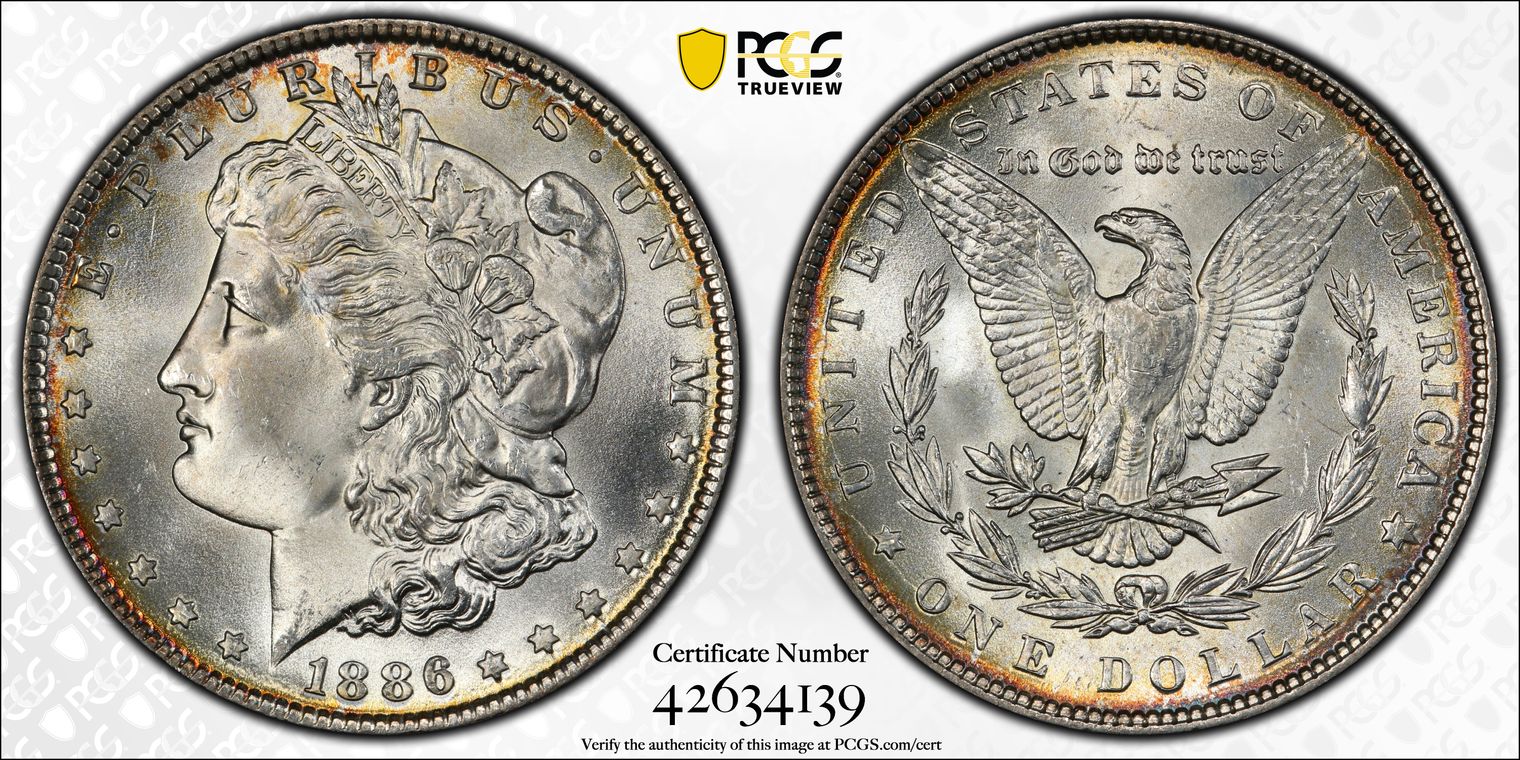
A beautifully preserved Superb Gem combining expansive frosty brilliance with delicate peripheral patina and exceptionally clean focal areas. Predominantly brilliant on both sides, the coin is framed by restrained touches of russet, golden-orange, rose, and intermittent blue-green that provide originality and visual interest without distracting from the underlying silver-white surfaces. The obverse displays a thin, irregular border of warm amber and russet toning, most evident across the upper rim and from approximately 6 to 9 o’clock. Flecks of crimson, cobalt, and turquoise appear near the denticles, while Liberty’s portrait and the greater part of the fields remain brilliant. The toning is light and transparent, permitting the mint frost to remain fully expressive. The reverse is similarly composed, with brilliant centers surrounded by a narrow peripheral band of golden-orange, russet, violet, and subtle blue. Color is strongest along the lower border and at the left rim, forming a natural frame around the eagle. The two sides are closely matched in general character, though the reverse color appears slightly more continuous. Strike quality is strong overall. Liberty’s forehead curls, cotton leaves, blossoms, and lower hair are sharply delineated. The hair directly above the ear shows good definition, although some of the central strands remain lightly blended rather than fully separated. On the reverse, the wing feathers, wreath, arrows, and peripheral elements are crisply rendered. The eagle’s breast retains respectable feather detail, though the central definition is not entirely complete. The coin is well struck, but its Superb Gem status rests more heavily upon preservation and luster than upon an unusually forceful impression. Luster is a principal attribute. Broad, satiny, almost greasy cartwheels rotate freely across both sides, with a lightly textured mint bloom extending through the open fields and over the devices. The peripheral patina does little to suppress this movement, instead giving the brilliant centers additional contrast. The mintage of the 1886-P Morgan dollar is just under 20 million coins. While some were released at the time of striking, many survived untouched in original mint bags until the mid 20th century. Thus, the 1886-P Morgan dollar is one of the most common in uncirculated grades today, with nearly 1000 equal in grade to this MS67 example. CAC approved.
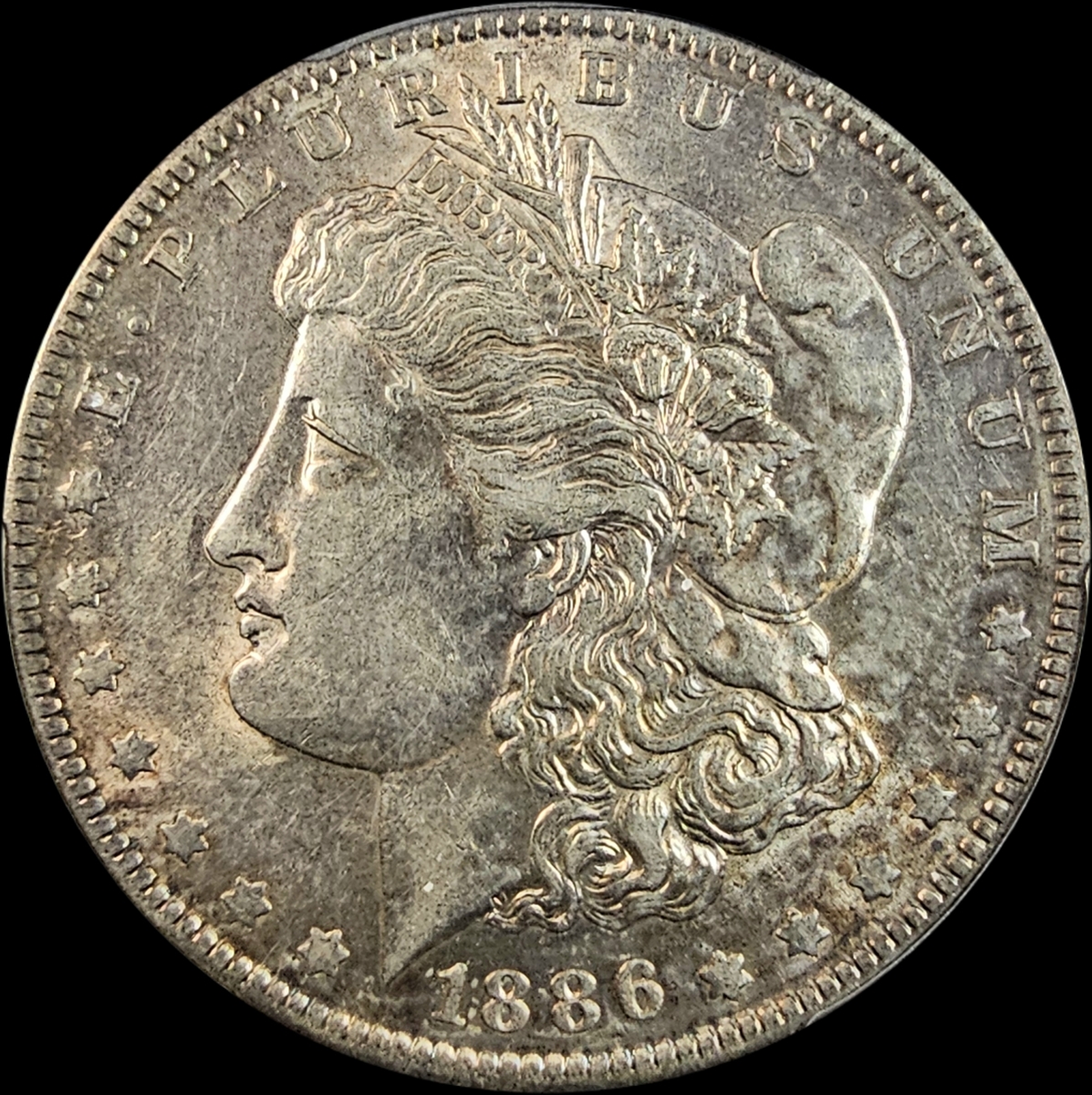
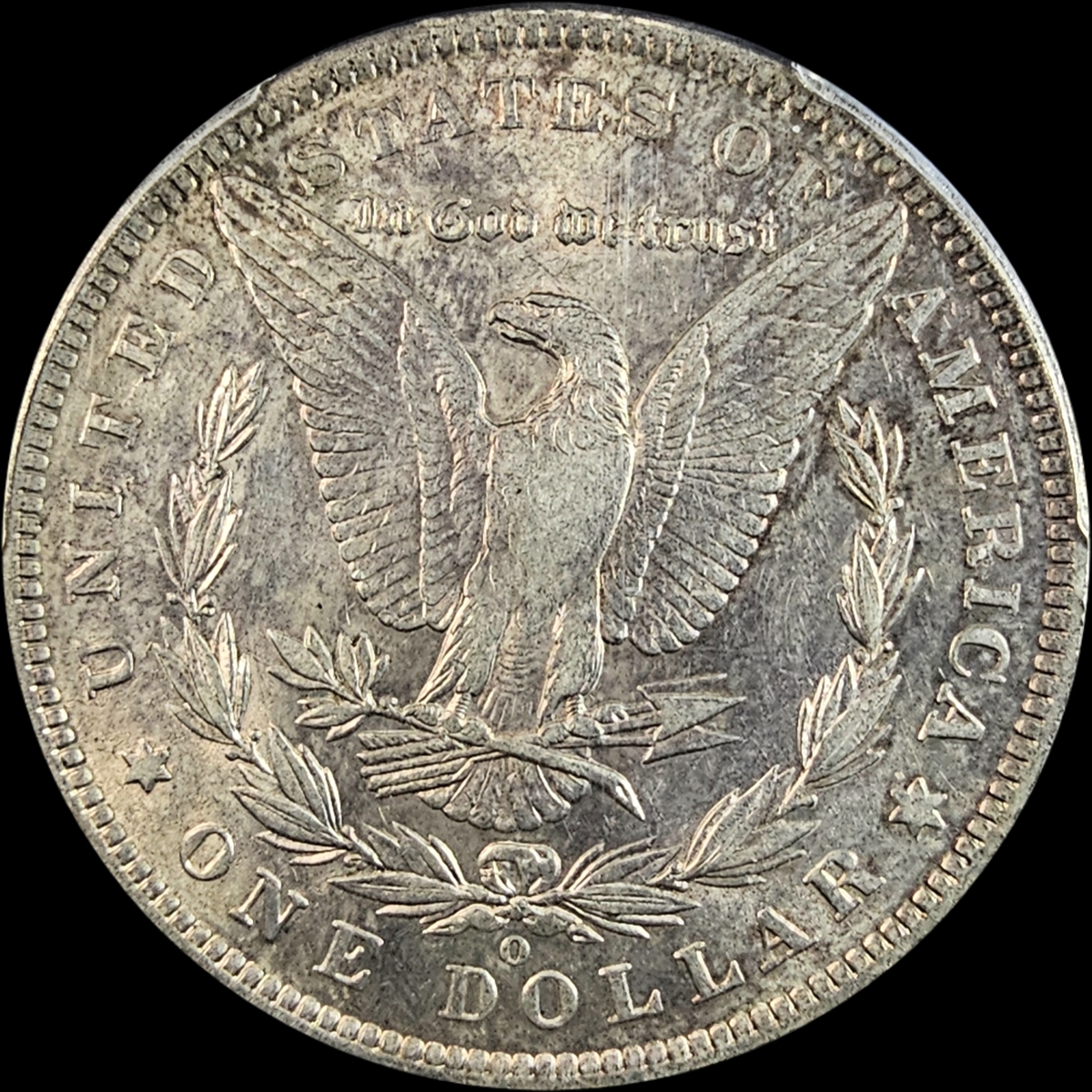
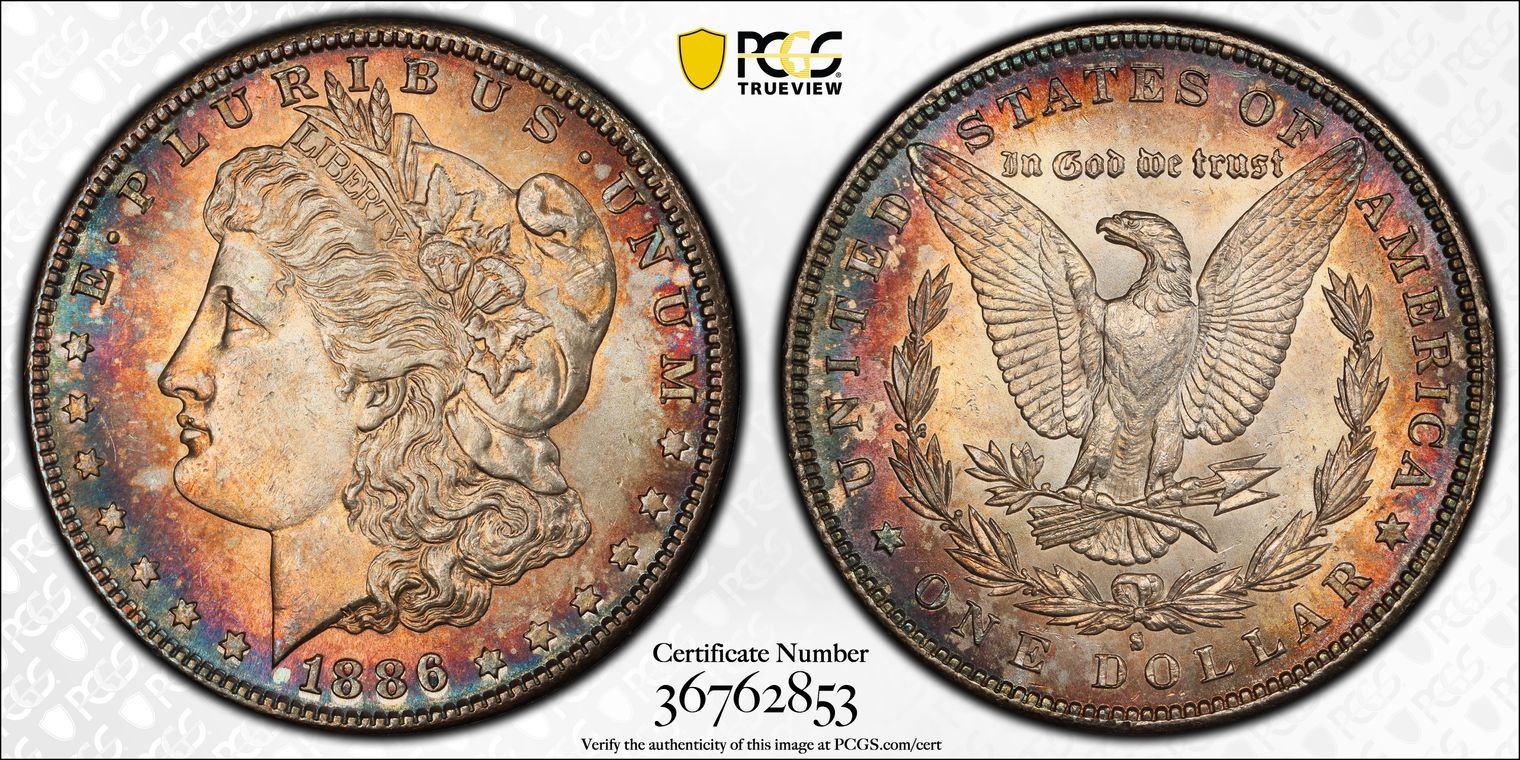
An exceptionally original Choice Mint State representative of this popular San Francisco issue, combining vibrant underlying luster, a strong strike, and richly developed multicolored cabinet patina. While many surviving examples are encountered brilliant or lightly toned, the present coin displays a far more mature appearance, its naturally evolved surfaces reflecting decades of uninterrupted storage. The obverse is dominated by warm champagne and silver-gray centers that transition outward into vivid amber, russet, cobalt-blue, and violet along the periphery. The color develops organically rather than uniformly, with irregular patches of deeper oxidation surrounding Liberty's portrait and cap. Despite the extensive toning, the underlying frost remains evident, lending transparency and depth to the surfaces rather than masking them. The reverse exhibits similar originality, framed by concentric bands of crimson, violet, sapphire, and golden-orange around the borders while the central devices remain softly brilliant. The peripheral colors complement rather than overwhelm the design, creating an appealing natural frame for the eagle and wreath. Strike quality is notably strong. Liberty's hair displays excellent separation through the forehead curls and above the ear, while the cotton blossoms and leaves are boldly impressed. The reverse is equally satisfying, with sharply rendered wing feathers, well-defined wreath elements, and unusually complete breast feather detail for the issue. Overall definition reflects the consistently high manufacturing standards associated with late-1880s San Francisco production. Luster remains lively beneath the mature patina. Frosty mint bloom radiates through the fields and devices, producing energetic cartwheel reflectivity that is softened—but by no means obscured—by the original toning. The result is a pleasing balance between brilliance and age, giving the coin a distinctly natural appearance. CAC approved.
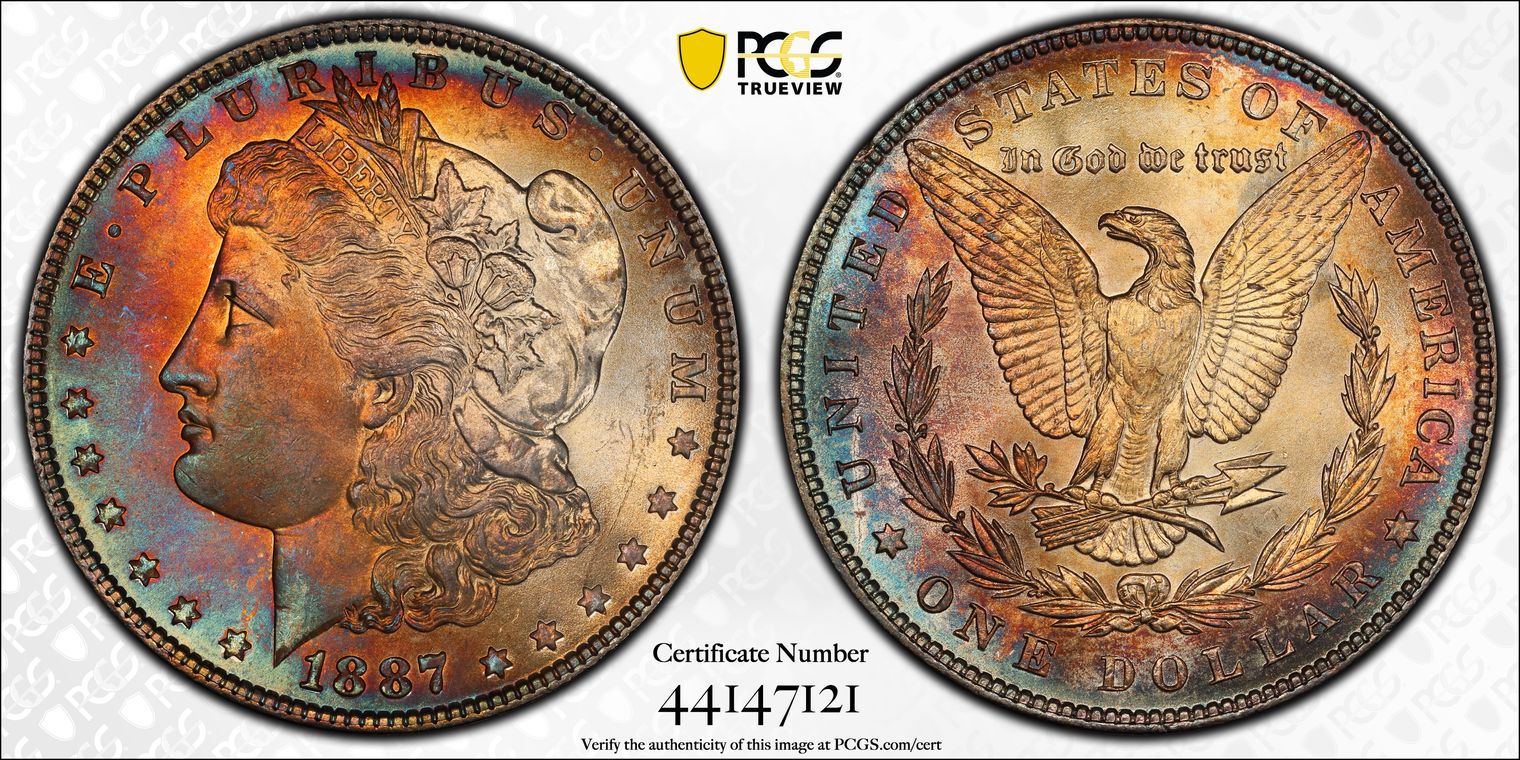
An arresting Premium Gem whose extraordinary peripheral toning transforms one of the Morgan series' classic Philadelphia issues into a work of remarkable visual drama. Boldly contrasted yet exquisitely balanced, this 1887 captivates through the interplay of incandescent color, pristine preservation, and exceptional mint brilliance. The obverse presents an extraordinary crescent of deeply saturated iridescence flowing along the left border and sweeping across Liberty's portrait in vivid bands of fiery orange, crimson, magenta, cobalt, teal, and emerald. The progression of color is both intense and remarkably natural, transitioning seamlessly into brilliant silver over Liberty's cap and upper right field. Unlike many rainbow-toned Morgans in which color competes with the design, the translucent patina here enhances every sculptural detail while allowing the underlying frost to remain fully evident. The reverse exhibits an equally attractive, though more restrained, palette. Warm champagne-gold dominates the central eagle and surrounding fields, framed by peripheral ribbons of electric blue, violet, rose, and copper concentrated along the left and lower borders. The asymmetry between the two sides creates an appealing visual dialogue: a boldly expressive obverse complemented by an elegantly framed reverse.
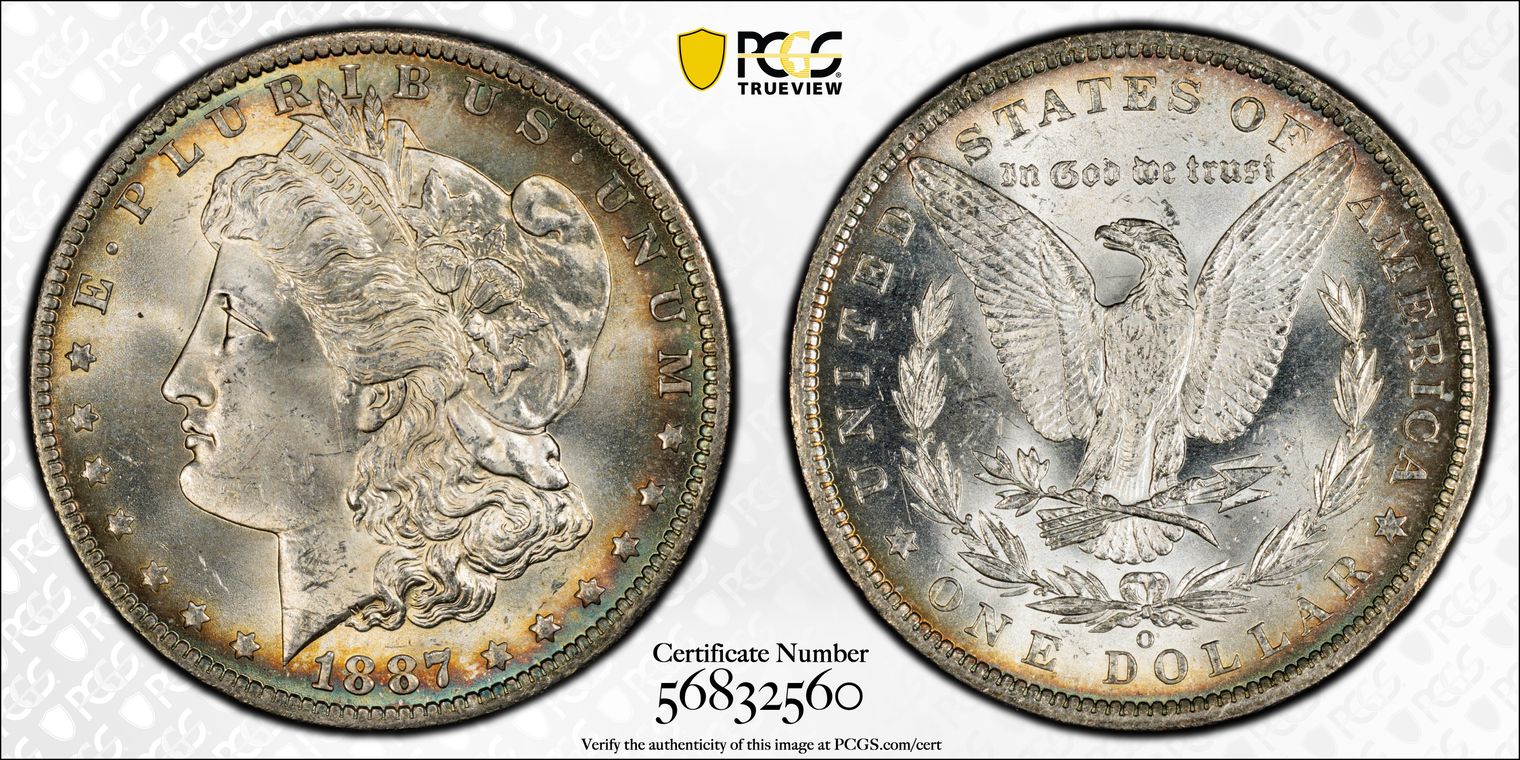
The typical 1887-O is heavily bagmarked, has dull lustre, and is poorly struck, and in lower grade levels. At the MS-64 level it becomes scarce, with 3,000 to 6,000 surviving. Fully struck MS-65 coins are rare and number only in the hundreds. This coin is bright and lustrous, well struck on the eagle's breast feathers and the hair above Liberty's hair, and has very few bagmarks. Luster is original and generally consistent with the issue. The obverse displays a subdued, satiny bloom that has mellowed beneath a light veil of natural patina, while the reverse exhibits somewhat greater cartwheel activity without reaching the vibrant brilliance associated with the most frosty Morgan dollar issues. The overall impression is one of honest, undisturbed mint luster that complements the coin's originality rather than defining its visual appeal. Strike quality exceeds what is often encountered for the issue. Liberty's hair exhibits pleasing separation above the ear and throughout the forehead curls, while the cotton blossoms and leaves are well impressed. On the reverse, the eagle displays strong wing detail and above-average breast feather definition, with sharply rendered wreath elements and lettering. The strike contributes meaningfully to the coin's visual quality without reaching the extraordinary level reserved for the finest New Orleans impressions. An attractive premium Choice Mint State representative displaying above-average striking quality, original surfaces, restrained peripheral patina, and honest mint luster. The coin's appeal lies in its balance and authenticity rather than any single dramatic attribute, making it an excellent example of this popular New Orleans issue.
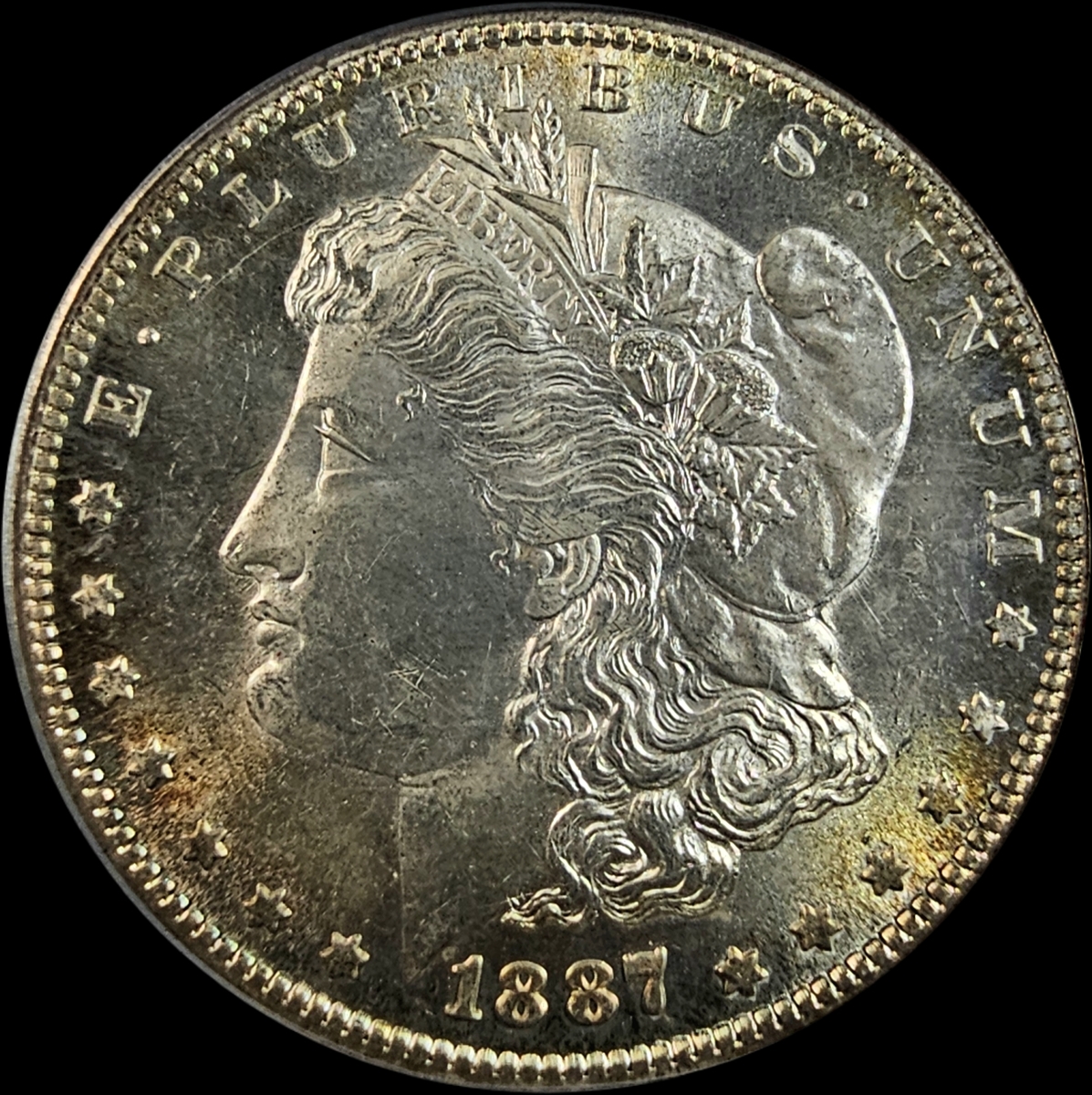
Light peripheral toning around the date highlight this super clean S-mint coin. A real stunner.
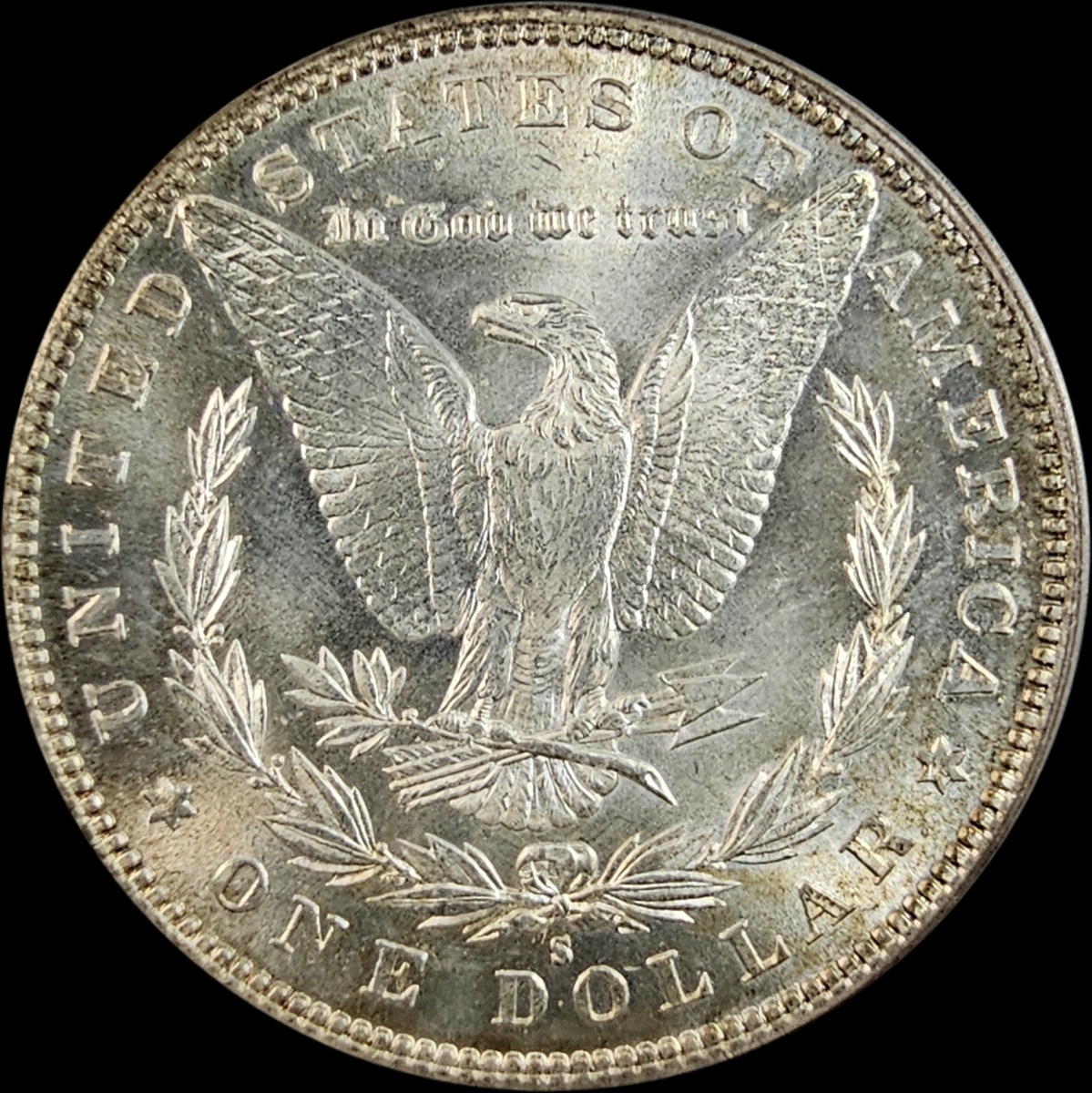
Light peripheral toning around the date highlight this super clean S-mint coin. A real stunner.
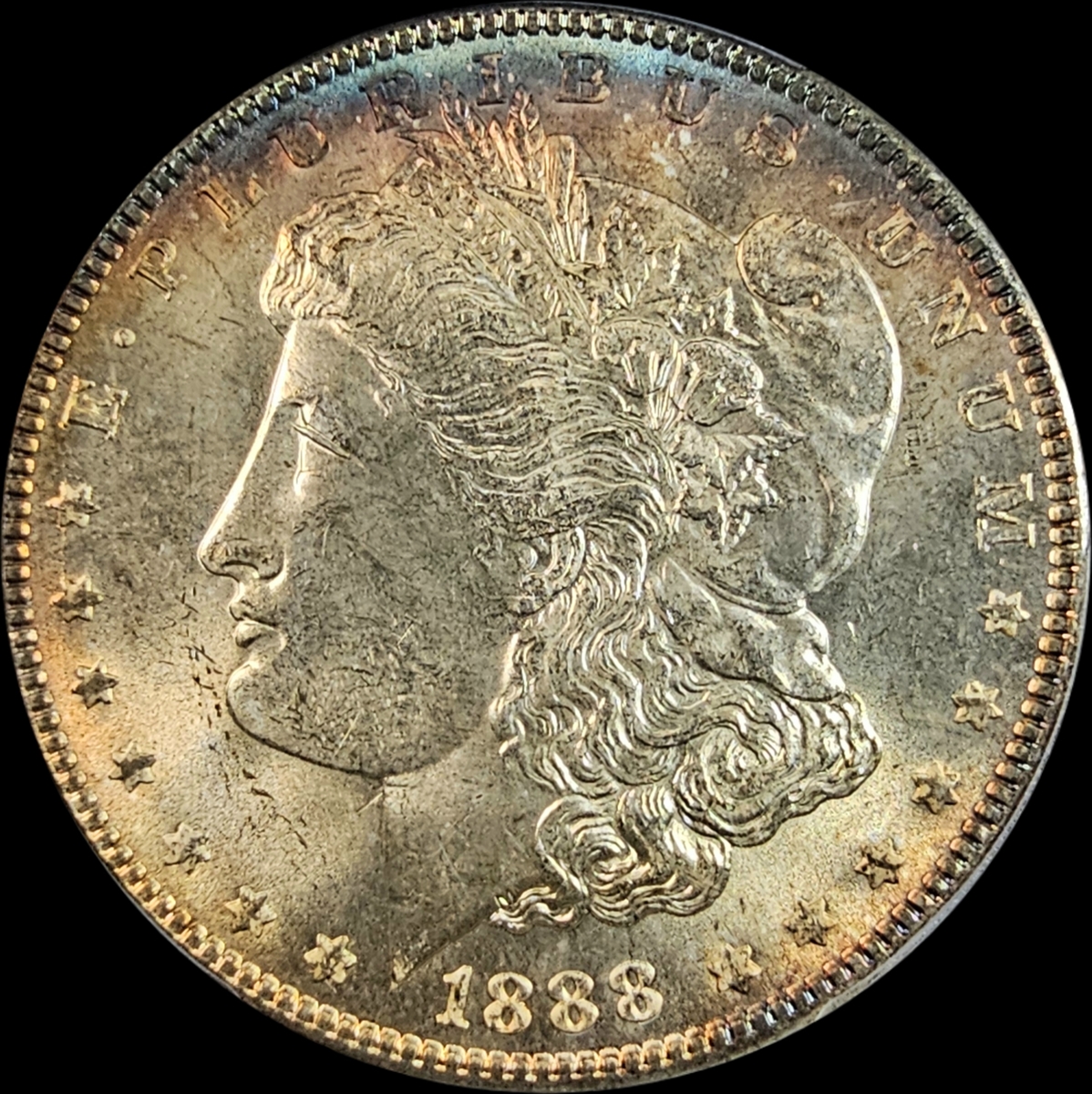
Formerly in ANACS holder, this coin has moderate blue, plum and orange toning around the edges of the obverse and reverse.
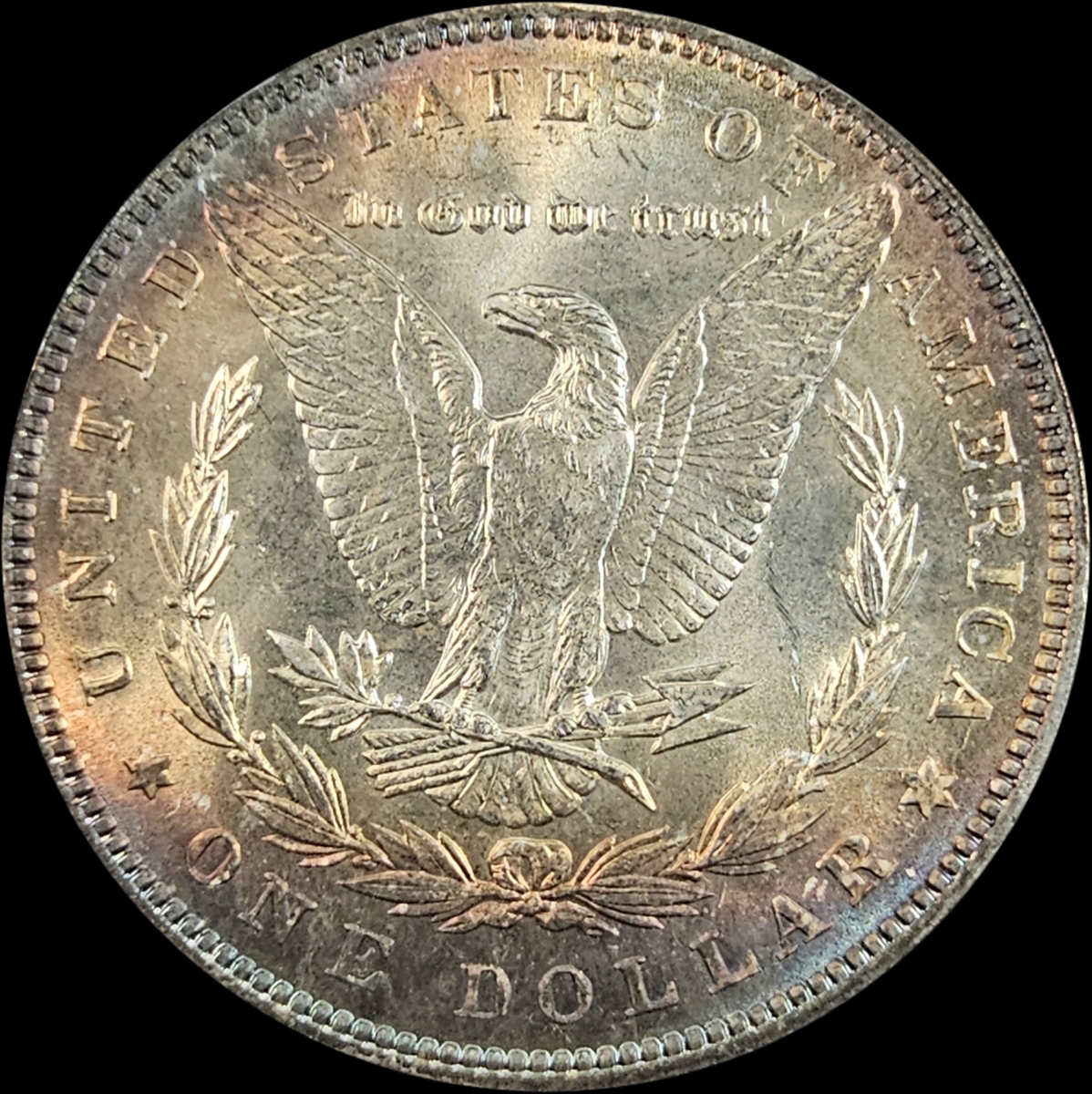
Formerly in ANACS holder, this coin has moderate blue, plum and orange toning around the edges of the obverse and reverse.
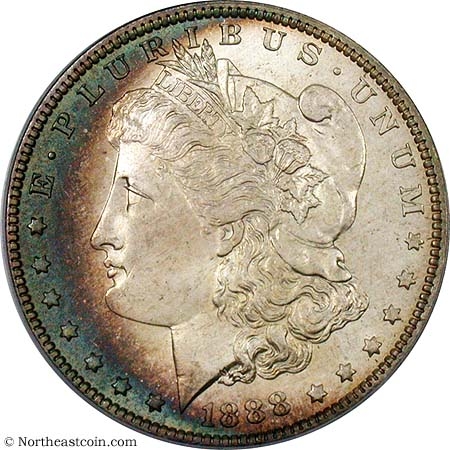
A thick blue crescent adorns the obverse while peripheral rim toning highlights the reverse...
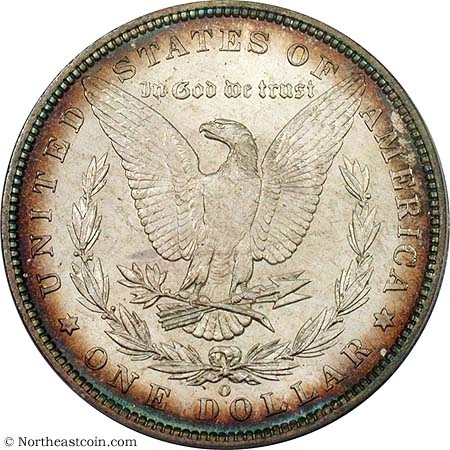
A thick blue crescent adorns the obverse while peripheral rim toning highlights the reverse...
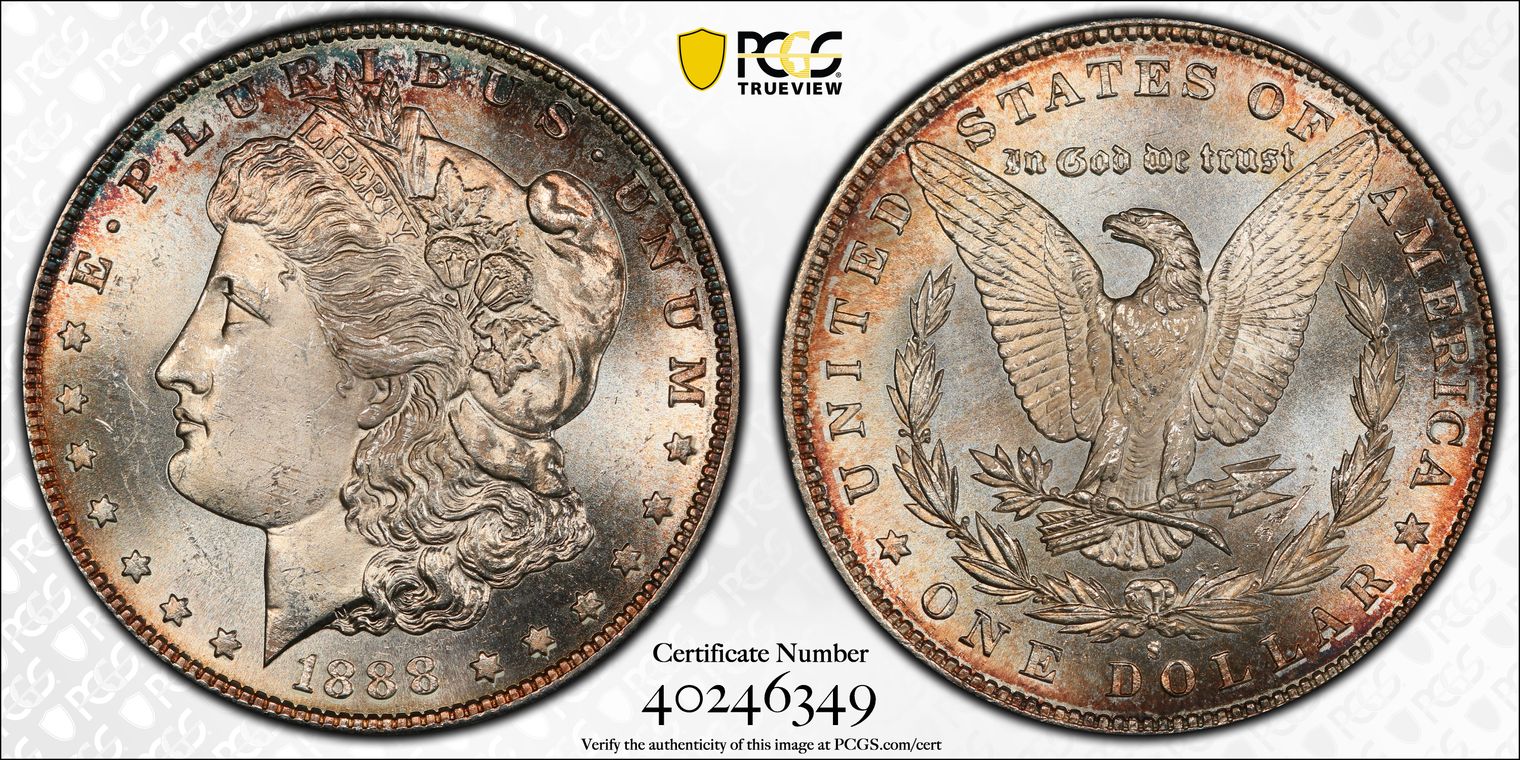
An attractive Choice Mint State representative of this low-mintage San Francisco issue, displaying pleasing originality, strong striking quality, and harmonious peripheral toning. Careful preservation and balanced visual character distinguish this example from the many survivors that exhibit heavier handling or impaired surfaces. The obverse is predominantly silver-white with soft champagne centers framed by naturally developed peripheral patina in shades of amber, russet, cobalt, and faint violet. The toning is irregular and translucent, gathering most heavily near the borders while allowing the underlying frost to remain visible throughout the central design. Similar coloration appears on the reverse, where warm golden-orange and russet accents blend into subtle blue-violet highlights around the rim, naturally framing the eagle without overwhelming the devices. Strike quality is notably strong, reflecting the generally careful manufacture associated with the San Francisco Mint during this period. Liberty's hair is sharply defined through the forehead and above the ear, with crisp cotton blossoms and leaves exhibiting full detail. The reverse is equally satisfying, displaying well-defined wing feathers, strong wreath detail, and above-average breast feather definition. The overall impression is one of complete and balanced execution. The coin retains original mint luster that remains evident beneath the light peripheral patina. The obverse exhibits pleasing frost with moderate cartwheel movement, while the reverse appears somewhat more reflective, producing a stronger sense of brilliance as light moves across the fields. The overall effect is lively without appearing excessive, complementing the coin's original surfaces rather than dominating its presentation.
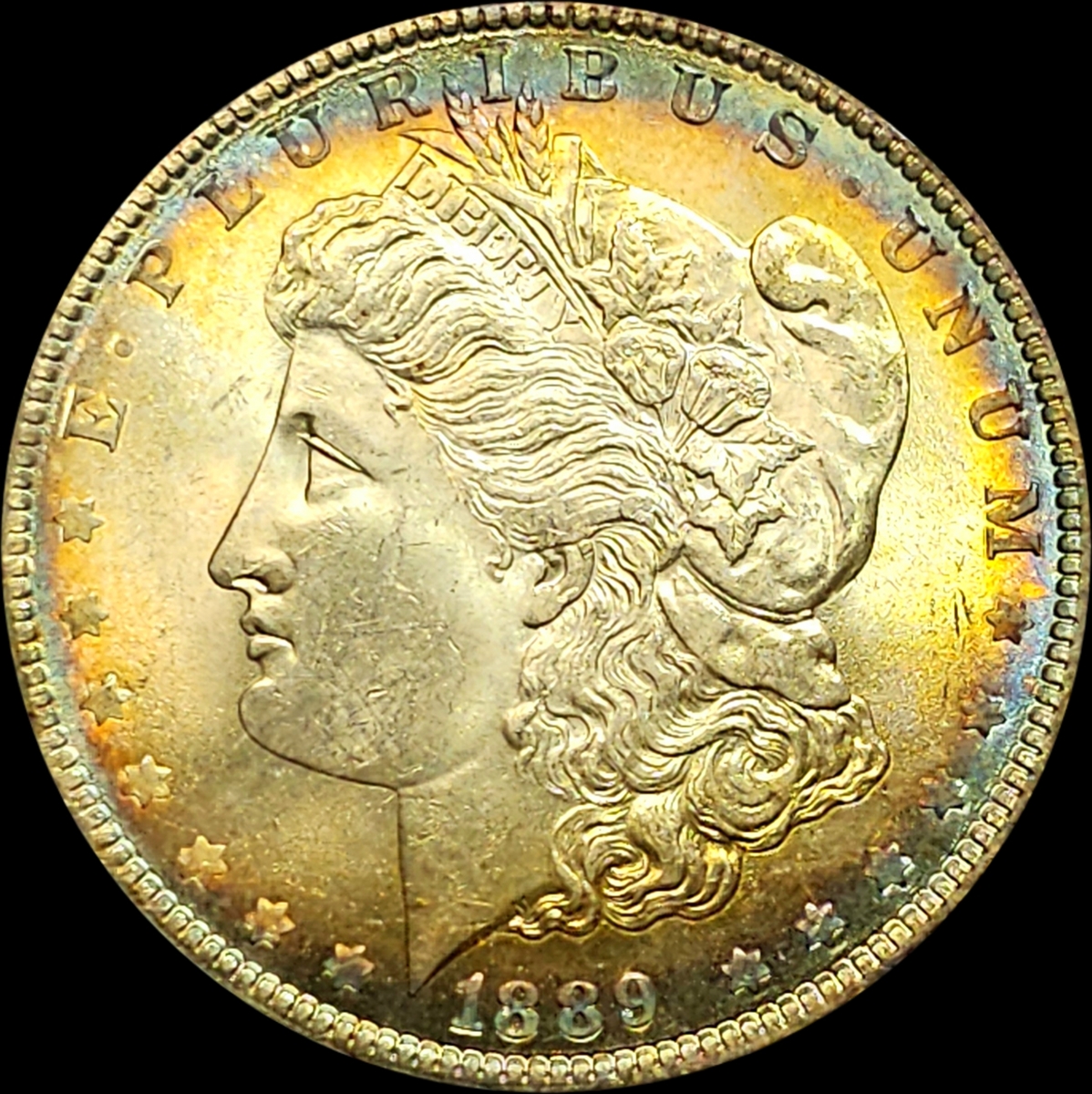
Concentric rings of blue, orange and gold hem the obverse and reverse of the periphery of this clean MS64 Morgan dollar.
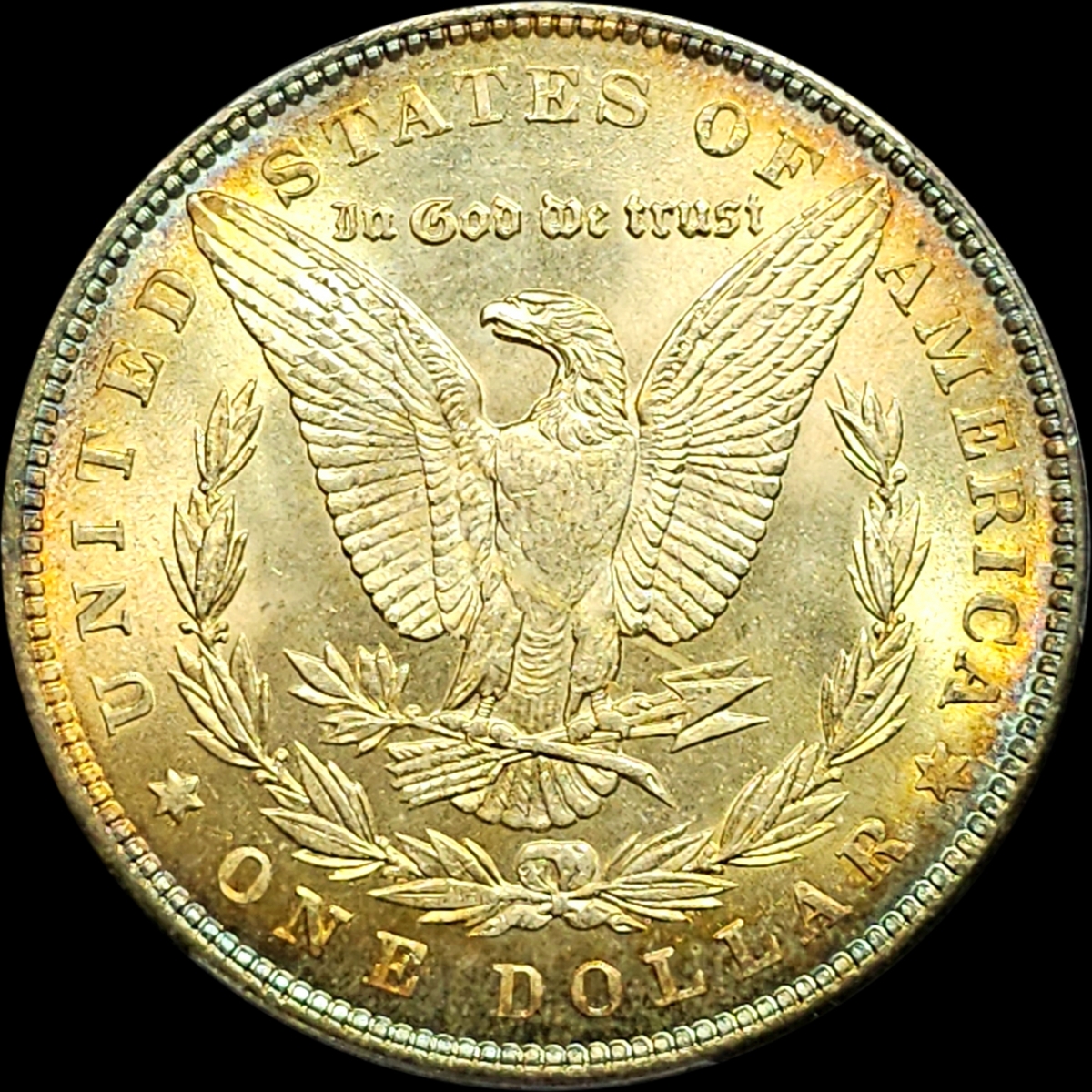
Concentric rings of blue, orange and gold hem the obverse and reverse of the periphery of this clean MS64 Morgan dollar.
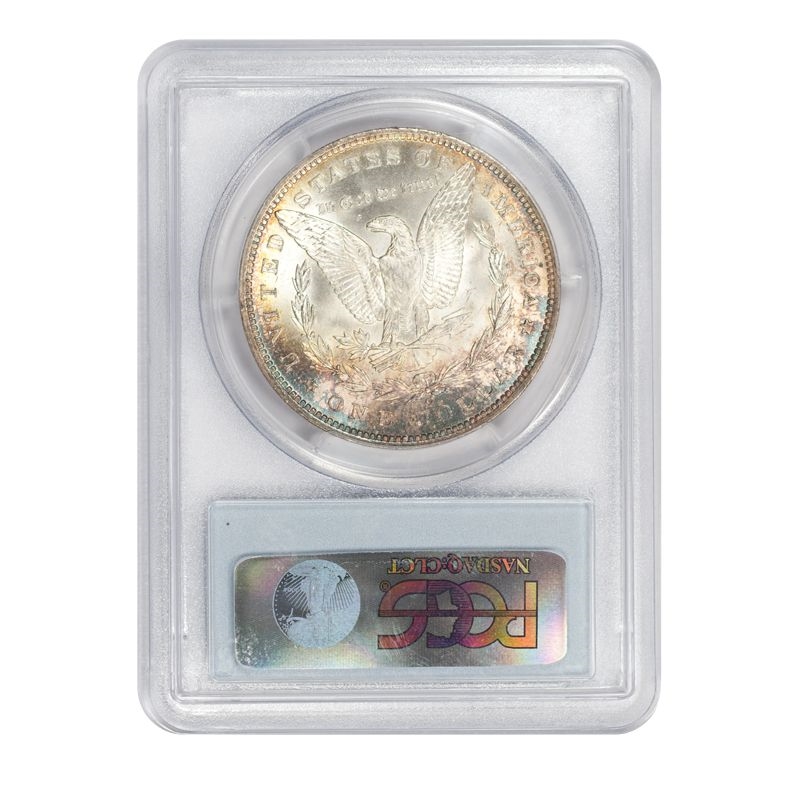
Blue, orange and gold rim the obverse and reverse in a nearly continuous circle of color and flash on this CAC reviewed, nearly gem New Orleans Morgan dollar.
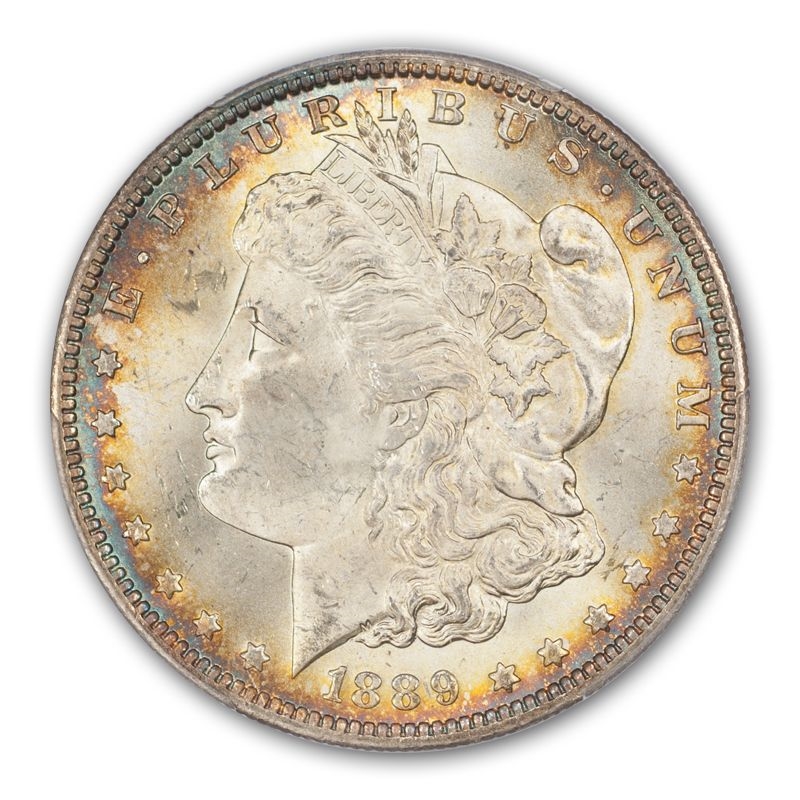
Blue, orange and gold rim the obverse and reverse in a nearly continuous circle of color and flash on this CAC reviewed, nearly gem New Orleans Morgan dollar.
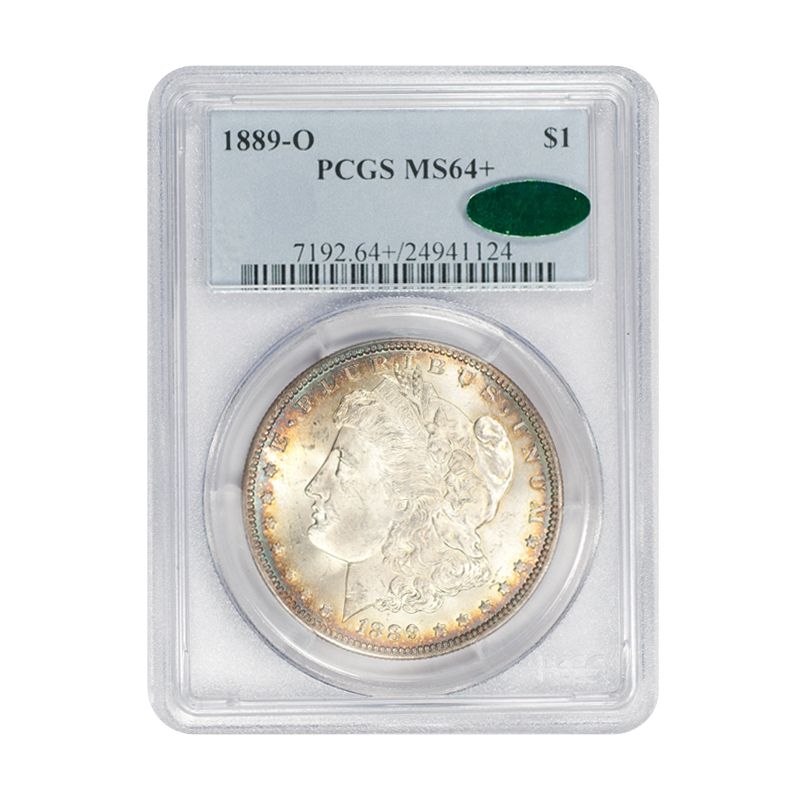
Blue, orange and gold rim the obverse and reverse in a nearly continuous circle of color and flash on this CAC reviewed, nearly gem New Orleans Morgan dollar.
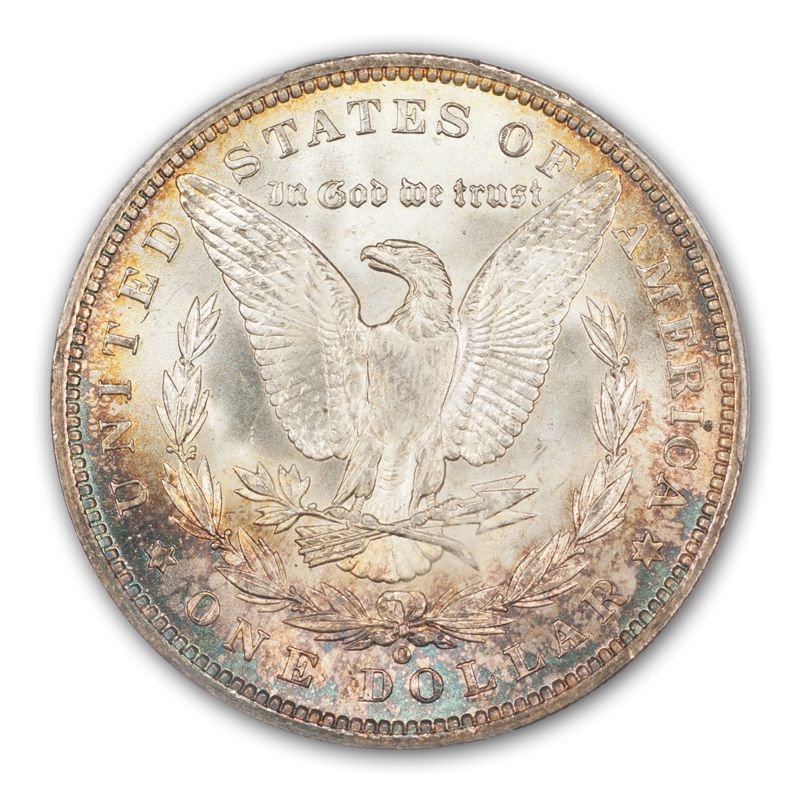
Blue, orange and gold rim the obverse and reverse in a nearly continuous circle of color and flash on this CAC reviewed, nearly gem New Orleans Morgan dollar.
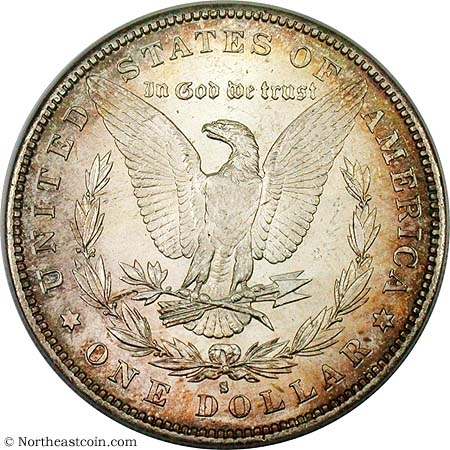
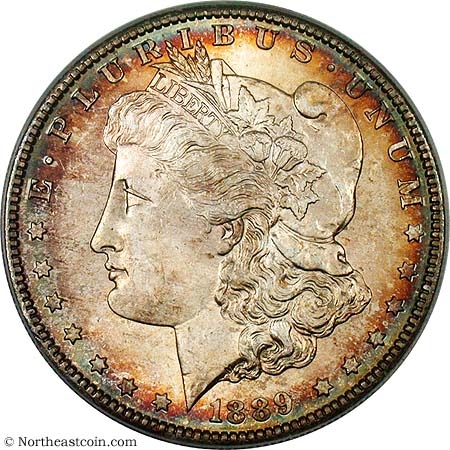
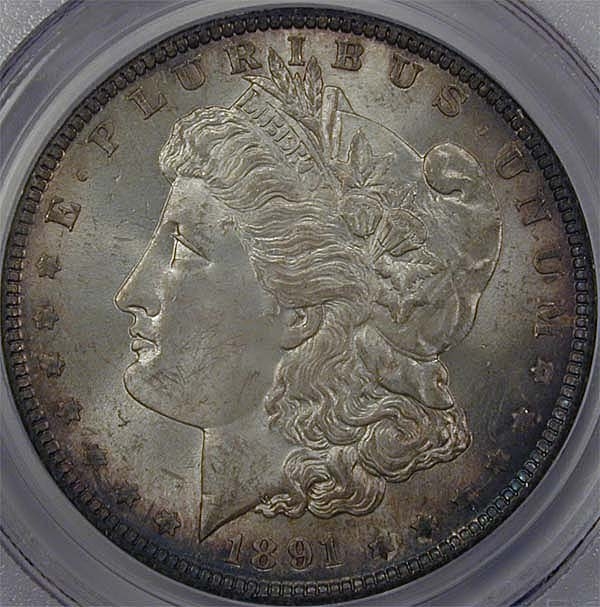
This date is tough to find without bagmarks and scuffs. This example displays rim toning in blue and umber along the obverse and reverse. Liberty's cheek is clean. CAC approved...
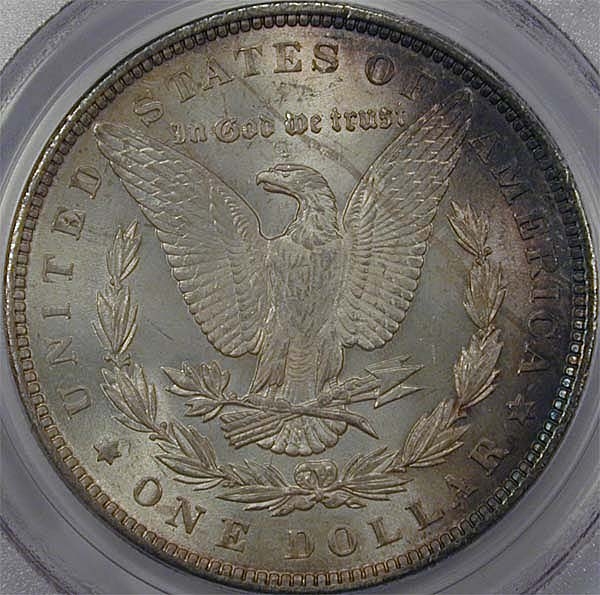
This date is tough to find without bagmarks and scuffs. This example displays rim toning in blue and umber along the obverse and reverse. Liberty's cheek is clean. CAC approved...
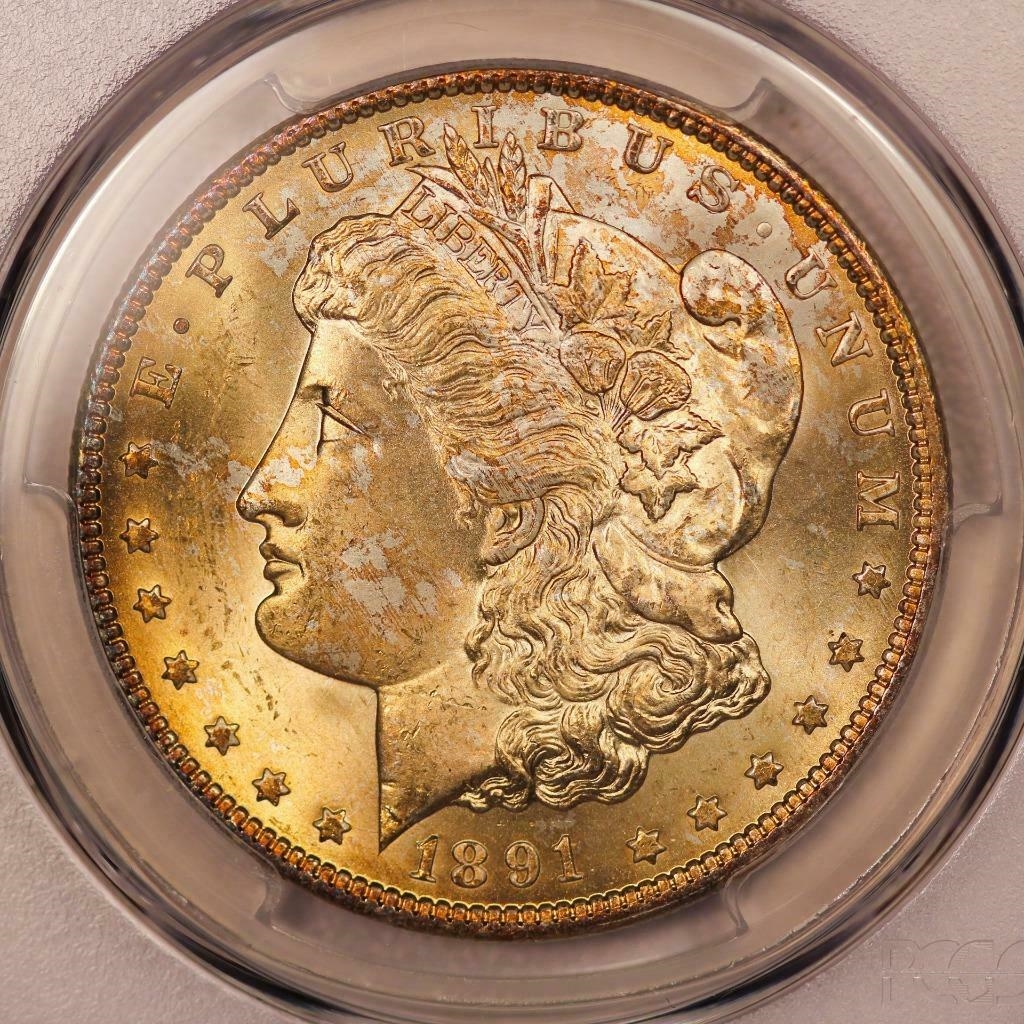
Nice, sharply struck lustrous Carson City issue with light golden toning on the obverse surface.
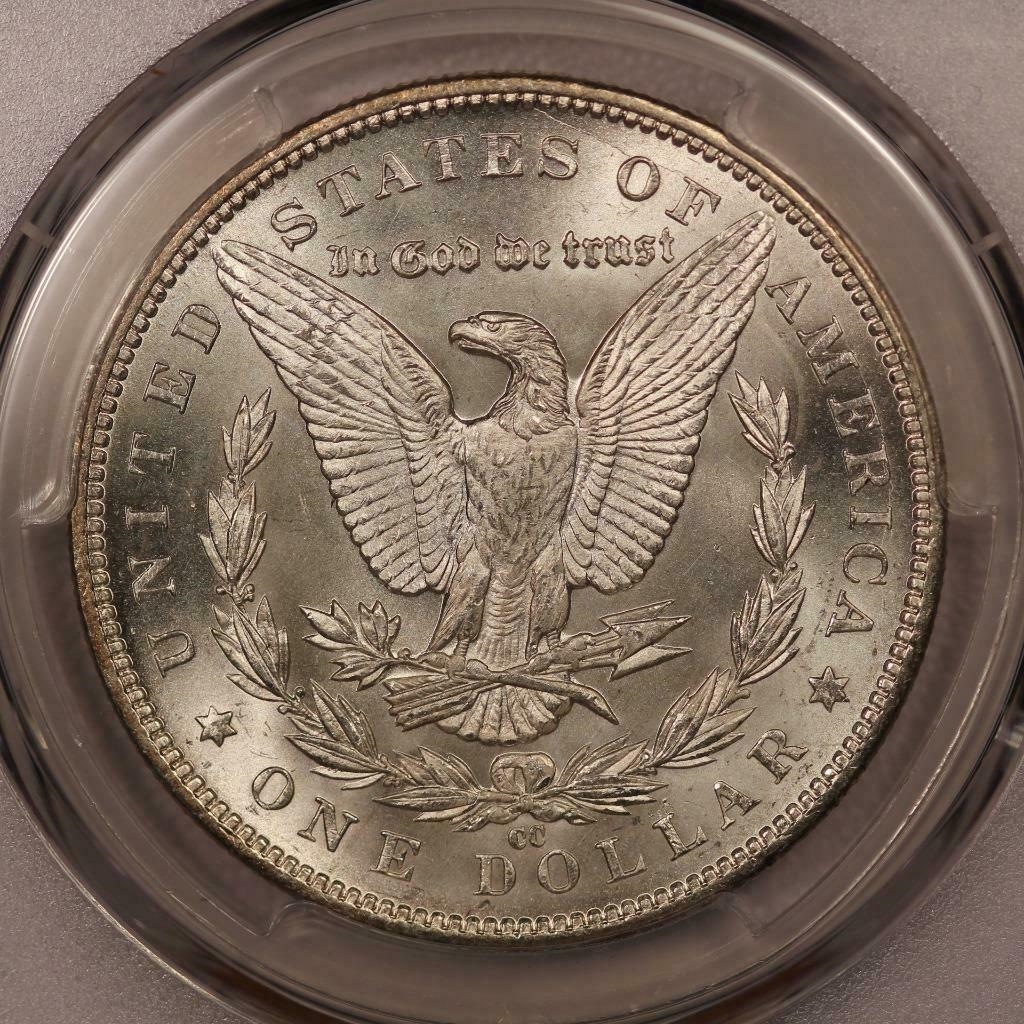
Nice, sharply struck lustrous Carson City issue with light golden toning on the obverse surface.
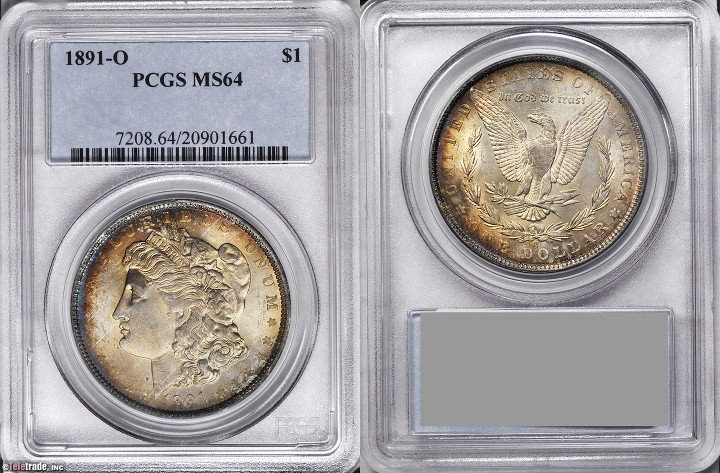
Target rim toned in blue and ochre framing the obverse and reverse, especially on the left side of the coin. Typical mushy strike for this issue.
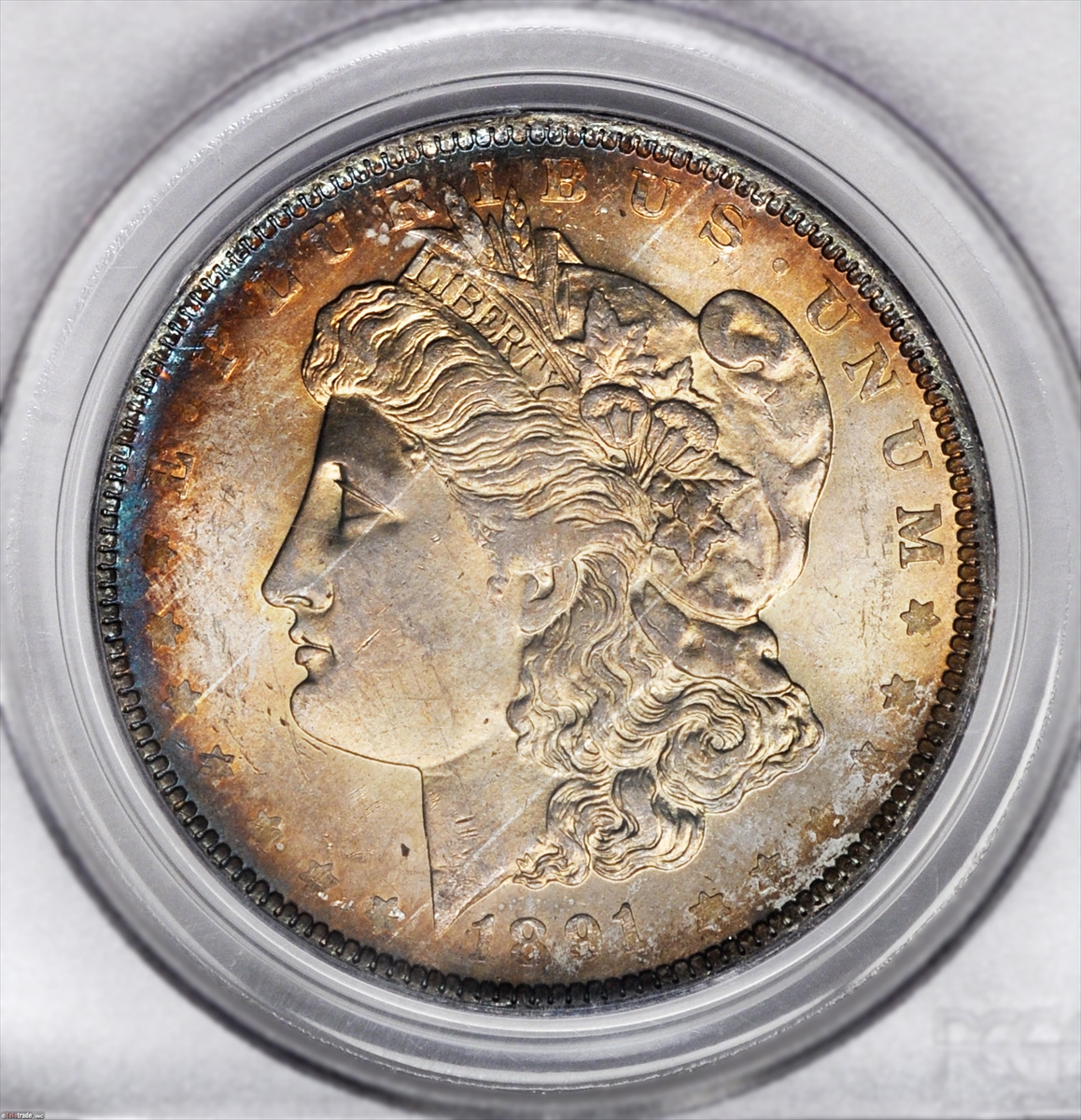
Target rim toned in blue and ochre framing the obverse and reverse, especially on the left side of the coin. Typical mushy strike for this issue.
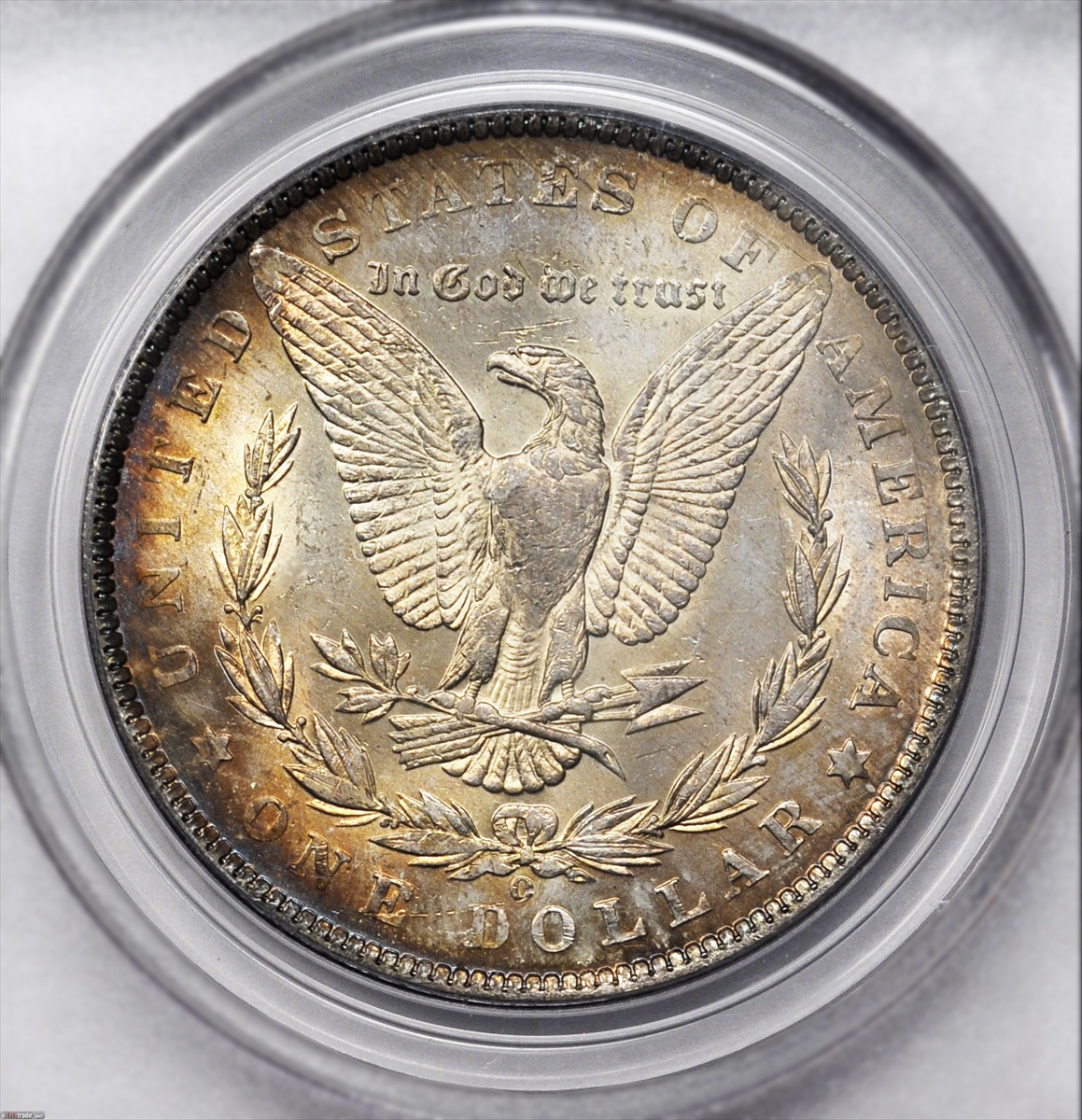
Target rim toned in blue and ochre framing the obverse and reverse, especially on the left side of the coin. Typical mushy strike for this issue.
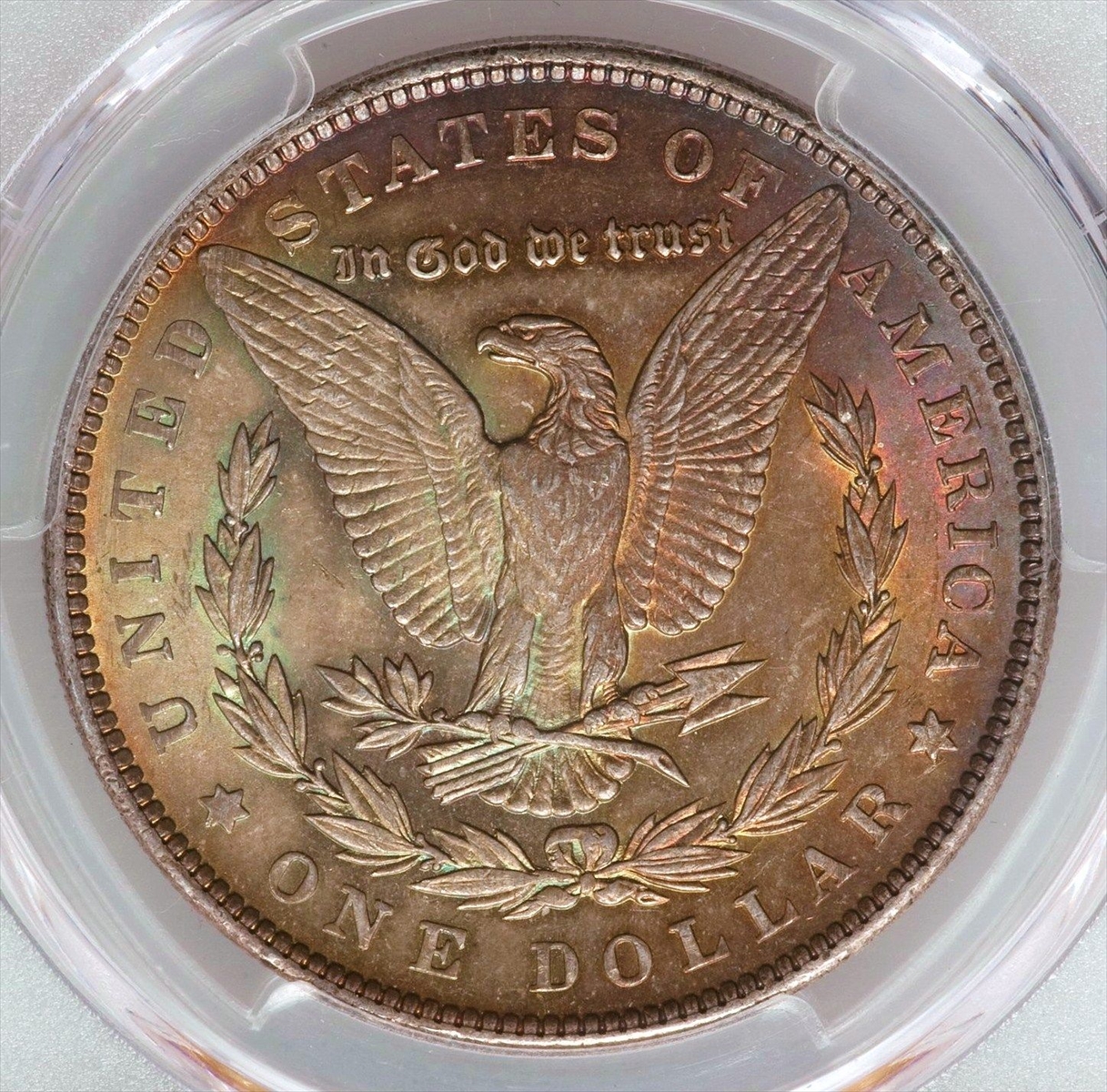
Rainbow toning rings the obverse while a deeper plum and orange mingles with the devices on the reverse.
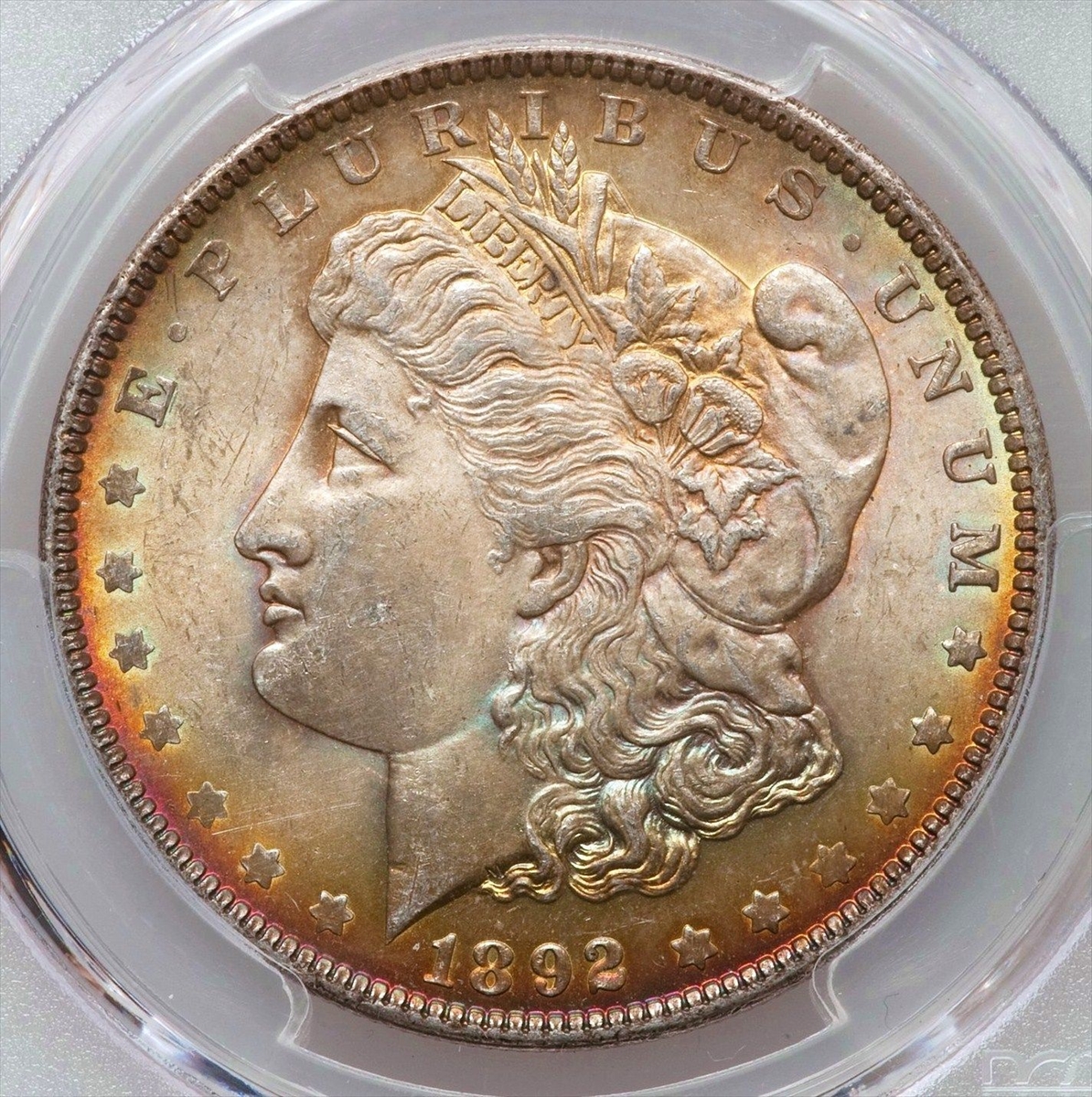
Rainbow toning rings the obverse while a deeper plum and orange mingles with the devices on the reverse.
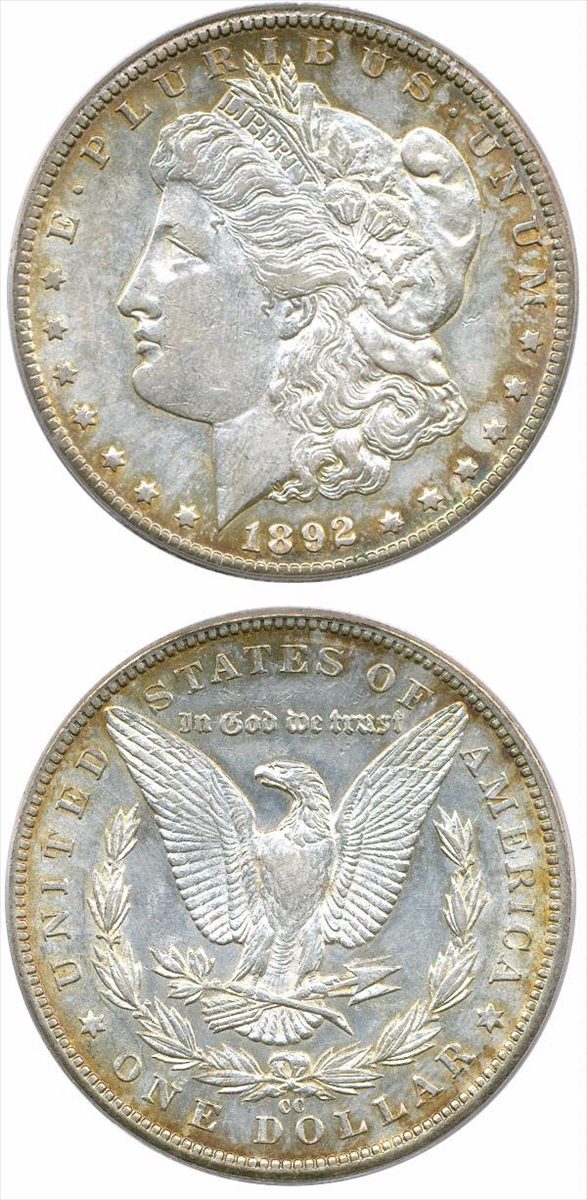
Most 1892-CC dollars are well struck. This nice AU rim toner still possesses tons of luster and flash. Although the mintage of the 1892-CC exceeded that of 1882-CC, 1883-CC, and 1884-CC, it is much more elusive in uncirculated grade, due to the relatively small amount of hoard coins remaining.
.jpg)
Since the striking quality is usually poor on the average 1892-O, with most surviving coins lightly struck over Miss Liberty's ear and lack of breast feathers on the eagle, this is a rather tough coin to find with a decent strike. In the hurry to coin as many dollars as possible with the smallest amount of effort, technicians at the New Orleans Mint spaced the dies too far apart. Among all Morgan dollars, the 1892-O is one of the most notorious for being flatly struck at the centers. This particular coin possesses a vibrant ring of blue and red, which frame the obverse in a typical target toned pattern, which is the object of each coin in this set.
.jpg)
Since the striking quality is usually poor on the average 1892-O, with most surviving coins lightly struck over Miss Liberty's ear and lack of breast feathers on the eagle, this is a rather tough coin to find with a decent strike. In the hurry to coin as many dollars as possible with the smallest amount of effort, technicians at the New Orleans Mint spaced the dies too far apart. Among all Morgan dollars, the 1892-O is one of the most notorious for being flatly struck at the centers. This particular coin possesses a vibrant ring of blue and red, which frame the obverse in a typical target toned pattern, which is the object of each coin in this set.
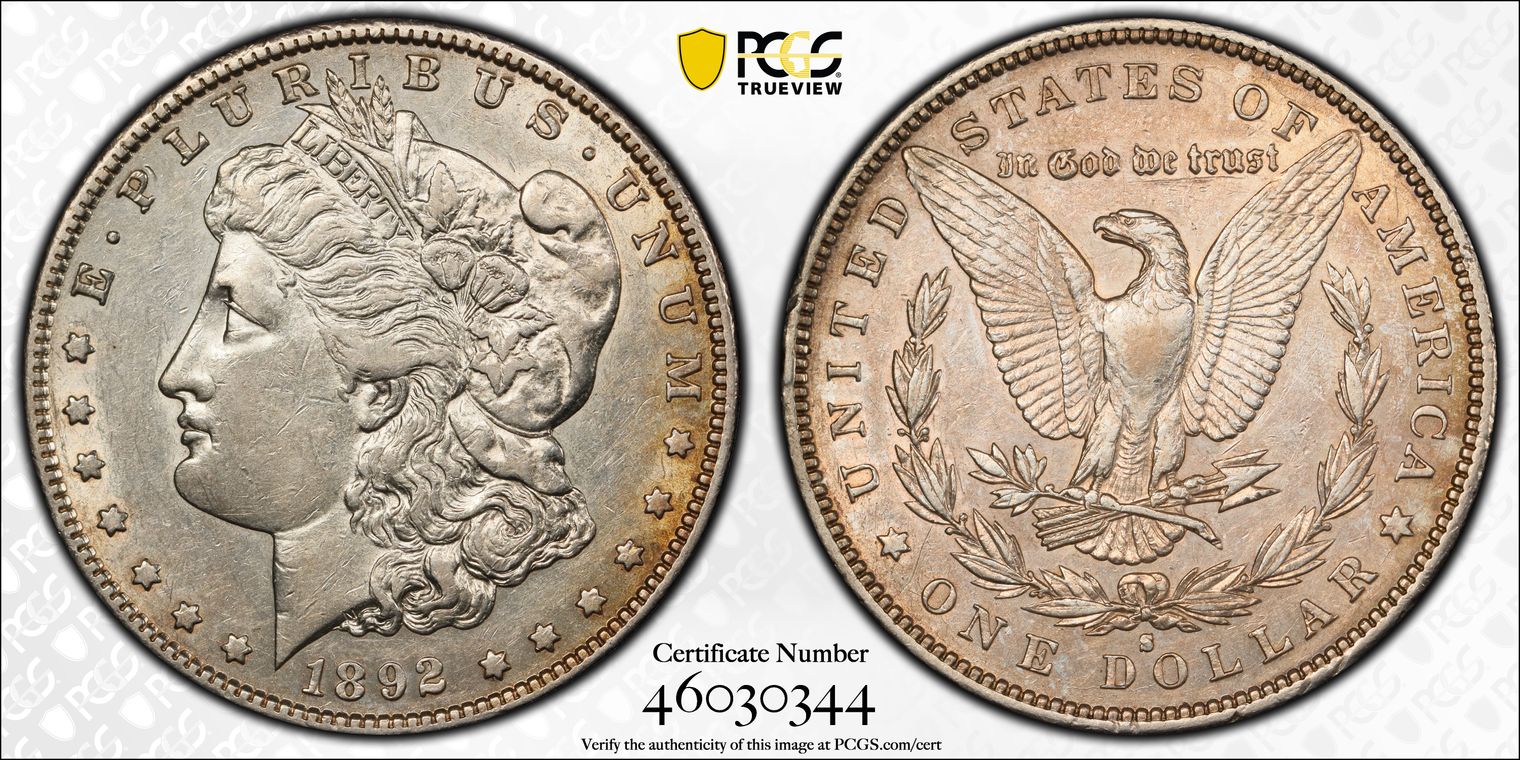
A pleasing and highly original Extremely Fine example of one of the more elusive San Francisco Morgan dollar issues. Careful circulation has imparted an attractive, even appearance while preserving strong overall definition and natural silver-gray surfaces that speak to decades of honest preservation. The obverse exhibits soft silver-gray patina with faint champagne highlights that gently warm the protected areas surrounding the devices. The reverse displays similar originality, accented by delicate golden hues that lightly frame the eagle and wreath. The coloration remains understated throughout, emphasizing originality rather than visual drama. Wear is entirely consistent with the assigned grade. Liberty's hair retains considerable detail through the curls above the forehead and behind the neck, while the cotton leaves and blossoms remain clearly outlined despite moderate high-point friction. On the reverse, the eagle's wings display strong feather separation, with the breast showing the expected smoothing from circulation while retaining enough central definition to preserve the coin's overall sharp appearance. Rim, legends, stars, and denticles remain bold on both sides. Surface preservation is particularly noteworthy. The fields display only the scattered, moderate abrasions expected of a coin that spent time in commerce, yet none rise to the level of distraction. Liberty's cheek remains remarkably smooth for the grade, avoiding the heavy contact or deep circulation marks that often define lower-end circulated examples. The resulting appearance is balanced, wholesome, and entirely original. As expected for an Extremely Fine survivor, mint luster has largely yielded to an even circulating patina, though traces of reflectivity remain tucked within portions of the protected recesses. The surfaces possess the soft, settled appearance that only long-term natural aging can impart.
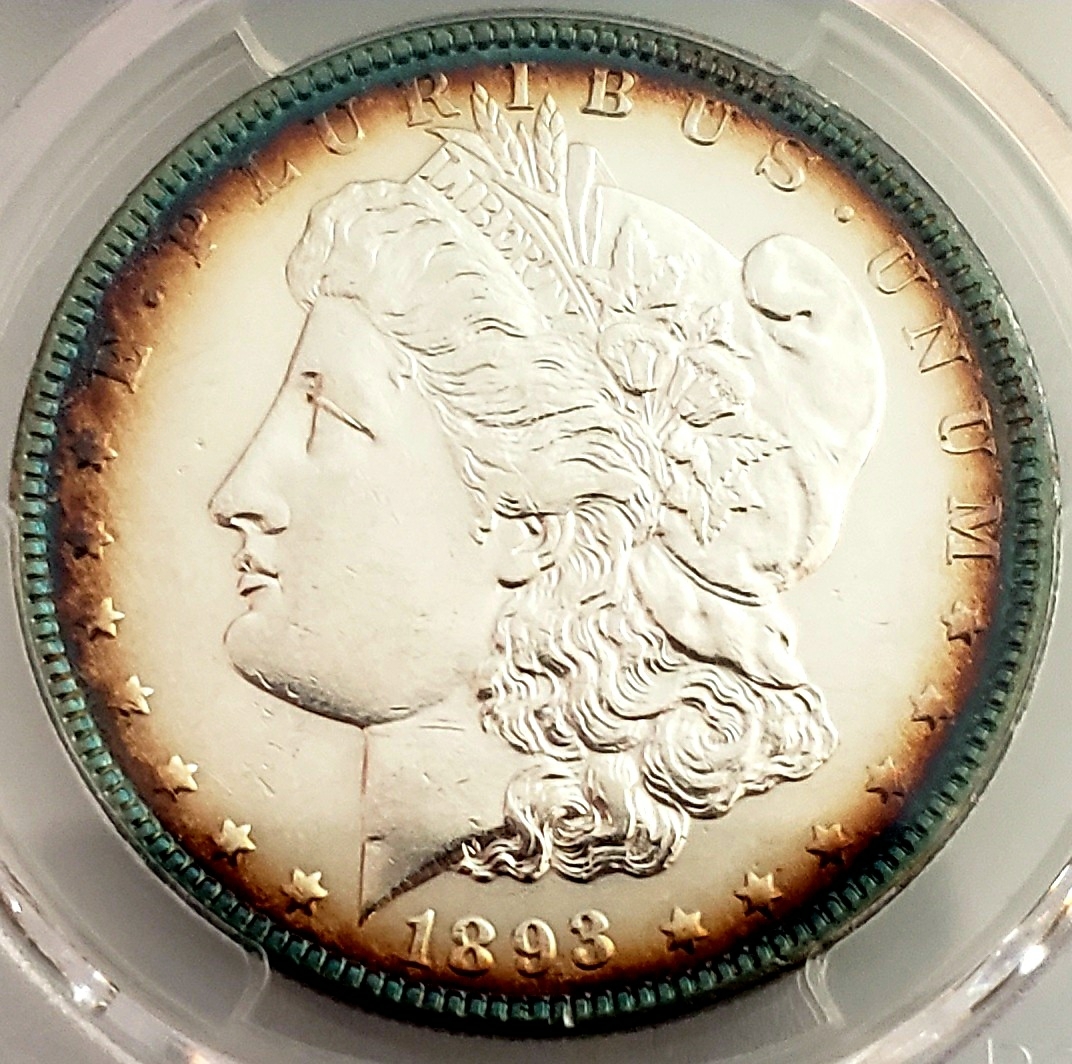
Ring of Blue and orange surround the obverse devices on this AU Morgan dollar.
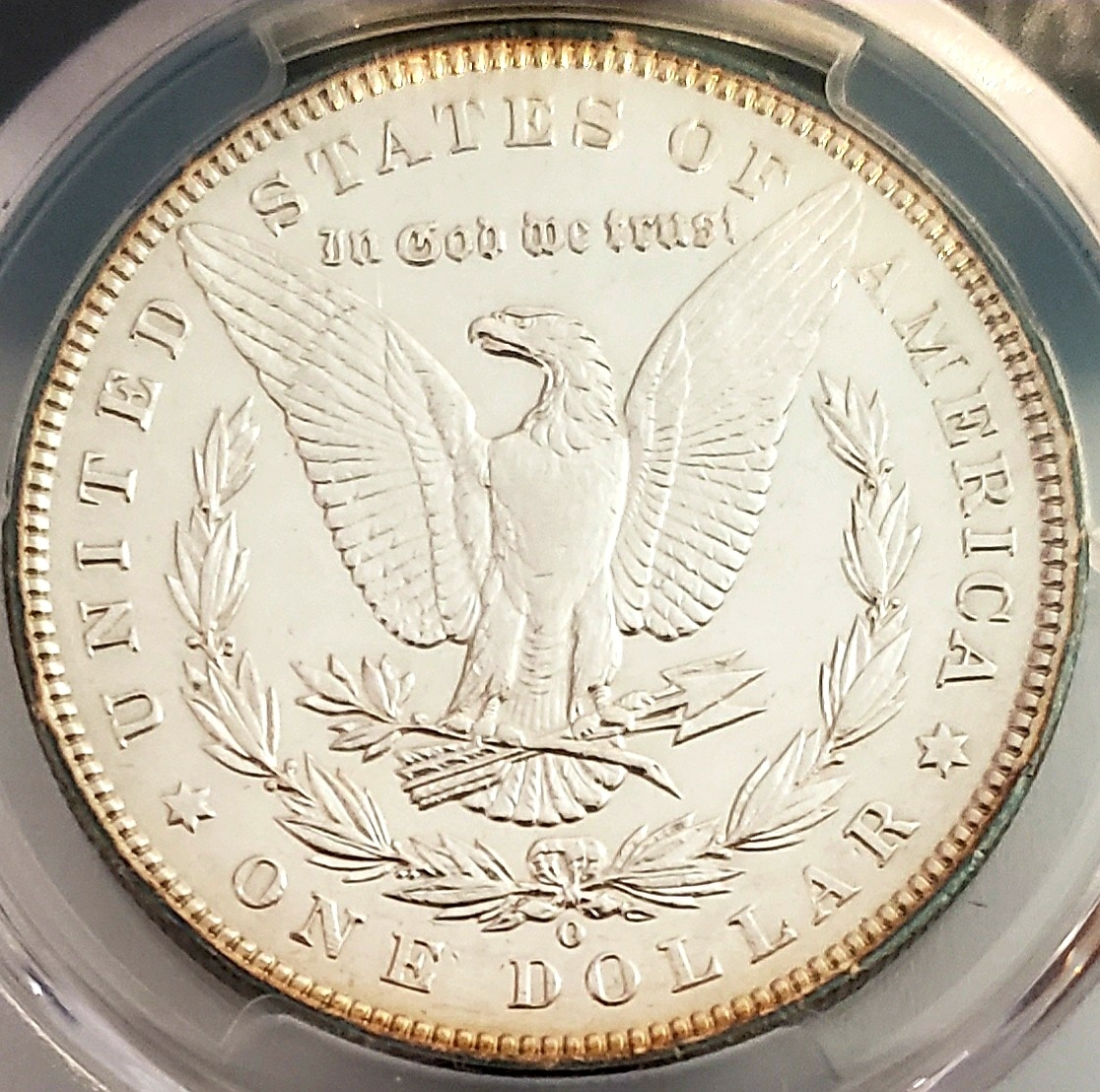
Ring of Blue and orange surround the obverse devices on this AU Morgan dollar.
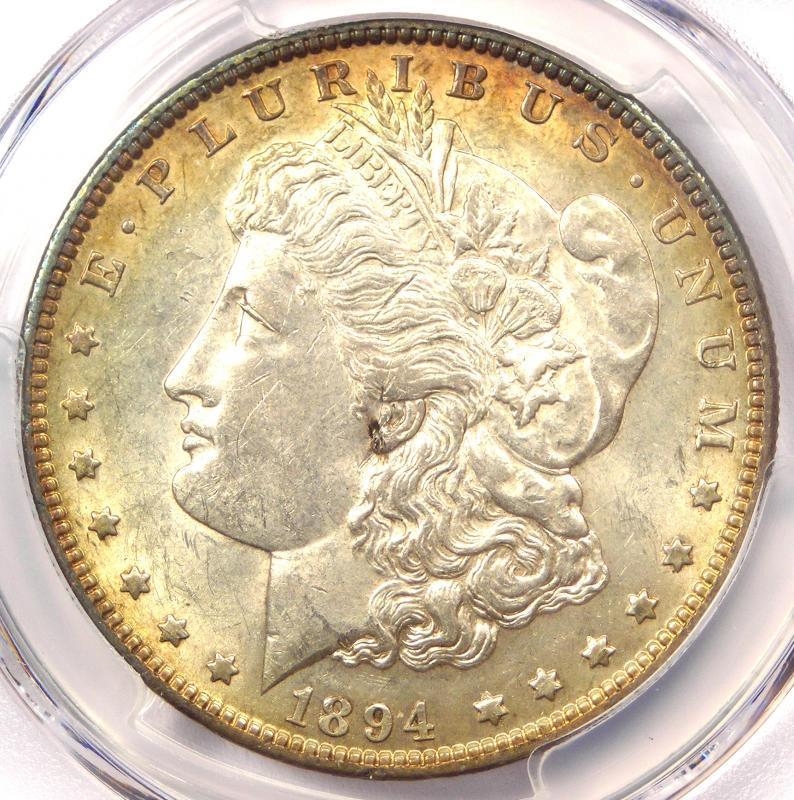
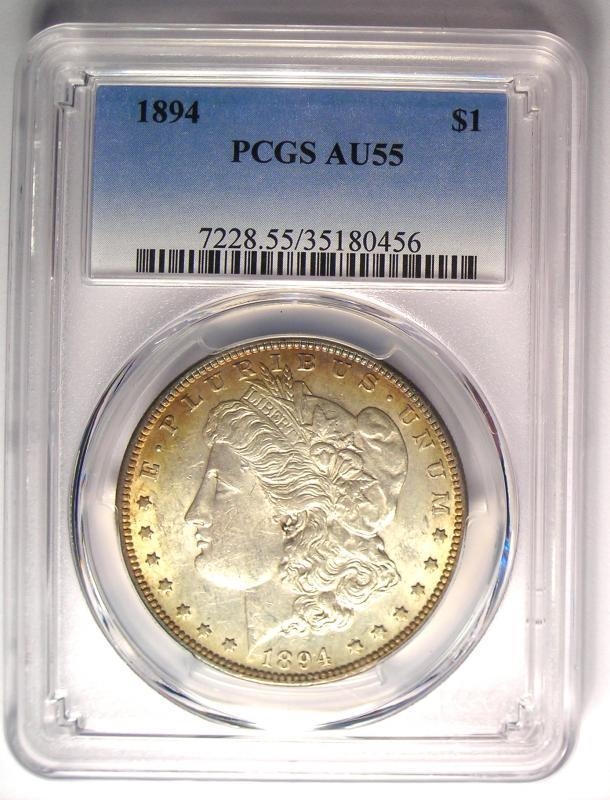
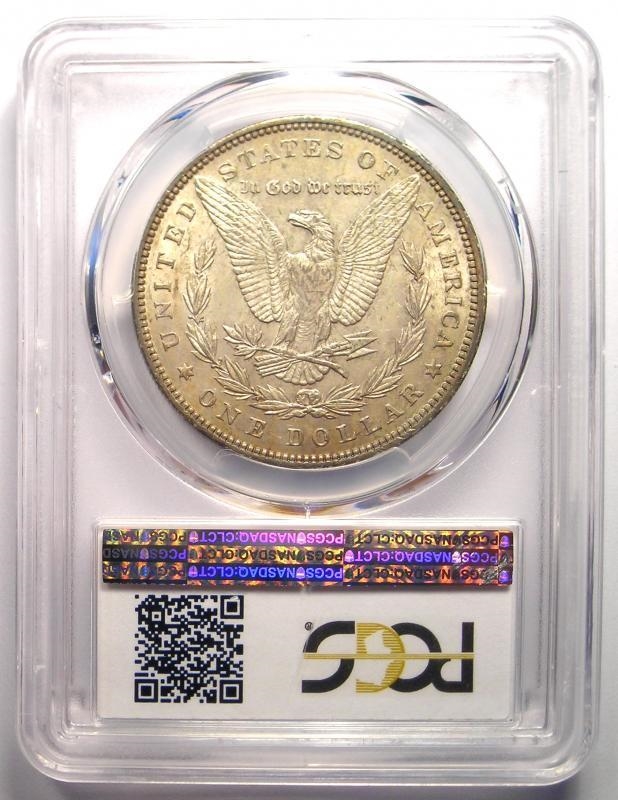
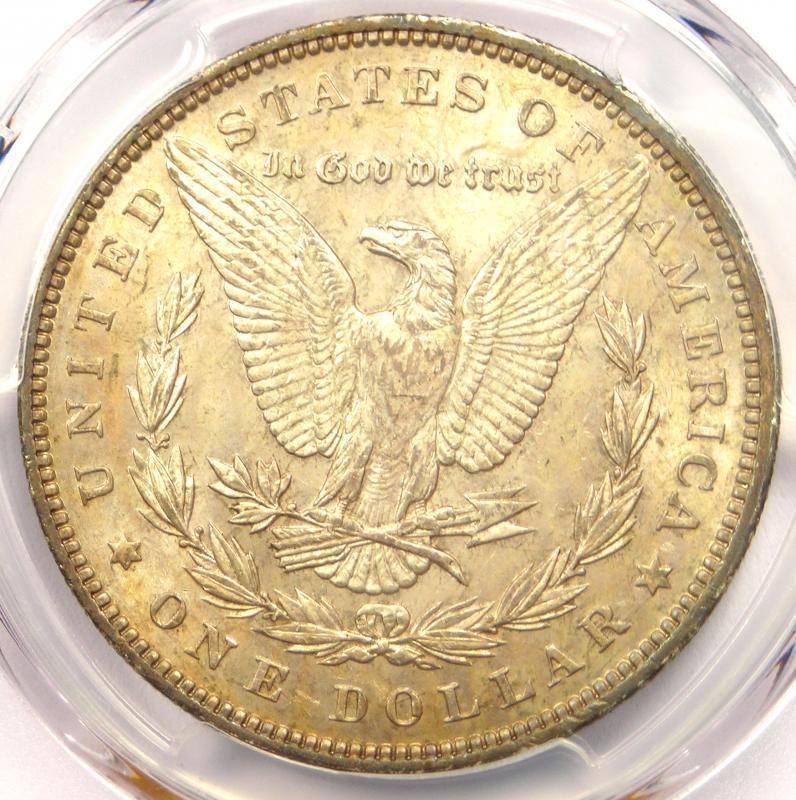
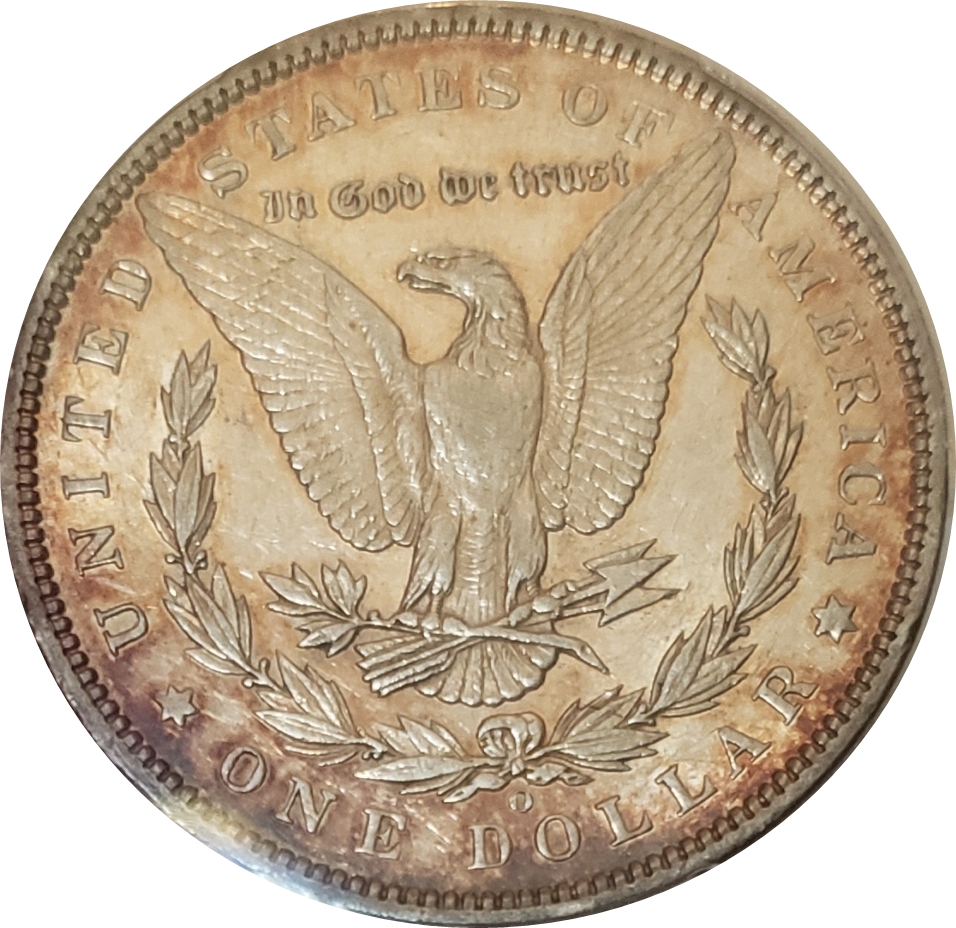
Muted luster and toning on the obverse, flashy luster with muted orange on the reverse.
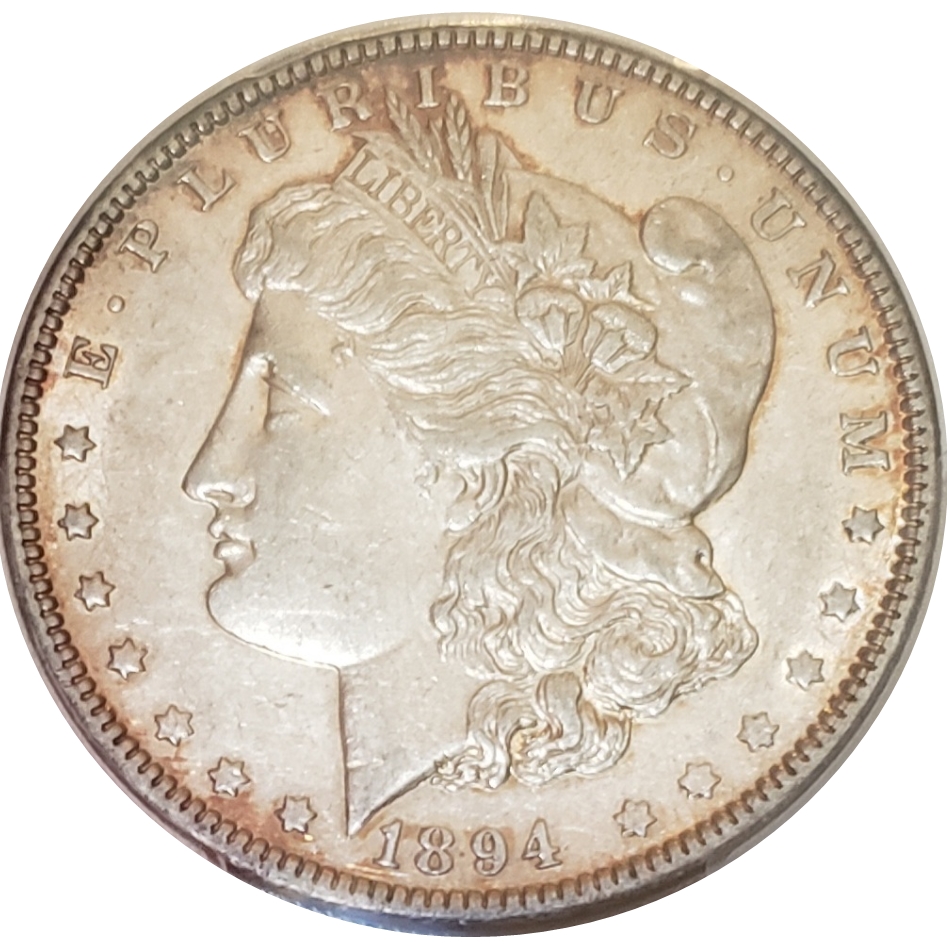
Muted luster and toning on the obverse, flashy luster with muted orange on the reverse.
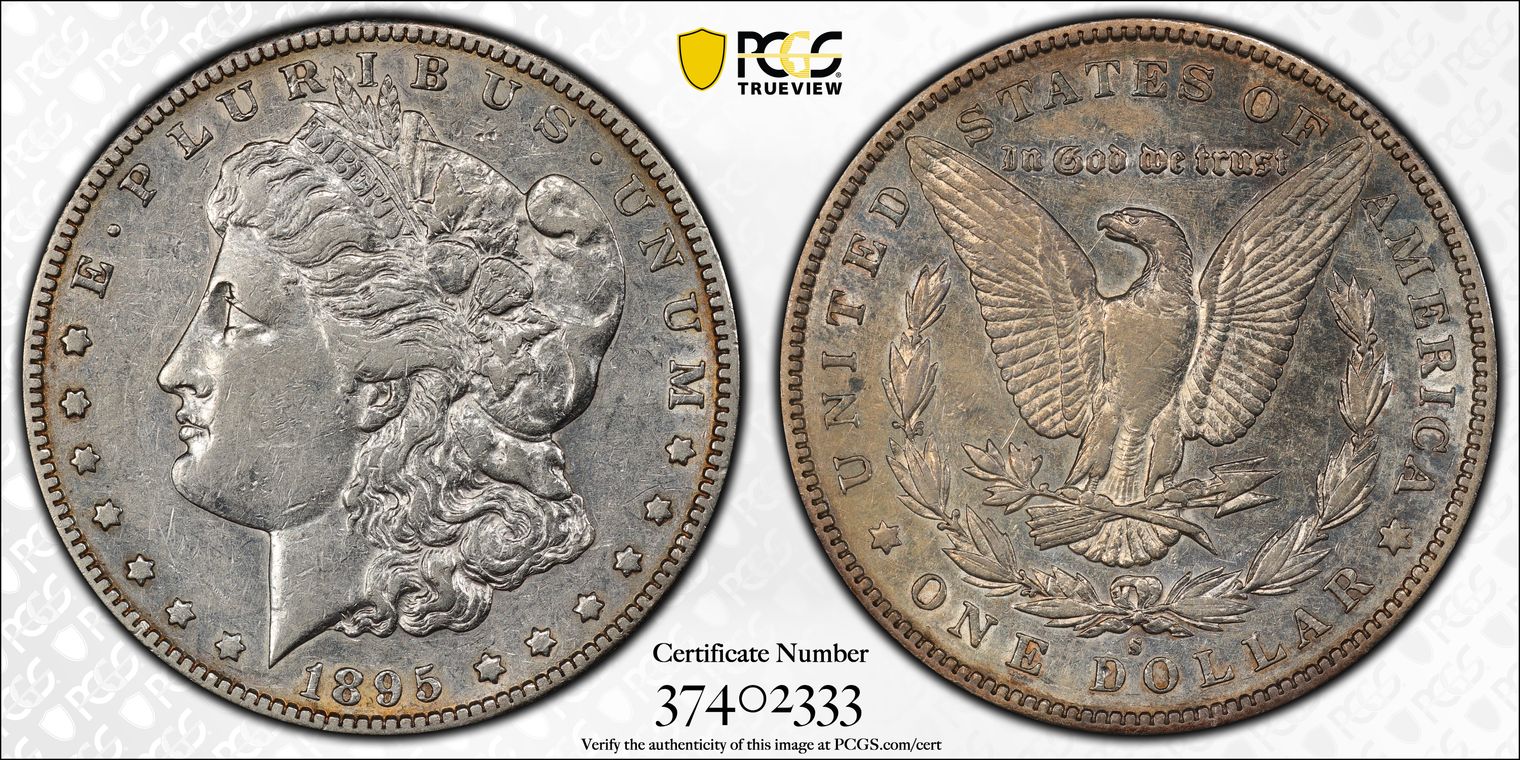
A thoroughly original and highly appealing Extremely Fine representative of one of the premier circulation-strike rarities in the Morgan dollar series. Even wear, pleasing silver-gray patina, and remarkably honest surfaces combine to produce a coin whose character rests firmly in its authenticity rather than embellishment. The obverse is draped in soft dove-gray patina with subtle champagne undertones gathering around the peripheral legends and protected recesses. The reverse displays slightly deeper steel-gray coloration with faint golden warmth nestled among the eagle, wreath, and lettering. The overall appearance is quiet and natural, free from the artificial brightness or uneven coloration so often encountered on better-date circulated pieces. Wear is entirely appropriate for the assigned grade and evenly distributed across the highest points of the design. Liberty's hair retains substantial internal definition, particularly through the lower curls and behind the neck, while the cotton leaves and blossoms remain well outlined despite moderate friction. On the reverse, the eagle's wings exhibit strong feather separation, and although the breast is smoothly worn, enough detail survives to preserve a pleasing balance throughout the central design. The legends, stars, rims, and denticles remain bold and sharply defined. The surfaces are especially commendable for this challenging issue. Moderate circulation marks are present, as expected, yet they blend naturally into the fabric of the coin without creating any singular distraction. Liberty's cheek retains a notably smooth appearance for the grade, and both fields display the honest texture of a coin that circulated briefly before spending decades undisturbed. Any remaining mint frost has long since mellowed into a soft, even patina. Rather than flashes of luster, the eye is greeted by a cohesive, settled appearance that reflects careful preservation and unquestioned originality.
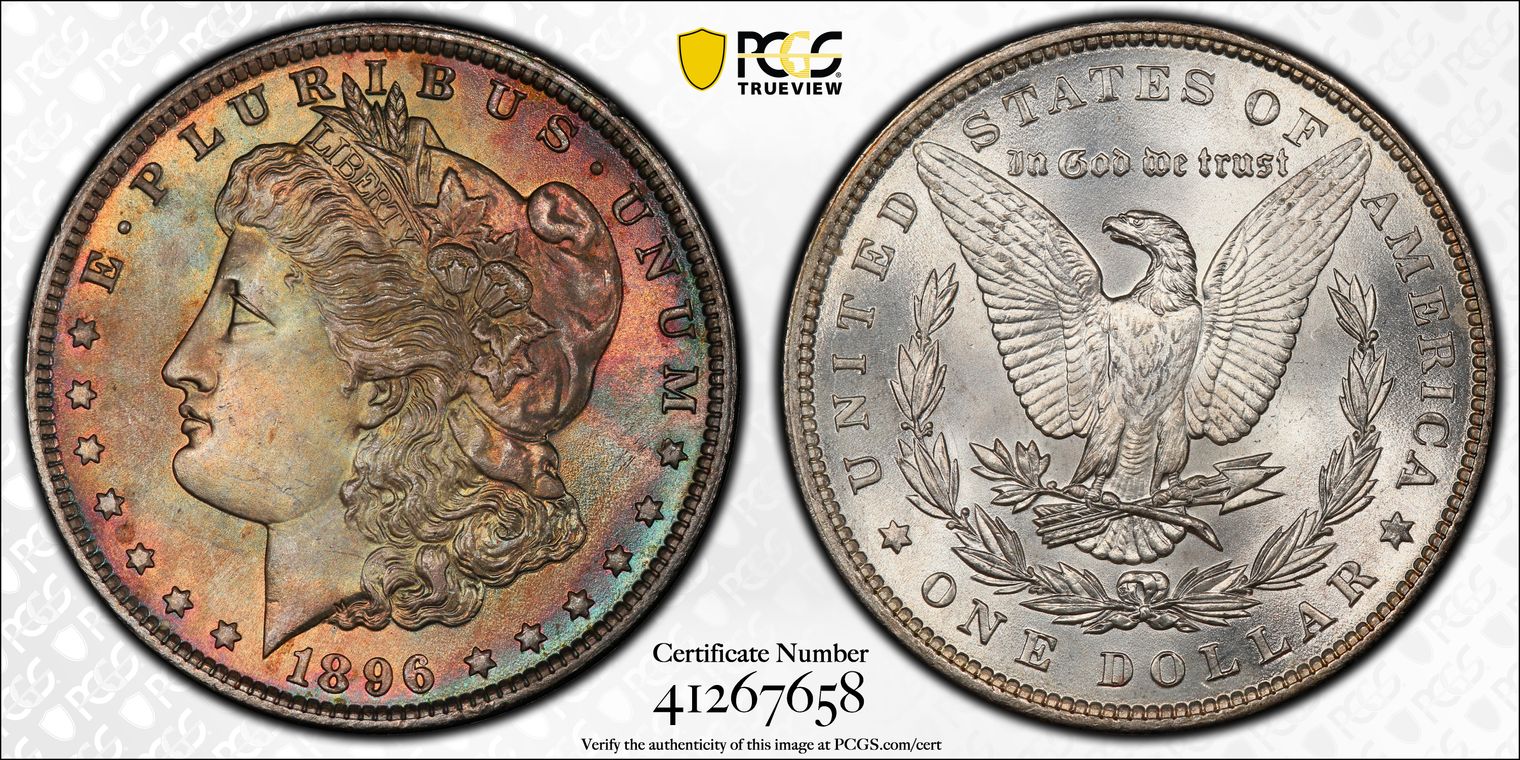
The 1896 is the most common Morgan dollar of the 1890s and is plentiful in all circulation strike grades. Finding one with unique toning and a sharp strike at a high grade was important in making this purchase. A beautifully preserved Gem representative of this Philadelphia issue, displaying softly blended peripheral toning, exceptional surface preservation, and the refined eye appeal expected of a premium Mint State survivor. The combination of original patina and balanced presentation results in a coin of uncommon harmony and lasting visual appeal. The obverse is framed by a delicate progression of color beginning with pale champagne and honey-gold, transitioning through soft rose and blush toward deeper teal and blue along portions of the left border. The colors are neither bold nor overpowering, instead forming a natural halo that complements the brilliant central devices. The reverse presents a pleasing contrast, remaining largely brilliant with only the faintest peripheral accents of gold and pale blue that reinforce the originality of the surfaces without distracting from the design. Strike quality is excellent overall. Liberty's hair exhibits crisp separation throughout the central curls and above the forehead, while the cotton leaves and blossoms are sharply defined. The reverse is equally well executed, with strong feather detail across the wings and legs, and a well-defined breast that retains full sculptural character. Denticles, stars, and legends are uniformly bold on both sides. Surface preservation is a principal strength. The expansive fields remain remarkably clean for the assigned grade, interrupted only by a few trivial contact marks that require careful examination to locate. Liberty's cheek, always the focal point on a Morgan dollar, is exceptionally smooth and free from the distracting abrasions that often limit otherwise attractive examples. The surfaces possess the fresh, undisturbed appearance expected of a premium Gem. The underlying mint frost remains well preserved beneath the translucent patina. Rather than overwhelming brilliance, the luster contributes a soft, even radiance that carries naturally across both sides, allowing the toning to remain integrated with the surfaces rather than resting above them. This coin has been stickered by CAC, designating agreement with PCGS's assessment of the coin's authenticity and grade.
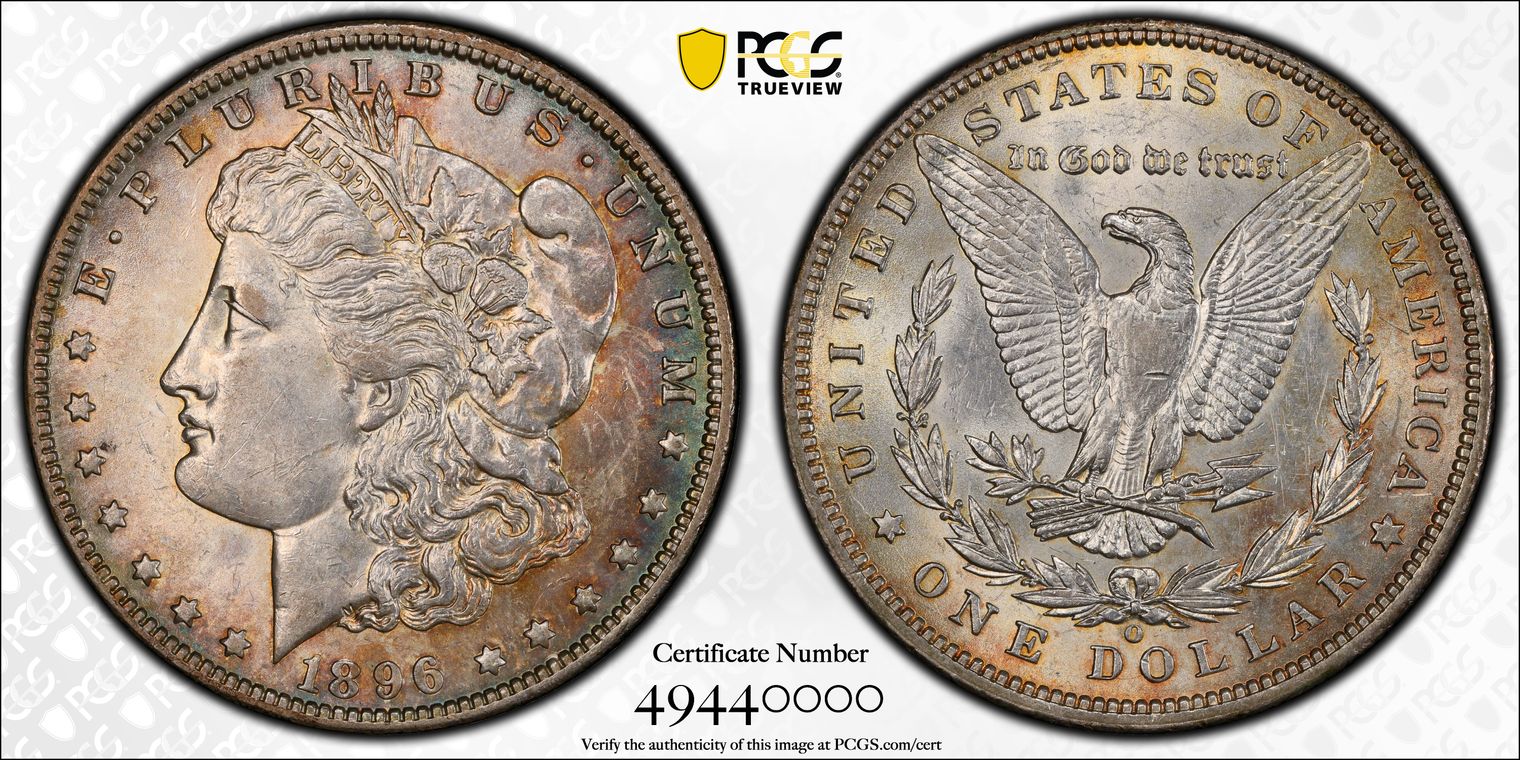
An exceptionally original About Uncirculated representative of this challenging New Orleans issue. Light cabinet friction, warm peripheral toning, and remarkably wholesome surfaces combine to produce a coin with considerable eye appeal and the understated elegance so often associated with premium AU58 Morgan dollars. The obverse displays soft silver-gray surfaces complemented by delicate champagne and pale golden patina concentrated along the borders and within the protected recesses. Similar coloration continues onto the reverse, where subtle amber accents gently frame the legends and wreath. The toning remains entirely natural in appearance, lending warmth to the surfaces without obscuring the underlying detail. Only the slightest friction is evident on the highest points of Liberty's hair and the eagle's breast, entirely consistent with the assigned grade. The remaining design elements are sharply defined, with the hair curls, cotton leaves, wreath, and wing feathers retaining excellent overall definition. While the strike reflects the typical softness encountered on this New Orleans emission, the design remains balanced and fully appreciable throughout. Surface preservation is a significant strength. The fields and devices display only the moderate contact expected from limited handling before entering storage, avoiding the heavy abrasions that frequently detract from high-grade examples of this issue. Liberty's cheek remains particularly attractive, with only minor scattered marks that never distract from the overall presentation. As expected for an AU58 example, much of the original mint luster survives beneath the lightly toned surfaces. While not flashy, the remaining frost provides a soft underlying glow that reinforces the coin's originality and contributes to its pleasing, well-settled appearance.
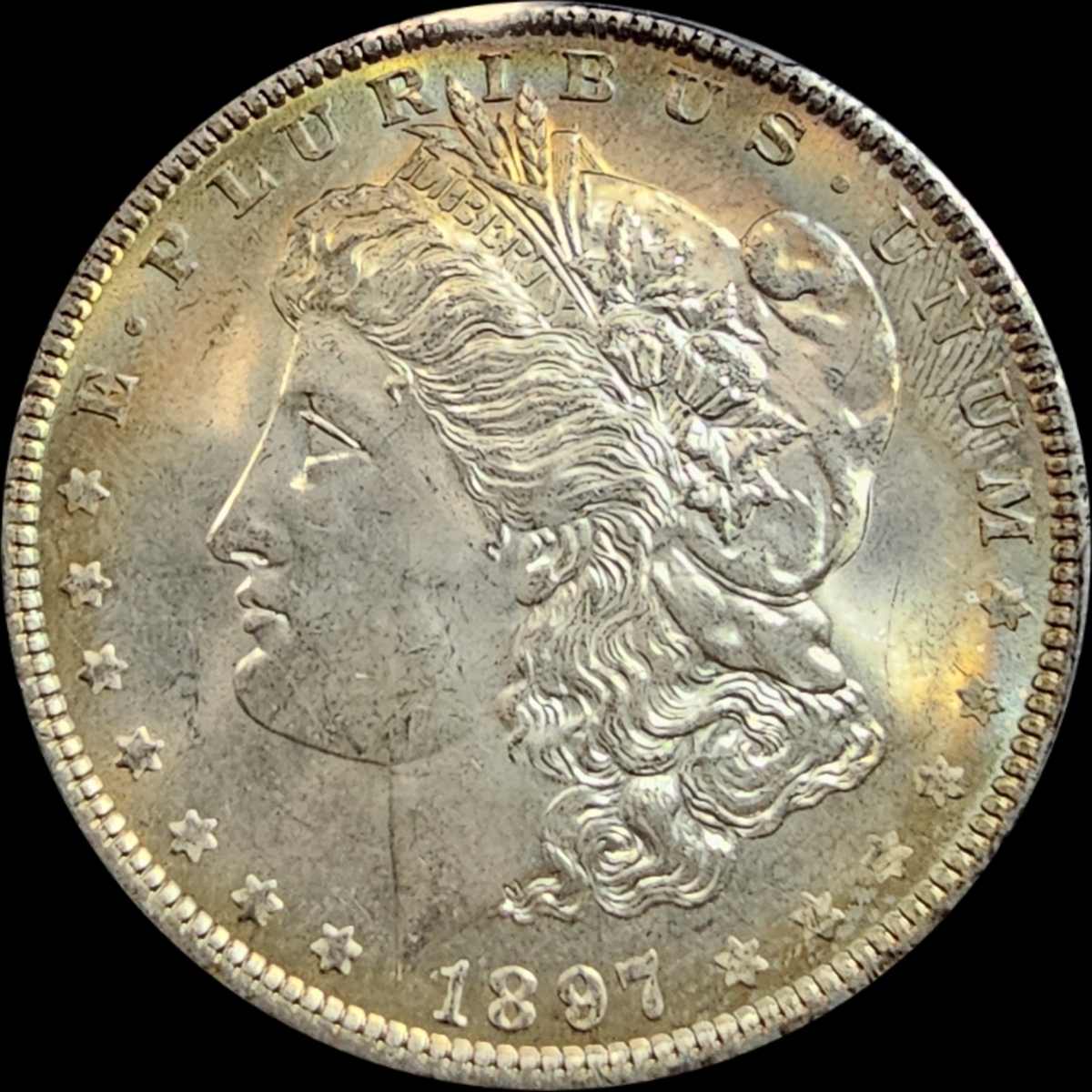
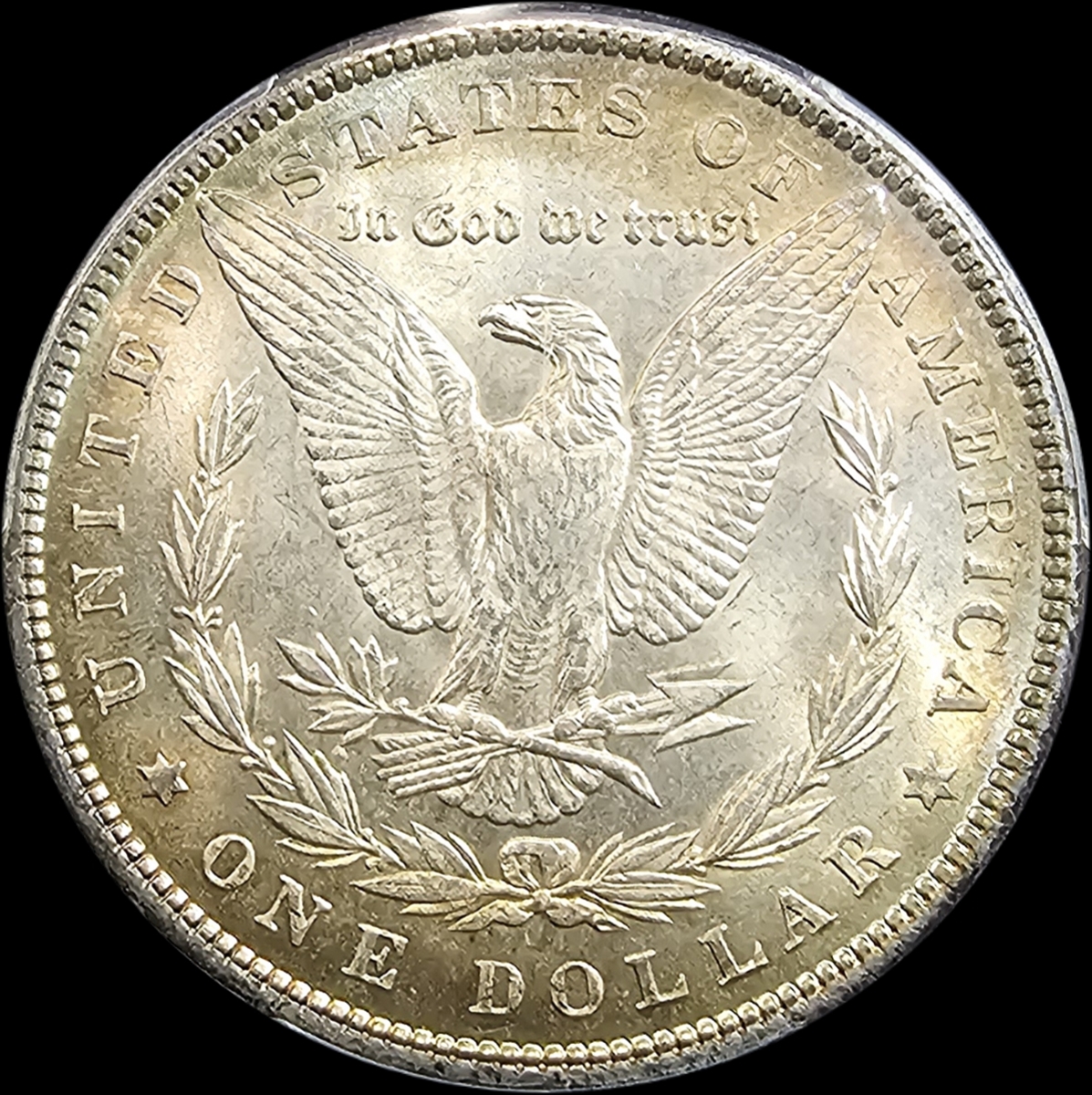
Nicely rim toned on both the obverse and reverse, this coin demonstrates the typical russet, blue and plum toning pattern of this series.
Nicely rim toned on both the obverse and reverse, this coin demonstrates the typical russet, blue and plum toning pattern of this series.
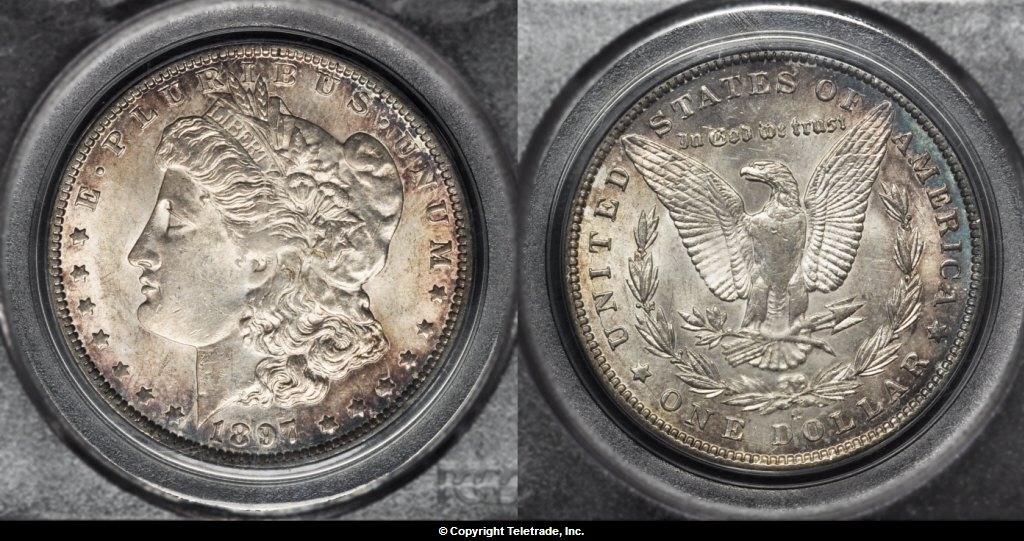
Blue rims highlight the obverse and reverse of this almost uncirculated New Orleans issue.
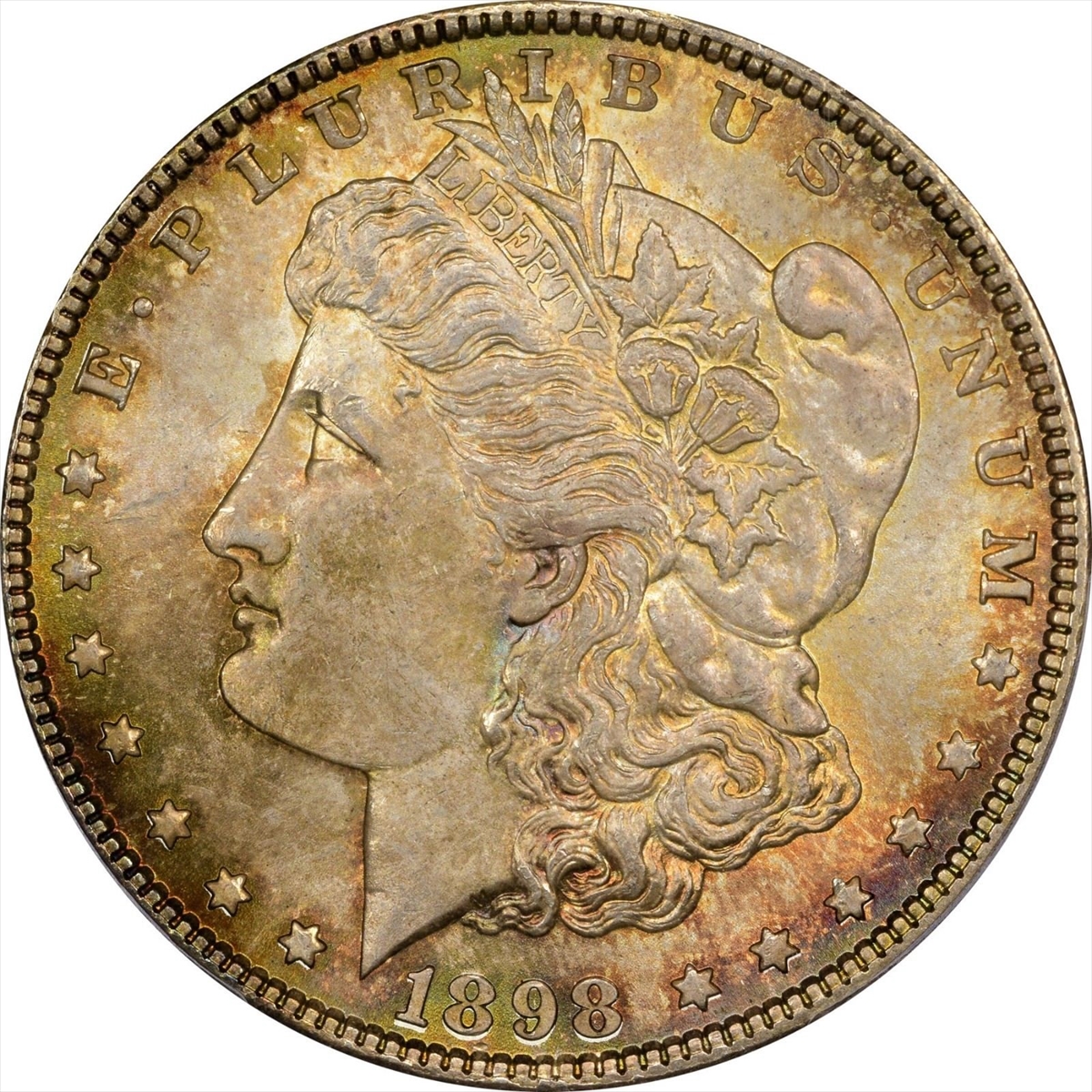
Nice peripheral toning with orange hues extending along the obverse and reverse rims.
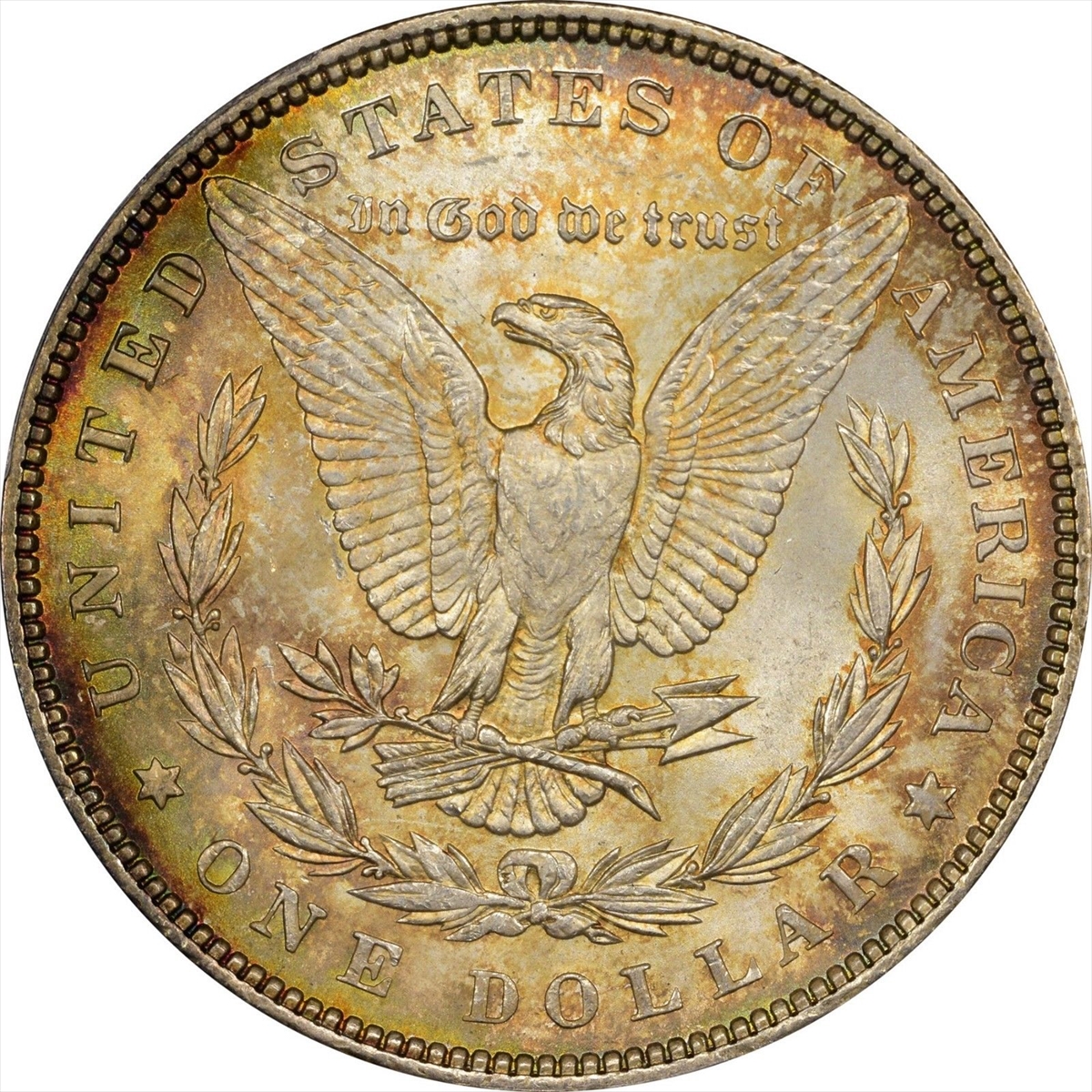
Nice peripheral toning with orange hues extending along the obverse and reverse rims.
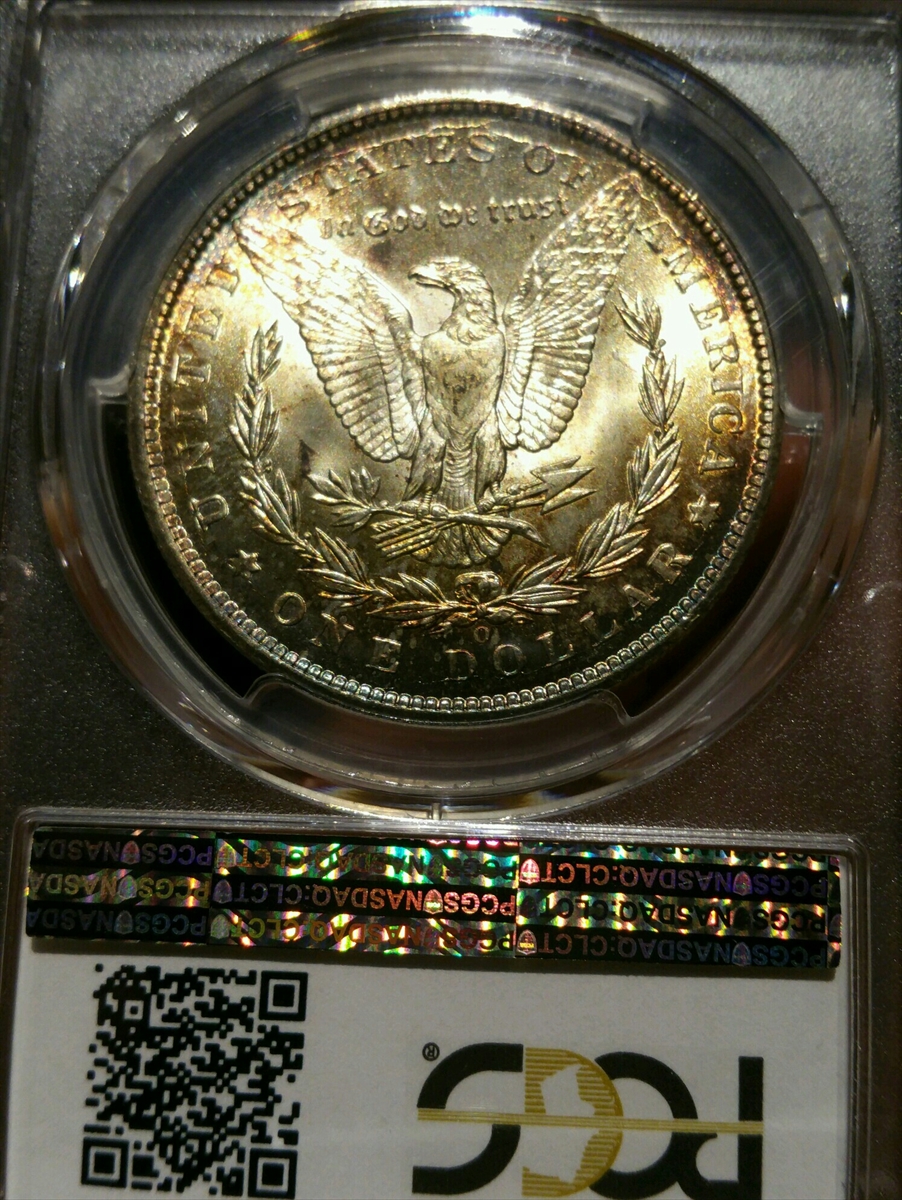
Originally in an ANACS MS64 holder, this lustrous, colorful Morgan dollar has upgraded to an MS65 holder.
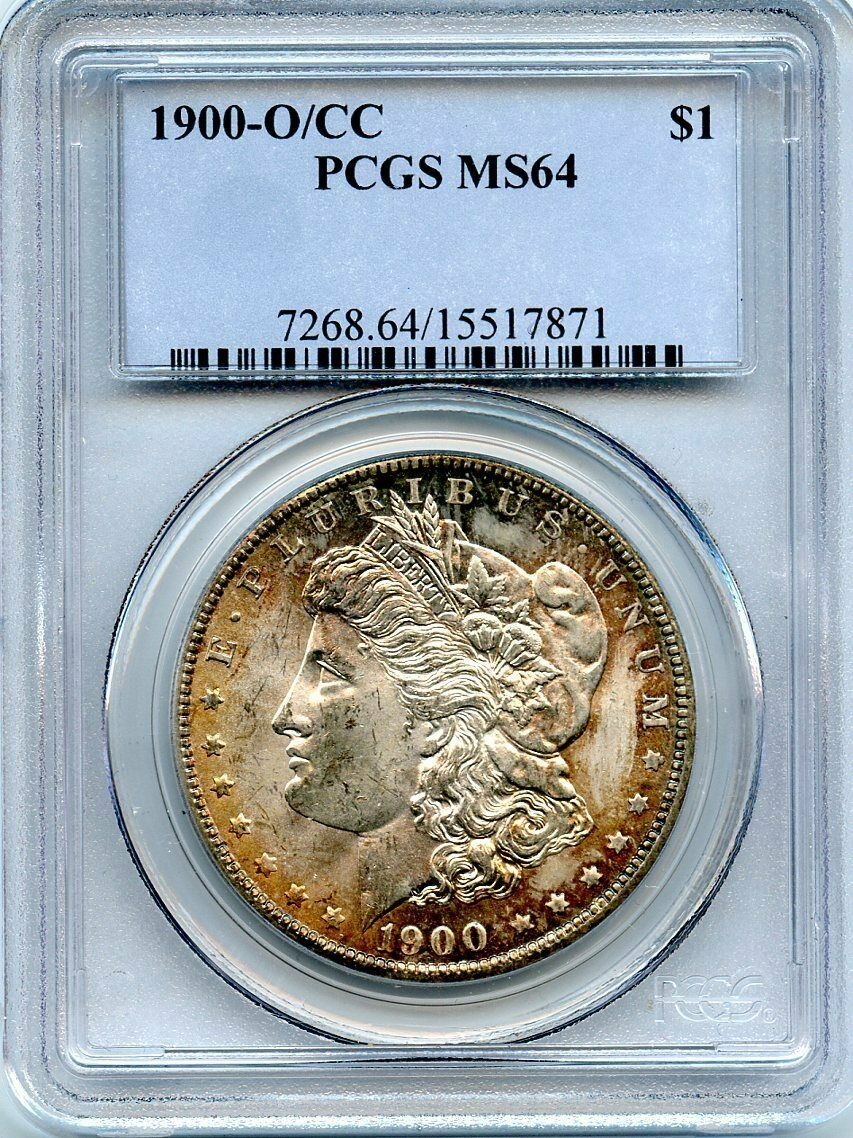
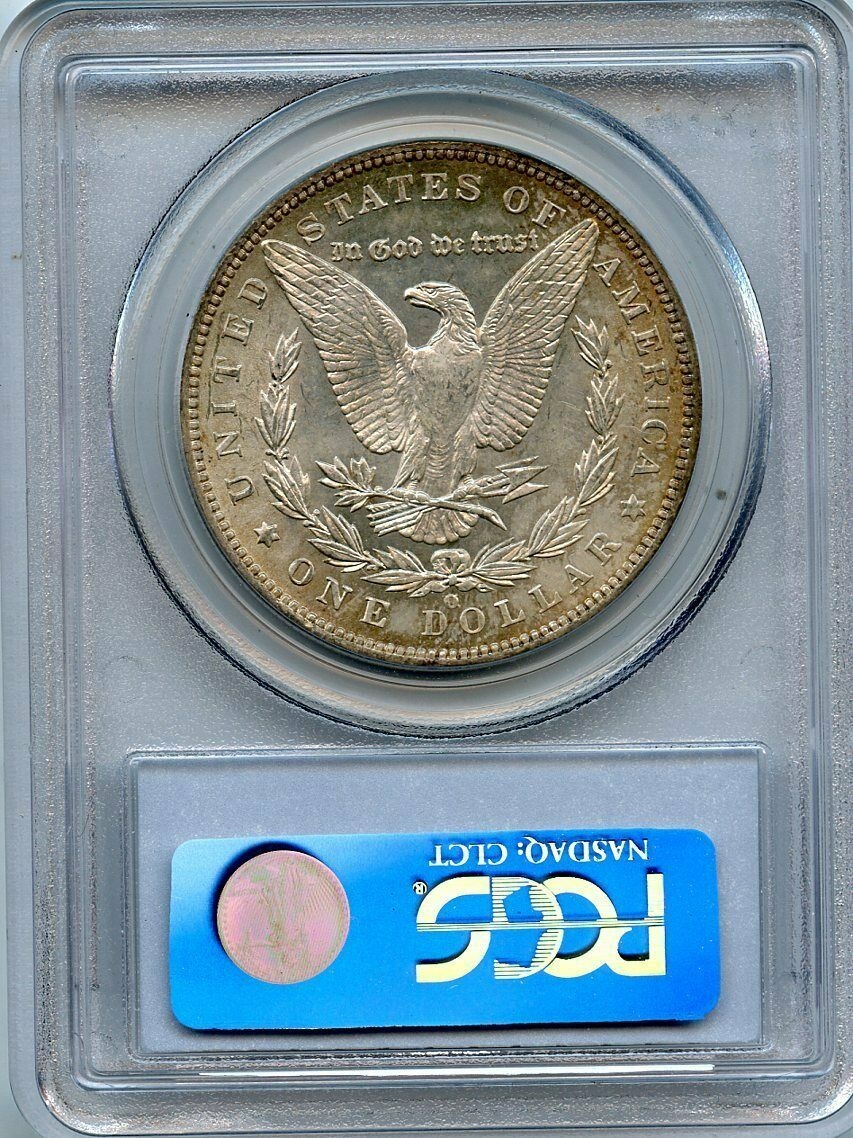
Clean, rim toned Morgan dollar in orange and blue shows a New Orleans mintmark punched over a Carson City Mintmark. A common variety, but a fun issue nonetheless.
Clean, rim toned Morgan dollar in orange and blue shows a New Orleans mintmark punched over a Carson City Mintmark. A common variety, but a fun issue nonetheless.
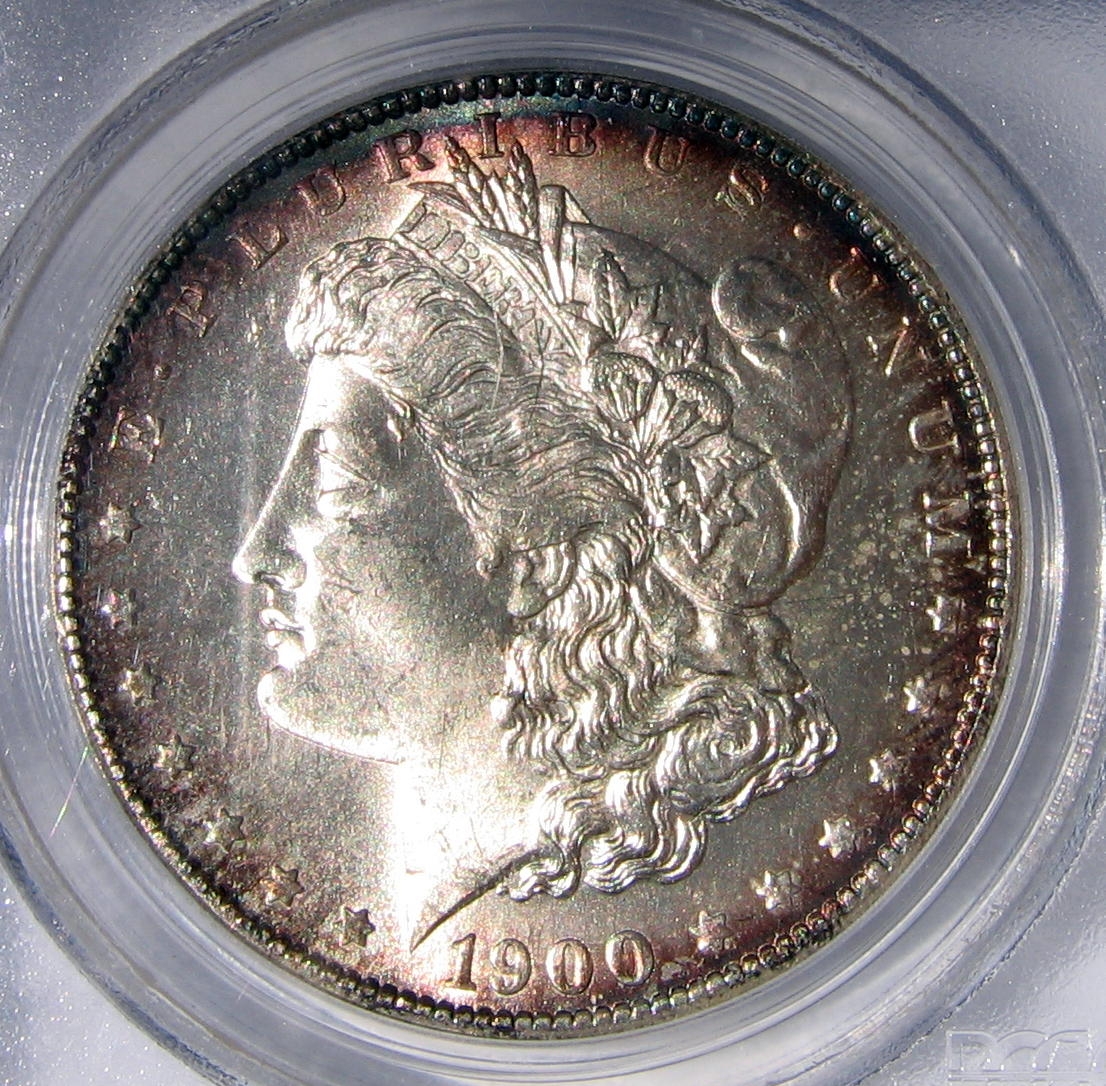
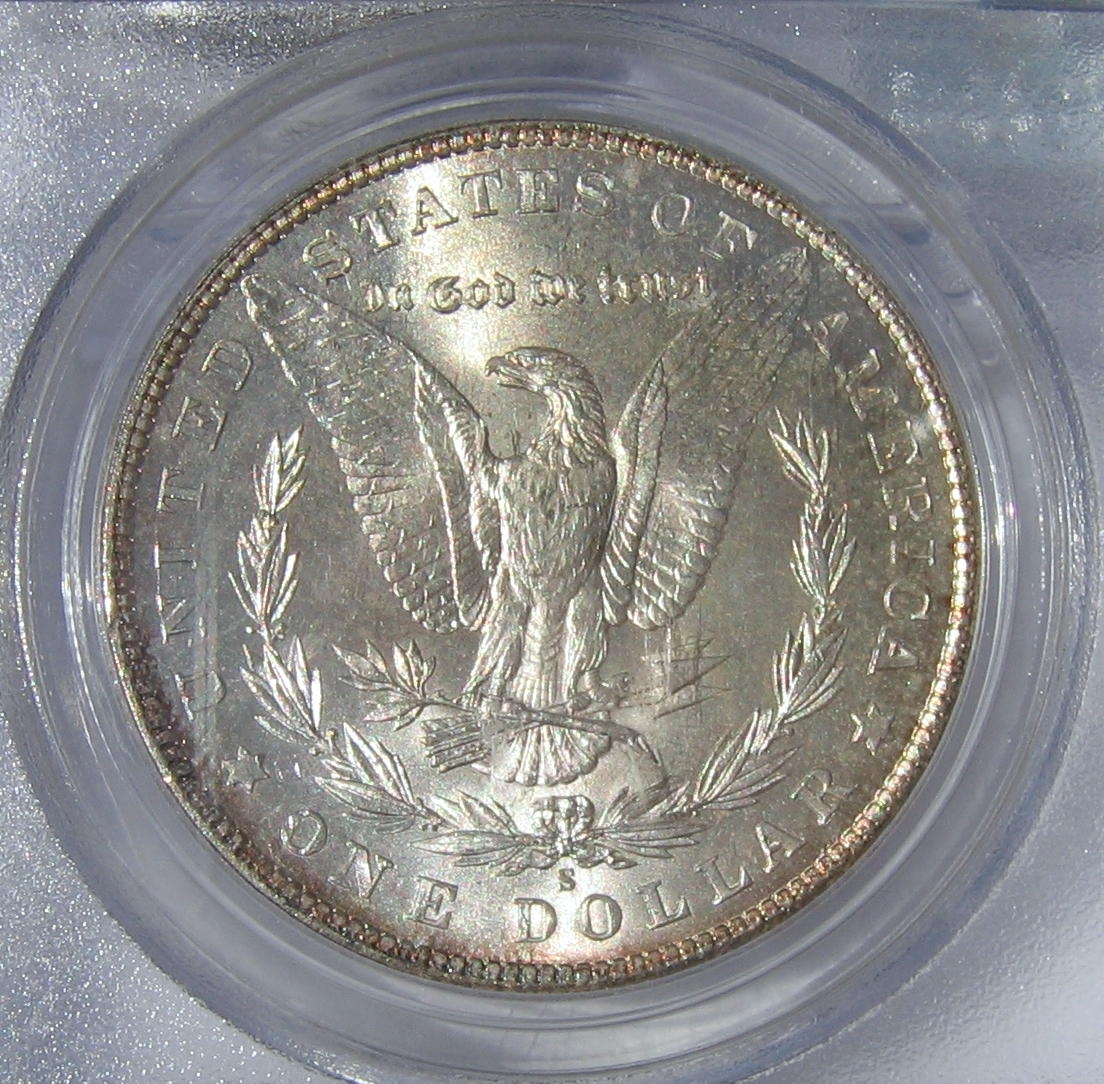
Rim toning in blue and russet accents the obverse of this Morgan Dollar. This is a difficult date to find nicely toned.
Rim toning in blue and russet accents the obverse of this Morgan Dollar. This is a difficult date to find nicely toned.
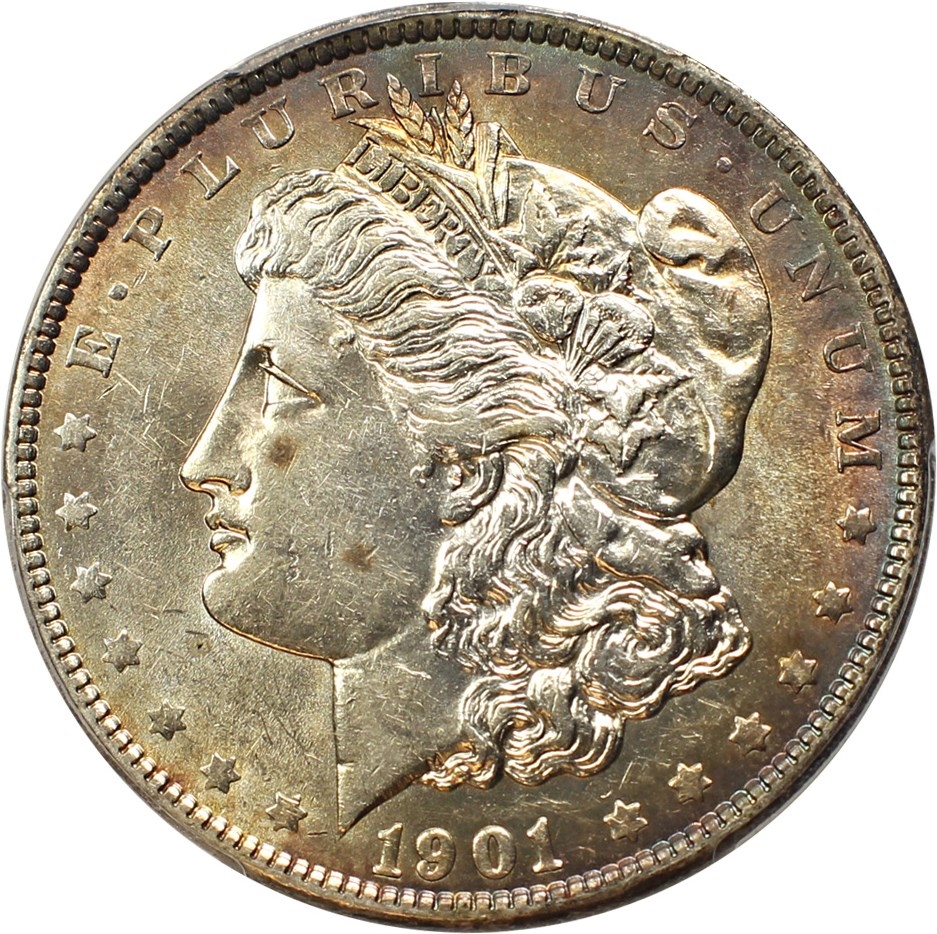
Tough date Morgan dollar, this coin is toned with blue and orange fields on both the obverse and reverse.
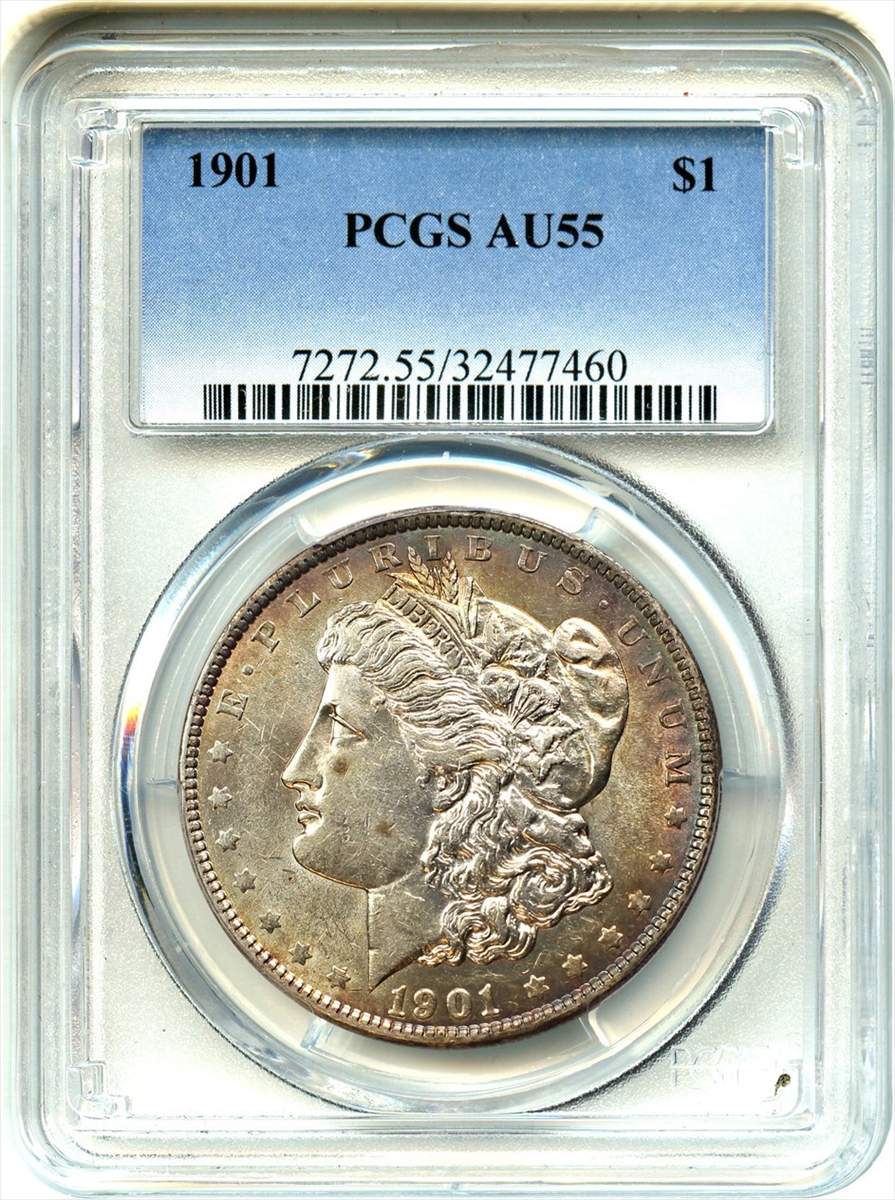
Tough date Morgan dollar, this coin is toned with blue and orange fields on both the obverse and reverse.
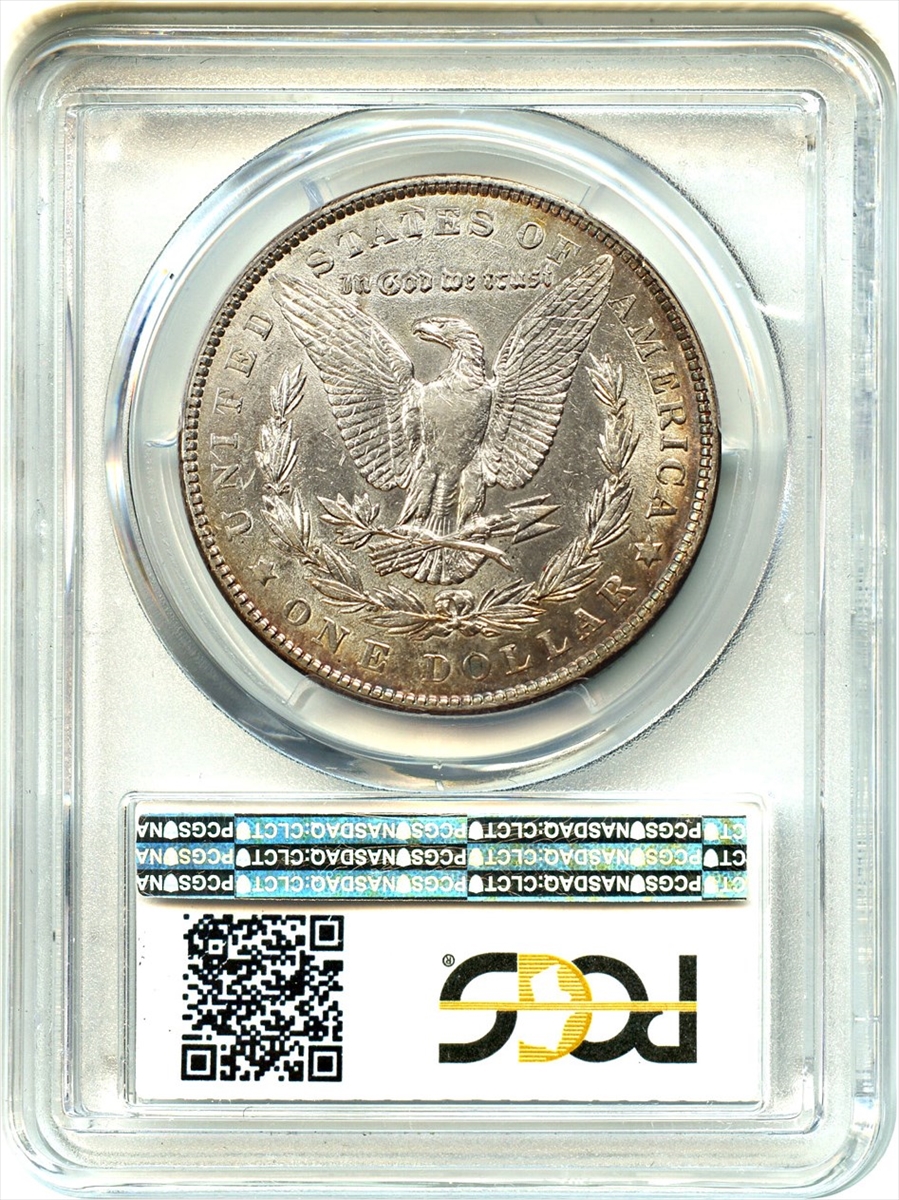
Tough date Morgan dollar, this coin is toned with blue and orange fields on both the obverse and reverse.
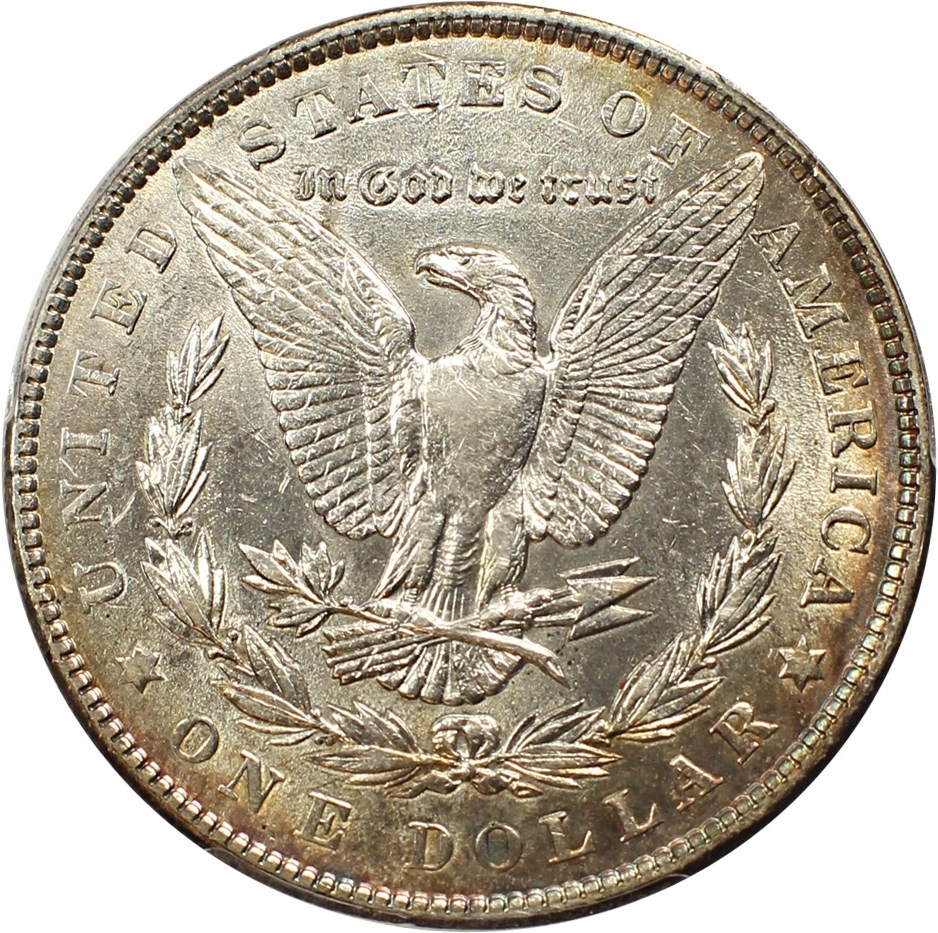
Tough date Morgan dollar, this coin is toned with blue and orange fields on both the obverse and reverse.
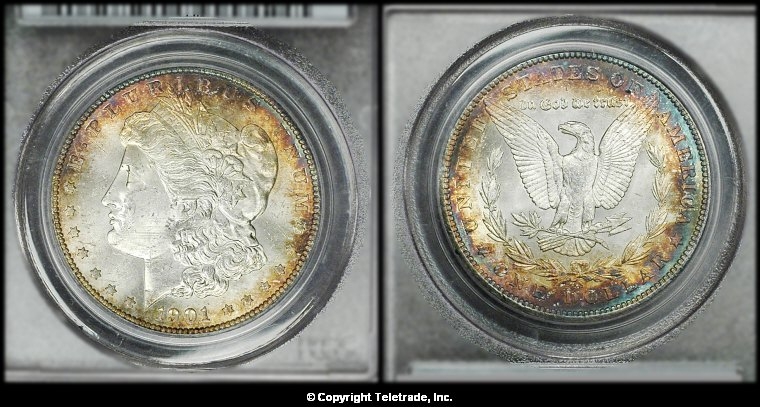
Nice reverse rim toning in blue and gold. Minor planchet striations run horizontally across Liberty's cheek which are common for this issue.
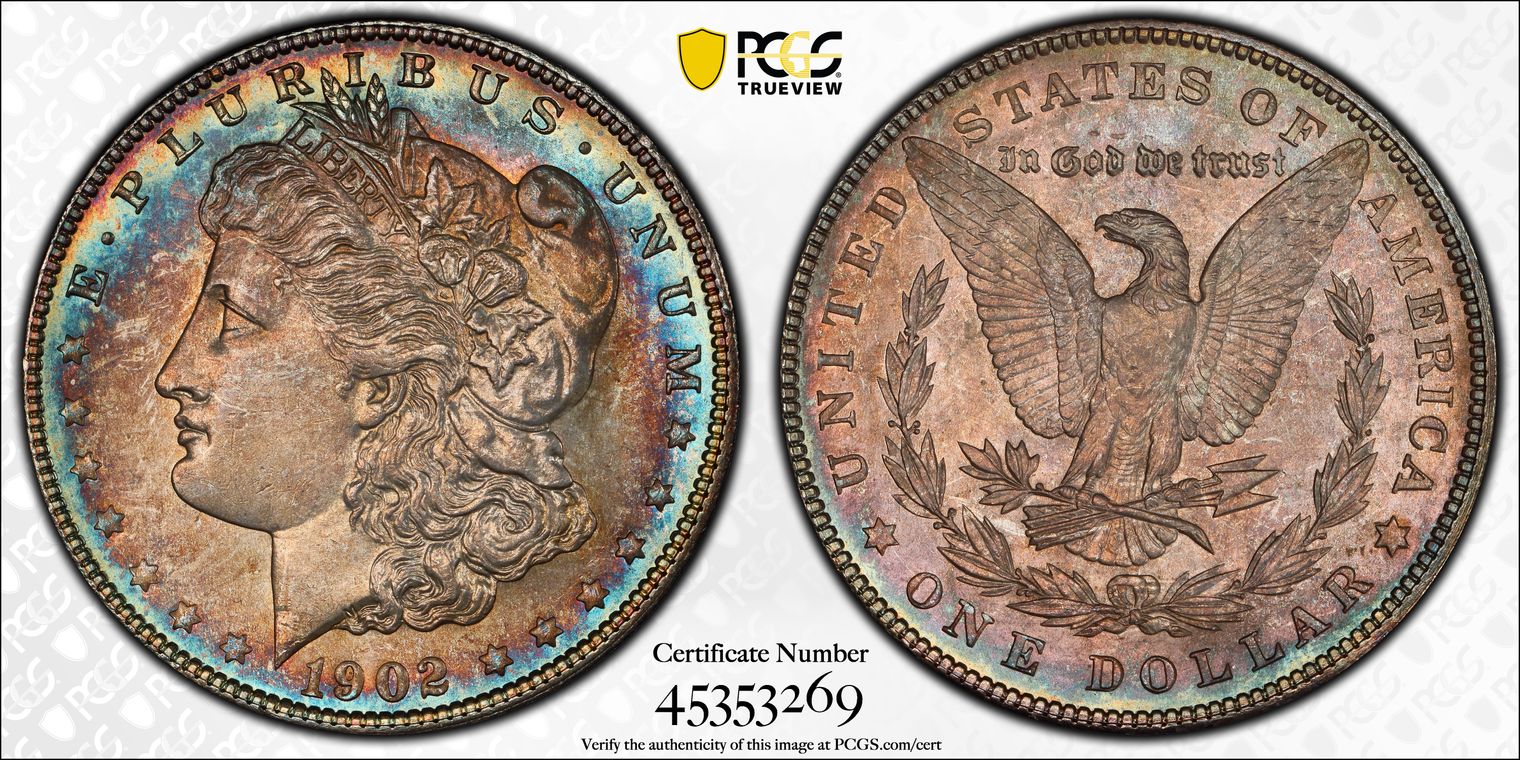
A richly original Gem whose understated satiny surfaces and beautifully matured peripheral toning present a distinctly different aesthetic from the brilliant frost more commonly associated with late-date Philadelphia Morgan dollars. Elegant rather than flamboyant, this specimen derives its appeal from remarkable originality, harmonious color, and quietly sophisticated surface quality. The obverse is framed by a vivid ring of peripheral iridescence displaying shades of turquoise, cerulean blue, violet, rose, and amber-gold that gradually yield to warm champagne-gray across the central portrait. Rather than forming a sharply defined crescent, the toning envelops Liberty with remarkable continuity, the colors remaining transparent enough to reveal every nuance of the underlying design. The reverse exhibits a complementary palette of soft rose, pale lavender, copper-gold, and muted aqua concentrated near the borders, while the central eagle retains a warm silver-gray appearance that reinforces the coin's balanced presentation. Perhaps the coin's most distinctive attribute is its luster. Rather than the vibrant frosty cartwheel often encountered on Morgan dollars of this era, the surfaces display a refined satiny bloom that diffuses light beneath the original toning. The resulting appearance is almost silky in texture, lending the coin an understated elegance and considerable visual depth. As the piece is rotated, light seems to glide across the fields instead of flashing from them, creating an effect that rewards prolonged examination.
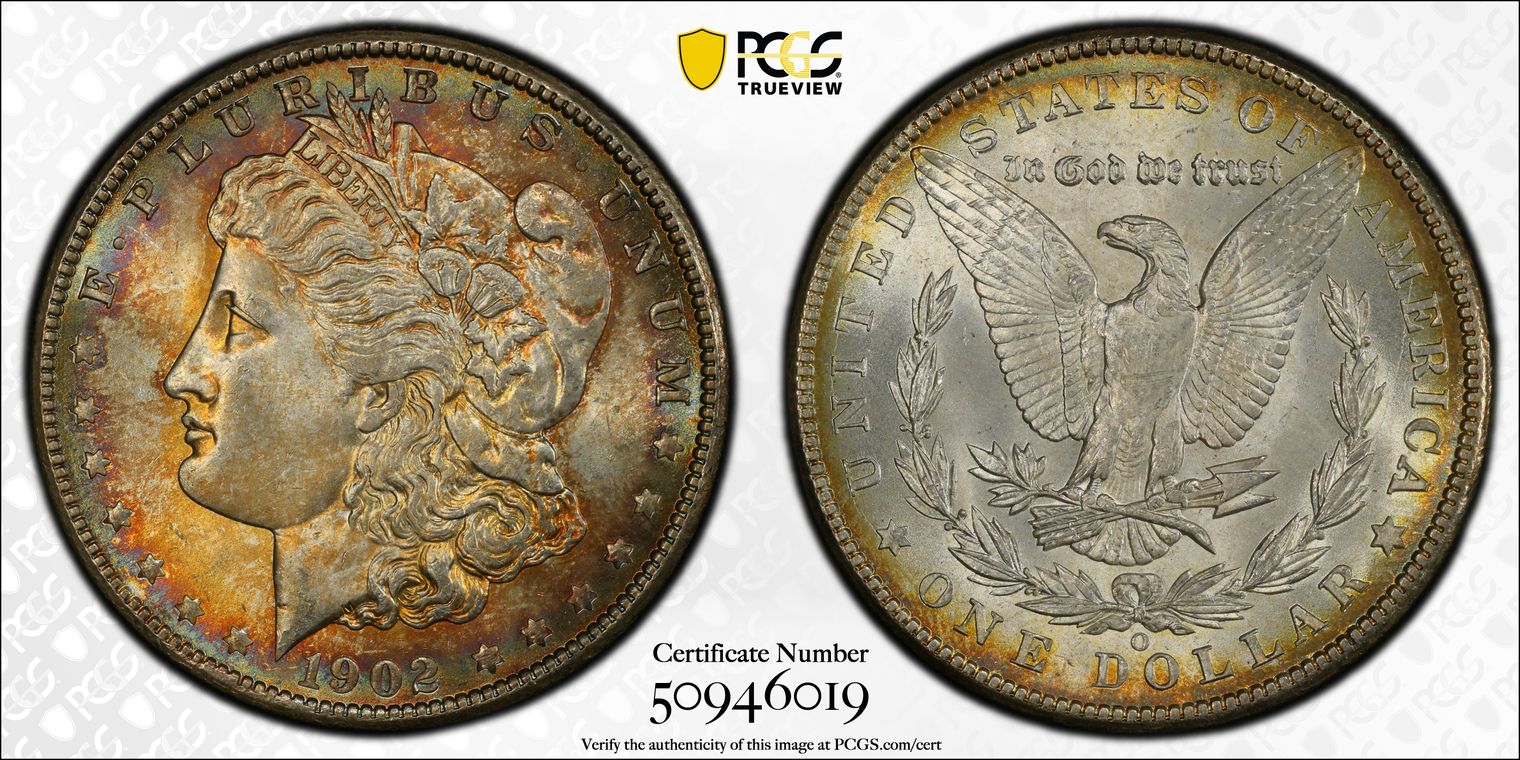
A richly original Premium Gem that beautifully captures the rugged character so often associated with the finest New Orleans Morgan dollars. Distinguished by deeply matured peripheral patina, remarkably satiny surfaces, and an almost sculptural sense of substance, this handsome 1902-O possesses an individuality that extends well beyond its technical merits. The obverse is framed by an intricate halo of antique gold, chestnut, burnt amber, and smoky violet that gradually transitions into warm silver-gray over Liberty's portrait. Along the lower left rim, subtle flashes of cobalt and magenta emerge beneath the deeper golden hues, lending welcome complexity without disturbing the coin's remarkable balance. The reverse presents a complementary appearance, with delicate champagne-gold surrounding predominantly silver-gray central devices. The thin peripheral color serves as an elegant frame, allowing the eagle to remain the visual focal point. Perhaps the coin's defining characteristic is its remarkable surface texture. Beneath the original patina resides an exceptionally rich satiny luster possessing a dense, almost velvety quality. Rather than flashing brightly beneath illumination, the luster rolls deliberately across the surfaces with a thick, oily appearance that imparts uncommon visual depth. The effect is one of substance and maturity, giving both Liberty and the eagle an almost sculptural weight rarely encountered among more brilliant examples.
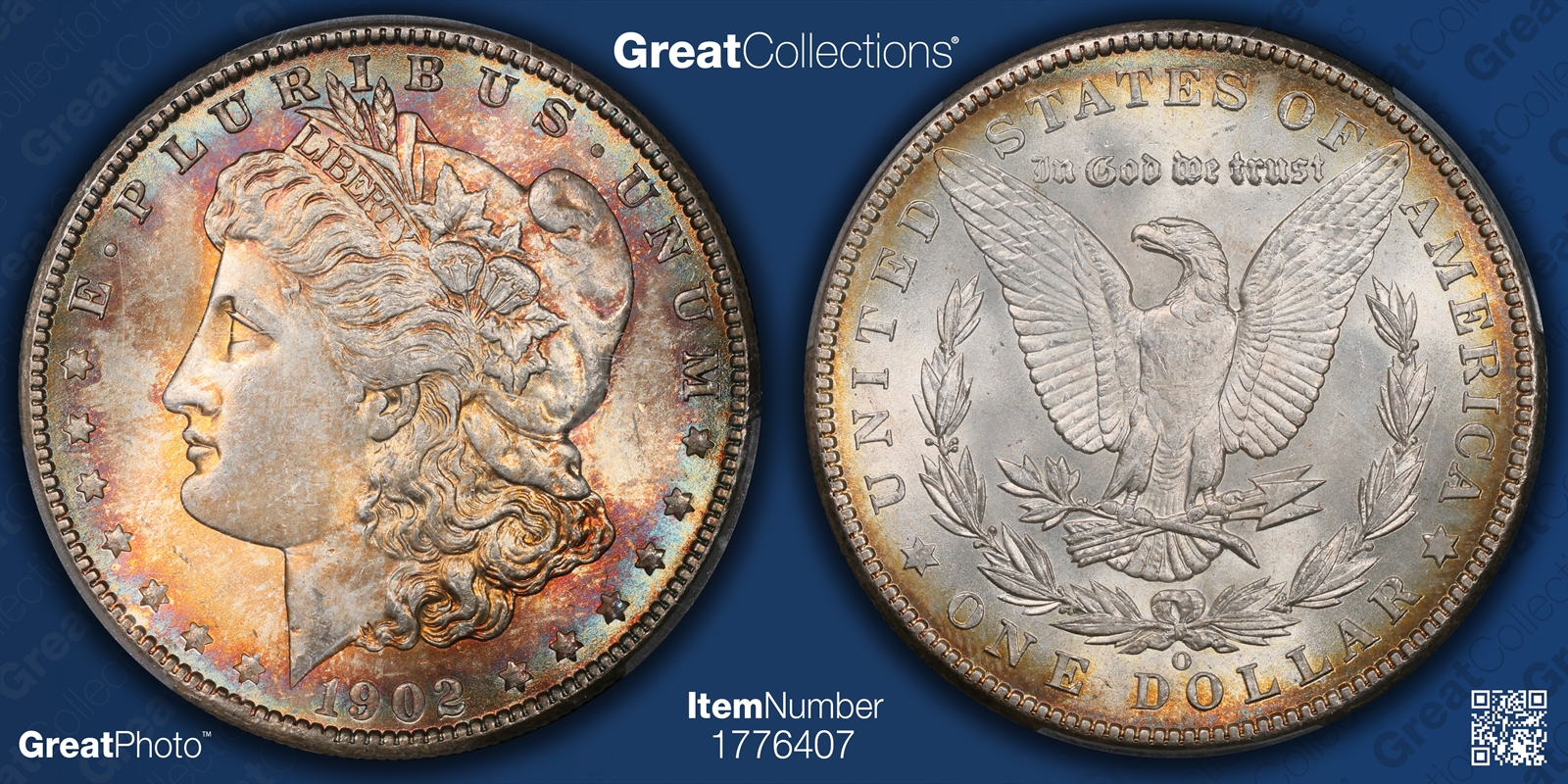
A richly original Premium Gem that beautifully captures the rugged character so often associated with the finest New Orleans Morgan dollars. Distinguished by deeply matured peripheral patina, remarkably satiny surfaces, and an almost sculptural sense of substance, this handsome 1902-O possesses an individuality that extends well beyond its technical merits. The obverse is framed by an intricate halo of antique gold, chestnut, burnt amber, and smoky violet that gradually transitions into warm silver-gray over Liberty's portrait. Along the lower left rim, subtle flashes of cobalt and magenta emerge beneath the deeper golden hues, lending welcome complexity without disturbing the coin's remarkable balance. The reverse presents a complementary appearance, with delicate champagne-gold surrounding predominantly silver-gray central devices. The thin peripheral color serves as an elegant frame, allowing the eagle to remain the visual focal point. Perhaps the coin's defining characteristic is its remarkable surface texture. Beneath the original patina resides an exceptionally rich satiny luster possessing a dense, almost velvety quality. Rather than flashing brightly beneath illumination, the luster rolls deliberately across the surfaces with a thick, oily appearance that imparts uncommon visual depth. The effect is one of substance and maturity, giving both Liberty and the eagle an almost sculptural weight rarely encountered among more brilliant examples.
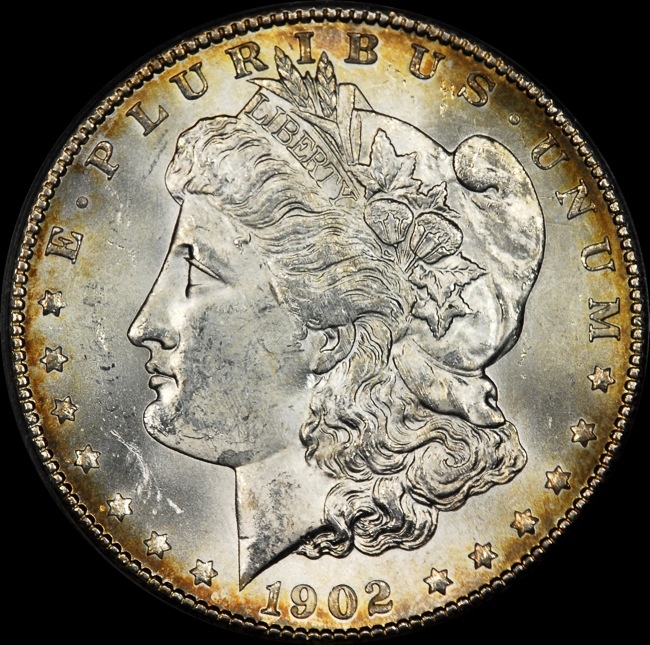
The 1902-S is one of the scarcer San Francisco Mint entries in the Morgan dollar series, many of the 1,530,000 coins produced likely melted pursuant to the terms of the 1918 Pittman Act. Even so, thousands of Mint State examples came to light through government distributions from the 1920s through the early 1950s. Obtainable with relative ease in lower uncirculated grades, if still scarce by the standards of the type, the 1902-S remains a formidable condition rarity as an upper end Gem. This coin exhibits nice rim tones that are beginning to appear as golden orange tints on the obverse and reverse. CAC approved.
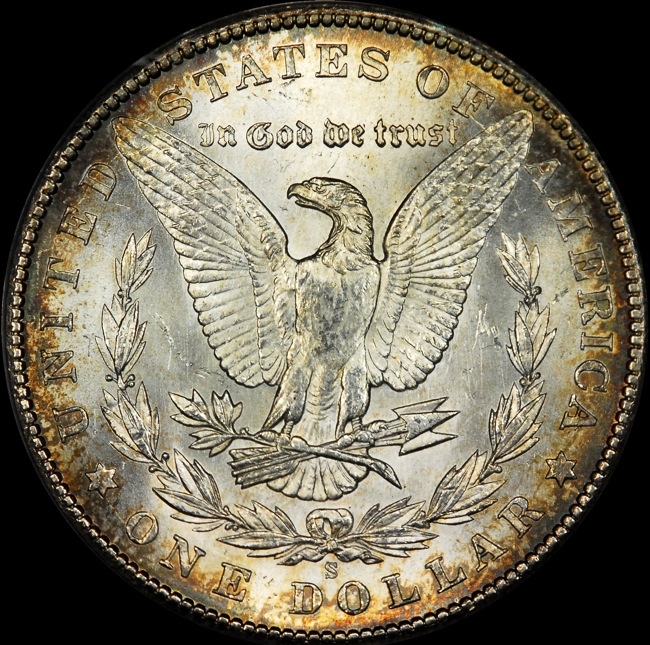
The 1902-S is one of the scarcer San Francisco Mint entries in the Morgan dollar series, many of the 1,530,000 coins produced likely melted pursuant to the terms of the 1918 Pittman Act. Even so, thousands of Mint State examples came to light through government distributions from the 1920s through the early 1950s. Obtainable with relative ease in lower uncirculated grades, if still scarce by the standards of the type, the 1902-S remains a formidable condition rarity as an upper end Gem. This coin exhibits nice rim tones that are beginning to appear as golden orange tints on the obverse and reverse. CAC approved.
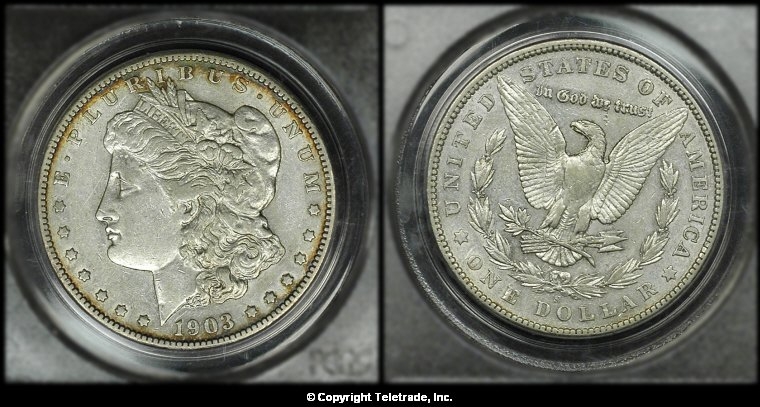
Subtle toning on obverse along the rim on this circulated example of a tough S-mint dollar.
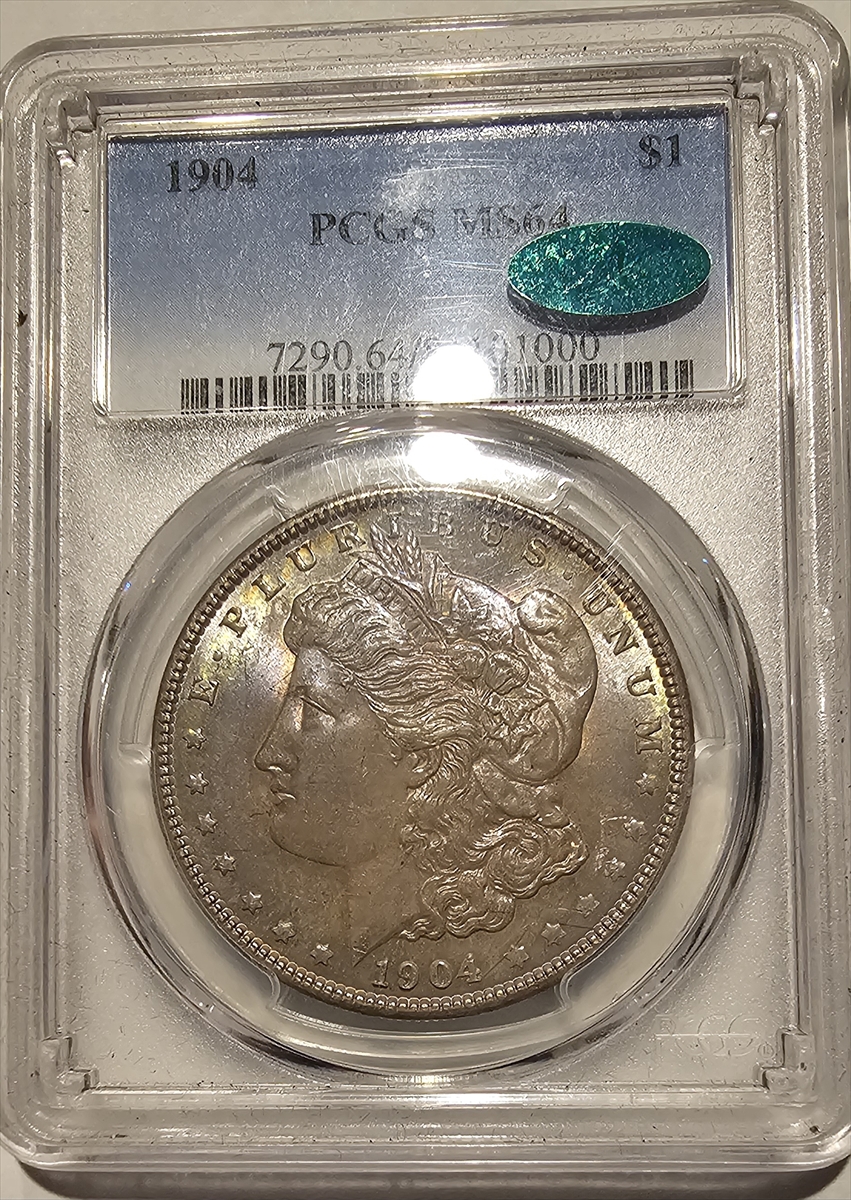
What this coin lacks in luster, it makes up for in color. Exhibiting deep plums, blues and pinks on both the obverse and reverse, the near-terminal toning of this coin pops when held at the correct angle in the light. Nicely struck and free of any marks on the cheek, this Morgan dollar is the rare exception to the rule for this date. Most coins of this issue have a subdued gray luster that is often dull and unattractive with poor to average stike at best. This coin demonstrates none of those characteristics. CAC approved.
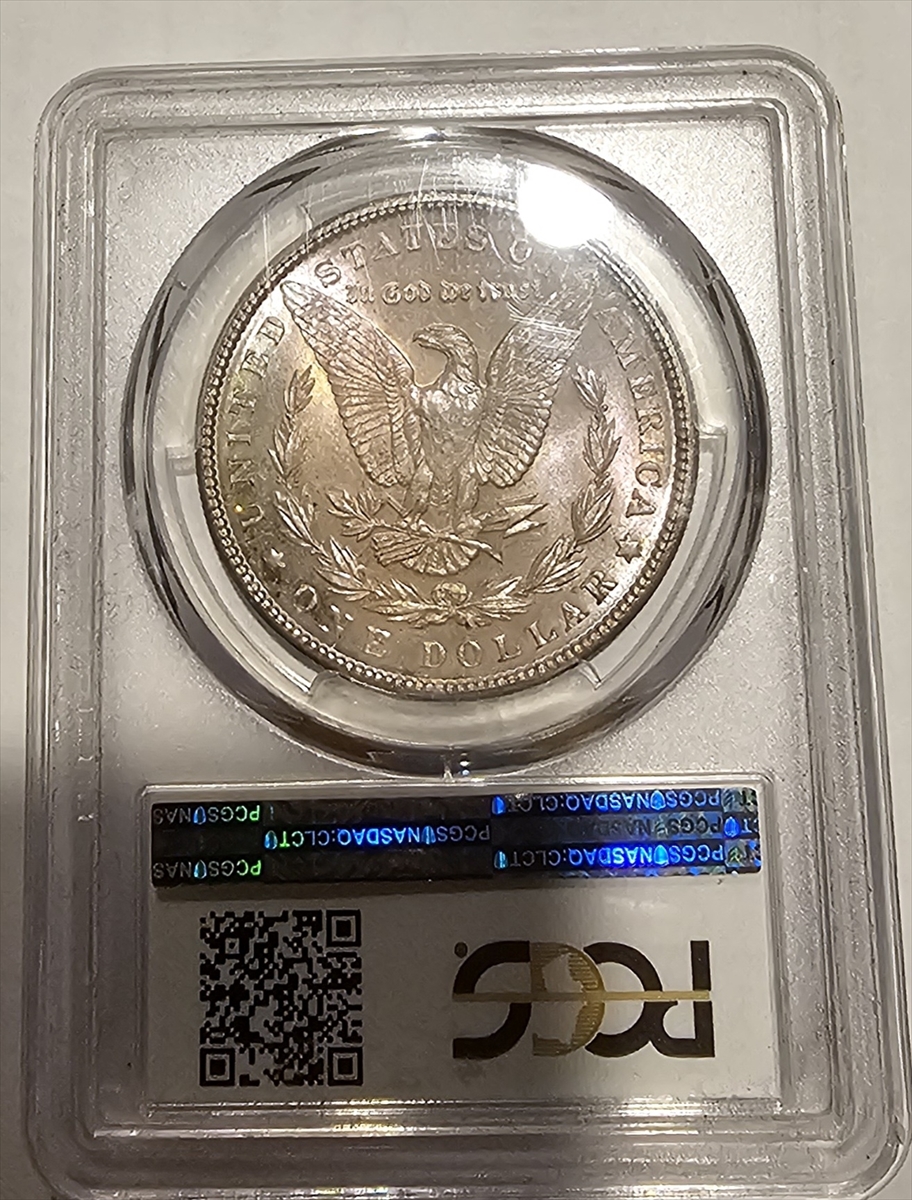
What this coin lacks in luster, it makes up for in color. Exhibiting deep plums, blues and pinks on both the obverse and reverse, the near-terminal toning of this coin pops when held at the correct angle in the light. Nicely struck and free of any marks on the cheek, this Morgan dollar is the rare exception to the rule for this date. Most coins of this issue have a subdued gray luster that is often dull and unattractive with poor to average stike at best. This coin demonstrates none of those characteristics. CAC approved.
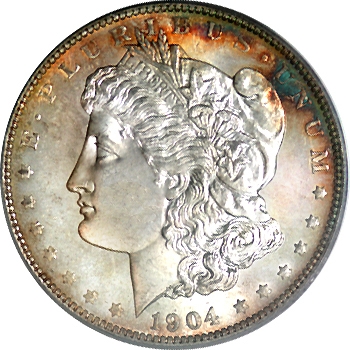
Blue rim toning is featured on the reverse of this Morgan Dollar while gold, russet and blue highlight the rim near Liberty's cap on the obverse.
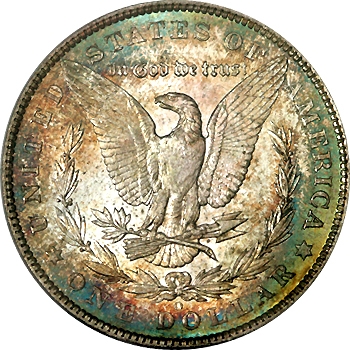
Blue rim toning is featured on the reverse of this Morgan Dollar while gold, russet and blue highlight the rim near Liberty's cap on the obverse.
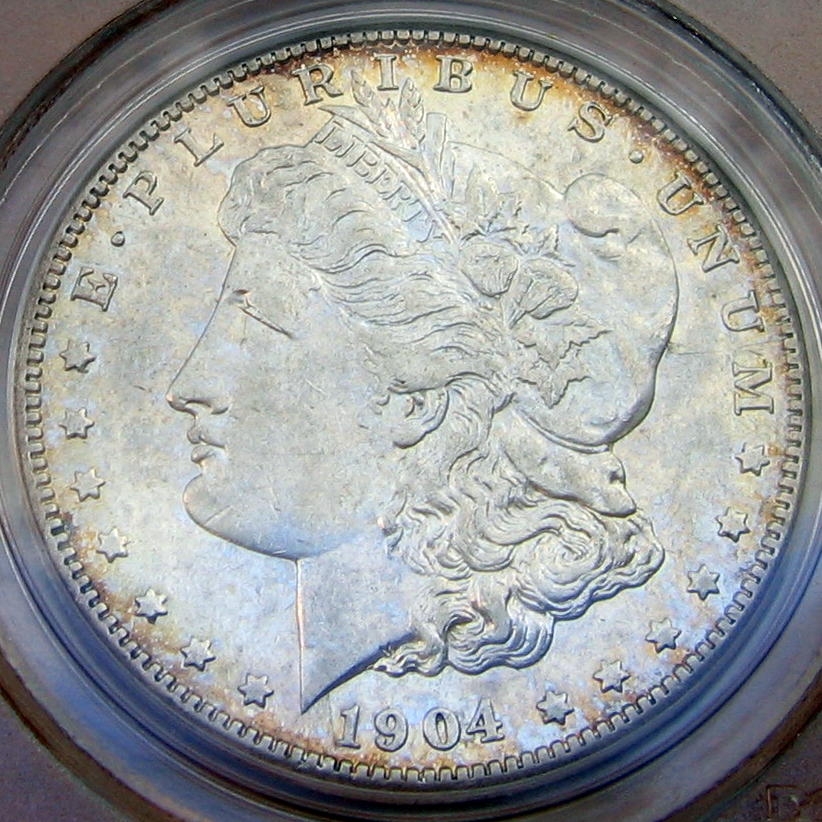
Nice AU example of a tough date with just a whisp of toning along the obverse rim above Liberty's portrait.
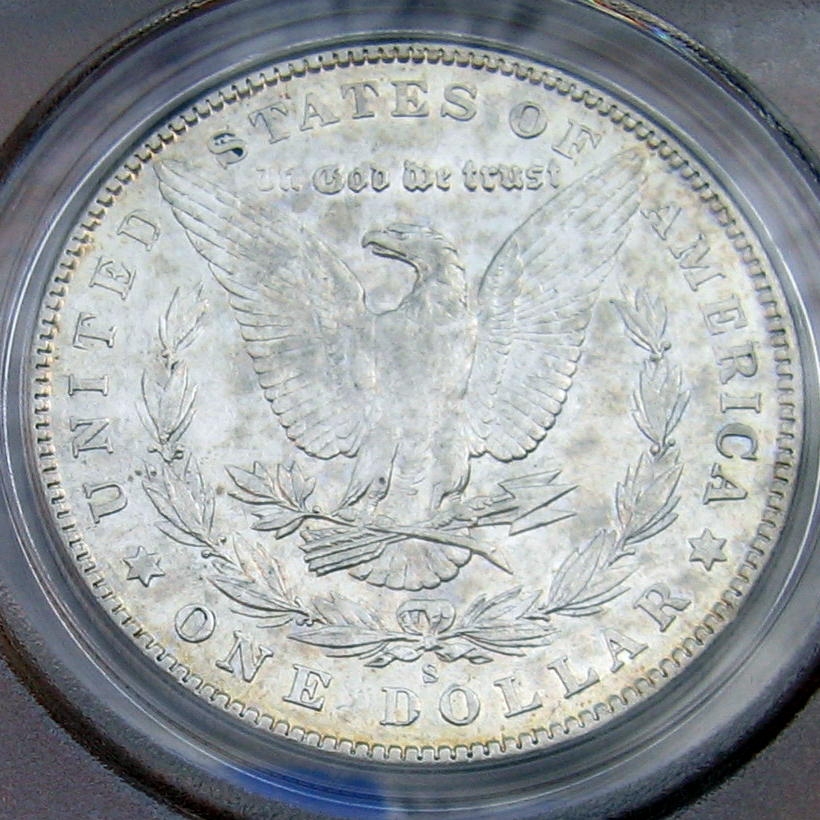
Nice AU example of a tough date with just a whisp of toning along the obverse rim above Liberty's portrait.
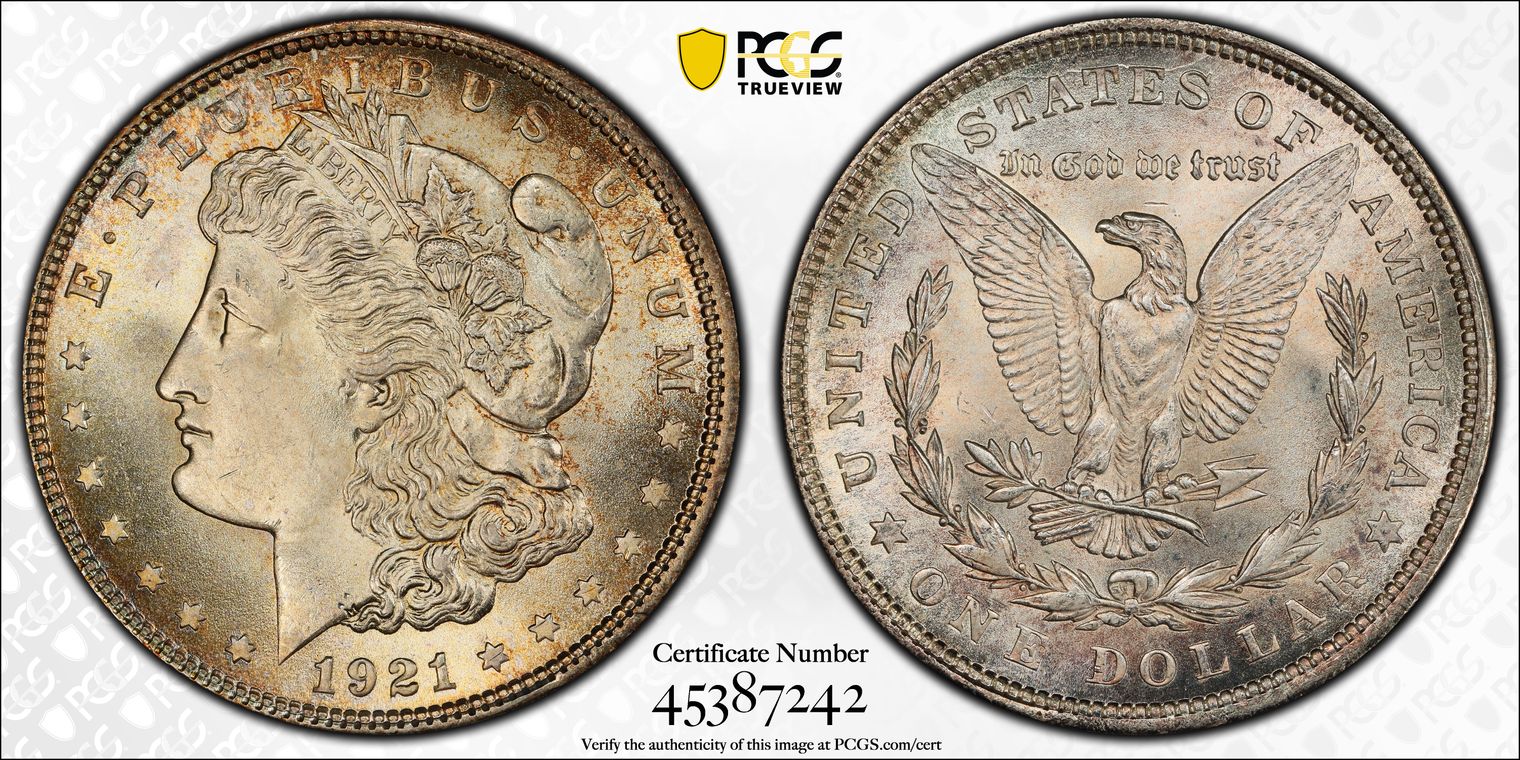
An impressively preserved Premium Gem that demonstrates the often-overlooked elegance attainable within the final-year Morgan dollar coinage. Eschewing dramatic color in favor of pristine satiny surfaces and delicate golden peripheral patina, this handsome Philadelphia issue possesses a quiet sophistication seldom encountered among the enormous output of 1921. The obverse displays a warm silver-white complexion lightly accented by champagne-gold and pale honey tones that gather naturally around the peripheral lettering and stars. Flecks of soft amber and faint olive-gray lend additional depth to the fields without disturbing the coin's overall harmony. The reverse is similarly restrained, exhibiting subtle golden highlights with the faintest blush of lavender and dove gray near the borders. The toning remains thin, original, and entirely translucent, allowing the underlying character of the metal to remain fully visible. Strike quality is outstanding within the limitations of the 1921 master hubs. Although the year's redesigned low-relief portrait lacks the sculptural depth of pre-1904 Morgan dollars, every available detail is sharply realized. Liberty's hair is crisply delineated throughout the forehead and above the ear, the cotton blossoms and leaves are boldly defined, and the reverse eagle displays excellent feather articulation within the confines of the modified design. The lettering, denticles, and wreath are uniformly bold, reflecting the careful die preparation characteristic of Philadelphia production. The surfaces exhibit a pleasing satiny sheen rather than pronounced frosty brilliance. Light moves smoothly across the fields with a soft, creamy texture that complements the delicate peripheral patina. Unlike many brilliant white 1921 dollars whose reflective surfaces can appear harsh beneath strong illumination, this specimen possesses a more settled, mature appearance that speaks to decades of careful preservation.
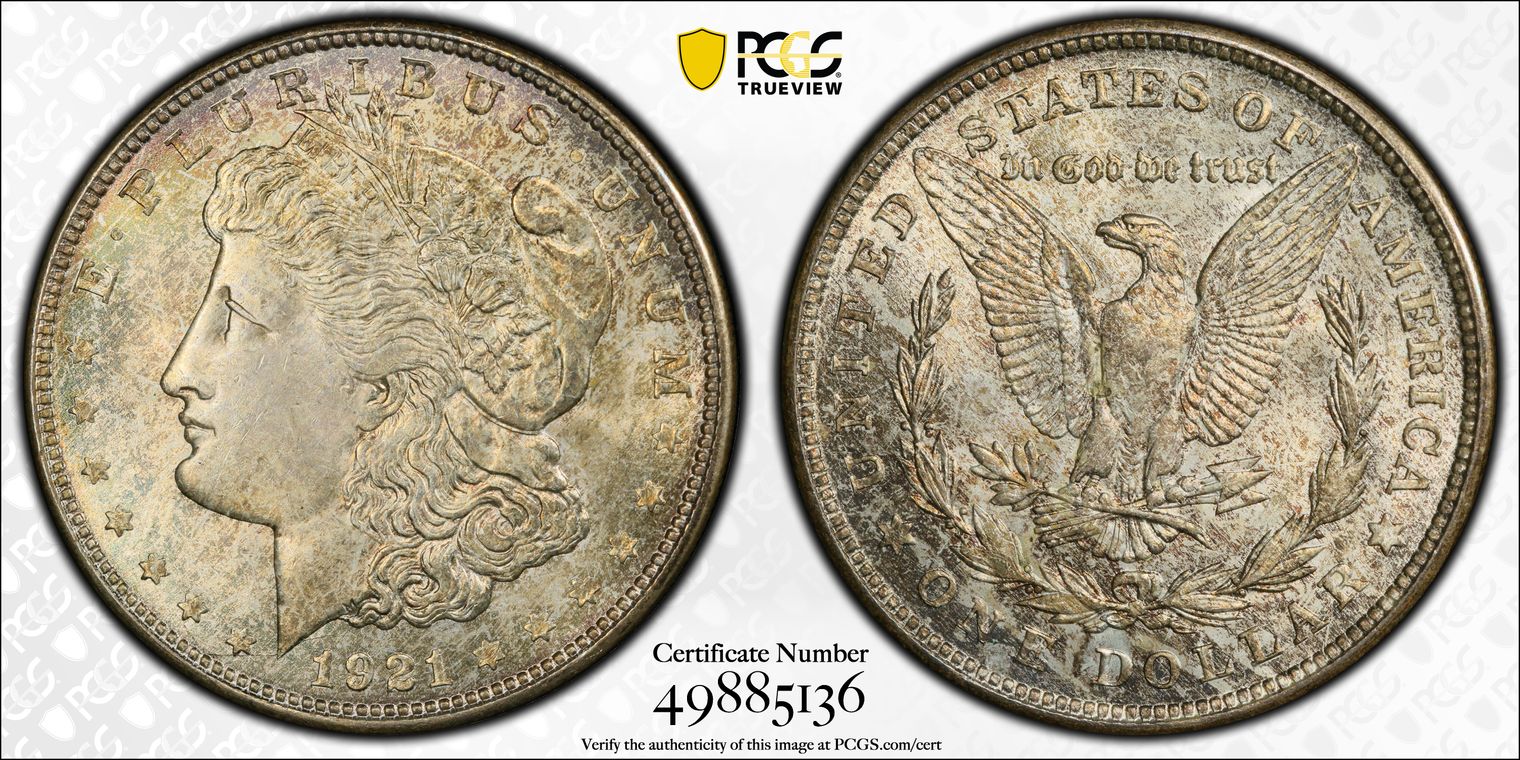
A thoroughly original Premium Gem whose patina transforms one of the more asthetically challenging issues of the final Morgan dollar year into a coin of exceptional individuality. Rather than relying upon vivid peripheral color, this 1921-D demonstrates an intricate tapestry of mottled antique toning, satiny surfaces, and remarkable preservation—a combination seldom encountered on the Denver issue. The obverse is enveloped in a delicate veil of warm silver-gray accented by pale olive, champagne, and faint golden hues that drift naturally across the fields. Wisps of soft blue-gray emerge near the left border, while subtle russet and amber accents gather around portions of the legend and stars. Rather than displaying a sharply defined pattern, the toning has developed organically across the entire surface, creating an appearance reminiscent of aged sterling silver that has remained undisturbed for generations. The reverse continues this remarkable originality. A complex interplay of pearl-gray, pale gold, olive, and charcoal tones blankets the fields, punctuated by darker concentrations in the lower left quadrant that provide visual counterpoint without becoming distracting. The mottled surface texture lends the eagle an almost sculptural presence, reinforcing the impression of a coin that has quietly matured over decades rather than one whose appearance was dramatically shaped by a single storage event. The D mintmark is tiny on this coin, as is the case with all issues. CAC approved.
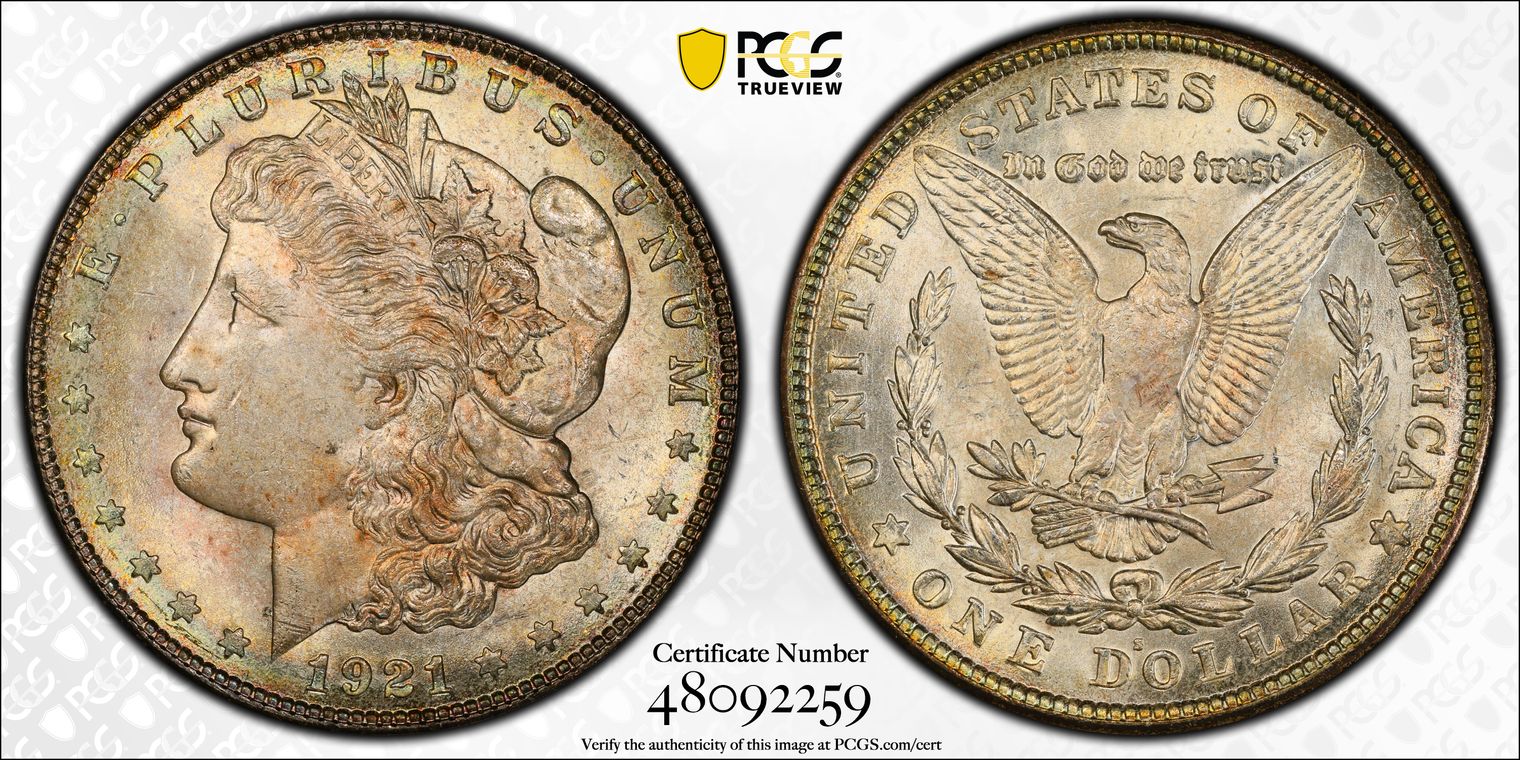
A remarkably original Premium Gem that transcends the typical appearance of the 1921-S issue through exceptional surface quality, refined satiny luster, and delicately matured peripheral patina. Although struck from the modified low-relief hubs introduced for the Morgan dollar's final year of production, this handsome survivor possesses an elegance seldom associated with the date. The obverse displays a soft veil of antique silver accented by subtle champagne-gold, pale apricot, and faint olive undertones. Delicate peripheral iridescence emerges along portions of the rim in shades of pale blue, lavender, and muted amber, framing Liberty without distracting from the overall composition. The reverse is similarly understated, featuring warm silver-gray surfaces highlighted by gentle rings of golden olive and soft rose near the borders. Rather than relying upon vivid rainbow coloration, the coin derives its appeal from remarkable uniformity and wholly original skin. Strike quality is notably strong for the issue. While the 1921 Morgan's modified hub lacks the sculptural depth of earlier emissions, Liberty's hair remains sharply defined within the confines of the design, and the cotton blossoms, leaves, and cap folds display crisp delineation. The reverse eagle is equally impressive, with bold feather definition extending through the wings and breast, complemented by sharply impressed wreath details and fully legible lettering. The strike reflects careful die preparation and strong striking pressure from the San Francisco Mint. CAC approved.
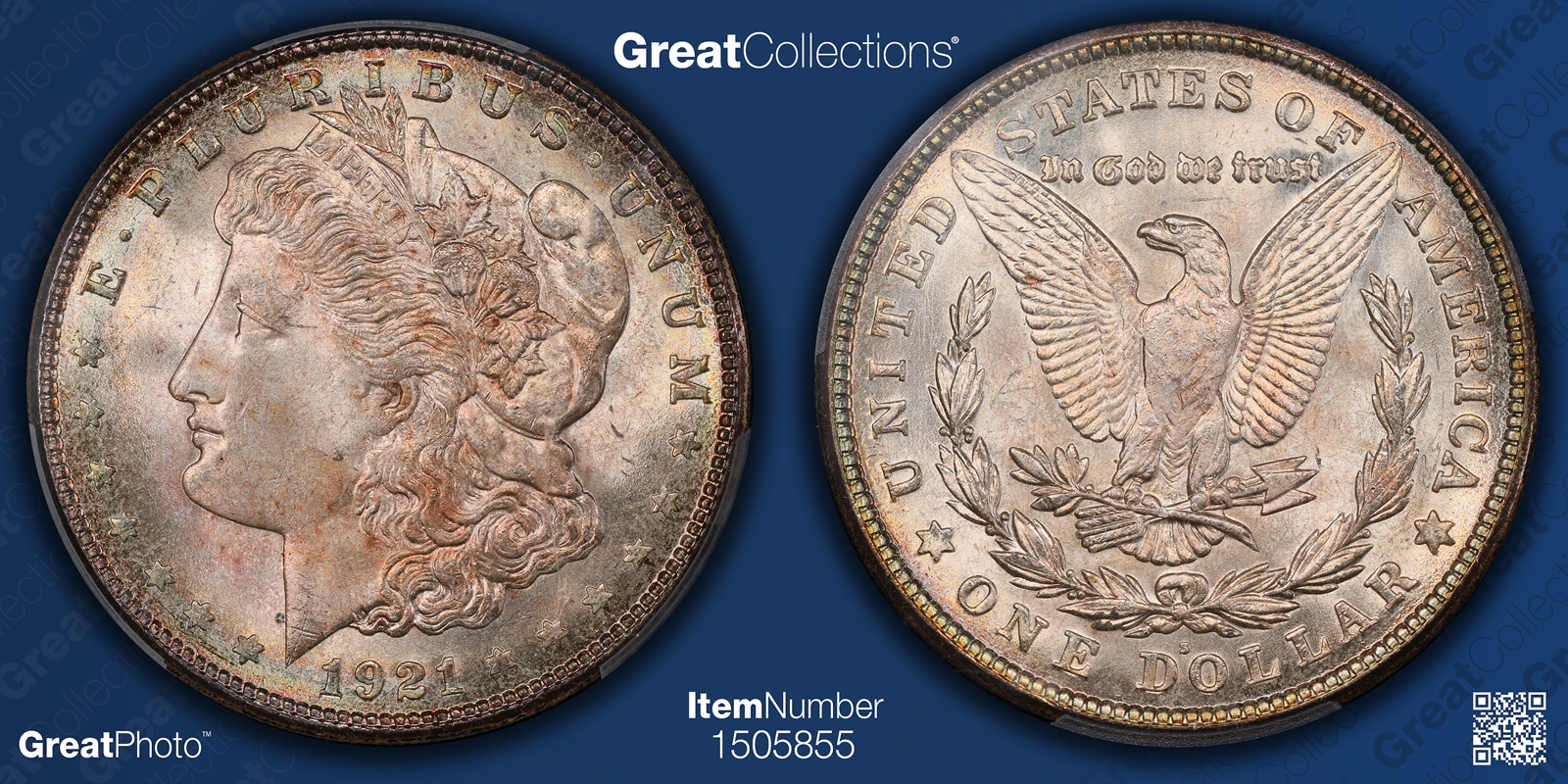
A remarkably original Premium Gem that transcends the typical appearance of the 1921-S issue through exceptional surface quality, refined satiny luster, and delicately matured peripheral patina. Although struck from the modified low-relief hubs introduced for the Morgan dollar's final year of production, this handsome survivor possesses an elegance seldom associated with the date. The obverse displays a soft veil of antique silver accented by subtle champagne-gold, pale apricot, and faint olive undertones. Delicate peripheral iridescence emerges along portions of the rim in shades of pale blue, lavender, and muted amber, framing Liberty without distracting from the overall composition. The reverse is similarly understated, featuring warm silver-gray surfaces highlighted by gentle rings of golden olive and soft rose near the borders. Rather than relying upon vivid rainbow coloration, the coin derives its appeal from remarkable uniformity and wholly original skin. Strike quality is notably strong for the issue. While the 1921 Morgan's modified hub lacks the sculptural depth of earlier emissions, Liberty's hair remains sharply defined within the confines of the design, and the cotton blossoms, leaves, and cap folds display crisp delineation. The reverse eagle is equally impressive, with bold feather definition extending through the wings and breast, complemented by sharply impressed wreath details and fully legible lettering. The strike reflects careful die preparation and strong striking pressure from the San Francisco Mint. CAC approved.