



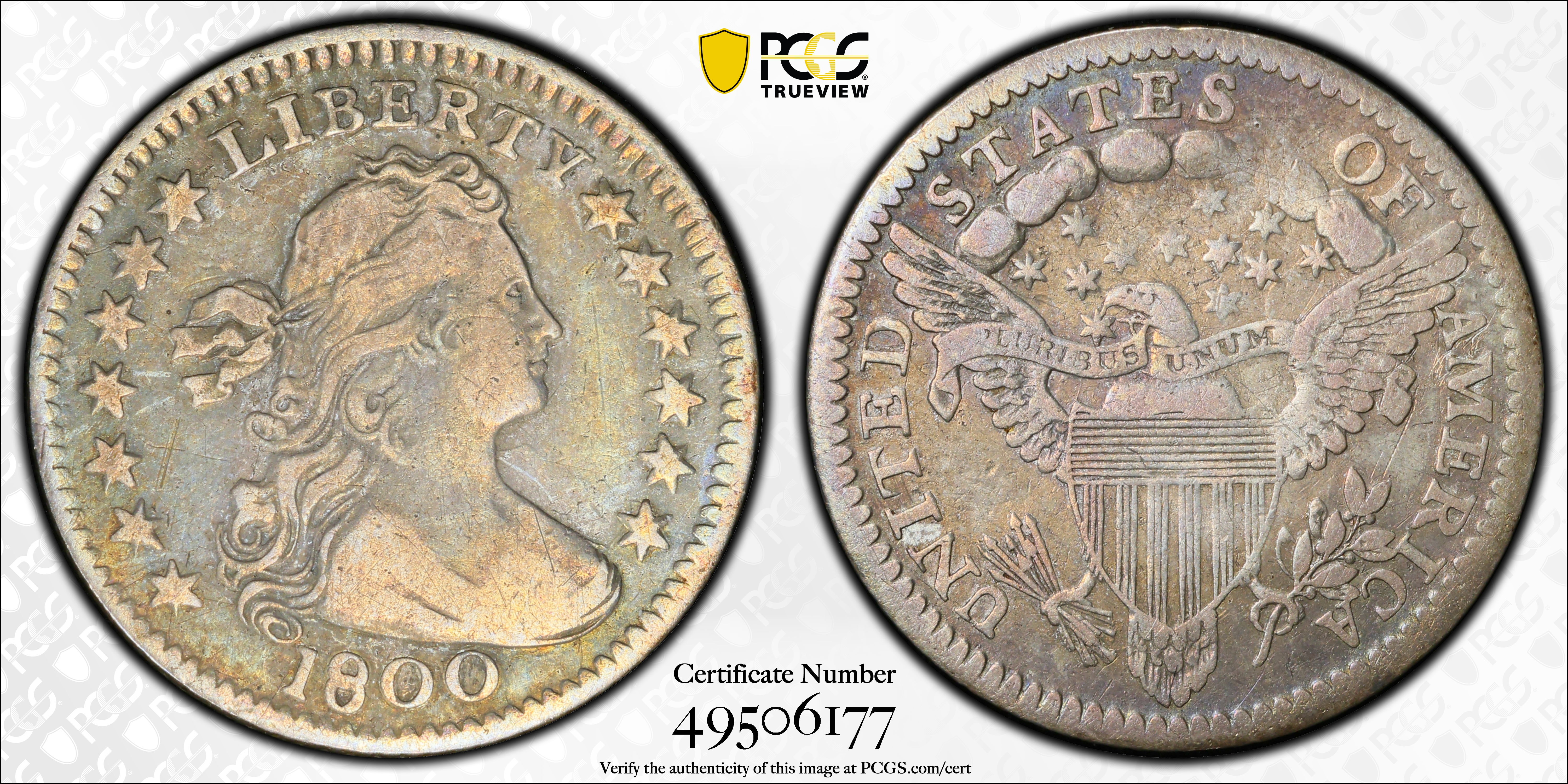
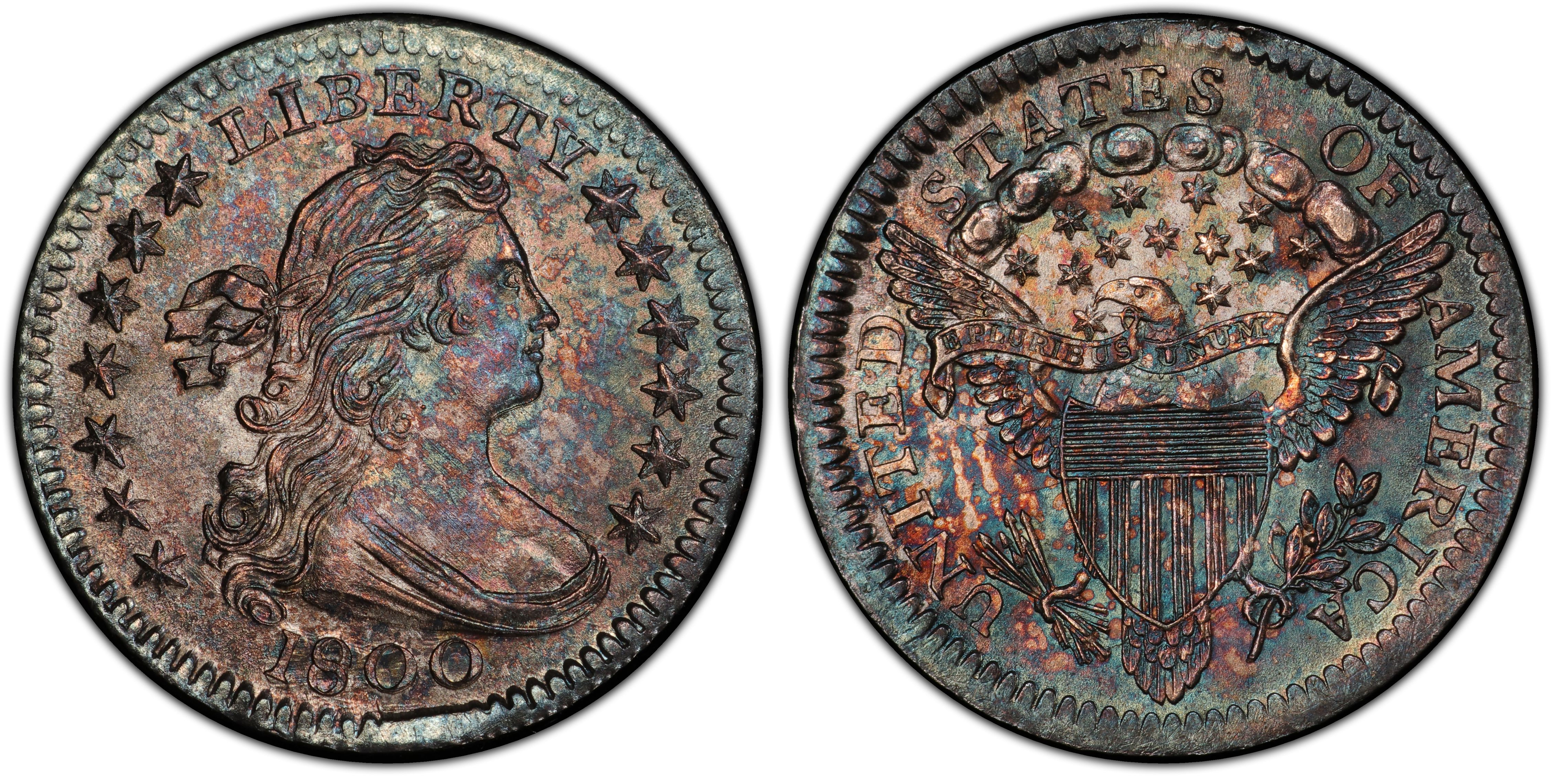
1800 H10C VF25 Certification #49506177, PCGS #4264
Expert Comments
Charles Morgan
The 1800 Draped Bust Half Dime
After a two-year hiatus, the Draped Bust Half Dime returned in 1800, featuring the Heraldic Eagle reverse that had recently become the standard for United States gold and silver coinage. While the reported mintage is estimated at 40,000 pieces, the issue is famously split between two distinct obverse styles: those with "LIBERTY" spelled correctly and those with "LIBEKTY", where a broken letter punch caused the top of the "R" to be absent. Both styles are recognized in the Guide Book (Red Book), with the "LIBEKTY" variety typically commanding a small premium due to its status as a mint blunder. In reality, the LIBEKTY coins are more scarce than people realize.
The Five Die Marriages of the 1800 Half Dime: Only Two Survive in Quantity
Numismatists have identified five distinct die marriages for the 1800 issue, ranging from the common to the exceptionally rare. The most frequently encountered is the LM-1 (#38601), which is easily identified by the "LIBERTY" spelling and an oddly shaped "8" in the date, created by overlapping two "small o" punches. On the reverse, the eagle’s beak touches the point of the bottom-left star.
The LM-2 (#38602) is a significant R7 rarity; discovered by Walter Breen and published in 1958, fewer than a dozen specimens are known to exist, and they are rarely seen without impairment.
The remaining three die marriages—including the recently discovered LM-5 (#906788)—comprise the "LIBEKTY" group. These coins were struck using a broken letter punch, resulting in the famous misspelling. While the "LIBEKTY" error is a major Red Book variety, it is actually composed of one relatively common marriage and two very rare ones. These rarer varieties are typically found only in well-worn or damaged condition.
Collecting the 1800 "LIBERTY" Draped Bust Half Dime
The common LM-1 die marriage offers collectors the best opportunity to acquire an 1800 Draped Bust Half Dime. PCGS estimates a total surviving population of approximately 750 coins across all grades, though only about 60 are believed to exist in Mint State.
Notably, this issue boasts the finest known specimen of the type: an extraordinary PCGS MS68 toned example from the legendary Norweb and Pogue collections. Widely considered the finest Draped Bust Half Dime in existence, its pristine condition and historical significance were reflected in its $381,875 sale price during the May 2015 Stack’s Bowers/Sotheby’s Pogue session.
* * *
Rarity and Survival Estimates Learn More
| 65 or Better | 750 |
| All Grades | 60 |
| 60 or Better | 10 |
| 65 or Better | R-5.5 |
| All Grades | R-8.4 |
| 60 or Better | R-9.5 |
| 65 or Better | 7 / 7 |
| All Grades | 6 / 7 |
| 60 or Better | 4 / 7 |
| 65 or Better | 12 / 12 |
| All Grades | 11 / 12 |
| 60 or Better | 8 / 12 |
Condition Census Learn More
 #1 PCGS MS68
Emery May Norweb; “The Norweb Collection, Part I,” Bowers and Merena, October 1987, Lot 308 – $70,400; The Knoxville Collection; “The Knoxville Collection,” The Mint (Jay Parrino), 2002 Fixed Price List. As PCGS MS68 #11398219. “The D. Brent Pogue Collection, Part I,” May 2015, Lot 1010 – $381,875. LM-1. Spectacular green, blue, and violet toning throughout. Likely, the finest known Draped Bust Half Dime. |
 #2 PCGS MS65
Dell Loy Hansen; "The D.L. Hansen Early Half Dimes (1792-1837) Collection" (PCGS Set Registry). |
| #2 PCGS MS65 |
| #2 PCGS MS65 |