



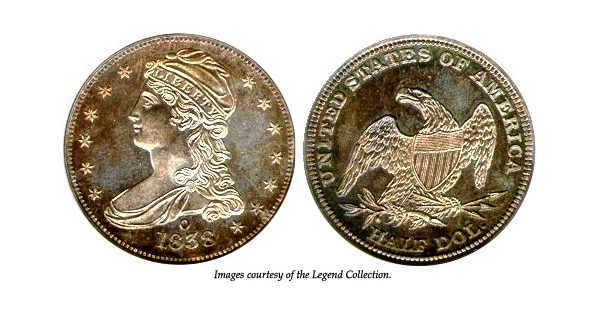
1838-O 50C, CAM PR64CAM Certification #-6139, PCGS #86226
Owner's Comments
Expert Comments
Charles Morgan
The 1838-O Capped Bust Half Dollar Proof
The 1838-O Capped Bust Half Dollar Proof (#6226) stands as one of the most storied rarities in American numismatics. Ranked #30 in the 6th Edition of 100 Greatest U.S. Coins (2024), its history is shrouded in mystery. While the New Orleans Mint eventually produced 116,000 half dollars dated 1839, the status of the 1838-O remains a subject of intense debate.
Conflicting Origins: New Orleans or Philadelphia?
Though official mint records are silent on the total mintage, it is generally believed that 20 examples were struck, with no more than 11 known today (8 in PCGS holders). These coins first surfaced in numismatic circles around 1867, a period defined by a growing appetite for rarities among well-connected dealers and elite collectors.
Two primary theories dominate the discussion of their origin:
- The Philadelphia Theory: In The Surprising History of the 1838-O Half Dollar (2012), David Stone and Mark Van Winkle suggest the coins were actually struck in Philadelphia as "showpieces" to demonstrate the new "O" mintmark for the branch mints. Stone cites 19th-century writings by Édouard Frossard and notes that the coins were produced on screw presses, whereas the New Orleans Mint had been sent steam presses.
- The New Orleans Theory: Others dispute the Philadelphia origin, citing a lack of contemporary media coverage regarding the new mintmarks and a February 25, 1839, letter from New Orleans Chief Coiner Rufus Tyler to Mint Director Robert M. Patterson. Tyler reported that the reverse dies were too short for the press, forcing him to "splice" a die to test the machinery. Tyler claimed this makeshift setup produced 10 successful impressions before failing.
Note: If Tyler’s account explains the first 10 coins, researchers John Dannreuther and Kevin Flynn suggest the remaining 10 may have been struck later with more care, accounting for the "Prooflike" or "Specimen" qualities seen on surviving examples.
Noteworthy Pedigrees
Legend suggests these coins were intended as presentation pieces for dignitaries. One was reportedly given to Alexander Dallas Bache, President of the University of Pennsylvania, and another to Frances Parke Lewis Butler, the grand-niece of George Washington. No recently published pedigree affirms these ownership claims; however, examples have been traced to many of the most important numismatic cabinets in history: Atwater, Eliasberg Sr., Pogue, Stack, and most recently, "Elite."
* * *
Rarity and Survival Estimates Learn More
| 65 or Better | 2 |
| All Grades | 2 |
| 60 or Better | 1 |
| 65 or Better | R-9.9 |
| All Grades | R-9.9 |
| 60 or Better | R-10.0 |
| 65 or Better | N/A |
| All Grades | N/A |
| 60 or Better | N/A |
| 65 or Better | N/A |
| All Grades | N/A |
| 60 or Better | N/A |
Condition Census Learn More
|
#1 PCGS PR64BMCAM
James B. Wilson, purchased October 1884; “The James B. Wilson Collection,” Thomas Elder, October 1908, Lot 346 - $570; Albert Fairchild Holden; Emery May Holden (Norweb). As "Proof 64 to 65." “The Norweb Collection, Part III,” Bowers and Merena, November 1988, Lot 3119 - $93,500; unknown intermediaries; Andrew Lustig; Bruce Morelan (from 2001-2003). As PCGS PR64BMCAM #50034366. "The Elite Collection" (PCGS Set Registry). |