



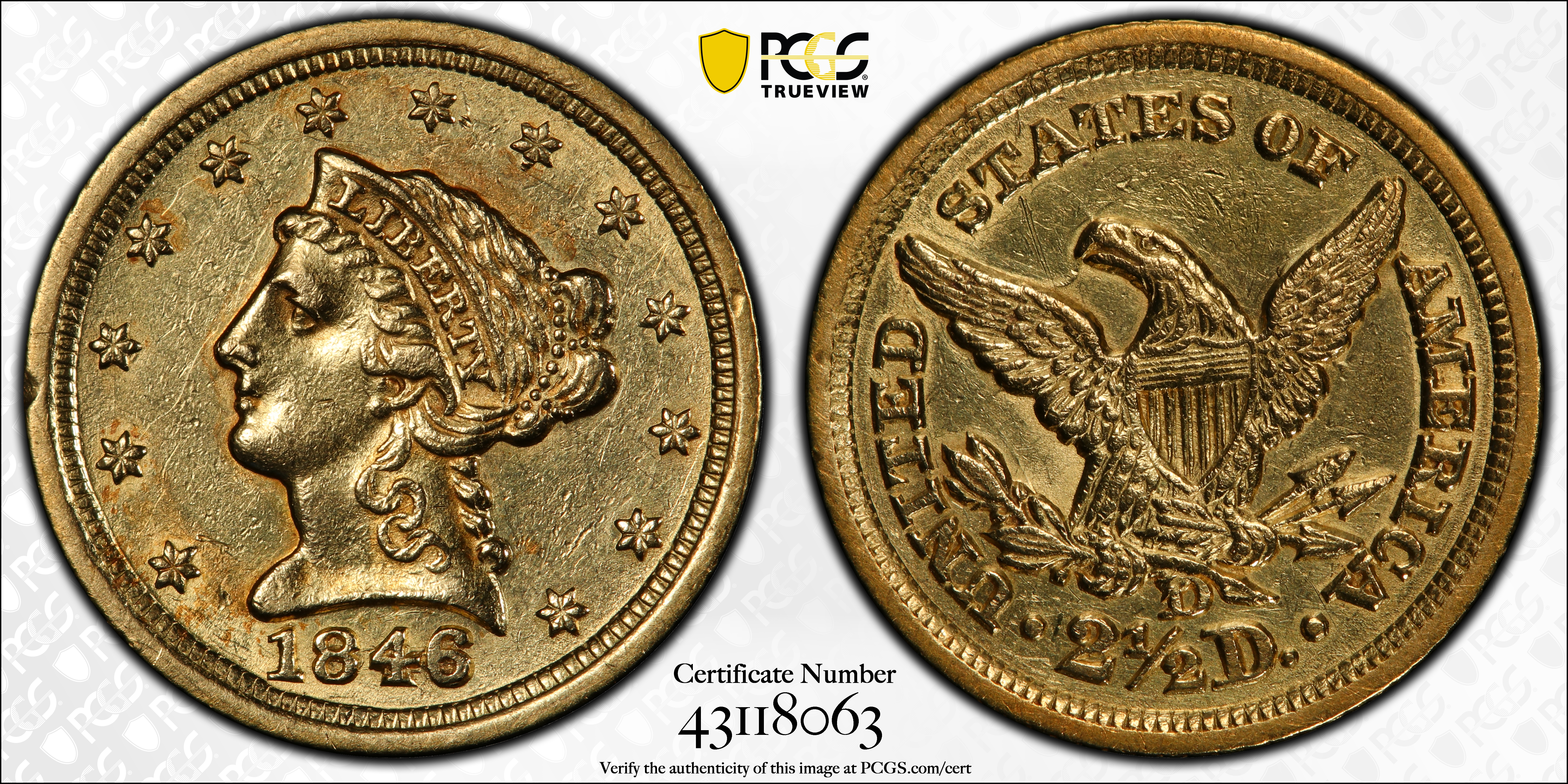
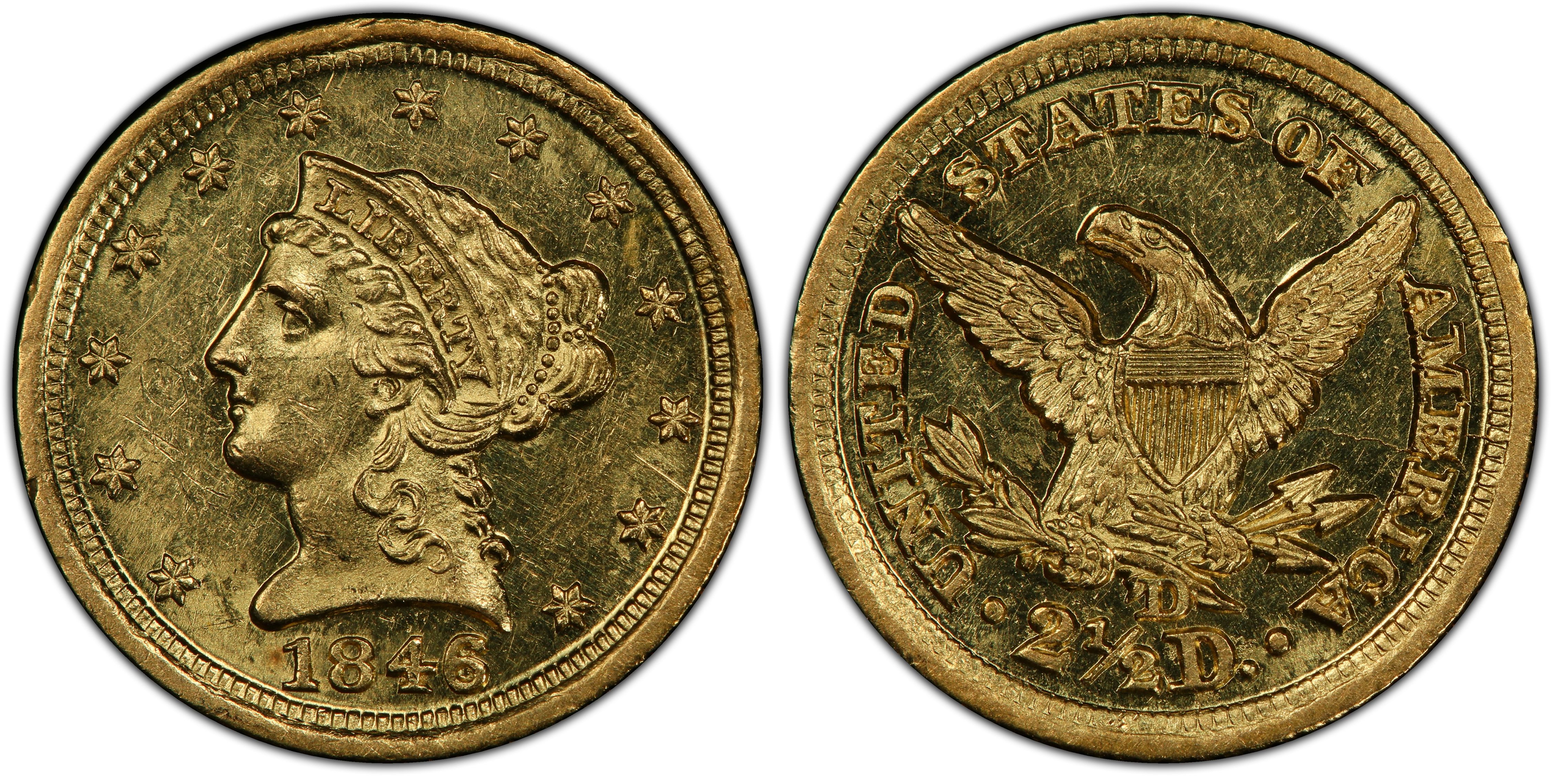
1846-D $2.50 AU55 Certification #43118063, PCGS #7742
Expert Comments
Charles Morgan
The Dahlonega Mint produced both Liberty Head Quarter Eagles and Liberty Head Half Eagles in 1846, with the $5.00 half eagle denomination being struck more extensively. For the 1846-D Liberty Head Quarter Eagle, the Georgia branch mint struck 19,303 pieces, which was 157 fewer than its quarter eagle output in 1845.
The roster of known surviving examples has grown in recent decades. David Akers, writing in his landmark United States Gold Coins, An Analysis of Auction Records, Volume I (1975), estimated a surviving population of just 63 pieces. In the 50 years since, grading data shows that number is well over 300 pieces, with PCGS reporting over 210 coins graded.
Despite its similar mintage with the 1845-D, PCGS population data suggests that 20% fewer 1846-D $2.50 gold pieces survive in AU55 and above. Curiously, the market does not always appear to favor the scarcer of the two coins.
Dahlonega Mint Gold Coin Production in 1846
- 1846-D Liberty Head Quarter Eagle | Mintage: 19,303
- 1846-D Liberty Head Half Eagle | Mintage: 80,294
1846-D Liberty Head Quarter Eagle Varieties
Doug Winter describes four die marriages for the 1846-D. Three of these share the same obverse die, but the "D Near D" (Variety 7-K) is the most popular among specialists and PCGS has certified more than 20 in About Uncirculated Condition, and one example in Mint State.
For those who enjoy shipwreck coins, a single example of the "D Near D" variety is reported in the PCGS population report as having been recovered from the SS Central America. This coin is graded PCGS AU58 and has been encapsulated with a pinch of recovered gold.
The fourth known variety is distinguished by its high date and high mintmark positioning.
- Variety 7-H (Rare): Shares the same obverse as two other varieties. On this obverse, the triangle of the "4" and the base of the "6" are lightly repunched. Defects within the "4" and "6" (extra metal) are present, a feature seen on 1846 quarter eagles from all four producing mints and sometimes mistaken for an 1846/44 overdate.
- Variety 7-J (Scarce): Reverse used only in 1846. The arrow shaft ends over the left side of the upright of the mintmark. Many examples show die breaks running from the rim through the letters in AMERICA and STATES.
- Variety 7-K: "D Near D Reverse" (Premium Variety): The mintmark is placed far to the right and is joined to the branch stem. In early die states, the remains of another mintmark are visible over the "1" in the fraction. This mark fades as the die is used, eventually leaving only the left tip visible over the numerator. Therefore, only coins that plainly show sharp traces of the first mintmark punch qualify for the "D Near D" designation. Early die state coins showing the first mintmark are rare and command a strong premium. Later die state examples are common and sell for little or no premium. A visible die crack runs from the D in UNITED through the eagle’s right wing tip to the base of STATES OF. A later die crack through E in AMERICA to the left wing develops in later die states.
- Variety 8-L (Very Rare): Features a high date (not close to the denticles) with the "6" equally spaced. It shows the same defects in the "4" and "6" as Obverse 7. The reverse has a high mintmark close to the stem. This variety is considered very rare, with an example discovered and sold in the Pittman Collection in May 1998.
Rarity and Survival
The 1846-D Liberty Head Quarter Eagle is a conditional rarity that is almost unknown in Choice Uncirculated condition. The issue heavily circulated and is most often seen in Very Fine (VF) and Extremely Fine (XF) grades. It is scarce in lower About Uncirculated (AU) grades and rare in the higher AU grades. Very few coins survive with their original surfaces intact.
Technical Characteristics
(per Doug Winter)
Strike: 1846-D quarter eagles are usually fairly well struck.
- Obverse: Well-defined, with only slight weakness on the curls near the ear and eye. The stars are generally sharp, though a few may lack radial lines. The milling is sharp.
- Reverse: Not as bold as the obverse. The eagle shows some weakness on its neck and wings, and the right leg is invariably weak. Lettering is full, but the denticles are often weak.
- Late Die States: Centers become weaker and show clashmarks, and a number of cracks (detailed below) weaken the overall appearance.
Surfaces: This date is generally found with numerous marks scattered across the fields. Many have been cleaned and show hairlines. This issue appears to have seen heavy commercial use, making any piece with clean, problem-free surfaces very rare.
Luster: High-grade examples have bright, frosty luster with an appealing texture. A small number of slightly reflective pieces have also been seen.
Coloration: Uncleaned, original 1846-D quarter eagles exhibit colors ranging from intense orange-gold to lighter yellow gold and medium green-gold. More original pieces are available than for the 1844-D and 1845-D, but a growing number show signs of having been cleaned or dipped.
Eye Appeal: Some very pleasing pieces exist, but the typical example shows below-average eye appeal.
Doug Winter's Personal Observations
In the late 1990s, the 1846-D/Near D quarter eagle (Variety 7-K) was accorded a high premium by specialists. While interest remains high, its price premium has decreased. An early die state example that grades AU-50 or better is currently worth a 30–40% premium, and this premium would be even greater in Uncirculated due to the extreme rarity of very high-grade 1846-D/Near D quarter eagles.
* * *
Rarity and Survival Estimates Learn More
| 65 or Better | 200 |
| All Grades | 7 |
| 60 or Better | 0 |
| 65 or Better | R-7.0 |
| All Grades | R-9.6 |
| 60 or Better | R-10.1 |
| 65 or Better | 74 / 147 TIE |
| All Grades | 43 / 147 TIE |
| 60 or Better | 1 / 147 |
| 65 or Better | 74 / 147 TIE |
| All Grades | 43 / 147 TIE |
| 60 or Better | 1 / 147 |
Condition Census Learn More
| #1 PCGS MS63 |
| #1 PCGS MS63 |
|
#1 Est. MS63
As NGC MS63 #302712-005. Dr. Arthur Montgomery; Hancock & Harwell; “Auction ’84,” Stack’s August 1984, Lot 1315 – $8,250; Georgia Collection; Hancock & Harwell; Leon Farmer; Hancock & Harwell; “The Duke’s Creek Collection of Dahlonega Gold,” Heritage Auctions, April 7, 2006, Lot 1502 – $27,600. DUKES CREEK on insert. Remnant of errant D above numerator. |
 #4 PCGS MS62
|
 #4 PCGS MS62
|