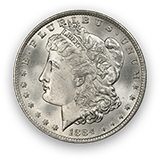




1858 25C MS65 Certification #21660422, PCGS #5445

Owner's Comments
Expert Comments
Charles Morgan
The 1858 Liberty Seated Quarter
By 1858, the United States was a nation caught in a deceptive paradox: economically invigorated by western expansion and robust international trade, yet structurally rotting at its political core. The illusion of a unified republic was collapsing under the weight of irreconcilable economic and moral systems. It was quickly fracturing into two separate countries. The industrial North welcomed 90% of all new immigrants, while the South, deeply entrenched in its plantation economy, remained a closed society that immigrants actively avoided due to a lack of economic opportunity.
The collapse of the Second Party System during the 1850s destroyed the last national institutions capable of bridging the North-South divide, removing the final political barriers to the American Civil War. During the 1830s and 1840s, the Whigs and the Democrats operated as true national coalitions. They successfully united Northerners and Southerners over economic debates regarding banking, tariffs, and infrastructure, while deliberately suppressing the explosive issue of slavery. This détente ended in 1854 with the passage of the Kansas-Nebraska Act, which resulted in frontier bloodshed and birthed the fiercely regional Republican Party. The future of the country would no longer be determined at the ballot box, but in bloodied fields across the American countryside.
In 1858, Abraham Lincoln delivered his prophetic "House Divided" speech, perfectly articulating the national paralysis. The Second Party System was entirely dead. The Whigs had dissolved over the issue of slavery's expansion, replaced by a Republican Party that did not even attempt to appeal to Southern voters; it existed primarily to halt the spread of the peculiar institution into the western territories. Meanwhile, the once-formidable Democratic Party was tearing itself apart. The vicious debate over the pro-slavery Lecompton Constitution in Kansas created a bitter schism between Northern Democrats, led by Stephen A. Douglas, and Southern Democrats, who demanded uncompromising federal protection for slavery. By 1858, political parties were no longer vehicles for national compromise; they were engines of rising sectional division.
Underlying this political disintegration was a rapidly evolving, yet highly volatile, monetary and economic system driven by western extraction. The California Gold Rush of 1849 had fundamentally altered the nation's wealth, injecting massive quantities of gold into the U.S. economy. As prospectors scoured the West for both gold and early silver deposits, the sudden influx of precious metals disrupted the traditional bimetallic ratio. Because gold became relatively cheaper, citizens frequently hoarded or melted down silver coins for their bullion value. To keep small change in circulation, the federal government passed the Coinage Act of 1853, reducing the silver content in half dimes, dimes, quarters, and half dollars to ensure they remained in the pockets of consumers rather than the crucibles of speculators. Furthermore, 1858 marked a critical transition year for American currency; just a year prior, Congress had officially stripped foreign coins—such as the ubiquitous Mexican 8 Reales of their legal tender status, forcing the nation to rely entirely on its own federally minted coinage.
1858 Business Strike Coinage by Branch Mint
| Denomination | Philadelphia | San Francisco | New Orleans | Charlotte | Dahlonega |
|---|---|---|---|---|---|
| Cent | 24,600,000 | 0 | 0 | 0 | 0 |
| Three-Cent Silver | 1,603,700 | 0 | 0 | 0 | 0 |
| Half Dime | 3,500,000 | 0 | 1,660,000 | 0 | 0 |
| Dime | 1,540,000 | 60,000 | 200,000 | 0 | 0 |
| Quarter | 7,368,000 | 121,000 | 520,000 | 0 | 0 |
| Half Dollar | 4,225,700 | 476,000 | 7,294,000 | 0 | 0 |
| Dollar | 0 | 0 | 0 | 0 | 0 |
| Gold Dollar | 117,995 | 0 | 0 | 0 | 3,477 |
| Quarter Eagle | 47,377 | 0 | 0 | 9,056 | 0 |
| Three-Dollar Gold | 2,133 | 0 | 0 | 0 | 0 |
| Half Eagle | 15,136 | 18,600 | 0 | 38,856 | 15,362 |
| Eagle | 2,521 | 11,800 | 20,000 | 0 | 0 |
| Double Eagle | 211,714 | 846,710 | 35,250 | 0 | 0 |
The flow of money was decidedly lopsided. The Southern states operated three of the nation’s five mint branches, but only one of them, the New Orleans Mint, struck silver coins, and only the Philadelphia Mint struck cents. The Southern states produced the vast majority of the world's raw cotton, the primary export of the United States. However, Northern merchants financed and insured this trade, funneling immense profits into Northeastern banks. Internationally, the United States ran a persistent trade deficit with Europe, importing massive quantities of British and French manufactured goods. To settle these international debts, millions of dollars in western gold were continuously shipped across the Atlantic. When European demand temporarily faltered, as it did during the Panic of 1857, the resulting outflow of specie severely strained American banks. This panic disproportionately crippled Northern financial centers, while the cotton-rich South remained largely insulated. This dangerously inflated Southern confidence in the independent viability of their slave-based economy.
Collecting the 1858 Liberty Seated Quarter
The 1858 Liberty Seated Quarter and Liberty Seated Half Dollar were workhorse silver denominations used for both domestic circulation and foreign commerce. Unlike the silver dollar, which was primarily an export coin, the quarter and half dollar were used throughout the country. The federal government's utilization of its Eastern, Western, and Southern mint branches illustrates the vital commercial importance of this coinage.
With silver coinage stabilized in the mid-to-late 1850s, the Philadelphia Mint’s production met current demand. But just three years later, following the outbreak of the Civil War, virtually all coinage vanished from circulation along the eastern and southern seaboards. The three Southern mints ceased coinage operations by the end of 1861. On May 1, 1862, Federal troops officially occupied New Orleans and seized its mint, cutting off the Confederacy's largest city and most vital port. This inflicted a catastrophic blow to the South’s ability to deliver its most valuable economic weapon: cotton. In the absence of Southern exports, Britain turned heavily to India and the burgeoning long-staple cotton markets of Egypt to supply its textile mills, while simultaneously exporting much-needed arms, uniforms, and medical supplies to the Union.
Of course, all of this was still a few years into the future. But for Americans in 1858, the Civil War wasn’t a surprise. It was an inevitability.
Coin collecting in America saw a surge in popularity following the transition from the large cent to the small cent in 1857, but by late 19th-century standards, the hobby was still in its infancy. Quarters and larger denominations had real spending power, meaning one had to be a person of at least some means to pull money from circulation for study and leisure. It is highly likely that domestic coinage from the mid-1850s to the mid-1860s was saved in high circulated grades or in Mint State not because of early numismatists, but because of the Civil War and its long-tail impact on the American monetary system.
The 1858 Liberty Seated Quarter is common compared to other issues in the series. It survives in AU and Mint State grades in relatively high numbers and only becomes conditionally scarce in PCGS MS66 and above. Toning is typical for silver coins of this period, but original examples in Mint State will often exhibit a frosty sheen. Strike quality varies, though many premium examples show full star radials. Perhaps the finest known example of the issue is a PCGS MS67+, currently residing in the important collection of Dell Loy Hansen.
* * *
Rarity and Survival Estimates Learn More
| 65 or Better | 3500 |
| All Grades | 500 |
| 60 or Better | 65 |
| 65 or Better | R-4.3 |
| All Grades | R-6.0 |
| 60 or Better | R-8.3 |
| 65 or Better | 47 / 49 TIE |
| All Grades | 43 / 49 |
| 60 or Better | 28 / 49 |
| 65 or Better | 106 / 114 TIE |
| All Grades | 100 / 114 TIE |
| 60 or Better | 71 / 114 TIE |
Condition Census Learn More
 #1 PCGS MS67 As PCGS MS66 #8350568. Heritage Auctions, October 1991, Lot 5235 - $9,680; Heritage Auctions, March 2004, Lot 5647 - $8,625. As NGC MS67 #3414107-010. Stack's Bowers, August 2015, Lot 356 - $8,812.50; Heritage Auctions, January 2016, Lot 3863 - $7,637.50. As PCGS MS67 #25605135. Heritage Auctions, June 2016, Lot 4436 - $9,400; Heritage Auctions, November 2016, Lot 5229 - Passed; Dell Loy Hansen. |
| #1 PCGS MS67 |
 #3 PCGS MS66+ Heritage Auctions, January 2003, Lot 6683; "The D. Brent Pogue Collection, Part V," Stack's Bowers & Sotheby's, March 2017, Lot 5023 - $7,637.50. Turquoise toning along the lower-right obverse periphery, blending into warm apricot hues across the surfaces. |
| #4 PCGS MS66 |
 #4 PCGS MS66 |