



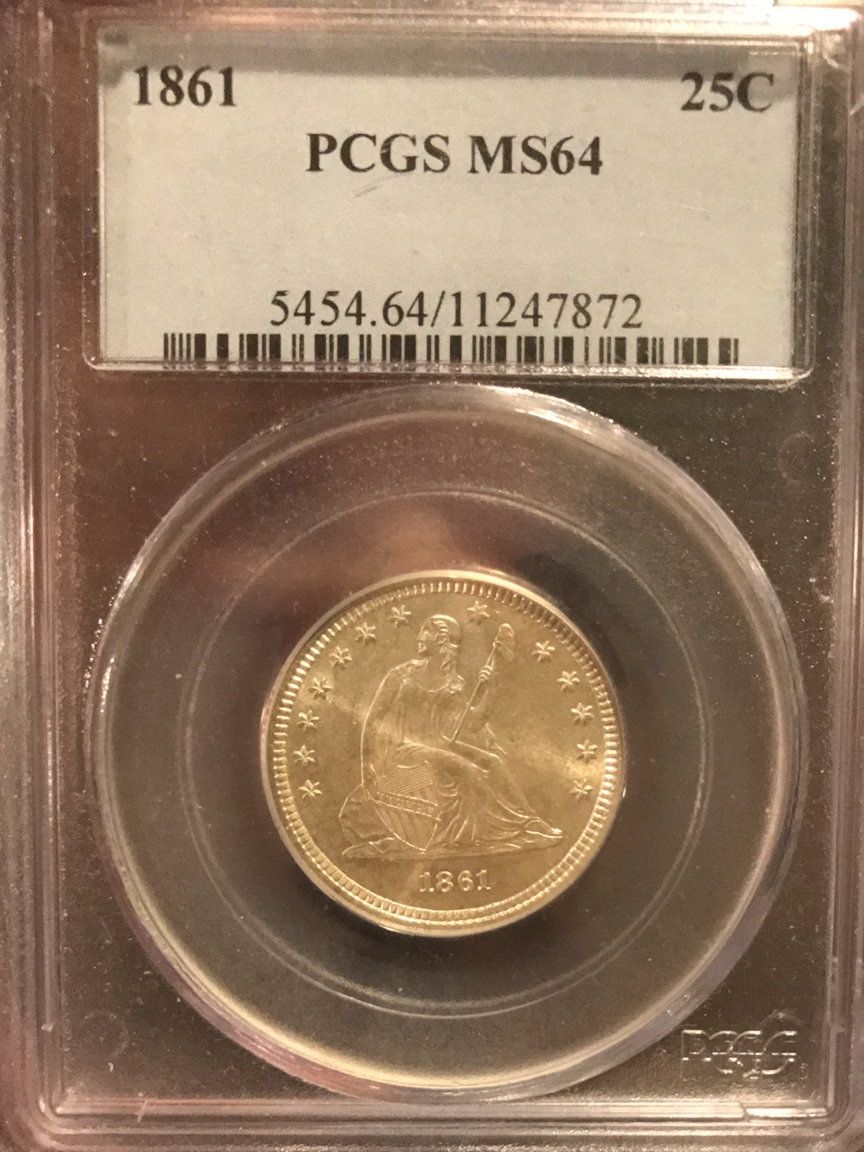
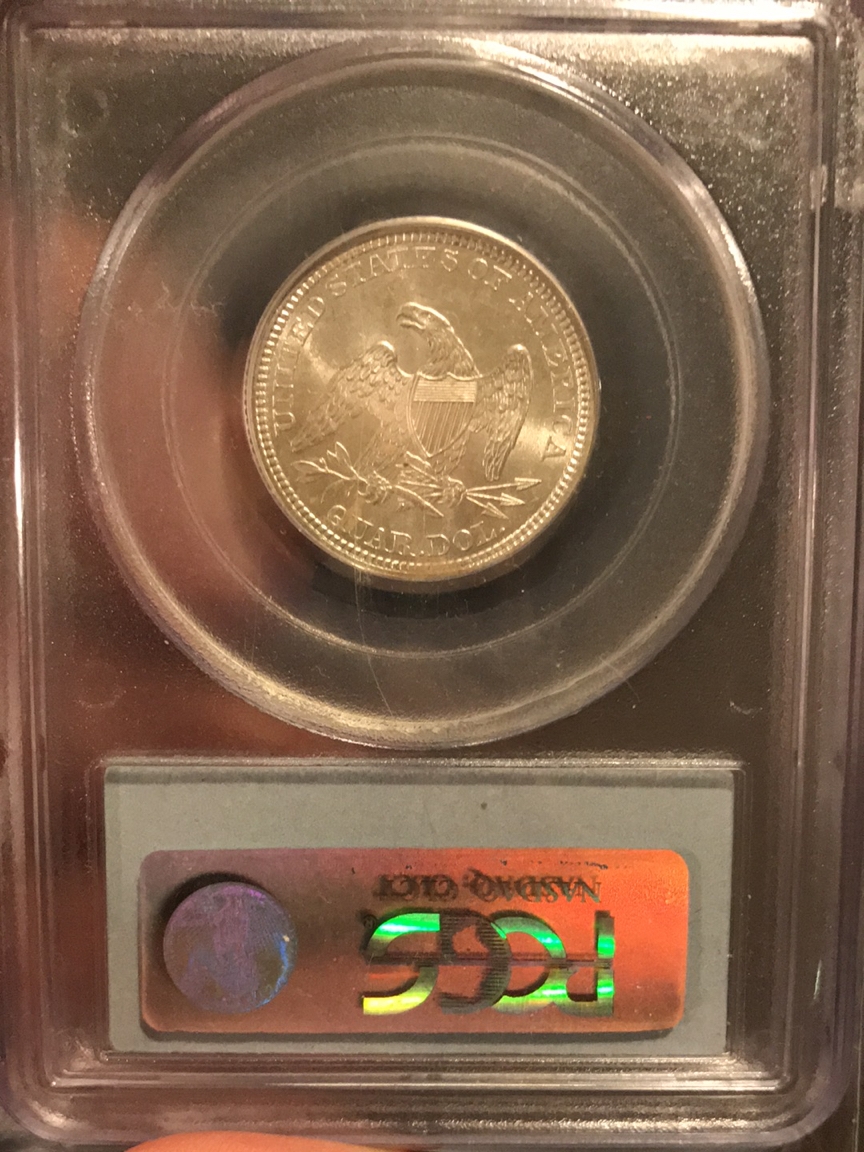
1861 25C MS64 Certification #11247872, PCGS #5454
Expert Comments
Charles Morgan
1861 Liberty Seated Quarter
Southern secession began on December 20, 1860. Abraham Lincoln’s election victory—secured entirely by Northern electors—convinced pro-slavery Southerners that the Union no longer served their political or economic interests.
The primary catalyst for South Carolina’s exit was the anti-slavery movement. State leaders felt the "peculiar institution" was under direct threat after Lincoln’s 1858 declaration that a "house divided against itself cannot stand," and that the government could not endure "half slave and half free." In the South Carolina Declaration of Secession, the state charged that non-slaveholding states had:
"[A]ssumed the right of deciding upon the propriety of our domestic institutions; and have denied the rights of property established in fifteen of the States... they have denounced as sinful the institution of slavery; they have permitted open establishment among them of societies, whose avowed object is to disturb the peace... They have encouraged and assisted thousands of our slaves to leave their homes."
The Road to Conflict
As the federal government began to fracture, Unionists remained firm in their resolve to hold federal property. Despite Confederate demands to evacuate Fort Sumter in Charleston Harbor, Lincoln attempted to resupply the garrison with provisions rather than reinforcements.
Meanwhile, the federal government reached a standstill as Southern legislators resigned. On January 21, 1861, Senator Jefferson Davis announced Mississippi's separation from the United States, famously stating, "I rise, Mr. President, for the purpose of announcing to the Senate that... the state of Mississippi... has declared her separation from the United States."
Impact on the U.S. Mint
The secession crisis created a logistical nightmare for the American monetary system. At the time, the United States Mint system consisted of the main facility in Philadelphia and four branches: New Orleans, Charlotte, Dahlonega, and San Francisco.
The Philadelphia Mint worked feverishly to maintain national circulation, but the onset of war shifted the landscape:
- Seizure of Mints: Even before the firing on Fort Sumter, state troops seized the Southern branches. The New Orleans Mint was taken in January 1861, followed by Charlotte and Dahlonega in the spring.
- Confederate Coinage: The New Orleans Mint actually struck 1861-O Liberty Seated Half Dollars (#6303) under three different authorities: the U.S. Government, the State of Louisiana, and the Confederate States of America.
- Permanent Closure: For the Charlotte and Dahlonega mints, the Civil War marked the end of their operations; they never reopened as coinage facilities.
- New Orleans Resumption: The New Orleans Mint remained dormant for nearly two decades, finally resuming production with the Morgan Dollar in 1879.
Collecting the 1861 Liberty Seated Quarter
Despite the Philadelphia Mint's best efforts to keep coinage in circulation, major American financial centers reported a collapse of the monetary system by December 1861. Early Union defeats shook Northern confidence, causing widespread hoarding. Meanwhile, after a brief period of production in 1861 using bullion seized when the facilities fell to state (and ultimately Confederate) control, the three Southern mints fell silent.
The Confederacy could not hold the vital port of New Orleans, and that mint fell back under Union control in 1862. The Charlotte and Dahlonega facilities, however, remained in Southern hands but were never reopened for coinage, eventually being converted to other uses.
Given the Philadelphia Mint's proximity to the conflict—most notably in 1863, when the Battle of Gettysburg was fought just 140 miles to its west—collectors have long found the pursuit of "P-Mint" Civil War issues particularly evocative. Toward this end, the 1861 issues remain some of the most historically significant and attainable pieces for most collectors.
1861 Civil War Coinage Registry
Indian Head Cent (#2061) | Mintage: 10,100,000
- With the later 1864 transition to bronze, these copper-nickel "white cents" are predictably tough in high grades. Compared to other Civil War denominations, however, the 1861 is relatively affordable.
Three-Cent Silver (#3679) | Mintage: 497,000
- An accessible Civil War date with many Gems available for collectors.
Liberty Seated Half Dime (#4379) | Mintage: 3,360,000
- A plentiful date with many high-grade examples to choose from.
Liberty Seated Dime (#4633) | Mintage: 1,883,000
- This was the highest mintage for the denomination since 1857 and remains easily obtainable today.
Liberty Seated Quarter (#5454) | Mintage: 4,853,600
- A high-mintage issue for the era, serving as a cornerstone for a Civil War type set.
Liberty Seated Half Dollar (#6302) | Mintage: 2,887,400
- Struck in abundance, this remains an affordable and popular date for the series.
Liberty Seated Dollar (#6951) | Mintage: 77,500
- While this is the highest mintage among Civil War-dated silver dollars, it remains a scarce issue. Historical records suggest the majority were struck between January and March.
Gold Dollar (#7558) | Mintage: 527,150
- Common for the Type 3 design. Gems are relatively plentiful.
Liberty Head Quarter Eagle (#7794) | Mintage: 1,283,788
- Features a transition between the "Old" and "New" reverse hubs. The New Reverse is common; the Old Reverse is significantly scarcer.
Gold Three-Dollar (#7982) | Mintage: 5,959
- A low-mintage issue that is scarce in all grades and highly sought after by specialists.
Liberty Head Half Eagle (#8288) | Mintage: 688,084
- This is the most common issue of the "No Motto" Type (1839–1866).
Liberty Head Eagle (#8633) | Mintage: 113,164
- The fourth most common No Motto Eagle, trailing only the 1847, 1847-O, and 1851-O.
Liberty Head Double Eagle (#8932) | Mintage: 2,976,387
- One of the most common Type I Double Eagles. While the standard reverse is plentiful, it is conditionally rare in Gem. The ultra-rare Paquet Reverse (featuring taller, slender lettering) is a premier numismatic rarity worth millions.
* * *
Rarity and Survival Estimates Learn More
| 65 or Better | 5000 |
| All Grades | 600 |
| 60 or Better | 75 |
| 65 or Better | R-4.0 |
| All Grades | R-5.8 |
| 60 or Better | R-8.2 |
| 65 or Better | 49 / 49 |
| All Grades | 44 / 49 |
| 60 or Better | 29 / 49 |
| 65 or Better | 110 / 114 TIE |
| All Grades | 103 / 114 |
| 60 or Better | 73 / 114 TIE |
Condition Census Learn More
 #1 PCGS MS67+
As PCGS MS67 #06666663. “The Oliver Jung Collection,” American Numismatic Rarities, July 23, 2004, Lot 52 – $17,825. As PCGS MS67+ #40273843. “The Bob R. Simpson Collection, Part V,” Heritage Auctions, April 23, 2021, Lot 4124 – $20,400; “The Benedict Family Collection,” Heritage Auctions, August 14, 2024, Lot 4011 – $33,600. Russet toning along the peripheries, lightening toward the centers. Pin-sized toning spot below the second S in STATES. |
 #1 PCGS MS67+
As NGC MS68 #4655845-002:.Heritage Auctions, January 12, 2023, Lot 3693 – $22,800. Stack’s Bowers, March 26, 2024, Lot 4088 – $19.200. As PCGS MS67+ #31879740. Satiny surfaces that are awash in peacock green, blue, russet, and gold color. Two small dark toning spots to the left of Star 12. One below Star 13. Briggs 6-E. |
 #2 PCGS MS67
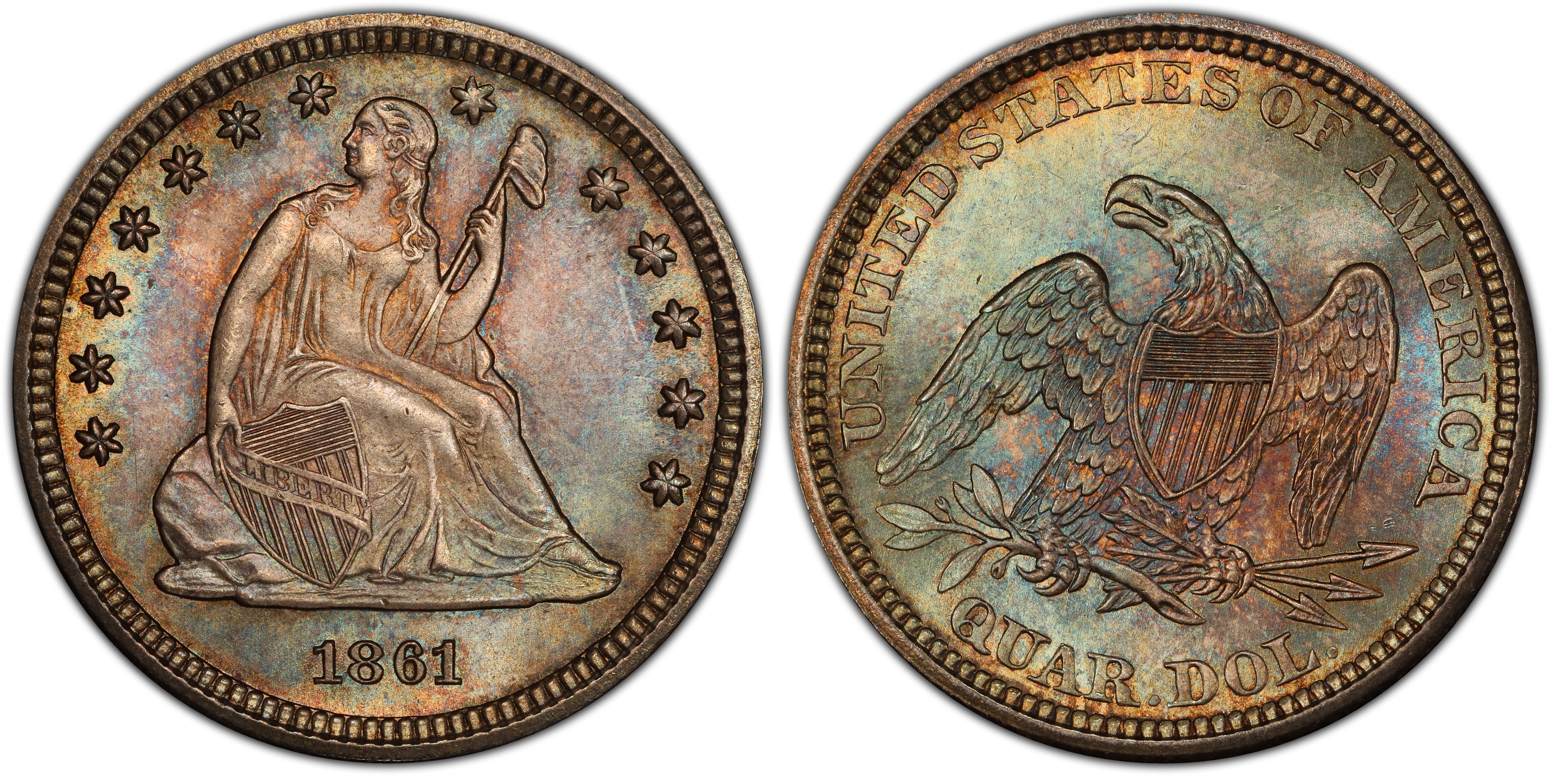
Bill Nagle to Eugene Gardner, September 2001. As NGC MS67 #1274048-004. “The Eugene H. Gardner Collection, Part III,” Heritage Auctions, May 2015, Lot 98349. As PCGS MS67 #32544455: Heritage Auctions, September 17, 2015, Lot 3866 – $11,750; “The Bender Family Collection, Part I,” Heritage Auctions, August 24, 2022, Lot 3796 – $9,900. Antiqued toning with shades of pale green, blue, and apricot. |
 #2 PCGS MS67
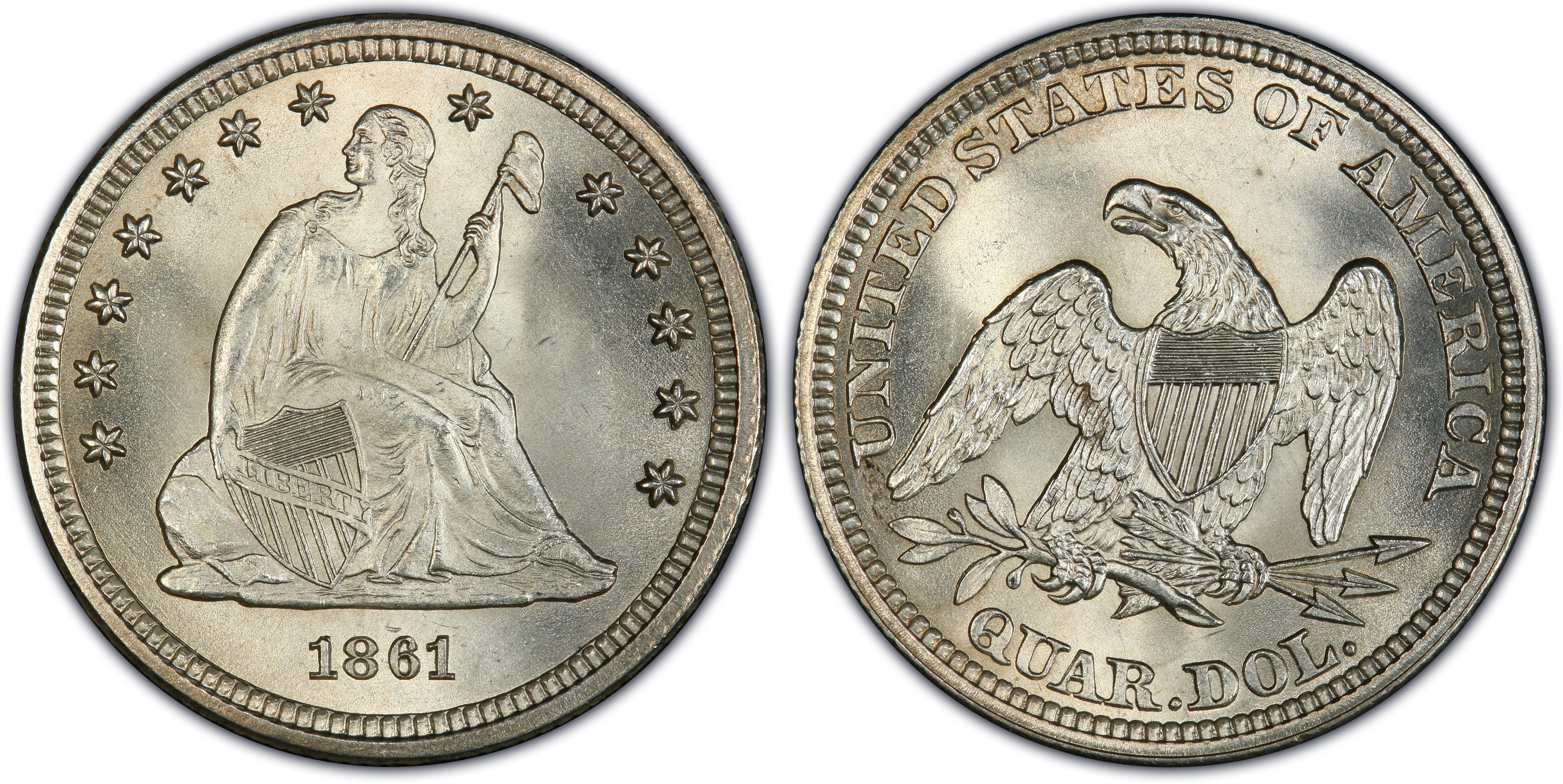
As NGC MS66 #1731142-002. Heritage Auctions, August 13, 2006, Lot 1120 – $6,900. Light goldenrod toning along the periphery. As PCGS MS67 #10890380. Heritage Auctions, November 29, 2006, Lot 632 – $16,100. Brilliant. “The Joseph C. Thomas Collection, Part Two,” Heritage Auctions, April 30, 2009, Lot 2341 – $12,650. As PCGS MS67 #14534132. Legend Rare Coin Auctions, July 16, 2020, Lot 7 - $17,450. Tiny tick above 6. Pinsized toning spot below OF. Faint toning around U in UNITED and above STATES. |
|
#2 PCGS MS67
Heritage Auctions, August 12, 2015, Lot 4027 – $12,925. Briggs 6-E. Brilliant. A diagonal contact mark is noted on Liberty's neck, with a small tick on the knee. |