



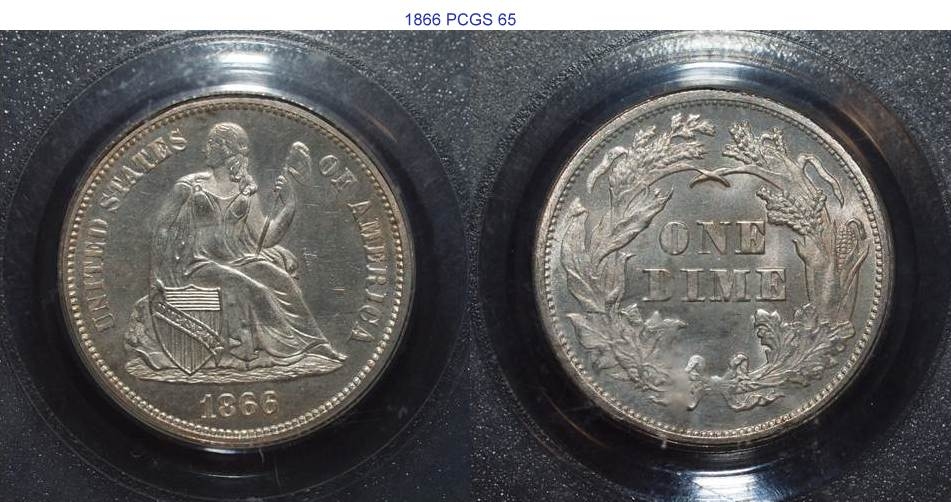
1866 10C MS65 Certification #21144890, PCGS #4643
Expert Comments
Charles Morgan
The 1866 Liberty Seated Dime
Although 1865 signaled the end of hostilities between the North and South, the nation remained in a state of shock. President Lincoln’s assassination on April 14, occurring just a week after Robert E. Lee’s surrender at Appomattox, cast a long shadow over the North's "victory." It felt tragically poetic that a conflict claiming between 750,000 and 850,000 American lives would demand one final, monumental sacrifice.
The South, in particular, was a landscape of ruin. With two-thirds of its wealth evaporated, its infrastructure reduced to rubble and ash, and its agricultural capacity in tatters, the economic burden of reunification was staggering. In this era of profound instability, the country sorely missed Lincoln’s steady, measured leadership.
The Philadelphia’s 1866 Mintage Explained
The Philadelphia Mint’s activities in 1866 reflected a nation attempting to restart its "economic bloodstream." The year's coin output was largely bifurcated between low-value base metal coins and high-value gold.
The disparity was massive: of the $15.6 million in total circulation strikes produced that year, approximately 90% of the value was comprised of a single denomination: the 1866 Liberty Head Double Eagle (#8949). This imbalance was a direct symptom of the Civil War’s aftermath:
Gold For Trade: The $20 gold coins were not meant for the pockets of the average citizen. Instead, these coins served as instruments for rebuilding national financial reserves, settling foreign trade debts, and facilitating government customs payments—obligations that legally required payment in gold.
The Paper Problem: During the war, "good money" (specie) had been hoarded and driven out of circulation by over $400 million in federally issued "greenbacks." These notes depreciated upon their release, causing Americans to hoard what gold, silver, and even base metal coins they came in contact with.
The Base Metal Bridge: Because silver commanded a market premium and the public remained starved for metallic currency, a return to a true bimetallic system was impossible in 1866. To bridge this gap, the Mint pivoted to base metal issues, such as the newly introduced Shield Nickel. These copper-nickel coins provided the public with a durable, functional medium for daily commerce without the risk of being melted down for their intrinsic metal value.
Of the 15 coin types struck in Philadelphia in 1866, eight saw "token" mintages of fewer than 25,000 pieces and the 1866 Liberty Seated Half Dollar (#6319) stood as the only silver denomination produced in any significant volume.
The year 1866 was also the first in which the motto "IN GOD WE TRUST" was added to the larger silver and gold coins. The Liberty Seated Dime—along with the other small denominations like the Half Dime and the two Three-Cent pieces, was deemed too small to accommodate the additional inscription. Therefore, the denomination did not undergo a design change for 1866.
Collecting the 1866 Liberty Seated Dime
The 1866 Liberty Seated Dime (#4643) is an underrated 19th-century low-mintage issue. Only 8,000 circulation-quality strikes were produced, all on a single day: January 31. While the Mint also produced 725 Proofs (#4759) for collectors, the business-strike figures illustrate a trend of declining production that began in 1863 and did not bottom out until 1867. Furthermore, collecting attitudes in the mid-19th and early 20th centuries prioritized Proof coins when available, a habit that condemned many would be high-end business strikes to the rigors of circulation and wear.
For this date, specialist Gerry Fortin recognizes two die marriages. The first, F-101, is a Proof-only marriage. The second, F-102, was used for both Proofs and business strikes. During the production of the 8,000 circulation strikes, the obverse and reverse dies came into contact with one another without a planchet between them. This resulted in strong clash marks, which are easily visible in most high-resolution photographs. Fortin delineates these two die states as F-102a (Perfect Reverse) and F-102b (Clashed Reverse). While the F-102a is supposedly the more common of the two by a small margin, the PCGS Condition Census is dominated by the clashed F-102b.
The 1866 Liberty Seated Dime is scarce in Mint State, but is known in grades PCGS MS63 through PCGS MS67.
Given the age of the issue, it is not unusual to find toned pieces—some with spectacular eye appeal. Far scarcer are premium examples that have retained their original brilliance through sheer luck or skillful conservation. One notable exception is the frosty, brilliant example currently housed in the Dell Loy Hansen Collection.
Market Snippet
The Millholland Discovery: In 2023, a beautifully toned specimen emerged from the James Allaire Millholland Collection after 112 years off the market. The coin graded PCGS MS67. Millholland was a 19th-century connoisseur known for his exceptional eye for original silver surfaces, and the quality of this discovery reaffirms his reputation as a premier collector of the era.
* * *
Rarity and Survival Estimates Learn More
| 65 or Better | 400 |
| All Grades | 50 |
| 60 or Better | 8 |
| 65 or Better | R-6.2 |
| All Grades | R-8.5 |
| 60 or Better | R-9.6 |
| 65 or Better | 23 / 67 TIE |
| All Grades | 22 / 67 TIE |
| 60 or Better | 19 / 67 TIE |
| 65 or Better | 40 / 122 TIE |
| All Grades | 46 / 122 TIE |
| 60 or Better | 45 / 122 TIE |
Condition Census Learn More
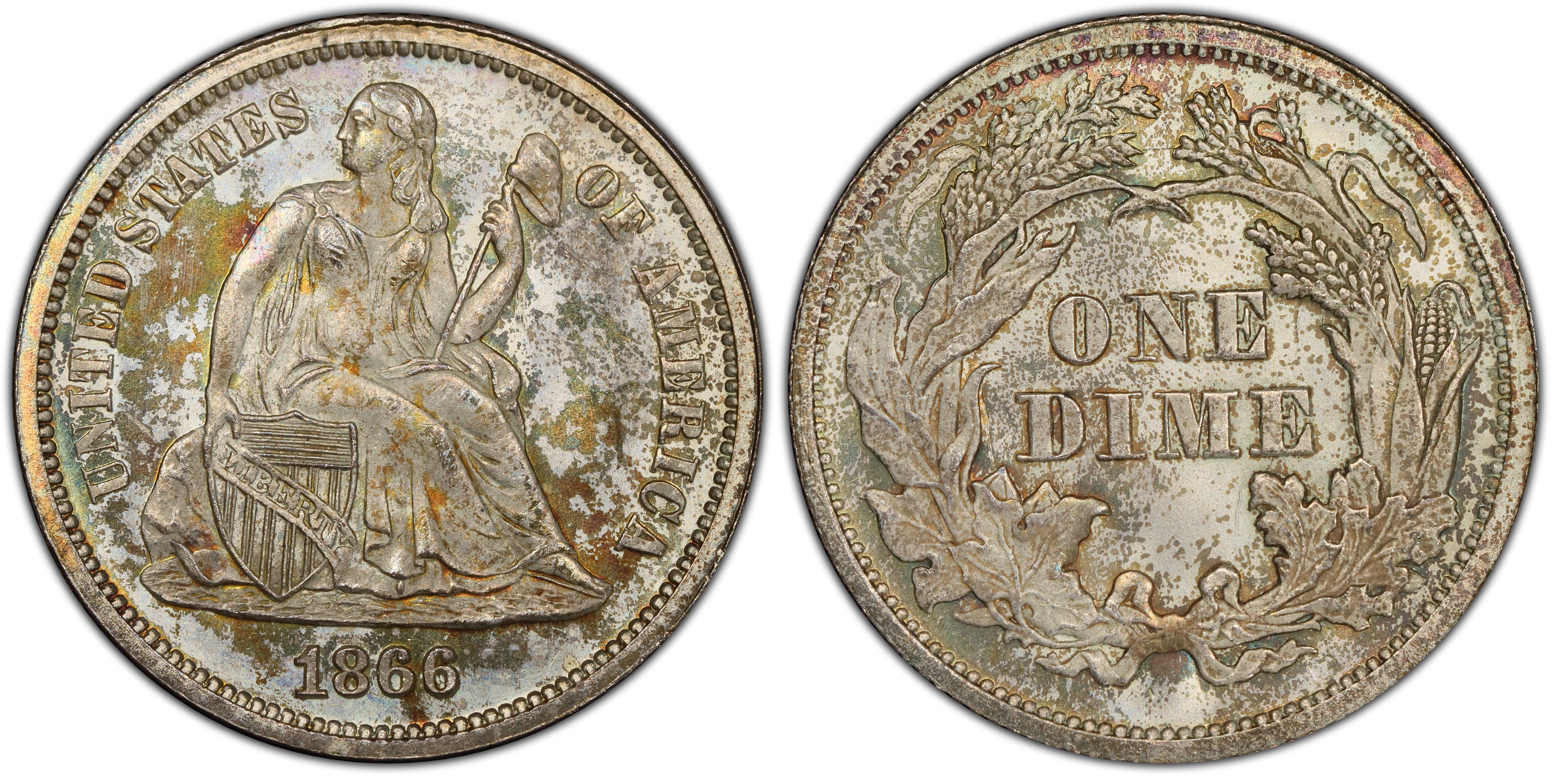 #1 PCGS MS67
“The James Allaire Millholland Collection,” Stack’s Bowers, March 21, 2023, Lot 3003 – $7,200. F-102b (per Stack's Bowers). Gallimaufry olive, gold, and russet toning. This coin was held for 112 years in the collection of the estate of James Allaire Millholland, a prominent collector who lived from 1842 to 1911. |
 #1 PCGS MS67
Dell Loy Hansen. "The D.L. Hansen Seated Dimes Collection & Proof (1837-1891) Collection" (PCGS Set Registry). F-102b. Brilliant and frosty. |
|
#1 PCGS MS67
"Nic's 1866 Philly Mint Set" (PCGS Set Registry) |
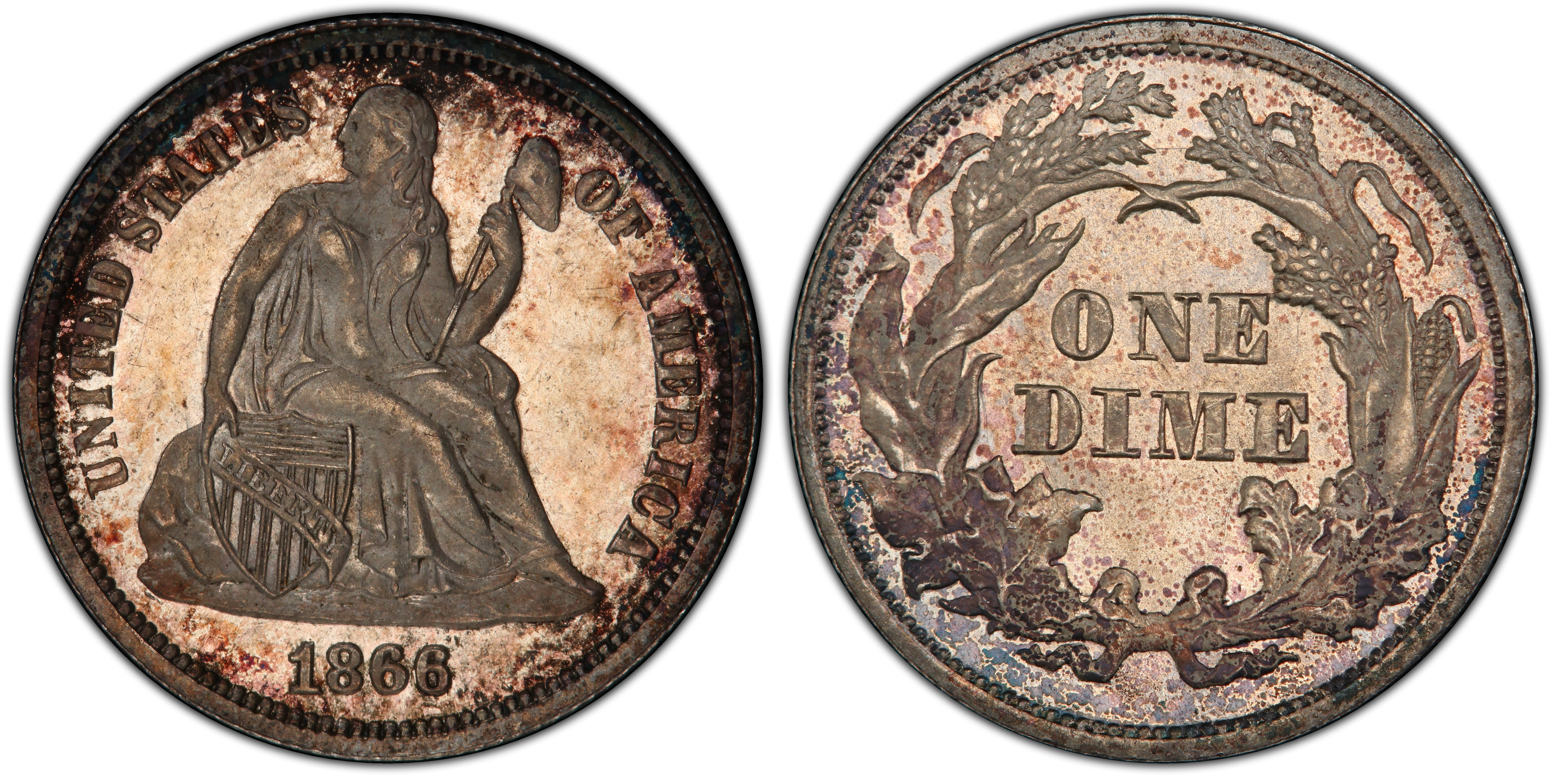 #4 PCGS MS66+
|
|
#5 PCGS MS66
Legend Rare Coin Auctions, May 26, 2022, Lot 127 - $6,168.75. F-102b. Champagne-gold hues illuminate the fields, complemented by vibrant turquoise-blue toning along the obverse periphery. The reverse is similarly awash in a deep turquoise-blue patina. |