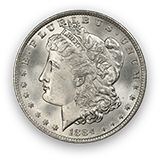




1885-S $20 MS62 Certification #05489453, PCGS #9005
Expert Comments
Charles Morgan
The 1885-S Liberty Head Double Eagle
Gold and silver deposits at the San Francisco Mint declined in 1885, resulting in a 25% year-over-year decrease in Double Eagle production. The facility struck a total of 683,500 1885-S Liberty Head Double Eagles (#9005); while many entered domestic circulation, a significant portion was exported to settle international accounts or held in Treasury vaults to back gold certificates.
A dramatic public scandal also defined the San Francisco Mint in 1885, involving the melter and refiner. The ensuing corruption probe led to the August 1 suspension of Superintendent Col. E.F. Burton and his replacement by Judge Israel Lawton, as well as the removal of Assayer O.D. Munson in favor of J.W. Twiggs. Investigators discovered that a dishonest employee had been casting "light" ingots by shaving the weight to the absolute limit of legal tolerance to embezzle the residual precious metal.
For years, the 1885-S Liberty Head Double Eagle was considered a scarce date and commanded a significant numismatic premium. For historical context, New York dealer M.L. Kaplan offered a "Brilliant Uncirculated" specimen for a mere $75 in the April 1968 issue of Numismatic Scrapbook Magazine. This scarcity persisted for decades; in his landmark 1982 reference, David W. Akers noted that only a few dozen Uncirculated examples had appeared at auction. The 1885-S remained a formidable Mint State rarity until the 1980s and 1990s, when significant quantities were repatriated from European bank hoards. While additional examples surfaced in the 2010s and 2020s, these more recent appearances warrant further discussion.
The Saddle Ridge and Fairmont Hoards
Since 2010, the census of PCGS MS64 and finer 1885-S Double Eagles has expanded significantly. This growth, particularly in MS64+, is largely attributable to the Fairmont Collection, a massive hoard of About Uncirculated and Mint State U.S. gold coins marketed by Stack’s Bowers and others since 2018. Reportedly sourced from a South American bank, this hoard has redefined the availability of high-grade specimens for the date. What makes this find so unusual is that nearly all the coins retain their original surfaces. Coin expert Doug Winter noted this as remarkable, as most collectors had never seen what 19th-century gold coins looked like "as struck"; historically, most gold coins of the era had been "professionally curated" to remove the dirt and oil that some felt detracted from eye appeal. The size and scope of the Fairmont Hoard remains unprecedented in modern numismatics.
A decade earlier, a smaller yet equally significant find made national news: the Saddle Ridge Hoard. A California couple stumbled upon a rusted tin can while walking their dog on their sprawling property. The can was unusually heavy, and upon cracking it open, they discovered it was filled with gold. Returning with a shovel, they eventually unearthed eight metal cans containing 1,427 gold coins dating from 1847 to 1894.
The identity of the individual who buried the coins remains a mystery. While some speculated the coins were the loot from a 1901 robbery of the San Francisco Mint, the dates and denominations did not match, and the United States Mint officially ruled out this theory. Other theories lean into the romance and intrigue of the Old West, but the truth may be as simple as a wealthy individual, distrustful of banks, squirreling away money for a later day and never returning to recover it.
The couple approached David McCarthy of Kagin's to assess the find. Following professional curation, the hoard’s value was estimated at over $10 million. The "crown jewel" was a rare 1866-S No Motto Liberty Head Double Eagle (#8945) worth over $1 million, though several other condition-census coins were also discovered.
Regarding the 1885-S Double Eagle, the Saddle Ridge Hoard yielded 22 examples. The finest of these graded PCGS MS64+, with six others ranging from PCGS MS61 to PCGS MS63+. Twelve examples fell into the AU range, two were graded XF, and one was No Grade. Kagin’s sold many of these coins through Amazon's then-newly launched Collectibles platform, with the remainder sold via private treaty.
* * *
Rarity and Survival Estimates Learn More
| 65 or Better | 16500 |
| All Grades | 2625 |
| 60 or Better | 2 |
| 65 or Better | R-2.8 |
| All Grades | R-4.4 |
| 60 or Better | R-9.9 |
| 65 or Better | 45 / 73 TIE |
| All Grades | 43 / 73 |
| 60 or Better | 1 / 73 TIE |
| 65 or Better | 120 / 148 TIE |
| All Grades | 112 / 148 TIE |
| 60 or Better | 2 / 148 TIE |
Condition Census Learn More
 #1 PCGS MS65
“The Fairmont Collection – Hendricks Set,” Stack’s Bowers, April 6, 2022, Lot 5456 – $44,400; GreatCollections, May 25, 2025, Lot 1304522 – $34,876.13. Lustrous, well-struck example. A long, arced mark to the lower right of Liberty's head and a rim hit above the LL in DOLLARS serve as identifiable pedigree markers. |
| #1 PCGS MS65 |
| #1 PCGS MS65 |
| #4 PCGS MS64+ |
 #4 PCGS MS64+
Lustrous. Small tick under star 10. Small tick above N in TWENTY. |