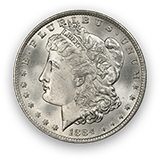




1894 5C MS64 Certification #42023249, PCGS #3855

Expert Comments
Charles Morgan
The 1894 Liberty Nickel
The Liberty Nickel was produced from 1883 to 1912, and during this period the United States suffered no fewer than nine distinct economic downturns by most business-cycle counts. The Depression of 1882 to 1885 contributed to the low-mintage 1885 (#3846) and 1886 (#3847) issues. Later, the Panic of 1893 struck, set off in part by the collapse of the Philadelphia and Reading Railroad. It landed on a Treasury that was already bleeding gold. Under the Sherman Silver Purchase Act of 1890, the government had been buying silver with notes redeemable in gold, and holders increasingly chose gold. The panic accelerated a drain that had been building for years, and the repeal of the silver purchase clause in the fall of 1893 did not stop it.
To avoid a catastrophic government default, President Grover Cleveland’s administration turned to a private syndicate after Congress declined to authorize a gold bond issue. The syndicate was led by J.P. Morgan and August Belmont Jr., the U.S. agent for the Rothschild family, with the London Rothschild house also taking part. It supplied the Treasury with 3.5 million ounces of gold, valued at roughly $65 million and much of it sourced from Europe, in exchange for about $62 million in 30-year Treasury bonds.
While this controversial arrangement helped prevent the crisis from becoming something far worse, it was fiercely debated in the newspapers and in Congress. The deal did not create the antisemitic Rothschild conspiracy theory, which predated it. It did give proponents of such theories a highly visible example of private financiers holding sway over the American economy, though historians debate how much it shaped those theories.
For American coinage, these troubles show up unevenly. Silver coinage fell sharply from 1893 to 1895, and the 1893 Morgan Dollar mintages were very low, but the causes were mixed. The gold drain, the panic and the repeal of the silver purchase clause all played a part, and the 1893-S (#7226) was in fact struck in January, before the panic began. Other denominations in 1893 were mixed: cents, nickels and half dollars held steady or rose, while dimes fell by more than half and quarters dipped. By 1894, the ongoing depression had cut combined cent and nickel production by roughly 63%. The Philadelphia Mint struck just 5,410,500 Liberty Nickels in 1894, down from 13,368,000 the year before. It was the lowest mintage for the series since 1886.
* * *
Rarity and Survival Estimates Learn More
| 65 or Better | 20000 |
| All Grades | 900 |
| 60 or Better | 200 |
| 65 or Better | R-2.8 |
| All Grades | R-5.2 |
| 60 or Better | R-7.0 |
| 65 or Better | 4 / 32 TIE |
| All Grades | 3 / 32 TIE |
| 60 or Better | 6 / 32 TIE |
| 65 or Better | 4 / 33 TIE |
| All Grades | 3 / 33 TIE |
| 60 or Better | 6 / 33 TIE |
Condition Census Learn More
 #1 PCGS MS67 As PCGS MS66+ #25625745. "The Grand Cru Collection," GreatCollections, May 17, 2026, Lot 2127603 - $4,947.75. As PCGS MS67 #54917542. Heritage Auctions, October 8, 2026, Lot 3410 - $9,455; "The GG V's Collection" (PCGS Set Registry). |
 #1 PCGS MS67 Heritage Auctions, March 28, 2026, Lot 3023 - $19,520; "The Grand Cru Collection" (PCGS Set Registry). |
 #1 PCGS MS67 Heritage Auctions, July 23, 2023, Lot 3021 - $9,000. |
 #1 PCGS MS67 Dell Loy Hansen. |
 #1 PCGS MS67 |