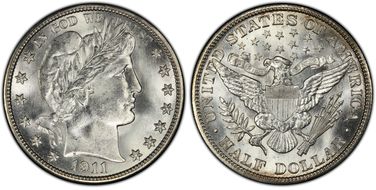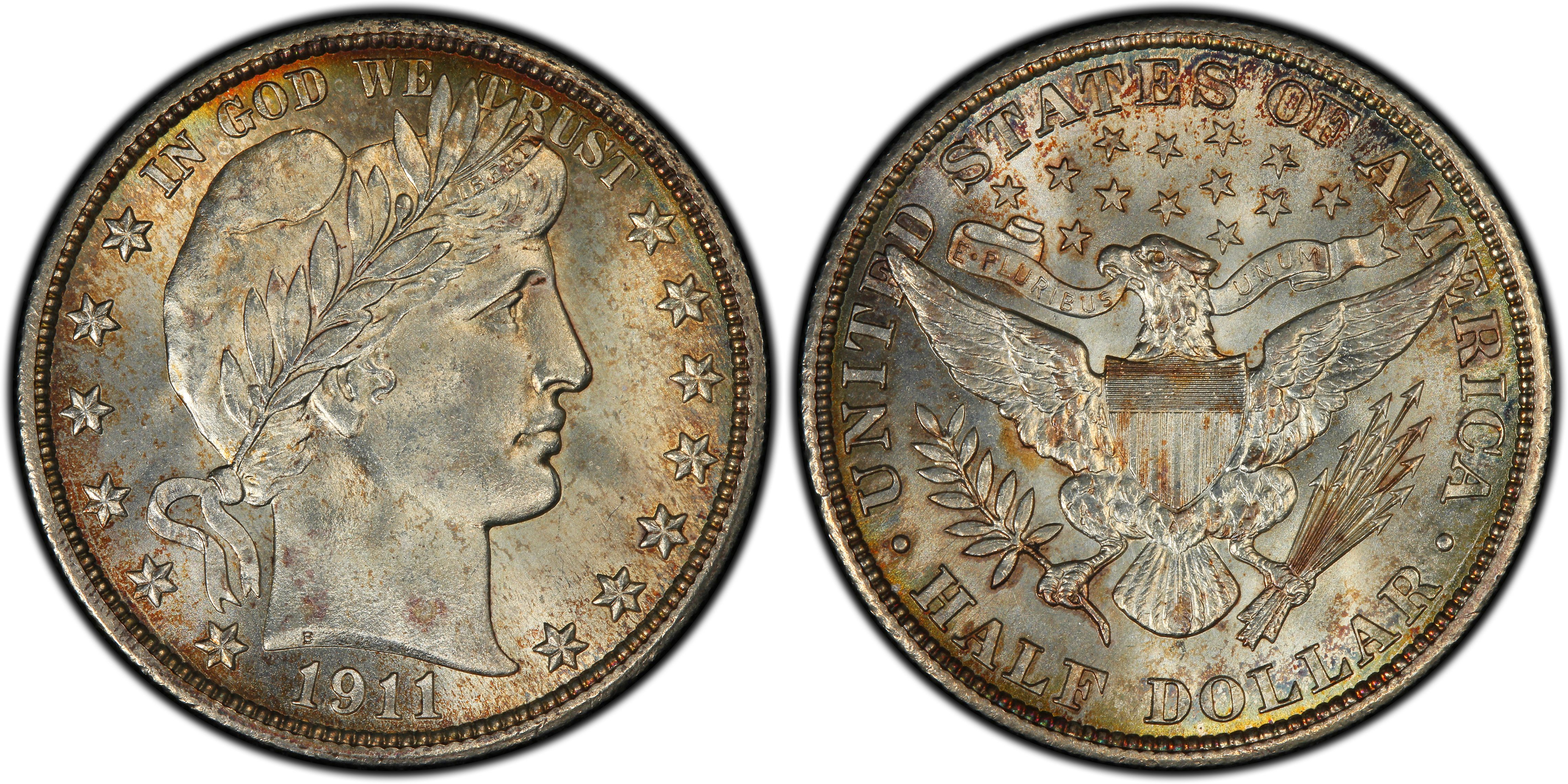
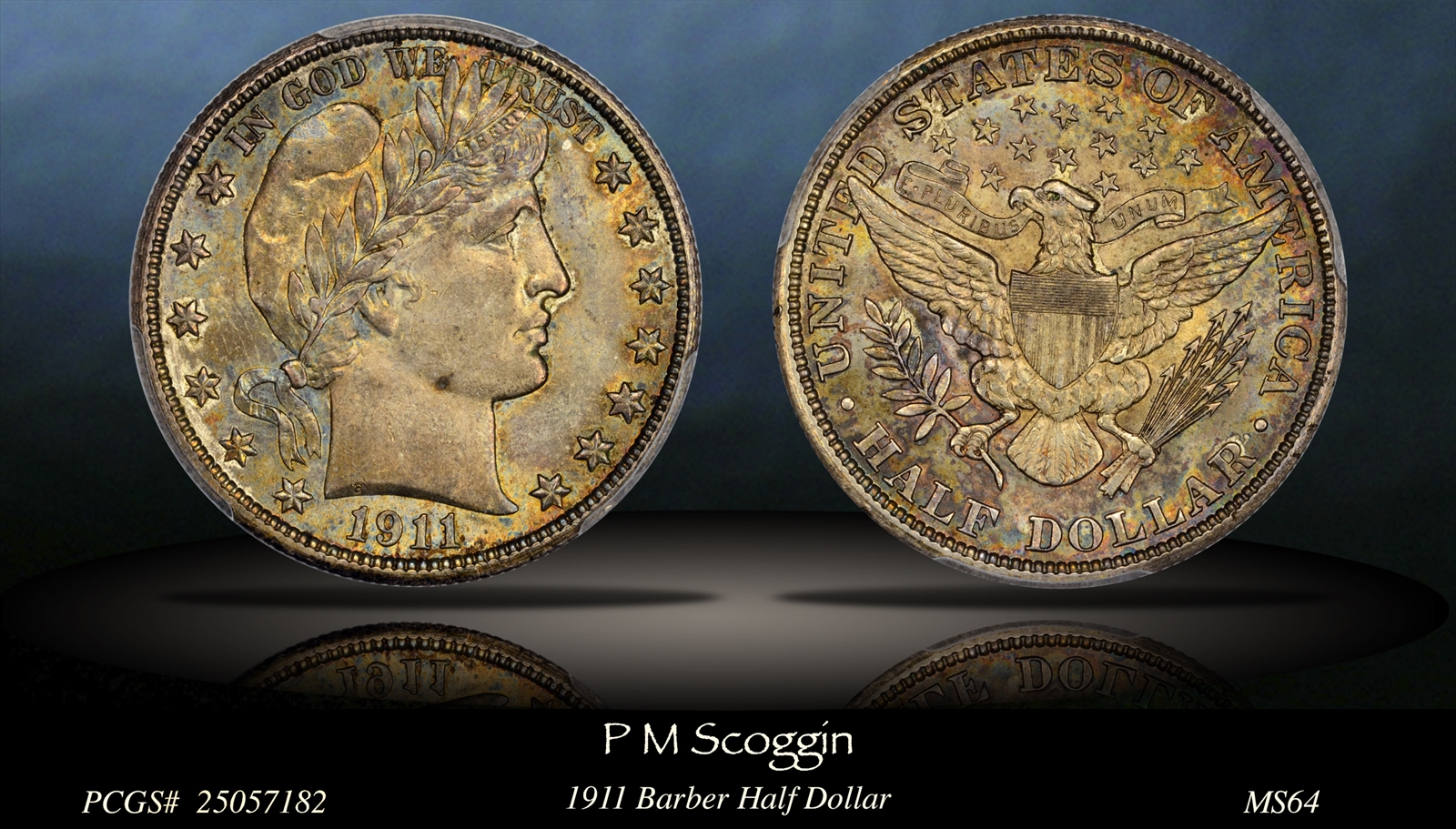
1911 50C MS64 Certification #25057182, PCGS #6521
Owner's Comments
Type: Barber Half Dollar
Designer: Charles E. Barber
Content: 90% Silver, 10% Copper
Weight: 12.50 grams
Diameter: 30.00 millimeters
Edge: Reeded
Mint: Philadelphia
Production Strikes: 1,406,000
General Type Description: In 1892 the half dollar was redesigned to the so-called Barber type. Designer Charles E. Barber’s Miss Liberty now faces right, her hair is in a Phrygian cap, and a wreath of laurel encircles her head. The word LIBERTY appears on a small band or ribbon above her forehead. IN GOD WE TRUST is above, six stars are to the left, seven stars are to the right, and the date is below. The reverse is an adaptation of the Great Seal of the United States and features a heraldic eagle grasping an olive branch and arrows and holding in its beak a ribbon inscribed E PLURIBUS UNUM. A galaxy of stars is above. UNITED STATES OF AMERICA and HALF DOLLAR surround. The same head of Miss Liberty appears on dimes and quarters of the era. Mintage was continuous at the Philadelphia and San Francisco Mints from 1892 through 1915, with additional pieces supplied from New Orleans through 1909 and from Denver beginning in 1906. Unlike the Barber Quarter series, which has some genuinely tough coins, there are no significant rarities in the Barber Half series, although the 1892-O, 1892-S, 1893-S, 1897-O. 1897-S, 1914 and 1915 will be tougher to locate. The type set collector will encounter no difficulty in acquiring specimens in grades of Good or Very Good. Fine pieces, believe it or not, are scarce. Very Fine coins are very scarce and Extremely Fine coins can be called rare in the context of modern issues. AU coins are rarer yet, Uncirculated pieces are still more rare, and superb Uncirculated pieces are very rare. Proofs exist in proportion to their original mintages, which like the quarters, typically ran in the neighborhood of 500 to 900 pieces per year. One of the reason for the scarcity of high grade circulated pieces, is once the coins entered circulation, they tended to remain there many years, and the few XFs and AUs that remained, were often “enhanced” in the 1960s and 1970s and sold as Uncs. (Source: Bowers, W. David. “United States Coins by Design Types - An Action Guide for the Collector and Investor”)
Specific Issue Description: This is not a rare issue at all, but rather a fairly common one in all mint state grades, including Gem condition, something that cannot be said for very many Barber Half Dollar issues. (Source: Akers, David. PCGS CoinFacts)
Exemplar Notes: Acquired 9/2013 from David Lawrence Rare Coins.
Expert Comments
Ron Guth
The 1911 Half Dollar is not the most common date in the series, but it is readily available in most grades. PCGS alone has certified over 100 MS64's and over four dozen MS65's. Even MS66's are available (for a price, of course) but, surprsingly, PCGS has graded no MS67's of this date. Because so many nice examples exist today, collectors can be choosy and pick examples with full strikes and strong eye appeal.
David Akers
This is not a rare issue at all, but rather a fairly common one in all mint state grades, including Gem condition, something that cannot be said for very many Barber Half Dollar issues.PCGS #
6521
Designer
Charles E. Barber
Edge
Reeded
Diameter
30.00 millimeters
Weight
12.50 grams
Mintage
1406000
Metal
90% Silver, 10% Copper
Pop Higher
83
Pop Lower
734
Region
The United States of America
Price Guide
PCGS Population
Auctions - PCGS Graded
Auctions - NGC Graded
Rarity and Survival Estimates Learn More
| 65 or Better | 5500 |
| All Grades | 750 |
| 60 or Better | 200 |
| 65 or Better | R-3.9 |
| All Grades | R-5.5 |
| 60 or Better | R-7.0 |
| 65 or Better | 68 / 74 TIE |
| All Grades | 68 / 74 TIE |
| 60 or Better | 69 / 74 TIE |
| 65 or Better | 68 / 74 TIE |
| All Grades | 68 / 74 TIE |
| 60 or Better | 69 / 74 TIE |