



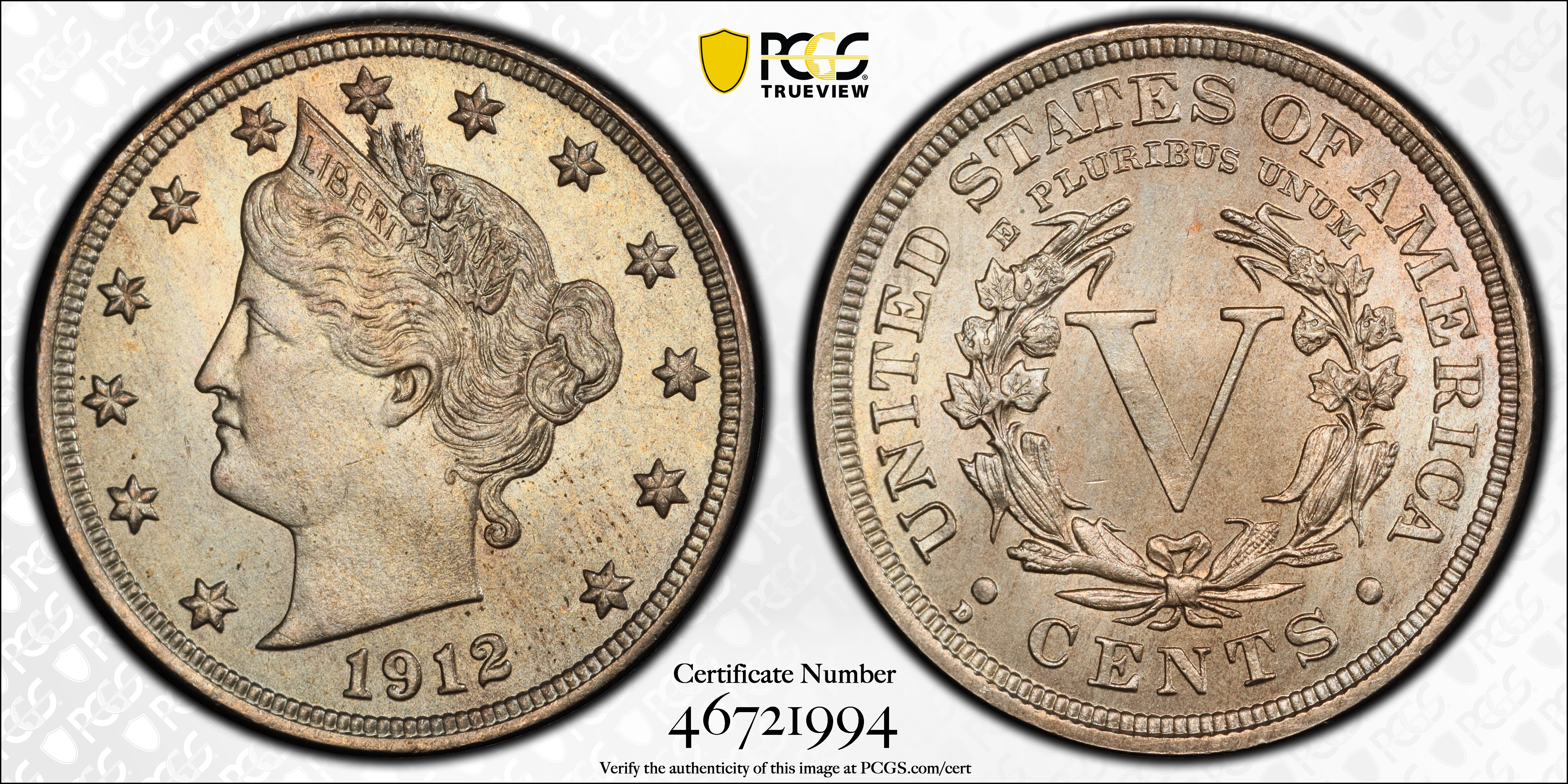
1912-D 5C MS66 Certification #46721994, PCGS #3874
Expert Comments
Charles Morgan
The 1912-D Liberty Head Nickel
The year 1912 marked the only instance in the Liberty Head Nickel series where branch mints struck the denomination. When the series entered circulation in 1883, it was immediately mired in controversy (due to the "Racketeer Nickel" scandal), yet it continued through 1911 without a single example being struck outside of Philadelphia. As the Western economy expanded, an acute need for minor coinage prompted the Mint to reverse a policy dating back to the establishment of the first branch mints in 1838, which had previously restricted base-metal coinage to the main facility.
By 1912, the Liberty Head Nickel’s days were numbered. Mint leadership was already selecting a successor, eventually choosing sculptor James Earle Fraser. A prominent artist, Fraser was notable for his apprenticeship under Augustus Saint-Gaudens and his penchant for depicting Native American subjects. His "Buffalo Nickel" motif followed a lineage of indigenous-themed coinage: James B. Longacre’s Indian Cent (actually Liberty in a headdress), Saint-Gaudens’ Indian $10 gold piece, and Bela Lyon Pratt’s incuse, ultra-realistic Indian Quarter Eagles and Half Eagles.
These depictions were not isolated to coinage; they were a central fixture of the American Zeitgeist. Following the closing of the frontier, "Indian" designs became symbols of a romanticized American identity. The Hunkpapa Lakota chief Running Antelope graced the 1899 $5 Silver Certificate. Wooden "Cigar Store Indians" stood guard at tobacco shops, while Calumet Baking Powder used a chief's profile to symbolize purity. Native motifs appeared on everything from "snake oil" elixirs to "Indian Chic" fashion. Zane Grey and James Willard Schultz popularized the Western novel, and Wild West shows offered choreographed caricatures of tribal culture. In this light, Fraser’s nickel was a quintessential product of its era- a totem of 1910s nostalgia.
The new design’s debut was held until 1913, allowing the Liberty Head Nickel a final bow. While the San Francisco Mint did not begin striking the 1912-S Liberty Head Nickel (#3875) until December 24, the Denver Mint received orders much earlier. Following a month-long technical delay, the first 1912-D nickels were struck on February 5. This initial batch of 20,000 pieces was delivered under the supervision of the mint’s coiner, John Wells. Struck from the standard alloy of 75% copper and 25% nickel, the Denver coins reportedly utilized copper sourced exclusively from Western mines. By February 23, they were appearing in Colorado circulation. By year’s end, Denver produced 8,474,000 pieces—roughly one-third of Philadelphia’s output, but far eclipsing the meager 238,000 struck in San Francisco.
Collecting the 1912-D Liberty Head Nickel
The 1912-D Liberty Head Nickel (#3874) is highly collectible in all grades and is seldom encountered in "junk" boxes due to the numismatic premium placed on even heavily worn examples. The PCGS Population Report clearly underreports the number of circulated survivors - as well as the true ratio of circulated to Mint State examples - because the economics of certification often discourage the grading of lower-tier pieces. Nevertheless, collectors are encouraged to choose PCGS-certified coins for their grading accuracy and authenticity guarantees, especially given the proliferation of "added mintmark" counterfeits.
In Mint State, the median grade of PCGS MS64 underscores the difficulty of finding uncirculated examples with full luster and strong strikes. On this issue, star radials are not always fully defined, and the lower-left portion of the wreath, specifically the corn ears, is frequently flatly struck. While auction listings often mention these weakly-struck areas, novice collectors may neglect to notice them.
The five-cent nickel’s copper-nickel alloy is particularly prone to toning. This process was often exacerbated by the long-term storage of well-preserved examples in Wayte Raymond albums or vintage coin boards. Consequently, fully original examples can frequently be found exhibiting intense gold, peach, peacock green, and even deep shades of violet and aubergine.
* * *
Rarity and Survival Estimates Learn More
| 65 or Better | 30000 |
| All Grades | 2000 |
| 60 or Better | 600 |
| 65 or Better | R-2.7 |
| All Grades | R-4.6 |
| 60 or Better | R-5.8 |
| 65 or Better | 7 / 32 TIE |
| All Grades | 19 / 32 TIE |
| 60 or Better | 22 / 32 TIE |
| 65 or Better | 7 / 33 TIE |
| All Grades | 19 / 33 TIE |
| 60 or Better | 22 / 33 TIE |
Condition Census Learn More
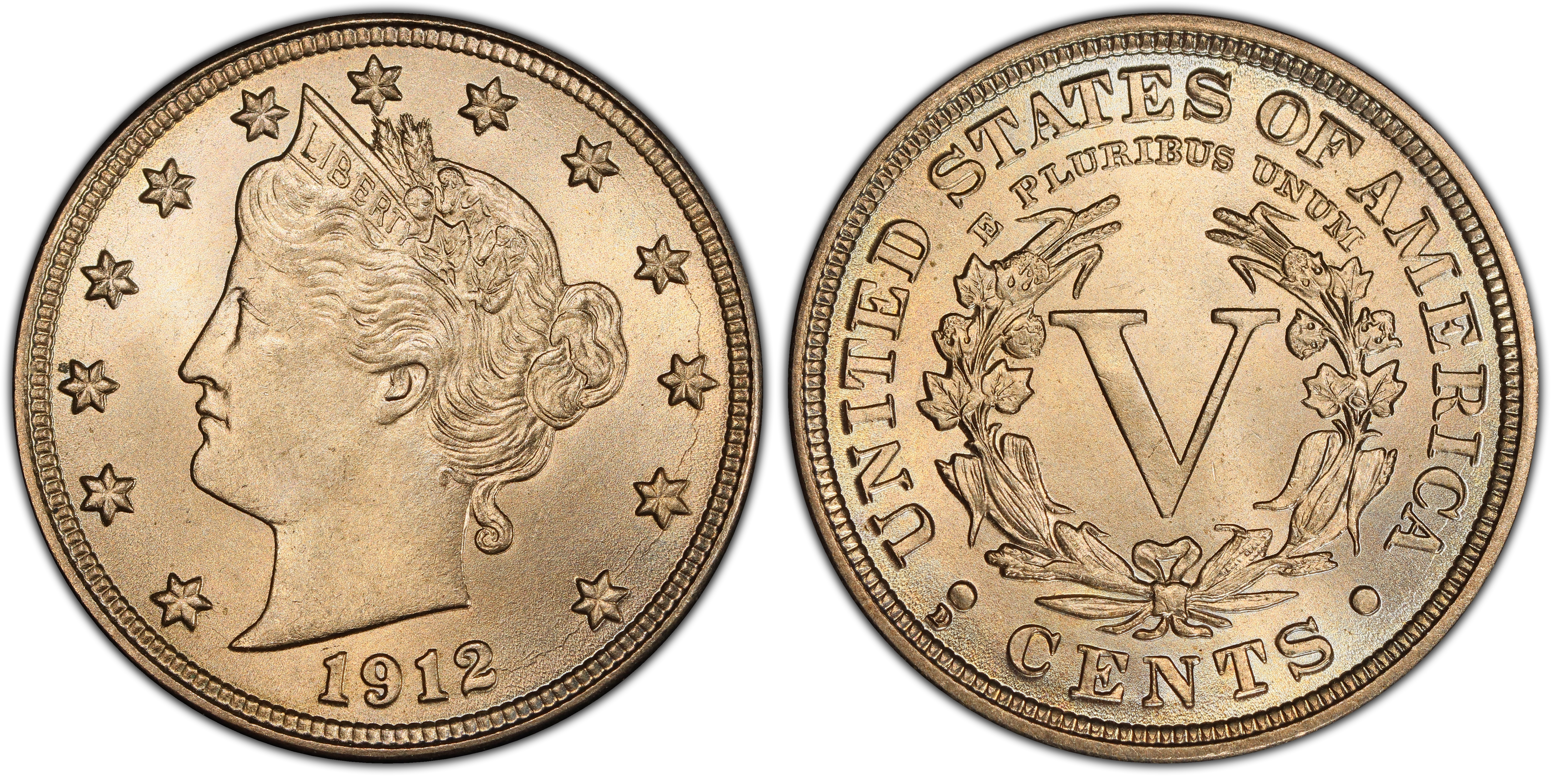 #1 PCGS MS67
GreatCollections, August 27, 2023, Lot 1190747 - $20,250; "The Grand Cru Collection" (PCGS Set Registry). Champagne patination. Toning spot above Star 3. Die crack throug Stars 1 to 4 and Stars 8 through 13 to the date. On the reverse, there is a thin crack above AMERICA. |
 #1 PCGS MS67
Violet and gold iridescence. Die cracks along the stars and AMERICA. Curved mark under Liberty's lowest curl. |
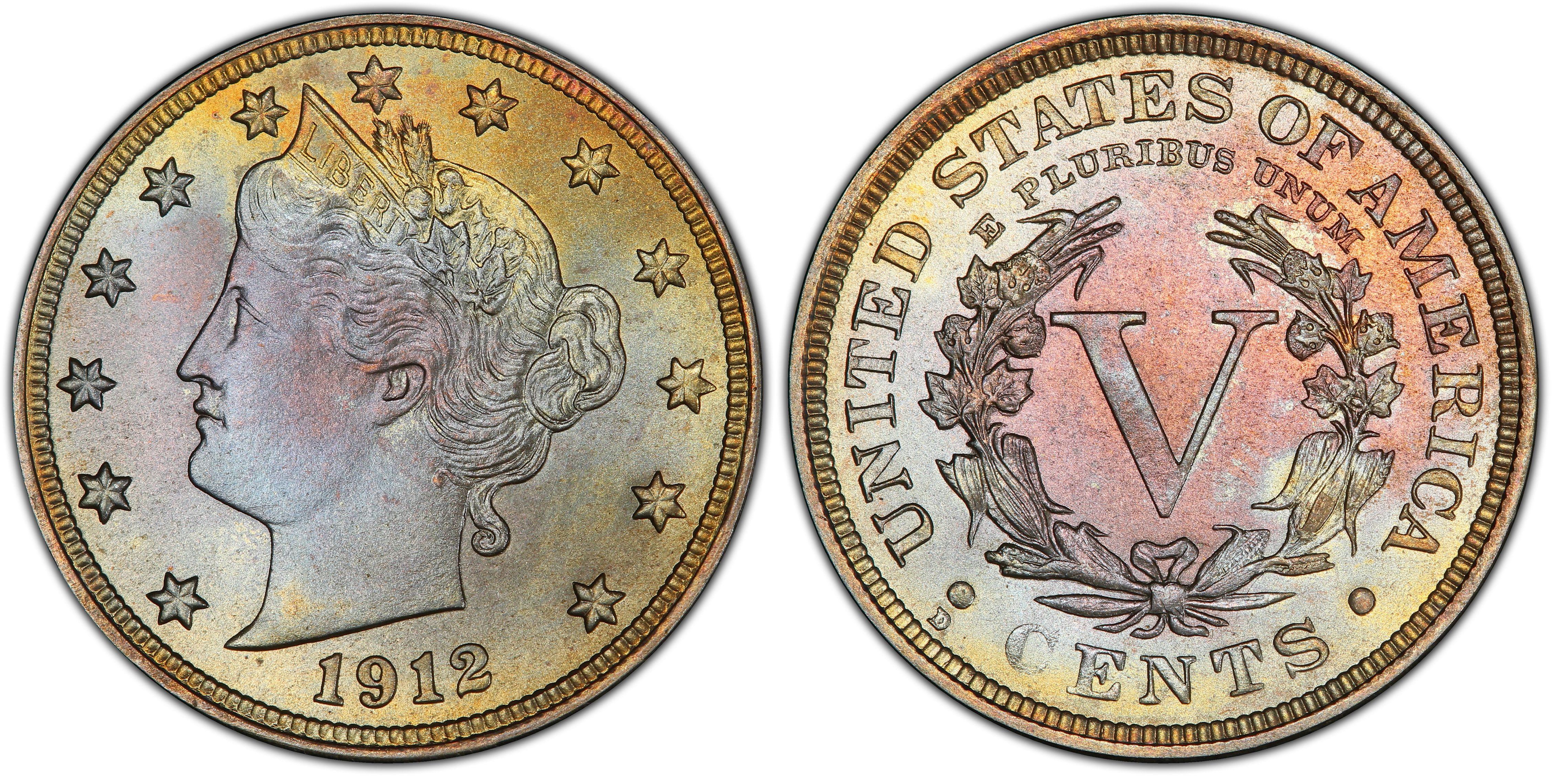 #1 Est. MS67
As PCGS MS67 #08379012. Legend Rare Coin Auctions, November 15, 2018, Lot 73 - $41,125; Dell Loy Hansen. As CACG MS67 #173778144. Iridescent yellow-gold, blue, orange, and peach. |
 #4 PCGS MS66+
Golden peach toning. Scattered flecks of darker toning on Liberty's portrait and above the V. |
 #4 PCGS MS66+
Lustrous peach toning blends into shimmering orange toward the outer periphery. Deeper, dark patches of patination are noted at the base of the 'V' and along the right side of the ribbon. |