



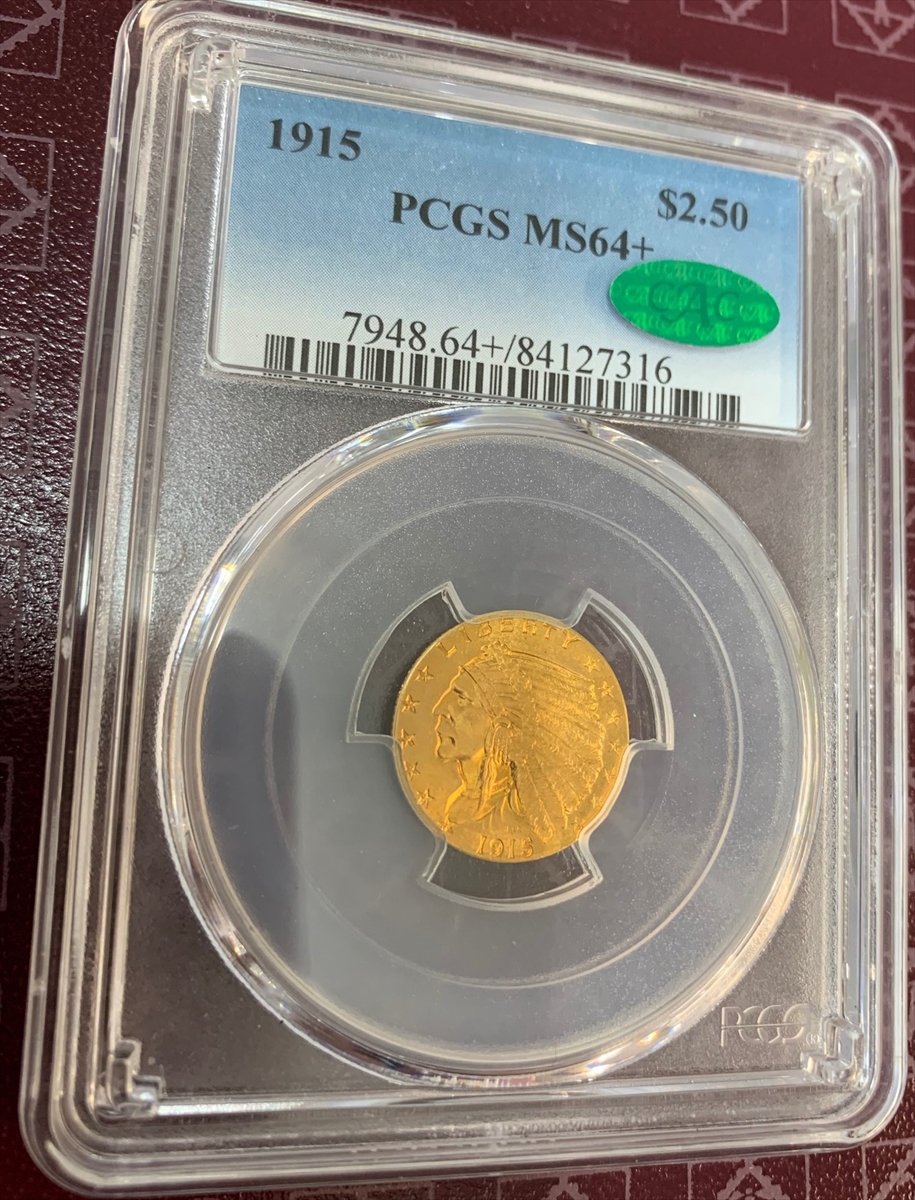
1915 $2.50 MS64+ Certification #84127316, PCGS #7948
Expert Comments
Charles Morgan
The 1915 Indian Head Quarter Eagle
The Indian Head Quarter Eagle was struck in two distinct periods: 1908–1915 and 1925–1929. The production gap was a direct consequence of World War I, which prompted the United States to issue severe export restrictions. This conflict triggered a global economic shift that transformed gold from a common tool of daily commerce into a strategic national reserve—a shift that impacted all U.S. gold denominations.
World War I had a catastrophic impact on the global gold standard. The war was an "Empire Killer," not only because of the staggering losses on battlefields like Ypres and Verdun, but because the cost of financing the war bankrupted national treasuries and set the stage for the global financial strife to come.
By the time gold coinage resumed, the economic landscape had changed. The Federal Reserve Act of 1913 had consolidated the federal government's ability to manage the national currency and fostered a public willingness to forgo physical metal in favor of government-backed currency notes.
Production resumed in the mid-1920s after Britain returned to the Gold Standard. As a leading creditor nation, America produced gold coins to reinforce its strategic holdings and meet the demands of international trade.
Collecting the 1915 Indian Head Quarter Eagle
The 1915 Indian Head Quarter Eagle (#7948) was the tenth issue in the series. Struck exclusively at the Philadelphia Mint, 606,000 were produced for circulation, along with 100 Matte Proofs (#7964). Notably, 1915 marked the final year for Proof Quarter Eagles.
The issue is typically well-struck with average luster for the series; a characteristic yellow gold hue is common. The incuse design poses a unique challenge for the Indian Head Quarter Eagle and Indian Head Half Eagle series. Because the fields represent the highest points on the coin's surface, they offer no protection against contact marks or abrasions. Consequently, most original coins grade no finer than PCGS MS64. In David Akers’ United States Gold Coins: An Analysis of Auction Records (1975), the expert ranked this date ninth out of fifteen for Gems. Nearly 50 years later, Akers’ observations remain accurate. To date, no coins have graded finer than PCGS MS66—the typical "top pop"grade for the series.
* * *
Rarity and Survival Estimates Learn More
| 65 or Better | 37000 |
| All Grades | 22333 |
| 60 or Better | 283 |
| 65 or Better | R-2.6 |
| All Grades | R-2.7 |
| 60 or Better | R-6.4 |
| 65 or Better | 6 / 15 TIE |
| All Grades | 6 / 15 TIE |
| 60 or Better | 8 / 15 |
| 65 or Better | 6 / 15 TIE |
| All Grades | 6 / 15 TIE |
| 60 or Better | 8 / 15 |
Condition Census Learn More
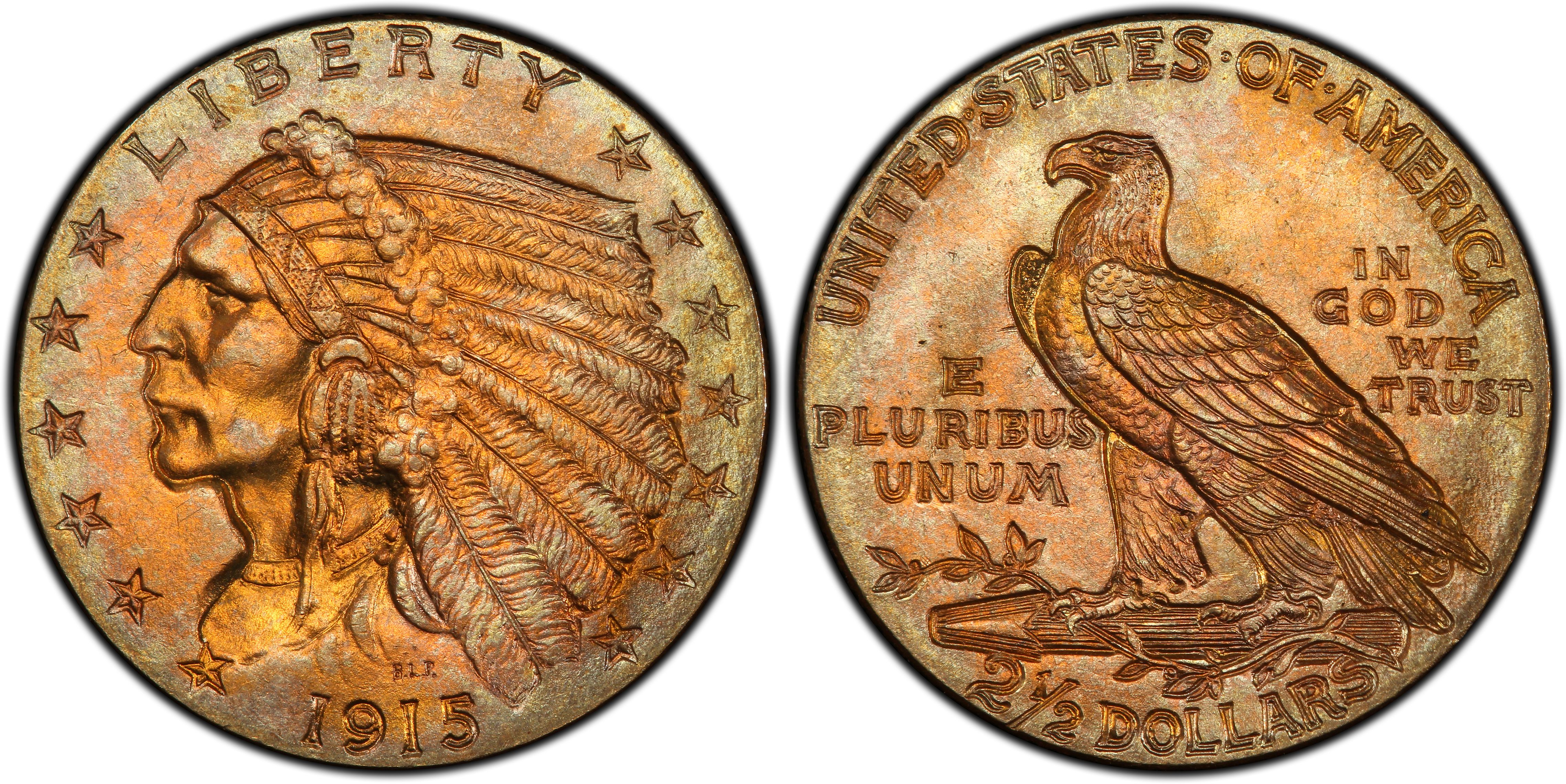 #1 PCGS MS66
"The Donald Kutz California Collection," Heritage Auctions, January 19, 2025, Lot 4689 - $20,400. Blue-green toning along the periphery. A pin-sized toning spot is located to the upper left of the "E" in E PLURIBUS UNUM, with a second similar spot at the lower tip of the eagle's left wing. |
 #1 PCGS MS66
As PCGS MS65+ #84683942. Heritage Auctions, September 7, 2017, Lot 3952 - $5,760; Heritage Auctions, July 15, 2022, Lot 3971 - $8,400. As PCGS MS66 #8463942. As PCGS MS66 #46486794. Stack’s Bowers, March 26, 2024, Lot 4246 – $18,000. As PCGS MS66 #57246507. Two pin-sized contact marks in the field between Star 6 and the Indian's headdress. Faint diagonal hairline above the "1" in the date. On the reverse, a vertical mark is visible above the "E" in E PLURIBUS UNUM. |
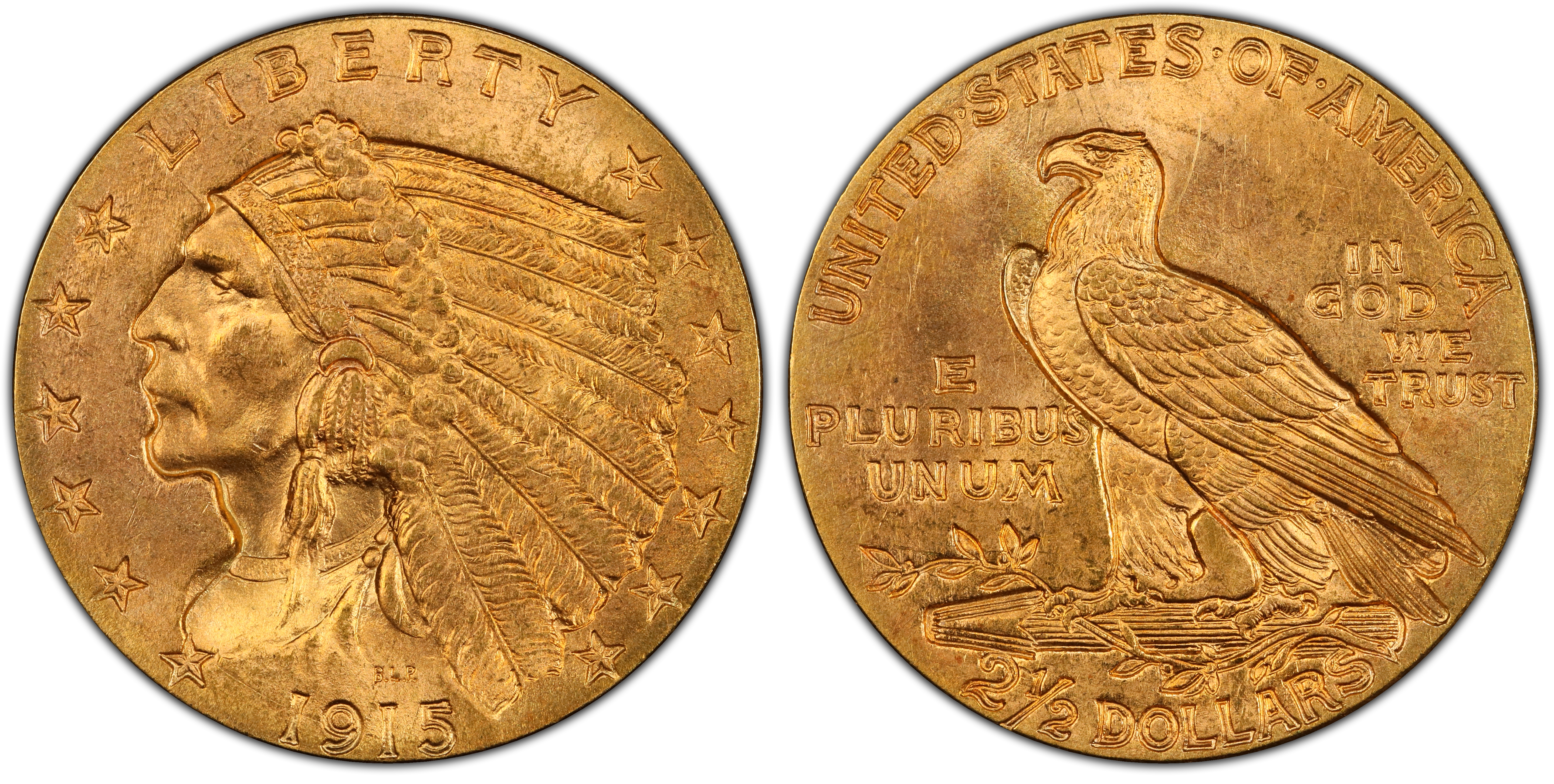 #1 PCGS MS66
GreatCollections, March 5, 2023, Lot 111082 – $22,600. Small diagonal mark on the Indian's jaw. Curved die line extending from the right of Star 1 through the date. Vertical mark concealed within the second lowest feather of the headdress. Gold-orange toning spots to the left of GOD.
|
| #1 PCGS MS66 |
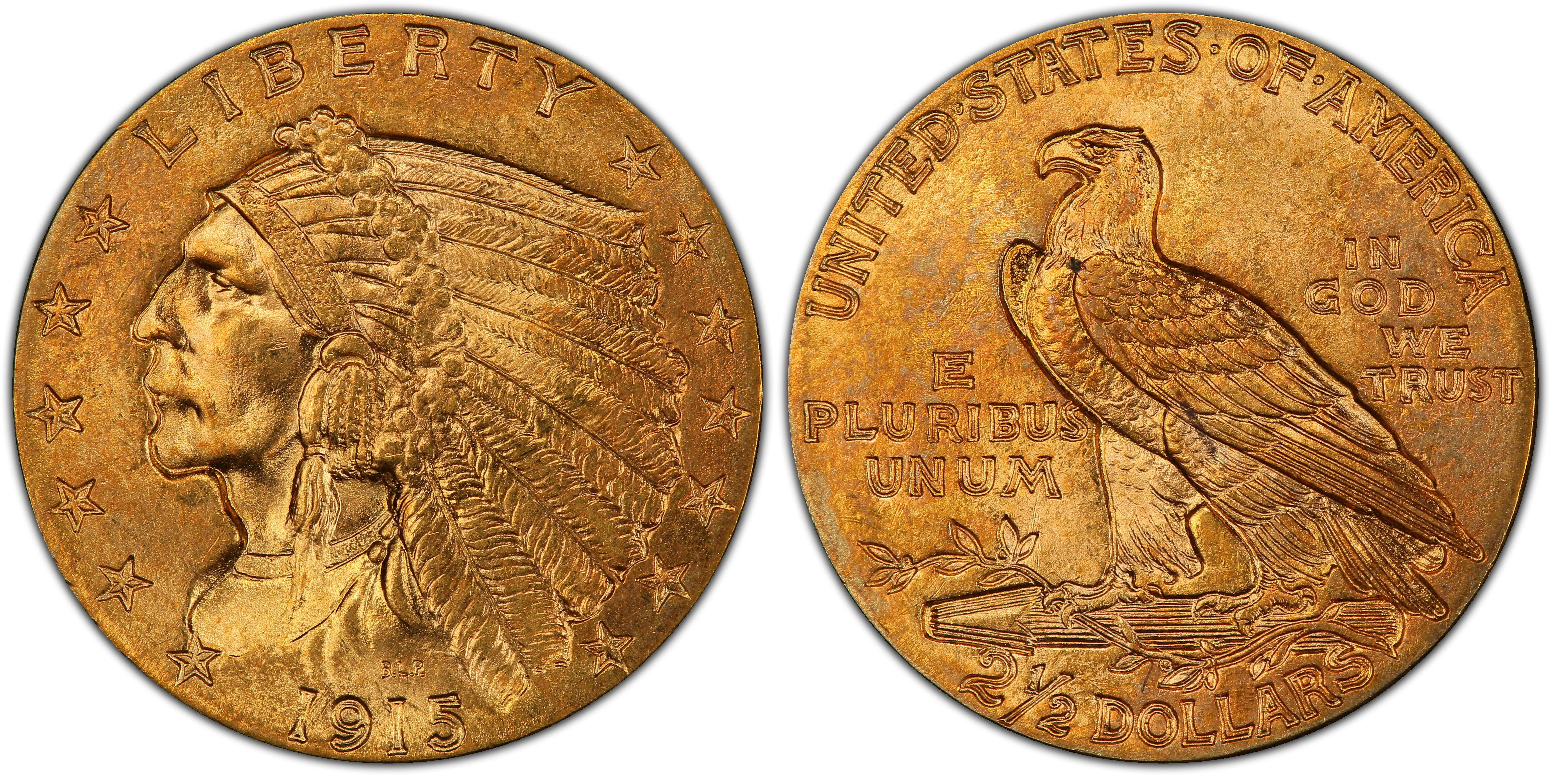 #1 PCGS MS66
Heritage Auctions, October 3, 2016, Lot 3285 – $16,450; "The D.L. Hansen 2 1/2 Gold Complete Set" (PCGS Set Registry). Faint mark on the cheek. Diagonal hairline to the left of the Indian's necklace. Light toning on the reverse, with a spot at the top of the eagle's left wing. A diagonal toning streak is also visible across the middle of the left wing, extending through the left leg. |