



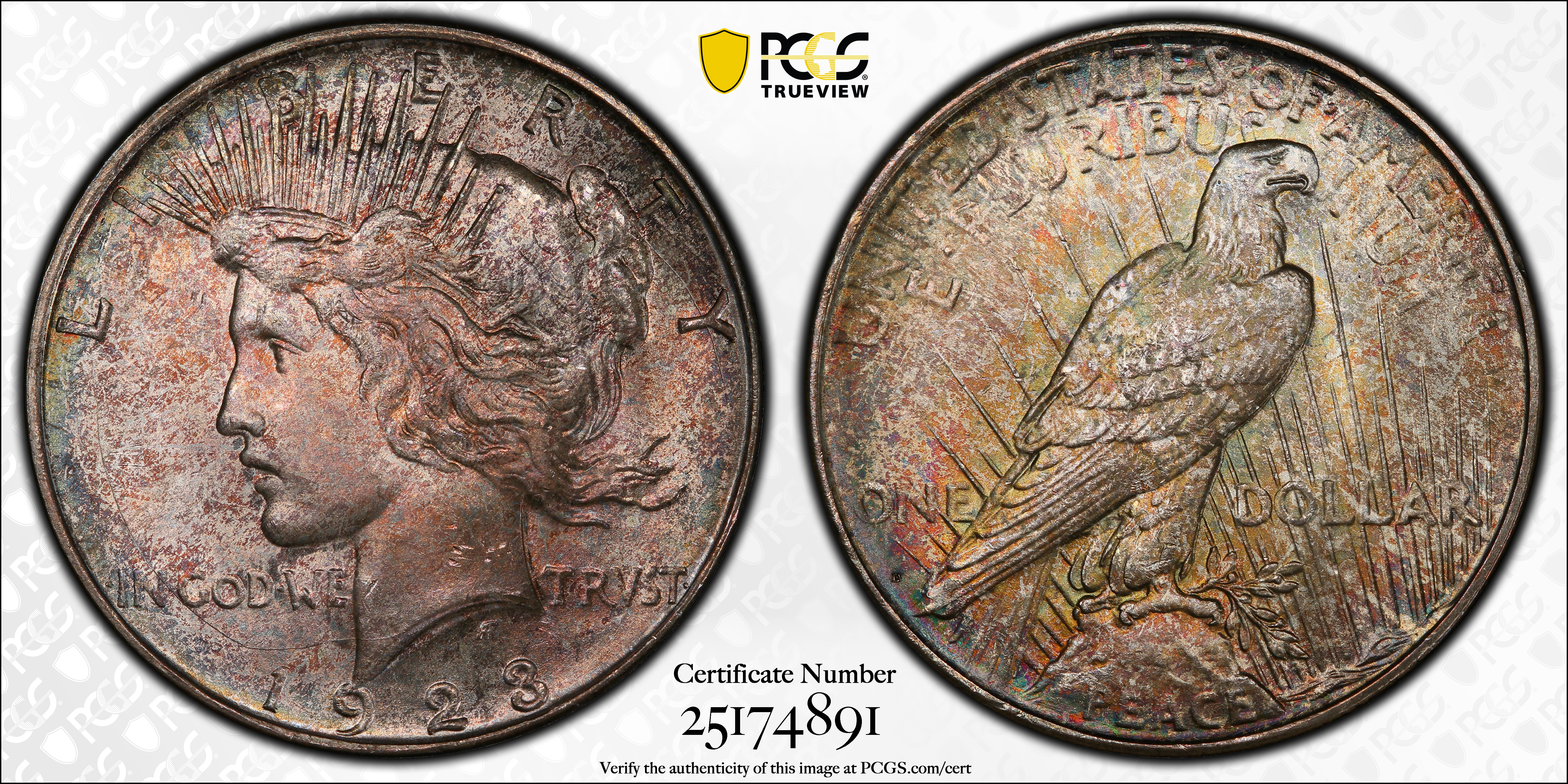
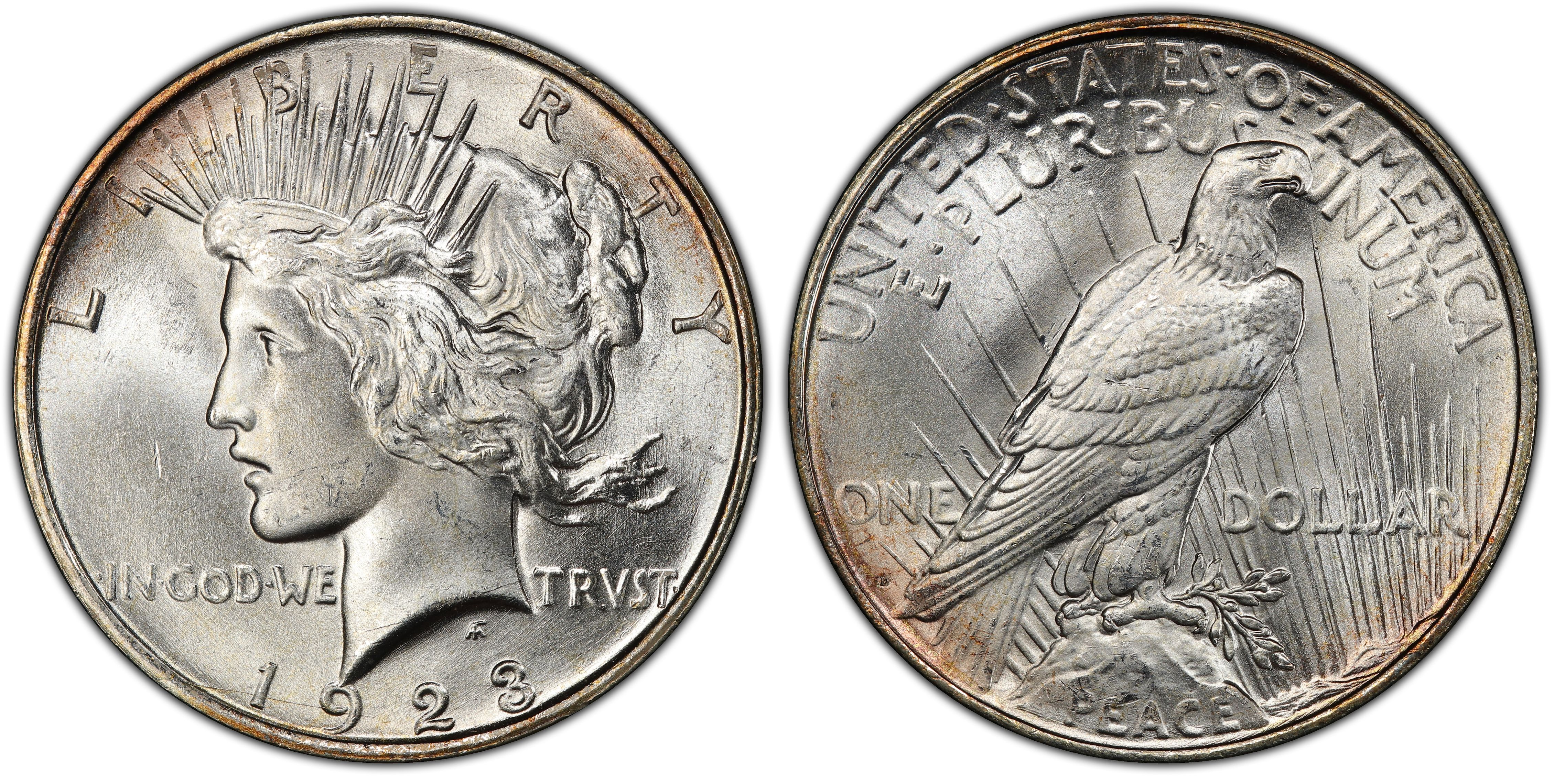
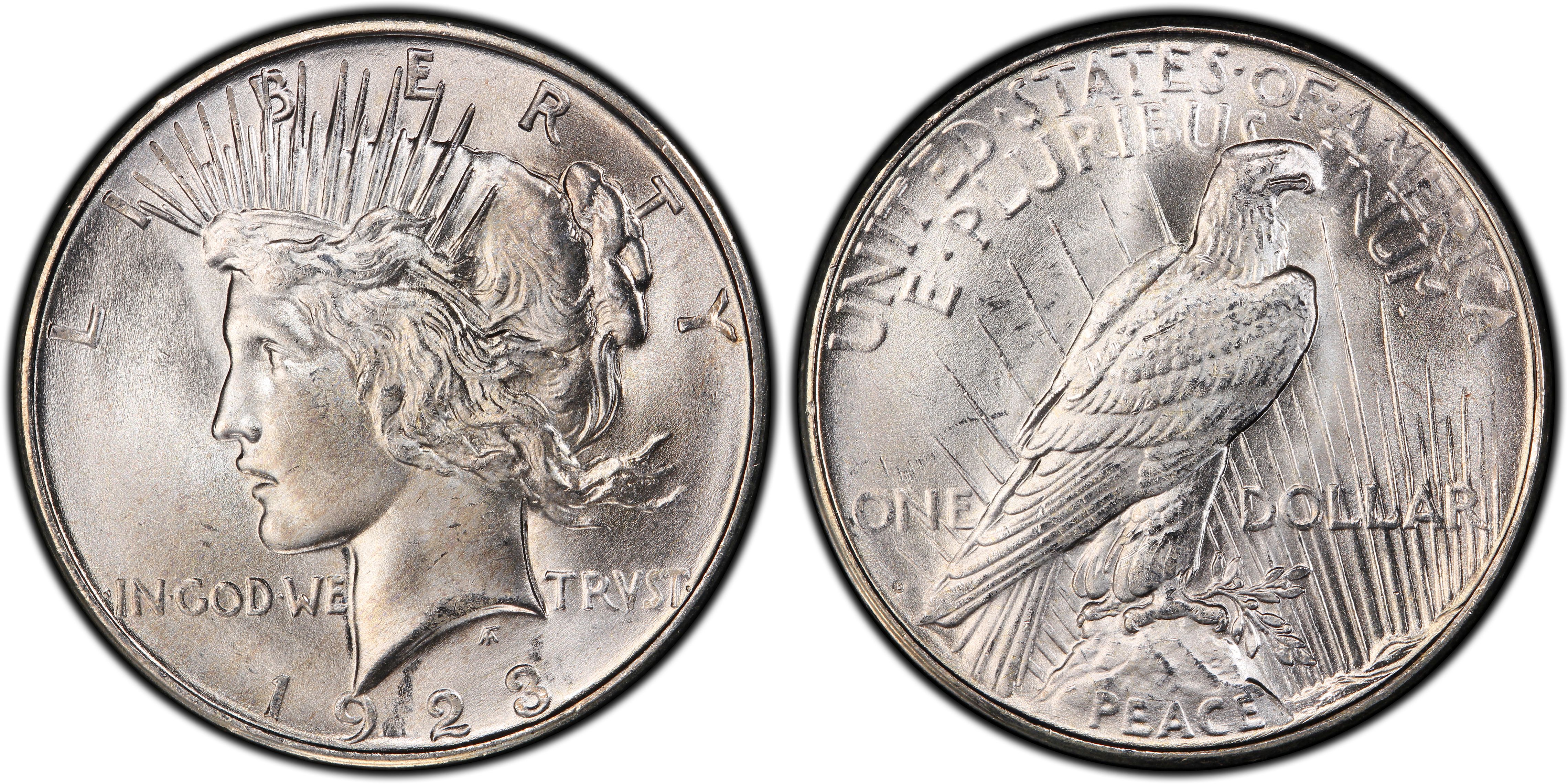
1923-D $1 MS65+ Certification #25174891, PCGS #7361
Owner's Comments
Expert Comments
Ron Guth
The 1923-D Peace Dollar has the second highest mintage of all the Peace Dollars made at the Denver mint. Like the 1922-D, the 1923-D sometimes comes weakly struck in the centers, but it is possible to find fully struck examples with a little bit of luck and effort. Most of the examples certified by PCGS are fairly equally distributed between the MS63 and MS64 grades, mostly because of strike and mark issues. MS65 examples are fairly scarce, though not rare. In MS66, the population drops off dramatically. PCGS has not graded any 1923-D Peace Dollars in MS67. Luster ranges from frosty white to chrome-like. Many 1923-D Peace Dollars show spidery die cracks on both sides.
Q. David Bowers
The following narrative, with minor editing, is from my "Silver Dollars & Trade Dollars of the United States: A Complete Encyclopedia" (Wolfeboro, NH: Bowers and Merena Galleries, Inc., 1993).Coinage Context
When minted, the 1923-D dollars were not needed in the channels of commerce. Most were sent to storage vaults.
Numismatic Information
The first Peace dollar rarity: In an article in The Numismatist, July 1925, collector E.S. Thresher stated' that in June 1919 he embarked on a search to find each and every date of coin variety believed to be available in circulation. In the Peace dollar series, still a relatively new series when he wrote his letter in 1925, he had located every issue from 1921 through 1925 except for 1923-D, 1925-D, and 1925-S, the first being non-existent and the second not having been released yet. From this it is apparent that the 1923-D was rare in its own time, and may not have been released in 1923 or 1924, through early 1925 (for the article to have appeared in the July 1925 issue, it was probably received in April or May).
In due time, the 1923-D became the first coin to be considered a rarity in the Peace dollar series. Today, this makes curious reading, as 1923-D is not even remotely in the same context now. By 1938, the elusive nature of the 1923-D in Uncirculated grade was recognized, and in that year specimens sold for $12.50 to $20. As a point of contrast, a comparable 1934-S cost less than $1.50. However, fame was fleeting for the 1923-D, and in late autumn 1938 the Treasury turned a number of bags loose. Within a month or two the price plummeted to the $2 range or even less.
Hoard coins: Many bags were paid out by the Treasury Department from the late 1930s through at least the 1950s, after which time the government stock of mint-sealed bags of this issue was largely depleted.
Circulated grades: The 1923-D is among the commonest mintmarked Peace dollars in VF-20 to AU-58 grades. In EF and AU condition it is very plentiful, probably the result of bags having been released into circulation in the 1940s.
Mint State grades: The 1923-D is plentiful in Mint State. Most are in lower ranges such as MS-60 through 62, at which level probably several tens of thousands exist. In MS-63 grade, I believe that 5,000 to 10,000 exist, and in MS-64, 2,500 to 5,000. In comparison to the number of collectors desiring Peace dollars for their collections, these numbers are small. At the MS-65 level, probably fewer than 1,000 survive.
Most Mint State 1923-D dollars seen on the market today are well struck and lustrous on the obverse. The reverse is often lightly struck at the center, due to the dies being spaced too far apart. Some are weakly struck on the rims and at the date. The situation of careless minting was endemic at the Denver Mint in the mid-1920s, and Buffalo nickels and Lincoln cents of the era were often poorly struck as well.
As most Mint State dollars were shuffled hither and yon in storage vaults for years before being released, the typical 1923-D dollar is apt to show bagmarks, sometimes severe. Cherrypickers can profit by searching for high-grade, well struck, bagmark-free examples of this date. These are very beautiful and are very rare.
It is not unusual to see 1923-D dollars with multiple fine die cracks on the obverse, the result of dies having been employed beyond their normal useful life.
Varieties
Business strikes:
1. Breen-5719. Hub combination II-B2. VAM-I.
Micro D mintmark. One standard variety. Minor mintmark positional varieties are not collected.
Dies prepared: Obverse: Unknown; Reverse: Unknown.
Business strike mintage: 6,811,000
Estimated quantity melted: Unknown
Characteristics of striking: Most show light striking at the center of the reverse.
Known hoards of Mint State coins: A few bags exist today, but most contain coins in the lower Mint State ranges.
Commentary
Mint State coins are usually heavily bagmarked. High-grade, well-struck coins are rare.
Rarity and Survival Estimates Learn More
| 65 or Better | 750000 |
| All Grades | 30000 |
| 60 or Better | 2000 |
| 65 or Better | R-1.3 |
| All Grades | R-2.7 |
| 60 or Better | R-4.6 |
| 65 or Better | 16 / 23 |
| All Grades | 6 / 23 TIE |
| 60 or Better | 12 / 23 TIE |
| 65 or Better | 17 / 24 |
| All Grades | 6 / 24 TIE |
| 60 or Better | 12 / 24 TIE |
Condition Census Learn More
|
#1 MS67 PCGS grade
Heritage 6/2013:4681, $76,375 |
 #2 MS66+ PCGS grade
Heritage 3/2013:3921, $16,450 |
 #2 MS66+ PCGS grade
M A C Peace Dollar Collection (PCGS Set Registry) |
 #2 MS66+ PCGS grade
|
 #2 MS66+ PCGS grade
|