



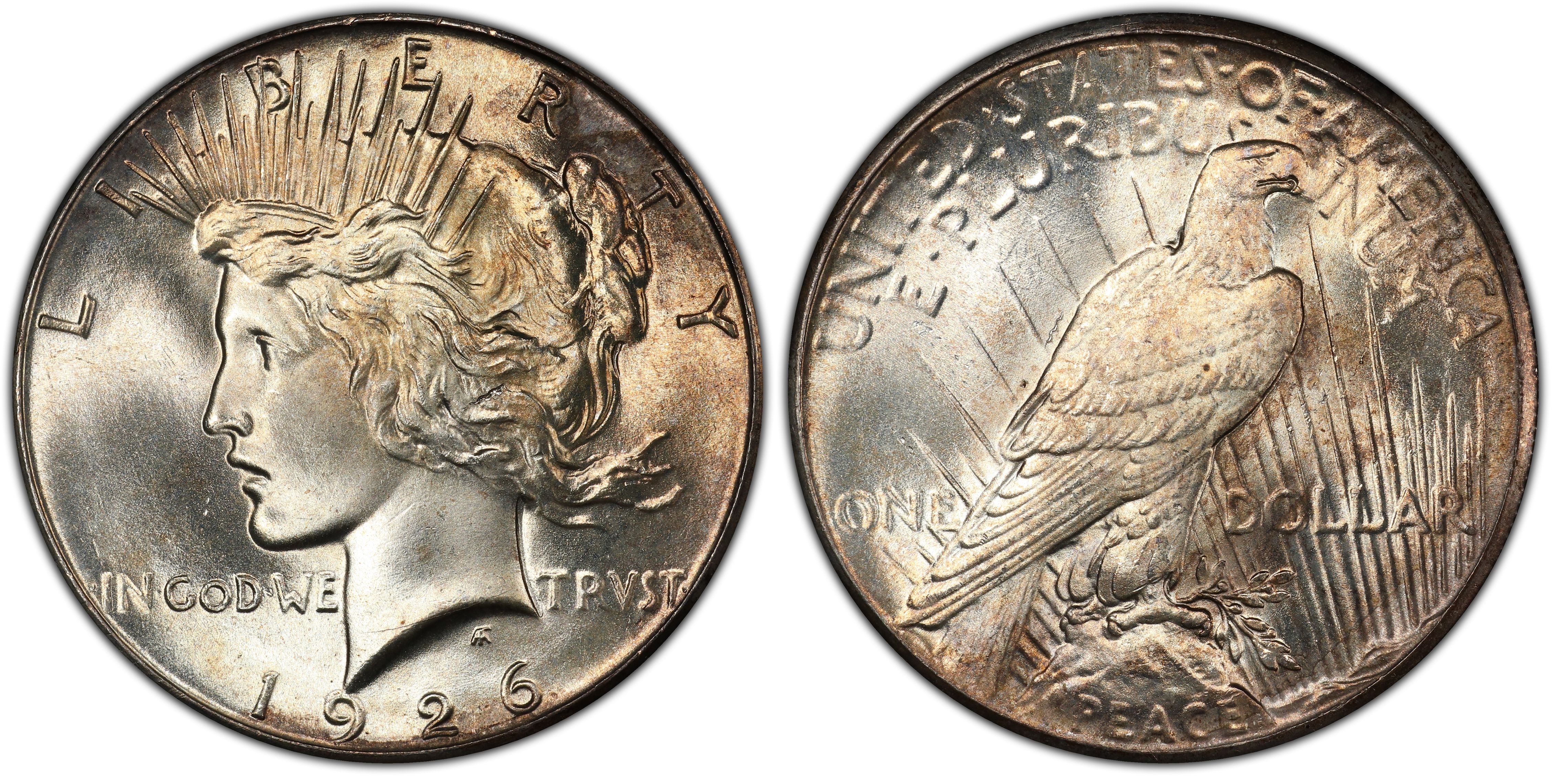
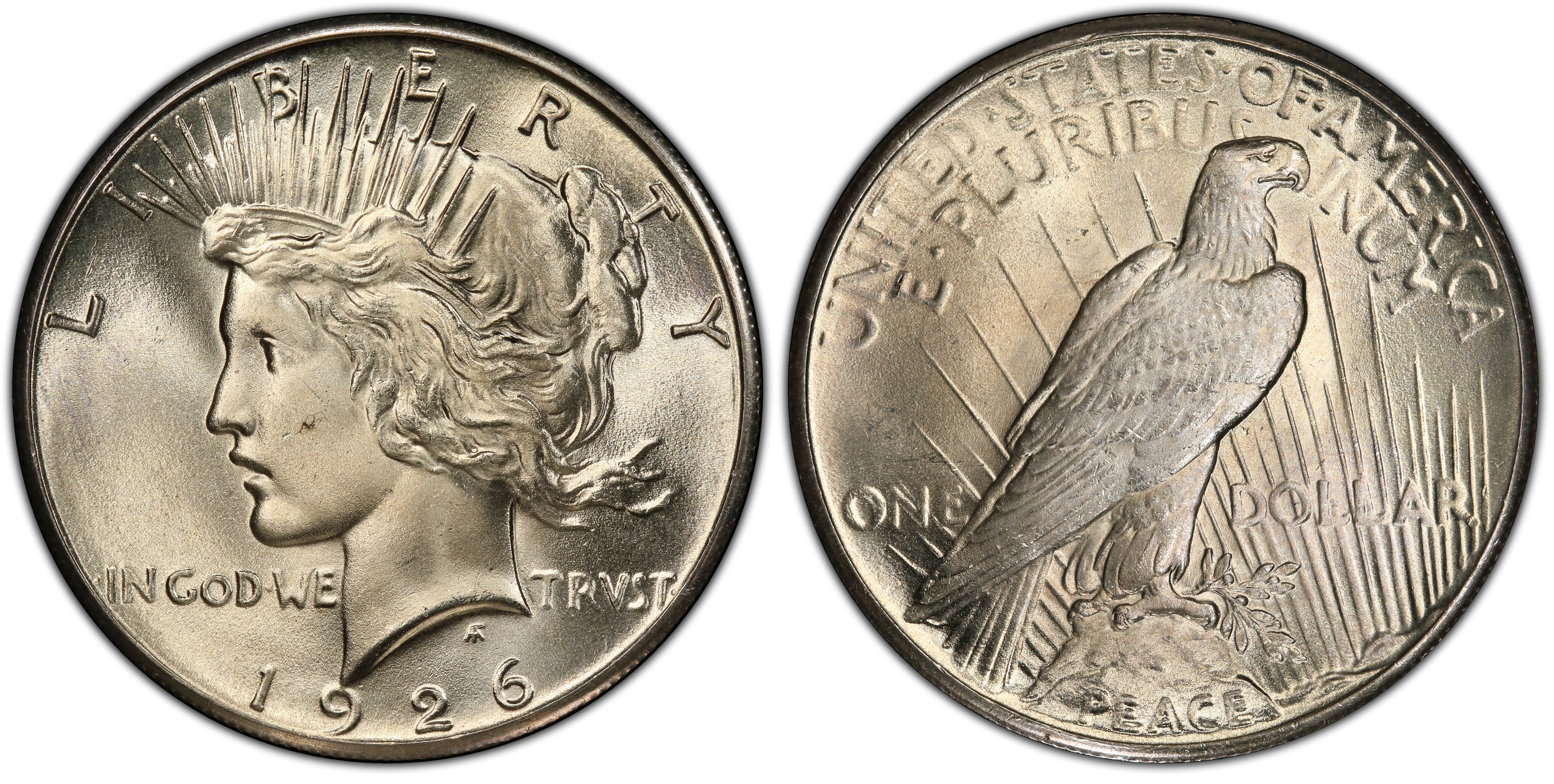
1926 $1 MS66 Certification #49021064, PCGS #7367

Owner's Comments
Expert Comments
Ron Guth
In 1926, the output of Silver Dollars at the Philadelphia mint dropped to less than a fifth of the previous year. For that reason alone, some collectors think the 1926 is scarce or worth a premium. In general it is not. Certainly, the population of certified Mint State examples is lower than in 1925, but not to the point where collectors are unable to find nice examples. In fact, thousand of MS-63 and MS-64 examples have been certified by PCGS and even in MS-65, this date is readiuly available. However, in MS-66, the population drops off dramatically and absolutely none have been graded finer by PCGS. Although strike varies, this date can be found with full details and a strong strike. Luster ranges from frosty to brilliant. Collectors seeking quality 1926 Peace Dollars should have no trouble finding nice-looking, well struck examples with a minimum of marks. Anything less should be avoided or discounted.
According to a notice in the June 1934 issue of The Numismatist (p. 416), collectors could still purchase Uncirculated 1926 Peace Dollars directly from the U.S. Treasury for "the face value of the coins and an amount sufficient to cover the mail charrges by first-class mail."
Q. David Bowers
The following narrative, with minor editing, is from my "Silver Dollars & Trade Dollars of the United States: A Complete Encyclopedia" (Wolfeboro, NH: Bowers and Merena Galleries, Inc., 1993).Coinage Context
Low mintage: The production of 1,939,000 1926 Philadelphia Mint Peace dollars is the lowest Philadelphia Mint figure since 1921.
Numismatic Information
Commentary: In November 1941 in an advertisement in The Numismatist, the Hollinbeck Stamp & Coin Stores referred to the 1926 Peace dollar as the scarcest coin in the series, and offered Uncirculated coins for $4.50, each. The honor for the scarcest is" sue changed from time to time, as hoards Were dispersed. Later, the 1926 became common. In 1944, bags, Were released; several authorities, John Highfill, Walter Breen, and Wayne Miller among them, report that most of these were extensively bagmarked.
In 1953 and 1954, a large number of bags came out through Eastern banks, but they were generally ignored. It was felt that 1926 dollars would be, forever common. However, these bags were soon dispersed, and as the decade wore on, not many others came to light, although-a few are said to have emerged in 1962-64.
Circulated grades: The 1926 Peace dollar is common in worn grades, up to and including AU. Many seem to be in the higher grade ranges, indicating that they may have been put into circulation in the 1940s or early 1950s. Probably, several hundred thousand exist.
Mint State grades: Many Mint State coins survive.
Most are in grades from MS-60 to MS-63; but MS-64 coins are not rare, and MS-65 pieces Can be located without difficulty. The typical specimen is well struck with nice lustre. Bagmarks, when present, are apt to be light. Cherrypicking is worth doing, but you will not have to look long or hard to find a quality piece.
The 1926 is usually not available in large quantities. Most on the market are encountered a coin or two at a time.
Varieties
Circulation strikes:
1. Normal reverse: Breen-5724. Hub combination II-B2. VAM-1. Standard variety with normal reverse. 2. Doubled die reverse: VAM-2. Doubling plainest on claws and leaves. Discovered by Fred White. Listed in new VAM 3rd edition.
Dies prepared: Obverse: Unknown; Reverse: Unknown.
Circulation strike mintage: 1,939,000
Estimated quantity melted: Unknown.
Characteristics of striking: Usually well struck, lustrous, and attractive.
Known hoards of Mint State coins: Many bags were released by the Treasury in 1944; others were released from then through 1962-64, but not enough to make this a "common date."
Commentary
Mint State 1926 Peace dollars usually have very attractive surfaces.
Rarity and Survival Estimates Learn More
| 65 or Better | 275000 |
| All Grades | 75000 |
| 60 or Better | 6000 |
| 65 or Better | R-1.8 |
| All Grades | R-2.2 |
| 60 or Better | R-3.8 |
| 65 or Better | 13 / 23 TIE |
| All Grades | 18 / 23 |
| 60 or Better | 18 / 23 |
| 65 or Better | 14 / 24 TIE |
| All Grades | 19 / 24 |
| 60 or Better | 19 / 24 |
Condition Census Learn More
 #1 MS66+ PCGS grade
|
 #1 MS66+ PCGS grade
|
 #1 MS66+ PCGS grade
|
| #1 MS66+ PCGS grade |
 #1 MS66+ PCGS grade
|