



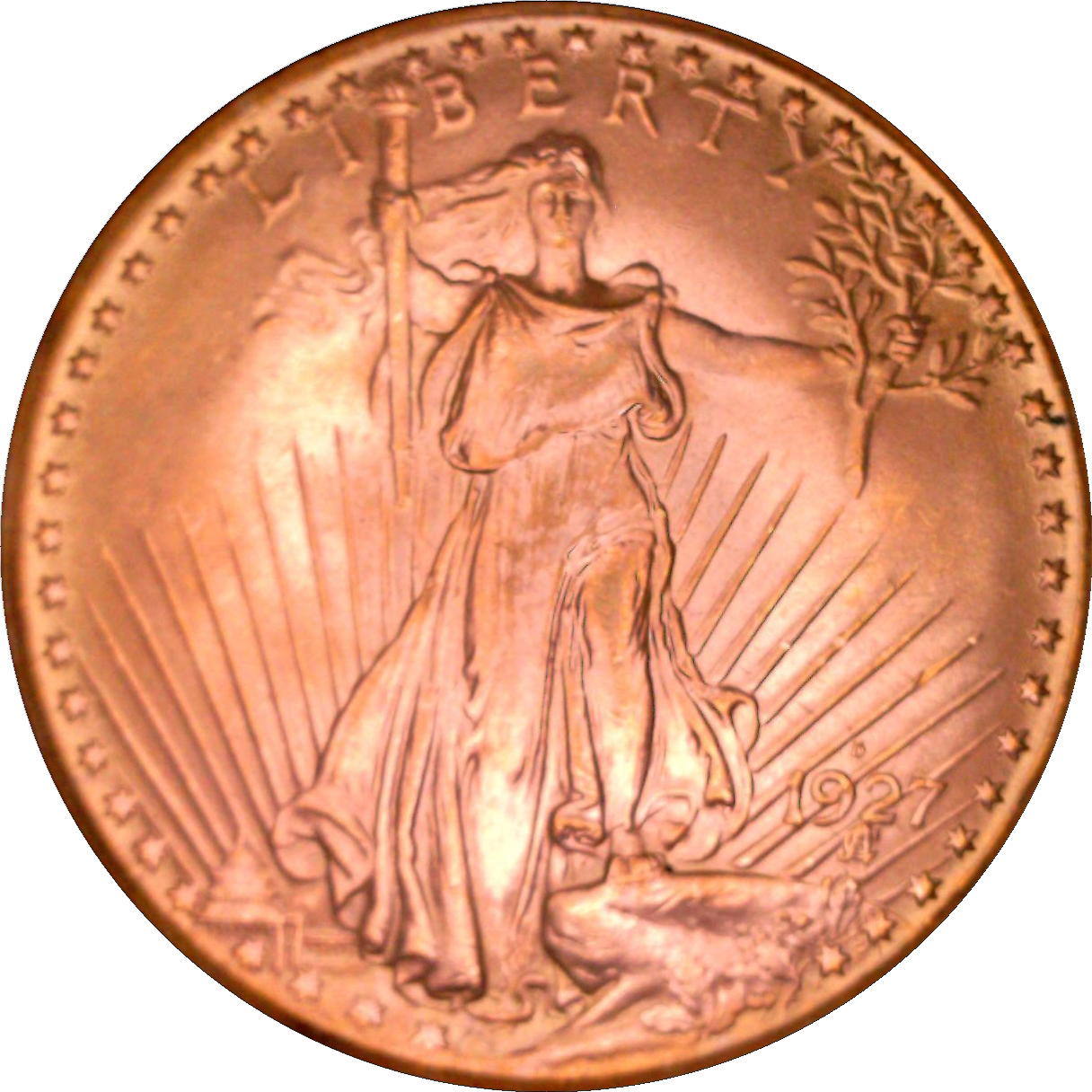
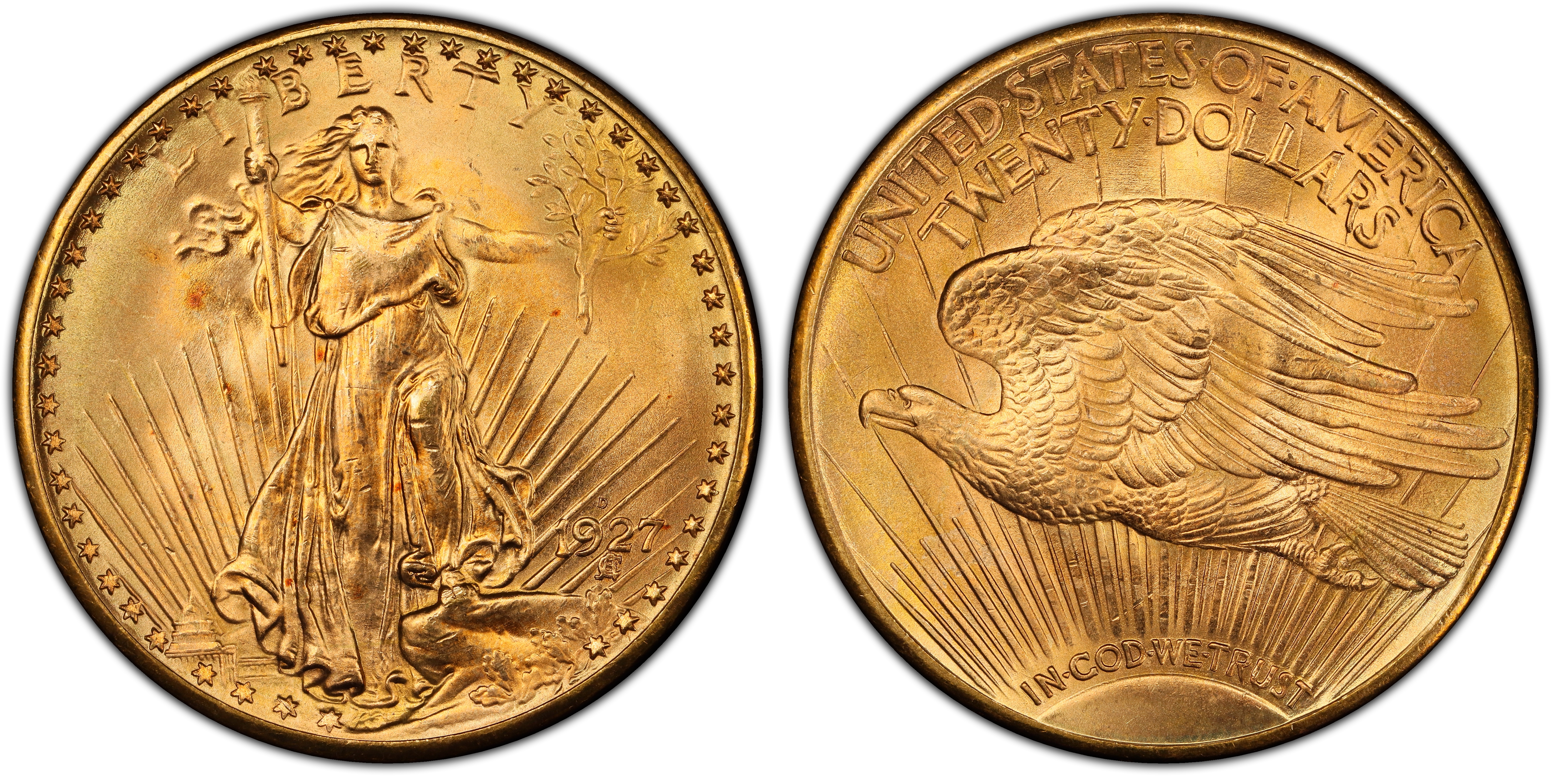
1927-D $20 MS66 Certification #45402577, PCGS #9187
Expert Comments
David Akers (1975/88)
When all grades are considered, the 1927-D is the rarest collectible, regular issue Saint-Gaudens double eagle by far. Futhermore, it is also the rarest 20th-century gold coin of any denomination. (Of course, the 1933 double eagle is more rare but it is not collectible in the sense that it cannot presently be legally held, and although the 1907 Extremely High Relief is of virtually identical rarity to the 1927-D, technically it is a pattern and not a regular issue.) Estimates of the number of examples known of the 1927-D generally have been in the six to eight pieces, but I have personally examined 11 specimens that I know for certain to be different. I estimate that at least a dozen are known, perhaps as many as 15. The majority are MS-63 or better and several are solid gems. The Eliasberg coin now owned by a prominent Eastern collector is a high end MS-65, and the Dr. Steven Duckor example which he purchased from Auction '84 and the Browning specimen are both full MS-65. The three examples in the Smithsonian Institution are all MS-63 to MS-64 as is the coin from Stack's October 1985 sale that was purchased by MTB for a client. It is difficult to pick out one piece as the "finest" but that accolade most likely should go to the Elaiasberg specimen.
In the 1940's, when many great collections were sold (J.F. Bell, Flanagan, WGC, Atwater etc.), the 1927-D was considered to be rare but it was not held in the same high regard as the 1924-S and 1926-D which were considered to be the two rarest dates in the series, nor was it thought to be as rare as the 1926-S, 1927-S, or 1931-D. However, since the early 1950's additional specimens of all others have turned up but, to the best of my knowledge, no "new" 1927-D Double Eagles have been discovered during that time.
The mintage of the 1927-D is low by late date standards but a number of different sets of dies were used to strike the 180,000 coins. Most, but not all, existing specimens were struck from the same pair of dies with the following characteristics. Obverse: Thin hairline die crack from star to star at the top of the L in LIBERTY. Another thin die crack running from the base of the L to the torch. Reverse: Thin vertical die scratch through the eagle's beak. A 1927-D with these characteristics is undoubtedly genuine. However, a specimen without these characteristics is not necessarily a fake because it may have been struck from one of the other pairs of dies used.
The 1927-D is always well struck, except that the stars in the lower left quadrant are normally flat. The surfaces are always frosty, and the color and lustre are very good to excellent. All specimens that I have seen have similar color, a light medium orange and greenish gold. Not surprisingly, a nice 1927-D (and most of them are nice) looks very much like a nice 1923-D or 1924-D.
David Hall
Noted researcher Roger Burdette made the following comment in January, 2010,
"During examination of gold coin transfer journals of the US Treasurer, I noted that no 1927-D double eagles were transferred from the Denver Mint during the years 1927 through 1930. This suggests that the coins remained in Denver Mint vaults at least until 1931. The same records also support very heavy demand for small gold, $2.50 and $5.00 during the holiday season each year."
Charles Morgan
The 1927-D Saint-Gaudens Double Eagle
The 1927-D Saint-Gaudens $20 Double Eagle (#9187) is among the most coveted rarities in American numismatics. While the Denver Mint struck 180,000 coins, the vast majority were melted following the Gold Recall of 1933. Today, survival estimates range from just 14 to 15 specimens, a significant increase from the six or seven examples known in 1974.
Most surviving coins are in Mint State, with three currently held in the National Numismatic Collection at the Smithsonian Institution. Two of these came directly from the Denver Mint. The third was donated via the Josiah K. Lilly Collection.
The pedigree and grading of these survivors are subjects of intense study:
- The Parrino/Museum of Connecticut Specimen: In 1992, dealer Jay Parrino advertised the finest known example, then graded PCGS MS66 (Cert #6431397). This coin—believed to be the former Museum of Connecticut History specimen—is now the single example graded PCGS MS67.
- The Bob R. Simpson Specimen: This example is traced back to the famous "Dallas Bank Collection" of Jeff Browning.
- The Fox-Duckor Specimen: The most recent auction appearance featured this remarkable example, graded PCGS MS65+ CAC. It was acquired by GreatCollections for $3.84 million. Current Status: This specimen now resides in the "Elite Collection" alongside the famed 1933 Double Eagle—the only example of its year currently legal for an individual to own.
* * *
Rarity and Survival Estimates Learn More
| 65 or Better | 18 |
| All Grades | 15 |
| 60 or Better | 8 |
| 65 or Better | R-9.2 |
| All Grades | R-9.3 |
| 60 or Better | R-9.6 |
| 65 or Better | 2 / 49 |
| All Grades | 1 / 49 TIE |
| 60 or Better | 4 / 49 TIE |
| 65 or Better | 2 / 54 |
| All Grades | 1 / 54 TIE |
| 60 or Better | 4 / 54 TIE |
Condition Census Learn More
|
#1 PCGS MS67
Stack’s, March 1991, Lot 1217 – $522,500; purchased by Jay Parrino. In a February 1992 Numismatist ad, Jay Parrino’s The Mint advertised the finest known example—then graded PCGS MS66 #6431397. As PCGS MS67 #2574992. “The Phillip H. Morse Collection of Saint-Gaudens Coinage,” Heritage Auctions, November 3, 2005, Lot 6697 – $1,897,500; Todd Imhof (then at Pinnacle Rarities) on behalf of a private client. Old Green Holder. |
 #2 PCGS MS66+
F.C.C. Boyd; “World’s Greatest Collection,” Numismatic Gallery, January 1946, Lot 1045; Louis E. Eliasberg, Sr.; “Louis E. Eliasberg, Sr. Collection,” Bowers and Ruddy, October 1982, Lot 1067 -$170,000; Manfra, Tordella & Brookes, Inc. via private treaty sale to a private collector, August 1983, $290,000; North American Certified Trading via private treaty sale to an East Coast dealer, $1,900,000; Sold by Witter Coin to a private buyer in August 2021 for $3,090,00; "The Elite Collection" (PCGS Set Registry). |
|
#3 PCGS MS66
Herb Tobias; Mike Brownlee and Julian Leidman; H. Jeff Browning, September 1974 - $175,000. As PCGS MS66 #06666186. "The Dallas Bank Collection (Browning)," Sotheby’s / Stacks, October 2001, Log 206 - $402,500; Bowers & Merena, August 2003, Lot 4417 - Passed; Rare Coin Wholesalers, June 2005 - $1,650,000; Legend Numismatics; Bob R. Simpson, 6/2005. As PCGS MS66 #45402577.“Important Selections from the Bob R. Simpson Collection, Part IX,” Heritage Auctions, August 22, 2022, Lot 3417 – $4,440,000. Light contact mark on Liberty's left leg. Two small ticks in the rays above "19." Horizontal mark on eagle's left wing below TY.
|
 #3 PCGS MS66
Museum of Connecticut History - Connecticut State Library. As NGC MS66. Heritage Auctions, June 1995:6026 - $390,500; Jay Parrino. As PCGS MS66 #15500221. “The Ralph P. Muller Collection,” Heritage Auctions, January 7, 2010, Lot 2331 – $1,495,000; "Half Dome Collection." Copper-red toning spots scattered on obverse. |
| #3 PCGS MS66 |