



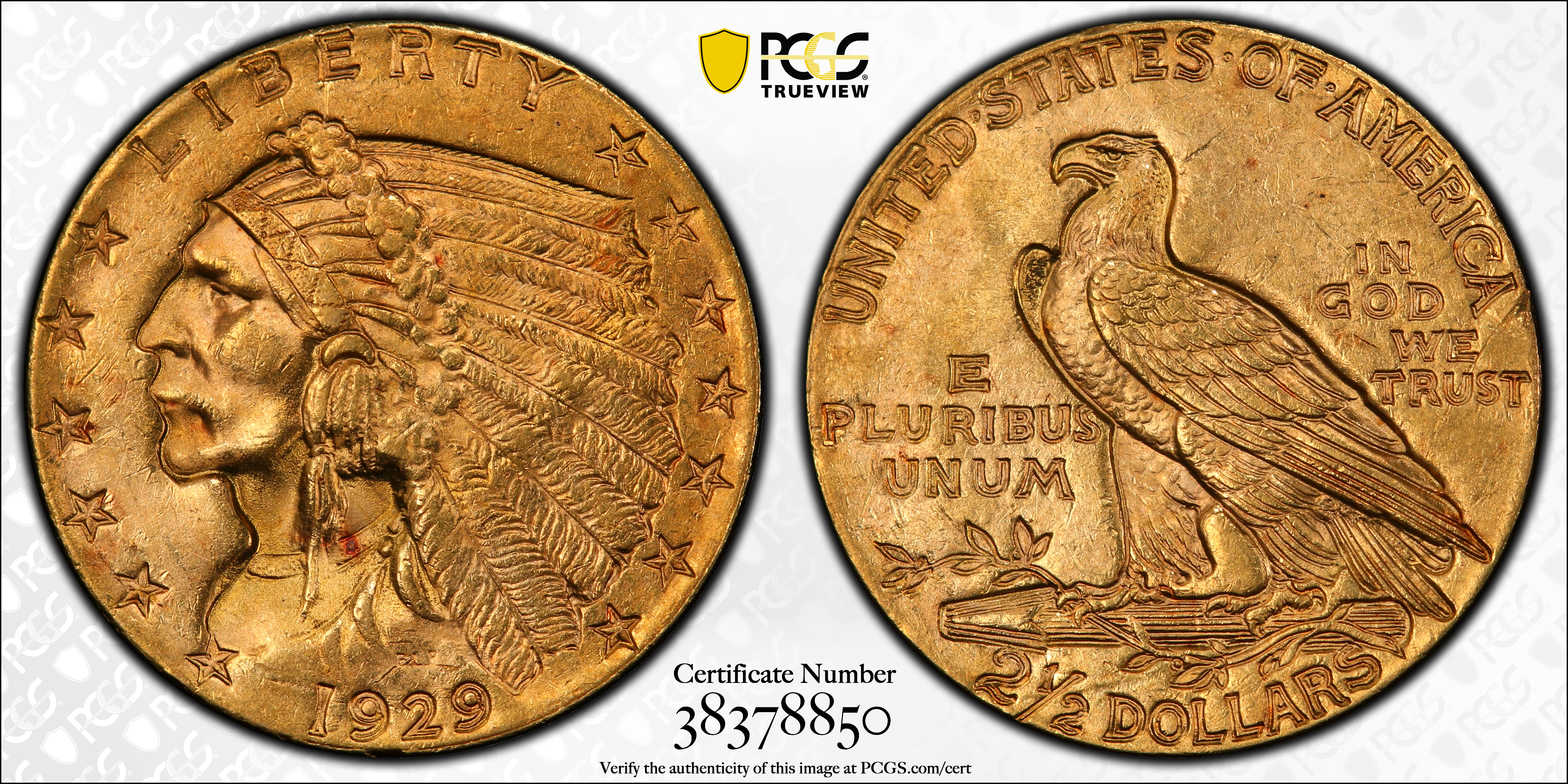
1929 $2.50 MS63 Certification #38378850, PCGS #7953
Expert Comments
Charles Morgan
The 1929 Indian Quarter Eagle
The story of the Pratt-Bigelow $2.50 Indian Head Quarter Eagle is, at its core, a tale of two presidential cousins. Fifth cousins Theodore Roosevelt and Franklin D. Roosevelt bookended the series. Theodore spearheaded its creation in 1908, while Franklin brought about its official demise with the gold recall of 1933.
In a December 1904 letter to his Secretary of the Treasury, Theodore Roosevelt famously condemned U.S. coinage as being artistically of "atrocious hideousness," sparking his crusade to revolutionize American coin design before leaving office.
While changing some coin designs required congressional approval, federal law permitted the president to order redesigns for denominations that had been minted for at least 25 years without modification. This allowed Roosevelt to target gold denominations initially, joining forces with ailing Cornish, New Hampshire sculptor Augustus Saint-Gaudens to redesign the $10 Eagle and $20 Double Eagle pieces. The resulting coins were triumphant in design, guided across the finish line by Saint-Gaudens' assistant Henry Hering and Mint Chief Engraver Charles E. Barber. While Saint-Gaudens reviewed early trial pieces, he died before the coins entered mass production.
When it came time to revise the Half Eagle and Quarter Eagle denominations, scaling down the designs and mandated inscriptions of the larger coins proved impractical. To overcome this, Dr. William Sturgis Bigelow, a close friend of President Roosevelt, proposed two radical solutions:
- Commission Boston sculptor Bela Lyon Pratt to create a fresh design.
- Mint the coins in an incuse (sunken) "Egyptian" relief, where the design elements were recessed below the flat surface of the field rather than raised above it.
The incuse design allowed the coins to stack evenly and protected the details from wear, though the public initially feared (unfounded) that the recessed areas would collect germs and dirt.
The Great Depression & The End of the Series
Like America’s other gold coinage, the Indian Quarter Eagle fell victim to the Great Depression. Following the stock market crash in late 1929, the U.S. Mint suspended production of gold coinage. While the Treasury initially intended to resume production once the economy recovered, 1929 proved to be the final year the Quarter Eagle was ever struck.
In April 1933, President Franklin D. Roosevelt signed Executive Order 6102, halting gold coin production and forbidding the "hoarding of gold coin, gold bullion, and gold certificates within the continental United States."
Because of the severe economic climate in 1929, few Quarter Eagles struck that year entered active circulation. Later, under the Gold Reserve Act of 1934, vast quantities of unissued and returned gold coins were melted into bars. Consequently, the surviving population of the 1929 Indian Quarter Eagle (#7953) is far smaller than its original mintage of 532,000 suggests.
Collecting the 1929 Indian Quarter Eagle
Despite a moderate original mintage, the 1929 issue is a major condition rarity in top grades. The strike is generally sharp and well-defined, though overall eye appeal slightly lags behind the 1926 (#7950), 1927 (#7951), and 1928 (#7952) issues. Because the flat, exposed fields are highly susceptible to contact marks, examples finer than PCGS MS65+ are virtually unheard of.
Noted coin authority David Akers observed that while 1929 gold coins often display a standard yellow luster, many surviving specimens feature a distinctive greenish-gold hue. Having examined Mint State specimens of this issue for years, I can corroborate Akers's findings. It is also worth noting that many examples appear to have been struck with buckled or distorted dies - a sad end for such a fantastic design.
* * *
David Hall
The 1929 is the major condition rarity of the later date $2.5 Indians. It is really rare in superb condition. The one MS67 was graded by PCGS in August, 1987. I remember the coin and it was really spectacular. I haven't seen the coin since and it hasn't appeared in any auction that I know of.
Rarity and Survival Estimates Learn More
| 65 or Better | 66166 |
| All Grades | 49000 |
| 60 or Better | 433 |
| 65 or Better | R-2.3 |
| All Grades | R-2.5 |
| 60 or Better | R-6.1 |
| 65 or Better | 13 / 15 TIE |
| All Grades | 13 / 15 TIE |
| 60 or Better | 10 / 15 |
| 65 or Better | 13 / 15 TIE |
| All Grades | 13 / 15 TIE |
| 60 or Better | 10 / 15 |
Condition Census Learn More
| #1 PCGS MS67 |
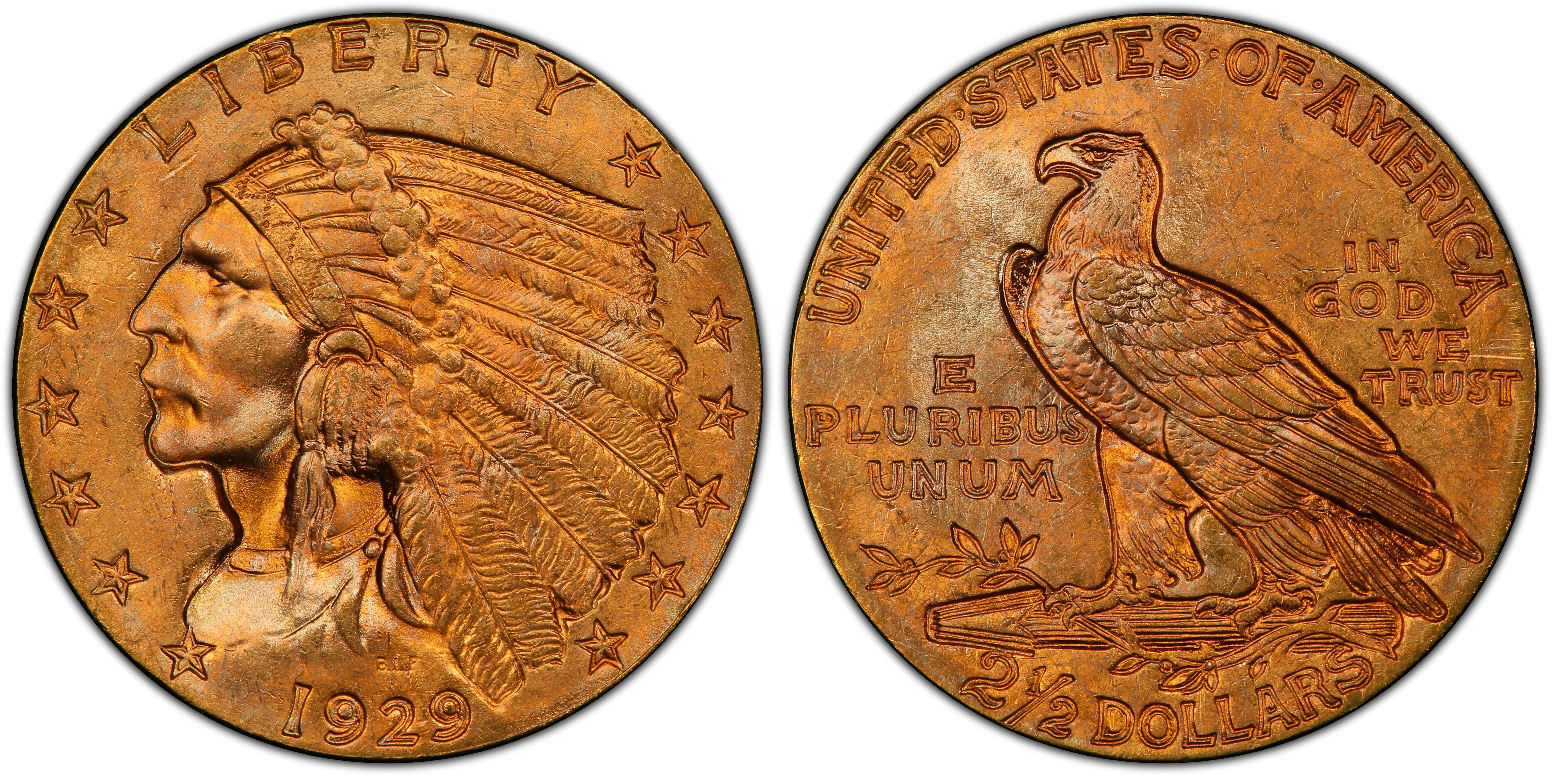 #2 PCGS MS66
|
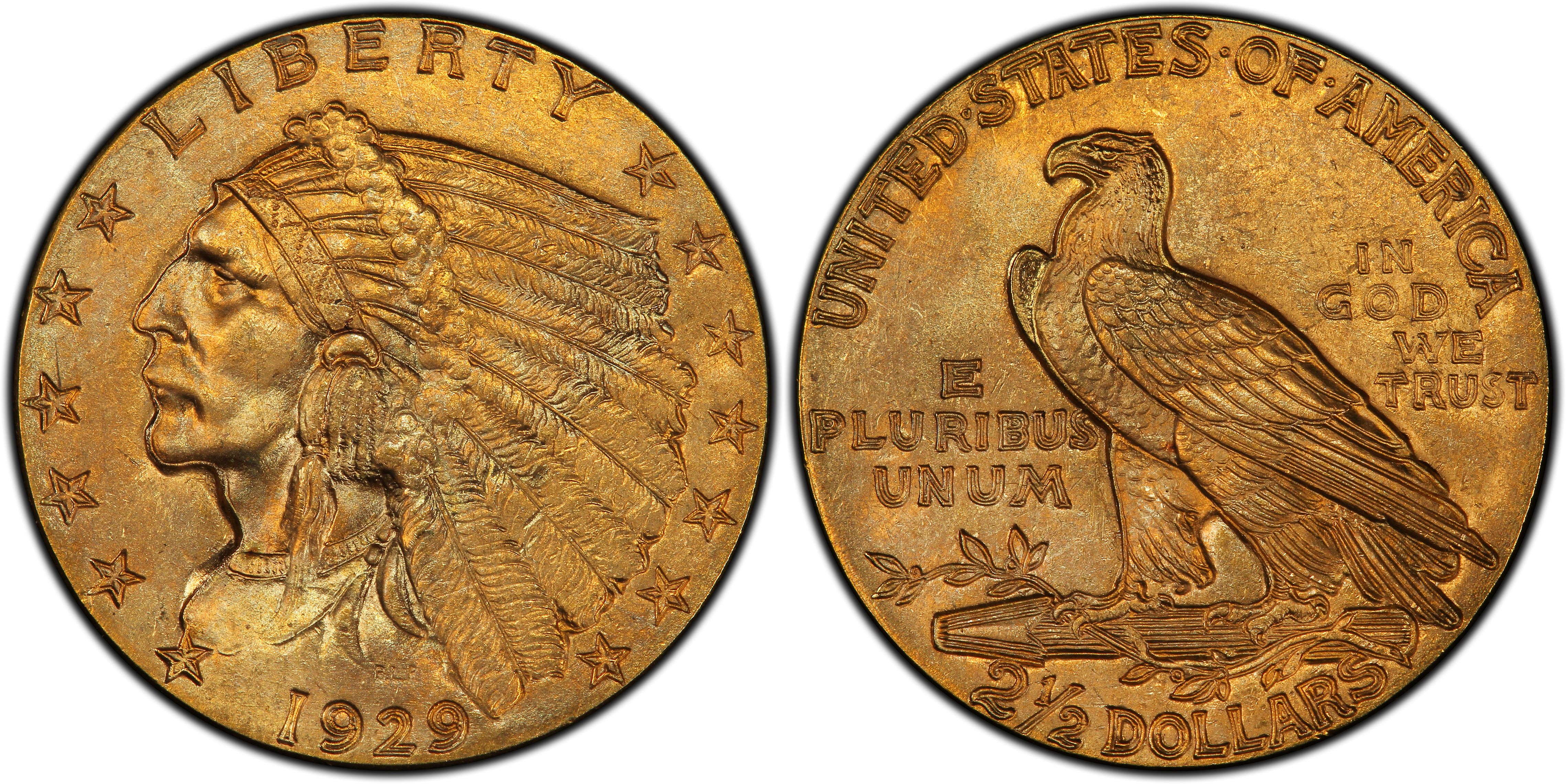 #2 PCGS MS66
Heritage Auctions, June 4, 2014, Lot 4791 - $30,550. |
 #2 PCGS MS66
|
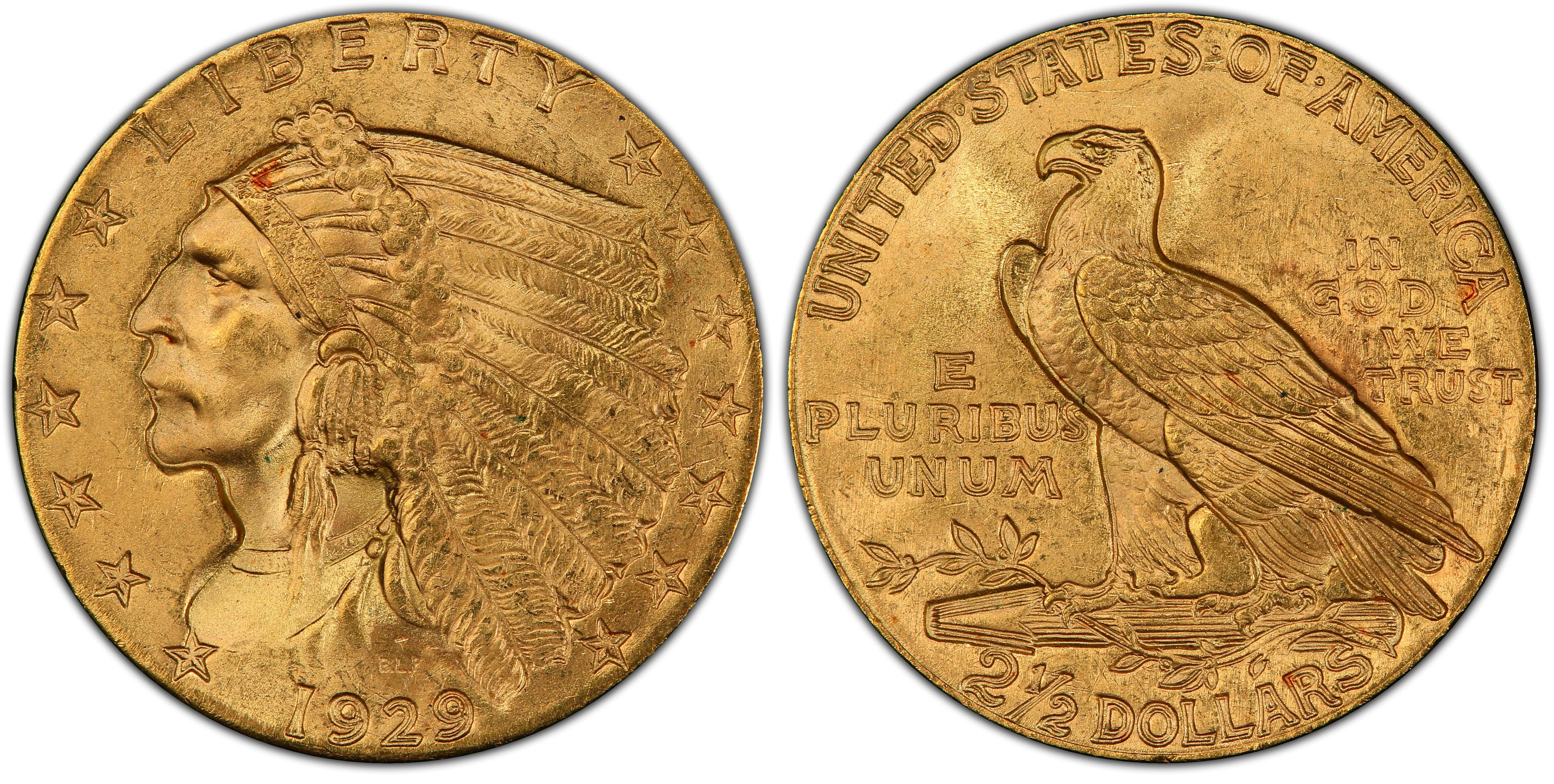 #2 PCGS MS66
|