



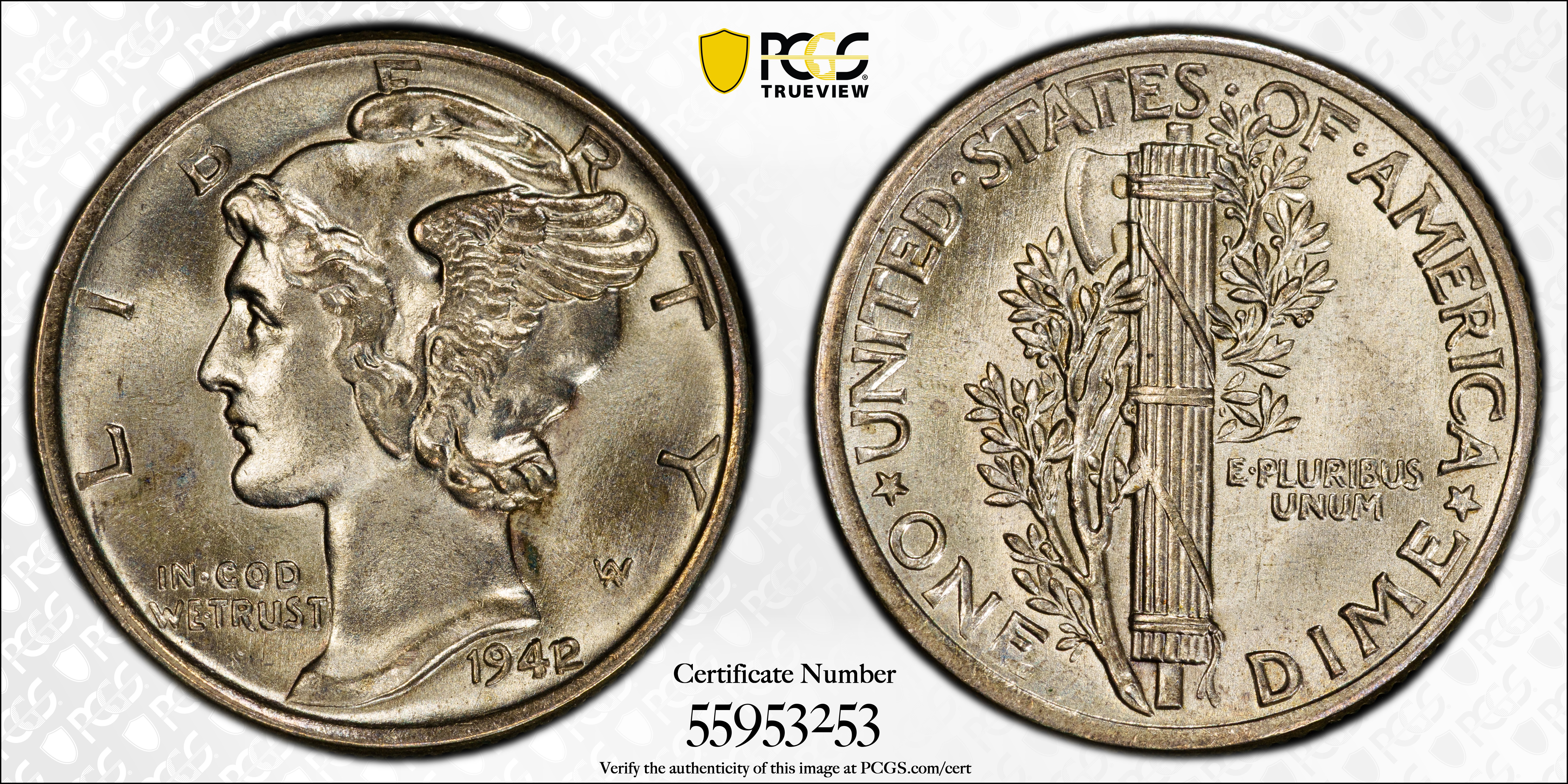
1942/1 10C, FB MS64FB Certification #55953253, PCGS #5037
Owner's Comments
Expert Comments
Charles Morgan
1942/1 Mercury Dime: The Famous Overdate
Discovered in 1943 by collector Arnold Kohn of Kingston, New York, the 1942/1 Mercury Dime overdate (also a doubled die) gained rapid fame following a feature in the March 1943 issue of Numismatic Scrapbook Magazine. By May of that year, the magazine published the first photograph of the variety. Its popularity was instantaneous, leading to its inclusion in standard numismatic reference guides starting in 1945.
Key Diagnostics
- The Date: A doubled "4" features a distinct notch at the top and behind the base. Traces of the 1941 undertype are visible on the other digits.
- Lettering: Clear doubling appears on the motto IN GOD WE TRUST and the "Y" in LIBERTY.
- Die Markers (Obverse): A diagonal die polish line extends from the crossbar of the "4" to the rim, accompanied by a reflective area behind Liberty’s neck.
- Die Markers (Reverse): A thin die polish line runs from the left side of the fasces base to the olive branch stem.
Production and Provenance
This variety resulted from a hubbing error, where a single die was impressed by both a 1941-dated hub and a 1942-dated hub.
The rarity of the coin is well-documented; notably, 166 examples were identified within the famous New York Subway Hoard. Numismatist Walter Breen also noted that the majority of known uncirculated specimens originated from four original rolls discovered in 1954.
The PCGS Population Report indicates that nearly a quarter of all 1942 Mercury Dimes certified are the 1942/1 overdate. While this reflects the population within PCGS holders, it is not a representative sample of the actual ratio between the error and the standard issue.
Beacuse the 1942/1 commands prices ranging from $350 in Fine 12 to $700 in XF45, there is a significant financial incentive for collectors to submit the overdate in mid-circulated grades. Conversely, no such incentive exists for the 1942 "Perfect Date" unless it is a Mint State example. Despite its scarcity, the 1942/1 remains a highly collectible variety and is slightly more common than its Denver counterpart, the 1942/1-D (#5036, #5037).
Vintage Market Snippet
The coin’s status as a "must-have" rarity was cemented early on. In the June 1961 issue of The Numismatist, dealer Lester Merkin offered an About Uncirculated (AU) example for just $95.
* * *
Rarity and Survival Estimates Learn More
| 65 or Better | 75 |
| All Grades | 75 |
| 60 or Better | 30 |
| 65 or Better | R-8.2 |
| All Grades | R-8.2 |
| 60 or Better | R-8.9 |
| 65 or Better | 1 / 80 |
| All Grades | 1 / 80 |
| 60 or Better | 2 / 80 TIE |
| 65 or Better | 1 / 80 |
| All Grades | 1 / 80 |
| 60 or Better | 2 / 80 TIE |
Condition Census Learn More
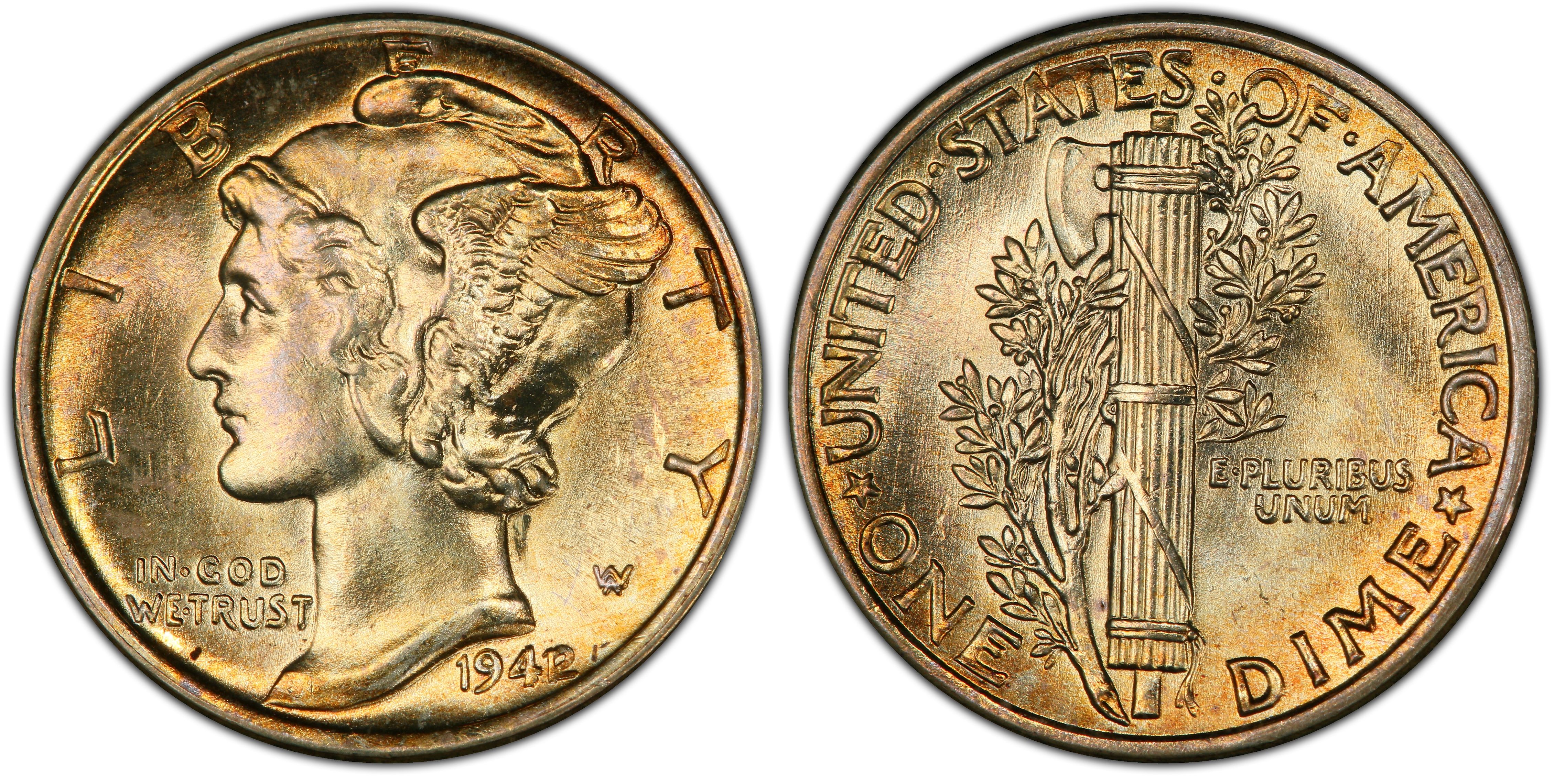 #1 PCGS MS66FB
"The William Dominick Collection," Heritage Auctions, April 2001. AS PCGS MS66FB #21026802. "The Joshua II Collection" (PCGS Set Registry); Heritage Auctions, November 8, 2003, Lot 6115 – $46,000; “The Jack Lee Collection, III,” Heritage Auctions, November 2005, Lot 2089 – $46,000; Heritage Auctions, January 6, 2011, Lot 5497 – $60,950; “The Dr. Tory Prestera Collection,” Stack’s Bowers, June 20, 2007, Lot 527 – $43,700; "The Charles McNutt Collection," Heritage Auctions, January 10, 2019, Lot 4425 - $57,600; Dell Loy Hansen. As PCGS MS66FB #31814143. DLRC, August 29, 2024, Lot 781478 – View. Gold toning. A small cluster of diagonal marks is present on Liberty's cheek. |
 #1 PCGS MS66FB
|
|
#1 PCGS MS66FB
Heritage Auctions, September 18, 2008, Lot 1772 – $71,875; “The Burgess Lee Berlin, M.D., J.D. Collection of Important United States Rarities,”Heritage Auctions, January 4, 2018, Lot 4809 – $120,000. "The Sadlerr Collection" (PCGS Set Registry). Scattered brown toning to the left of Liberty's nose and under UNUM. |
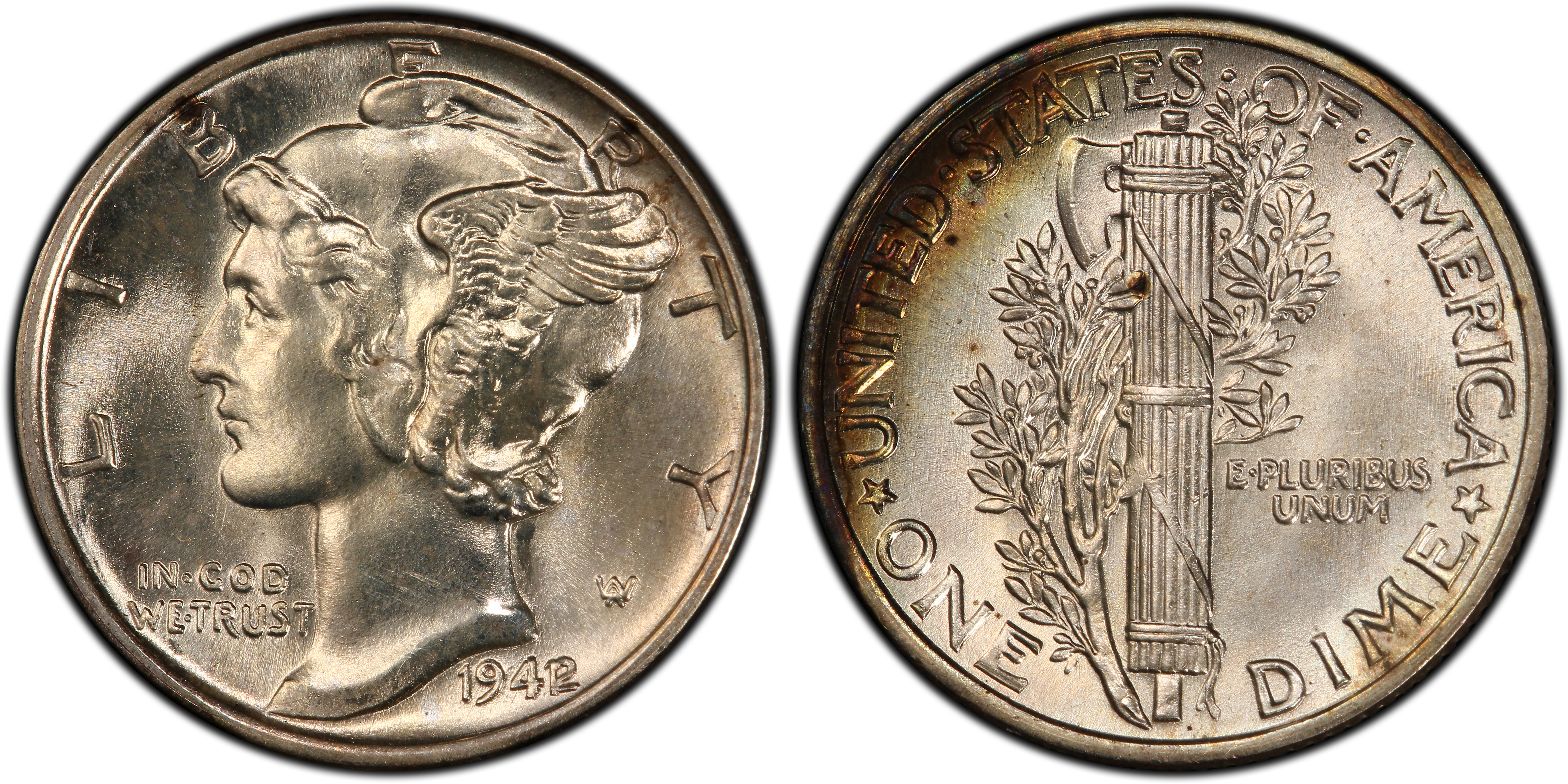 #1 PCGS MS66FB
|
|
#1 PCGS MS66FB
"The Joshua II Collection of Mercury Dimes, #1 All-Time Finest PCGS Registry Set," Heritage Auctions, August 12, 2010, Lot 4554 - $63,250. Plum, ice blue, and green toning along the periphery. |