



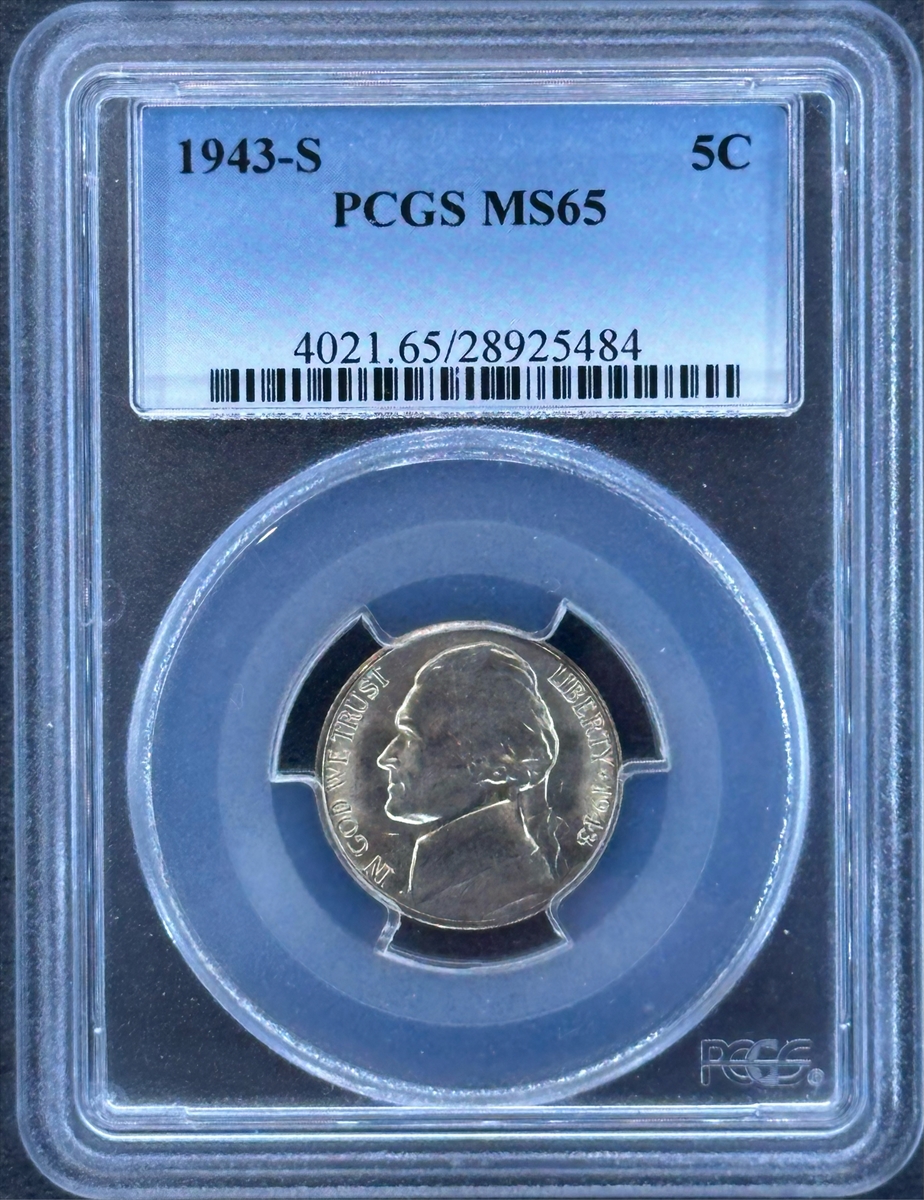
1943-S 5C MS65 Certification #28925484, PCGS #4021
Expert Comments
Charles Morgan
The 1943-S Jefferson Nickel
Like all "War Nickels," the 1943-S (#84021) features an emergency wartime alloy of 35% silver, 9% manganese, and 56% copper. These issues are further distinguished from regular-issue nickels by the presence of a bold mint mark positioned above the dome of Monticello—a feature intended to facilitate the coins' eventual withdrawal from circulation.
Authorized in late March 1942, this composition change was designed to divert strategically vital copper and nickel toward the war effort. According to the United States Mint, this shift saved 4,900 tons of copper and 300 tons of nickel. This emergency measure extended beyond the nickel; in 1943, copper was also removed from the Lincoln Cent. Consequently, two of the nation’s five circulating denominations were minted under emergency compositions simultaneously.
The true impact of these resource shifts remains a subject of historical debate. In a 2000 article for The Numismatist, Mark A. Benvenuto pondered whether the primary aim was to encourage a sense of public solidarity and sacrifice. He suggested the nickel saved was perhaps more of a "placebo" to help the American public feel personally invested in the conflict. Some evidence for this theory exists in the long-standing lore of the 1944 Lincoln Cent (#2720), which was famously said to be struck from spent shell casings. However, the sheer volume of cents struck that year suggests that recycled brass was likely not the primary source of copper for the series.
Regardless of the motive, these materials were objectively precious. Journalist James Gray noted in 1947 that Adolf Hitler would have "willingly traded the whole Silesian basin" for a year's possession of the Sudbury Basin in Ontario—a region that produced 95% of the Allies' nickel requirements for tank armor, portable bridges, and the B-29 Superfortress.
Production at the San Francisco Mint
The San Francisco Mint met wartime demand with a massive 1943 issuance of 104,060,000 coins, a 68% increase over 1942 (#4017). To put this scale in perspective, the facility struck nearly as many nickels in 1943 alone (92.23%) as it did in 1942, 1944 (#4024), and 1945 (#4027) combined. Because of this massive mintage, the 1943-S is considered a common date, despite the fact that the PCGS Population Report shows other issues, such as the 1943-D (#4020) and 1944-D (#4023), have been submitted in larger numbers.
Strike Quality and "Full Steps"
For specialists, the ultimate measure of a strike is the Full Steps (FS) designation on the reverse. PCGS designates a Full Steps Jefferson Nickel as a Jefferson Nickel graded PCGS MS60 or better, with at least five complete steps on Monticello. Any steps that join or fuse together—whether created that way or subsequently damaged—cannot be considered for the Full Steps designation.
To identify a proper strike, the step area is divided into four distinct sections:
- The Plinth: The base of the four columns.
- The Stylobate: The walking surface leading into the residence.
- The Steps: The individual lines sandwiched between the stylobate and the foundation.
- The Foundation: The thicker segment at the base of the design, located below the steps.
Among coins in PCGS holders, non-Full Steps 1943-S nickels outnumber Full Steps examples by approximately 2.77:1. This ratio may not represent the total Mint State population, as collectors and dealers typically only submit better-than-average coins for encapsulation. Generally, the softer "War Nickel" alloy allowed for better strike quality than standard cupro-nickel, though die condition remained a deciding factor in sharpness. The most common certified grade for this issue, both with and without the FS designation, is PCGS MS66.
* * *
Rarity and Survival Estimates Learn More
| 65 or Better | 10000000 |
| All Grades | 475000 |
| 60 or Better | 235000 |
| 65 or Better | R-1.0 |
| All Grades | R-1.6 |
| 60 or Better | R-1.8 |
| 65 or Better | 4 / 14 TIE |
| All Grades | 11 / 14 TIE |
| 60 or Better | 11 / 14 TIE |
| 65 or Better | 12 / 82 TIE |
| All Grades | 75 / 82 TIE |
| 60 or Better | 69 / 82 TIE |
Condition Census Learn More
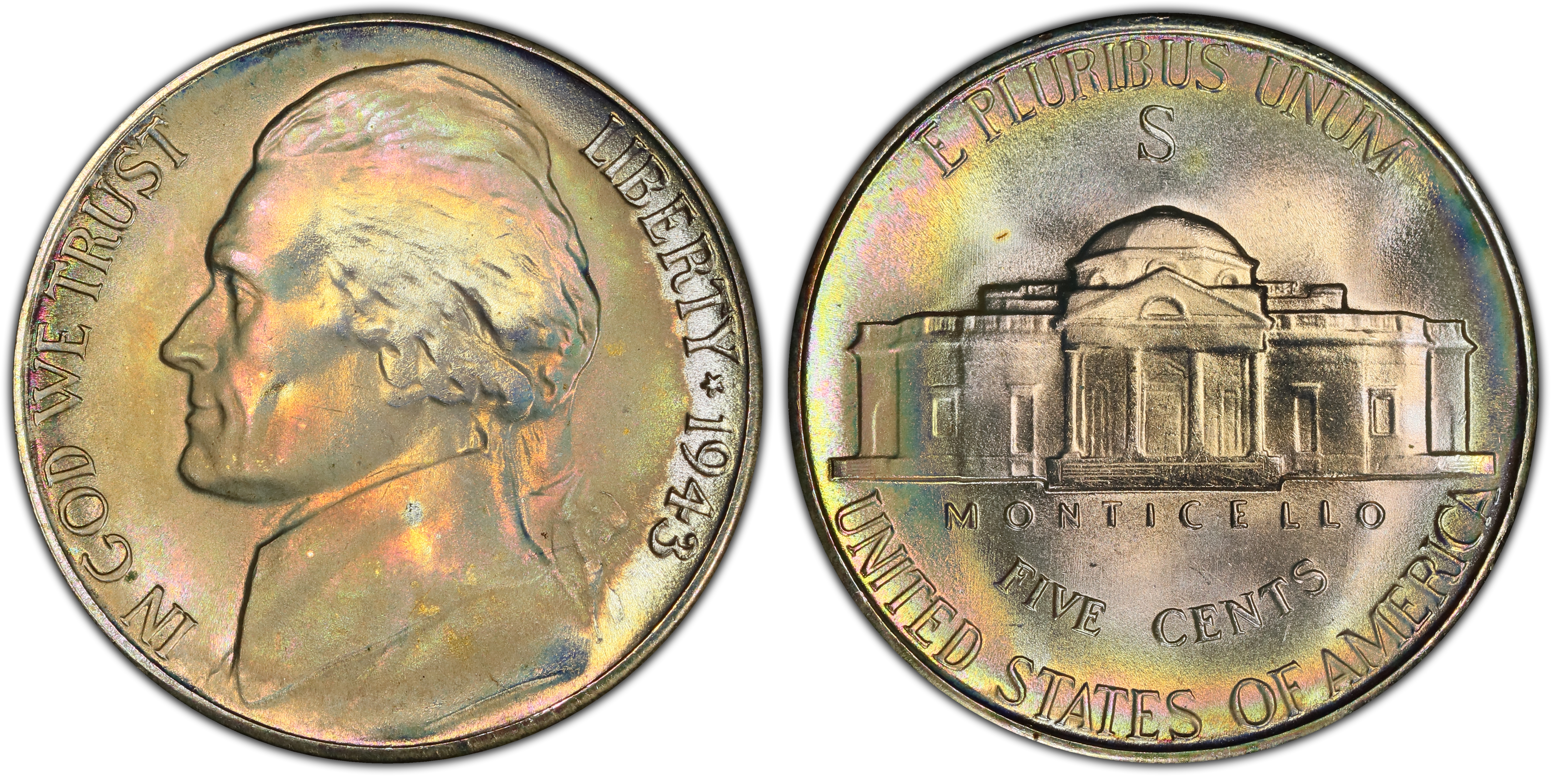 #1 PCGS MS68+
|
 #1 PCGS MS68+
|
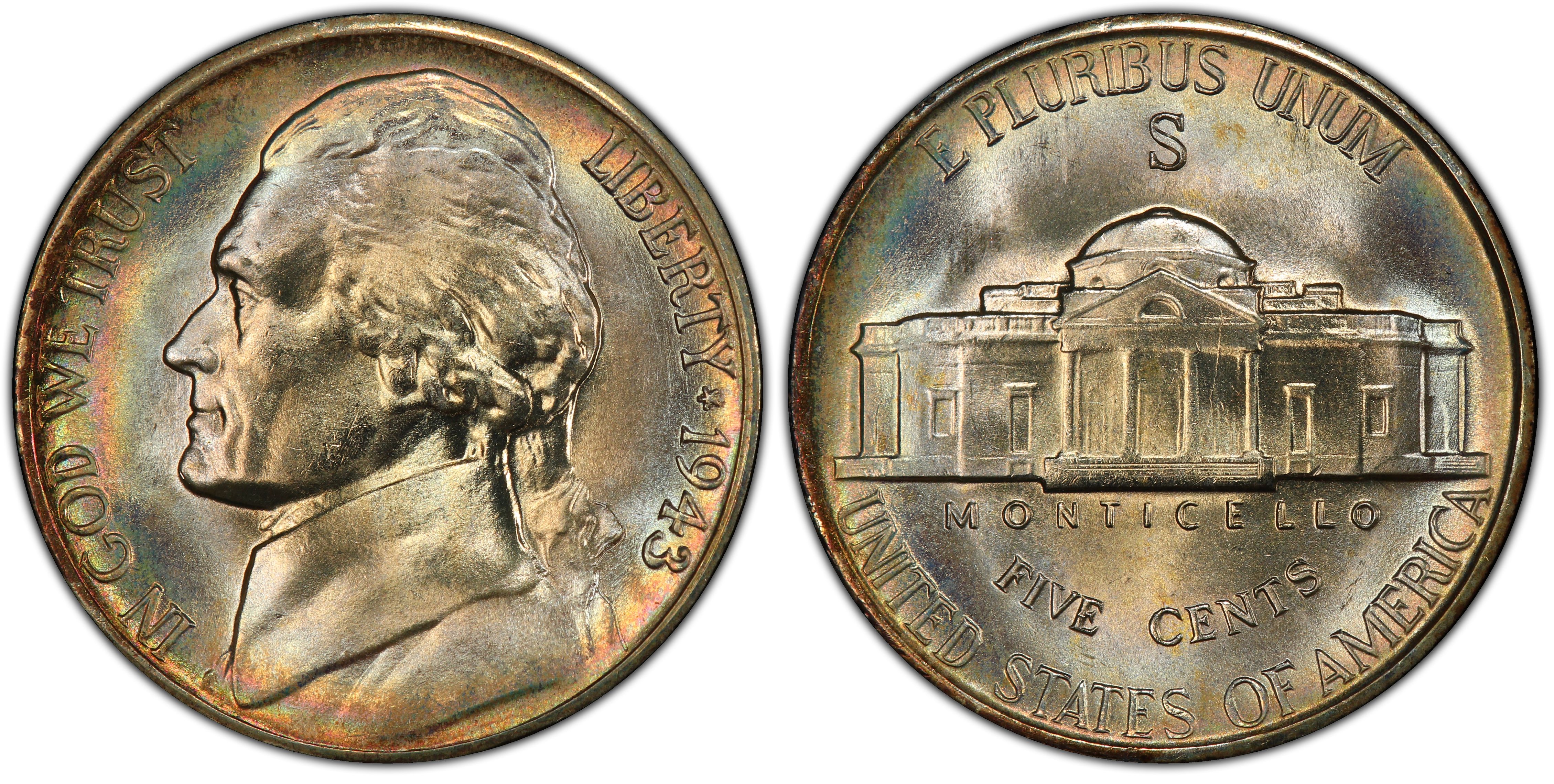 #3 PCGS MS68
|
 #3 PCGS MS68
GreatCollections, March 5, 2023, Lot 1139887 - $1,096.88. Ice blue and green toning in the centers. Wispy gold toning across the outer periphery. |
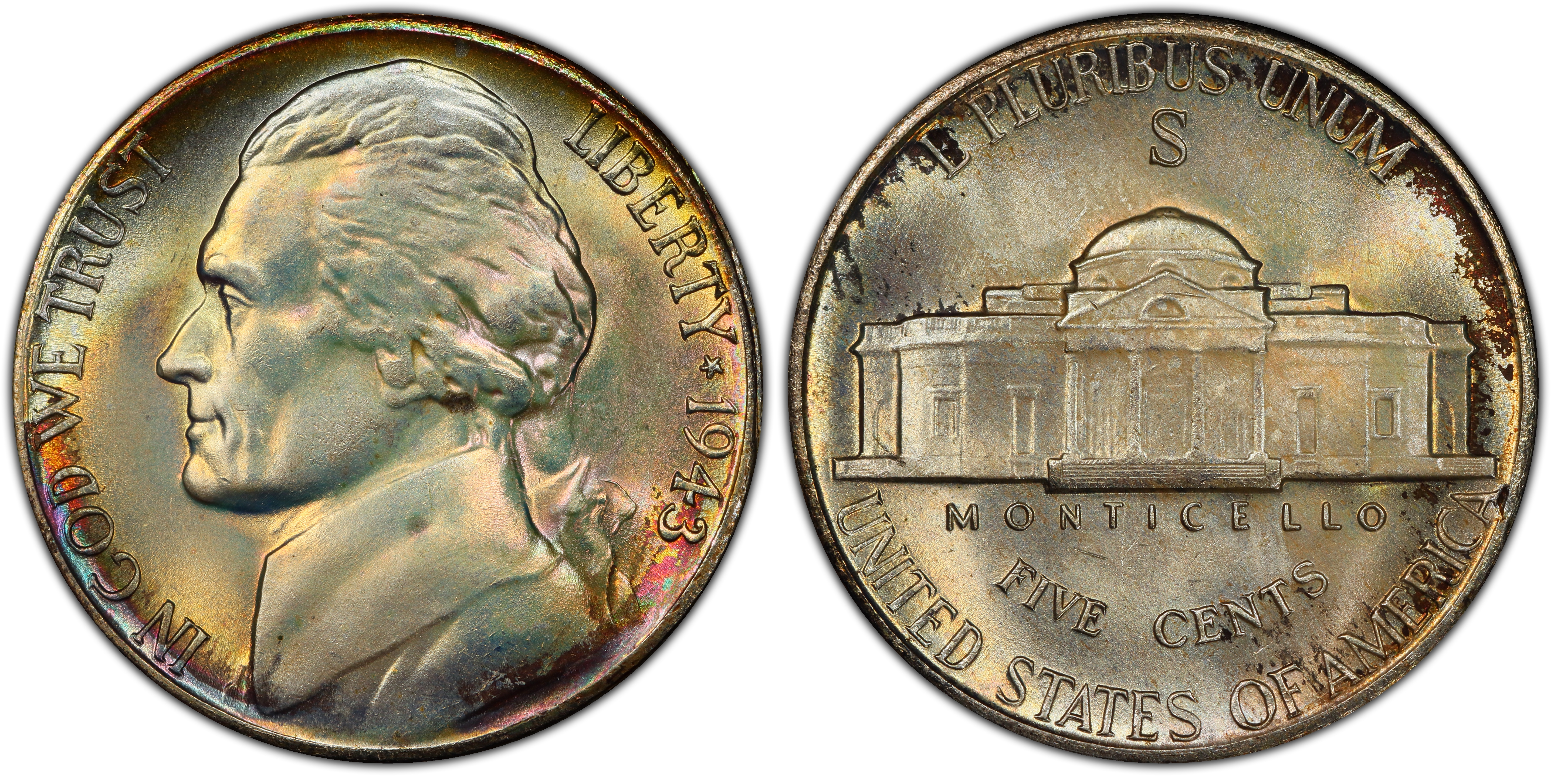 #3 PCGS MS68
GreatCollections, August 7, 2022, Lot 1206696 - $1,411.88; "The Stephen M. Sparks Collection" (PCGS Set Registry). Gold and green centers with vivid rainbow toning along the lower obverse periphery. Scattered ruby toning along the upper reverse periphery. |