



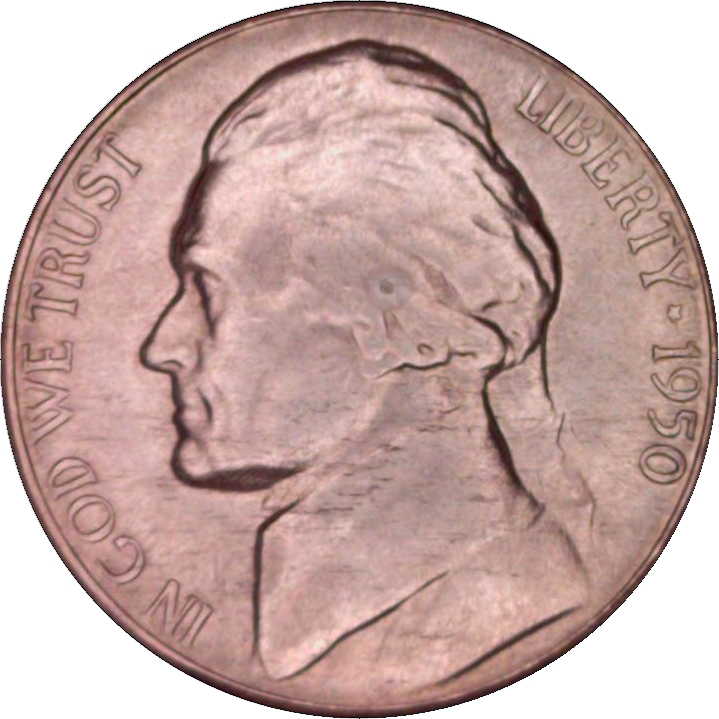
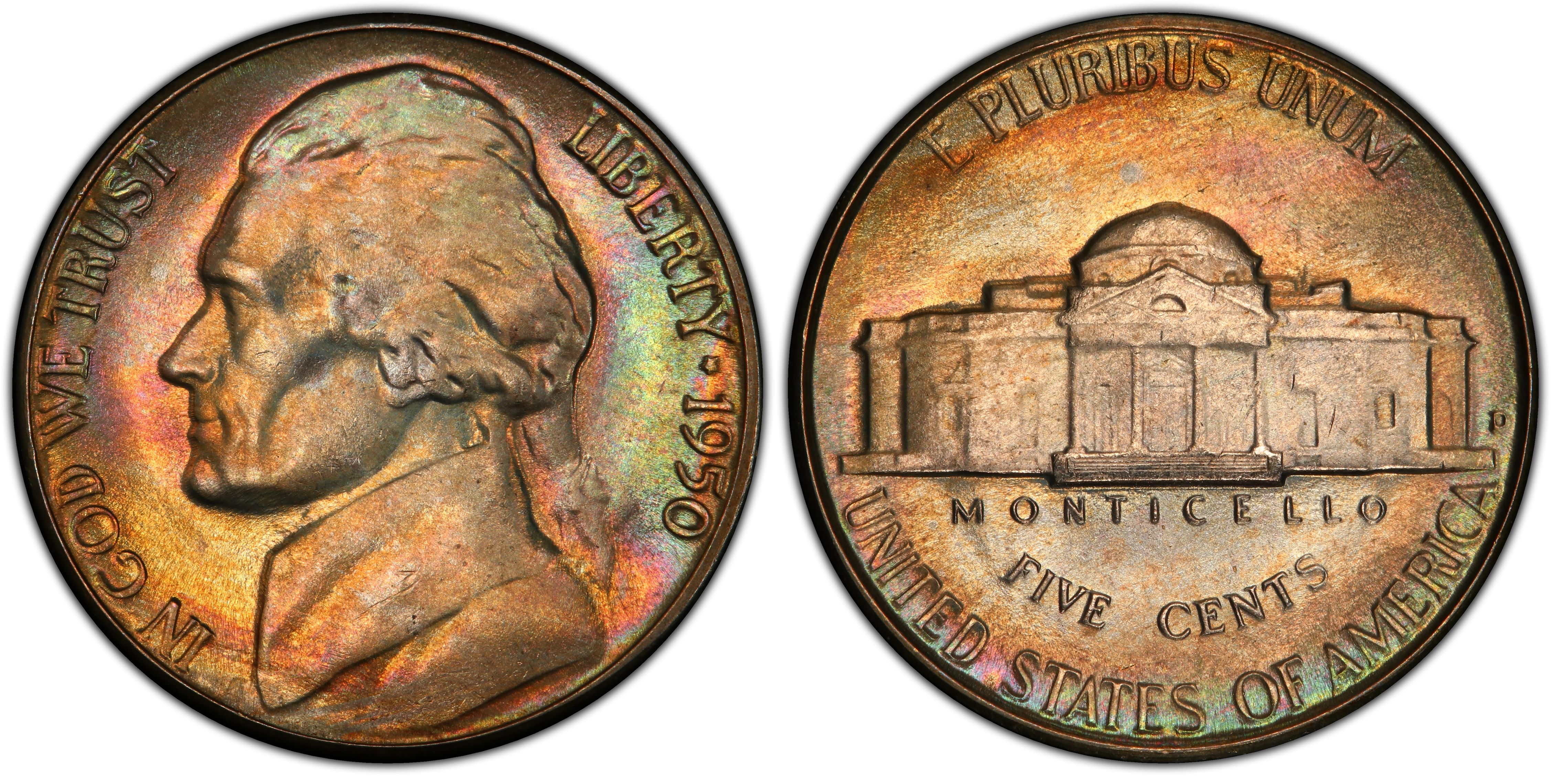
1950-D 5C MS65 Certification #18389091, PCGS #4042
Expert Comments
Charles Morgan
The 1950-D Jefferson Nickel
In 1950, the Denver Mint struck just 2,630,030 Jefferson Nickels. It was a production run completed with little fanfare and even less public notice. At the time, demand for new coinage in the regions serviced by Denver was sluggish; the American economy was still recalibrating after the post-war recession of the late 1940s. Because the supply from previous years remained sufficient, the Denver Mint received no orders for new nickels until that summer. Once that single delivery was made, no further coins were requested for the remainder of the calendar year.
The general public only became aware of this low mintage, and the coin’s potential as an investment, through the tireless promotion of coin dealers. Many of these marketers were newcomers to the industry, viewing the 1950-D Jefferson Nickel (#4042, FS #84042) as the perfect vehicle to capitalize on the public’s desire for a "get-rich-quick" collectible. Consequently, the 1950-D was heavily hoarded and aggressively marketed. For decades, it traded as a "modern rarity," sparking a broad, mainstream enthusiasm for modern coinage and ushering in the era of roll collecting and speculative investing.
The Rise and Fall of a Numismatic Bubble
By the late 1960s, advertisements in The Numismatist and other trade publications listed single 1950-D Jefferson Nickels for nearly $20- a staggering sum at the time. No other modern coin elicited quite as much fervor. The 1950-D became the benchmark for speculators, who premised their investments on the belief that a growing wave of new collectors would eventually "need" the issue to fill their National or Whitman coin albums.
What resulted was a classic market bubble. Marketers hoarded thousands of bags, effectively removing much of the 1950 summer production from circulation forever. Because of this mass preservation, a paradox exists today: it is actually more unusual to find a 1950-D in circulated condition than it is to find an example in Mint State. Today, a typical PCGS MS65 might sell for $30 or $40.
Mintages Alone Do Not Determine "Key Dates"
The 1950-D will likely never shed its notorious reputation as a "promoted" coin. For anyone contemplating the building of a Jefferson Nickel Basic Set, the date remains an essential. However, series specialists know that far scarcer coins exist, particularly when "Full Steps" (FS) designations and conditional rarity are factored in. Ultimately, the 1950-D serves as a valuable lesson in the difference between numismatic fact and numismatic hype.
For more than a generation, collectors were led to believe this was the key date of the series due to its low mintage. Yet, the coin has more in common with the 1931-S Lincoln Cent (BN #2618) than the 1909-S V.D.B. (BN #2426). The 1931-S was heavily hoarded by Maurice Scharlack, a coin dealer from Corpus Christi, Texas. Scharlack is said to have put away 200,000 examples, which reprsented roughly one-fourth of the total mintage. He reportedly accomplished this by buying bags directly from the San Francisco Mint and regional banks. Scharlack sought to corner the market and act as a wholesale source to dealers who were unaware of the full extent of his holdings. Unable to liquidate the majority of his 1931-S cents by the time of his death, his hoard was gradually absorbed by the market throughout the 1950s.
Similarly, about a third of the mintage of the 1950-D Jefferson Nickel was controlled by Texas dealer A.J. Mitula, who is rumored to have held a hoard of approximately one million pieces. Mitula and coin promoter Harry J. Forman successfully drove the value of 1950-D rolls to $1,000 by 1964. Sadly, speculators were left holding the bag when the roll craze collapsed following the transition from silver coinage to clad and the suspension of mintmarks for the 1965–1967 issues. The clad era saw mintages in the billions, which soured "get-rich-quick" investors on the hobby. The bubble burst, and the price of the 1950-D returned to reality. Still, the public perception of the coin as the series' most valuable issue persists—even though you can often buy two Full Steps 1950-D nickels for the price of a single Full Steps 1950 Plain (#4041).
* * *
Rarity and Survival Estimates Learn More
| 65 or Better | 2100000 |
| All Grades | 1000000 |
| 60 or Better | 765000 |
| 65 or Better | R-1.0 |
| All Grades | R-1.1 |
| 60 or Better | R-1.3 |
| 65 or Better | 9 / 68 TIE |
| All Grades | 68 / 68 |
| 60 or Better | 68 / 68 |
| 65 or Better | 12 / 82 TIE |
| All Grades | 82 / 82 |
| 60 or Better | 82 / 82 |
Condition Census Learn More
 #1 PCGS MS68
As PCGS MS67+ #51182024. GreatCollections, June 1, 2025, Lot 1831392 - $787.50. As PCGS MS68 #52621548. Iridescent rainbow toning on both sides. A thin diagonal streak of russet toning, extending from Jefferson’s hair to the rim at the left of the "0," serves as a pedigree marker. |
 #2 PCGS MS67+
GreatCollections, March 29, 2026, Lot 1888706 - $463.50. Sandy gold patination with iridescent rainbow toning on the obverse. There is a small horizontal mark on Jefferson's cheek and another one on his coat. Five of Monticello's windows are faintly visible. |
| #2 PCGS MS67+ |