



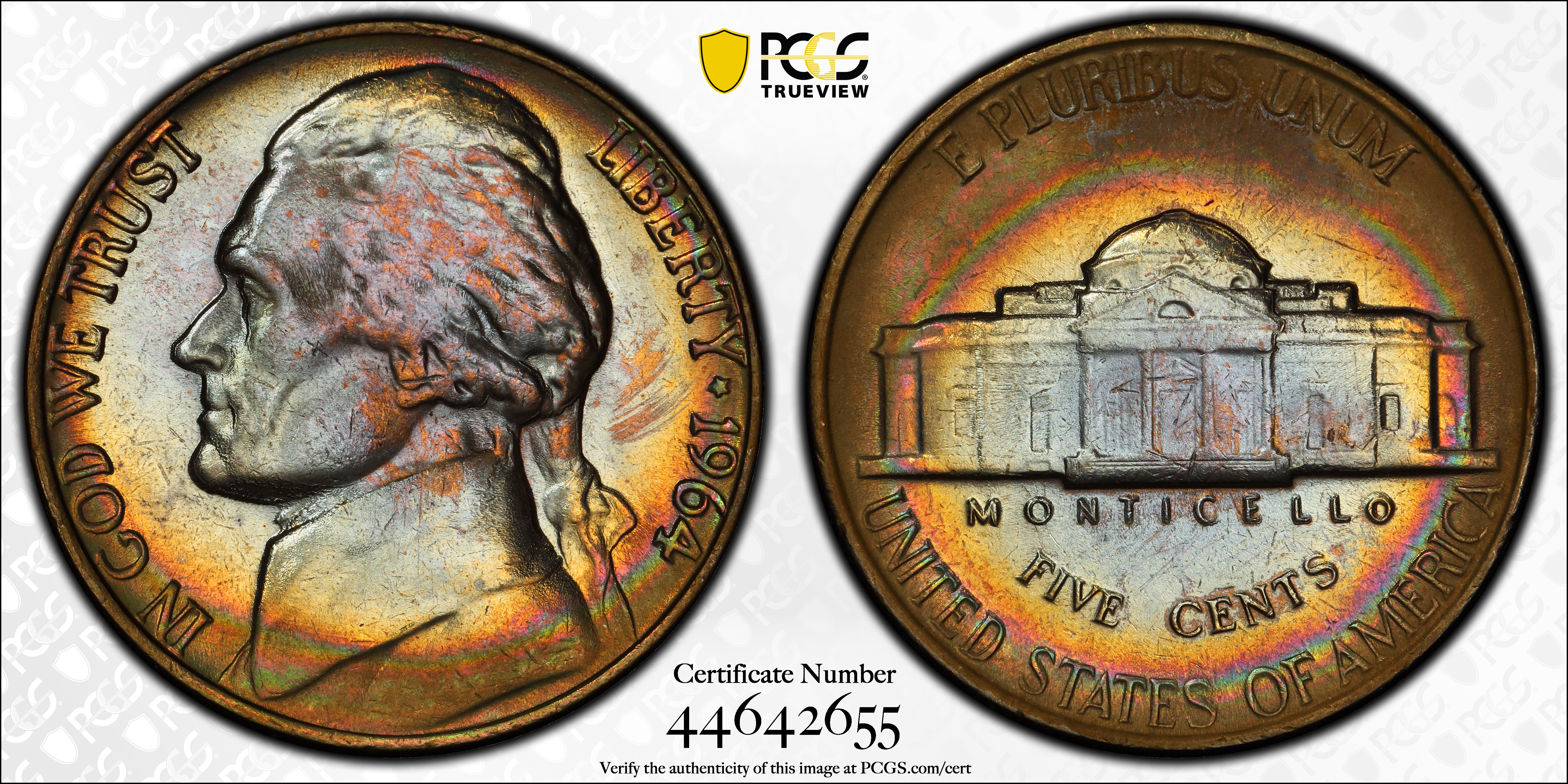
1964 5C MS65 Certification #44642655, PCGS #4075


Owner's Comments
Expert Comments
Charles Morgan
The 1964 Jefferson Nickel
A complex convergence of economic factors led to a nationwide coin shortage that ultimately forced Congress to enact the Coinage Act of 1965. Chief among these was the increasing impracticality of using silver for circulating coinage.
Europe had already begun to wean itself off the precious metal following World War II; notably, Great Britain transitioned to cupronickel in 1947 to help settle its war debts. Other nations followed suit or restricted silver to their highest denominations. When the United States finally adopted cupronickel-clad compositions for dimes and quarters and reduced the silver content of the half dollar, the remaining silver-holding nations in Europe quickly transitioned as well.
The severity of the crisis was vividly described in a July 1964 document from the Federal Reserve Bank of St. Louis:
“Deliveries of new coin from the Mint have risen, but this added supply has been more than offset by the drying up of return flows of coin from circulation… inventories have fallen to the point where the Reserve Banks have been unable to deliver coins on request, but instead have been forced to ration coins.”
Some within the government and the Mint bureaucracy blamed collectors and speculators for the situation. It is not hard to see why; many within the numismatic community were vocal about speculating on new releases. Recent issues - such as the 1950-D Jefferson Nickel (#4042), the 1955-S Lincoln Cent (RD #2833), and the 1955-S Roosevelt Dime (#5111) - had been heavily hoarded, and speculators had recently emptied the Treasury vaults of their large stockpile of silver dollars. However, the coin and bullion markets were only a small part of the problem. In truth, the principal cause of the shortage was the expanding economy and the proliferation of coin-operated vending machines.
While the composition of the 1964 Jefferson Nickel (#4075) and 1964-D Jefferson Nickel (#4076) remained unchanged by the Coinage Act of 1965, their production was profoundly impacted by the transition from silver to clad.
On September 3, 1964, President Lyndon B. Johnson signed legislation authorizing the Mint to continue striking coins dated "1964" well into the following year. This "date freeze" was a strategic attempt to strip the coins of any perceived numismatic rarity and thereby dissuade hoarding. In addition, coins dated 1965-1967 would not carry a mintmark, regardless of where they were struck.
For the 1964-dated Jefferson Nickels, the resulting production was staggering. Struck throughout 1964 and most of 1965, the 1964-dated Jefferson nickel reached mintage figures that dwarf nearly every other year in the series:
- Philadelphia Mint: 1,028,622,762
- Denver Mint: 1,787,297,160
To appreciate the scale, the Philadelphia Mint struck only about 100 million nickels in 1963. The sheer volume of 1964-dated nickels wouldn't be rivaled until the late 1990s.
To achieve these numbers, the Mint turned to private industry, purchasing rolled nickel strip ready for blanking. This freed the Mint’s internal melting and rolling capacity to focus on bronze cents and silver denominations. Other drastic measures included:
- Polishing blanks at the Frankford Arsenal
- Suspending Proof Set production from 1965 through 1967 (replacing them with Special Mint Sets).
- Reactivating coinage operations at the San Francisco Assay Office (formerly, the San Francisco Mint)
- Purchasing additional high-speed coining presses.
Felix Schlag at the ANA
Amidst this production frenzy, the designer of the Jefferson Nickel, Felix Schlag, found himself a reluctant celebrity. Speaking at the 1964 American Numismatic Association Convention in Cleveland, Schlag reflected on his design process, noting that his goal was "to find a likeness that portrayed the character and strong facial features of the great American as I imagined him."
He also expressed bemusement at the sudden surge in attention from the public:
“A few years ago I retired. The Jefferson nickel popped up again. I was rediscovered... One dealer came to me with a cartload of coin books to autograph. I found out that my signature was being sold... and books I signed were advertised for sale.”
Schlag’s experience mirrored the national mood; the coin shortage had turned every pocket piece into an object of public fascination.
Last year, PCGS Hall of Fame Coin Dealer Jeff Garrett purchased a large collection of Schlag ephemera connected to this period.
Collecting the 1964 Jefferson Nickel
Because 1964 nickels were struck in such massive quantities over an extended period, quality control was a secondary concern to volume.
In The Jefferson Nickel Analyst, Bernard Nagengast notes that while finding a "decent" coin is possible with patience, the quality varies wildly. Nagengast elaborates that many 1964 nickels were struck from "well-used dies." Furthermore, even those struck from fresh dies often lack sharp detail because the master hub (dating back to the "Reverse of 1940") was itself showing significant wear by the mid-60s.
Out of more than 1,600 submissions, Full Steps examples make up just over 11% of the total population. For a coin to earn the PCGS FS designation, the reverse must not only exhibit full step separation but those steps must also be completely uninterrupted by contact marks.
Even in Superb Gem grades, Jefferson nickels often retain remnants of the planchet’s original annealing chatter, which is typically most visible along Jefferson’s jawline. Additionally, it is unusual to find specimens that have not acquired some degree of toning over the decades.
* * *
Rarity and Survival Estimates Learn More
| 65 or Better | 819000000 |
| All Grades | 150000 |
| 60 or Better | 42500 |
| 65 or Better | R-1.0 |
| All Grades | R-1.9 |
| 60 or Better | R-2.5 |
| 65 or Better | 9 / 68 TIE |
| All Grades | 13 / 68 TIE |
| 60 or Better | 10 / 68 TIE |
| 65 or Better | 12 / 82 TIE |
| All Grades | 16 / 82 TIE |
| 60 or Better | 13 / 82 TIE |
Condition Census Learn More
 #1 PCGS MS67
Faintly iridescent. Small diagonal mark at the corner of Jefferson's bedroom wall. |
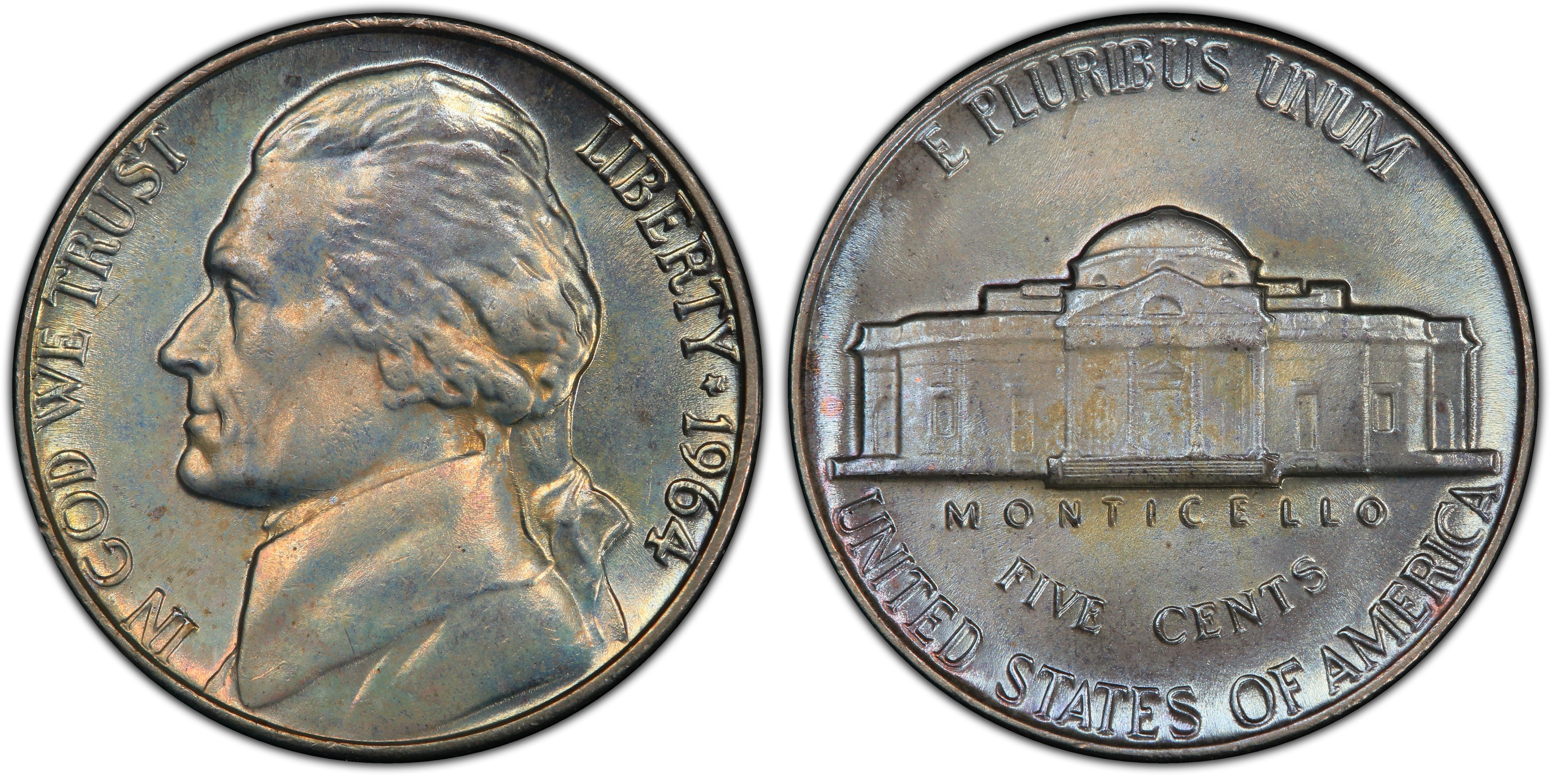 #1 PCGS MS67
Iridescent color on both sides. The obverse skews toward peach, gold, and seafoam, while the reverse introduces shimmering violet. |
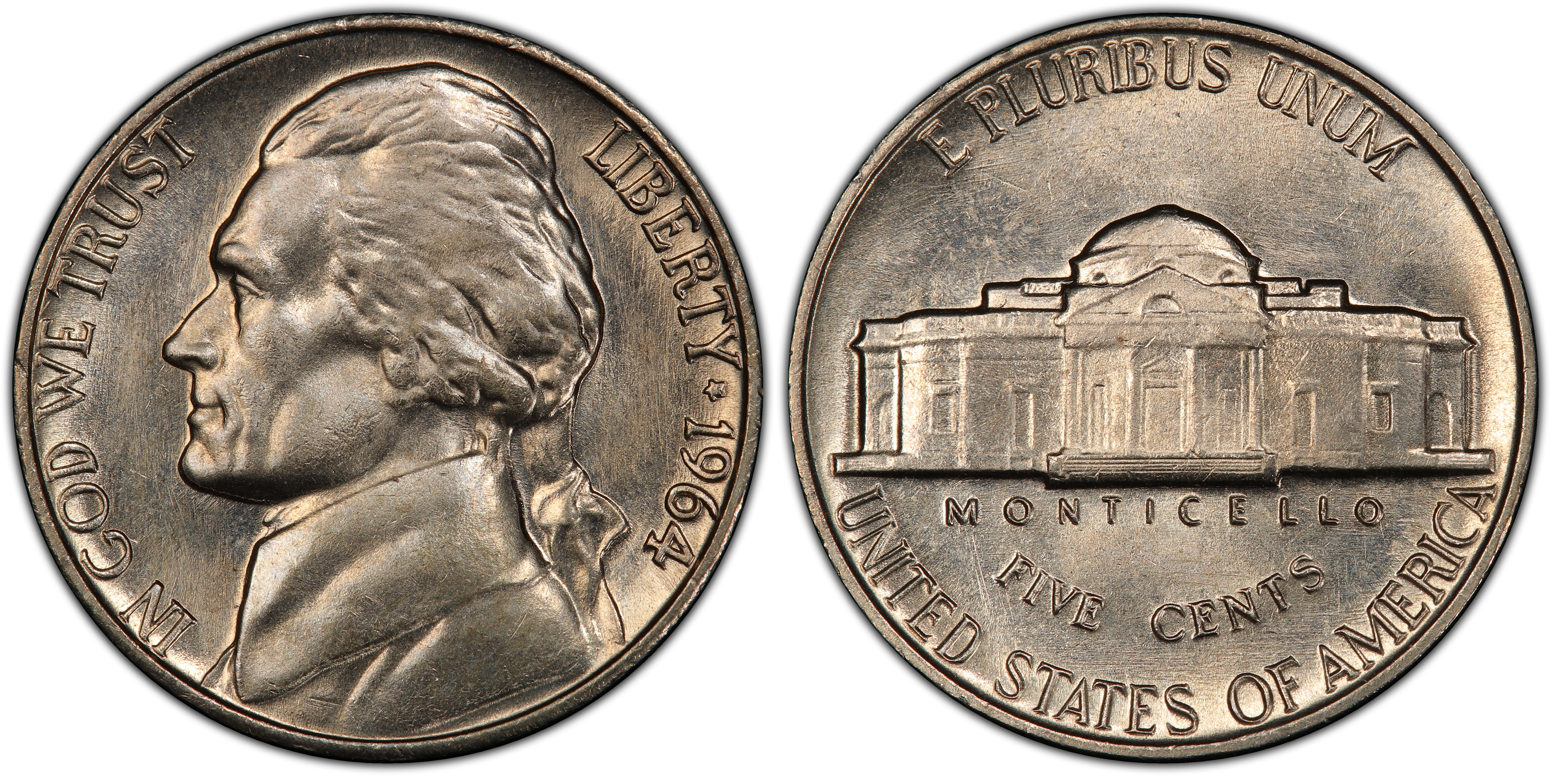 #1 PCGS MS67
Peach gold patination. Die polishing lines still visiable along the obverse and reverse fields. |
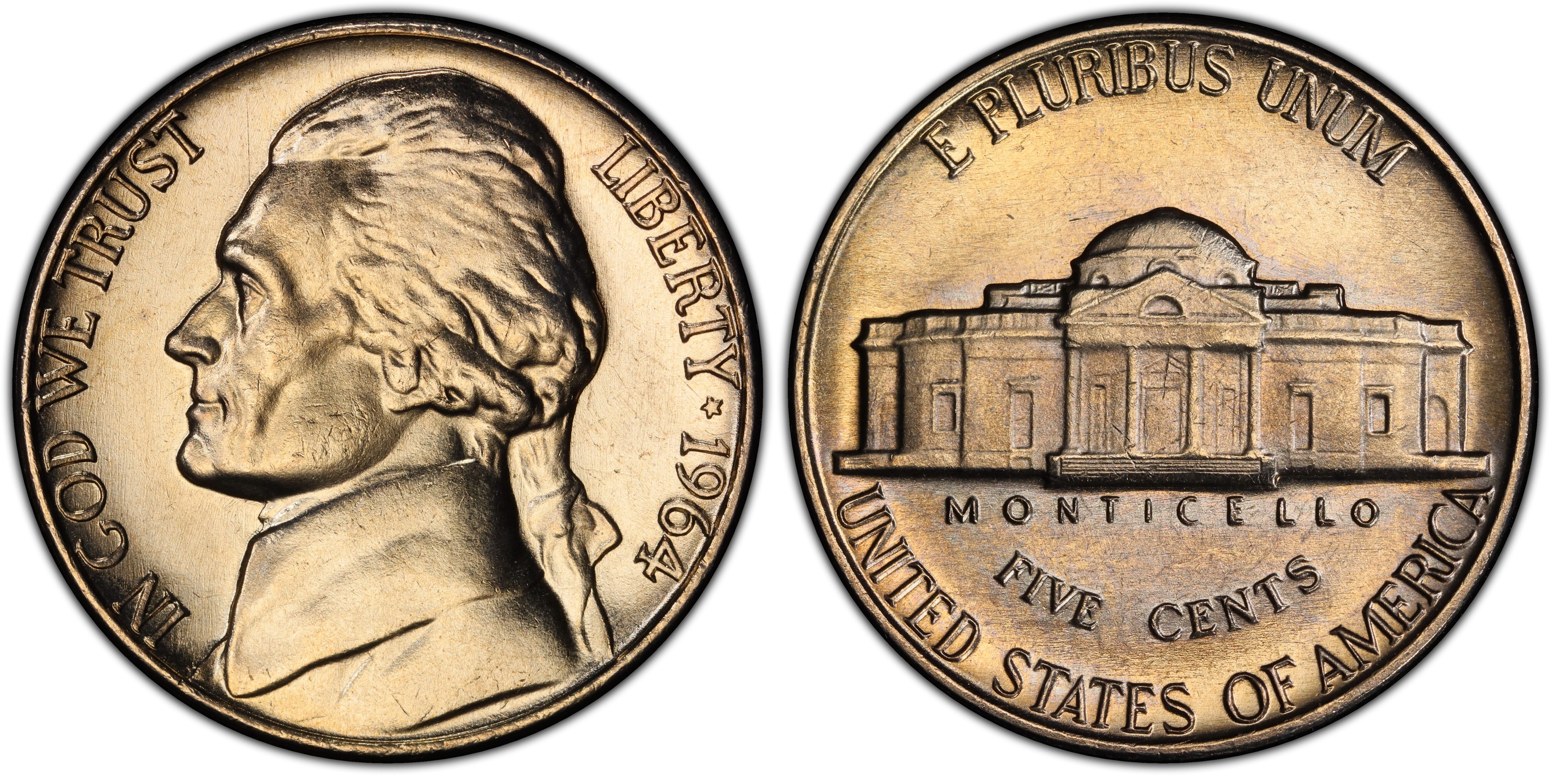 #1 PCGS MS67
Pale gold patination covers the obverse. The reverse adds an element of dusklight purple. Some planchet chatter was not fully struck out along Jefferson's jawline. |
 #1 PCGS MS67
Fully brilliant. |