



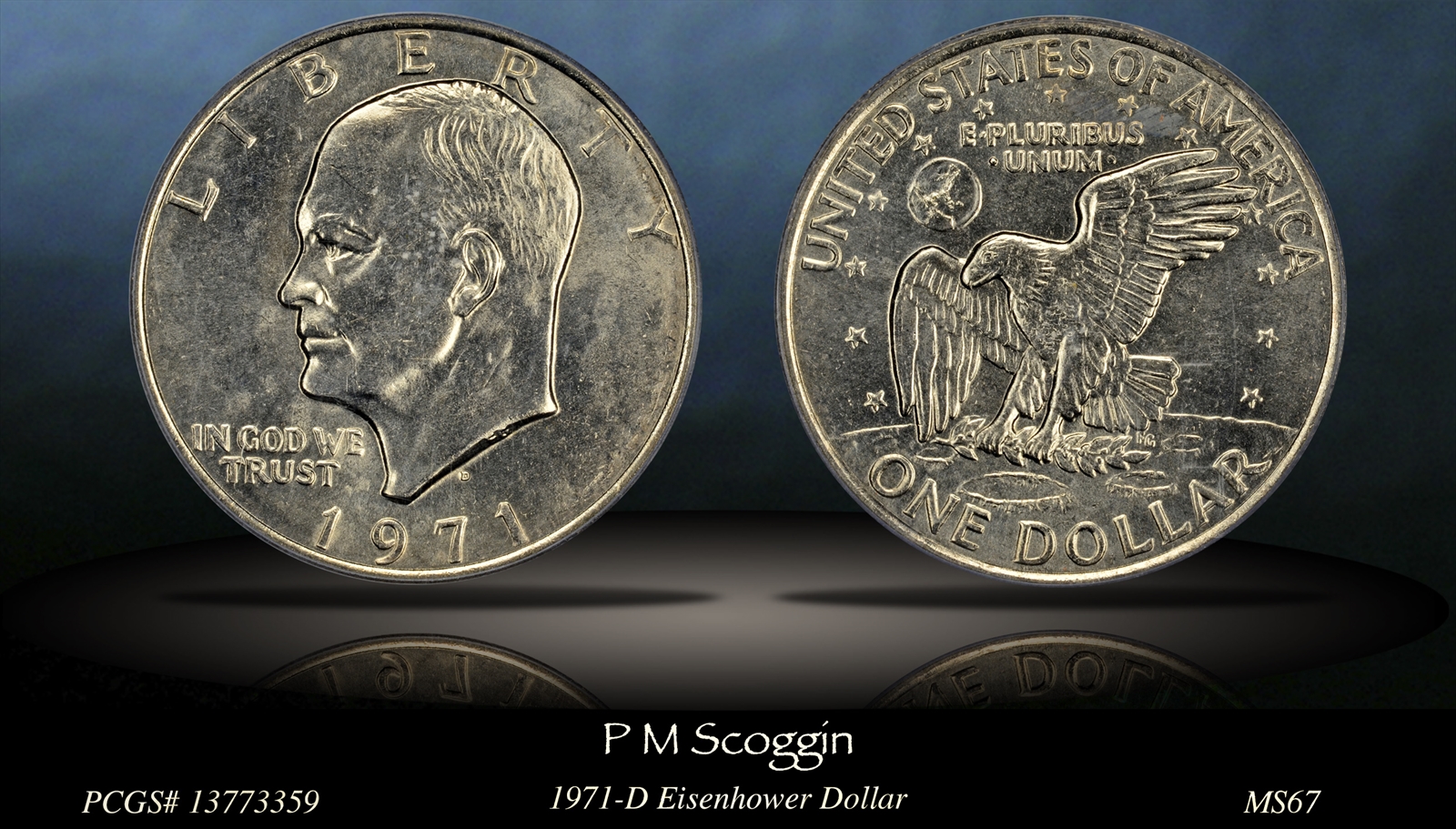
1971-D $1 MS67 Certification #13773359, PCGS #7407
Owner's Comments
Expert Comments
Charles Morgan
The United States has a long and complicated history with the large silver dollar coin. Though the denomination was a cornerstone of the monetary system at the Mint's founding, by 1803, the Jefferson administration scuttled production of Draped Bust Dollars to preserve the domestic flow of silver coinage. Efforts to resume coining dollars resulted in the Gobrecht Dollars (1836–1839) and the low-mintage Liberty Seated Dollar series (1840–1873).
Following a five-year period when Congress favored the international Trade Dollar, the domestic silver dollar was forcefully reintroduced (overriding a Presidential veto) in 1878 with the Morgan Dollar. Primarily a sop to Western mining interests, millions of the mandated Morgans stacked up, unwanted, inside Treasury vaults.
Dollar coin production only resumed in 1921 because Congress compelled the Mint to strike 270 million coins to replace the vaulted silver melted to aid Great Britain during World War I. That year, the Mint struck 86 million Morgan Dollars before introducing Anthony de Francisci’s Peace Dollar design. While the "Peace Dollar" was proposed by key members of the American Numismatic Association, its final design faced initial displeasure from figures like Farren Zerbe, voiced in the pages of The Numismatist.
The Failed 1964 Attempt
A genuine effort to resume dollar production was launched in the early-to-mid 1960s, prompted by the rising price of silver draining the Treasury's stockpile. The Philadelphia Mint prepared dies for both Morgan and Peace designs, but the Peace Dollar was selected.
In May 1965, the Denver Mint produced 316,106 1964-D Peace Dollars (antedated due to a contemporary date freeze to deter hoarding). Almost immediately, intense public and Congressional backlash erupted, opposing the production of silver dollars during a national coin shortage. President Johnson quickly rescinded the production order for new dollars and ordered that all struck coins be melted, which the Mint complied with shortly thereafter.
The Eisenhower Dollar is Conceived
Five years later, the situation was fundamentally different. The Coinage Act of 1965 had ushered in a massive shift, replacing 90% silver coins with Copper-Nickel clad coinage as the American standard.
President Dwight D. Eisenhower's death in 1969 served as the catalyst for the dollar coin's reintroduction as a memorial. This bipartisan effort, similar to the authorization of the Kennedy Half Dollar in 1963, stalled briefly over metal composition. With Congress's prohibition on new dollar coins set to expire on July 23, 1970, a compromise was reached:
- Copper-nickel clad for general circulation.
- Silver-clad (40%) for the collector market.
The coin's authorization was secured with the signing of the Bank Holding Company Act Amendments of 1970 by President Richard M. Nixon on December 31, 1970. (This legislation also notably permitted the GSA to sell 2.8 million Carson City Morgan Dollars held in Treasury vaults.)
Quality and the "Friendly Eagle" Variety
The creation of the large Cu-Ni clad Eisenhower Dollar presented a significant technical challenge for the U.S. Mint facilities. The Denver Mint was the first facility to strike the new coins, producing the 1971-D Eisenhower Dollar (#7407) several weeks before Philadelphia struck the 1971 (#7406). Initial mintages were substantial: 68,587,424 at Denver and 47,799,000 at Philadelphia.
Despite operating older presses, the Denver issues generally achieved better quality with a sharper, cleaner look, often fully lustrous. In contrast, most Philadelphia issues appear dull, lack luster, and frequently show residual annealing chatter marks on the high points (such as Eisenhower’s chin and hair).
A key variety is found on the Denver reverse:
1971-D "Friendly Eagle" (FS-901): Early strikings display a flattened earth with the Andes Mountains appearing raised. This variety is distinguished by an eagle that has no eyebrow, giving it a "friendlier" facial expression. The variety was initially published in ErrorScope, catalogued as RDV-006, and is now recognized by PCGS by its Cherrypicker's Guide catalog number of FS-901.
Die Sink: A Common Issue on the 1971-D Eisenhower Dollar
Despite the superior striking quality, even the 1971-D dollars often show significant die sink along the bottom periphery—a flaw visible through the date and flattening the first few letters of the motto IN GOD WE TRUST.
* * *
Rarity and Survival Estimates Learn More
| 65 or Better | 68000000 |
| All Grades | 1371500 |
| 60 or Better | 13700 |
| 65 or Better | R-1.0 |
| All Grades | R-1.0 |
| 60 or Better | R-2.9 |
| 65 or Better | 2 / 14 TIE |
| All Grades | 13 / 14 TIE |
| 60 or Better | 13 / 14 |
| 65 or Better | 2 / 18 TIE |
| All Grades | 15 / 18 TIE |
| 60 or Better | 14 / 18 |
Condition Census Learn More
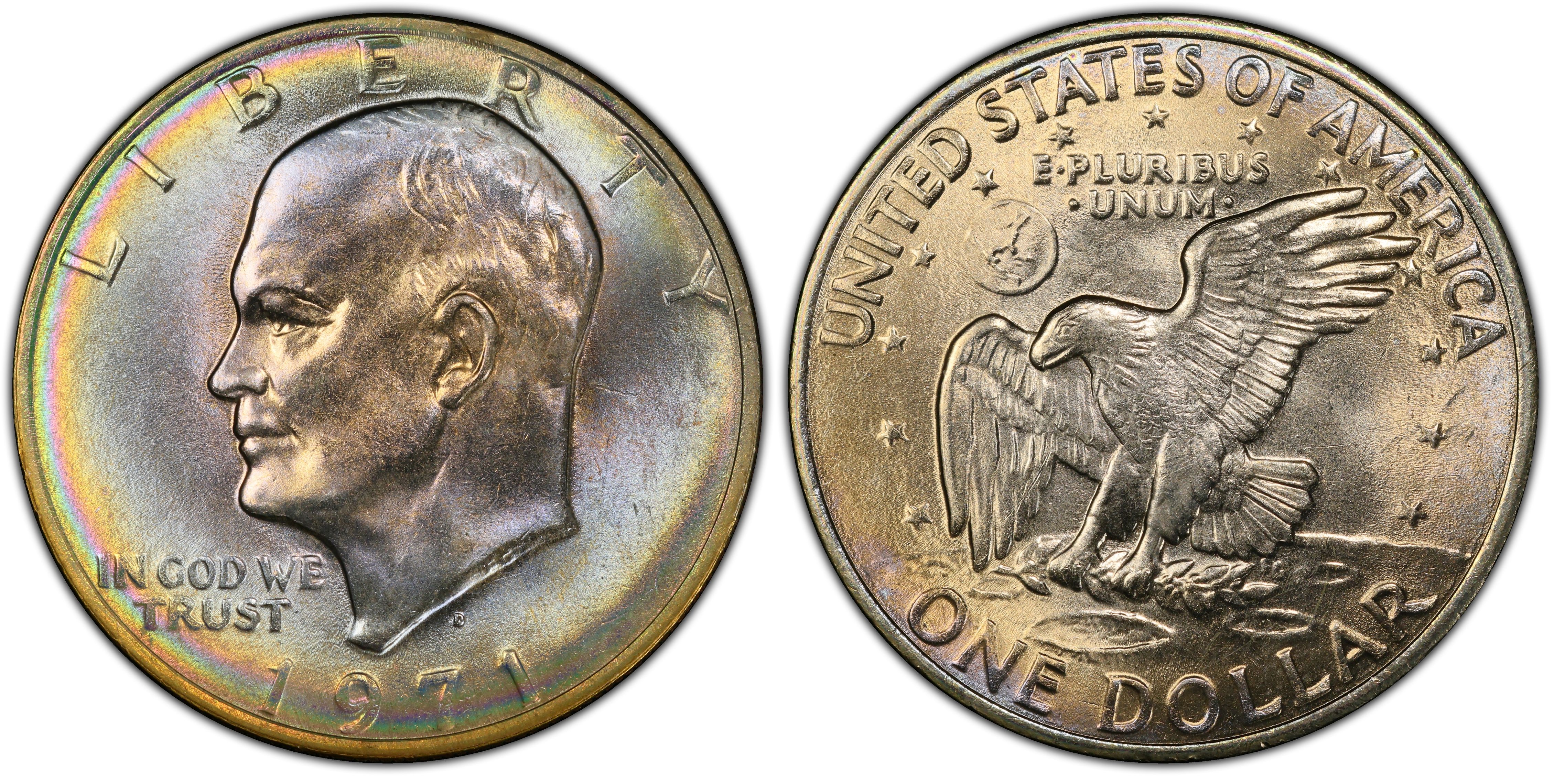 #1 PCGS MS67+
Heritage, May 10, 2024, Lot 4913 – $3,600. Displays target toning with a prismatic ring at the periphery. The fields are a steel-blue, featuring golden highlights across Eisenhower's cheek and jaw. |
 #1 PCGS MS67+
Heritage Auctions, May 10, 2024, Lot 4912 - $3,480; McCaw Family Trust (PCGS Set Registry). Brilliant. |
 #1 PCGS MS67+
Heritage, September 15, 2023, Lot 3454 – $6,000. Brilliant with traces violet and butterscotch color. |
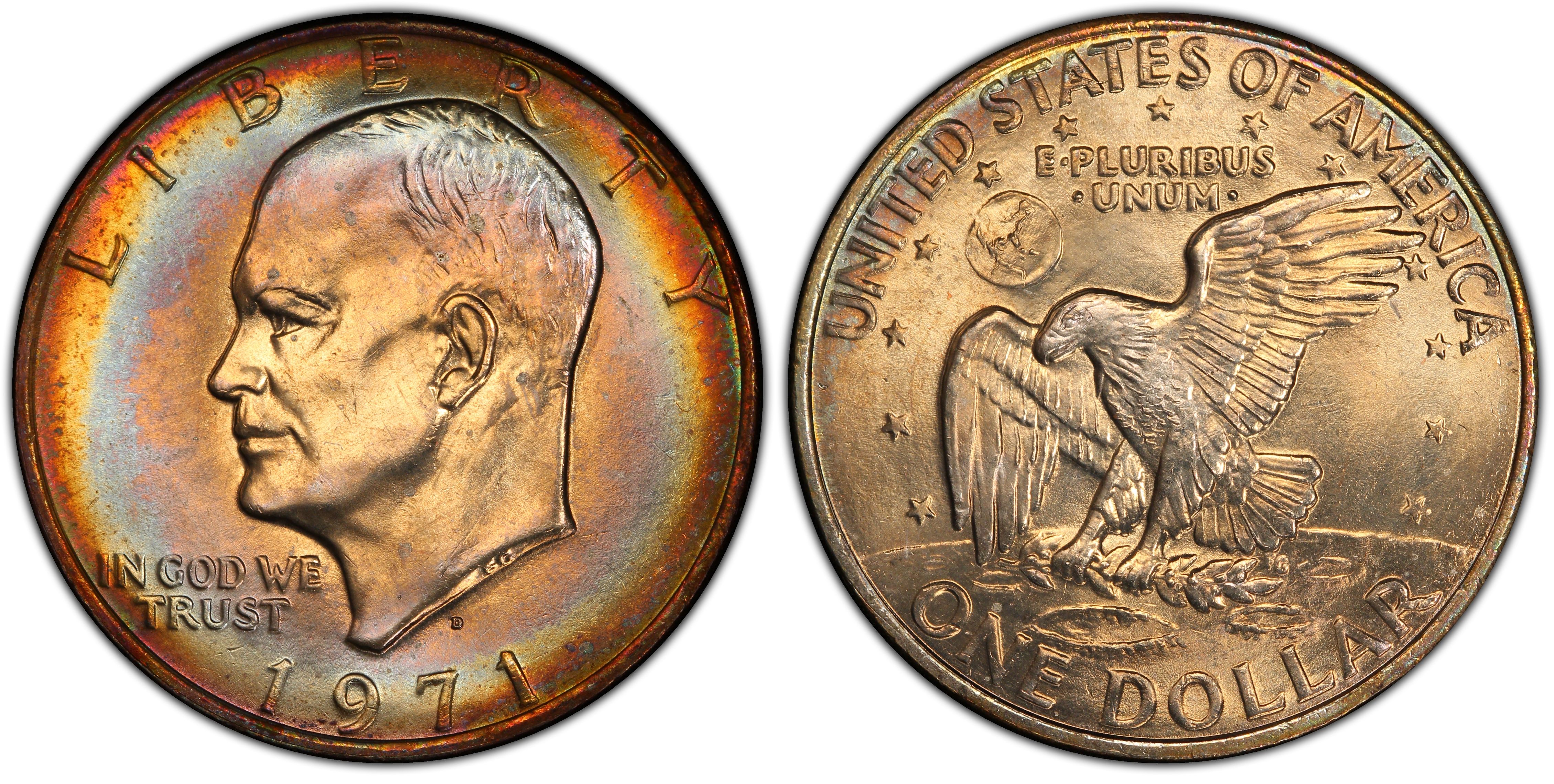 #1 PCGS MS67+
Heritage, January 12, 2023, Lot 3559 – $10,200. Target toning with rust-coloration visible along the obverse rim. |
 #1 PCGS MS67+
The Rambert Registry (PCGS Set Registry). |