



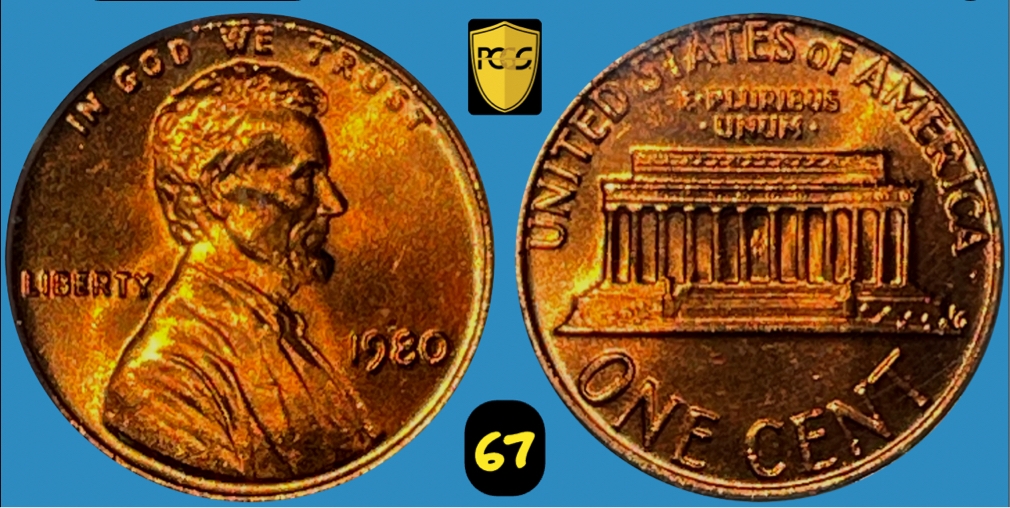
1980 1C, RD MS67RD Certification #21368001, PCGS #3001
Expert Comments
Charles Morgan
1980 Lincoln Cent
For the Lincoln Cent, 1980 was an inflection point. As the antepenultimate date (third to last) struck in the 95% copper alloy used since 1962, the 1980 cent was born into a climate of economic volatility. While the coins are are generally considered common today, they represent a period when the Treasury Department was fighting to save the denomination from rising metal prices, hoarding, and the threat of total elimination.
The Looming Copper Crisis
By 1980, the cent’s composition had become a bugbear for the United States Mint. As inflation surged, the cost of manufacturing a bronze cent approached its face value. This raised the specter of negative seigniorage, where it costs more than a cent to make a cent, and encouraged speculators to hoard coins in anticipation of melting them for their melt value.
The Mint had been bracing for this since the early 1970s:
- The Aluminum Experiment: In 1974, the Mint struck over 1.5 million aluminum cents as a low-cost alternative. Public and political pushback killed the project, but it signaled that the copper era was coming to an end.
- The "Penny Redemption" Push: Mint Director Mary Brooks and Second Lady Betty Ford launched "Penny Redemption Month" in June 1974, offering citations and savings bonds to citizens who returned hoarded cents to banks.
- Mint Mark Removal: By 1979, Director Stella Hackel attempted to discourage hoarding by removing mint marks from all cents, hoping to "de-collectibilize" the coins. The plan was short-lived due to collector outcry, but it underscored the Treasury’s desperation.
Production and Technical Quality
Despite this climate of uncertainty, the Philadelphia Mint and its "stealth" auxiliaries struck a massive 7,414,705,000 cents in 1980. While all of these coins lack a mint mark and appear to be Philadelphia products, the Mint actually distributed production across three facilities:
- Philadelphia: 4,648,470,000
- West Point: 1,574,535,000
- San Francisco: 1,191,700,000
However, quantity did not equal quality. According to numismatist David Lange, the obverse hubs by 1980 were "showing their age." Years of continuous use without a master hub refresh resulted in a "mushy" appearance. Because of this, the bronze issues of 1980-1982 lack the razor-sharp definition seen in the early 1970s, making high-grade, well-struck examples a prize for condition-conscious collectors.
Collecting the 1980 Lincoln Cent
While a raw circulated 1980 cent is worth little more than its intrinsic copper melt value (roughly 4¢), the certified market for high grade Mint State Red examples reveals a different story.
The 1980 cent is likely abundant through PCGS MS66RD, typically trading for $15–$25. The condition cliff begins at PCGS MS67RD, where prices jump to the $250–$300 range. These values have increased following the Treasury Department’s decision to conclude production of the one-cent coin for circulation. While it is possible for 1980 Lincoln cents to grade higher than current populations, such a discovery remains unlikely. The current "Top Pop" (highest known grade) is PCGS MS68RD. Because an example in PCGS MS67+RD or MS68RD is required to compete for a top position in the PCGS Set Registry, coins of this quality remain in high demand and command significant premiums.
The 1980 Lincoln Cent Doubled Die Obverse (DDO)
Collectors should keep a sharp eye out for the FS-101 (#38407). This variety shows distinct doubling on the date and the word "LIBERTY." It is the most significant variety of the year and commands a healthy premium in all grades, serving as a reminder that even in years of multi-billion mintage, there are still treasures to be found.
* * *
Rarity and Survival Estimates Learn More
| 65 or Better | 1482941000 |
| All Grades | 148294100 |
| 60 or Better | 14829410 |
| 65 or Better | R-1.0 |
| All Grades | R-1.0 |
| 60 or Better | R-1.0 |
| 65 or Better | 10 / 48 TIE |
| All Grades | 10 / 48 TIE |
| 60 or Better | 15 / 48 TIE |
| 65 or Better | 11 / 95 TIE |
| All Grades | 11 / 95 TIE |
| 60 or Better | 48 / 95 TIE |