



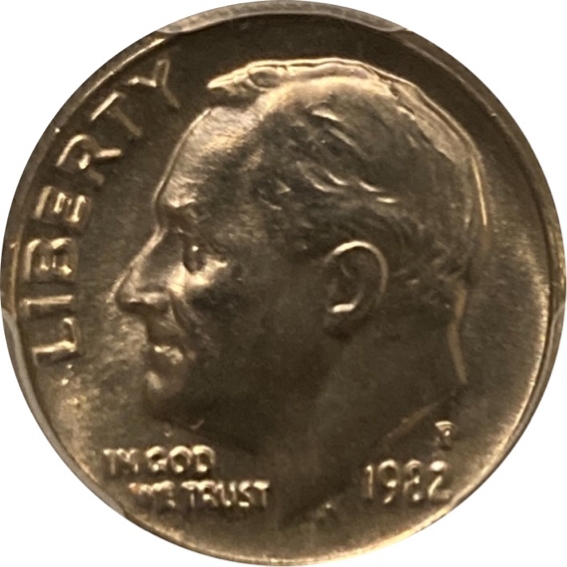
1982-P 10C MS66 Certification #33932372, PCGS #5161
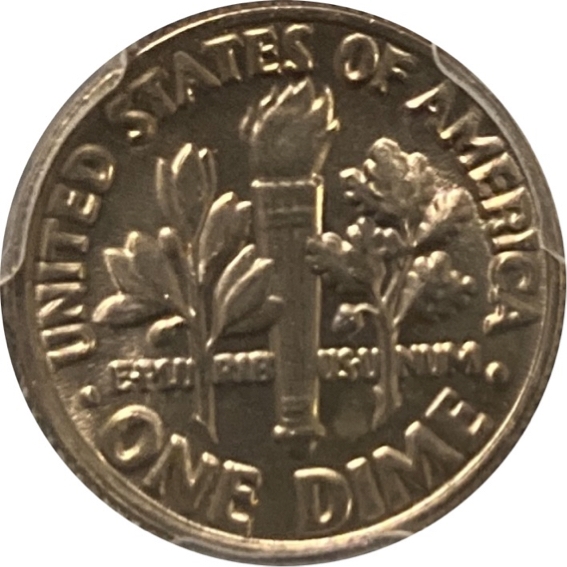
Expert Comments
Charles Morgan
1982-P Roosevelt Dime
Roosevelt Dimes minted since 1980 have carried a “P” mintmark. This fact is well-known to numismatists, though it is not necessarily familiar to the general public. From the Mint's inception, Philadelphia-struck coins bore no mintmark. This changed in 1838 when the opening of branch mints in Charlotte (C), Dahlonega (D), and New Orleans (O) required marks to identify the facility of origin. The tradition continued as facilities in San Francisco (S), Carson City (CC), and Denver (D) came online.
Interestingly, the Dahlonega and Denver Mints shared the same “D” mintmark. However, nearly a half-century of time separated their production, as Dahlonega closed in 1861 and Denver did not begin striking coins until 1906. This gap makes it impossible to confuse the two.
With the 1979 introduction of the Susan B. Anthony Dollar, the Mint sought to standardize mintmark usage by adding the “P” to the dollar. In 1980, this was expanded to include Philadelphia-struck nickels, dimes, quarters, and half dollars. The cent was spared because the Mint occasionally struck pennies for circulation at the San Francisco Mint and the West Point Bullion Depository. By omitting the mintmark, the Mint ensured these overflow runs remained indistinguishable from Philadelphia's output and were not hoarded by collectors.
The Mint intended for every 1982-P Roosevelt Dime (#5161) to be struck with a mintmark; famously, this was not the case.
Collecting the 1982-P and 1982 "No Mintmark" Roosevelt Dimes
The 1982-P Roosevelt Dime was struck during the first of two "Non-Mint Set Years." To cut costs, the Mint suspended sales of its popular Mint Set program, which had provided collectors a convenient way to acquire uncirculated examples of every denomination struck that year. The Treasury Department estimated that eliminating the program would save approximately $3.5 million annually, assuming collectors would find alternative sources for the coins.
While private businesses attempted to fill the gap, the usual "backstop" of 1-2 million government-issued sets was gone. This disruption has left today’s collectors with far fewer options when searching for top-population examples.
The Full Bands (FB) Designation
1982-P Roosevelt Dimes with Full Bands are not exactly scarce, but they are far from typical. According to the PCGS Population Report, only 36.8% of coins certified for this date earn the FB designation.
Note: It is likely this percentage is inflated in favor of Full Bands; submitters often prescreen their coins for high-quality strikes before sending them in for grading.
The 1982 “No Mintmark” Roosevelt Dime
The most notable dime from this era is the scarce “No Mintmark” variety, believed to have been produced by a single die. This occurred when a working die was accidentally put into service without the Philadelphia “P” mintmark. The error was discovered in late 1982—most famously at the Cedar Point amusement park in Sandusky, Ohio. Others were subsequently discovered in Pennsylvania.
The first three individuals credited with discovering the coins were Walter Placzwkis, Andrew Macdonald, and Lane Durkee. Walter Breen credited a dealer from Toledo with handling over 1,500 examples; PCGS's Jaime Hernandez later identified this dealer as Clyde Englehardt of the Toledo Coin Exchange.
Englehardt had been a full-time coin dealer since 1960 when he was thrust into the "No Mintmark" dime frenzy. In a conversation with Hernandez, Englehardt recalled that local dealers and bank tellers offered him the dimes in large quantities.
Most numismatic references categorize the 1982 “No Mintmark” into two classes: Strong and Weak. These terms describe the strike quality; the "Strong" version is nearly fully struck, while the "Weak" version features flattened outer design details. While some specialists collect both, the Strong “No Mintmark” is generally considered more numismatically significant.
While handling the coins, Englehardt found that the most efficient way to distinguish between Strong and Weak strike examples within coin rolls was by observing their thickness.
Interestingly, Englehardt claimed he never found a single example of the 1982 “No P” dime in circulation himself, despite being located in the heart of the region where the coins were most prevalent. While Englehardt marketed and sold nearly all the examples that crossed his desk, he generously donated specimens to both the National Numismatic Collection at the Smithsonian Institution and the American Numismatic Association’s Money Museum.
How Many "No Mintmark" Dimes Were Struck?
The exact number of 1982 “No Mintmark” Roosevelt Dimes in circulation is unknown, though some estimates suggest as many as 10,000 were released (out of approximately 75,000 to 150,000 struck). However, judging PCGS submission totals, it stands as the most-submitted clad Roosevelt Dime for grading outside of the 1996-W (#5189). Unlike that 1996 novelty, which was not intended for circulation, the “No Mintmark” is genuinely scarce and numismatically desirable. An ungraded example in Extra Fine condition typically finds a buyer at $60, while a Mint State "Gem" or better can command $300 or more.
The 1982 “No P” Roosevelt Dime is ranked #32 in the fifth edition of 100 Greatest U.S. Modern Coins by Scott Schechter and Jeff Garrett.
* * *
Condition Census Learn More
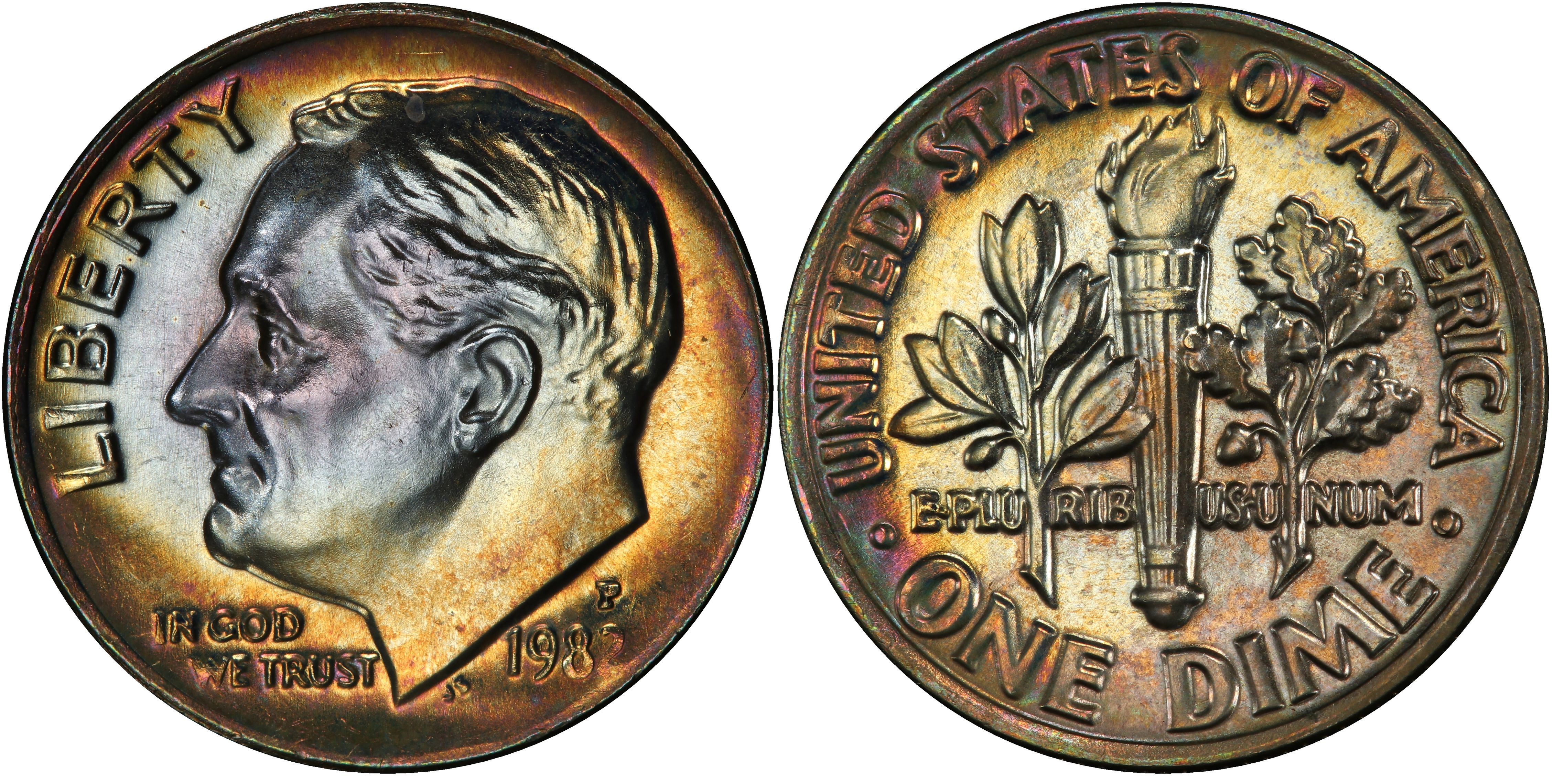 #1 PCGS MS67
GreatCollections, April 12, 2020, Lot 812119 - $49.37; GreatCollections, October 5, 2025, Lot 1895079 - $76.50. Target-toned obverse with purple and blue centers, transitioning to orange and gold along the periphery. The reverse blends gold and orange hues, accented by a thin band of magenta and green along the left edge. |
|
#1 PCGS MS67
GreatCollections, March 13, 2016, Lot 344398 - $41. Rainbow toning on the obverse and reverse. Small diagonal rim tick below the N in ONE. |
|
#1 PCGS MS67
Heritage Auctions, March 29, 2004, Lot 384 - $87. Brilliant and semi-Prooflike. |
|
#1 PCGS MS67
"The RickJones (2) Collection" (PCGS Set Registry). |
|
#1 PCGS MS67
"The Dimeman Collection" (PCGS Set Registry). |