



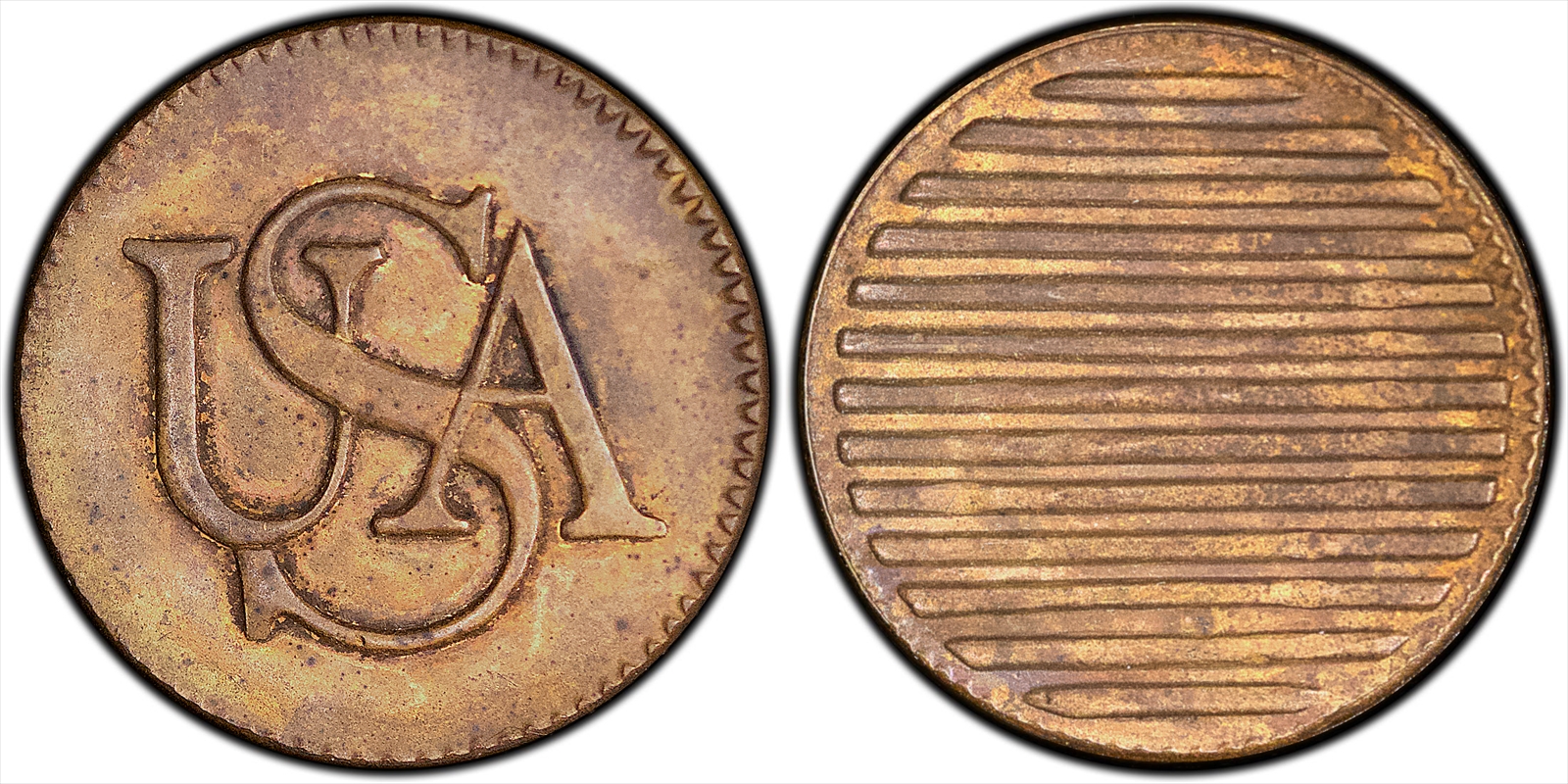
(1785) AE Token "USA" Bar Copper, BN PCGS #599
Owner's Comments
Expert Comments
Charles Morgan
The (1785) Bar Copper
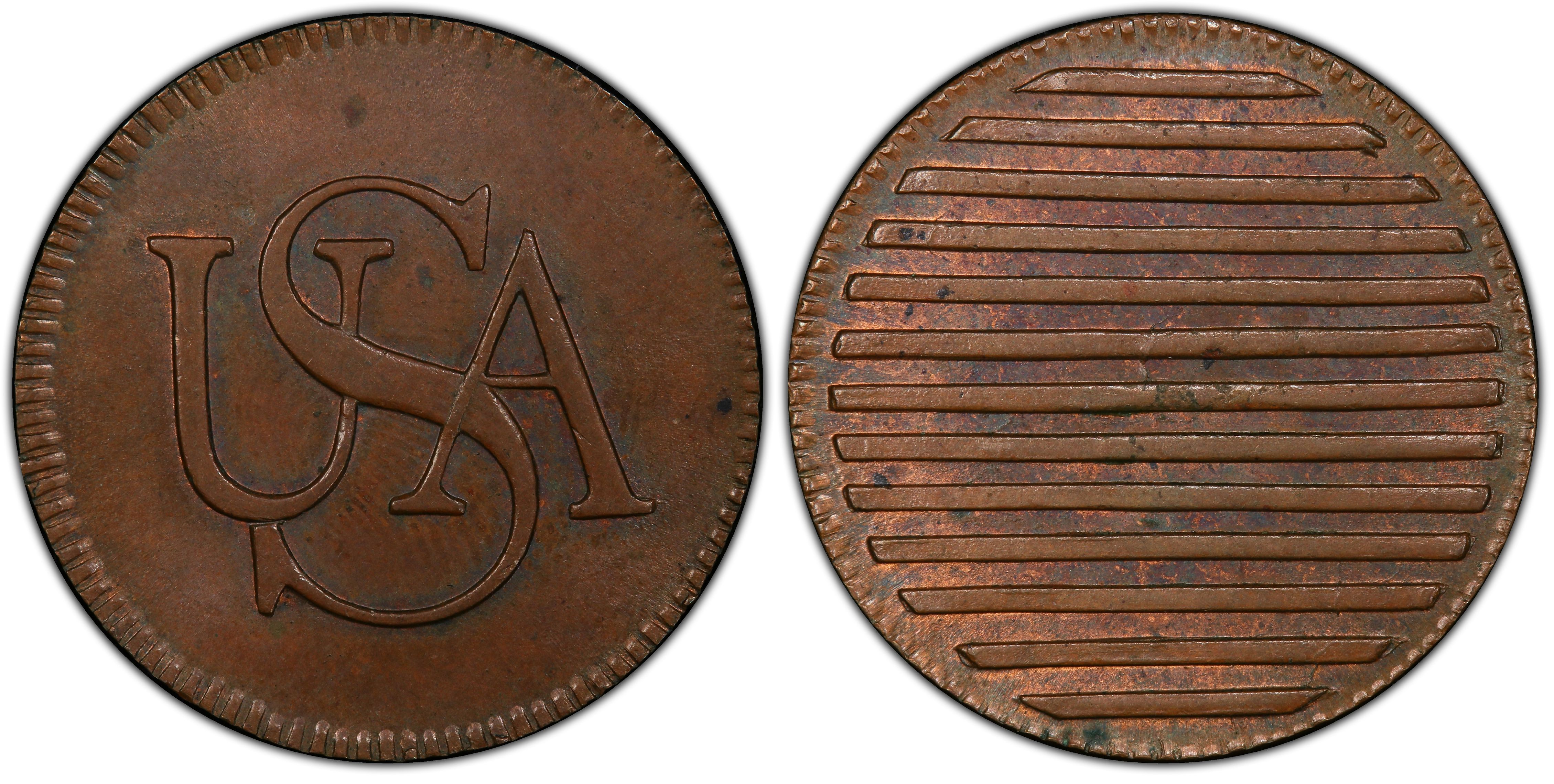
The Bar Copper (#599) is an enigmatic yet attractive private issue that displays the interlocking letters USA on the obverse and 13 bars on the reverse. The reverse is tilted counterclockwise by about 10 to 15 degrees. While the coin is believed to have originated in England, its design draws from the service button adopted by the Continental Army in early 1777. These buttons were largely manufactured by French military contractors, although a surviving 1777 brass button mold used to cast these exact USA buttons in the field is preserved in the collection of the Museum of the American Revolution in Philadelphia, Pennsylvania. As for the Bar Copper, the coins were likely struck in England for profit and sent to America, possibly through New York. A contemporaneous newspaper report places 1785 as the year they entered circulation.
The November 12, 1785, issue of the New Jersey Gazette states:
"A new and curious kind of coppers have lately made their appearance in New York. The novelty and bright gloss of which keeps them in circulation. These coppers are in fact similar to Continental buttons without eyes; on the one side are thirteen stripes and on the other U.S.A., as was usual on the soldiers' buttons."
Bar Coppers were underweight, with most examples ranging from 80 to 90 grains. By 1789, these underweight coins were largely removed from circulation and melted down for their copper content. Because of this, most surviving examples fall in the higher circulated grades through low Mint State.
Originals vs. Bolen Restrikes
While original Bar Coppers date to around 1785, numismatist John Adams Bolen (1826–1907) produced high-quality restrikes in the early 1860s. Bolen had quite a side business producing 19th-century facsimiles of rare colonial coins; Higley Coppers (#535247), Carolina Elephant Tokens (#881762), and George Clinton New York Coppers (#524033) all received the Bolen treatment.
All genuine original examples have a small, thorn-like projection on the far right side of the bottom edge of the second bar from the top. Unfortunately, electrotypes will also show this projection, making PCGS authentication mandatory.
* * *
Rarity and Survival Estimates Learn More
| 65 or Better | 200 |
| All Grades | N/A |
| 60 or Better | N/A |
| 65 or Better | R-7.0 |
| All Grades | |
| 60 or Better | |
| 65 or Better | 1 / 1 |
| All Grades | 1 / 1 |
| 60 or Better | 1 / 1 |
| 65 or Better | 2 / 2 |
| All Grades | 1 / 2 TIE |
| 60 or Better | 1 / 2 TIE |
Condition Census Learn More
|
#1 PCGS MS66BN
RAAB Coins (Randy Block) marketed the coin at the 2002 New York American Numismatic Association - $36,000. |
| #1 PCGS MS66BN |
| #1 PCGS MS66BN |
 #4 PCGS MS65BN |
|
#5 PCGS MS64BN
As "Uncirculated." "The Gilbert Steinberg Collection of Early American Colonial Coins," Stack's, October 17, 1989, Lot 165. As PCGS MS64BN #03641554. "The Catskill Collection," GreatCollections, July 26, 2020, Lot 846566 - $51,750. |