



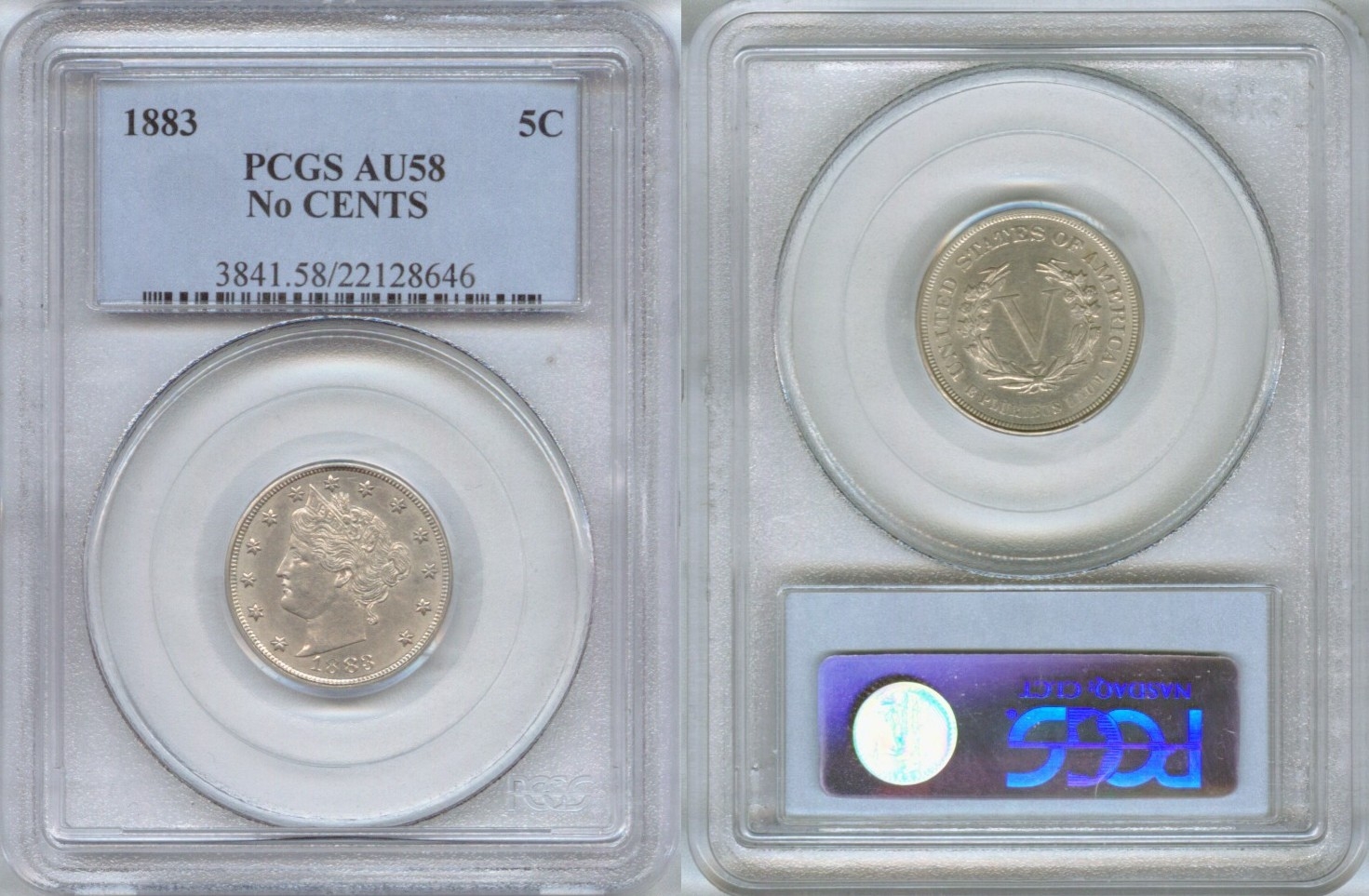
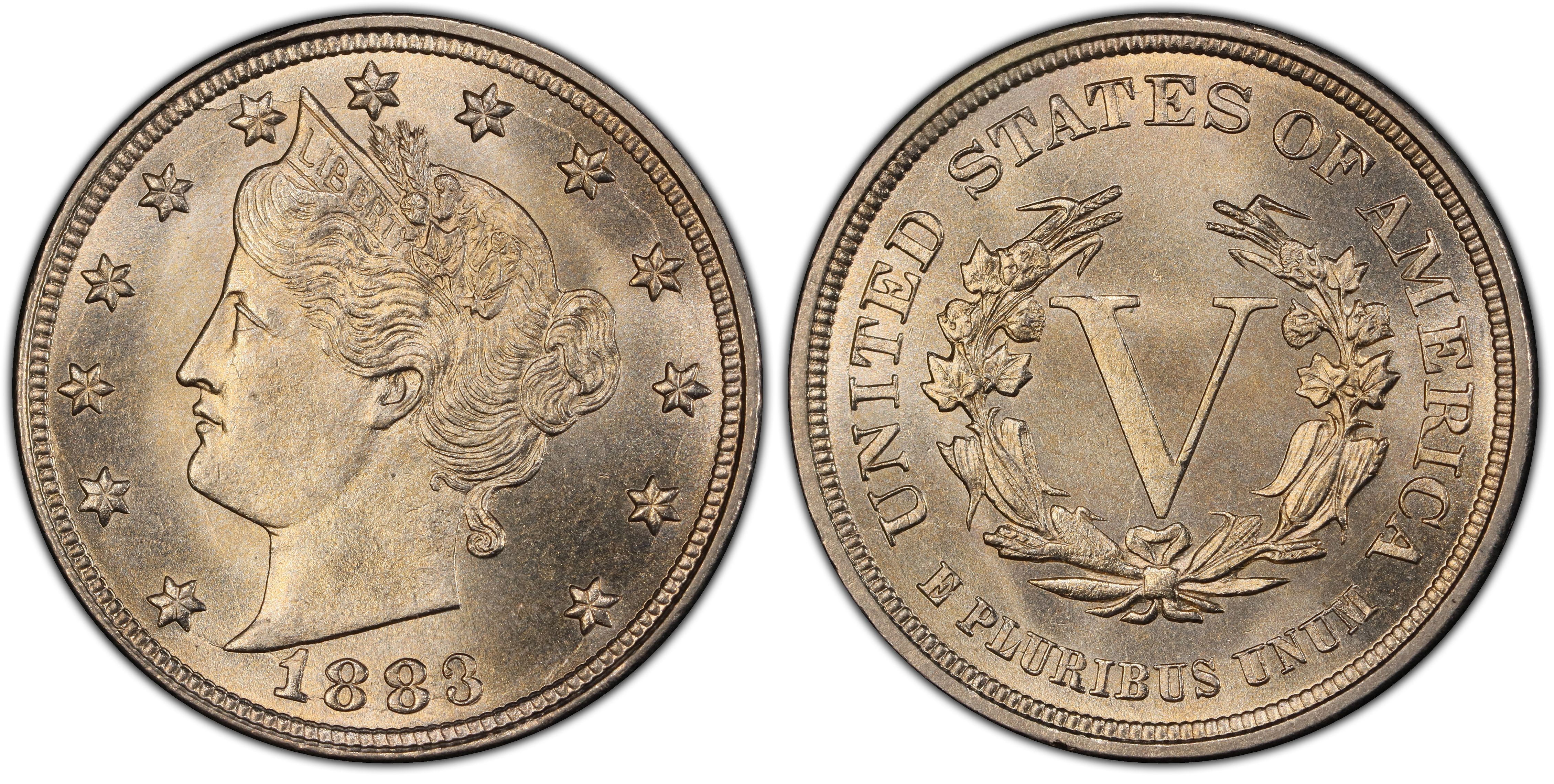
1883 5C No CENTS AU58 Certification #22128646, PCGS #3841
Owner's Comments
Expert Comments
Charles Morgan
The 1883 Liberty Head Nickel, No Cents
The Liberty Head Nickel - or “V” Nickel, as it is commonly known - represented the second major design for the United States nickel five-cent piece. Designed by Chief Engraver Charles E. Barber, it was intended as a modest improvement over James B. Longacre’s Shield Nickel, which had served the nation since 1866.
Archibald's Attempt at a Unified Minor Coinage
In 1881, Philadelphia Mint Superintendent Archibald Loudon Snowden sought to unify the designs of the cent, three-cent, and five-cent pieces. While the cent and nickel circulated heavily, the Three-Cent Nickel was waning in popularity. Despite a mintage of over one million pieces in 1881, the denomination would never again see a mintage exceeding 42,000 for the remainder of its life.
Barber created Liberty Head designs for all three denominations, and patterns were struck in late 1881. However, Snowden was unable to implement the alterations for the cent and three-cent pieces; consequently, only the five-cent nickel design proceeded to full production.
Barber’s design was heavily influenced by George T. Morgan’s famous silver dollar obverse, which had debuted in 1878. However, when placed side-by-side, the comparison is often unflattering to Barber. Where Morgan’s Liberty is naturalistic and full-bodied, Barber’s rendition feels more distant, flat, and comparatively lifeless.
An interesting technical aspect of Barber's work is his reliance on rigid, geometric lines. The top of Liberty’s diadem cuts a sharp 45-degree angle downward, her chin follows a 30-degree angle, and the bust truncation is a straight 12-degree angle pointing upward. Compared to the organic curves, bulbous chin line, and arched truncation of Morgan’s design, Barber’s portrait often strikes collectors as lackluster and overly formal.
Treasury Department Heavily Involved in Design Modifications
Barber’s redesign was not a smooth process. In December 1882, after two years of refinement, Barber submitted his designs to Mint Director Horatio Burchard and Treasury Secretary Charles Folger.
The initial submission featured a left-facing Liberty with UNITED STATES OF AMERICA around the rim and the date below. The reverse depicted a large Roman “V” within a wreath, with E PLURIBUS UNUM above.
Secretary Folger, described by researcher R.W. Julian as a "stickler for the letter of the law", rejected them. He insisted the design satisfy the strict language of the Coinage Act of 1873, stipulating that LIBERTY and the date appear on the obverse, while the legend UNITED STATES OF AMERICA, the motto E PLURIBUS UNUM, and the denomination appear on the reverse.
Superintendent Snowden appealed, arguing the design was legally sound, but Folger overruled him. Revised designs were finally approved on January 8, 1883, and production began shortly thereafter.
A "Centsless" Release
The nickel was initially released without the word CENTS on the reverse—a type now known as "No Cents." The Roman numeral “V” was intended to denote value, much like the three-cent pieces of the era which also lacked a formal word for the denomination.
A commencement ceremony was held on January 30, 1883, with the first business strike sent to President Chester A. Arthur. Regular coinage for the public began on February 1.
The "Racketeer" Scandal: Myth vs. Reality
Shortly after the coin's release, reports surfaced of criminals gilding the new nickels and passing them as five-dollar gold pieces. The most famous name associated with this scheme is Josh Tatum, a supposedly deaf-mute con artist. Legend says Tatum plated 1,000 nickels and spent them across New England. However, no contemporaneous newspaper accounts, criminal records, or census data exist to corroborate Tatum’s existence.
Regardless of the Tatum legend, the threat was real. Just nine days after the release, the U.S. Secret Service issued a press release calling the new nickel “dangerous,” warning that a thin plating of gold could easily deceive the public. Superintendent Snowden traveled to Washington to defend the design, pointing out the success of the similarly-styled three-cent piece. His arguments fell on deaf ears. In early March 1883, the Mint began work on a new reverse die that prominently featured the word CENTS, bringing an end to the brief, controversial life of the No Cents Liberty Nickel.
* * *
Rarity and Survival Estimates Learn More
| 65 or Better | 100000 |
| All Grades | 20000 |
| 60 or Better | 5000 |
| 65 or Better | R-2.0 |
| All Grades | R-2.8 |
| 60 or Better | R-4.0 |
| 65 or Better | 1 / 1 |
| All Grades | 1 / 1 |
| 60 or Better | 1 / 1 |
| 65 or Better | 28 / 33 TIE |
| All Grades | 33 / 33 |
| 60 or Better | 33 / 33 |
Condition Census Learn More
 #1 PCGS MS67+
Stack’s Bowers, April 1, 2025, Lot 2225 – $5,760. Faint champagne and ice blue toning throughout. Pin-sized Toning spot at the denticles between stars 6 and 7. Planchet cracks across the top of UNITED. |
 #1 PCGS MS67+
GreatCollections, June 16, 2019, Lot 667007 - $5,118.75; Bruce Scherr; “The Scherr Family Collection,” Heritage Auctions, April 23, 2020, Lot 3218 – $2,280; “The Scherr Family Collection, Part II,” Heritage Auctions, February 28, 2025, Lot 3708 – $4,080; "The Grandpas Dream Collection" (PCGS Set Registry). Light gold and blue toning with scattered specks of brown throughout the obverse. Light die cracks through stars 3-7 and 12-13. Vertical gouge to the left of star 10. Diagonal hit to the right of V. |
 #1 PCGS MS67+
As PCGS MS67 #39135084. Heritage Auctions, January 11, 2023, Lot 3091 – $4,440. As PCGS MS67+ #39135084. Legend Rare Coin Auctions, May 25, 2023, Lot 75 – Passed; Legend Rare Coin Auctions, November 11, 2023, Lot 29 – $4,230. Brilliant. A prominent die crack runs from the rim at the 12 o’clock position through the "L" in the coronet. There is a small patch of discoloration above the gap between the 8s in the date. A thin diagonal scratch is visible above the ear, with a small gouge in the field to the right of star 9. |
 #1 PCGS MS67+
As PCGS MS67 #27771619. “The Ally Collection,” Heritage Auctions, January 7, 2015, Lot 3534 – $3,525. As PCGS MS67+ #40715254. GreatCollections, January 3, 2021, Lot 925749 - $2,764.13; Legend Rare Coin Auctions, May 25, 2023, Lot 76 – $3,055; Legend Rare Coin Auctions, July 14-23, 2023, Lot 15117 – $3,055. Champagne hue. A small tick is visible between stars 2 and 3, toward Liberty’s chin. A die crack curves from the denticles to the bottom of the second 8 in the date. On the reverse, a die crack runs from the rim above the first T in STATES through the AT. Another crack extends from the base of the V to the N in UNUM. Additional minor cracks are noted throughout. |
 #1 PCGS MS67+
GreatCollections, February 26, 2023, Lot 717025 - $2,549.25; "The Grand Mere Collection Nickels" (PCGS Set Registry). Champagne patination. Prominent die cracks are visible along both the upper and lower portions of the obverse. |