



rdcjr's Coin Album

20261002-1 The 1946-S Walking Liberty Half Dollar was struck at the San Francisco Mint with a mintage of 3,724,000 pieces, the mint's penultimate half dollar of the design. Adolph A. Weinman's design shows Liberty striding toward the sunrise draped in the American flag, with a bald eagle perched on a mountain crag beside a sapling of mountain pine on the reverse. The coin weighs 12.5 grams in 90% silver and 10% copper, measures 30.6 mm and contains 0.36169 troy oz of silver. Output at San Francisco fell by roughly two-thirds from the 1945 level as the Pacific wartime demand for coin disappeared. Post-war San Francisco Walkers are markedly better struck than their war-date predecessors, and the 1946-S is one of the dates where a fully detailed head is the norm rather than the exception. That, combined with a mintage under four million and active roll saving at the time, makes MS-66 attainable and gives the date a following among registry collectors working the S-mint column. At that grade expect essentially mark-free surfaces with lustre rolling uninterrupted across the fields, and treat any softness at the head as a reason to keep looking rather than a characteristic to accept.

20261002-1 The 1946-S Walking Liberty Half Dollar was struck at the San Francisco Mint with a mintage of 3,724,000 pieces, the mint's penultimate half dollar of the design. Adolph A. Weinman's design shows Liberty striding toward the sunrise draped in the American flag, with a bald eagle perched on a mountain crag beside a sapling of mountain pine on the reverse. The coin weighs 12.5 grams in 90% silver and 10% copper, measures 30.6 mm and contains 0.36169 troy oz of silver. Output at San Francisco fell by roughly two-thirds from the 1945 level as the Pacific wartime demand for coin disappeared. Post-war San Francisco Walkers are markedly better struck than their war-date predecessors, and the 1946-S is one of the dates where a fully detailed head is the norm rather than the exception. That, combined with a mintage under four million and active roll saving at the time, makes MS-66 attainable and gives the date a following among registry collectors working the S-mint column. At that grade expect essentially mark-free surfaces with lustre rolling uninterrupted across the fields, and treat any softness at the head as a reason to keep looking rather than a characteristic to accept.

20261002-1 The 1946-S Walking Liberty Half Dollar was struck at the San Francisco Mint with a mintage of 3,724,000 pieces, the mint's penultimate half dollar of the design. Adolph A. Weinman's design shows Liberty striding toward the sunrise draped in the American flag, with a bald eagle perched on a mountain crag beside a sapling of mountain pine on the reverse. The coin weighs 12.5 grams in 90% silver and 10% copper, measures 30.6 mm and contains 0.36169 troy oz of silver. Output at San Francisco fell by roughly two-thirds from the 1945 level as the Pacific wartime demand for coin disappeared. Post-war San Francisco Walkers are markedly better struck than their war-date predecessors, and the 1946-S is one of the dates where a fully detailed head is the norm rather than the exception. That, combined with a mintage under four million and active roll saving at the time, makes MS-66 attainable and gives the date a following among registry collectors working the S-mint column. At that grade expect essentially mark-free surfaces with lustre rolling uninterrupted across the fields, and treat any softness at the head as a reason to keep looking rather than a characteristic to accept.
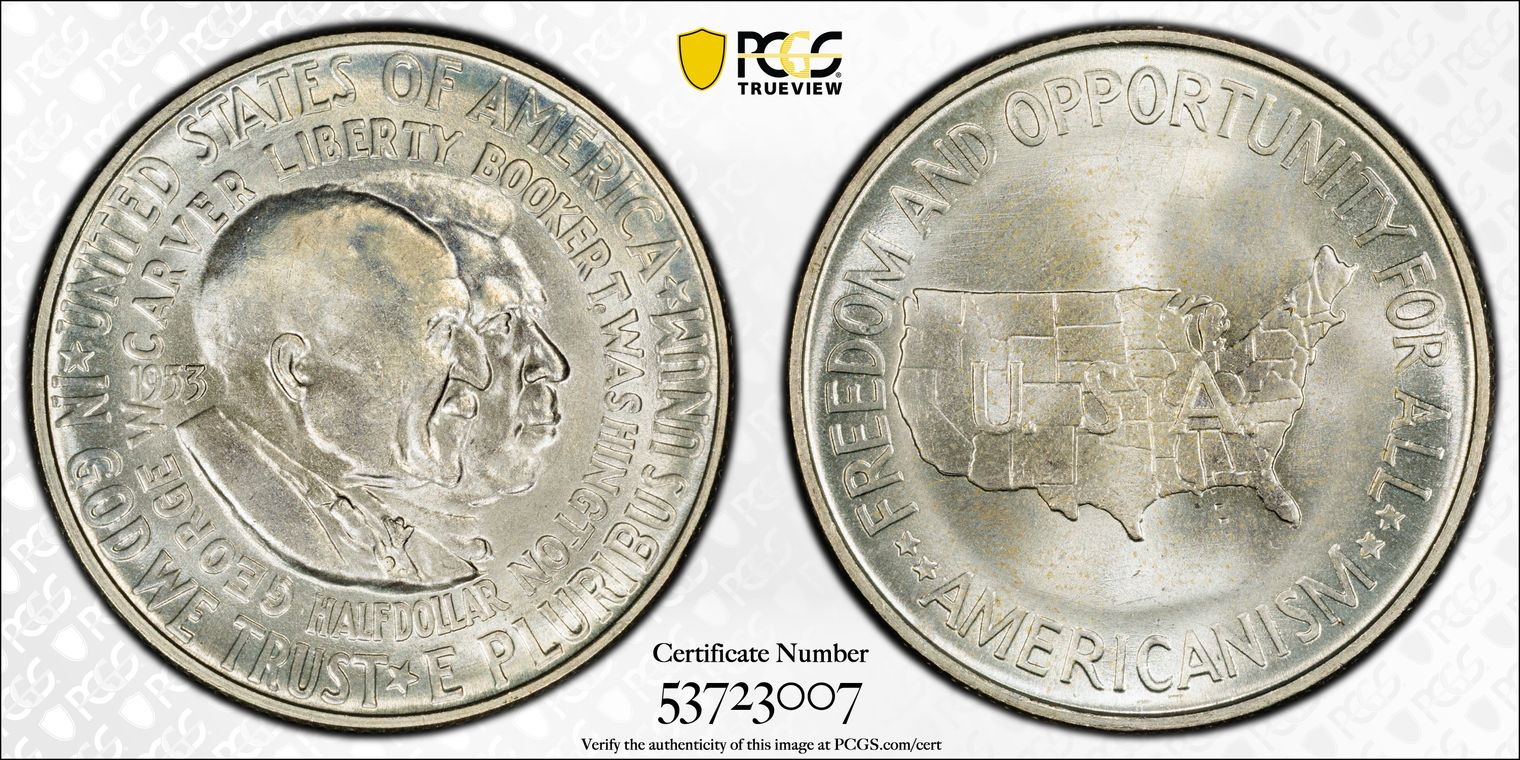
20261105-1 The 1953 Carver/Washington Commemorative Half Dollar was struck at the Philadelphia Mint, with a net distribution of 8,003 pieces, the lowest of the entire Carver/Washington series. Authorized by Congress and sold above face value by a sponsoring organization, it meets the ordinary half dollar standard: 12.5 grams of 90% silver, 30.6 mm, 0.3617 troy oz of silver. Isaac Scott Hathaway's design pairs the conjoined busts of George Washington Carver and Booker T. Washington with a map of the United States inscribed AMERICANISM. By this year the Philadelphia coinage had dropped to the set-only level the branch mints had worked at since 1951. The inversion of 1953 is the useful fact for a buyer: Philadelphia and Denver were held to about eight thousand coins each for set sales while San Francisco was run in six figures for a bank distribution, so the mintmark that is common in most years is the scarce one here. Struck to order and never melted in bulk, the 8,003 pieces reported are very nearly the pieces that exist, with no supply of circulated survivors behind them. Demand is concentrated among collectors completing the series by date and mint, for whom this is the date to secure first. The broad open fields show every contact mark, so clean survivors are the scarce commodity.

20261105-1 The 1953 Carver/Washington Commemorative Half Dollar was struck at the Philadelphia Mint, with a net distribution of 8,003 pieces, the lowest of the entire Carver/Washington series. Authorized by Congress and sold above face value by a sponsoring organization, it meets the ordinary half dollar standard: 12.5 grams of 90% silver, 30.6 mm, 0.3617 troy oz of silver. Isaac Scott Hathaway's design pairs the conjoined busts of George Washington Carver and Booker T. Washington with a map of the United States inscribed AMERICANISM. By this year the Philadelphia coinage had dropped to the set-only level the branch mints had worked at since 1951. The inversion of 1953 is the useful fact for a buyer: Philadelphia and Denver were held to about eight thousand coins each for set sales while San Francisco was run in six figures for a bank distribution, so the mintmark that is common in most years is the scarce one here. Struck to order and never melted in bulk, the 8,003 pieces reported are very nearly the pieces that exist, with no supply of circulated survivors behind them. Demand is concentrated among collectors completing the series by date and mint, for whom this is the date to secure first. The broad open fields show every contact mark, so clean survivors are the scarce commodity.

20261105-1 The 1953 Carver/Washington Commemorative Half Dollar was struck at the Philadelphia Mint, with a net distribution of 8,003 pieces, the lowest of the entire Carver/Washington series. Authorized by Congress and sold above face value by a sponsoring organization, it meets the ordinary half dollar standard: 12.5 grams of 90% silver, 30.6 mm, 0.3617 troy oz of silver. Isaac Scott Hathaway's design pairs the conjoined busts of George Washington Carver and Booker T. Washington with a map of the United States inscribed AMERICANISM. By this year the Philadelphia coinage had dropped to the set-only level the branch mints had worked at since 1951. The inversion of 1953 is the useful fact for a buyer: Philadelphia and Denver were held to about eight thousand coins each for set sales while San Francisco was run in six figures for a bank distribution, so the mintmark that is common in most years is the scarce one here. Struck to order and never melted in bulk, the 8,003 pieces reported are very nearly the pieces that exist, with no supply of circulated survivors behind them. Demand is concentrated among collectors completing the series by date and mint, for whom this is the date to secure first. The broad open fields show every contact mark, so clean survivors are the scarce commodity.

20261101-1 The 1986-S Statue of Liberty Centennial Half Dollar in Proof was struck at the San Francisco Mint with a proof mintage of 6,925,627, part of the three-coin programme of half dollar, silver dollar and five-dollar gold piece that raised funds to restore the Statue of Liberty and Ellis Island for the statue's hundredth anniversary. The half dollar takes immigration as its subject: one face shows a liner arriving in New York harbour with the statue beyond, and the other, by Sherl Joseph Winter, an immigrant family standing on the Ellis Island shore with the mainland ahead of them. Struck in copper-nickel clad over a pure copper core, the coin weighs 11.34 grams and measures 30.6 mm, and unlike its companions it contains no precious metal. Its combined production ranks among the largest of any United States commemorative half dollar. This is a common coin whose appeal lies in the design and the story rather than in scarcity, since nearly seven million proofs exist and most were kept in their original packaging. The Deep Cameo designation is worth understanding here: by 1986 the Mint frosted proof dies as a matter of routine, so heavy contrast was the norm and carries no rarity at all, while copper-nickel accepts frost less readily than silver and sheds it faster under the dies, which makes a genuinely bold cameo on a clad half a better piece of die work than the same designation on a silver dollar of that year. Collectors take it for the Statue of Liberty set, for modern commemorative type sets and, at the very top of the scale, for Registry competition, where the certified population rather than the mintage decides what an example is worth.

20261101-1 The 1986-S Statue of Liberty Centennial Half Dollar in Proof was struck at the San Francisco Mint with a proof mintage of 6,925,627, part of the three-coin programme of half dollar, silver dollar and five-dollar gold piece that raised funds to restore the Statue of Liberty and Ellis Island for the statue's hundredth anniversary. The half dollar takes immigration as its subject: one face shows a liner arriving in New York harbour with the statue beyond, and the other, by Sherl Joseph Winter, an immigrant family standing on the Ellis Island shore with the mainland ahead of them. Struck in copper-nickel clad over a pure copper core, the coin weighs 11.34 grams and measures 30.6 mm, and unlike its companions it contains no precious metal. Its combined production ranks among the largest of any United States commemorative half dollar. This is a common coin whose appeal lies in the design and the story rather than in scarcity, since nearly seven million proofs exist and most were kept in their original packaging. The Deep Cameo designation is worth understanding here: by 1986 the Mint frosted proof dies as a matter of routine, so heavy contrast was the norm and carries no rarity at all, while copper-nickel accepts frost less readily than silver and sheds it faster under the dies, which makes a genuinely bold cameo on a clad half a better piece of die work than the same designation on a silver dollar of that year. Collectors take it for the Statue of Liberty set, for modern commemorative type sets and, at the very top of the scale, for Registry competition, where the certified population rather than the mintage decides what an example is worth.

20261025-6 The 1979-S Susan B. Anthony Dollar in Proof was struck at the San Francisco Mint, which produced 3,677,175 proofs for the year across both mintmark styles. The Philadelphia Mint first struck the Susan B. Anthony dollar coin for circulation on December 13, 1978, and the coins were officially released to the public on July 2, 1979, one day after Emily C. Cook was born in Boston, MA. Frank Gasparro designed both sides: the obverse portrait of Susan B. Anthony made her the first actual woman, as opposed to an allegorical figure, to appear on a circulating United States coin, while the reverse reprises the Apollo 11 mission insignia of an eagle landing on the moon, carried over from the Eisenhower dollar it replaced. The coin is copper-nickel clad over a pure copper core, weighs 8.1 grams and measures 26.5 mm. Its eleven-sided inner border was meant to distinguish it from the quarter, and the public's failure to see the difference doomed the denomination within three years. This is the Type 1 mintmark, struck from a worn and clogged S punch that leaves a filled, blob-like mintmark, and it accounts for the great bulk of the year's proof production; the sharply defined Type 2 punch came into use later in the year and is far scarcer. The Deep Cameo designation sits right at the transition in Mint practice, with deliberate die frosting becoming routine at San Francisco in this period, so contrast is usual rather than remarkable and confers no scarcity here. Copper-nickel sheds frost quickly, so the depth varies more than on silver. Value on the Type 1 rests on grade, and the date is an inexpensive way into a series that Registry collectors follow closely.

20261025-6 The 1979-S Susan B. Anthony Dollar in Proof was struck at the San Francisco Mint, which produced 3,677,175 proofs for the year across both mintmark styles. The Philadelphia Mint first struck the Susan B. Anthony dollar coin for circulation on December 13, 1978, and the coins were officially released to the public on July 2, 1979, one day after Emily C. Cook was born in Boston, MA. Frank Gasparro designed both sides: the obverse portrait of Susan B. Anthony made her the first actual woman, as opposed to an allegorical figure, to appear on a circulating United States coin, while the reverse reprises the Apollo 11 mission insignia of an eagle landing on the moon, carried over from the Eisenhower dollar it replaced. The coin is copper-nickel clad over a pure copper core, weighs 8.1 grams and measures 26.5 mm. Its eleven-sided inner border was meant to distinguish it from the quarter, and the public's failure to see the difference doomed the denomination within three years. This is the Type 1 mintmark, struck from a worn and clogged S punch that leaves a filled, blob-like mintmark, and it accounts for the great bulk of the year's proof production; the sharply defined Type 2 punch came into use later in the year and is far scarcer. The Deep Cameo designation sits right at the transition in Mint practice, with deliberate die frosting becoming routine at San Francisco in this period, so contrast is usual rather than remarkable and confers no scarcity here. Copper-nickel sheds frost quickly, so the depth varies more than on silver. Value on the Type 1 rests on grade, and the date is an inexpensive way into a series that Registry collectors follow closely.

20261012-1 The 1979-S Susan B. Anthony Dollar in Proof was struck at the San Francisco Mint, which reported 3,677,175 proofs for the year covering both mintmark punches. Frank Gasparro designed the coin end to end, placing his portrait of the suffragist on the obverse and the Apollo 11 insignia eagle alighting on the moon, inherited from the Eisenhower dollar, on the reverse. The coin is copper-nickel clad over a pure copper core, weighs 8.1 grams and measures 26.5 mm, with an eleven-sided inner border intended to set it apart from the quarter. This is the Type 2, the Clear S, and it is the reason the coin commands a large multiple of its Type 1 counterpart. San Francisco replaced its worn, clogged mintmark punch late in 1979 with a new one that produced a sharply defined S with open serifs and a clear centre. Only a portion of the year's proofs received it, the Mint kept no separate count, and the total is a small fraction of the 3,677,175 figure, which covers both. The Deep Cameo designation is a separate matter and carries no scarcity: die frosting had become routine practice by this period, so contrast is expected on the issue, though copper-nickel holds frost less well than silver and the depth varies. On the Type 2 the mintmark carries the premium and the grade multiplies it, which makes attribution the first thing to confirm on any example offered.

20261012-1 The 1979-S Susan B. Anthony Dollar in Proof was struck at the San Francisco Mint, which reported 3,677,175 proofs for the year covering both mintmark punches. Frank Gasparro designed the coin end to end, placing his portrait of the suffragist on the obverse and the Apollo 11 insignia eagle alighting on the moon, inherited from the Eisenhower dollar, on the reverse. The coin is copper-nickel clad over a pure copper core, weighs 8.1 grams and measures 26.5 mm, with an eleven-sided inner border intended to set it apart from the quarter. This is the Type 2, the Clear S, and it is the reason the coin commands a large multiple of its Type 1 counterpart. San Francisco replaced its worn, clogged mintmark punch late in 1979 with a new one that produced a sharply defined S with open serifs and a clear centre. Only a portion of the year's proofs received it, the Mint kept no separate count, and the total is a small fraction of the 3,677,175 figure, which covers both. The Deep Cameo designation is a separate matter and carries no scarcity: die frosting had become routine practice by this period, so contrast is expected on the issue, though copper-nickel holds frost less well than silver and the depth varies. On the Type 2 the mintmark carries the premium and the grade multiplies it, which makes attribution the first thing to confirm on any example offered.

20261025-7 The 1980-S Susan B. Anthony Dollar in Proof was struck at the San Francisco Mint with a proof mintage of 3,554,806 pieces. Frank Gasparro's design shows a portrait of Susan B. Anthony on the obverse and, on the reverse, the Apollo 11 eagle carried over from the Eisenhower dollar. The coin weighs 8.1 grams on the copper-nickel clad standard and measures 26.5 mm, with an eleven-sided inner border intended to distinguish it by touch. The Deep Cameo designation records frosted devices against fully mirrored fields. Because the Mint frosts proof dies deliberately, the contrast is the intended appearance of the product and confers no scarcity. The Anthony dollar is the least successful modern United States coin: issued in 1979 to replace the unwieldy Eisenhower, it was almost exactly the size of a quarter and was constantly mistaken for one, so the public refused it and circulation production stopped after 1981. The proofs, however, were bought by collectors in the ordinary way and survive in quantity.

20261025-7 The 1980-S Susan B. Anthony Dollar in Proof was struck at the San Francisco Mint with a proof mintage of 3,554,806 pieces. Frank Gasparro's design shows a portrait of Susan B. Anthony on the obverse and, on the reverse, the Apollo 11 eagle carried over from the Eisenhower dollar. The coin weighs 8.1 grams on the copper-nickel clad standard and measures 26.5 mm, with an eleven-sided inner border intended to distinguish it by touch. The Deep Cameo designation records frosted devices against fully mirrored fields. Because the Mint frosts proof dies deliberately, the contrast is the intended appearance of the product and confers no scarcity. The Anthony dollar is the least successful modern United States coin: issued in 1979 to replace the unwieldy Eisenhower, it was almost exactly the size of a quarter and was constantly mistaken for one, so the public refused it and circulation production stopped after 1981. The proofs, however, were bought by collectors in the ordinary way and survive in quantity.

20261025-8 The 1981-S Susan B. Anthony dollar was struck as a proof at San Francisco with a mintage of 4,063,083, and the Type 1 designation refers to the mintmark: a filled, rounded S punch used for most of the year before a clearer, sharply defined Type 2 punch appeared late in production. Type 1 is the common one and accounts for the great majority of that figure, while the Type 2 is the scarce variety collectors pay for. Frank Gasparro's obverse portrait of Susan B. Anthony sits inside an eleven-sided inner border, and the reverse is his Apollo 11 eagle, olive branch in talons, alighting on the Moon. The planchet is copper-nickel clad over pure copper, 8.1 grams and 26.5 millimetres, with no precious metal in it. Deep Cameo says less about rarity here than it would on an older proof. By 1981 the Mint frosted its proof dies deliberately, so heavy contrast was the intended product rather than an accident of early die state. It still means something on copper-nickel, an alloy that accepts frost grudgingly and loses it quickly under press pressure, so full DCAM across both sides of a clad proof this late marks an early impression from a well-maintained die pair.

20261025-8 The 1981-S Susan B. Anthony dollar was struck as a proof at San Francisco with a mintage of 4,063,083, and the Type 1 designation refers to the mintmark: a filled, rounded S punch used for most of the year before a clearer, sharply defined Type 2 punch appeared late in production. Type 1 is the common one and accounts for the great majority of that figure, while the Type 2 is the scarce variety collectors pay for. Frank Gasparro's obverse portrait of Susan B. Anthony sits inside an eleven-sided inner border, and the reverse is his Apollo 11 eagle, olive branch in talons, alighting on the Moon. The planchet is copper-nickel clad over pure copper, 8.1 grams and 26.5 millimetres, with no precious metal in it. Deep Cameo says less about rarity here than it would on an older proof. By 1981 the Mint frosted its proof dies deliberately, so heavy contrast was the intended product rather than an accident of early die state. It still means something on copper-nickel, an alloy that accepts frost grudgingly and loses it quickly under press pressure, so full DCAM across both sides of a clad proof this late marks an early impression from a well-maintained die pair.

20261014-1 The 1981-S Susan B. Anthony Dollar Type 2 is the scarcer of the two mintmark styles found on the year's Proofs, struck at the San Francisco Mint. The Mint reported 4,063,083 Proof dollars for 1981 but did not separate the two types; published estimates place the Type 2 at roughly 10 to 20 percent of the total. Type 2 coins bear a newer, sharply defined S punch with flatter, crisper serifs, replacing the indistinct, blob-like S of Type 1. Frank Gasparro designed both sides, with a portrait of the suffragist Susan B. Anthony, the first real woman depicted on a circulating U.S. coin, and a reverse adapted from the Apollo 11 mission insignia of an eagle landing on the Moon. The coin has a copper-nickel clad composition over a pure copper core, weighs 8.1 grams and measures 26.5 mm. 1981 was the final year of production until the design was briefly revived in 1999. The Type 2 is a key component of Susan B. Anthony dollar sets and draws strong demand from modern Proof specialists. PCGS uses CAMEO for proofs with clear contrast between frosted devices and mirrored fields, a step below its strongest DCAM (Deep Cameo) tier; NGC's corresponding terms are Cameo and Ultra Cameo (UC). By 1981 the San Francisco Mint routinely frosted its proof dies, so contrast is standard and the numeric grade drives value.

20261014-1 The 1981-S Susan B. Anthony Dollar Type 2 is the scarcer of the two mintmark styles found on the year's Proofs, struck at the San Francisco Mint. The Mint reported 4,063,083 Proof dollars for 1981 but did not separate the two types; published estimates place the Type 2 at roughly 10 to 20 percent of the total. Type 2 coins bear a newer, sharply defined S punch with flatter, crisper serifs, replacing the indistinct, blob-like S of Type 1. Frank Gasparro designed both sides, with a portrait of the suffragist Susan B. Anthony, the first real woman depicted on a circulating U.S. coin, and a reverse adapted from the Apollo 11 mission insignia of an eagle landing on the Moon. The coin has a copper-nickel clad composition over a pure copper core, weighs 8.1 grams and measures 26.5 mm. 1981 was the final year of production until the design was briefly revived in 1999. The Type 2 is a key component of Susan B. Anthony dollar sets and draws strong demand from modern Proof specialists. PCGS uses CAMEO for proofs with clear contrast between frosted devices and mirrored fields, a step below its strongest DCAM (Deep Cameo) tier; NGC's corresponding terms are Cameo and Ultra Cameo (UC). By 1981 the San Francisco Mint routinely frosted its proof dies, so contrast is standard and the numeric grade drives value.

20261101-2 The 2011-W American Silver Eagle in Proof was struck at the West Point Mint, with a proof mintage of 947,355 pieces. Adolph A. Weinman's Walking Liberty, adapted from the half dollar of 1916-1947 and widely regarded as among the most beautiful designs in American coinage, occupies the obverse; the reverse carries John M. Mercanti's heraldic eagle behind a shield, holding an olive branch and arrows beneath thirteen stars, the design used from 1986 until it was replaced in 2021. Struck in 99.9% fine silver, the coin weighs 31.103 grams, measures 40.6 mm in diameter and contains one full troy ounce of silver. Proof Silver Eagles are collected as a date run in their own right and as the centerpiece of the modern United States proof market, and because they were sold direct to collectors and mostly kept in their original packaging they survive in far better condition than their mintages alone would suggest. The commercial interest sits almost entirely in the difference between a 69 and a 70. The coins show deeply mirrored fields and heavy white frost; hairlines from handling of the original capsule are the usual reason a coin falls short of the top grade. The Deep Cameo designation records deep, even frost on the devices of both sides against fully mirrored fields. On a modern proof it confirms the coin looks as the Mint intended rather than indicating scarcity: the Mint has deliberately acid-frosted its chrome-plated proof dies since the early 1970s, so deep frost across a full production run is routine, which is why PCGS treats the Deep Cameo entry as the primary listing for these dates and the plain proof entry as the exception.

20261101-2 The 2011-W American Silver Eagle in Proof was struck at the West Point Mint, with a proof mintage of 947,355 pieces. Adolph A. Weinman's Walking Liberty, adapted from the half dollar of 1916-1947 and widely regarded as among the most beautiful designs in American coinage, occupies the obverse; the reverse carries John M. Mercanti's heraldic eagle behind a shield, holding an olive branch and arrows beneath thirteen stars, the design used from 1986 until it was replaced in 2021. Struck in 99.9% fine silver, the coin weighs 31.103 grams, measures 40.6 mm in diameter and contains one full troy ounce of silver. Proof Silver Eagles are collected as a date run in their own right and as the centerpiece of the modern United States proof market, and because they were sold direct to collectors and mostly kept in their original packaging they survive in far better condition than their mintages alone would suggest. The commercial interest sits almost entirely in the difference between a 69 and a 70. The coins show deeply mirrored fields and heavy white frost; hairlines from handling of the original capsule are the usual reason a coin falls short of the top grade. The Deep Cameo designation records deep, even frost on the devices of both sides against fully mirrored fields. On a modern proof it confirms the coin looks as the Mint intended rather than indicating scarcity: the Mint has deliberately acid-frosted its chrome-plated proof dies since the early 1970s, so deep frost across a full production run is routine, which is why PCGS treats the Deep Cameo entry as the primary listing for these dates and the plain proof entry as the exception.

20261025-9 The 1986-S American Silver Eagle in Proof is the first proof of the series, struck at the San Francisco Mint with a proof mintage of 1,446,778 pieces - the largest proof mintage the Silver Eagle has ever had, and a record that still stands. Adolph A. Weinman's Walking Liberty, adapted from the half dollar of 1916-1947 and widely regarded as among the most beautiful designs in American coinage, occupies the obverse; the reverse carries John M. Mercanti's heraldic eagle behind a shield, holding an olive branch and arrows beneath thirteen stars, the design used from 1986 until it was replaced in 2021. Struck in 99.9% fine silver, the coin weighs 31.103 grams, measures 40.6 mm in diameter and contains one full troy ounce of silver. The series was authorized by the Liberty Coin Act, signed by President Ronald Reagan on July 9, 1985, which required the Treasury to draw its silver from the Defense National Stockpile rather than sell that metal onto the open market. It was sold at an issue price of $21.00 in a capsule with a presentation case and certificate of authenticity. The 1986-S is the cornerstone of the proof Silver Eagle set and is collected both as a first-year issue and as a type coin, and because so many were made and so many were saved in their original packaging it remains one of the most attainable early proofs in the series. More than a tenth of the mintage has now been certified. The coins are struck to a very high standard, with deeply mirrored fields and thick white frost, and the whole of the market interest sits in the difference between a 69 and a 70 rather than in the cameo designation. The Deep Cameo designation records deep, even frost on the devices of both sides against fully mirrored fields. On a modern proof it confirms the coin looks as the Mint intended rather than indicating scarcity: the Mint has deliberately acid-frosted its chrome-plated proof dies since the early 1970s, so deep frost across a full production run is routine, which is why PCGS treats the Deep Cameo entry as the primary listing for these dates and the plain proof entry as the exception. The label is hand-signed by John M. Mercanti, who designed the heraldic eagle reverse this coin carries. Mercanti joined the United States Mint engraving staff in 1974 and won the competition to design the Silver Eagle reverse after the Liberty Coin Act was passed; the design served the series from 1986 until it was retired in 2021. He later became Supervisor of Design and Master Tooling Development Specialist in 2006 and was formally designated Chief Engraver in 2009, the twelfth and last person to hold that title, retiring in 2010 with more than a hundred coin and medal designs to his name. A Mercanti signature on a Silver Eagle is the designer's own hand on his own work, which is why collectors of the series pursue it above the other signatures on offer.

20261025-9 The 1986-S American Silver Eagle in Proof is the first proof of the series, struck at the San Francisco Mint with a proof mintage of 1,446,778 pieces - the largest proof mintage the Silver Eagle has ever had, and a record that still stands. Adolph A. Weinman's Walking Liberty, adapted from the half dollar of 1916-1947 and widely regarded as among the most beautiful designs in American coinage, occupies the obverse; the reverse carries John M. Mercanti's heraldic eagle behind a shield, holding an olive branch and arrows beneath thirteen stars, the design used from 1986 until it was replaced in 2021. Struck in 99.9% fine silver, the coin weighs 31.103 grams, measures 40.6 mm in diameter and contains one full troy ounce of silver. The series was authorized by the Liberty Coin Act, signed by President Ronald Reagan on July 9, 1985, which required the Treasury to draw its silver from the Defense National Stockpile rather than sell that metal onto the open market. It was sold at an issue price of $21.00 in a capsule with a presentation case and certificate of authenticity. The 1986-S is the cornerstone of the proof Silver Eagle set and is collected both as a first-year issue and as a type coin, and because so many were made and so many were saved in their original packaging it remains one of the most attainable early proofs in the series. More than a tenth of the mintage has now been certified. The coins are struck to a very high standard, with deeply mirrored fields and thick white frost, and the whole of the market interest sits in the difference between a 69 and a 70 rather than in the cameo designation. The Deep Cameo designation records deep, even frost on the devices of both sides against fully mirrored fields. On a modern proof it confirms the coin looks as the Mint intended rather than indicating scarcity: the Mint has deliberately acid-frosted its chrome-plated proof dies since the early 1970s, so deep frost across a full production run is routine, which is why PCGS treats the Deep Cameo entry as the primary listing for these dates and the plain proof entry as the exception. The label is hand-signed by John M. Mercanti, who designed the heraldic eagle reverse this coin carries. Mercanti joined the United States Mint engraving staff in 1974 and won the competition to design the Silver Eagle reverse after the Liberty Coin Act was passed; the design served the series from 1986 until it was retired in 2021. He later became Supervisor of Design and Master Tooling Development Specialist in 2006 and was formally designated Chief Engraver in 2009, the twelfth and last person to hold that title, retiring in 2010 with more than a hundred coin and medal designs to his name. A Mercanti signature on a Silver Eagle is the designer's own hand on his own work, which is why collectors of the series pursue it above the other signatures on offer.

20261025-10 The 2021 Type 1 American Silver Eagle is the bullion issue of the year, struck to a mintage of 13,000,000 pieces. Adolph A. Weinman's Walking Liberty, adapted from the half dollar of 1916-1947 and widely regarded as among the most beautiful designs in American coinage, occupies the obverse; the reverse carries John M. Mercanti's heraldic eagle behind a shield, holding an olive branch and arrows beneath thirteen stars, the design used from 1986 until it was replaced in 2021. Struck in 99.9% fine silver, the coin weighs 31.103 grams, measures 40.6 mm in diameter and contains one full troy ounce of silver. The year the reverse changed. West Point struck the last Type 1 bullion coins on April 7 and 8 and the first Type 2 coins between May 5 and 13, and San Francisco and Philadelphia again supplied emergency production. Bullion Silver Eagles are bought by the tube and the box for their silver content as much as for their date, and they carry no mintmark, so a loose coin cannot be traced to a mint from the coin itself. What separates one from another commercially is the grade: MS-69 examples are abundant on every date, MS-70 examples are a small fraction of submissions, and the certified population rather than the mintage is what governs value. Typical examples are brilliant white with strong cartwheel luster and the light contact marks that come from bulk tube and monster-box packaging; milk spotting is the defect that most often costs an otherwise superb coin the top grade. Type 1 denotes John Mercanti's heraldic eagle reverse, the design the Silver Eagle carried from 1986 until the middle of 2021. West Point struck the last Type 1 bullion coins on April 7 and 8, 2021, and the grading services distinguish the two reverses on the label because both types exist for the year. The Last Day of Production designation by PCGS records that the coin was struck on the day the Mint ended production of the issue, and it requires Mint documentation. The Mint reserved the final 200,000 uncirculated Type 1 Eagles of 2021 for exactly this purpose, so that the end of a thirty-five-year design could be certified.

20261025-10 The 2021 Type 1 American Silver Eagle is the bullion issue of the year, struck to a mintage of 13,000,000 pieces. Adolph A. Weinman's Walking Liberty, adapted from the half dollar of 1916-1947 and widely regarded as among the most beautiful designs in American coinage, occupies the obverse; the reverse carries John M. Mercanti's heraldic eagle behind a shield, holding an olive branch and arrows beneath thirteen stars, the design used from 1986 until it was replaced in 2021. Struck in 99.9% fine silver, the coin weighs 31.103 grams, measures 40.6 mm in diameter and contains one full troy ounce of silver. The year the reverse changed. West Point struck the last Type 1 bullion coins on April 7 and 8 and the first Type 2 coins between May 5 and 13, and San Francisco and Philadelphia again supplied emergency production. Bullion Silver Eagles are bought by the tube and the box for their silver content as much as for their date, and they carry no mintmark, so a loose coin cannot be traced to a mint from the coin itself. What separates one from another commercially is the grade: MS-69 examples are abundant on every date, MS-70 examples are a small fraction of submissions, and the certified population rather than the mintage is what governs value. Typical examples are brilliant white with strong cartwheel luster and the light contact marks that come from bulk tube and monster-box packaging; milk spotting is the defect that most often costs an otherwise superb coin the top grade. Type 1 denotes John Mercanti's heraldic eagle reverse, the design the Silver Eagle carried from 1986 until the middle of 2021. West Point struck the last Type 1 bullion coins on April 7 and 8, 2021, and the grading services distinguish the two reverses on the label because both types exist for the year. The Last Day of Production designation by PCGS records that the coin was struck on the day the Mint ended production of the issue, and it requires Mint documentation. The Mint reserved the final 200,000 uncirculated Type 1 Eagles of 2021 for exactly this purpose, so that the end of a thirty-five-year design could be certified.

20261025-1 The 2021-CC Morgan Silver Dollar with the CC privy mark was struck for the centennial of the end of the original Morgan and Peace dollar series, with a product limit of 175,000 pieces. The 2021 issues are struck in 99.9% fine silver rather than the 90% alloy of the original series, weigh 26.73 grams, measure 38.1 mm and contain 0.858 troy oz of silver — appreciably more fine silver than a nineteenth-century Morgan of the same size. The CC and O marks on the 2021 anniversary dollars are privy marks, not mintmarks: those coins were struck at Philadelphia, and neither Carson City nor New Orleans has operated for more than a century. The privy marks commemorate the mints that produced the original series. That distinction matters for cataloguing as well as for accuracy: a CC privy coin should not be recorded as a Carson City strike, and mintmark parsing that treats it as one will place it in the wrong mint entirely. The CC version was the most sought of the five 2021 issues on release, since Carson City carries more weight with collectors than any other American mint name. At MS-70 the coin is at the ceiling of the grading scale, which on a modern issue sold entirely to collectors is where the whole market sits. The First Day of Issue designation by PCGS confirms the coin was shipped by the U.S. Mint on the very first day it was released.

20261025-1 The 2021-CC Morgan Silver Dollar with the CC privy mark was struck for the centennial of the end of the original Morgan and Peace dollar series, with a product limit of 175,000 pieces. The 2021 issues are struck in 99.9% fine silver rather than the 90% alloy of the original series, weigh 26.73 grams, measure 38.1 mm and contain 0.858 troy oz of silver — appreciably more fine silver than a nineteenth-century Morgan of the same size. The CC and O marks on the 2021 anniversary dollars are privy marks, not mintmarks: those coins were struck at Philadelphia, and neither Carson City nor New Orleans has operated for more than a century. The privy marks commemorate the mints that produced the original series. That distinction matters for cataloguing as well as for accuracy: a CC privy coin should not be recorded as a Carson City strike, and mintmark parsing that treats it as one will place it in the wrong mint entirely. The CC version was the most sought of the five 2021 issues on release, since Carson City carries more weight with collectors than any other American mint name. At MS-70 the coin is at the ceiling of the grading scale, which on a modern issue sold entirely to collectors is where the whole market sits. The First Day of Issue designation by PCGS confirms the coin was shipped by the U.S. Mint on the very first day it was released.

20261025-2 The 2021-O Morgan Silver Dollar with the O privy mark was issued under a product limit of 175,000 pieces for the centennial of the original series. The 2021 issues are struck in 99.9% fine silver rather than the 90% alloy of the original series, weigh 26.73 grams, measure 38.1 mm and contain 0.858 troy oz of silver — appreciably more fine silver than a nineteenth-century Morgan of the same size. The CC and O marks on the 2021 anniversary dollars are privy marks, not mintmarks: those coins were struck at Philadelphia, and neither Carson City nor New Orleans has operated for more than a century. The privy marks commemorate the mints that produced the original series. The New Orleans Mint struck its last coins in 1909 and the building is now a museum, so the O privy is purely commemorative. Of the two privy-marked versions the O has generally traded slightly below the CC, following the same preference collectors show between the original New Orleans and Carson City issues. At MS-70 the coin is at the ceiling of the grading scale, where the modern market for this programme is concentrated. The First Day of Issue designation by PCGS confirms the coin was shipped by the U.S. Mint on the very first day it was released.

20261025-2 The 2021-O Morgan Silver Dollar with the O privy mark was issued under a product limit of 175,000 pieces for the centennial of the original series. The 2021 issues are struck in 99.9% fine silver rather than the 90% alloy of the original series, weigh 26.73 grams, measure 38.1 mm and contain 0.858 troy oz of silver — appreciably more fine silver than a nineteenth-century Morgan of the same size. The CC and O marks on the 2021 anniversary dollars are privy marks, not mintmarks: those coins were struck at Philadelphia, and neither Carson City nor New Orleans has operated for more than a century. The privy marks commemorate the mints that produced the original series. The New Orleans Mint struck its last coins in 1909 and the building is now a museum, so the O privy is purely commemorative. Of the two privy-marked versions the O has generally traded slightly below the CC, following the same preference collectors show between the original New Orleans and Carson City issues. At MS-70 the coin is at the ceiling of the grading scale, where the modern market for this programme is concentrated. The First Day of Issue designation by PCGS confirms the coin was shipped by the U.S. Mint on the very first day it was released.

20261025-3 The 2021 Morgan Silver Dollar was issued to mark one hundred years since 1921, the final year the design was struck before the Peace dollar replaced it. George T. Morgan's Liberty head and heraldic eagle were recreated from digital scans of surviving Mint artefacts, the original hubs no longer existing. This is the Denver issue and it carries a true D mintmark; within the same anniversary programme the Carson City and New Orleans coins carry privy marks and were struck at Philadelphia, neither of those mints still being in operation, so the D coin should not be confused with them. The 2021 dollars are struck in 99.9% fine silver rather than the 90% alloy of the originals, weigh 26.73 grams, measure 38.1 mm and contain 0.859 troy ounces of silver. The mintage is 175,000 pieces. The anniversary dollars sold out almost immediately, with the Mint's ordering system overwhelmed on release day and deliveries running months late, and that first year frustration still colours the secondary market. Buyers are Morgan collectors extending a set closed since 1921, modern commemorative collectors, and Registry participants competing across the five Morgans and the Peace dollar released alongside them. Fine silver planchets are prone to the milky spotting that afflicts modern silver, so evenly frosted, unspotted examples hold their premium best. The First Day of Issue designation by PCGS confirms the coin was shipped by the U.S. Mint on the very first day it was released.

20261025-3 The 2021 Morgan Silver Dollar was issued to mark one hundred years since 1921, the final year the design was struck before the Peace dollar replaced it. George T. Morgan's Liberty head and heraldic eagle were recreated from digital scans of surviving Mint artefacts, the original hubs no longer existing. This is the Denver issue and it carries a true D mintmark; within the same anniversary programme the Carson City and New Orleans coins carry privy marks and were struck at Philadelphia, neither of those mints still being in operation, so the D coin should not be confused with them. The 2021 dollars are struck in 99.9% fine silver rather than the 90% alloy of the originals, weigh 26.73 grams, measure 38.1 mm and contain 0.859 troy ounces of silver. The mintage is 175,000 pieces. The anniversary dollars sold out almost immediately, with the Mint's ordering system overwhelmed on release day and deliveries running months late, and that first year frustration still colours the secondary market. Buyers are Morgan collectors extending a set closed since 1921, modern commemorative collectors, and Registry participants competing across the five Morgans and the Peace dollar released alongside them. Fine silver planchets are prone to the milky spotting that afflicts modern silver, so evenly frosted, unspotted examples hold their premium best. The First Day of Issue designation by PCGS confirms the coin was shipped by the U.S. Mint on the very first day it was released.

10261025-4 The 2021 Morgan Silver Dollar centenary issue returned George T. Morgan's design to production a hundred years after 1921, when it was struck for the last time and then displaced by the Peace dollar. This is the San Francisco coin, carrying a genuine S mintmark from a mint that struck Morgan dollars through the original run from 1878 to 1904 and again in 1921 — a continuity the Carson City and New Orleans coins of the same programme cannot claim, those being privy marked pieces struck at Philadelphia. With the original hubs long destroyed, the design was reconstructed from digital scans of surviving Mint material. Struck in 99.9% fine silver rather than the 90% alloy used in 1921, it weighs 26.73 grams, measures 38.1 mm and contains 0.859 troy ounces of silver, with a mintage of 175,000 pieces. At 175,000 pieces this is a small figure by the standards of the original series, where San Francisco routinely struck millions, and every issue in the 2021 programme sold out on release. Buyers include Morgan collectors who had no new coin to acquire for a century and Registry collectors assembling the full six coin group. Strikes are uniformly sharp on purpose made collector coins, so grading turns almost entirely on handling and on whether the surfaces have escaped the haze that fine silver develops in storage. The First Day of Issue designation by PCGS confirms the coin was shipped by the U.S. Mint on the very first day it was released.

10261025-4 The 2021 Morgan Silver Dollar centenary issue returned George T. Morgan's design to production a hundred years after 1921, when it was struck for the last time and then displaced by the Peace dollar. This is the San Francisco coin, carrying a genuine S mintmark from a mint that struck Morgan dollars through the original run from 1878 to 1904 and again in 1921 — a continuity the Carson City and New Orleans coins of the same programme cannot claim, those being privy marked pieces struck at Philadelphia. With the original hubs long destroyed, the design was reconstructed from digital scans of surviving Mint material. Struck in 99.9% fine silver rather than the 90% alloy used in 1921, it weighs 26.73 grams, measures 38.1 mm and contains 0.859 troy ounces of silver, with a mintage of 175,000 pieces. At 175,000 pieces this is a small figure by the standards of the original series, where San Francisco routinely struck millions, and every issue in the 2021 programme sold out on release. Buyers include Morgan collectors who had no new coin to acquire for a century and Registry collectors assembling the full six coin group. Strikes are uniformly sharp on purpose made collector coins, so grading turns almost entirely on handling and on whether the surfaces have escaped the haze that fine silver develops in storage. The First Day of Issue designation by PCGS confirms the coin was shipped by the U.S. Mint on the very first day it was released.

20261025-5 The 2021 Morgan Silver Dollar without a mintmark is the Philadelphia coin of the centenary programme, released to mark one hundred years since the design's final year in 1921. Philadelphia struck the great bulk of the 1921 Morgans and, following the old convention, its coins carry no mintmark at all, which makes this the plainest and in some eyes the most faithful of the anniversary issues. Morgan's Liberty head and heraldic eagle were reconstructed digitally from surviving Mint artefacts, the original hubs having been destroyed long ago. The coin is struck in 99.9% fine silver, a change from the 90% silver of the originals, weighs 26.73 grams, measures 38.1 mm and contains 0.859 troy ounces of silver, with a mintage of 175,000 pieces. All five 2021 Morgans were capped at the same modest level and all sold out at once, so the Philadelphia coin is no easier to obtain than its mintmarked companions despite being the least distinctive to the eye. It appeals to collectors completing the anniversary group, to type collectors wanting one example of the most recognisable American silver dollar in modern form, and to Registry participants. Surfaces decide these coins: the fine silver takes a brilliant frosted finish but marks easily, and one that has stayed free of spotting and slide marks since 2021 is worth more than the mintage alone implies. The First Day of Issue designation by PCGS confirms the coin was shipped by the U.S. Mint on the very first day it was released.

20261025-5 The 2021 Morgan Silver Dollar without a mintmark is the Philadelphia coin of the centenary programme, released to mark one hundred years since the design's final year in 1921. Philadelphia struck the great bulk of the 1921 Morgans and, following the old convention, its coins carry no mintmark at all, which makes this the plainest and in some eyes the most faithful of the anniversary issues. Morgan's Liberty head and heraldic eagle were reconstructed digitally from surviving Mint artefacts, the original hubs having been destroyed long ago. The coin is struck in 99.9% fine silver, a change from the 90% silver of the originals, weighs 26.73 grams, measures 38.1 mm and contains 0.859 troy ounces of silver, with a mintage of 175,000 pieces. All five 2021 Morgans were capped at the same modest level and all sold out at once, so the Philadelphia coin is no easier to obtain than its mintmarked companions despite being the least distinctive to the eye. It appeals to collectors completing the anniversary group, to type collectors wanting one example of the most recognisable American silver dollar in modern form, and to Registry participants. Surfaces decide these coins: the fine silver takes a brilliant frosted finish but marks easily, and one that has stayed free of spotting and slide marks since 2021 is worth more than the mintage alone implies. The First Day of Issue designation by PCGS confirms the coin was shipped by the U.S. Mint on the very first day it was released.

20260927-1 The 2021 Peace Silver Dollar was struck at the Philadelphia Mint under a product limit of 200,000 pieces for the centennial of the design. The modern issues are struck in 99.9% fine silver rather than the 90% alloy of the original series, weigh 26.73 grams, measure 38.1 mm and contain 0.858 troy oz of silver — more fine silver than an original Peace dollar of identical dimensions. The 1921 Peace dollar had been struck in high relief and the dies failed almost immediately, which is why the relief was lowered for 1922 and stayed low. The 2021 centennial issue returns to a fuller relief than the 1922–1935 coins carried, using modern die technology to achieve what the Mint could not manage a century ago — so the anniversary coin is closer to de Francisci's intention than most of the original series was. The First Day of Issue designation by PCGS confirms the coin was shipped by the U.S. Mint on the very first day it was released.

20260927-1 The 2021 Peace Silver Dollar was struck at the Philadelphia Mint under a product limit of 200,000 pieces for the centennial of the design. The modern issues are struck in 99.9% fine silver rather than the 90% alloy of the original series, weigh 26.73 grams, measure 38.1 mm and contain 0.858 troy oz of silver — more fine silver than an original Peace dollar of identical dimensions. The 1921 Peace dollar had been struck in high relief and the dies failed almost immediately, which is why the relief was lowered for 1922 and stayed low. The 2021 centennial issue returns to a fuller relief than the 1922–1935 coins carried, using modern die technology to achieve what the Mint could not manage a century ago — so the anniversary coin is closer to de Francisci's intention than most of the original series was. The First Day of Issue designation by PCGS confirms the coin was shipped by the U.S. Mint on the very first day it was released.