



The Link Early American Silver Capped Bust Type Set Coin Album
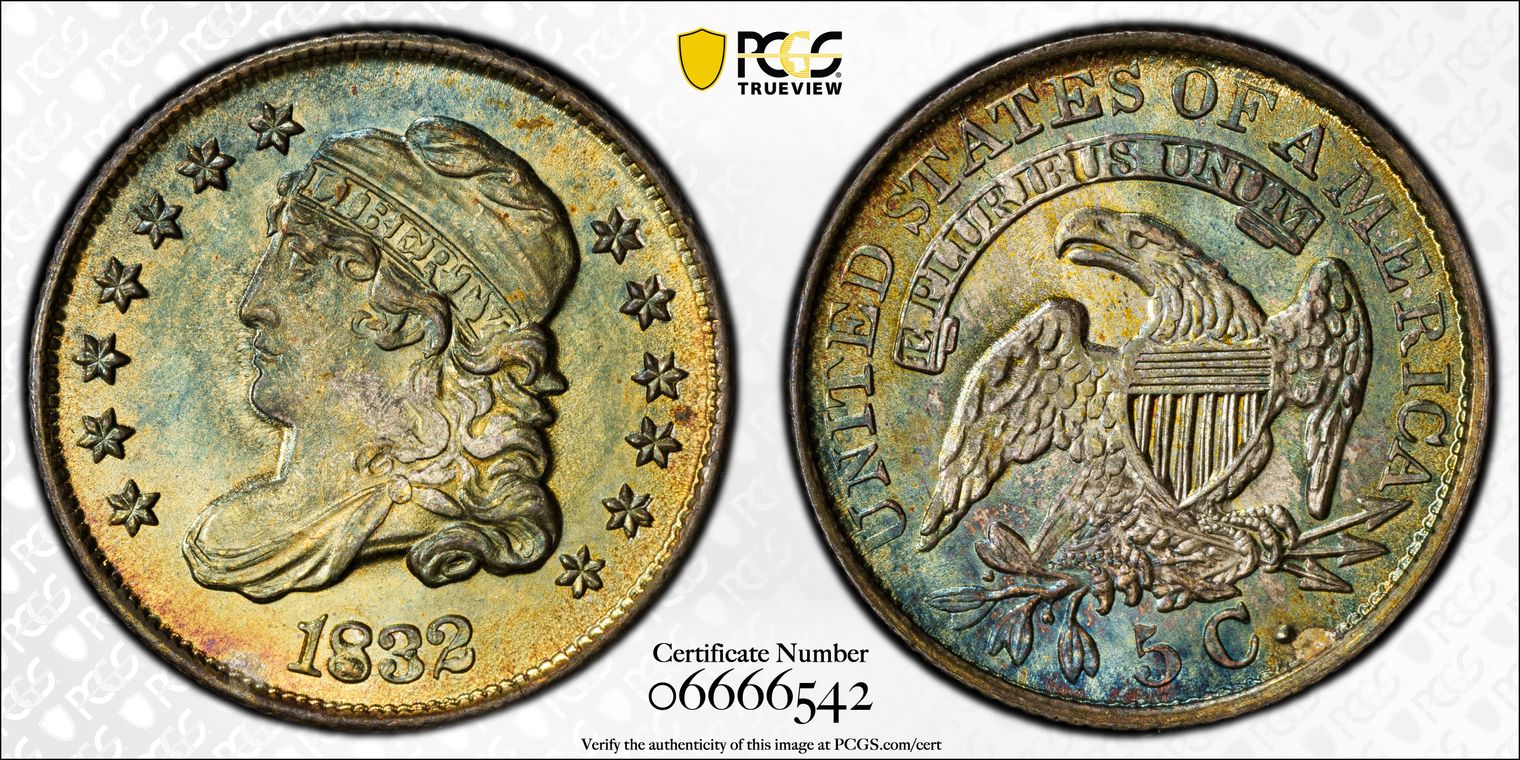
LM-13 R.3. CAC. Simpson. Bender. Finest Known Capped Bust Half Dime. Stunning quality, surfaces and eye appeal. Lovely colors with almost unbelievably clean surfaces. A beauty to behold. WOW! Obtained from Heritage Galleries Auction of the Bender Family Collection on August 24, 2022, Lot 3728.
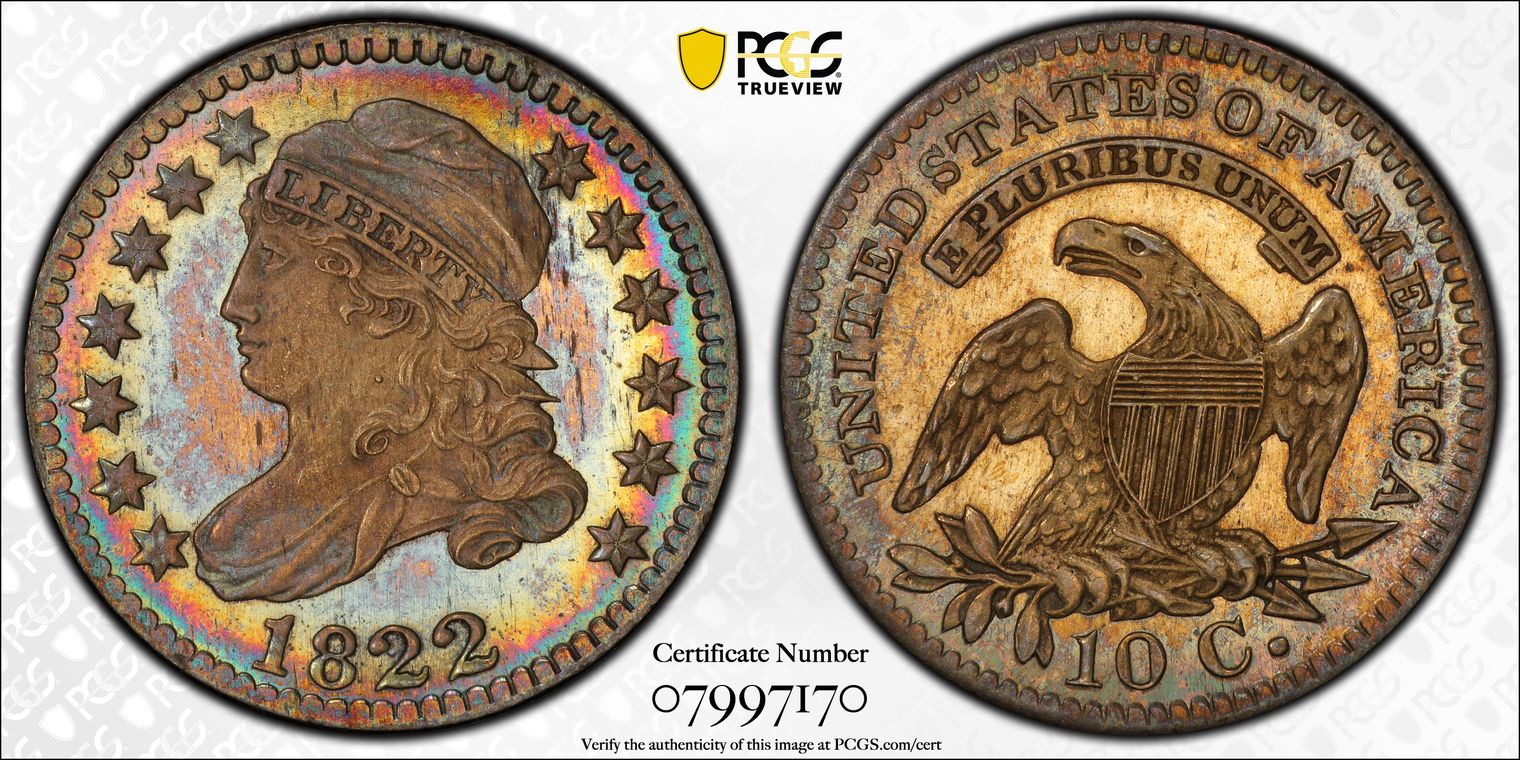
JR-1. R.8. CAC. Gardner. Quint. Two known. Per Heritage cataloger, "1822 Dime, Stunning PR66 Cameo. JR-1, The F.C.C. Boyd-James A. Stack Example. Likely Only Two Known. 1822 10C PR66 Cameo PCGS. CAC. JR-1, R.3, R.8 as a Proof. Ex: James Stack. Stunning surfaces on this no-questions proof show iridescent gold, blue, and green on the obverse encircling the portrait of Liberty, while the reverse offers lighter golden-gray in the centers with a ring of blue at the rims. The strike is sharper on the left-side stars than those on the right. The preservation is impeccable throughout. Variety: JR-1, R.3 as a circulation strike, but R.8 (two or three known) as a proof. Sole dies known for the year. The upper serif on the 1 in the denomination is defective, as seen on the circulation strikes. The existence of a single die pair known for the year reinforces the belief that much of the 1822 mintage was actually dated 1821 -- a year for which 10 die marriages are known. Population Data (5/14): Among Cameo coins, PCGS shows only this PR66 Cameo example. Among non-Cameo coins, there are two in PR66 and one in PR63. Duplications are almost a certainty, as we find auction records only for the PR63 and believe that only two different examples likely survive. NGC shows no proof 1822 dimes. Heritage Commentary: We can find auction records for only this piece and one other, the PR63 PCGS example which traded in a Superior sale (1/1990), lot 2432, for a strong (especially for the grade) $28,600 at the time. This Premium Gem Cameo 1822 proof dime is likely one of only two surviving, and it is by far the finest. The 1822 dimes saw a reported mintage of 100,000 pieces, compared to nearly 1.2 million for the 1821 issue and 440,000 coins for the 1823. Along with the smaller number, it appears, given the scarcity of 1822 dimes overall, that many of the dimes struck for circulation in 1822 actually bore the date 1821, an extremely common Mint practice of the day. Walter Breen also listed three proof 1822 dimes in his Proof Encyclopedia of 1989, despite having seen only one other. It is always possible that another 1822 proof dime could surface some day, but as years go by, the possibility recedes further. Even in a collection of the first water such as the Gardner Collection, this piece is simply a miraculous coin, a coin that clearly has no equal. Provenance: World's Greatest Collection (Numismatic Gallery, 5/1945), lot 467; James A. Stack Collection (Stack's, 1/1990), lot 28; Benson Collection, Part III (Goldberg, 2/2003), lot 1834, as PR66 PCGS, provisionally offered individually and as part of an (assembled) three-piece 1822 silver proof set including an 1822 quarter (B-1, PR65 PCGS; lot 1835) and 1822 half dollar (O-103, PR65 PCGS; lot 1836), but none of the lots sold, either individually or together; purchased from Joseph O'Connor (7/2007). Prior Heritage Auction June 23, 2014, $440,625, Lot 30242. Obtained by private treaty with Legend Numismatics on May 24, 2019.
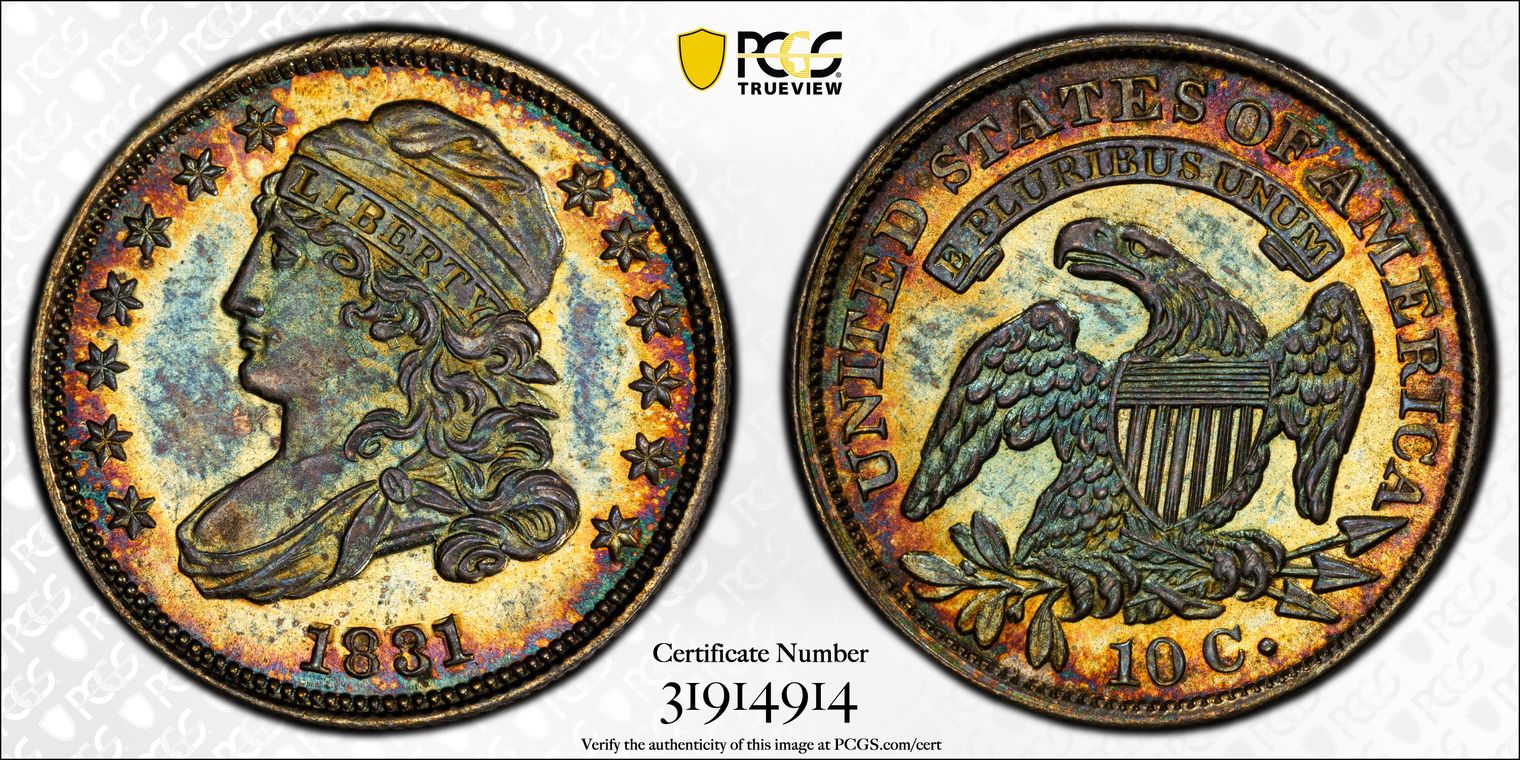
JR-5 R1. CAC. Pogue. Finest Known Small Size Capped Bust Dime. Finest Known 1831 Dime. How exactly does this coin exist one might ask? Breathtaking color, luster with essential perfect surfaces. Flashlight luster and wow!
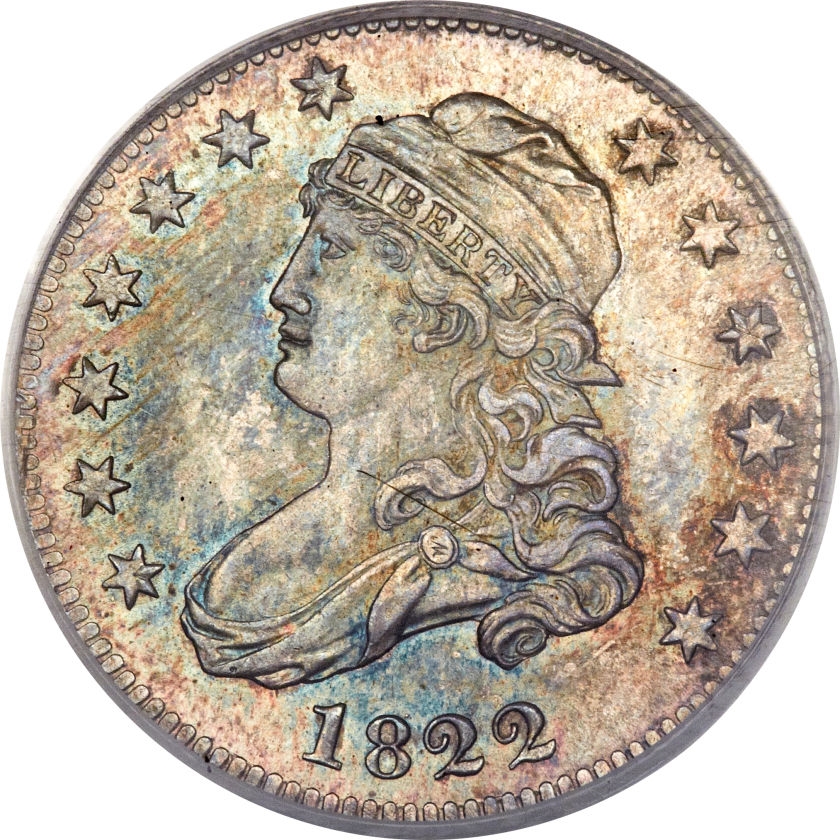
B-1 R2. Finest Known by 3 grading points. Only 4 large Sized Capped Quarters are graded MS67 at PCGS (and none finer) Per cataloger,"Single-Finest Certified. Recently Rediscovered Example. B-1, R.2, MS67 PCGS. A small mintage of 64,080 Capped Bust quarters was accomplished in 1822, with just two die varieties known for the date. This coin represents the more available B-1 variety, easily recognized by the Square Base 2 in the denomination. The scarce B-2 variety displays a blundered 25/5/50 denomination, and employs a Curl Base 2 numeral punch. A single obverse die was used to strike the entire production run and all coins seen were struck from perfect dies. The Capped Bust quarters were first studied and attributed by die varieties in the 1870s, by Captain John W. Haseltine and John Colvin Randall. In his famous Type Table catalog from November 1881, Haseltine described the 1822 B-1 quarter in lot 1330 as: "1822; No. 1; upper left star points to the junction of the upper curl with the band on the forehead; rev., P and I in 'Pluribus' are slightly to the left of being under the centres of S and second T in 'States' very fine; scarce." The lot realized $3.40, a strong price for the time. More recent sales include the spectacular MS64 NGC example from the "Colonel" Green-Eric P. Newman Collections (Heritage, 11/2013), lot 33168, which realized $25,850. That coin was billed as the finest known business-strike 1822 B-1 quarter at the time, but this piece easily eclipses it. The present coin has been off-the-market for decades and is not included in any recent Condition Census. It is the single-finest certified example at either of the leading grading services, with no serious challenger. We believe it is the Anderson Dupont example, last sold in lot 1796 of that Stack's sale in November of 1954, but the low-quality of the image in that appearance makes plate matching problematic. Like most examples seen, this coin shows just a touch of softness on some stars and the eagle's claw, but the eagle's feathers and Liberty's hair and drapery are boldly rendered. The impeccably preserved surfaces radiate vibrant mint luster, under spectacular shades of gold, lavender, and silver-gray toning. Eye appeal is terrific. This coin is a Registry Set essential. Population: 1 in 67, 0 finer (4/15)." Obained from Heritage Long Beach Auction #1221 on June 4, 2015, Lot 3896.
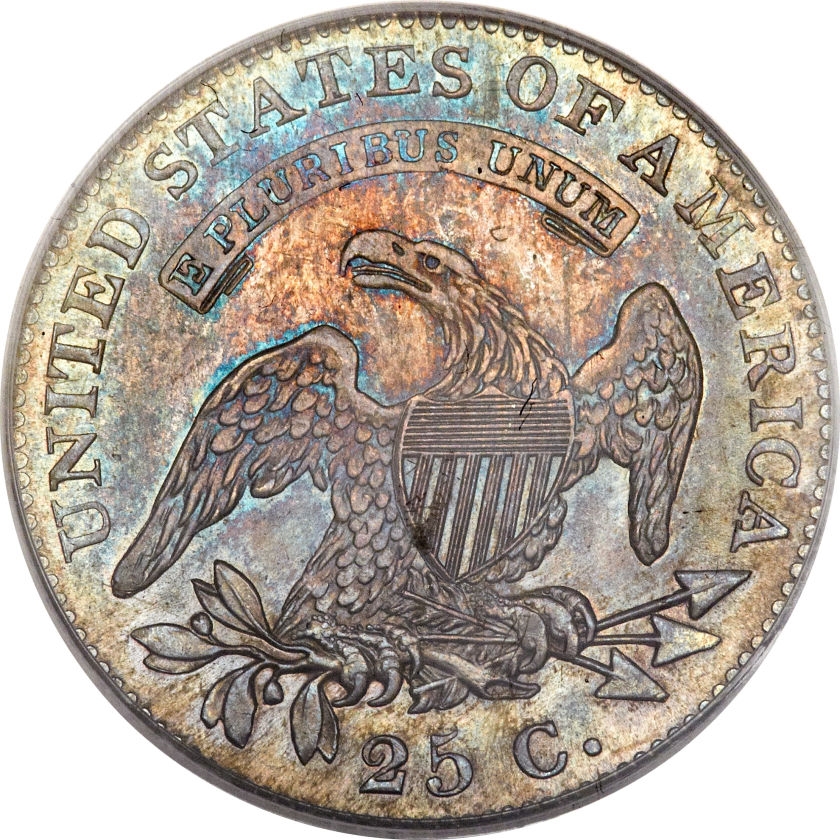
B-1 R2. Finest Known by 3 grading points. Only 4 large Sized Capped Quarters are graded MS67 at PCGS (and none finer) Per cataloger,"Single-Finest Certified. Recently Rediscovered Example. B-1, R.2, MS67 PCGS. A small mintage of 64,080 Capped Bust quarters was accomplished in 1822, with just two die varieties known for the date. This coin represents the more available B-1 variety, easily recognized by the Square Base 2 in the denomination. The scarce B-2 variety displays a blundered 25/5/50 denomination, and employs a Curl Base 2 numeral punch. A single obverse die was used to strike the entire production run and all coins seen were struck from perfect dies. The Capped Bust quarters were first studied and attributed by die varieties in the 1870s, by Captain John W. Haseltine and John Colvin Randall. In his famous Type Table catalog from November 1881, Haseltine described the 1822 B-1 quarter in lot 1330 as: "1822; No. 1; upper left star points to the junction of the upper curl with the band on the forehead; rev., P and I in 'Pluribus' are slightly to the left of being under the centres of S and second T in 'States' very fine; scarce." The lot realized $3.40, a strong price for the time. More recent sales include the spectacular MS64 NGC example from the "Colonel" Green-Eric P. Newman Collections (Heritage, 11/2013), lot 33168, which realized $25,850. That coin was billed as the finest known business-strike 1822 B-1 quarter at the time, but this piece easily eclipses it. The present coin has been off-the-market for decades and is not included in any recent Condition Census. It is the single-finest certified example at either of the leading grading services, with no serious challenger. We believe it is the Anderson Dupont example, last sold in lot 1796 of that Stack's sale in November of 1954, but the low-quality of the image in that appearance makes plate matching problematic. Like most examples seen, this coin shows just a touch of softness on some stars and the eagle's claw, but the eagle's feathers and Liberty's hair and drapery are boldly rendered. The impeccably preserved surfaces radiate vibrant mint luster, under spectacular shades of gold, lavender, and silver-gray toning. Eye appeal is terrific. This coin is a Registry Set essential. Population: 1 in 67, 0 finer (4/15)." Obained from Heritage Long Beach Auction #1221 on June 4, 2015, Lot 3896.
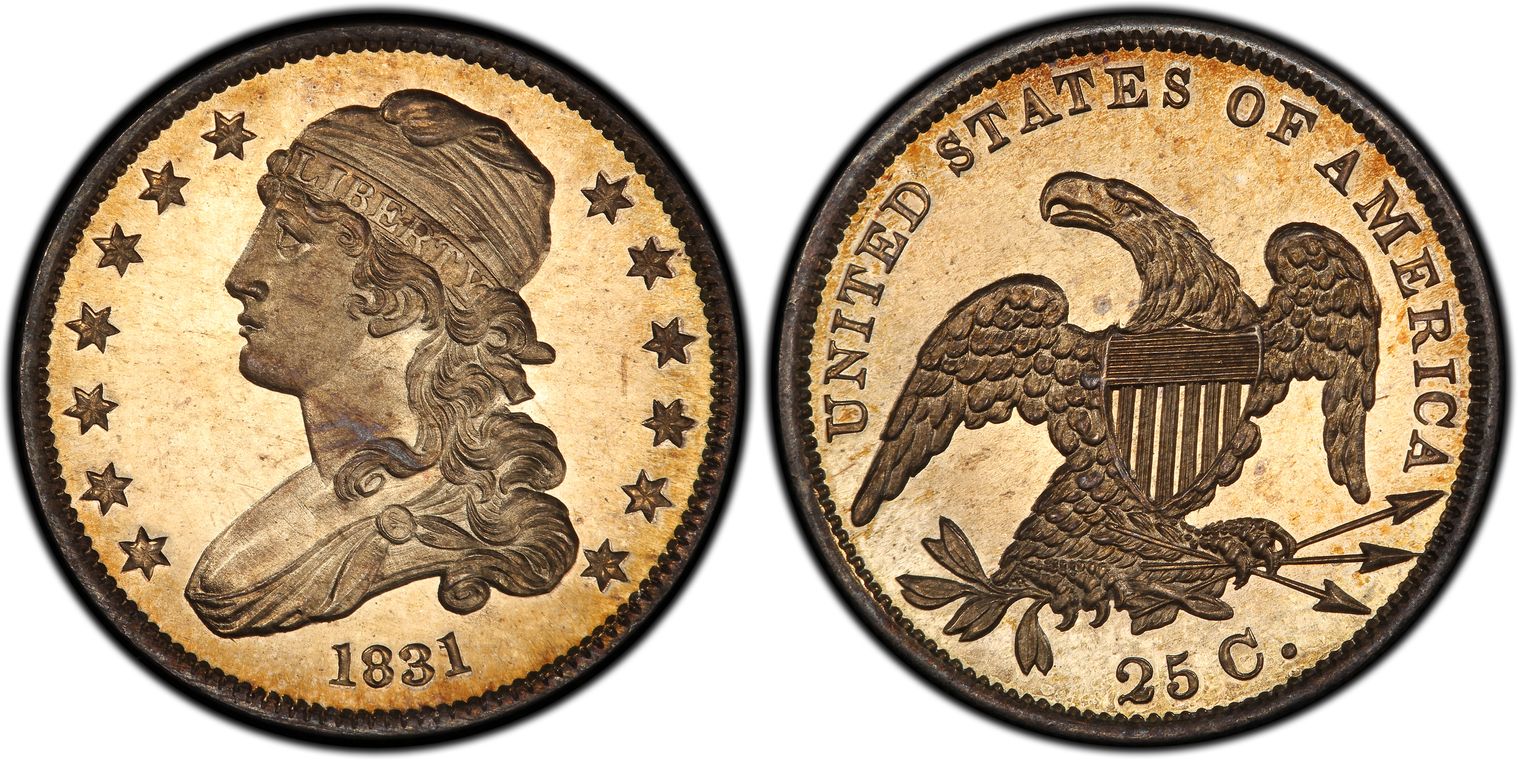
B-5. R.7. Private treaty with Numismatic Financial Corporation on December 18, 2014.
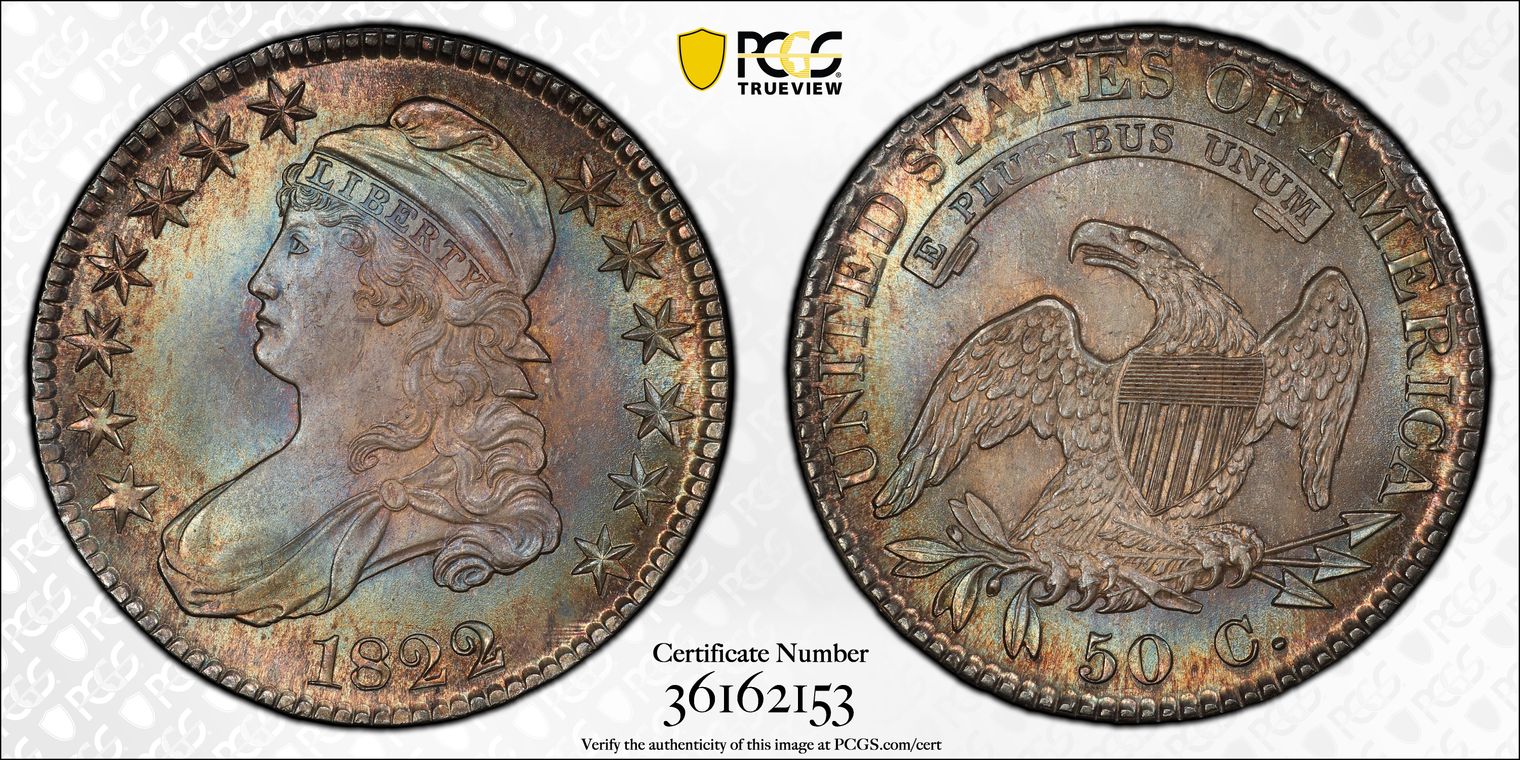
O-106. CAC. R3. Finest Known 1822 Half Dollar. Blazing cartwheel luster and color with pristine surfaces. Visually stunning eye appeal. Obtained by private treaty from Numismatic Americana on August 15, 2018.
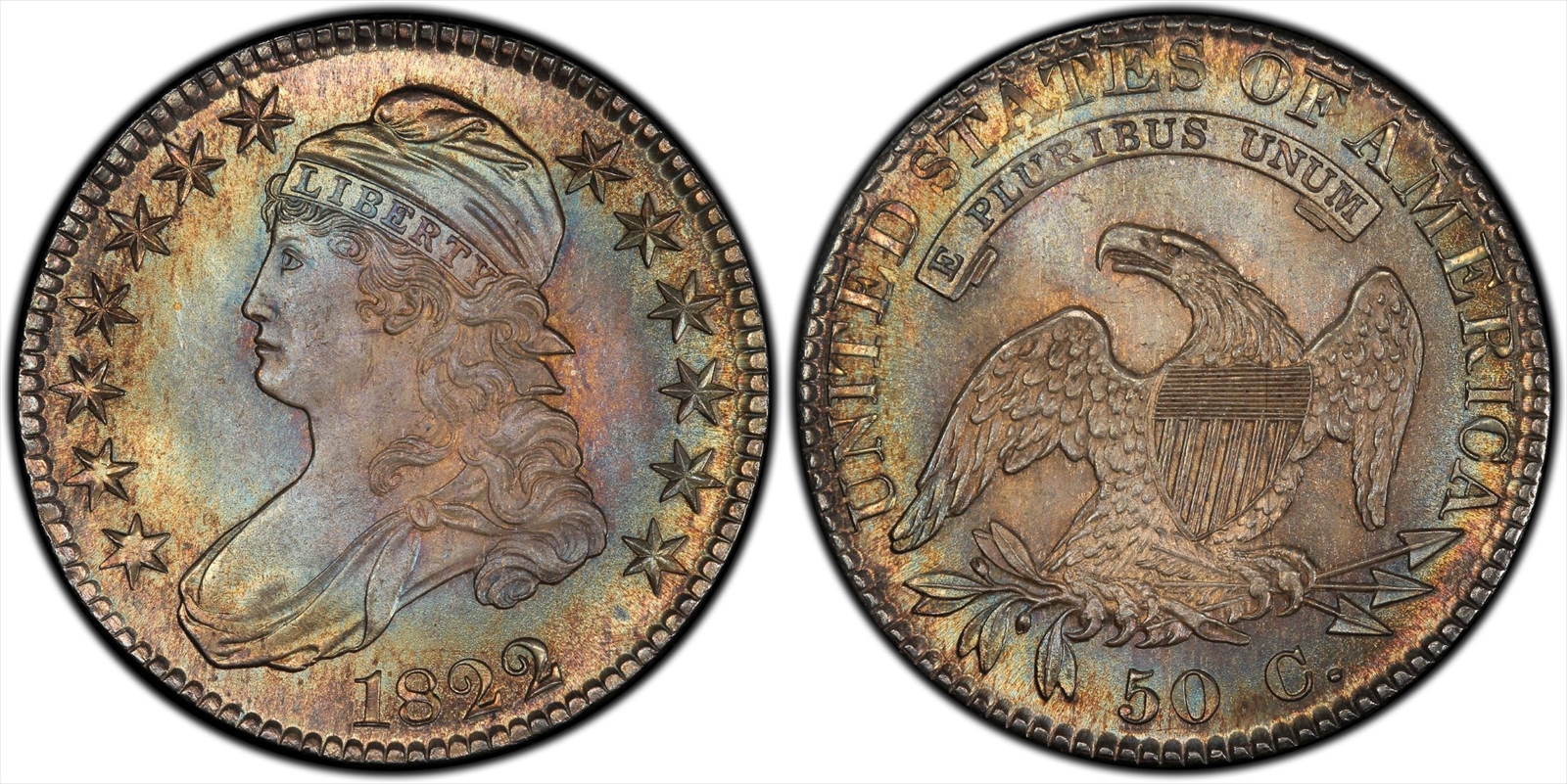
O-106. CAC. R3. Finest Known 1822 Half Dollar. Blazing cartwheel luster and color with pristine surfaces. Visually stunning eye appeal. Obtained by private treaty from Numismatic Americana on August 15, 2018.
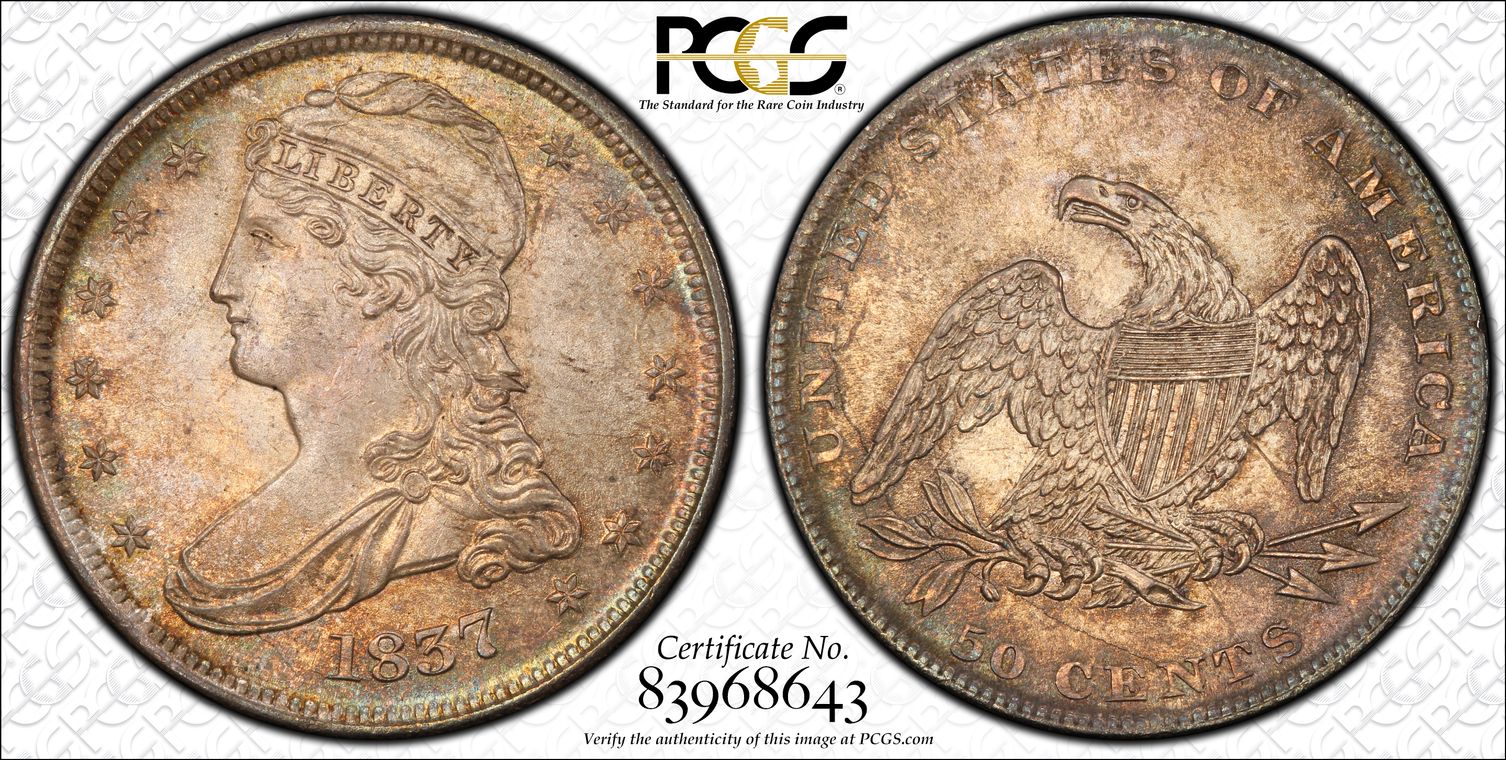
GR-18 CAC. R.1 Lovely original tan surfaces with outstanding eye appeal. Among the finest known of all 1837 halves, and very competitive in coins in MS67 holders (one of which I turned down for this current one). Per cataloger, "Beautiful 1837 Reeded Edge Half Dollar. Condition Census. 1837 Capped Bust Half Dollar. Reeded Edge. 50 CENTS. GR-18. Rarity-1. MS-66 (PCGS). CAC. This is a stunning example of a short-lived, design type in the Capped Bust half dollar series. Soft sandy-silver patina is enhanced with wisps of iridescent olive-russet and champagne-apricot highlights that are largely confined to the peripheries. Intense satin luster is seen throughout and the striking detail is sharp to full. This is easily one of the most carefully preserved, visually appealing examples of the Capped Bust, Reeded Edge, 50 CENTS half dollar that we have ever offered. It is sure to see spirited bidding among advanced specialists and Gem type collectors. This short-lived type, produced only in 1836 and 1837, came about through the introduction of steam coinage to the United States Mint. The first working dies for the Reeded Edge Capped Bust half dollar were completed by Christian Gobrecht during the autumn of 1836. The type is superficially similar to that of its Lettered Edge predecessor, although Liberty's portrait and the eagle have a more refined look, the scroll on which the Latin motto E PLURIBUS UNUM was engraved in the upper reverse field is gone, and the diameter is smaller and more uniform within a beaded border. The final-listed refinement, in particular, was meant to accommodate the close collar, a new innovation to the United States made possible by the introduction of the steam press. The close collar allowed the Mint to produce half dollars not only of a uniform diameter, but also with a reeded edge for the first time. A final innovation of the revolutionary Reeded Edge half dollar is a revised weight standard of 13.36 grams, as stipulated by the Act of January 18, 1837. Gobrecht's initial Reeded Edge half dollar design has the denomination expressed as 50 CENTS along the lower reverse border. This was changed in 1838 to read HALF DOL., presumably for uniformity with the contemporary quarter and silver dollar. Given the rarity and key date status of the 1836 Reeded Edge, the 1837 is the only realistic type candidate of the 50 CENTS design for most collectors. Mint State examples, however, are scarce in an absolute sense and rare relative to the strong demand for them among collectors building high grade type sets. In the finest Mint State grades, as here, the 1837 is very rare by any standard. Solidly in the Condition Census for both the issue and the type. This handsomely toned, expertly preserved Gem represents an important find for the connoisseur. Exquisite! PCGS Population (all die marriages of the issue): only 5; with a lone MS-67 finer." Obtained from Stacks Bowers Auction of the Douglas Kaselitz Collection on July 2015
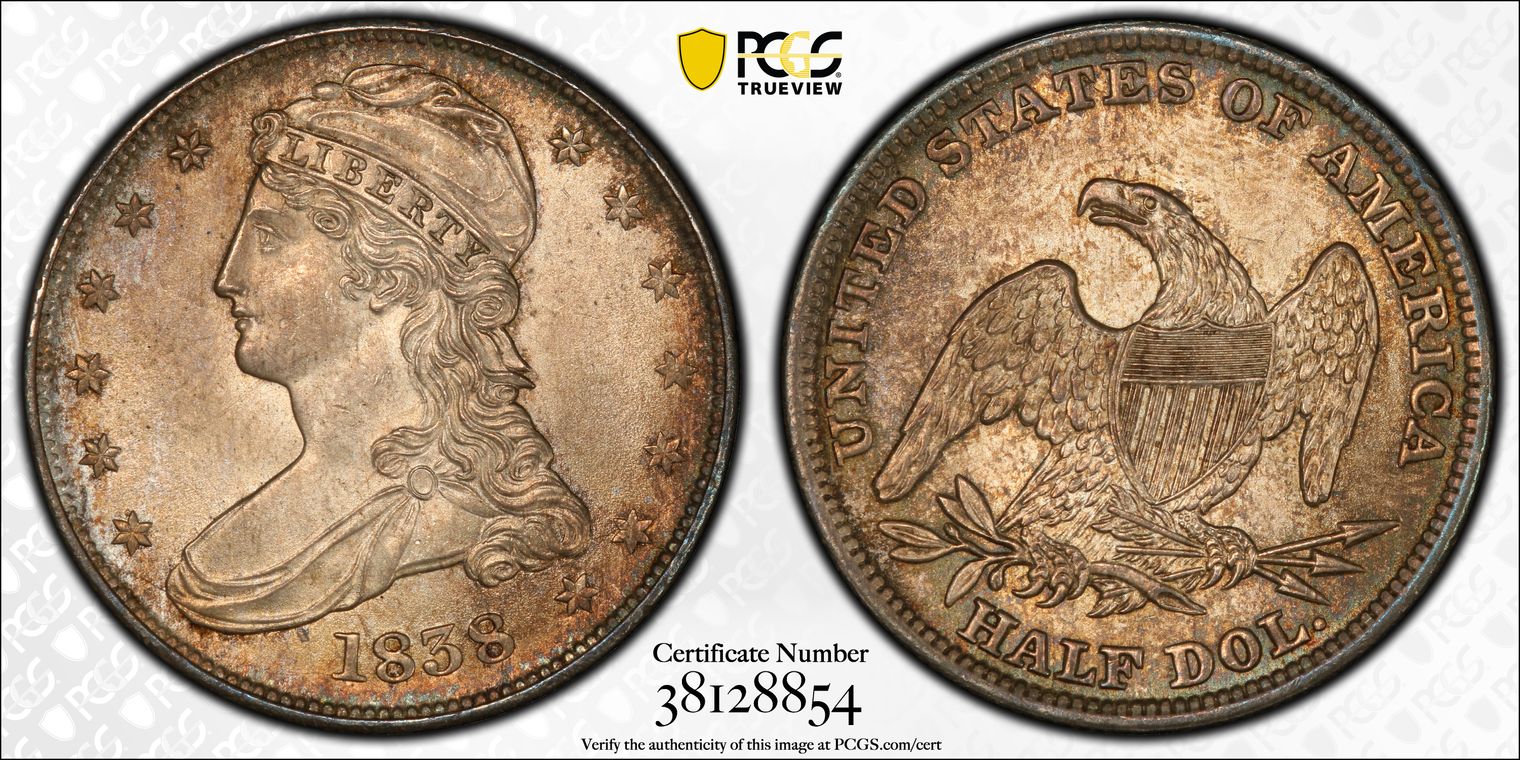
GR-11 R1. CAC. Eliasberg. Finest Known 1838 Half Dollar. Per Heritage cataloger, "Lot 5149. Wow! "The Mint introduced steam-powered coin presses in 1836 and used a close collar on the half dollar denomination for the first time, as well. These innovations made the Reeded Edge design possible, and large numbers of high-quality coins could be produced to meet the economic needs of the time. The reverse design was changed in 1838, with the denomination expressed as HALF DOL. instead of 50 CENTS, and the Capped Bust obverse was replaced by Gobrecht's Seated Liberty in 1840. As the first issue of the short-lived HALF DOL. design, the 1838 Reeded Edge half dollar is especially important to type collectors. The present coin is the finest known example of the date, with no serious challenger. This coin is the single finest certified at NGC, while PCGS has graded no examples finer than MS66 (11/11). It occupies the number 1 spot in Stephen J. Herrman's Condition Census and claims a pedigree of illustrious owners back to the 19th century. This coin traces its history to the fabled Eliasberg Collection, and before that to the famous father-and-son collecting team of John M. and John H. Clapp, and finally to H.P. Smith, who served as a sort of dean of respected coin dealers in the late 19th century. Eliasberg was the only collector to ever complete a full collection of U.S. federal coins by date, mintmark, and major design type. He was also justly famous for the quality of the coins in his collection, as he would accept only the finest available specimens. The present coin is a marvelous Superb Gem, with sharply detailed design elements throughout. The eagle's claws are complete and fine definition shows on all of Liberty's curls. The virtually pristine surfaces are blanketed in attractive shades of russet-gold and gunmetal-blue patina, with satiny mint luster on both sides. This magnificent coin should find a home in the finest collection of Reeded Edge half dollars. The present coin is a marvelous Superb Gem, with sharply detailed design elements throughout. The eagle's claws are complete and fine definition shows on all of Liberty's curls. The virtually pristine surfaces are blanketed in attractive shades of russet-gold and gunmetal-blue patina, with satiny mint luster on both sides. This magnificent coin should find a home in the finest collection of Reeded Edge half dollars." Ex: Harlan Page Smith Collection (S.H. & H. Chapman, 5/1906), lot 667; John M. Clapp; John H. Clapp; Clapp Estate to Louis Eliasberg in 1942, via Stack's; Louis E. Eliasberg, Sr. Collection (Bowers and Merena, 4/1997), lot 1910; Pre-Long Beach Elite Coin Auction (Superior, 5/2006), lot 4233; Johnson-Blue Collection (Stack's, 8/2010), lot 502; FUN (Heritage, 1/2012), lot 3233". Obtained at Heritage Platinum Night Auction #1173 on August 3, 2012. Crossed from NGC MS67 [686283-002} to PCGS MS66+ on 6/23/2017.