



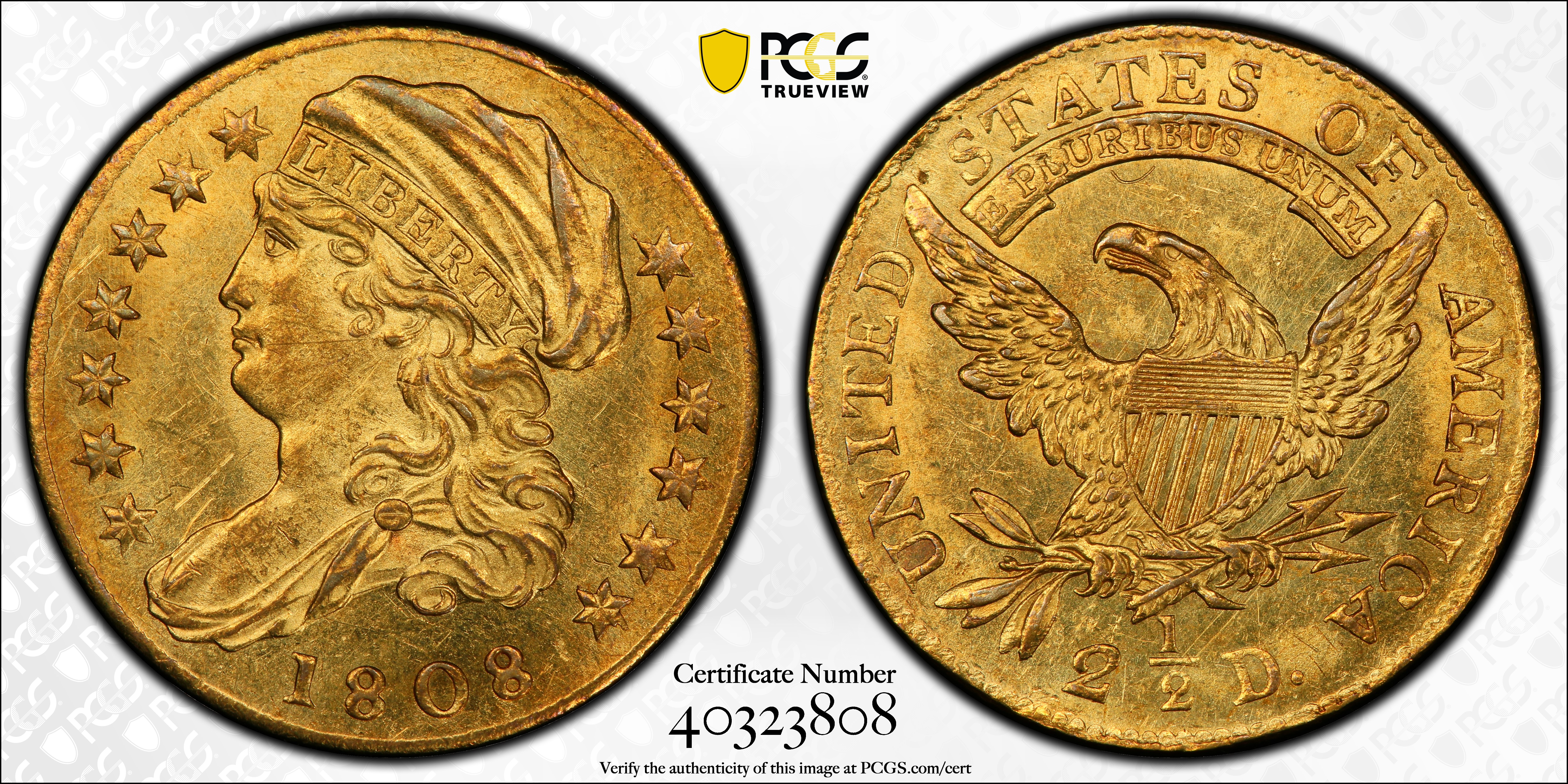
1808 $2.50 MS63 Certification #40323808, PCGS #7660
Owner's Comments
Expert Comments
Charles Morgan
The 1808 Capped Bust Quarter Eagle
For many collectors pursuing a complete U.S. gold type set, the 1808 Capped Bust Quarter Eagle ( #7660, BD-1 #45515) represents a formidable "stopper." The design debuted in 1808, was utilized for a single mintage of just 2,710 coins, and was never used again. The United States Mint suspended production of the quarter eagle from 1809 through 1820; when coining finally resumed in 1821, the "Large Cap" motif was abandoned in favor of a smaller, modified head style executed by Chief Engraver Robert Scot.
The genesis of this distinct type was a mandate from Mint Director Robert Patterson to John Reich for a comprehensive redesign of all denominations. Reich, a Bavarian native, brought a European aesthetic to the Mint beginning April 1, 1807. During his ten-year tenure, he successfully redesigned every denomination from the Half Cent to the Half Eagle. In 1807, his Capped Bust design debuted on the Half Dollar and Half Eagle. A modification of this design, the Classic Head, appeared on Large Cents in 1808 and Half Cents in 1809. The Capped Bust look was adapted for Dimes in 1809, Quarters in 1815, and Half Dimes in 1829, twelve years after Reich left the Mint.
While John Reich was an exceptionally skilled engraver, he spent much of his tenure at the Mint working in the shadow of Scot.
Reich's Quarter Eagle Design
For his Capped Bust Quarter Eagle, Reich flipped Liberty's profile to face left and moved the legend "LIBERTY" from the upper periphery to the headband of a large pileus cap.
On the reverse, Reich introduced a heraldic eagle that became a cornerstone of American coinage. This motif served as the foundational motif for various iterations across all $2.50, $5, and $10 gold denominations for a full century, from 1807 through 1907.
Production
The Philadelphia Mint struck the entire mintage of 2,710 coins on a single day: February 26, 1808. Following this brief production run, the denomination was suspended for 13 years, rendering the 1808 a unique, one-year-only type. While early studies suggested a survival of only 35 to 40 specimens, PCGS population data indicates the true number of extant pieces likely exceeds 120, with approximately half of the known examples being impaired.
Technical Characteristics
Collector Harry W. Bass, Jr. and numismatist John Dannreuther confirmed that only one die marriage was used for the entire mintage. Consequently, all known examples share specific diagnostic features:
- Die Crack: A faint, thin die crack traditionally extends from the top of Liberty’s cap toward the stars on the right.
- Weak Borders: A lack of well-defined denticles or borders is the defining characteristic of the 1808 issue.
- Hooked 13th Star: This features is often attributed as an intentional signature added by Reich.
Numismatist Walter Breen speculated that these shallow borders left the coins' surfaces vulnerable, leading to a high rate of wear and "rim problems" seen on nearly every surviving specimen.
Collecting the 1808 Capped Bust Quarter Eagle
The 1808 Capped Bust Quarter Eagle is a rarity that typically falls into one of two categories: high-grade (About Uncirculated to low Mint State) or impaired. The "crucible" of the early 19th-century melting pots claimed the vast majority of the mintage, which explains the unusual scarcity of examples in lower circulated grades.
Many experts, including John Kraljevich, Jr. in his cataloging for the D. Brent Pogue Collection, have noted that many coins currently graded MS60 or MS61 would likely have been considered "About Uncirculated" by previous generations. While true, this shift must be viewed in context. Before the advent of PCGS, the industry lacked a uniform grading standard. Different dealers might use a term like "Extremely Fine" to describe a coin we now recognize as Mint State, and these decisions were rarely made through consensus or the benefit of seeing a broad population of survivors.
Today’s collectors possess a much more sophisticated and standardized view of grading. Consequently, direct comparisons between 19th-century catalogs and modern certified holders are often impossible. Consider the very coin Kraljevich highlighted in the Pogue catalog: the Parmelee-Pogue 1808 Quarter Eagle, currently graded PCGS MS65. This stunning specimen has seen a fascinating evolution of descriptors:
- 1890 (Parmelee Sale): "Very fine, scarcely circulated."
- 1921 (John Story Jenks Sale): "Extremely Fine, showing only the slightest abrasion."
- 1962 (Abe Kosoff): A "dream coin" for the Dr. J. Hewitt Judd collection.
- 1989 (David W. Akers): "A very choice uncirculated 64."
- 2015 (PCGS): PCGS MS65.
Throughout these decades of shifting terminology, one thing remained consistent: you would not find a better example. This finest-known specimen ultimately set a world record, selling for $2,350,000 in 2015.
* * *
Rarity and Survival Estimates Learn More
| 65 or Better | 132 |
| All Grades | 9 |
| 60 or Better | 1 |
| 65 or Better | R-7.6 |
| All Grades | R-9.6 |
| 60 or Better | R-10.0 |
| 65 or Better | 1 / 1 |
| All Grades | 1 / 1 |
| 60 or Better | 1 / 1 |
| 65 or Better | 10 / 12 TIE |
| All Grades | 2 / 12 TIE |
| 60 or Better | 1 / 12 TIE |
Condition Census Learn More
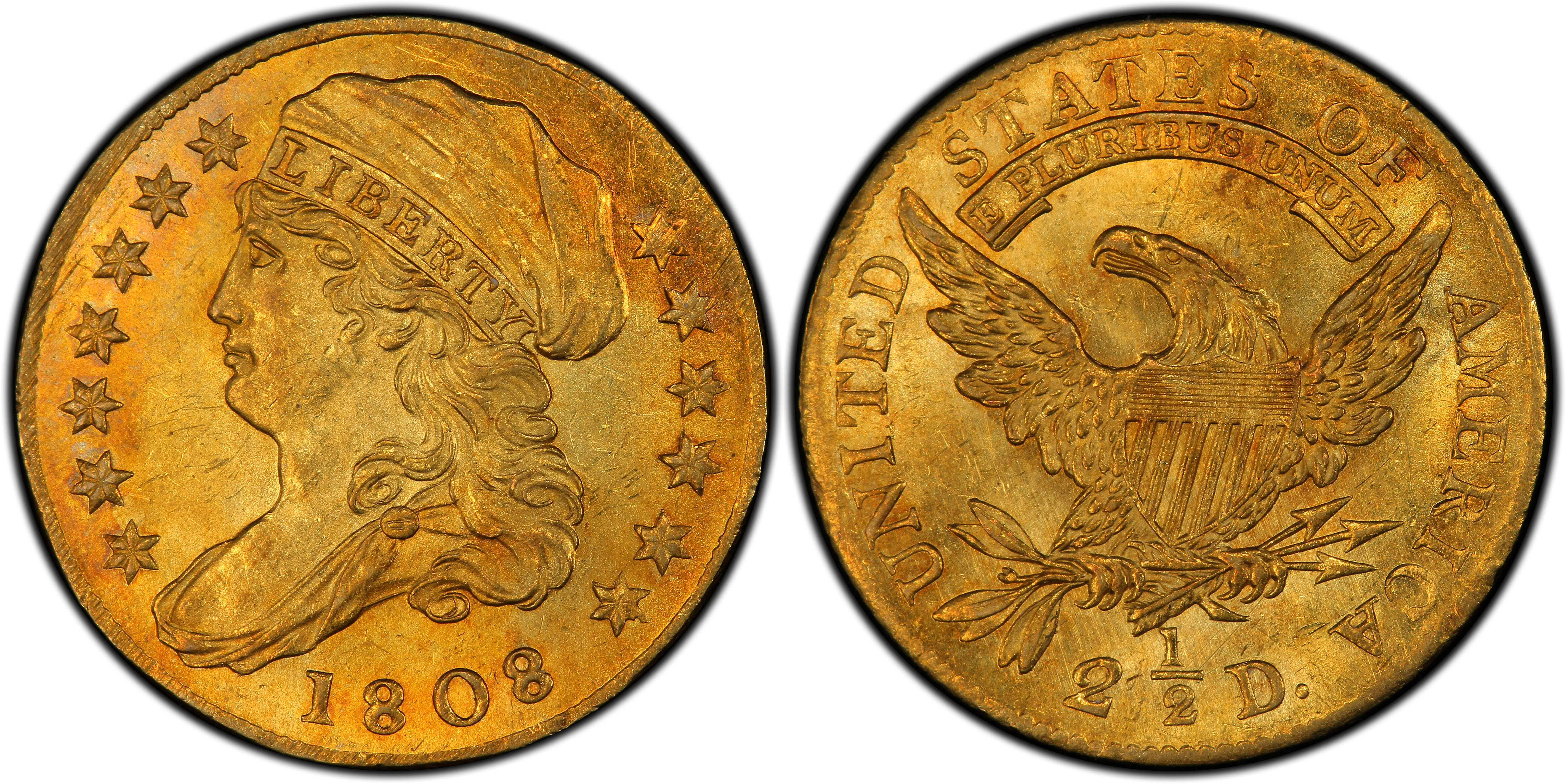 #1 PCGS MS65
Lorin G. Parmelee, acquired before 1890. As "Very fine, scarcely circulated." “Lorin G. Parmelee Collection,” New York Coin and Stamp Company, June 1890, Lot 856 - $5.75; John Story Jenks. As "Extremely Fine, showing only the slightest abrasion." “John Story Jenks Collection," Henry Chapman, December 1921, Lot 5792 - $100; "Colonel" E.H.R. Green; "Colonel" E.H.R. Green estate to Burdette G. Johnson, via Eric P. Newman; B. Max Mehl, May 1950, Lot 11; Dr. J. Hewitt Judd to Dr. Herbert Ketterman; Dr. Ketterman to Jimmy Hayes in Kansas City, Missouri, via sale, 1982; "Auction '84," Stack’s, July 1984, Lot 1372 - $99,000. As "Very Choice Uncirculated 64." "Auction '89," David W. Akers, July 1989, Lot 1361 - $231,000. Pogue Family Trust. As PCGS MS65 #31385747. “The D. Brent Pogue Collection, Part I,” Stack’s Bowers / Sotheby’s, May 19, 2015, Lot 1128 – $2,350,000. BD-1. Kosoff called this a dream coin, when describing it in the Judd Collection in 1962. |
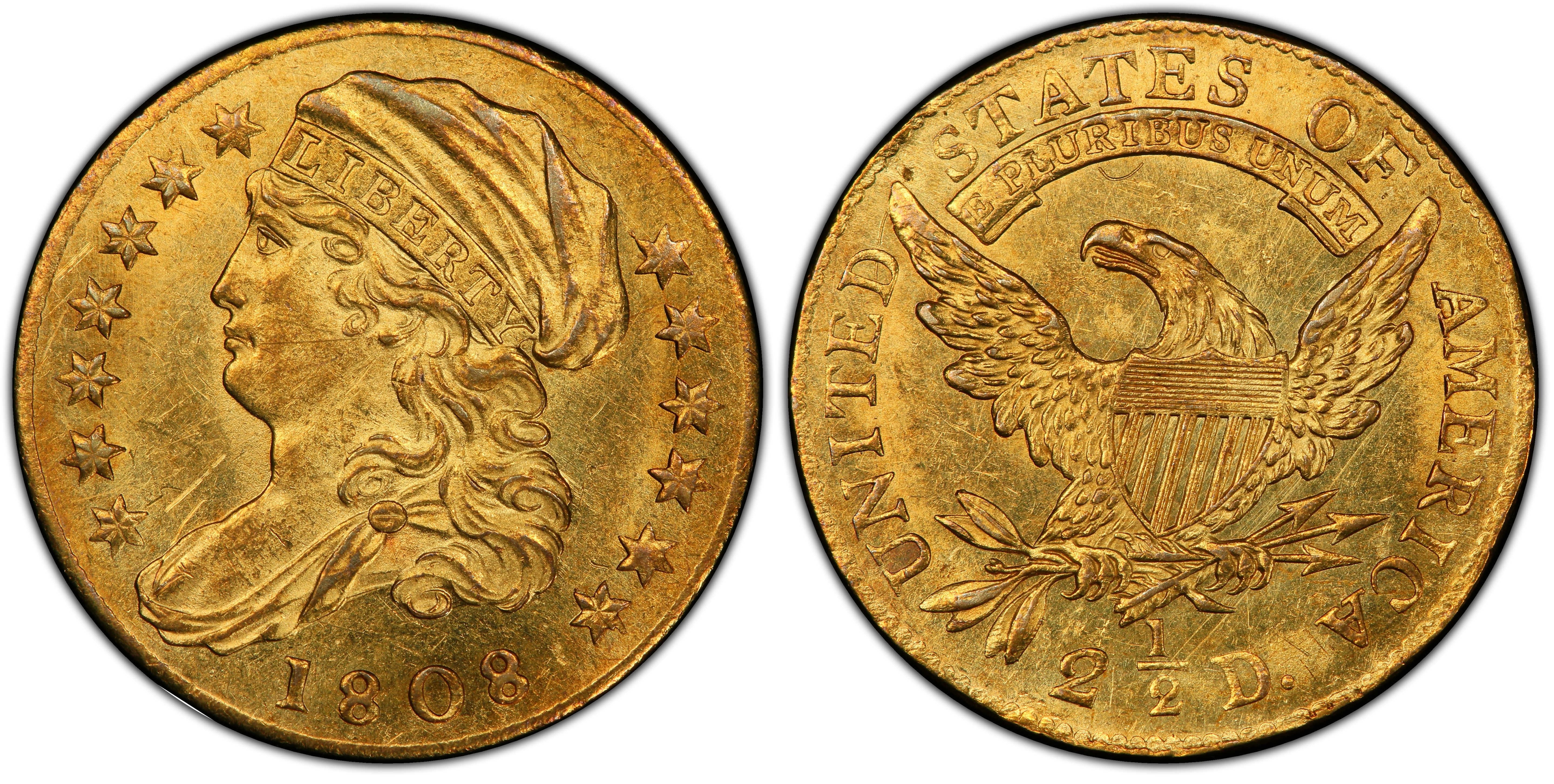 #2 PCGS MS63
Heritage Auctions, August 2001, Lot 7585 – $73,600; As PCGS MS63. “Oliver Jung Collection,” American Numismatic Rarities, July 2004, Lot 84 – $322,000; Stack’s, March 2007, Lot 1441 – $425,500; Stack’s, November 18, 2008, Lot 4176 – $517,500. As PCGS MS63 #40323808. Heritage Auctions, September 17, 2020, Lot 10122 – $576,000; "The earlyAurum Collection" (PCGS Set Registry). BD-1. Full borders on both sides. Copper steel patination on the high points of Liberty's cap and the eagle's head. Curved lintmark under RIB in E PLURIBUS UNUM |
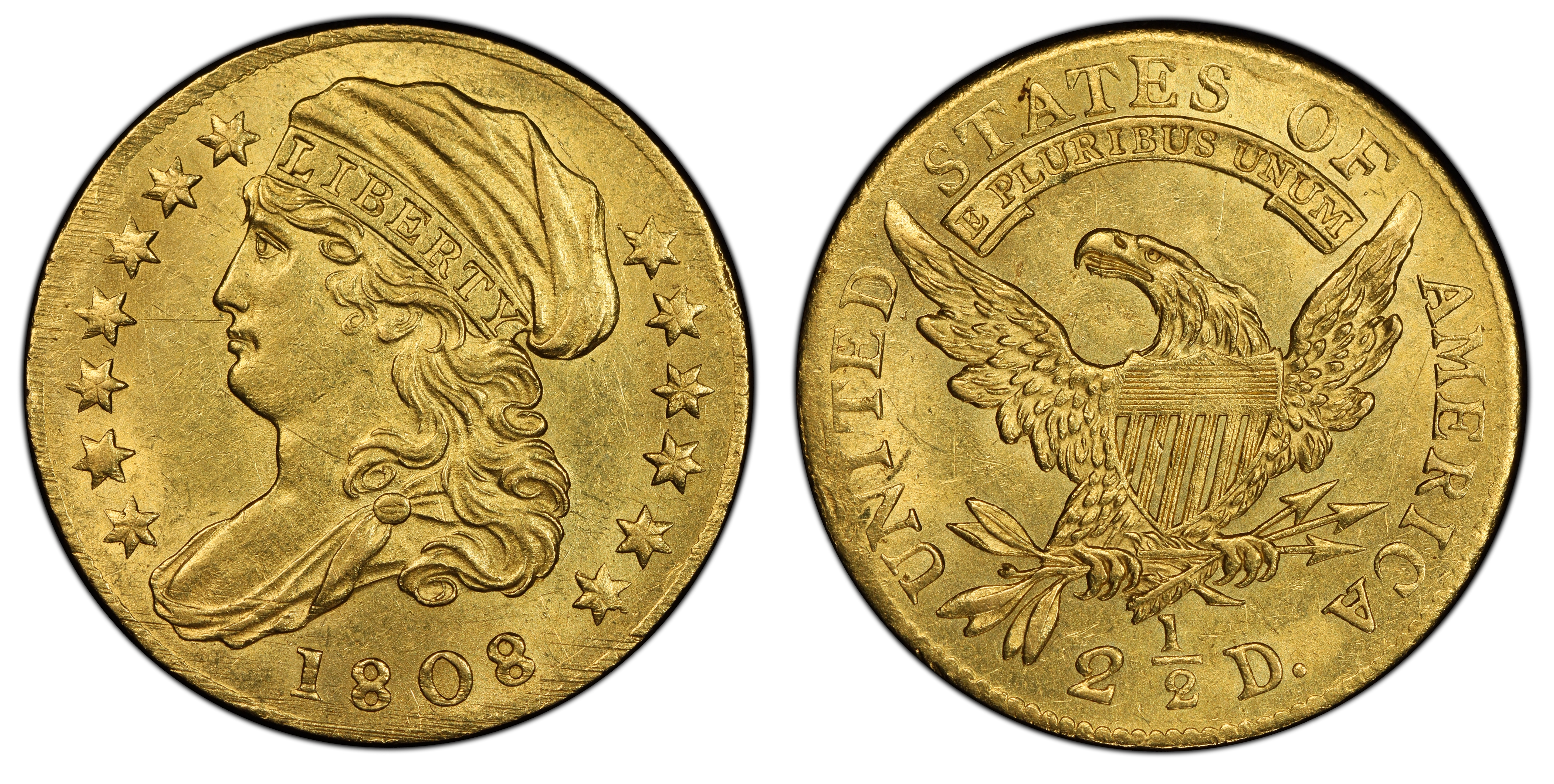 #3 PCGS MS62
Abner Kreisberg, March 1972, Lot 1163. As PCGS MS62 #46092657. “The Harry W. Bass, Jr. Core Collection, Part II,” Heritage Auctions, January 5, 2023, Lot 9006 – $372,000. Adjustment marks are visible along the left and bottom obverse peripheries. A thin, diagonal mark connects Star 4 to Liberty's lips, with a similar diagonal mark noted across the neck. On the reverse, a tiny fleck of original copper-red toning is nestled at the apex of the "A" in STATES. |
|
#3 PCGS MS62
As NGC MS63 #1776966-006. “The Freedom Collection,” Heritage Auctions, January 4, 2007, Lot 3392 – $287,500; “The Madison Collection,” Heritage Auctions, January 10, 2008, Lot 3069 – $322,000. As PCGS MS62 #14468068. "The Black Cat - 100 Greatest U.S. Coins Collection" (PCGS Set Registry). BD-1. Full radial lines are visible on stars 1, 3 through 7, and 11 through 13. A small tick is noted to the right of star 1, with another situated to the left of the "T" in LIBERTY. The reverse exhibits adjustment marks at 12 o’clock, while splotchy dark toning arcs from star 1 around the base of the design to star 12. |
 #3 PCGS MS62
BD-1. Light adjustment marks are present at the upper-left obverse periphery. On the reverse, minor rim bumps are noted above the "E" and the second "A" in AMERICA. |