



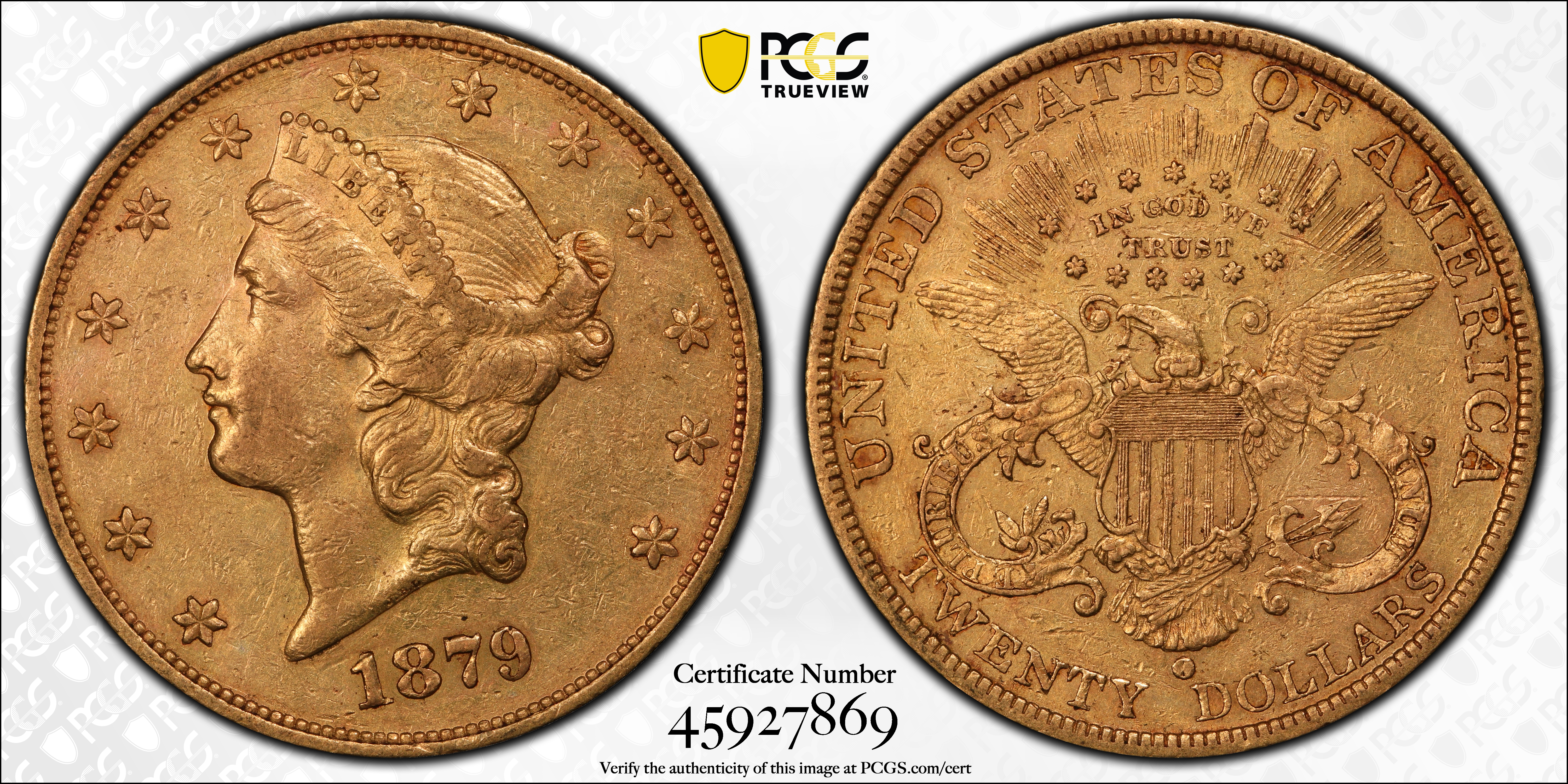
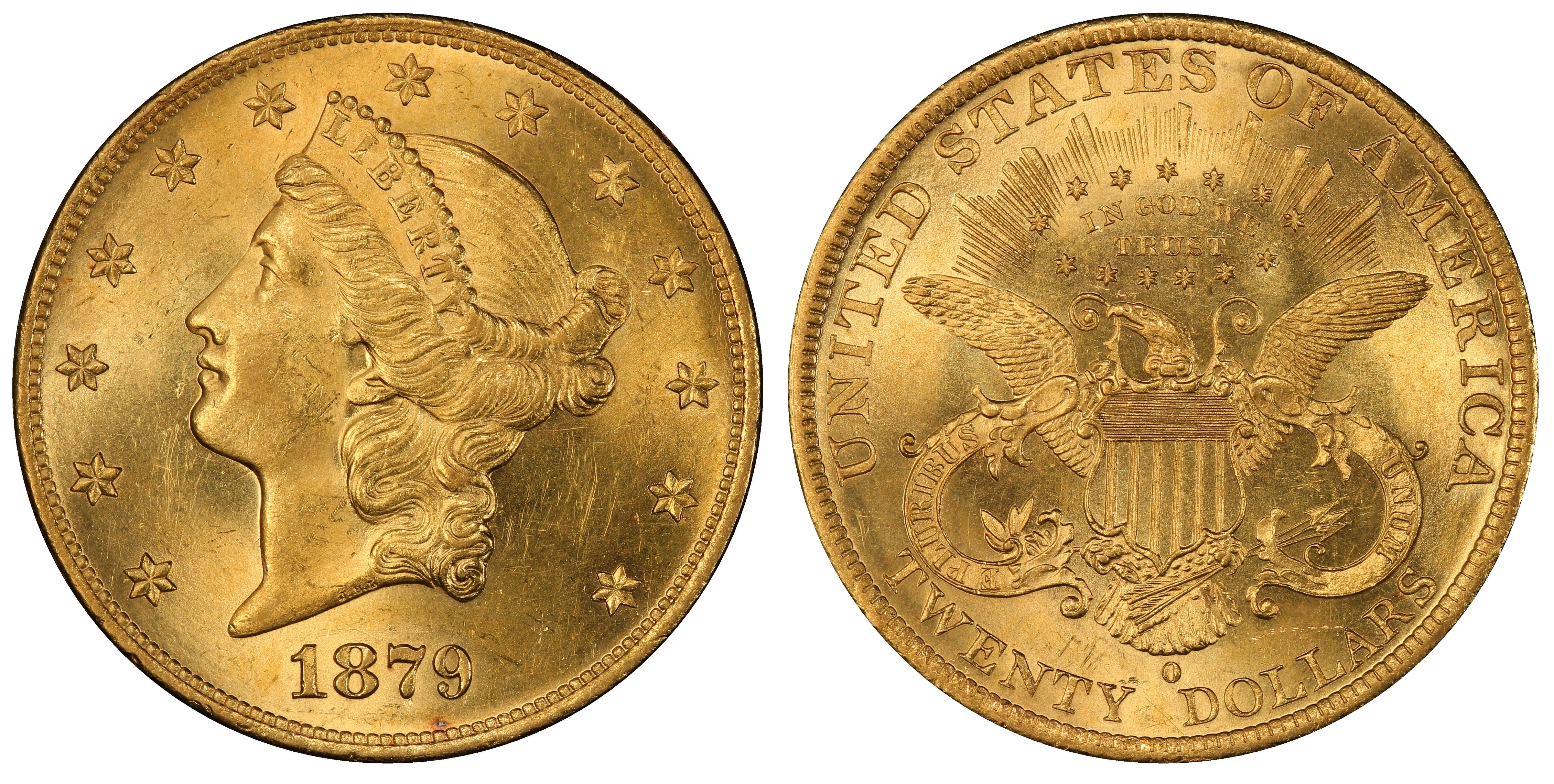
1879-O $20 XF45 Certification #45927869, PCGS #8990
Owner's Comments
Expert Comments
Charles Morgan
The 1879-O Liberty Head Double Eagle
The American Civil War effectively halted operations at the three Southern branch mints: Charlotte (North Carolina), Dahlonega (Georgia), and New Orleans (Louisiana). Of these, only New Orleans would reopen as a mint after the conflict. Recognizing the strategic importance of the Mississippi waterways, Union forces seized the city on April 25, 1862. While the facility remained under federal control during the occupation, no coinage was produced; the building gained notoriety, however, when a Union flag desecrator was executed for treason from its rooftop.
The New Orleans Mint returned to service first as an Assay Office in 1876 and then as a branch mint in 1879. The Bland-Allison Act, with its mandate to produce millions of silver Morgan Dollars, was the primary catalyst for the resumption of coinage. Additionally, the Specie Payment Resumption Act of 1875 provided the economic justification for a limited production of gold coinage at the facility.
Collecting the 1879-O Liberty Head Double Eagle
Following its introduction in 1850, the Liberty Head Double Eagle became the dominant gold coin of the United States. Although seldom used for daily purchases, as its face value often exceeded a citizen's weekly wage, it was vital for backing currency, bank-to-bank transfers, and international trade. In 1879, Double Eagles were struck at Philadelphia (#8988), Carson City (#8989), New Orleans (#8990), and San Francisco (#8991).
The 1879-O is a significant rarity, representing the first $20 gold coin issued in New Orleans since 1861 and the only Type 3 (With Motto, "Twenty Dollars") issue struck at the facility. It was produced from a single set of dies and has a mintage of just 2,325 pieces—the second-lowest for any New Orleans Double Eagle, surpassed only by the 1856-O (#8918). While its mintage is low, its surviving rarity is often compared to the 1854-O, 1855-O, and 1859-O. Most known examples are circulated, and many have been harshly cleaned; Mint State specimens number under 10.
The Fairmont Hoard included four examples, none of which graded finer than PCGS AU58. Two Condition Census examples - including the finest known - sold recently as part of "The Collection of a Texas Gentleman."
1879-O Liberty Head Double Eagle: Physical Characteristics
(per Doug Winter)
- Die Marriage: There is only one known die marriage for this issue: The date is small and centered midway between the bust truncation and the denticles. The mintmark is very small and placed centrally between the Y in TWENTY and the D in DOLLARS.
- Strike: This issue is among the best-struck New Orleans Double Eagles. The Type 3 design generally offers better hair detail than Type 1 issues, and most 1879-O examples exhibit crisp detail in the hair and full radial lines in the stars. The reverse is occasionally less boldly impressed, with some lightness noted on the lettering.
- Surfaces: Virtually every known example displays numerous deep abrasions. Furthermore, many 1879-O specimens show mint-made planchet spots or areas of discoloration. A high percentage of the surviving population has been cleaned or scratched. Finding an example with choice surfaces is an extreme challenge, with only a handful of such pieces known.
- Luster: The luster is typically prooflike, though some examples exhibit a frosty appearance with a soft, almost "fuzzy" texture. Luster is frequently impaired by heavy clusters of marks or "zealous" past cleanings.
- Eye Appeal: The eye appeal for the 1879-O is generally well below average. Most pieces are heavily worn and abraded with detracting marks or planchet imperfections. The few high-end pieces in existence are highly prized, and a discerning collector may wait years for the "right" example to appear on the market.
- Die Characteristics: Light repunching is visible on some of the obverse stars. To the naked eye, the obverse and reverse borders appear mismatched: the obverse features a wide border with long denticles, while the reverse border is narrower with shorter, "stubby" denticles.
* * *
Rarity and Survival Estimates Learn More
| 65 or Better | 152 |
| All Grades | 3 |
| 60 or Better | 0 |
| 65 or Better | R-7.4 |
| All Grades | R-9.8 |
| 60 or Better | R-10.1 |
| 65 or Better | 6 / 73 |
| All Grades | 1 / 73 TIE |
| 60 or Better | 1 / 73 |
| 65 or Better | 14 / 148 |
| All Grades | 11 / 148 TIE |
| 60 or Better | 1 / 148 |
Condition Census Learn More
 #1 PCGS MS63
Spink America, December 1995, Lot 2571; Anthony Terranova; Larry Hanks. As NGC MS63 #6702052-001. "Property of a Texas Genteman."Stack's Bowers, November 11, 2025, Lot 3180 - $264,000. As PCGS MS63 #54209478. Bright and lustrous. A small diagonal mark is visible between stars 1 and 2, with another noted in Liberty’s hair above the RT in LIBERTY. On the reverse, a copper toning spot is located on the talon clutching the arrows. |
 #2 PCGS MS62
H. Jeff Browning; "Dallas Bank Collection (Browning)," Sotheby's/Stack's, October 2001, Lot 82 - $115,000; unknown intermediaries; Dell Loy Hansen. Copper spot below 9. A cluster of thin hairlines in the left and right obverse fields. Hit in front of Liberty’s mouth. Long light scratch above LLAR on the reverse. |
 #3 PCGS MS61
|
| #4 PCGS MS60 |
| #4 PCGS MS60 |