



Harriet Emma Hymas (1875-1980) Coin Album
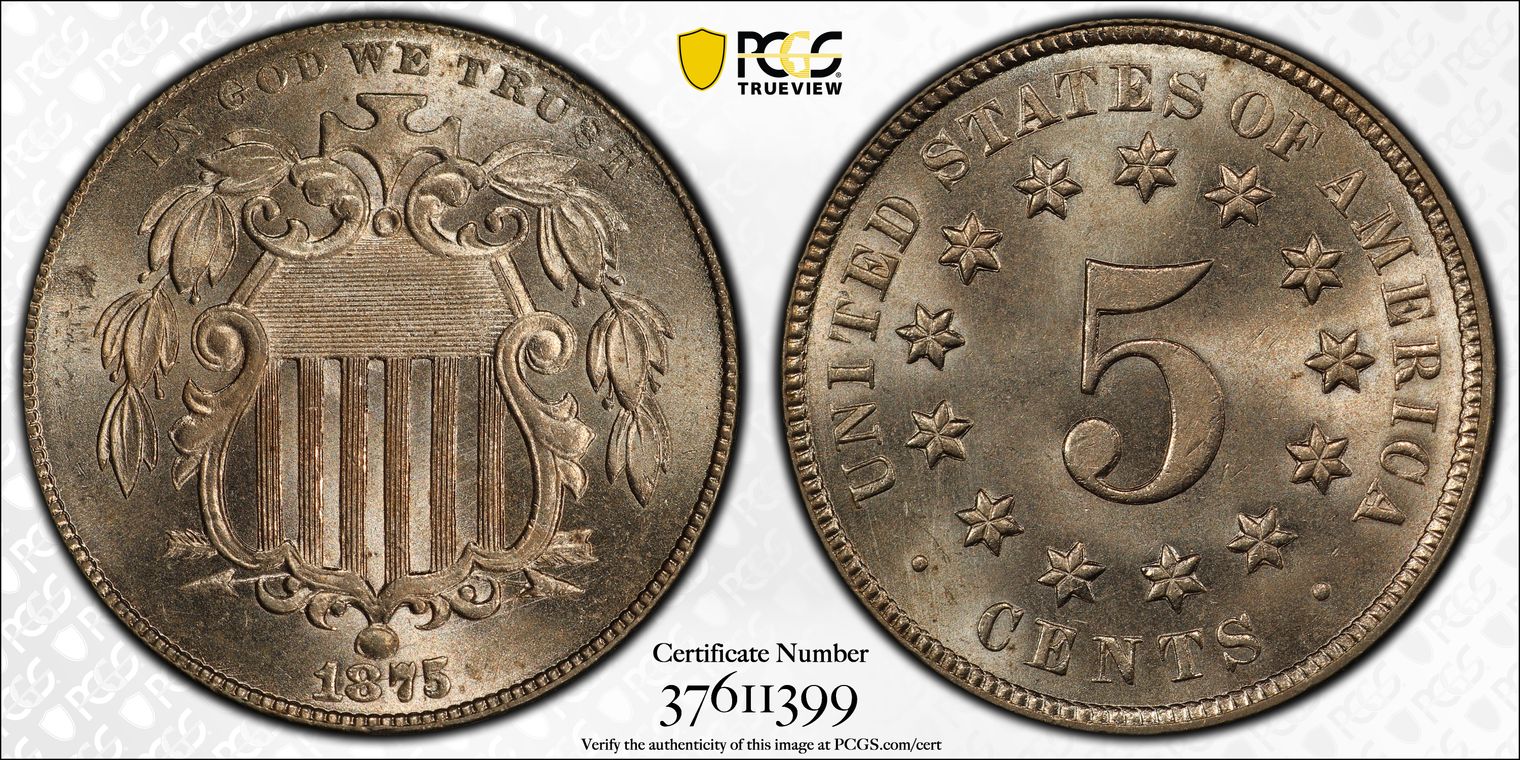
The 1875 Shield Nickel is a relatively common coin, though it is far less available than the super-common dates such as the 1868 and 1869. In Mint State, the grade seen most frequently is MS-64, followed by MS-63, then MS-65. The best examples are a cluster of PCGS MS-66s that fill out the Condition Census. Look for the usual die cracks -- they are nearly impossible to avoid.
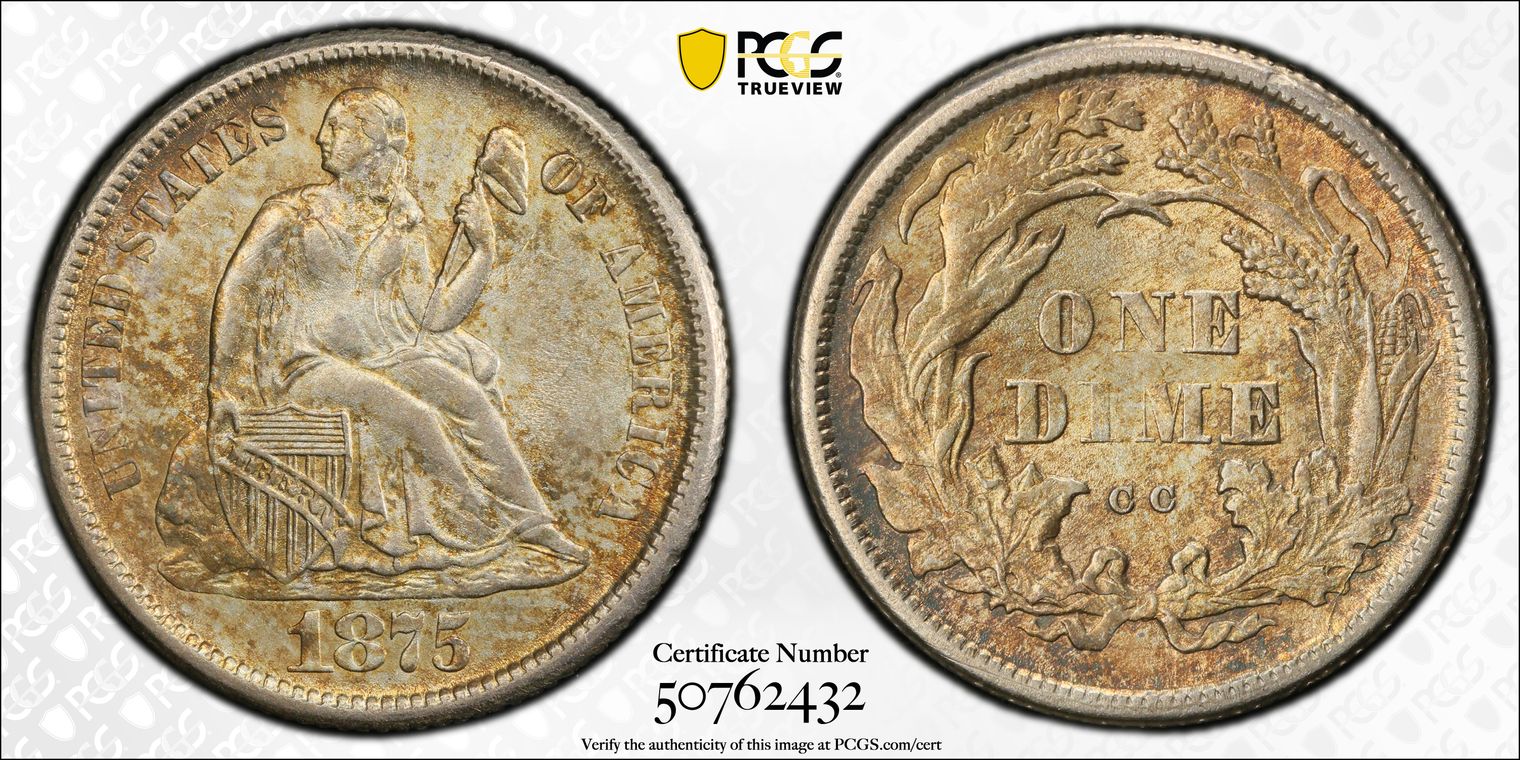
The placement of mintmarks on Liberty Seated Dimes varied over the years. From 1838 to 1860, the mintmark appeared within the wreath on the reverse. When the design changed from the Stars Obverse to the Legend Obverse in 1860, the mintmark began to appear below the wreath. However, there are three exceptions to this rule: 1860-S Dime; 1875-S; and 1875-CC. On the 1860-S Dime, the mintmark is always within the wreath; on the 1875's, the mintmarks appear either within the wreath or below the wreath. Between the two major types of 1875 Dimes, the Mintmark Above variety is slightly more common than the Below Wreath variety, but only by a small amount. Ample amounts of the Mintmark Above varieties exist in Mint State, to the tune of almost 200 coins (minus some resubmissions). The best examples top out at MS67. Gerry Fortin has identified nineteen different die varieties for this year.
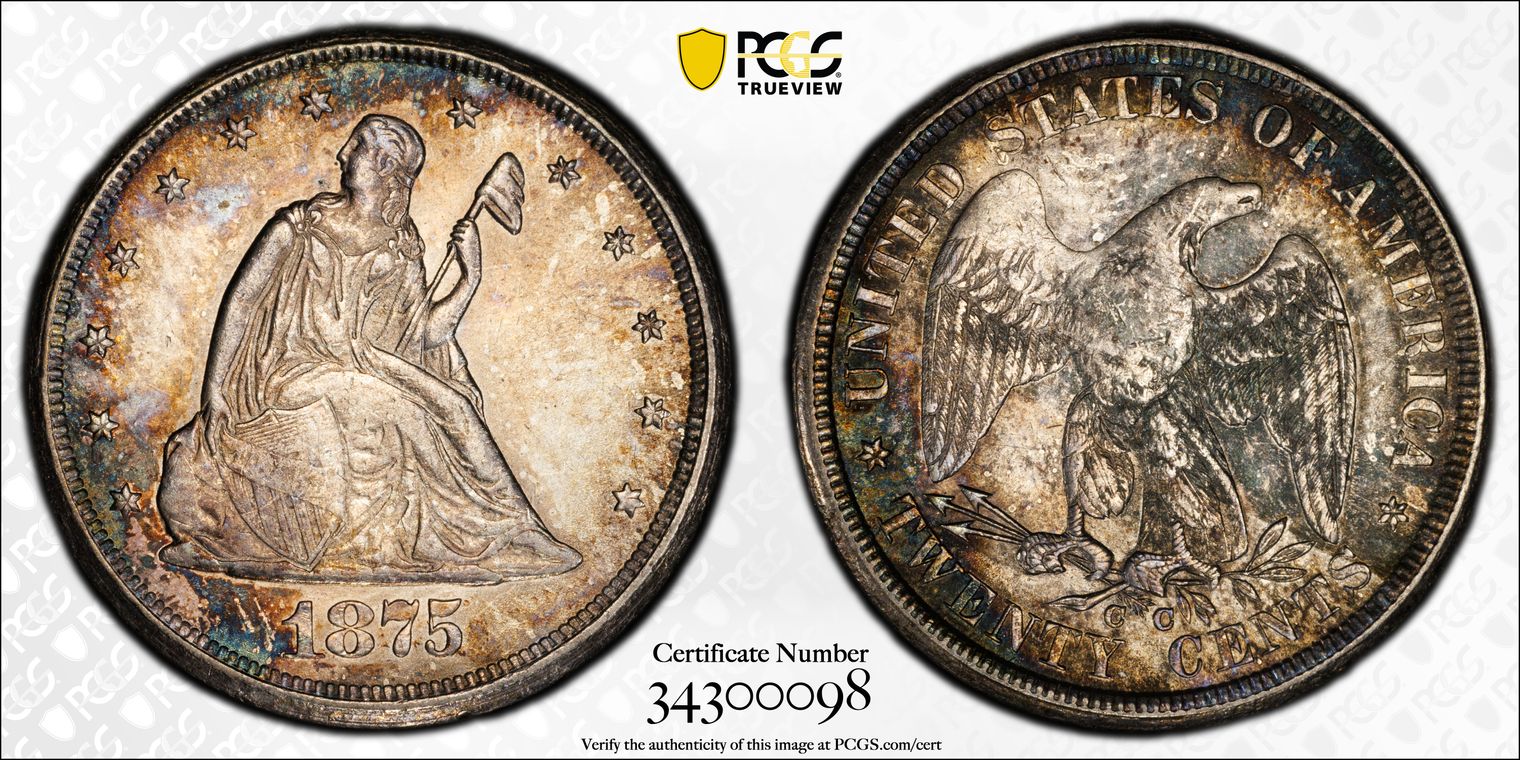
Production of the twenty-cent denomination commenced with a striking ceremony at the Carson City Mint on June 1, 1875. In attendance was Nevada Senator John Percival Jones, the primary advocate for the legislation that added the “double dime” to an already crowded roster of subsidiary coins. Jones believed the denomination would better serve the Western states, where minor coins like the cent and nickel—not yet produced at branch mints—were in short supply. During the coin's inaugural month in Carson City, outgoing coiner W. Hy Doane struck 3,290 pieces; his successor, Levi Dague, struck the remaining 130,000. In total, five die marriages were utilized for the issue. Despite being the brainchild of a Nevada senator, the San Francisco Mint struck the vast majority of twenty-cent pieces in 1875 to serve a wider geographic area, leaving Carson City a distant second and the Philadelphia Mint trailing far behind. 1875-CC Twenty-Cent Piece: The Only "Collectible" CC-Mint Issue Despite having a significantly higher mintage than the Philadelphia strike, the 1875-CC Twenty-Cent Piece (#5297) commands the highest numismatic premium for the date. As the only collectible Carson City issue in the short-lived series—the 1876-CC Twent-Cent Piece (#5300) being an extreme rarity—it carries a substantial "CC" mintmark premium that far exceeds the price of the lower-mintage 1875 Philadelphia issue. High-grade examples of the 1875-CC are scarce but obtainable for the dedicated specialist. The PCGS CoinFacts Condition Census for the top ten specimens consists entirely of coins graded MS66, with the finest known example reaching MS66+.
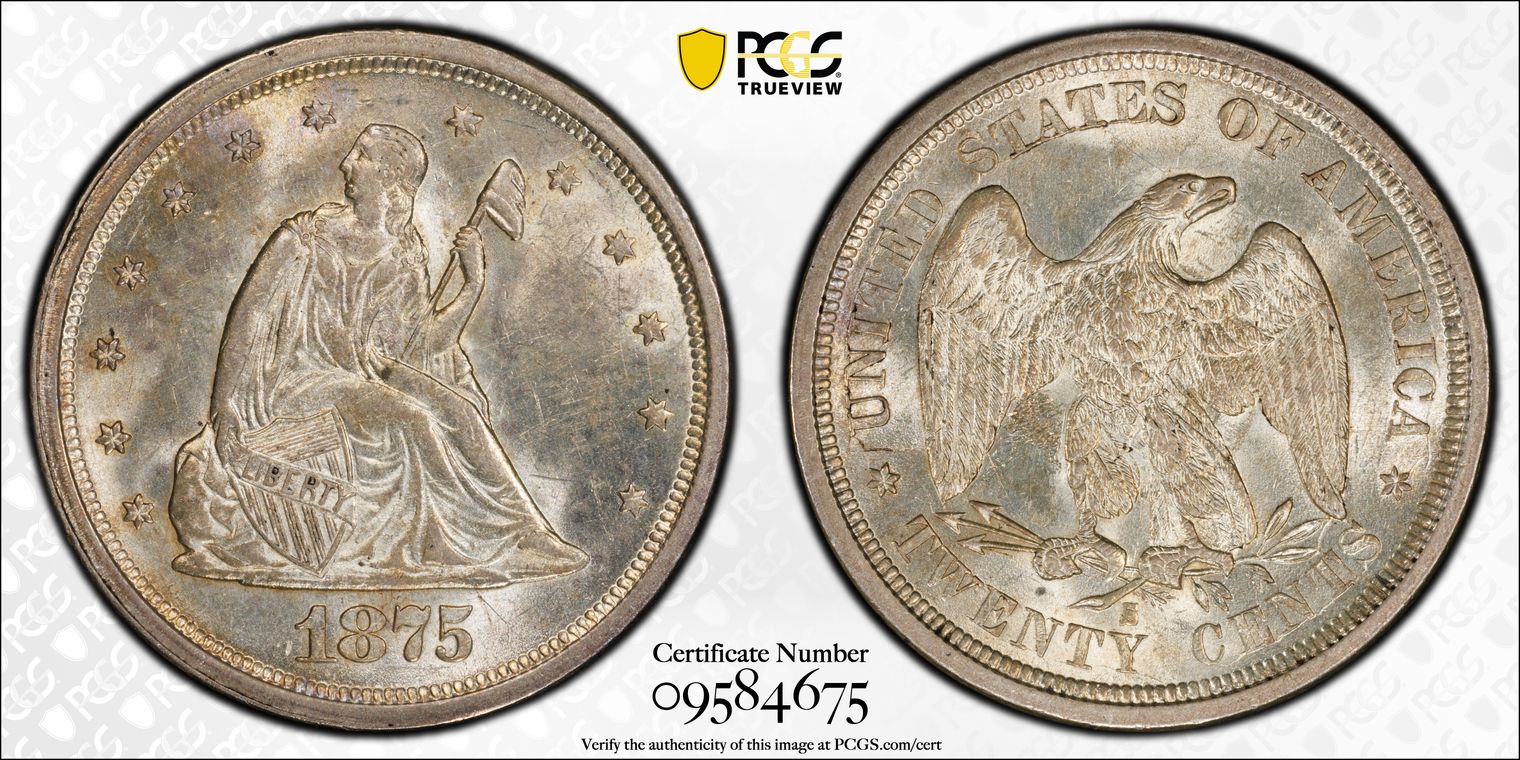
In the first week of June 1875, the San Francisco Mint commenced production of the new Twenty-Cent Piece. By the end of that year, the mint’s output of this short-lived denomination had dwarfed its total quarter production. In fact, excluding Proofs, the 1875-S alone accounts for approximately 85% of the total mintage for the entire series. A Western Experiment The Twenty-Cent Piece was originally conceived as a solution for Western states, where minor coinage was scarce because it was only struck at the Philadelphia Mint. However, the denomination failed to gain traction with the public, who often confused it with the quarter. The impact was immediate:
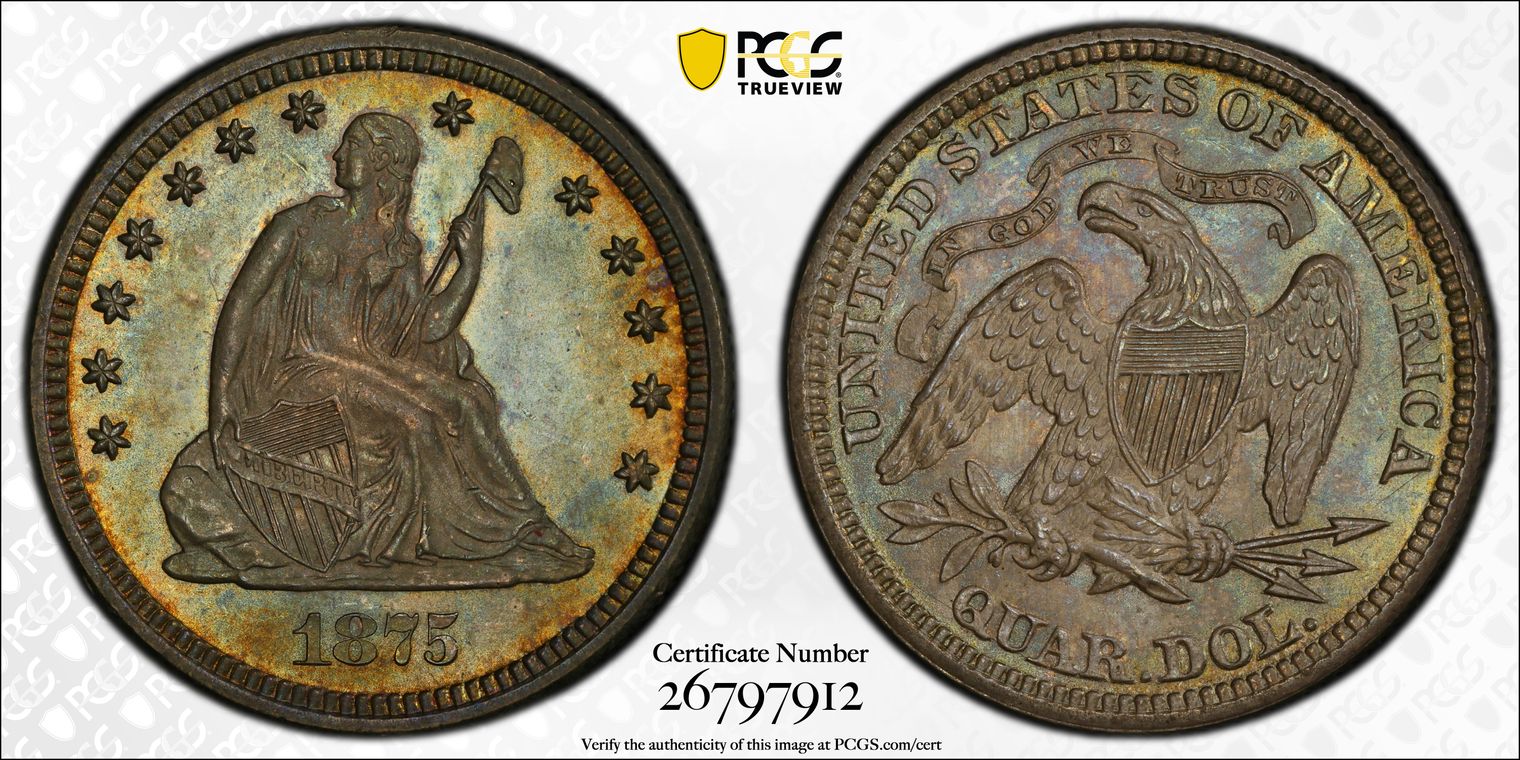
The mintage of the 1875 Quarter Dollar is massive for the period, topping out at over four million coins. As a result, this is one of the most common Quarter Dollar dates from the 1870s, though it is far less common than the 1876. PCGS alone has certified over two hundred Mint State 1875 Quarter Dollars, mostly in MS64. Gem examples are scarce and the best examples rate only MS67, where color and eye appeal count for a lot. Check out the best examples illustrated above to see what great toning looks like.
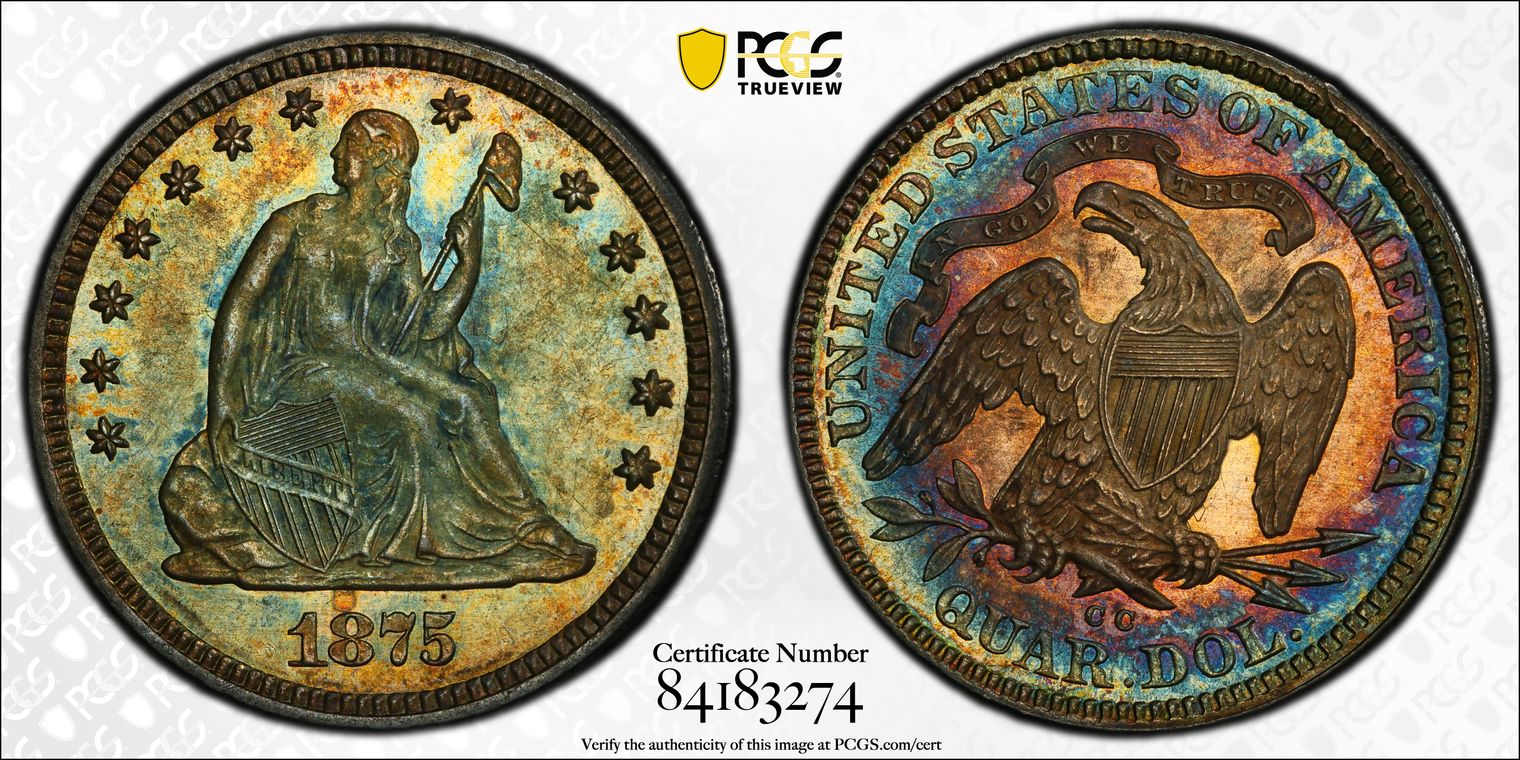
Production of Quarter Dollars at the Carson City Mint jumped up to 140,000 in 1875, a rather significant jump from previous years. Collector demand for this date is intense no matter what the grade, and competition for top condition pieces is intense. In Mint State, this date is very scarce and correspondingly expensive. A very small number of Gems sit atop the PCGS Condition Census, the finest being a single MS65+.
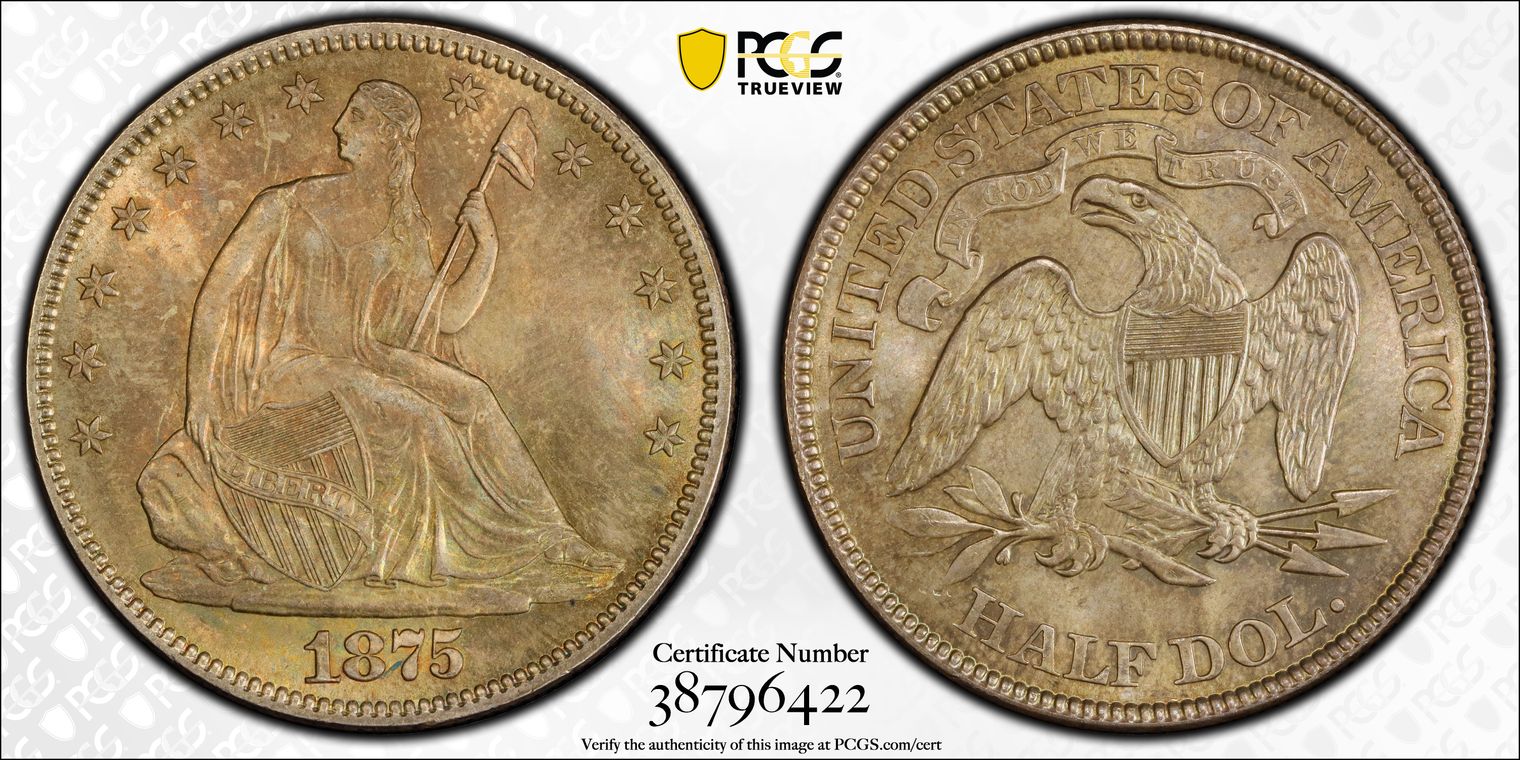
The 1875 has a huge mintage relative to virtually every other date in the series. At over six million coins, this mintage was the largest since 1858 and it was the fourth largest of the series. This makes the 1875 Half Dollar an affordable example of the type and one which can be found with relative ease. Scores of Mint State examples exist in a range of grades from MS62 to MS64. Gems are scarce, but not rare. What is most surprising is how rare this date is in grades above MS65. One would think that a coin with such a large mintage might have survived in better condition.
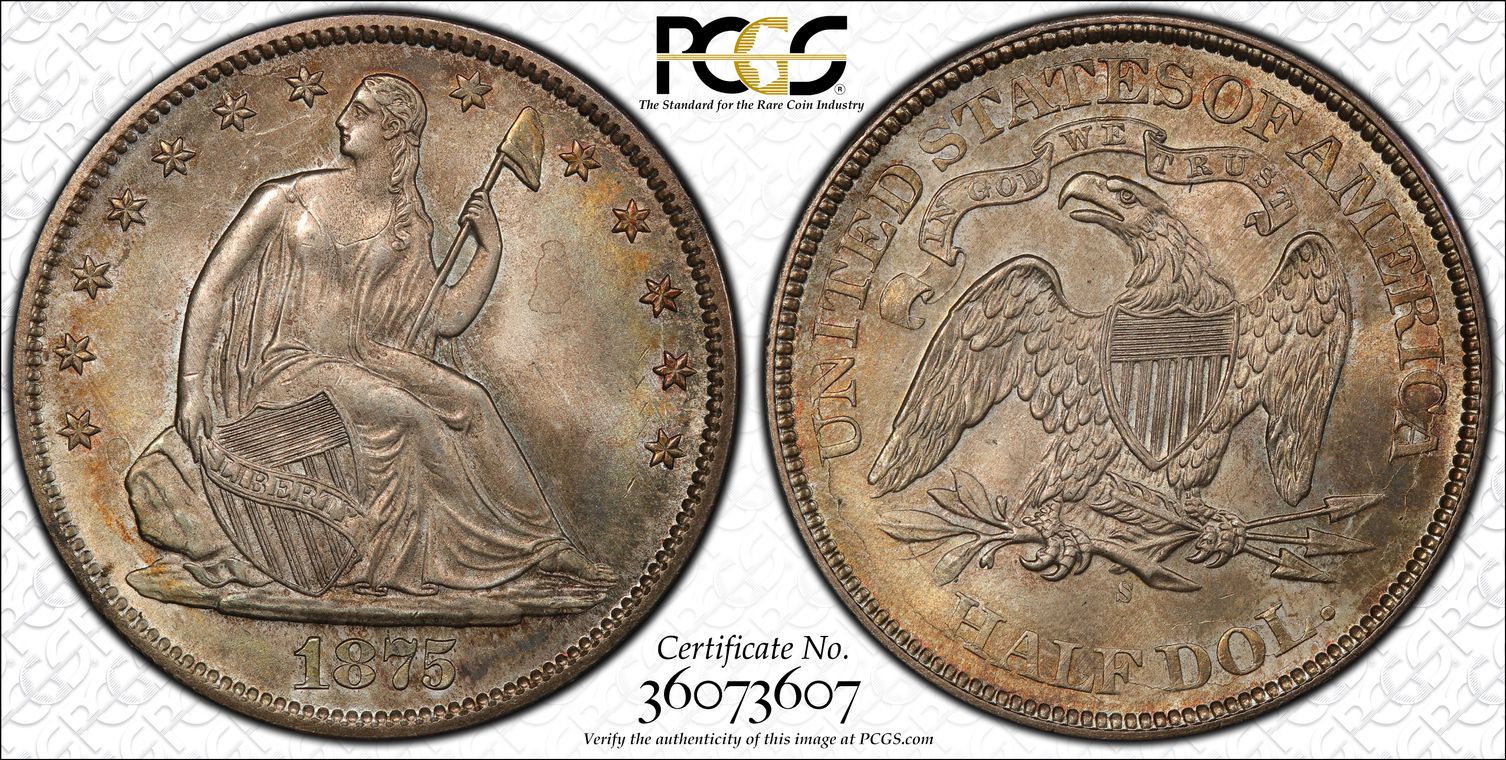
In 1875, the San Francisco Mint made twice as many Half Dollars as the Carson City Mint, but just over half as many as the Philadelphia Mint. With a mintage of 3,200,000 coins, the 1875-S Half Dollar is valued as a regular example of the type, with no premiums for most grades. Mint State examples are plentiful in all grades from MS62 to MS66, above which this date becomes an extreme, condition-rarity. The strike quality on 1875-S Half Dollars varies from soft to strong on the stars. Thus, if given the opportunity, and all else is equal, choose the coin that is better-struck.
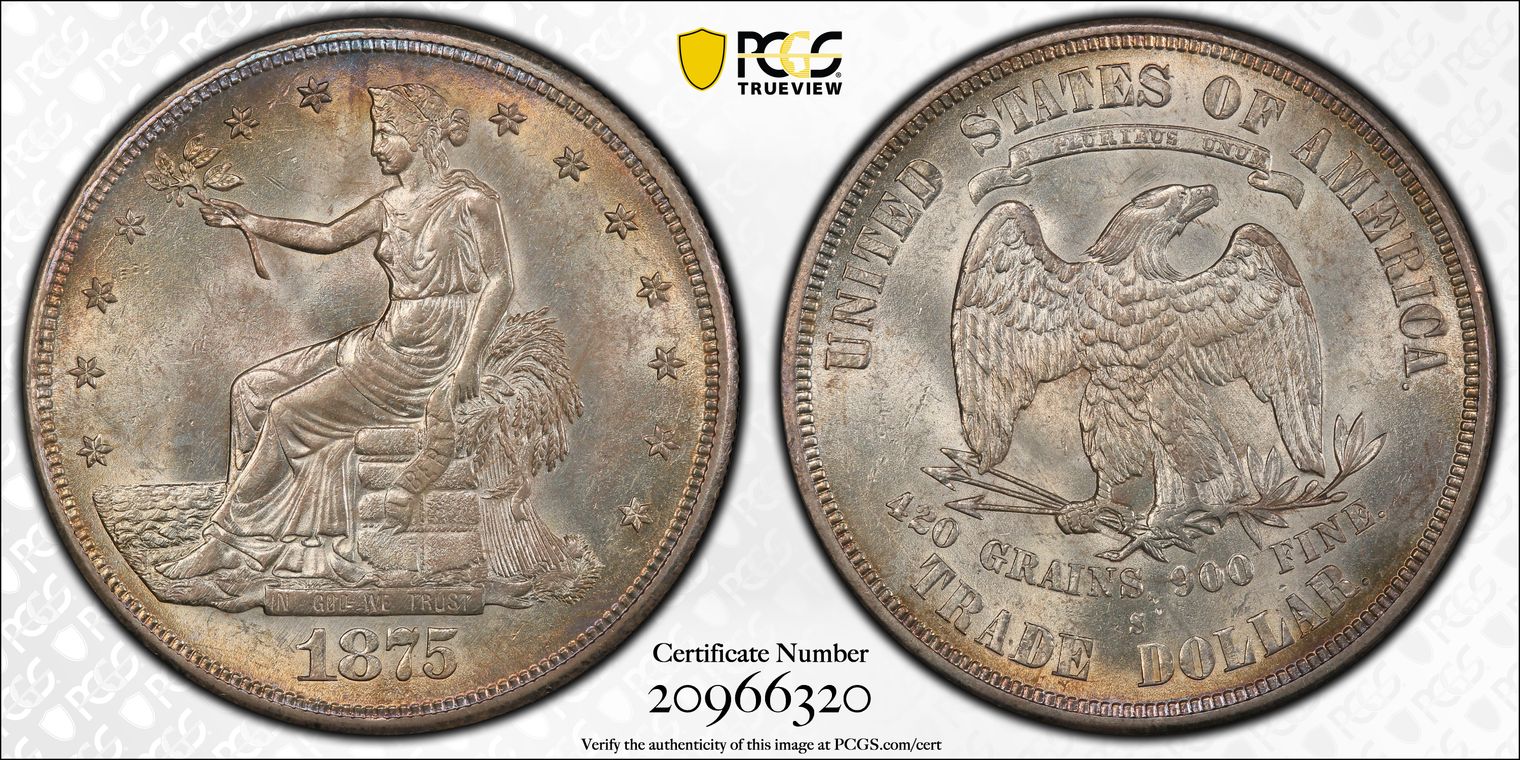
The production quantity of trade dollars at the San Francisco Mint in 1875 was immense. Included in the monthly figures (see Summary of Characteristics) were several months' production which on their own would have been satisfactory for a year in earlier times; namely, January 695,000, April 652,000, May 535,000, October 614,000, November 517,000, and December 516,000. These numbers when added to the figures for other months comprised a total of 4,487,000 pieces, a record for the series. While the majority of such coins were exported, thousands went into circulation on the West Coast, particularly in the San Francisco area, where they traded at face value in commercial transactions. Possibly the largest exporter was the Nevada Bank of San Francisco (see Additional Information under 1877). Mint officials rested easy, knowing that the silver-mining interests (and their congressional friends, Senators Allison and Jones and Representative Richard P. Bland) were satisfied in the knowledge that the market for the metal was strong. The Oriental demand was great, and domestically a good future awaited the continuing coinage of fractional pieces (from the dime through the half dollar), which were being minted in very large quantities to redeem Fractional Currency notes and to restore silver to United States commerce. Varieties: 80% to 90% are Type I/I, and the rest are I/II. Apparently, the Type II reverse dies reached San Francisco late in the year and were not used extensively. In grades from Very Fine to AU the 1875-S is the third most common trade dollar. As such, it is a favorite with "type" collectors. Tens of thousands of these coins exist. Chopmarked coins are also plentiful; most are Type I/I, but many are I/II; each is common. Mint State grades: In MS-65 the 1875-S is the most available of all trade dollars. I estimate that 75 to 150 or more exist. Most are decent strikes and are quite lustrous. At the MS-64 level I believe that 200 to 400 or more exist, while I estimate 500 to 1,000 or more as the population for MS-63 coins. In grades from MS-60 to 62, an estimated 1,500 to 3,000 or more survive. Many Uncirculated coins were brought to the United States from Hong Kong in the 1940s and 1950s. Most (about 80% to 90%) Mint State coins are Type I/I; the rest are Type I/II. The 1875-S Type I/I exists with micro s and with large S. The 1875-S Type I/II exists with tall S as well as with micro s, the latter being rare. Still another has an inadvertent "period" (die flaw, not punctuation) between IN and GOD and is considered rare. Collecting interest in trade dollars by mintmark sizes is not great, and usually such pieces can be obtained for little or no extra premium. Varieties: OBVERSE TYPE I: RIBBON ENDS POINT LEFT, 1873-1876 REVERSE TYPE I: BERRY BELOW CLAW, 1873-1876