



Edward M. Paterson II (1892-1972) Coin Album

The mintage of the 1892 Liberty Head Nickel is thirty percent less than the preceding year, but the two dates are virtually equal in terms of the number of certified survivors. Both are common in Mint State up to MS-66, at which point the population drops off significantly. The finest 1892 Nickels certified by PCGS are two MS66s with the Plus designation. Generally, this date is struck well, but occasionally some of the stars may be weak.

The 1892 Dime is the first date of the new type designed by Charles Barber. As a result, many were saved by collectors as a novelty, so high grade examples are fairly plentiful today. Nearly 1,000 examples have been certified in Mint State. most appearing in the MS63 and MS64 grade levels. Even Gems are plentiful up to the MS67 level, where less than a dozen have been certified by PCGS. A look at the PCGS Condition census for this date shows examples with some spectacularly colorful toning.

By 1891, the old Seated Liberty design (with some modifications over the years) exceeded more than 50 years of service on some denominations. Thus, in 1892, the Mint introduced the new "Barber" design on Dimes, Quarter Dollar, and Half Dollars. The new design's nickname had nothing to do with hair-cutters, but was named after its designer, Charles E. Barber. As they had done with previous new designs, the public grabbed up the new coins in large quantities, resulting in many high grade coins today. In fact, the 1892 is the second most common Mint State Barber Quarter according to the PCGS Population Report (as of August 2011), with a substantial lead over most other dates in the series. Not surprisingly, the only date with a higher population than the 1892 is the 1916-D, the last of the Barber Quarters (apparently, some collectors thought it, too, was going to be a rarity). Collectors of today can choose from a range of nice uncirculated grades, with the largest populations occurring in the MS-63 and MS-64 grades. MS-65 and MS-66 examples get a little scarcer, but they are not too difficult to find. In MS-67, the population declines rapidly, with less than two dozen examples in PCGS holders. The finest examples appear at the MS-68 level, where the single finest example is a lone PCGS MS-68+ it is one of only three PCGS MS-68+ Barber Quarters in the entire series, with none finer.

The 1892-O Barber Quarter Dollar is in the middle of the pack in terms of mintage and overall rarity, and is in the lower half in terms of rarity in Mint State. This means that collectors should be able to obtain a high-grade example of this date with relative ease. Most Mint State 1892-O Barber Quarters cluster around the MS-62 to MS-64 grades, with MS-63 being the most common by a slight edge. MS-65 examples are scarce, but available. MS-66 and better examples are very rare, dropping to a mere three examples graded by PCGS in MS-67. The overall strike is good for a New Orleans Mint product, but still short of the well-made Philadelphia Mint issues. Some collectors pay attention to the placement of the mintmark on the back of Barber Quarters, partly out of interest, and partly as an aid in authentication. In 1892, mint engravers placed the mintmark over the R of QUARTER, unlike the placement on all subsequent years, when the mintmark appears over either the D of DOLLAR or between the R and D (the same is true for the 1892-S Quarter). Why the change was made is unclear, as the placement on the 1892-O and 1892-S Quarters centers the mintmark perfectly beneath the eagle's tail.

A new design appeared on Half Dollars beginning in 1892 and it was an immediate hit with collectors. Today, Population Report data confirms David Akers' old and long-held belief that the 1892 Half Dollar was the most common date of the series. No other date has a larger population -- some are close, but none can equal or exceed it. For today's collectors, this means there are numerous opportunities to acquire a high-grade example of this first-year-of-issue date. PCGS has certified literally hundreds of Mint State examples, mostly in MS63 and MS64. Moving up and through the Gem and Superb categories, we come to a single PCGS MS68 example, one of the finest Barber Half Dollars of any date. This colorful example has appeared at auction three times since 2005 and it set price records every time it appeared. For approximately half the price, collectors can opt for one of the lovely PCGS MS67+'s. Despite its relatively low mintage of just 935,245 pieces, including Proofs, the 1892 Barber Half Dollar is by far the most common of the 74 issues in this series. Obviously, many were saved as souvenirs of the first year of issue of the design.

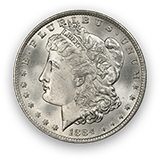
From the time of mintage through the early decades of the twentieth century, the 1892 was a major rarity. Very few had been released into circulation. However, Proofs were available readily enough, and they took care of the need to acquire a circulation strike of the date. This situation was true of such other Philadelphia Morgan dollar dates as 1894, 1897, and 1899, among others. The relatively few transactions involving Mint State 1892 dollars sold prior to 1940 did not take place at high prices. Accordingly, the erstwhile rarity of this date was not recognized until I researched the matter in connection with the present text. Large quantities of Mint State 1892 dollars were released by the Treasury in the late 1950s and early 1960s, before which time they were rare, as noted. By the late 1950s, they were very common. Harry J. Forman reported that Uncirculated 1892 dollars were second only to 1891 dollars from the standpoint of availability through Philadelphia banks at the time. However, by the time that the Treasury began emptying its vaults in earnest, circa 1962-1964, most 1892 dollars had already been paid out. The date was not well represented among later Treasury hoard coins. 1892 dollars are plentiful in higher circulated grades but rare in lower grades. Few were placed in circulation at or near the time of striking. In 1925, numismatist E.S. Thresher reported that despite searching since 1919, he had not been able to find an example in circulation; one of just eight coins absent from his Morgan dollar collection (the others were 1884-CC, 1885-CC, 1889-S, 1893-S, 1894, 1897, and 1899). Most worn coins seen now are those that were placed into the channels of commerce well into the present century. Estimated populations have a rapid fall-off as grades increase: MS-60 to 62, 75,000 to 150,000 exist; MS-63, 20,000 to 40,000; MS-64, just 2,000 to 4,000; and MS-65 or better, only 600 to 1,200. As a class, 1892 dollars are chameleons. Some are sharply struck with very nice lustre, and are a joy to behold. However, the typically encountered coin is apt to be flatly struck at the centers, have poor lustre, and be peppered with bagmarks. Once again, cherrypicking is advised when buying at any grade level. As always, this attention to detail will yield quality coins for your collection, while unknowing investors can take up the slack with poorly struck pieces. Proof-like and DMPL 1892 dollars are rare. Many prooflike coins are bagmarked and/or are flatly struck. However, Wayne Miller reported that "many" prooflike coins came on the market in the 1970s. About 10% of extant DMPL coins are MS-65 or finer.

Hundreds of thousands of 1892-CC dollars were put into circulation in the late nineteenth century. When the Carson City Mint closed down, quantities of 1892-CC dollars were shipped for storage to the San Francisco Mint and, to a lesser extent, to the Treasury Building in Washington, D.C. From the San Francisco Mint, quantities were paid out over a period of years, including 1925-1926, but particularly in the late 1940s and early 1950s. Some bags, but probably not many, were dispersed from the Cash Room at the Treasury Department in Washington during the same time frame, up through 1950-1953. Then came a quantity dispersal. Dealer Steve Ruddel stated that about 50 bags (50,000 coins) of 1892-CC dollars were released from the Treasury Building in 1955 alone. Few if any 1892-CCs were part of the Treasury release of 1962-1964. When the government took stock of the situation in March 1964 and stopped paying out Morgan and Peace dollars of any and all dates, just a single Uncirculated 1992-CC dollar remained! The news of the non-availability of the 1892-CC in the surviving Treasury cache caused a run-up in prices in the 1960s and 1970s. However, Wayne Miller in his Morgan and Peace Dollar Textbook, 1982, reported that as of that time, "large quantities of this date still exist in BU condition." Historically, the 1892-CC, like the 1990-CC and 1891-CC before it, was never considered to be a rare date. Enough were dispersed at or near the time of mintage that examples have been readily available on the market. However, in comparison to some of the 1878-1885 Carson City dollars sold by the G.S.A. in the 1970s, the 1892-CC is relatively elusive today. Most Mint State 1892-CC dollars are in lower grades and have many bagmarks. As Carson City Morgan dollars go, the 1892-CC is scarce today. Although the mintage of the 1892-CC exceeded that of 1882-CC, 1883-CC, and 1884-CC, it is much more elusive in Uncirculated grade, due to the relatively small amount of hoard coins remaining. Rolls or larger quantities are seldom seen on today's market. Higher Mint State level coins are scarce. Considering the great demand for them, MS-65 coins are an attraction whenever they are offered at auction or private sale. Most 1892-CC dollars are well struck with excellent frosty lustre. Specific estimates are as follows: MS-60 to 62, 20,000 to 35,000 survive; MS-63, 8,000 to 15,000; MS-64, 3,000 to 5,000; and MS-65 or better, only 1,000 to 1,800. A small percentage of Mint State coins are proof-like, and fewer yet are DMPL.

The 1892-O dollar has always been available in Mint State on the coin market. For example, in 1910 a specimen sold at auction at $1.25, a common-date price. Generous quantities were released at and immediately following the time of mintage. In later years enough remained in numismatic circles that dollar specialists always had them in stock. A few bags were released in the 1950s, from storage in the Treasury Building in Washington, D.C. However, the great deluge of this issue came during the unsealing in October 1962 of a vault in the Philadelphia Mint holding about 10 million Uncirculated New Orleans dollars. After that time, Harry J. Forman handled at least 20 bags and reported that the issue was very common in bag quantities, although the price never dipped much below about $5.00 per coin, and was more apt to be in the $7.50 to $12.50 range in the several years after 1964. Just before the October 1962 release, a typical Uncirculated coin was worth about $15.00. The Redfield estate, auctioned by the Reno Probate Court in 1976, is said to have had two to four bags, with the coins heavily damaged by a counting machine used during the pre-auction appraisal. In 1977 a bag from another source, said to have contained numerous gems (see below), was dispersed. In the 1980s, Bowers and Merena Galleries handled a bag of 1892-O dollars from a Pennsylvania estate. Most coins in the group were in the range of about MS-62 to MS-63. In Mint State the 1892-O is readily available. Most specimens are flat strikes with below average surfaces and lustre - not the kind of coins to excite anyone. Sharply struck gem coins in higher grades are rare, although Wayne Miller reported that in 1977 a bag of 1,000 coins contained many fully struck gems; most of these have been dispersed. Miller further stated this: After the usual promotion to bring up bid levels these were doled out to a greedy public. Most of the gem 1892-O dollars on the market today are from this hoard. Because the 1892-O is often available in quantity it is another favorite of promoters. High current prices reflect the demand for fully struck gem pieces-flat struck and bagmarked pieces are worth significantly less. Apart from the foregoing gems, striking quality is usually poor on the average specimen one is apt to find. Most surviving coins are lightly struck over Miss Liberty's ear and lack breast feathers on the eagle. In the hurry to coin as many dollars as possible with the smallest amount of effort, technicians at the New Orleans Mint spaced the dies too far apart. Among all Morgan dollars, the 1892-O is one of the most notorious for being flatly struck at the centers. Most Uncirculated 1892-O dollars grade in the MS-60 to 62 range, and are common thus. Probably, 40,000 to 80,000 exist. MS-63 coins are likewise in plentiful supply, to the extent of 15,000 to 30,000 pieces. At the MS-64 level, 1892-O becomes scarce, and probably only 3,000 to 6,000 survive. In MS-65 the issue is rare.


The 1892-CC is one of the most common Carson City Half Eagles and is approximately equal in overall rarity to the 1882-CC, 1890-CC and 1893-CC. It is decidedly more rare than the relatively common 1891-CC. Although uncirculated examples are occasionally available, VF or EF specimens are the most often encountered. Choice or gem quality pieces are rare and are seen less often than comparable quality coins dated 1890-CC or 1893-CC. David Akers' comments on this date are right on. The 1892-CC is one of the most common CC-Mint Half Eagles, and it is far less common than the 1891-CC. Less than twenty percent of the examples certified by PCGS are Mint State, and most of those are either MS62 or MS63. The low grades are usually the result of excessive bagmarks, caused by careless conveyance as they travelled cross-country. The very best example is an NGC MS66, believed to be the former PCGS MS65 from the 1/1990 Superior sale, where it set a record price that has not yet been beaten.

The 1892-S is scarce as a date and rare in strictly uncirculated condition. Most known specimens are well worn and grade in the VF to EF range and choice quality mint state pieces are very difficult to obtain.
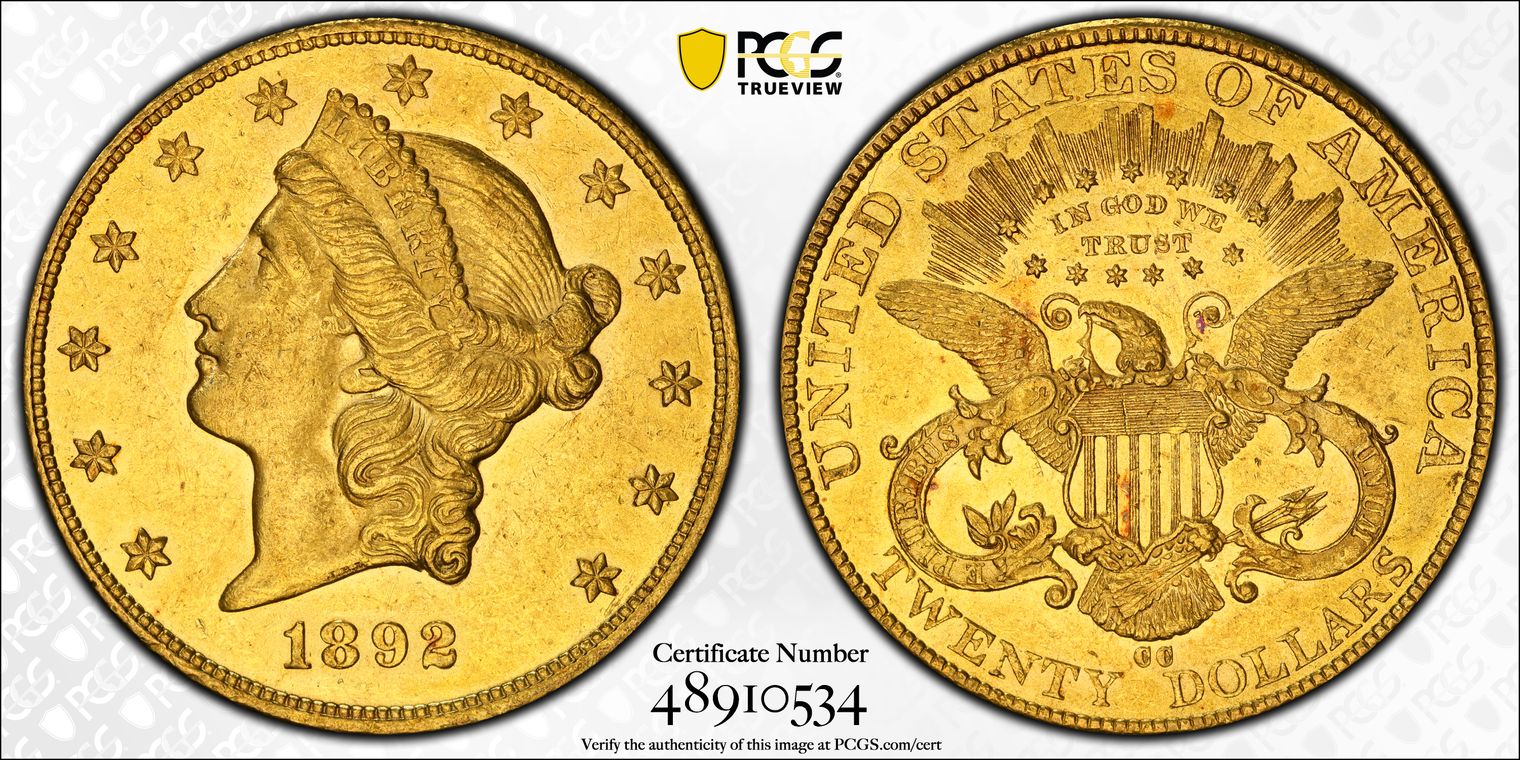
The 1892-CC is a scarce but not rare coin. It is a little more rare than the lower mintage 1893-CC in terms of population rarity and it is considerably more rare than the 1893-CC in Unc. The 1892-CC is usually seen in EF or AU condition although there are numerous VF examples around as well. Average uncirculated (MS-60) specimens are scarce but can be located without a great deal of difficulty. Choice quality uncs are very scarce and true gems are rare. This is another date that was considered quite rare in Unc. until the 1960's when many turned up in Europe.

The 1892-S is virtually identical with respect to both population rarity and condition rarity to the 1893-S. It is also very similar to the 1885-S, 1888-S, 1901-S and 1905-S except that it is more common than any of them in Unc. The 1892-S is more rare than the 1891-S as well as any of the S-Mint Double Eagles from 1894-1907 except the 1901-S and 1905-S. Average quality uncs are not difficult to find. Gems are very scarce but I have seen a number of them as well as a few truly superb quality specimens.