Walter Breen's Encyclopedia of Early United States Cents
Walter Breen
John H. Hickcox's History of American Coinage supplemented in certain limited areas the Eckfeldt and Dubois book, while adding misinformation of unknown parentage. Most likely, the shortcomings of this volume led to the three pre-Civil War bestsellers about coins (below), which put American numismatics onto the map. In the meantime, on November 1, 1858, Edward Cogan, who claimed to be our country's first full-time rare coin dealer, held the first American coin auction devoted entirely to large cents: 77 pieces. Sold by sealed bidding, the coins brought a then astounding $128.68-the equivalent of over six ounces of gold.
The first of the three bestsellers was Dr. Montroville Wilson Dickeson's American Numismatical Manual; this went into two later editions, 1860 and 1865. Compared to the Eckfeldt and Dubois book, or to the articles in the American Journal of Numismatics (beginning 1866), its writing is naive and amateurish, its descriptions are vague, its scholarship is dubious, its illustrations are primitive, and its understanding of how coins are made is minimal. Nevertheless, Dickeson deserves credit for even attempting so grandiose a project. A combination of the basic materials was later to be elaborated on by Crosby on colonials, my own book on half cents, Sheldon and Newcomb on large cents, various other writers on silver and gold coins, and Don Taxay's treatise on Native American artifacts thought to have been used as money. One may deplore its limitations, but a completely corrected and updated one-volume version of Dickeson' s project has never since been attempted. Not even my Complete Encyclopedia of U.S. and Colonial Coins covers the whole territory, partly because it does not attempt to list a couple of thousand pattern and experimental coins, and partly because it omits the Native American artifacts. Dickeson deserves commendation for a pioneering effort.
The second bestseller was by, no less, the director of the Mint. This was James Ross Snowden's A Description of Ancient and Modern Coins in the Cabinet Collection at the Mint of the United States. The author gave some mintage figures for United States coins and some historical material, but did not attempt to describe more than the major design changes. This is because the Mint Cabinet Collection then comprised an incomplete date set of each denomination, and did not attempt to include each design, type, variety change, or mintmark.
The third book was W. C. Prime's Coins, Medals, and Seals, Ancient and Modern, published in early 1861. This reference was, according to the author, written to provide younger people with a concise history of coinage from ancient times to modem. Provided are descriptions of a large body of coinage with over 100 plates providing engravings of various pieces relating to the descriptions and history. Like Dickeson's work, the illustrations were primitive; however, this tome is important for an understanding of the knowledge available at that time.
Taken as a threesome, these books furnished much information for collectors of the era and laid the foundation for later generations of scholars.
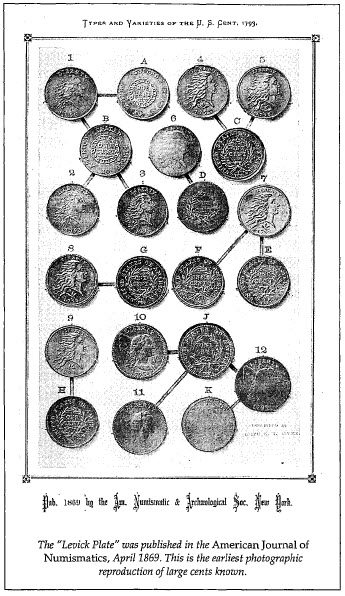
During the Civil War years, the major publications on American coins were auction catalogues. A full review of these is beyond the scope of this book, (Editor's note: Appendix A contains a listing of the most important catalogues and fixed price lists appearing in the large cent Condition Census. Three references provide much information concerning early auction catalogues. These are: Emmanuel J. Attinelli, Numisgraphics, New York, 1876; John W. Adams, United States Numismatic Literature, Volume 1, Mission Viejo, CA, 1982 and Volume 2, Crestline, CA, 1990; and Martin Gengerke, American Numismatic Auctions, 8th edition, Woodside, NY, 1990.) especially as cents comprised only a tiny fragment of their content, and seldom were varieties described recognizably except for some of 1793. Nevertheless, enough information was available that in the October 1868 issue of American Journal of Numismatics, Joseph N. T. Levick could publish a table listing auction appearances of 1793 cents with prices realized and buyers' names. In the April 1869 issue, he published the first photographic illustrations of the known varieties of 1793, described below.
Possibly to jump the gun on Levick, Ebenezer Locke Mason, Jr., the Philadelphia coin dealer, beginning in December 1868, published a list of 14 varieties of 1793: three Chains, eight Wreaths, and three Liberty Caps. Some of his descriptions are too vague to be identifiable today. (Mason, E., Jr., "Types and Varieties of U. S. Cents," Mason's Coin and Stamp Collectors' Magazine, Vol. II, Nos. 9-12, December 1868, pp. 85-86. This serial article concluded in Vol. III, No.8, August 1869.)
Levick collaborated with Sylvester Sage Crosby to produce the first accurate record of 1793 cents: the famous "Levick Plate" in the American Journal of Numismatics, April 1869. This illustrated 12 obverses and 10 reverses, clearly enough that the individual specimens illustrated are positively identifiable today. There were 100 separate copies of the plate in addition to those sent to subscribers of the journal. Crosby's text described 15 varieties of the date (four Chains, seven Wreaths, and four Liberty Caps), with a number-letter combination as an abbreviation to designate each: an innovation imitated in other denominations until recent years. Texts of this and the later studies of 1793-1794 cents are conveniently reprinted in Monographs on Varieties of United States Large Cents 1793-1794.