The Norweb Collection - An American Legacy
Michael Hodder and Q. David Bowers
The Cleveland Museum of Art
Mr. and Mrs. R. Henry Norweb, Sr. had long been involved with the world of fine art and its collection. Emery May Norweb's connection reached back to her childhood, when she played in her grandfather Liberty's gallery where the Jackson Jarves paintings hung. She may have been present when Liberty's widow, Delia Holden, presented those paintings to the fledgling Cleveland Museum of Art in 1916. The Holden family had close ties to the museum from its earliest days, ties that would last through all the years Emery May Holden Norweb spent with her husband in their country's foreign service.
The Cleveland Museum of Art installed an exhibition of pre-Columbian art in 1927, and two years later established a department of primitive art, which focused on the early cultures of Central and South America. That same year R. Henry Norweb was assigned to his first Latin American posting, in Santiago, Chile. The Norweb collection of pre-Columbian art began in 1929, and the connection with the museum's activities in this field may not be entirely coincidental.
The Norwebs' first opportunity to aid the museum in a grand scale came during negotiations over the purchase of the famous Guelph Treasure, conducted August through November 1930.
The Guelph Treasure consisted of priceless medieval liturgical and religious artifacts, mostly of Saxon and Rhenish l1th and 12th century work, but also including objects dating as early as the 8th century. The nine objects that made up the treasure were originally relics from the treasury of the Cathedral of Saint Blasius, in Brunswick, Germany. The inventory of the collection included the following: a portable altar; two gold crosses once the property of the Countess Gertrude of Brunswick; a monstrance (a processional reliquary) containing a relic of Saint Sebastian; a reliquary of silver gilt and enamel in the shape of an arm; the so-called "Horn of St. Blase"; an 8th century medallion bearing a likeness of Christ; the paten (a liturgical object) of Saint Bernward, mounted in a Gothic monstrance; and a reliquary in the form of a book, exhibiting the Marriage Feast at Cana.
The treasure had a long and colorful history. During the Napoleonic Wars it was sent to England by the then Duke of Brunswick, for safekeeping. Returned to the duchy after 1816, it was again sent away for safety in 1895, this time to Austria. At the outbreak of the First World War, the Duke of Brunswick sent the treasure to Switzerland, again for safety. Following the war the duke, who was son-in-law to the last Kaiser, offered the treasure for sale through art dealers in Frankfurtam-Main.
The Cleveland Museum of Art became interested in acquiring the Guelph Treasure at this time, and solicited funding from its patrons. Mr. and Mrs. Norweb subscribed to the purchase fund in a handsome fashion, and by November, 1930, the purchase was finalized. The total cost was $570,000, a staggering sum for the period, which was in the depth of the Great Depression.
The purchase established the museum's international reputation overnight, and the Norwebs' assistance with it further strengthened the bonds between the family and the institution. Two decades later, when the museum looked back over its first thirty five years and noted the three most important acquisitions made during its formative years, it was stated that the Holden and Norweb families together made two of them possible.
After their return to Cleveland in 1948, Mrs. Norweb in particular became very active in museum affairs. In the late 1950s she served as chairperson of the museum's inaugural committee, which was set up to arrange for the opening ceremonies honoring the new museum building. The cornerstone was laid in 1956, and when the new building was officially opened Life and Look magazines covered the occasion.
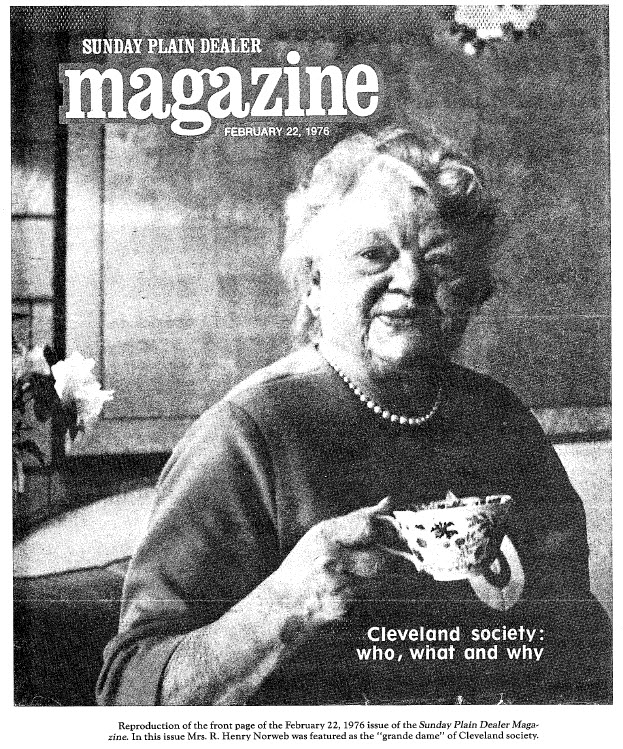
The culmination of a lifetime's involvement with the Cleveland Museum of Art came in January 1962, when Mrs. Norweb was asked to serve as president of the Board of Trustees. She was the first woman president of the museum, and the only woman to serve in that capacity in an institution of such world renown. When she was first asked to take the position, she said she gave it considerable thought. She reported that she asked herself the question, "was there any great harm she could do to the museum?" She told a reporter "I am a good gardener, yet every time I try to do anything with a fern, it dies. But, I concluded that the museum was sturdy and that I would do it no harm, so I accepted!'
The appointment recognized her many benefactions to the museum over the years since her return to Cleveland in 1948. Asshe said at the time, "My home is quite denuded of preColumbian and Oriental works of art of any great interest, but I am happy with them all at the museum!' Her presidency also benefitted from her easy familiarity with arranging receptions and formal ceremonies for large numbers of people, experience she had gained in many embassies around the world.
The Plain Dealer supported her choice as president in an editorial dated January 31, 1962:
Accepting the presidency of the Cleveland Museum of Art is a gracious act on the part of Mrs. R. Henry Norweb. Her interest in and willingness to serve our civic and cultural groups is historic. But here is an instance where her talents and experience in the field of art can best be utilized for the museum's sake, which means for the benefit of us all.
Mrs. Norweb's acquaintance with art in its many forms is global. Wherever her husband served in the diplomatic corps of his country, Mrs. Norweb furthered her study of the art of the region. As a result she is an acknowledged expert in many art forms, being especially authoritative in the native art media of Latin America. She also has painted on occasions with that famous statesman who is no tyro with the brush, Sir Winston Churchill.