The Norweb Collection - An American Legacy
Michael Hodder and Q. David Bowers
CHAPTER FIVE
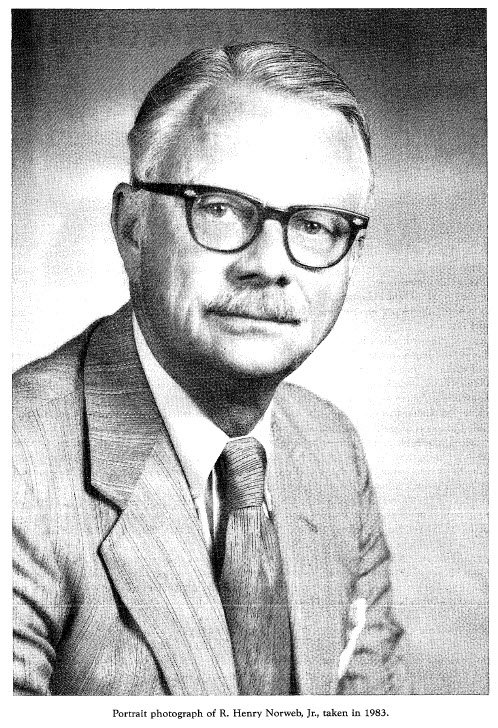
R. Henry Norweb
R. Henry Norweb, Jr.'s early years were mostly spent with his mother and father wherever they happened to be stationed, except for the posting to Japan in 1923, when he lived with his uncle Guerdon Holden at the family home in the Cleveland suburb of Bratenahl. As we have mentioned earlier, his education abroad was in the care of Mr. Thomas Langdon, the family's tutor. With Mr. Langdon's help, Henry survived the Dutch and Chilean educational systems.
In 1936 Henry entered Harvard, where he studied American history. He told the writers that he made this decision because he had lived abroad so much that it was time to get to know his own country better. He succeeded, and his senior thesis was on a most obscure aspect of American history-the cheese industry of Ohio! Henry graduated in 1940.
Henry had intended to go on to graduate school, perhaps to enter diplomatic service himself. He planned on entering Stanford in the fall of 1940. That summer, he took a job on the Plain Dealer and found he liked being away from the academic atmosphere so much that plans for graduate study were put aside. He enjoyed the newspaperman's life, and thought he might make a career with the paper his grandfather had created.
Events in the outside world decided differently, however. War with Japan and Germany seemed inevitable, and like most other young men of his generation, Henry registered for the draft. He received the lowest draft number of anyone on the Plain Dealer, and knowing that it was only a matter of time before he was called up, Henry joined the Ohio National Guard to have some say in the matter of his own future. By March of 1941 he was enlisted in the 107th Armored Cavalry Regiment.
The recruiting sergeant of the 107th needed radio experts. Henry told him that this was his lucky day, saying he knew a lot about shortwave radio, neglecting to tell the sergeant that his total experience with it was as a listener in Chile! Naturally, Henrywas signed up on the spot, and on the strength of the sergeant's comments in his file, Henry was transferred to the Signal Corps, later to the Air Force in which he served for the duration.
After successfully completing the officer's candidate course, Henry was commissioned a second lieutenant and was sent to Harvard for three months, to complete the special radar course taught there. Following completion of this course, Henry was assigned to the headquarters of the 6th Air Force, located in Balboa, Panama, on that country's Atlantic coast. There, he was responsible for the maintenance of the radar installations that observed shipping and aircraft traffic in the Caribbean Sea, as well as the radar controlled anti-aircraft batteries and the airborne radar sets carried on coastal patrol aircraft. Henry served in Panama for two and a half years. During his tour there, he went through several advanced radar training courses, one in Florida and one in a secret facility on the campus of the Massachusetts Institute of Technology. In 1946 Henry was discharged from the Air Force, with the rank of captain.
While Henry was stationed at Harvard, taking the first of several radar courses during his stint with the Signal Corps, he met his future wife, Libby Gardner. Libby is descended from an old Maine family; her grandfather, Obadiah Gardner, was Maine's first Democratic senator. Libby graduated from the University of Maine, Orono, and took a library science degree at Simmons College.
At the time of their first meeting, Libby was a librarian at the Maine State Library, and they met at a wedding where he was best man and she was a relative ofone in the wedding party. Two days later, Henry was assigned to his post in Panama. The "chemistry" between them must have been as strong as that between Henry's mother and father, earlier. A year later, when Henry returned from Panama to take the advanced radar course at M.LT., he again met Libby in Washington. By then, she had become a WAVE (Women Accepted for Volunteer Emergency Services, the women's reserve of the US Navy) officer, and was working on a joint civil aeronautics board in the capital.
Three days after their second meeting they were engaged. After a two month radar course in Florida, Henry traveled up to Libby's family home in Maine, and the couple was married two days after his arrival, in September, 1944. Henry and Libby Norweb have three children: Harry, born in 1947, now general manager of Trident Corporation, a Massachusetts software development company; Emery May Miller, born in 1949; and Constance Abbey, born in 1952.
After demobilization Henry returned to the Plain Dealer. On the strength of his wartime experience, the paper assigned him to the engineering section of the radio stations it owned. There, he oversaw the installation of the first FM station to broadcast in Cleveland. However, he soon realized that there was not much future in radio engineering, so he joined the sales staff of radio station WHK in Cleveland, where he worked for a short while.