The Early Quarter Dollars of the United States
A. W. Browning
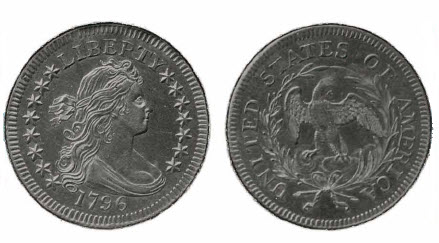
No. 2
Obverse: Date equally spaced, 6 is high and very near bust, but does not touch. In LIBERTY, T and Y do not touch at the top. Lower right star is twice as far from drapery as in [Browning 1].
Reverse: The same as [Browning 1].
Obverse die perfect; reverse usually showing the eagle's head weak. A few pieces are known with the eagle's head fairly well defined, but not perfect as in [Browning 1]. This is the most common variety, but since coinage for the year was small both varieties are rare.
Wide even date, 6 almost touching drapery; curl point under curve of B. Browning-2; Clapp-1; Duphorne-2, Breen-3882, Haseltine-1, Hilt-1.
State I. Perfect obverse die. Not found with eagle's head bold.
II. Shattered obverse die; cracks from IE to head, three others through ERTY and adjacent stars. Discovery announced in a Glendening sale, March 1935; illustration is of a plaster cast. 1.) The discovery coin. Uncirculated of thereabouts: impossible to trace pedigree photographically. 2.) Uncirculated, D.S. Wilson: 589, Yale University, S 12/71:234. 3.) Uncirculated, Spring:514 (4/11-12/78); 4) EF, WGC:3; 5) VF, Auction '81:1541, $6250. 6) VG, Ruby I:1125, $1250. Few others in lower grades.
The following deliveries are reported (Bullion Journal A, National Archives):
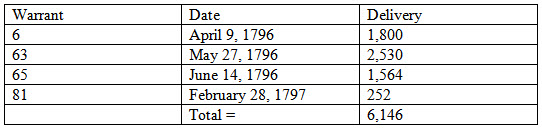
Hilt claims that all 6,146 were from these B-2 dies and that about 85 survive = 1.32% or 1 per 75.76 minted, of which some 7.0% or six should be Uncirculated (p. 106). However, Col. E.H.R. Green had a total of 200 Uncirculated 1796s, mostly from these dies, about half more or less prooflike, the remainder not. Abe Kosoff has personally described seeing quantities of these Col. Green 1796s; he and Andre DeCoppet were involved in their disposal during the 1940s. There are also about seven prooflike presentation coins (EPC), including J. Stack Collection and others.
The new variety claimed in WGC:3 is unidentified but from the description it appears to be a B-2 with light double striking at date.
Many show planchet cracks at edges – probably incurred during rolling of strip or punching of planchets from strip.
One is known countermarked S. LOOMIS.
One (much worn) is countermarked ADMIT TO WOOD'S MINSTRELS...BDWAY; the street number (444) not visible; this came from Edmund A. Rice, of Cranbury, NJ, and before him probably from Henry Chapman's stock. The Browning plate coin cost $25 before 1922 (source unknown), later to BPC, Col. Green. A specimen in very worn state with X scratched in obverse field was copied by forgers. Authentication is recommended.
Numerical Condition Census (RWM, Sr. [circa 1992]): 65+PL, 65, 64, 64, 64, 63+ Hoard Coin.