The Early Quarter Dollars of the United States
A. W. Browning
Quarter Dollars of 1821
Total number of pieces coin 216,851. Five varieties are known.
The coinage of 1821 appears to have been made from three obverse dies, but only one reverse. In four of the varieties of this year three reverse dies of 1820 were used.
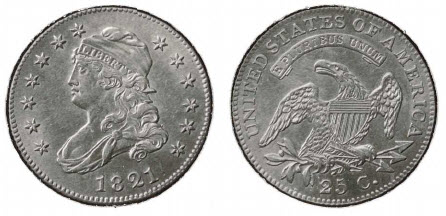
No. 1
Obverse: Date not equally spaced, 1 at left further from border than 1 at right; upper left star points to top of cap.
Reverse: The same as 1820 No. 4. (Die marks in field between olive leaf and 2.)
Dies perfect.
Emission sequence is B-4, 3, 1, 2, "6", 5 interspersed with 1820's.
Divided date 18 21, second 1 low; seventh star points down to cap.
Rust pit between leaf and 2.
Browning-1; Clapp-1; Duphorne-40; included in Breen-3903; Haseltine-1.
Rarity-2, high, possibly Rarity-3.
Spur on second hair wave from bottom behind head, a little above 12th star; possibly part of a misplaced star? Thirteenth star points to bottom edge of dentil, whereas on the B-3 to 4 it points to center, and on the B-5 obverse it points to upper half.
Best seen to date is the prooflike coin ex Massachusetts Historical Society. The variety is common in low grades but very rare choice.
Numerical Condition Census (RWM, Sr. [circa 1992]): 60PL, 60, 50, 50, 40, 40.
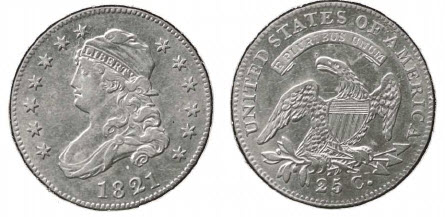
No. 2
Obverse: The same as [Browning] 1.
Reverse: The same as 1820 [Browning] 1.
Dies perfect.
Divided date 18 21, second 1 low; seventh star points down to cap.
Reverse: C much nearer stem than border.
Browning-2; Clapp-1; Duphorne-40; included in Breen-3903; Haseltine-1.
Rarity-3.
Die States: I. Perfect.
II. Rust marks in field below 5 C.
Usually found in VG to VF; rare in Mint State though not as rare as B-1. The best ones are apparently Eliasberg (prooflike); WGC:74; Bergen:46; and Haseltine-Davis-Graves:330, Winter:1327, Crouch:848. South:443 turned out to be B-5.
Numerical Condition Census (RWM, Sr. [circa 1992]): 60PL, 60, 60, 55+, 55, 50.
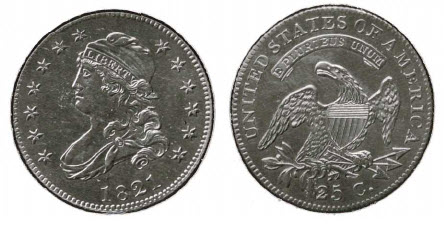
Obverse: Date not equally spaced, 1 at left same distance from border as 1 at right; upper left star points to center of Liberty band.
Reverse: The same as 1820 [Browning] 4. (Die marks in field between olive leaf and 2).
Obverse die perfect in early impressions; in later pieces it is cracked from right edge, through next to lower right star and extends over the hair. Reverse die perfect.
Seventh star points down to center of front of ribbon; 1's equidistant from border.
Seventh star points to lower half of a dentil, whereas in the other dies it points to space or extreme upper edge. 13th star points to center of dentil.
Rust pits between leaf and 2.
Browning-3; Clapp-3; Duphorne-42; included in Breen-3903; Haseltine-3.
Rarity-2.
Die States: I. Perfect. WGC:75. Plate IV.
II. Cracked lightly from rim through 12th star. Some of these were struck after at least some B-4's. This crack becomes heavy. J.H. South:445.
Proofs:
1. John H. Clapp, Louis Eliasberg Estate.
2. Shown me by David M. Bullowa, March 18, 1952.
3. Norweb:1534. $4,620. One sided.
Common enough in low grades, but evidently very rare choice. Uncirculateds, besides those mentioned above, include the Landau, NN 52:505, Eugene Gardner:1625 example. Scanlon:954 fell barely short of that level. 1978 ANA:718 was AU. An alleged Uncirculated, ill., Bowers & Ruddy RCR 15 (8-9/72), p. 28.
Numerical Condition Census (RWM, Sr. [circa 1992]): 65, 64, 63, 60+, 60, 60 (Many).