The Early Quarter Dollars of the United States
A. W. Browning
Quarter Dollars of 1837
Total number of pieces coined 252,400. Five varieties are known.
Emission sequence: "B-5", B-4, 1, 3, 2.
Standard weight 103-1/8 grains = 6.68 grams ± .065 gm. (Act of Jan. 18, 1837)
Older planchets at 104 grains could have been and probably were used.
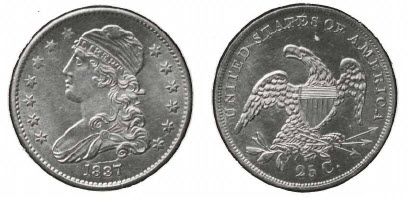
No. 1
Obverse: In the date upright of 7 about even with left of curl; upper left star points to between the two curls; lower left most distant from bust with upper right somewhat nearer cap; lower right close to hair.
Reverse: The same as 1835 [Browning] 8 and 1836 [Browning] 1.
Observe die cracked cround from lower left star, across lower front part of bust, through field over date, through lower part of hair and connecting the two lower stars at right. Reverse cracked from top edge through STATES (except last S) to D in UNITED, as in 1835 No. 8 and 1836 No. 1, but crack is heavier.
Coarse dentils, wide date.
Missing wing feathers at right.
Browning-1; not in Clapp; Duphorne-84; Breen-3932; not in Haseltine.
Rarity-5.
Die States: 1. Cracked as Browning describes.
II. Crack, rim to base of 7.
III. Crack continues through 7 to drapery. Winter Collection. Cherrypicked at the 1981 ANA sale.
This obverse die was doubtless made in 1834 or early 1835 but with final digit omitted, held in reserve until 1837.
Extremely rare Uncirculated. The following are the best ones known to me:
1. Col. Green. Plate VII. Uncirculated.
2. Landau, NN 52:510. Uncirculated, not illustrated. Bagmark on jaw.
3. NN 57:625. Uncirculated
4. 1975 ANA:367. AU, pin scratch on neck.
5. Ruby III:522. VF+.
6. Bergen:98. VF.
Reed Hawn:284 illustrates a B-2.
Numerical Condition Census (RWM, Sr. [circa 1992]): 64, 63, 63, 60, 60, 55.
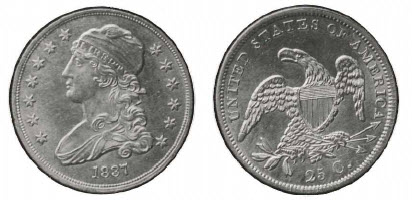
No. 2
Obverse: In the date top of 7 at extreme right is centered under curl; upper left star points to upper part of lower curl; lower left star most distant from bust and is further away than in [Browning] 1; upper right is about half as far from cap as lower left star is from front of bust; lower right is near hair, slightly further away than in No. 1.
Reverse: The value, 25 C., about midway between eagle and border, with 5 and C further apart than in No. 1; upper arrowhead nearer A than in [Browning] 1. The eagle has no tongue.
Dies perfect. Proofs were made from these dies.
Curl begins minutely right of left of left serif of 7; date almost straight.
Stem ends well to left of serif of C.
Browning-2; Clapp-2; Duphorne-87; included in Breen-3933; Haseltine-2.
Rarity-2.
Die States: I. Perfect dies.
II. Plain clash marks behind head and below wings. Reed Hawn:284.
Proofs:
1. Cleaneay:1352, believed later Col. Green (Plate VIII?).
2. Private collection (1950's).
Uncirculateds are rare, but not quite as rare as other varieties of this year.
1. Cleneay:1352, believed later Col. Green (Plate VII?).
2. Private collection (1950s).
Uncirculateds are rare, but not quite as rare as other varieties of this year.
1. Newcomer, Col. Green, Macallister, T. James Clarke, NN 47:1578, prooflike.
2. Private collection (1950's).
3. J.H. South:491.
4. J.H. South:492, prooflike.
5. Edgar Levy:28.
6. Terrell:677.
7. 1974 GENA:1337, faint rim dent above O; uneven strike.
8. 1975 ANA:366.
9. Reed Hawn:284, State II, as "B-1."
10. Boston Jubilee:383 (NERCA 1/7-10/81).
11. Robson:1295.
12. Spring:524, obverse field scratch.
13. FUN:1849 (NERCA 1/7-10/81)
Numerical Condition Census (RWM, Sr.) 66, 63+, 63, 63, 63, 63. many 60-63.