Silver Dollars & Trade Dollars of the United States - A Complete Encyclopedia
Q. David Bowers
1800. BB-184.
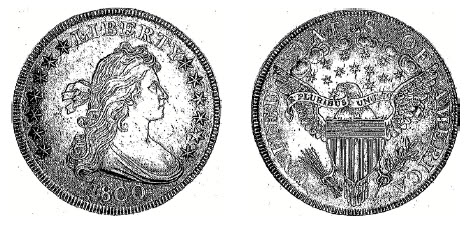
(B-12. H-12.)
• OBVERSE 2: See description under 1800 BB-182.
Obverse die used to strike 1800 BB-182, BB-183, and BB- 184.
• REVERSE C: A, die dot inside lower part of E in UNITED, and a more prominent die flaw at lower left side of K in AMERICA. Flaw or crack like a single quotation mark 01' line to the upper left of U in UNITED. These things quickly distinguish this reverse' from all others. Left side of N in UNUM about in a line with edge of eagle's neck, the only 1800 reverse for which this is true. Smallest letters in E PLURIBUS UNUM of any reverse die used this year. The berries are small. Leaf point under left side of upright of I in AMERICA. Point of upper part of eagle's beak shuts down near point of star. A does not touch feathers, and AME do not join. A over clouds 2 (partly) and 3 (mostly). Tip of arrowhead under right upright of U in UNITED. The D in UNITED is defective at its upper left corner from a broken punch (as with 1799 reverses H, I and P), but was hand-corrected by its engraver; thus, this is possibly one of the earliest 1800 dies. The fact that all but two 1799 reverses had small letters in E PLURIBUS UNUM also reinforces this suggestion.
Reverse die used to strike 1800 BB-184 only.
• DIE STATES:
Die State I: Obverse die without cracks. Reverse die without cracks. The usual die state seen.
Die State II: Bolender-12 a. Obverse with hairline crack from star 7 to L. Reverse with a crack across top of OF and right wing tip, nearly to A. A tiny crack extends from the milling down through center of F. Some show a line through the star under cloud 8. About 20% or so of BB-184 dollars are of this die state.
• AUCTION POPULATION SURVEY: Good: 2, Very Good: 4, Fine: 6,Very Fine: 18, Extremely Fine: 8, About Uncirculated: 8, Mint State-60 or better: 2. Total: 48. Average grade: VF-27.
• COLLECTING NOTES: The 1800 BB-184 dollar is fairly scarce. About 250 to 450 are known in all grades combined. As is the case with the majority of 1800 Bolender numbers, it is typically seen in worn grades up to and including VF. EF specimens .are very rare, AU pieces are rarer yet. The two Mint State coins listed below date well before the grading renaissance; I list them as MS-60 in the population distribution, but it is not known if they would grade full Mint State today.
• NOTABLE SPECIMENS:
Green Specimen. MS-60 .• Col. ,E.H.R Green Collection • M:H. Bolendcr Collection, 1952: 146. "Unc., Proof surface on reverse."
Hollinbeck-Kagih Specimen. MS-60 •• Hollinbeck-Kagin Sale, june 1970: 631. "Unc, golden."
Four Landmark Collections Specimen. AU-58 •• Bowers and Merena, 1989: 1974,. Medium Date. AU-58 to MS-60. "Prooflike reverse. Beautifully toned=iridescent purple, pale golden-brown, and silver-gray shades on both sides. The reverse surface is highly reflective and prooflike. Obverse strike is sharp, save on some stars on the right, as often seen on the variety; while the reverse shows pleasing detail in the eagle's wing and tail feathers."
Baldenhofer Specimen. AU-55 •• W. G. Baldenhofer to Stack's, Farish-Baldenhofer Sale, 1955 .• AJ. Ostheimer, 3rd Collection' Superior Galleries, ANA Convention Sale, 1975: 991. "AU-55 or so, lustrous olive, but not fully struck up in the centers of both' sides. Lovely cartwheel effect and very minimal signs of contact with other coins or handling marks."
Brown University Specimen. AU-55 •• Pine Tree, Brown University Sale, 1976: 316. "R in LIBERTY repunched; small berries, die chip at E(R), another before U. Surfaces suggest full MS-60, but there is just enough cabinet friction on isolated details to require that we downgrade it to AU-55. Attractive light golden tone. Free of visible handling marks."
Bergen Specimen. AU-55. • Herbert M. Bergen Sale (Quality Sales): 1356 .• Paramount, Auction '84, 1984: 733. "Choice AU-55. Boldly struck and well centered. A lovely warm gray color with gold, blue and russet highlights."
• POPULATION DISTRIBUTION:
Approximate population MS-65 or better: 0 (URS-0)
Approximate population MS-64: 0 (URS-0)
Approximate population MS-63: 0 (URS-0)
Approximate population MS-60 to 62: 1 or 2 (URS-1)
Approximate population AU-50 to 58: 10 to 20 (URS-5)
Approximate population VF-20 to EF-45: 140 to 250 (URS-9)
Approximate population G-4 to F-15: 100 to 175 (URS-8)
Approximate population for all grades combined: 250 to 450 (URS-10)
• CONDITION CENSUS: 60-58-55-55-55 (multiples)