Silver Dollars & Trade Dollars of the United States - A Complete Encyclopedia
Q. David Bowers
1881-CC Morgan: Market Values
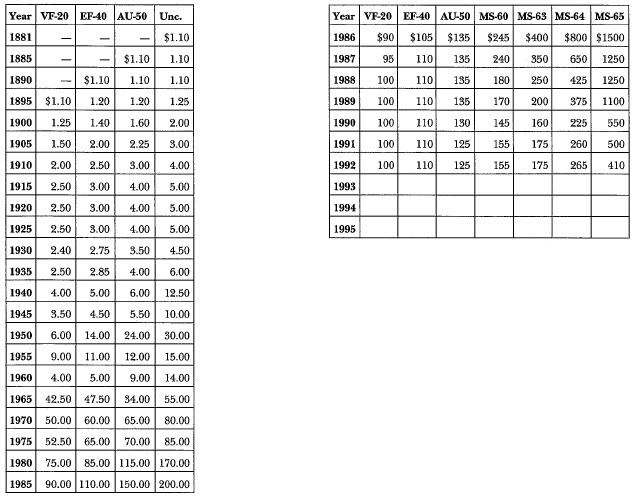
1881-CC: Summary of Characteristics
Business Strikes:
Enabling legislation: As earlier, plus Act of February 28, 1878
Designer: George T. Morgan
Weight and composition: 412.5 grains; .900 silver, .100 copper
Melt-down (silver value) in year minted: $0.87575
Dies prepared: Obverse: 25; Reverse: 25
Business strike mintage: 296,000
Estimated quantity melted: Relatively few
Approximate population MS-65 or better: 15,000 to 30,000 (URS-15)
Approximate population MS-64: 40,000 to 55,000 (URS-17)
Approximate population MS-63: 60,000 to 80,000 (URS-17)
Approximate population MS-60 to 62: 70,000 to 90,000 (URS-18)
Approximate population VF-20 to AU-58: 1,000 to 2,000 (URS-12)
Approximate population VG-8 to F-15: 2,500 to 4,000. (URS-13)
Availability of prooflike coins: Semi-prooflike coins are often seen. Full prooflike coins and DMPL pieces are readily available but are much scarcer than regular (frosty surface) Mint State coins.
Characteristics of striking: Nearly always seen sharply struck.
Known hoards of Mint State coins: Bags were released by the Treasury in 1954-1955. Harry J. Forman had several bags from CJ. Dochkus in 1957-1958. Others came from storage at the San Francisco Mint in the late 1950s, and from the Treasury in 1962-1964. 147,485 were held back from the 1962-1964 Treasury release and subse-quently sold by the General Services Administra-tion; this amounted to over half of the original mintage!
Proofs:
None
Commentary
The 1881-CC dollar, a low mintage issue, is easy to find today in Mint State condition due to the dispersal of former Treasury holdings. Probably not all 25 die-pairs were used. About 63% to 86% of the original mintage survives Unc., perhaps as high as 88% in all grades.
Dollars Stored
The Annual Report of the Director of the Mint, 1881, included this information: Carson City had 1,060,991 silver dollars on hand and had distributed 597,709 in the preceding year.