Silver Dollars & Trade Dollars of the United States - A Complete Encyclopedia
Q. David Bowers
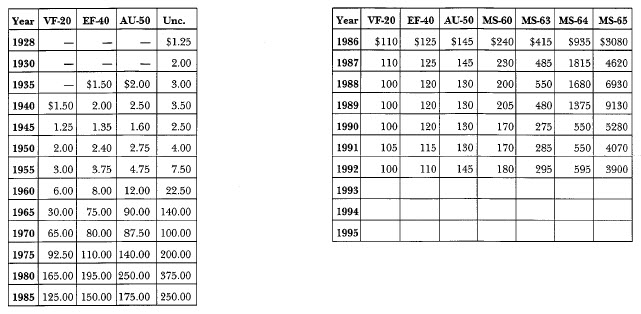
1928 Peace: Market Values
1928 Peace: Summary of Characteristics
Business Strikes:
Enabling legislation: As earlier; plus bullion authorized by the Pittman Act, April 23, 1918
Designer: Anthony de Francisci
Weight and composition: 412.5 grains; .900 silver, .100 copper
Melt-down (silver value) in year minted: $0.45237(Bullion value of a Peace silver dollar for years in which new coins were not produced, 1929 to 1933 inclusive: 1929 $0.41229, 1930 $0.29751,1931 $0.22440, 1932 $0.21814, 1933 $0.27068)
Dies prepared: Obverse: Unknown; Reverse: Unknown.
Business strike mintage: 360,649 (lowest mintage in the 1921-1935 series, except for the 1922 High Relief)
Estimated quantity melted: Unknown.
Approximate population MS-65 or better: 300 to 600 (URS-10)
Approximate population MS-64: 1,600 to 2,750 (URS-12)
Approximate population MS-63: 3,500 to 6,500 (URS-13)
Approximate population MS-60 to 62: 5,000 to 9,000 (URS-14)
Approximate population VF-20 to AU-58: 12,500 to 25,000 (URS-15)
Characteristics of striking: Average strikes; usually very lustrous .
Known hoards of Mint State coins: No bags are known to exist. Rolls come on the market occasionally.
Proofs:
None
Commentary
The Treasury Department released only a few in the year of coinage, 1928, saying that such were available for cornerstone-laying or other ceremonial purposes; later, large quantities were released.
Additional Information
Pittman Act Summary (1928)
The following summary is from The Annual Report of the Director of the Mint, 1928, and summarizes the transactions under the Pittman Act:
"During the fiscal year 1928 recoinage of the silver dollars, melted under the terms of the Pittman Act, was completed. A resume of the Treasury's silver operations under this act follows.
"The Pittman Act. The act of April 23, 1918, was entitled An act to conserve the gold supply of the United States; to permit the settlement in silver of trade balances adverse to the United States; to provide silver for subsidiary coinage and for commercial use; to assist foreign governments at war with the enemies of the United States;' and for the above purposes to stabilize the price and encourage the production of silver.'
"At the time of the passage of the act, Great Britain was in urgent need of the precious metals for use in India. The only possible source of sufficient silver to meet the war emergency was the United States Treasury stock of silver dollars. Congress therefore passed the act of April 23, 1918, which authorized the melting or breaking up and sale as bullion of not to exceed 350 million silver dollars from the large stock of silver dollars in the United States Treasury.
"The act also authorized the use of silver dollars and of silver purchased under the act for the manufacture of domestic subsidiary silver coins (halves, quarters, and dimes); the sale of silver bullion for commercial use and for conserving the gold supply of the United States and permitting the settlement in silver of trade balances adverse to the United States.
"Provisions also were made in the act for the retirement of a corresponding amount of silver certificates outstanding against the silver dollars melted; for the issuance of Federal Reserve bank notes. to prevent contraction of the currency on account of the retirement of silver certificates for the purchase of domestically produced silver at the fixed price of $1 per ounce; for the recoinage of the dollars melted; and, upon recoinage, for the retirement of the. Federal Reserve bank notes.
"Silver dollars melted. Melting of silver dollars was commenced immediately after the act was passed, and was vigorously prosecuted at the Philadelphia and San Francisco mints and at the New York Assay Office, until in May 1919, 259,121,554 silver dollars had been melted and the 200,032,325.64 fine ounces of bullion resulting there from had been sold to Great Britain. The bullion was sold to Great Britain at $1 per fine ounce, plus a charge estimated to cover the cost of melting, recoining, and other incidentals, with the intent that the United States government should neither gain nor lose by the transaction. In addition to the 259,121,554 silver dollars so melted and sold to Great Britain, 11, 111,168 silver dollars were melted and assigned for subsidiary silver coinage. However, this transaction was subsequently canceled, and the silver dollars so melted were replaced with silver dollars coined from silver in kind. There follows a statement showing in detail the number of dollars melted: