Silver Dollars & Trade Dollars of the United States - A Complete Encyclopedia
Q. David Bowers
As noted earlier, the combined, estimated mintage for 1802 and 1803 is too high; as it cannot theoretically exceed that government totals for those two years. Apparently, a slightly larger number of dollars of these two dates have been certified. I do not state that these estimated original figures are valid, but include them to complete the study.
However, it seems from the figures that more 1802-dated dollars were struck than were those dated 1803, and that more 1803 dollars were struck than were those dated 1801. Thus I conclude this: Of dollars dated 1801, 1802, and 1803, the 1802 had the highest mintage, followed by 1803, and then 1801. This is contrary to the government numbers, which suggest the order of 1803 (highest mintage), 1801, and 1802.
The Breen and Julian Studies (1963)
After having written Appendix II, my attention was called to two articles prepared nearly 30 years ago by R.W. Julian and Walter H. Breen. In light of the numbers just given, the Julian and Breen commentaries seem to reinforce the methodology.
In The Numismatist, June 1963, R.W. Julian published "Limited Census of Certain Early U.S. Coins," in which he gave a summary of findings from about 575 collectors and dealers who had responded to a questionnaire printed in the
February number of the same journal, and reported the numbers of various coin varieties held by them. For early dollars, selected dates and types were given (regrettably, not all dates were used) as follows:
1794: 28 coins reported. 1795 Flowing Hair: 367.
1795 Draped Bust: 184. 1801: 117.
1802: 171.
1803: 134.
This survey prompted Walter H. Breen to write an article, "Anatomy of a Coin Census," which was published in two parts in The Numismatic Scrapbook Magazine, July and August 1963. Excerpts from the Breen observations follow:
"Recently published figures of R.W. Julian's census of the number of specimens in the hands of 575 collectors and dealers of certain United States coins suggest a re-examination of the whole question of these dates and types .... I felt it was necessary to re-examine the predicted populations and C.R.s (characteristic survival ratios, number extant/number minted) in the light provided by Mr. Julian's sample, in the hope that something new might be learned that way .... "
Breen reported that while Julian had 28 1794 dollars revealed to him, Breen had been able to trace over 40, and estimated the population as being somewhere between 50 and 70, or about 4% of the mintage of 1,758. Concerning the other dates:
"1795: The census gives 367 with Flowing Hair and 184 with Draped Bust. This compares with [Breen's estimated] mintages of 124,795 and 78,238 respectively; the 2:1 ratio is not quite reflected in the mintages, but is close enough to be considered reasonably confirmatory .... In .these types and those to follow, the estimates are based on rarity ratings arrived at by Emanuel Taylor! and the writer over a number of years: Of the Flowing Hair dollars, probably somewhat over 5,000, possibly over 6,000, survive; of the Draped Busts, somewhere between 1,500 and 1,750 presumably survive. These indicate that the 2:1 ratio is not to be trusted; the correct ration is actually nearer to 3:1. ...
"I rather regret Julian's census did not include dollars of 1796 and 1797; I would have been very interested in testing Wayte Raymond's repeated claim that the 1796s were notably rarer than commonly believed, and in verifying (or even being forced to revise) my hypothetical division of the 1797 figures into types.
"For 1801, Julian's census gives 117, as against 171 of 1802. I am not surprised to find that 1801 is appreciably rarer; fewer dies were made, and all are scarcer than commonly believed. I have long suspected that the 54,454 dollars reported for 1801 included many dated 1800. Indeed, such assumption is necessary to account for the comparable commonness of 1802 with a lower reported mintage. For 1803, Julian's census gives only 134. This need not be taken seriously; Bolender-G, the familiar Large 3, is one of the three or four commonest of all early dollars, and I know I have seen at least a hundred of it alone, probably more than two hundred. If we write 84,634 as the mintage for 1803 (i.e., include the 19,570 struck in 1804), we get a ratio of 1:2 for 1802 to 1803 dollars, and my experience does tend to bear this out."
The Breen and Julian commentaries of long ago are in the same vein as my thoughts, although the percentages differ somewhat.
Concluding Commentary
These exercises in statistical analysis are interesting but are only as good as the input. Distortions may have been caused by rounding off the Economite Hoard coin figures when they were announced in 1878, and by the distinct possibility that the number of coins certified of early dollars may not truly represent the population of extant early dollars as a whole.
Similarly, NGC and PCGS certification data are distorted by resubmissions of more valuable dates and grades. Both the Economite Hoard and the certification service numbers are small in proportion to the original mintage figures. Thus, if either the Economite Hoard or certification service data are not representative, a small variance in these numbers will cause a big swing in any revised mintage figures calculated by using them.
Further, Economite Hoard and the certification service numbers tell us of survival, while the government mintage figures tell us of production. These are not the same entities. I believe that the two entities are related, but not necessarily on a direct basis for each and every date.
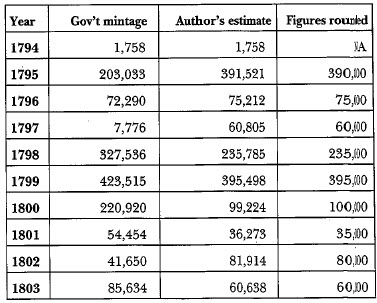
While my approximate figures have a ring of precision to them due to the mathematics involved, a number such as 99,224 given for dollars dated 1800 could just as well be 100,000, or 95,000, or 105,000, or some other figure some distance from the norm. However, it seems to me that the true figure must be between 90,000 and 110,000. Such a wide variation still seems to demonstrate that the government figures are not accurate. So as not to impart a sense of accuracy that is not there, I employ the following rounded-off estimates in connection with the early dollar section of the book:
Author's Estimated Figures All Years
Summary and Caveats
1. The actual truth re mintages of dollars dated 1794-1803: export quantities, etc will never be known with' finality
2. The calculations I give are based upon Economite Hoard and NGC and PCGS certification data, sources which may have bias and may not be" representative of the total population of dollars,
3. Any contemporary wholesale melting, export, or, destruction of early dollars may have had an, effect upon, the surviving quantities, leading to a presen terror of-estimating an original mintage smaller than it actually was. .
4. The rounded-off estimates should be used as approximations.
5. As early dollars 1794-1803 are studied by a wider circle of numismatists, more data will become available, and estimates can be refined.
However, I believe that the present discussion is more useful than simply reading official Mint figures and accepting them without question.