Care to buy a bag of 1931-S Lincoln cents -- 5,000 pieces-for face value, with the option of buying 99 additional bags?
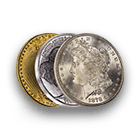
How about some Morgan silver dollars-brilliant Proofs-for $1.15 apiece?
Or maybe you'd prefer some Liberty Seated coins: dimes for 15 cents ... quarters for 35 cents ... and halves for 65 cents-all of them, again, flawless Proofs.
Sound too good to be true? It is, of course, in 1999's high-priced market. But the late Norman Shultz of Salt Lake City, Utah, took advantage of all these offers-and others like them-during his long career as a coin dealer.
Shultz was in his mid-90s when he passed away in 1988, and spent nearly three-quarters of a century in the coin business, amply justifying his unofficial title as "the dean of American dealers." He began his career a year before the U.S. Mint started making the Standing Liberty quarter, and remained active right up to the dawn of third-party certified coin grading. He was still going strong when I interviewed him for a New York Times column in 1981.
"I don't know what I'd do if I retired," Shultz told me at that time. "I'd hate to just sit and do nothing."
Ironically, his long career began at a time when doctors were predicting he would meet an early death. He had contracted tuberculosis, and at one point he was told he had 30 days to live. He survived the crisis-so well, in fact, that as of our conversation in 1981, he hadn't had a serious illness since. And during his convalescence, he started to develop the mail-order trade that formed the basis of his business all his life.
Things were far different in the business-and the hobby-in 1915, when Shultz ran his first advertisement in a publication called Philatelic West.
"In those days," he remarked, "there were probably 10 dealers in the United States and 10,000 collectors. Nowadays, it seems like there are 10 collectors and 10,000 dealers; everyone considers himself a dealer." Shultz shook his head when he contemplated how different the coin business was in the early 1980s.
"You can't imagine how much things have changed," he declared. "There's been such a change in the last 10 years or so that I hardly can believe it.
"Fifty years ago, I used to go to California and they'd charge me 10 cents apiece for 1909-S VDB Lincoln cents -- and I'd tell them they saw me coming and raised the price. Now, of course, those same coins sell for hundreds and hundreds of dollars.
"I can remember buying 1879-CC silver dollars by the sack in the 1940s for a dollar-and-a-half apiece. Now I see them priced in the thousands. One time, a fellow from Reno brought me a sack of them, and after buying the best ones for $1.50 each, I told him the rest were too scratched to be worth anything. I wouldn't even buy them for $1.25."
There were, of course, far fewer collectors in the "good old days"-so in terms of the demand, the supply of most coins was ample. And during the Depression, money was so tight that even at rock-bottom prices, few people could afford to buy coins.
That helps explain how Shultz got such a deal on those 1931-S Lincoln cents-and why he found it difficult to sell them.
"It was 1935," he recalled, "and a fellow from the Federal Reserve branch bank in Salt Lake City called and said a ton of 1931-S cents had just come in and I could have all I wanted for face value. He had 500,000 of them, so I could have bought the whole lot for $5,000. And keep in mind that the entire mintage of the coin was only 866,000.
"Well, money was pretty scarce in 1935, so I only took one sack -- $50 worth. My bank wouldn't lend me money to buy them all-and the funny thing is, they wouldn't even take the coins at face value for security; they said they didn't want the stuff cluttering up the bank.
"I ended up selling the sack to an attorney in California for 40 cents a coin; he had ideas of cornering the market. But things didn't work out, and he sold them back to me a year later for 30 cents each. After that, I simply peddled them out a few at a time."
Nowadays, it would take the $50 face value of that bag to buy a single '31-S cent in mint condition, and several hundred dollars to buy one graded Mint State-65 Red. At $50 per coin, the sack Shultz bought for $50 would now be worth roughly $250,000. And the half-million pieces he could have bought for $5,000 would be worth a cool $25 million. Although he bought coins through the years at prices that now seem cheap, Shultz sold them cheaply, too. And he wasn't exactly besieged by buyers, either. Take those Proof Morgan dollars, for example.
"I'd buy them for $1.15 in auction sales," he said, "and I'd have an awful time getting $1.25 for them."
Those Liberty Seated Proofs proved to be slow movers, too.
"Max Mehl, one of the biggest dealers in the country, used to send me cigar boxes full of dimes, quarters and halves-all brilliant Proofs-from the 1860s, '70s and '80s," Shultz related, "and I bought them for just slightly over face. But they didn't sell fast at all."
Today, of course, coins like those are hard to find at any price-and when buyers do locate them, they have to pay very fancy prices. Shultz had no regrets that he sold so many coins at what now seem like giveaway prices.
"It never bothered me how much they went up after I sold them," he said. "I was selling coins for a living, so as long as I made something when I sold them, that's all that mattered."
Ironically, his greatest profits came, in the long run, from coins for which he couldn't find buyers.
"They went up in value along with everything else," he pointed out, "and because I hadn't sold them, the profit was mine."
In 1937, when the San Francisco Mint was relocated, Shultz was able to purchase large quantities of silver dollars from a hoard that had been kept in the vaults at the Old Mint. Many of these were low-mintage issues-and since he had obtained them for face value, he was able to sell them for bargain prices and still turn a handsome profit. From that time on, he was identified closely with the large silver coins-so much so that hobbyists sometimes spoke of him as "Mr. Silver Dollar."
Postal employees in Salt Lake City knew him in this vein, too. They delivered mail to him bearing no further address than "Morgan Dollars, Salt Lake, Utah." He also dealt extensively in Japanese invasion currency.


 Copper & Nickel
 Silver Coins
 Gold Coins
 Commemoratives
 Others
 Bullion
 World
World
 Coin Market
 Auctions
 Coin Collecting
 PCGS News