By Tom LaMarre
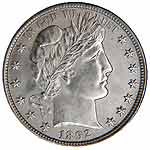
Writing in the February 1966 issue of the Whitman Numismatic Journal, Lawrence Block (who was on the staff of Whitman Publishing, but who later resigned and went on to pursue an illustrious career as a writer of mystery stories) stated that chief engraver Charles E. Barber's Liberty Head design was neither severely criticized nor lavishly praised in its own time. Today, however, Barber dimes, quarters, and half dollars attract a wide following. Indeed, there is even a club for specialists in the series.
"Of all American coins long in circulation, no series has stood the wearing demands of modern coinage so well as the half dollar, quarter, and dime developed by the chief engraver at Philadelphia," according to Cornelius Vermeule in Numismatic Art in America. "Liberty's cap, incised diadem and wreath of laurel were designed to echo all of the depth and volume of her Olympian countenance ...The wealth of irregular surfaces and sharp angles is an almost electrifying aesthetic experience..."
Of the three series of Barber coins, the half dollar is the least difficult to collect by date and mintmark variety, although many challenges exist. A complete set comprises 74 coins if the rare 1892-0 variety with "microscopic" mintmark is included.
In 1892, the first year of production, the Barber half dollar was overshadowed by the World's Columbian Exposition commemorative half dollar, and, in any event, there was little collector interest in mintmark varieties.
At the New Orleans Mint, however, the start of Barber half dollar production must have been a momentous occasion. The last time 50 pieces had been struck there was in 1861, under the authority of the Confederate States of America.
The New Orleans facility was the only southern mint to reopen after the Civil War, though it was not permitted to resume coinage until 1879, two years after Reconstruction officially ended. For years thereafter the Mint's output was restricted to silver dollars, gold eagles, and an almost negligible run of double eagles (1879 only). Beginning in 1892, there was a wider flow of denominations bearing the "O" mintmark, with half dollars struck each year through 1909.
Also producing Barber half dollars were the Philadelphia (1892-1915), Denver (1906-1915), and San Francisco (1892-1915) mints. In theory, it would have been possible to strike 1892-CC and 1893-CC Barber half dollars, as the Carson City Mint was still in operation in both years. Alas, its output in the final years was limited to silver dollars and various gold denominations. Half dollars were last struck there in 1878.
For the most dedicated collectors, the Philadelphia Mint struck a small number of Proof Liberty Head half dollars each year, using a process which Charles Barber said was reserved for only the most artistic coins and medals. Interestingly, while 1905-dated half dollars were being struck, Barber was touring the mints of Europe with a view to improving the U.S. Mint's Medal Department.
In 1906, the year of the great earthquake, the San Francisco Mint struck more than 1.7 million half dollars. Amid the devastation, it was rumored that an armed gang intended to steal $200 million in coins and bullion from the "Granite Lady," as the fortress-like building was called. As sometimes happens, hearsay became "fact," and a San Francisco newspaper erroneously reported that more than a dozen people were shot during an attempted robbery at the Mint.
On a somewhat less disturbing note, the following press dispatch with a Chicago, February 9,1906, dateline appeared in The Numismatist:
"Three counterfeit silver half dollars were found in a consignment of money which reached the United States sub-treasury yesterday from Texas. The coins cannot be detected as spurious except by the close inspection of an expert. Chief John E. Wilkie, of the United States Secret Service, identified them as some of a lot of counterfeit coins which were circulated in the United States three years ago, and were made in China by expert counterfeiters."
Peak production of Barber half dollars took place in 1908 when the four mints turned out a total of more than 11 million pieces (at that time the United States had a population of around 90 million). Taking honors for the lowest mintage, non-Proof Barber half dollar is the 1914 Philadelphia variety, of which fewer than 125,000 examples were struck. The New York Subway Hoard, acquired in the 1990s by Littleton Coin Company, included 25 1914-dated Philadelphia half dollars. For a long time the 1914 has been prized in just about any grade--from well worn to brilliant Mint State, the latter being almost unavailable.
In December 1915, the Treasury Department announced a design competition for a new dime, quarter, and half dollar. Although Barber dimes and quarters were minted into 1916, production of Barber half dollars came to an end in 1915.
Two years later, Charles Barber passed away. "Mr. Charles E. Barber, chief engraver of the United States Mint, died last Sunday afternoon [February 18,1917] very suddenly," Charles Warner reported in Mehl's Numismatic Monthly. "Mr. Barber was in the 75th year of his age ...There is no doubt but what his grand collection will be sold someday. It is said that he was the possessor of the grandest and very rarest pattern pieces that were ever known."
Currently five 1891-dated half dollar patterns are recognized, all but one bearing a Liberty Head design (the sole exception depicts a standing Columbia) and all in the Smithsonian Institution, according to a recent article by Paul Gilkes in Coin World.
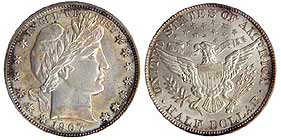
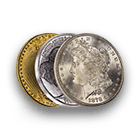
1907 Barber Half Dollar. Chief engraver Barber's design was neither severely criticized nor lavishly praised in its own time. Today, however, Barber dimes, quarters, and half dollars attract a wide following.


 Copper & Nickel
 Silver Coins
 Gold Coins
 Commemoratives
 Others
 Bullion
 World
World
 Coin Market
 Auctions
 Coin Collecting
 PCGS News