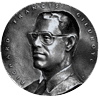
Most coin collectors in the United States are aware of the 1909 fiasco regarding the appearance of the initials VDB for coin designer Victor D. Brenner on the Lincoln cent introduced in that year. Indignant people complained about the initials appearing so prominently on a coin, as the appearance of the initials of a coin designer was something new.
Slightly more advanced collectors may seek out some of the modern coin varieties of various denominations on which the initials of the designer should be there, but are absent due to overpolishing of a die. These sell for a premium value.
These funny little letters have been misinterpreted and misunderstood by many collectors and non-collectors alike. The initials JS for coin designer John R. Sinnock appearing at the truncation of the Roosevelt dime beginning in 1946 were, at one time during the "Red Scare", suggested to stand for Joseph Stalin! The initials identifying Augustus Saint-Gaudens as the designer of the $20 double eagle gold coin introduced in 1907 (which coincidentally just happens to bear his name as the Saint-Gaudens double eagle coin) have often been mistaken by novices to be the Mint mark.
What most people may not realize is that the tradition of identifying the coin designer or engraver goes back to antiquity. Ironically, while the United States was having a snit in 1909 over the nerve of Brenner to have placed his initials on the 1-cent coin, the initial L for coin designer James B. Longacre had appeared on the Indian Head cent beginning in 1864 through 1909. Coins of both of these dates with designer initials bring a premium value.
They aren't the first. We don't know who all the celators (die engravers) were by name, but some of the most famous from history have been identified since their names appear on coins they designed. Perhaps the greatest of these are the issues of Eucleides, Euainetos, Eumenes and Kimon produced in the late 5th century to early fourth century B.C. at the Greek city-state of Syracuse on the island of Sicily.
No one knows much about the celators whose names are found on some of the most magnificent large silver decadrachm and tetradrachm coins of all time, but the names only appear on coins struck from some, rather than all, dies for the coinage series of the time. The reason for this may be that perhaps these were the head celator, a person who engraved the dies initially used before apprentices with lesser talents produced the more numerous later dies so larger quantities of coins could be produced. Just as with the 1909-S VDB Lincoln cent and the 1864-L Indian Head cent, these signed coins of Syracuse and other early Greek city-states bring hefty premiums above their counterpart coins without such initials or names appearing.
Although little is known about these early master die engravers, some interesting insights have been concluded through numismatic detective work. According to Kerry Wetterstrom in auction lots comments for Lot No. 338 in the Dec. 2-3, 1997, Triton I auction by Classical Numismatic Group, "The decadrachms of Euainetos and his school are more plentiful than those of his rival Kimon and doubtless were issued over a much longer period. Their influence on the die-engravers of later generations at mints throughout the Greek world was profound."
Next time you pull a coin from change or examine a specimen from your collection look carefully for a name or initials appearing in some obscure spot within the design elements. Some modern celator is being honored for all time for his efforts.
Richard Giedroyc is a numismatic writer, researcher, auction cataloger and coin dealer. He has been in the hobby and business most of his life, now having more than three decades’ experience in this fascinating hobby field. During this time Giedroyc has been the owner of Paris Bergman Galleries, owner of Classical Coin Newsletter, international editor of Coin World and owner of Giedroyc-Anderson Interesting World Coins. He is currently a numismatic consultant. He has written more than 2,000 byline numismatic stories and contributed to several coin catalogs.


 Copper & Nickel
 Silver Coins
 Gold Coins
 Commemoratives
 Others
 Bullion
 World
World
 Coin Market
 Auctions
 Coin Collecting
 PCGS News