
Rare coins are a hot commodity in China. The modern Chinese coin market has literally exploded in the past year. The Chinese are demonstrating a passion for coins rarely seen in recent times. As a result, PCGS is beginning to see a surge in modern coins coming from China. And to follow suit, the PCGS Set RegistrySM has expanded the Chinese registry.
The People's Republic of China standard coinage, made from 1955 to date, is interesting because there are a number of rare issues. The 1982 Jiao, 2 Jaio, 5 Jaio and Yuan were produced in circulation strike but in very limited numbers; in fact, the Krause catalogue does not list them. The exact mintages are not known. In 1986, all denominations were made in proof, but only 660 of each were minted. That year, the Jiao, 2 Jaio, 5 Jaio and Yuan were produced in proof only.
Due to the low mintages, building sets of the Chinese standard coinage can be quite challenging.
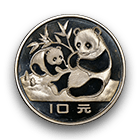
By far the most popular area of modern Chinese coinage is the Panda. First issued in 1982, these coins have achieved worldwide recognition. The coins, found in both BU and Proof, are minted in a number of different denominations with weights ranging from 1/20 ounce to 1 kilogram. The first issues in 1982 were gold. The following year, the silver 10 Yuan (27 grams) Panda was issued in proof. It wasn't until 1987 when the first platinum 1-ounce Panda appeared in proof, and it was followed in 1988 with a 1-ounce palladium proof.

1990 saw the introduction of the bi-metallic coins, a gold center and silver ring. It was also the year the Large and Small Date varieties appeared. Colorization was introduced in 1997. There are many different designs, some of which are commemorative in nature. While some issues have high mintages - up to 800,000 - with purchase prices based on the price of bullion, there is also a considerable number of low-mintage coins. For example, only 99 1995 1000 Yuan (12 oz) gold Pandas were made.
Next in popularity are the Chinese Lunars. These are incredibly fun to collect because of their interesting designs. The first issue appeared in 1981. The Lunars run in 12-year cycles, every year with a new animal. The sequence is Rooster, Dog, Pig, Rat, Ox, Tiger, Rabbit, Dragon, Snake, Horse, Goat and Monkey. The first cycle ran from 1981-1992, the second from 1993-2004, and the third started in 2005 and is currently running. Denominations vary through the years with some being discontinued and others being introduced.
To make the series even more interesting, not all the coins are round! There are also scalloped, rectangular and fan-shaped issues. In addition, colors were introduced in 1999. The coins were initially minted in silver and gold. Platinum was first used in 1988 and last used in 1999.

Modern Chinese commemoratives, which are considered legal tender, are the least known here in the United States. That is bound to change as the Chinese coin collecting fervor lights up in this country. The scope of this area of Chinese coinage is sizable. The commemoratives have a vast array of designs, denominations, compositions and shapes. There are a number of limited editions as well as a number of series that run for several years.
The Chinese Mint sculptors and engravers have done a wonderful job of creating some unique designs. For example, the Unicorn series (1994-1997) in silver, gold, platinum and bi-metallic offers delightful designs of the mythical unicorn. Some coins feature one unicorn, and others have two. Some have human figures in the design and others display just the unicorn's head. There are also the Eastern and Western unicorns. Mintages estimates range from just 18 to 45,007.
The Beijing Opera colorized coins (1999-2002) are absolutely stunning. Featured in gold and silver, these coins are sure to attract both numismatic collectors and those who love the beauty of great coin design. These coins are very collectible due to their higher mintages that range from 8,000 to 38,000.
There are far too many issues of Chinese commemoratives to cover in one article. And, although there are not many good resources on the subject due to the language barrier, several websites cover the subject quite well. www.china-mint.info lists the commemoratives (as well as the Pandas and Lunars) year by year from 1979 to 2010. www.modernchinacoins.com also does an excellent job of presenting detailed information on many of the Chinese series including the standard coinage. For Pandas, Peter Anthony's Gold and Silver Panda Coin Buyer's Guide is indispensible.
The PCGS Set Registry now lists over 300 different set compositions for the People's Republic of China. If you have an interest in collecting Chinese coins, pay a visit to the Chinese Set Registry to get an idea of the many options available to you. As a guarantee of authenticity, it is always recommended that you purchase PCGS-graded Chinese coins.


 Copper & Nickel
 Silver Coins
 Gold Coins
 Commemoratives
 Others
 Bullion
 World
World
 Coin Market
 Auctions
 Coin Collecting
 PCGS News