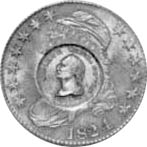
A Curious Counterstamp
Over a long period of years I have been fascinated by the famous counterstamp that is occasionally found on copper cents and silver half dollars, and a few other coins as well, dated 1824 and earlier. I first laid eyes on one of these about the year 1955, and found it fascinating.
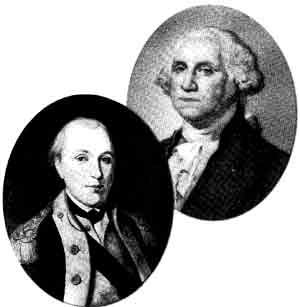
The counterstamps were made from a pair of dies measuring about 9 mm. in diameter. The obverse die has the inscription GEORGE WASHINGTON in a partial circle surrounding a portrait of Washington facing left, while the reverse is inscribed GENERAL LAFAYETTE, with the date 1824 below; surrounding a portrait of Lafayette facing right. Most examples seen by me have Washington on the obverse of the host coin and Lafayette on the reverse, although in my own collection I have a pair of 1824 half dollars (one from the Mehl's Belden Roach Sale catalogue, illustrated there), one with Washington on the obverse and the other with Lafayette on the obverse.
As in 1955 no one among my early numismatic acquaintances could tell me anything about the counterstamps, I reverted to that ever-helpful source: my numismatic library. At the time my shelves of books and catalogues were modest, but I did have nearly a full set of The Numismatist dating back to 1894 (I lacked the really rare issues of 1888-1893 and even today have only a reprint set).
Duffield's Study
I knew just where to look: In Frank Duffield's serial article, "A Trial List of the Countermarked Modern Coins of the World," which began in the July 1919 issue and continued for many years afterward. Duffield, a Baltimorean, was editor of The Numismatist. Relating to the counterstamp in question, he had this to say:
- “One of the most interesting stamps found on United States coins is that of the bust of Washington on one side and the bust of Lafayette on the other side. These pieces are not numerous, and bring good prices when offered for sale. The occasion for the stamping was Lafayette’s visit to this country in 1824, but where and when the stamping was done, has not been satisfactorily determined.
- "The version most generally accepted is contained in a letter received sometime ago from one of our correspondents as follows: ‘When you come to the United States section of your article on countermarked coins, play up with a good story regarding the Washington and Lafayette heads countermarked on various coins. There are different stories regarding the stamp, all of which have been questioned as to correctness. The story most generally told is that while Lafayette was being entertained at the Mint during his visit to the United States about 1824, in compliment to Lafayette, each of which party was
privileged to offer a coin on which the stamp was made from punches that had been prepared especially for the purpose. I have a United States half dollar with a very good stamp of Lafayette's head.’
- "Another story is to the effect that during a procession in honor of Lafayette, coins bearing the stamps were thrown from one of the carriages to the crowds lining the streets to which the procession passed. "
Duffield wrote that he was aware of this counterstamp existing on cents of 1815, 1817, 1818, 1822, and 1823; dimes of 1820, 1821, and 1822; half dollars of 1824; and a Spanish silver real.
Lafayette's Visit
In 1824 the Marquis de Lafayette, popularly known as General Lafayette, French hero of the American Revolution, revisited America and was proclaimed by Congress to be "the nation's guest." Numerous printed, medallic, and other tributes were created during the course of his stay in the United States, which extended into the year 1825. It was his plan to visit each of the states in the Union.
By coincidence, as these words are being written, I am putting the finishing touches on a new book, the working title of which is A Romantic Adventure: Edmund Roberts and the Famous Silver Dollars Dated 1804. Roberts was born in Portsmouth, New Hampshire, and lived there for much of his life. He was related by marriage to Levi Woodbury, who for much of the Andrew Jackson administration (1829-1837) served as secretary of the Treasury, including during the very important time when Christian Gobrecht was hired for the engraving staff (1835) and steam coinage was introduced (1836). However, although a book could be written about Woodbury, and during my research about Roberts I encountered much Woodbury family information, the focus was on Edmund Roberts. On October 1, 1835, he personally delivered on behalf of President Jackson a presentation set of coins to the Sultan of Muscat, consisting of Proof coins dated 1834 plus a Proof 1804 Class I silver dollar and a Proof 1804 $10. This represents the earliest known time at which an 1804 dollar changed hands. Later, it was to become what B. Max Mehl called "The King of American Coins," the most famous of all coin rarities.
In the course of ferreting out information concerning Edmund Roberts, I came across several accounts of Lafayette's visit to Portsmouth, an event in which Roberts played a part. The following is an excerpt from the forthcoming book:
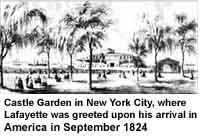
Gen. Lafayette Comes to Portsmouth
On Wednesday, September 1, 1824, Gen. Lafayette visited Portsmouth in the afternoon and evening, a brief stop on the beginning of what would be an extensive tour of the United States. He arrived at the harbor of New York City on August 15, was greeted effusively at Castle Garden and elsewhere, then headed north along the coast, stopping a towns and cities along the route. His entourage consisted of Gen. Lafayette; his son, George Washington Lafayette; his secretary A. Lavasseur; a servant; and drivers. The party was carried in three carriages consisting of an open barouche decorated with flags and drawn by four horses, this used in processions; a closed stagecoach drawn by four horses; and a covered baggage coach drawn by two horses.
All along the way Lafayette was greeted by public dignitaries, parades, balls, receptions, festooned buildings, and other evidences of trappings of celebration. The citizens of America were grateful for the help that Lafayette had provided during the War for Independence, and the 1824 visit, which extended into 1825, provided the opportunity to demonstrate their appreciation.
Portsmouth's hosting of Lafayette seems to have outdone all previous visits to the town by dignitaries including George Washington in 1789 and James Monroe in 1817 (when our Edmund Roberts was also on the greeting committee), both of whom stayed for a much longer time. The era seemed to be particularly right for a great deal of enthusiasm, and no effort was spared to make Lafayette welcome. Among those assisting with the arrangements and participating in the ceremonies was Edmund Roberts.
Members of the Committee of Arrangements met Lafayette at Hampton Falls, New Hampshire, near the border with Massachusetts. The first stop was Greenland, where he was greeted by a military salute, the assembled townspeople, and some who had come in advance from his next stop, Portsmouth. In Greenland several arches had been erected, one supported by two young ladies representing the allegorical figures of Liberty and Peace. The two girls gave Lafayette a wreath and olive branch respectively. After local ceremonies, he was introduced to the Portsmouth selectmen who had come to Greenland to join his escort party. The weather was rainy throughout the day, which dampened the clothing but not the spirits of those involved.
At the town line between Greenland and Portsmouth a vast procession was formed. The official order was as follows, but by the time that all interested citizens, merchants, organizations, and wellwishers had joined in, the parade was two miles long:
Marshal in front.
Marshals, escort on horseback, and additional marshals.
Marshal.
Committee of Arrangements in
carriages.
Selectmen in a carriage.
Chief Marshal and two aides.
General LaFayette in an open carriage, accompanied by the Chairman of
the Selectmen.
The General's family in a carriage accompanied by one of the Selectmen.
Marshal and two aides.
Gentlemen who have been Governors of the State.
Senators and Representatives in Congress.
Judges of the U.S. Courts and of the Superior Court of the State.
Officers of the Navy and Army of the United States, Senators and
Representatives of the State, and strangers of distinction in carriages.
Marshal and two aides.
Citizens in carriages.
Marshal and two aides.
The procession began about noon, and by about one o'clock had reached Wibird's Hill, where a "national salute" was given by the Portsmouth Artillery, and bells in town buildings began to ring. As they neared the business district, 1,000 school children watched the procession. Girls were dressed in white, with wreaths of flowers in their hair, while the boys wore hats with a badge inscribed "Welcome Lafayette." The procession was escorted by a battalion consisting of the Strafford Guards (from Dover), the Rockingham Guards, and Gilman's Blues under the command of Capt. Lefavour.
Large arches of evergreens, decorated with allegorical scenes and patriotic motifs, were built over Court Street and at the end of Market Street, each with the inscription, WELCOME LAFAYETTE, THE HERO OF '77, WHO FOUGHT AND BLED FOR FREEDOM.
Citizens waved ribbons and banners and cheered from the sides of the streets, from windows, and even from roofs of buildings. The long procession continued through Middle Street, Broad Street, Court Street, and Congress Street, to Franklin Hall, where Lafayette left his open coach and received the personal greetings of the selectmen.
Lafayette replied that although his schedule called for him to go to Washington as an early order of business: “I am happy to revisit, at least, the town of Portsmouth, where the remembrance of past favors [during the Revolutionary War] mingle, with most grateful feelings, for our present affectionate and flattering reception.”
Governor David L. Morrill then addressed Lafayette and the audience, adding his welcome.
A reception for Lafayette was held in Franklin Hall in the Portsmouth Hotel, with 30 Revolutionary War veterans who had served under him being among those in attendance. Included were General Smith of Portland, Maine, who had served under Lafayette for three years; and a Mr. Dow, of Portsmouth, who tearfully expressed his gratitude. The taproom in the hotel was a favorite hangout for Daniel Webster, the orator and politician who once lived in Portsmouth, but later moved to Massachusetts. The Portsmouth Hotel became known as the Franklin House by the late 1830s. The New-Hampshire Gazette continued the story:
From Franklin Hall the General was accompanied to the Mansion-House of the late Governor Langdon, which had been prepared for his reception. After this he was escorted to Jefferson Hall, where a public dinner was given. The Hon. John F. Parrott president, assisted by Nathaniel A. Haven, Edward Cutts, Jr., Enoch G. Parrott, Langley Boardman, Benjamin Penhallow, Edmund Roberts, Nathaniel B. March and Stanley Larkin, Esq'rs, as vice-presidents.
The company consisted of nearly 300, and is supposed to be the largest that ever dined together in this town. After dinner a number of toasts were drank-among them were the following:
- By Hon. John F. Parrott, President: "General LaFayette and the Rights of Man. While America welcomes her Hero and Friend, may Europe practice lessons he taught, and imbibe the principles for which he fought and bled:"
- By Gen. LaFayette: "The Town of Portsmouth. May the blessings of her Republican institutions ever give the lie to the narrow, selfish, sophistry of European Aristocracy and Despotism."
- By Governor Morrill: "Our distinguished guest, the adopted Son of our country, Gen. LaFayette, one of the surviving Heroes of the American Revolution."
- By N.A. Haven, Esq. Vice President: "National gratitude, the strongest incentive to public virtue, and its purest reward."
- By Edw. Cutts, Jr. Esq. Vice President: "The founders of American Independence. May those rational principles of liberty which they espoused and transmitted, be extended throughout the world."
- By Hon. Levi Woodbury: "The generous Allies of America in her war for Independence -ere long among them as among us may the voice of the People become every where triumphant."
- By Jacob Sheafe, Esq.: "The President of the United States."
- By Rev. Mr. Burroughs: "The Philanthropic Hero, who, amidst our revolutionary struggles, provided himself a ship to take passage to our country, and also supplied our troops with arms and clothing, when we were too poor to furnish them. May He and his descendants never want blessings and honors."
- By Judge Durell: "The Constitution of the United States-may it, ere long, be received as the general text-book of European politicians."
- By Col. Colden, of New York: "The enviable fame of the disinterested Patriot, the consistent Politician, and the gallant Soldier."
- By Capt. Crane, of the Navy: "The surviving Soldiers of the Revolution."
- By Lemuel Adams, Esq.: "Greece and the infant Republic of South America-may the next century give them as occasion of festivity as just and joyful as the present."
- By Samuel Cushman, Esq.: "Gen. LaFayette. As distinguished for his moral worth, as for his patriotism and love of rational liberty."
- In the evening the General attended the Ball, given at Franklin Hall in honor of the occasion.1He retired about 10 o'clock to his lodgings tat the John Langdon house], apparently very much gratified, and soon after left town for Boston, accompanied as far as Newburyport, by a deputation from the Committee of Arrangements.
- The Court-House, Jefferson-Hall, Franklin-Hall, the public houses, and several private buildings in Congress, Court, and pleasant Streets were brilliantly illuminated. The buildings at the Navy-Yard were also illuminated, and made a very handsome appearance.
Lafayette departed Portsmouth about midnight, and arrived in Boston at seven the next morning. While in Portsmouth he was implored to visit Dover by a contingent from that town, but stating that his schedule did not permit this, he expressed his regrets. Later in his American tour he revisited New Hampshire and stopped at various interior towns including Dover and Concord.
The C.C. Wright Connection
Spurred by my first encounter in 1955 with a Washington/Lafayette counterstamp, I began gathering as much information as I could find. Today in 1999,1 have a shelf filled with books and chronicles about Lafayette, concentrating upon his 1824-5 visit. While I have not read every paragraph in every book, I have done quite a bit of skimming, and, alas, l have not (yet) found any contemporary mention of the counterstamps.
For a long time-in fact, until this spring -I was of the opinion that the dies for this counterstamp (and a small medalet also struck from the same die pair) were the work of Charles Cushing Wright. I simply followed the thinking expressed oft times by earlier numismatists, including W.S. Baker in his 1885 book, Medallic Portraits of Washington, in which he attributes the dies to Wright (pp. 93, 95).
The fascination with this led me to accumulate a lot of information about Charles Cushing Wright, enough, in fact, to write a book about him (so many book ideas and so little time!). Without serious question, Wright was the pre-eminent American die sinker in the private sector from 1826 (the date of his illustrious Erie Canal medal) to the mid-1850s. Along the way he created some of the most beautiful medals ever struck by the Philadelphia Mint, he made the dies for the first 1851 octagonal $50 coins for Augustus Humbert, and more. He was also a numismatist, and in 1831 he is known to have given a lecture on ancient coins. Moreover, his personal collection was gifted to the New York Public Library. By one of those strange (but frequent) coincidences in numismatics, in 1982 the New York Public Library consigned its coins and medals to us for auction, and they were duly catalogued and presented. When the coins were entrusted to our care, the accompanying information said nothing about how they were acquired. Years later and from a different source, I learned that certain of the medals we sold, including from dies by Wright, were from the artist's own collection!
A New Contender!
In recent months I and several others have been corresponding with Karl Moulton, a seller of out-of-print-numismatic books and a diligent seeker of historical knowledge. He is in the process of studying early quarter dollars of the 1796-1838 years, and along the way has found some information not hitherto published in numismatic circles. Among our letters there was mention of Lafayette in regard to his connection with Edmund Roberts.
Out of the clear blue sky (for me) Karl Moulton informed me that on December 30,1824, E. Luigi Persico, a sculptor and artist was paid $80 by the Philadelphia Mint for "modeling a small medallion head for the silver coins."
A lightbulb flashed in my head! The last quarter of the year 1824 would have been a logical time for the Mint to have created dies for the counterstamp, for Lafayette's visit was just getting underway. The "small medallion head for the silver coins" could refer to this pair of dies, as the term small medallion was used. Besides, in 1824 there was no coinage portrait alteration.
Interestingly, Karl informed me that his source for this information was none other than Frank H. Stewart's History of the First United States Mint, page 188. Having read Stewart's book several times in my life, l secretly blushed at having overlooked this obvious clue!
If the Persico and Mint connection with the Washington/Lafayette dies can be confirmed, this would place the counterstamps as the first United States commemorative coins, unseating the present holder of that title, the 1848 CAL, gold $2.50. The third commemorative coin in the list would then become the 1892 Columbian Exposition half dollar.
I wrote to Karl Moulton forthwith:
I am very excited about the prospect of the 1824 Washington-Lafayette medalet, and I congratulate you for calling this to my attention. I had seen this notation many times before in the Stewart book, but had never really absorbed it! Incidentally, if you ever have any chance to see any back-up records, I would be very interested in any more you could provide. Lafayette was in America for parts of 1824 and 1825, as you know. The counterstamps may have been from dies made at the Mint-now I think this is likely based upon what you have said-but whether the coils were counterstamped at the Mint, I don't know. Certainly, coins other than current issues were used, including Spanish-American silver.
As a fantasy idea, I can't help but think that there might have been a scenario in which someone took the dies and traveled along with Lafayette, and struck souvenirs on the spot-just as someone might make rolled-out Lincoln cents today. I do have documentation that in 1832 Joseph Conradt caused to have struck medals from a press that traveled through Philadelphia on a float during the February 22 parade honoring President George Washington. This would fit in nicely with Frank Duffield's earlier comment:
"Another story is to the effect that during a procession in honor of Lafayette, coins bearing the stamps were thrown from one of the carriages to the crowds lining the streets through which the procession passed."
The dies for the Washington-Lafayette piece are so small that little force would have been required to have struck the pieces. Thus, a portable apparatus could have been used, possibly even something in the ancient coin style-two dies hinged.
Where to from Here?
Just as the New-Hampshire Gazette in Portsmouth chronicled what Lafayette did in his visit to that town, dozens of other papers in America carried accounts of his visit to their towns. Perhaps a perusal of some of these would describe the counterstamps and their distribution. On the other hand, what is everybody's business at one time sometimes becomes no one's business later. Journalists were apt to be dazzled by Lafayette's presence, and to concentrate on describing souvenirs simply was not done. General concepts were aplenty in early accounts, but minute details were scarce. Similarly, we may never know how the horses drawing his barouche were caparisoned, or what the seats were made of in the coach, or how many pairs of stockings he took with him.
The dies themselves may yield clues. Were the letter punches in the inscriptions, WASHINGTON and LAFAYETTE, and the numerals 1824, used on other tokens, or medals, or even coinage?
In my opinion, while the dies may have been made for the Mint, it seems unlikely that the counterstamps were produced within the Mint, or else current (1824 or 1825) coins would have been used. As it was, the coins counterstamped seem to have been taken from pocket change, with emphasis on one-cent pieces.
Perhaps someone struck these during parades, by impressing coins that the populace presented for stamping, much as one might insert a cent in a "penny-rolling" machine today to create a souvenir. Or, perhaps they were thrown from a parade exhibit which included a small Mint press and Mint employees.
The Conradt Medal
In connection with the possibility of coins being tossed to the crowd from a parade float, the aforementioned Conradt medal, also known as the "Cordwainers' Medal," provides an illustration. Only three are said to be known of this medal, one in the Massachusetts Historical Society Collection, another in the Norweb Collection at one time, and another in the George M. Parsons Collection sold by Henry Chapman, June 1914. One of these was catalogued as part of the Nicholas Petry Collection by the Chapman brothers, May 10,1893, Lot 770:
Bust with fine, strongly-marked features; in military costume, and draped facing right; down right side, beginning at forehead, is WASHINGTON. Beneath the bust in field, CONRADT 170 N. Fourth St. R. Oak wreath enclosing THE FATHER OF HIS COUNTRY, FEB. 221 1832; in six lines, beneath base of wreath. Phila. Tin. Very fine. Pierced over head for suspension. Of excessive rarity, only one other being known to exist, and its present whereabouts is unknown; it was bought by Mr. Cogan, but for whom we know not; it was sold at the Mickley sale, 1878. It was only 'very good,' so that this is probably the finest specimen of the two. Size 22.
This medal is not in the Petry collection, but placed here [as an added consignment] so everyone will have an equal chance to purchase it-the man who is willing to pay the most for it will secure the prize.
On February 22,1832, William L. Clayton, then a boy of six years of age, was standing at his father's door, Fifth Street below Buttonwood Street, Philadelphia, watching the procession in honor of Washington's Birthday pass by; when the "old coining press" came along they were striking these medals and throwing them out to the populace, the present piece was thrown to him and he caught it.
His father made a small hole in it, so he could wear it, and told him to preserve it as a memento of the occasion, and it has remained in his possession to the present time, highly prized. It is strange that it should be one of the only two known specimens, and until this appeared the Mickley one was considered unique. It decides that Conradt was the die sinker or engraver of the dies, and not merely a medal to advertise himself. In the Philadelphia Directory for 1831 he is given as an engraver.
Will the Mystery Be Solved?
The preceding narrative relates what I know about the Washington/ Lafayette counterstamp, not including some citations I could have provided from auction and fixed-price catalogues and some interesting correspondence I had a few years ago with John J. Ford, Jr., and, separately, the late Stu Witham.
It seems that the Luigi Persico connection draws us closer to the answer, but the mystery has not reached its last chapter. More clues will be welcomed!
Since writing the above I have learned that Dr. John Kleeberg will be giving a presentation on Lafayette at the Coinage of the Americas Conference, American Numismatic Society November 20, 1999. I have sent him much information from my files.
1While there, he greeted and shook the hands of about 300 ladies.
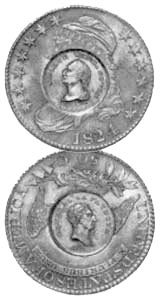
1824 Half Dollar counterstamped with the heads of Washington and Lafayette.
1824 Half Dollar counterstamped with the heads of Washington and Lafayette.


 Copper & Nickel
 Silver Coins
 Gold Coins
 Commemoratives
 Others
 Bullion
 World
World
 Coin Market
 Auctions
 Coin Collecting
 PCGS News