Considered one of the scarcest coins for the entire Commonwealth of Australia series, the 1916-I Mule Halfpenny, is often underappreciated despite its interesting history. With an estimated ten examples known, it might be its rarity to market that has caused it to be overlooked as a truly phenomenal coin.
A mule is an error that occurs when two coin dies never intended to be combined are used to strike a coin or multiple coins. Some of these errors are intentionally made by mint workers; however, the Australia 1916-I mule halfpenny is a true mistake that was released into circulation.

1916-I Halfpenny PCGS MS64+RB. Image courtesy of PCGS TrueView®. Click to enlarge.
With the outbreak of WWI, production of some Australian coins was transferred from the Royal Mint in England to the Calcutta Mint in India. The fear was that German ships and submarines would sink or capture ships transporting money to overseas colonies. The Calcutta mint was in full operation producing coinage for India when it began its first foreign productions with the 1916 Australian coinage. This coinage was distinguished by an "I" mintmark above the date on copper issues. At some point during the manufacturing, the obverse die used for the India ¼ Anna coins was mistakenly used instead of an Australian obverse die for the halfpenny. This error must have been discovered and quickly corrected because the survival rate for this coin is incredibly low. The mintage for 1916-I Australia halfpenny coins is 3,600,000 yet only about ten examples of the mule are known, all circulated.
The two coins are virtually the same diameter, the India ¼ Anna being 25.4mm and the Australia halfpenny being 25.5mm. The major difference is that the normal and correct Australia 1916 halfpenny features a bust of King George, with the obverse legend "GEORGIVS V D.G. BRITT: OMN: REX F.D.IND:IMP:" and a dot or pellet below the bust. The India obverse also features a bust of King George, with the legend "GEORGE V KING EMPEROR" and nothing below the bust. On the Indian bust of King George, there is an elephant emblem which isn’t on the Australia design.
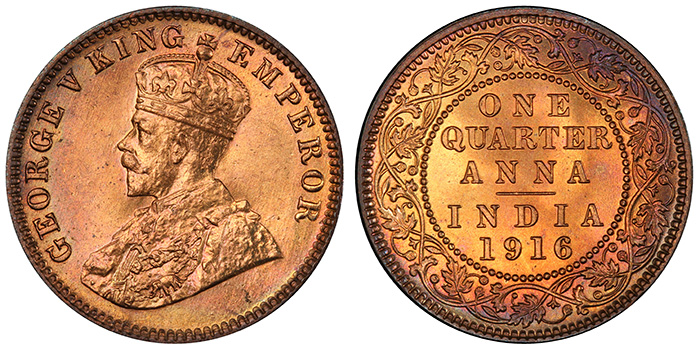
1916 ¼ Anna PCGS MS65RD. Image Courtesy of PCGS TrueView®. Click to enlarge.
Even with these differences, the discovery of this coin went unpublished for 49 years. The first publication in numismatic literature identifying the coin was in 1965. The coin highlighted was discovered in the estate of someone who had found one in circulation in the early 1930s. During the following six months after publication, another five examples were discovered and publicly announced. To date, only four examples have been certified by both third-party grading companies. The first is a fine-15 example that was first certified by NGC and crossed to PCGS at the same grade. The next example is this coin which graded VF-35. An XF-40 is the highest numerically graded problem-free example by PCGS. Finally, the benchmark example, which originally was in an NGC Damaged-AU has also been crossed to PCGS as a Damaged-AU Details.
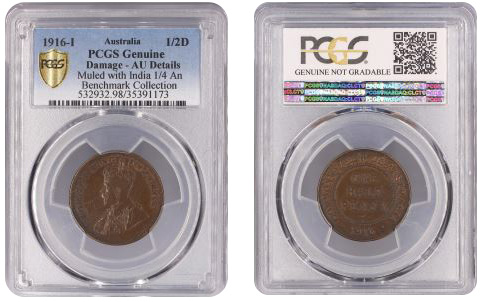
From the Benchmark Collection. Graded PCGS Genuine Damage – AU Details. Muled with India ¼ Anna.
The fact this coin is from two different countries, India and Australia, should have mass collector appeal. The rarity of this coin and large collector base in Australia prevents common appearances. Due to its scarcity, it rarely goes to auction compared to other rarities that appear in public sale and are advertised more frequently. The publications state there are only ten known examples, all four have been certified by PCGS. However, the question remains, how many exist and might be waiting to be discovered? Nevertheless, the coin is an amazing piece and a true rarity.
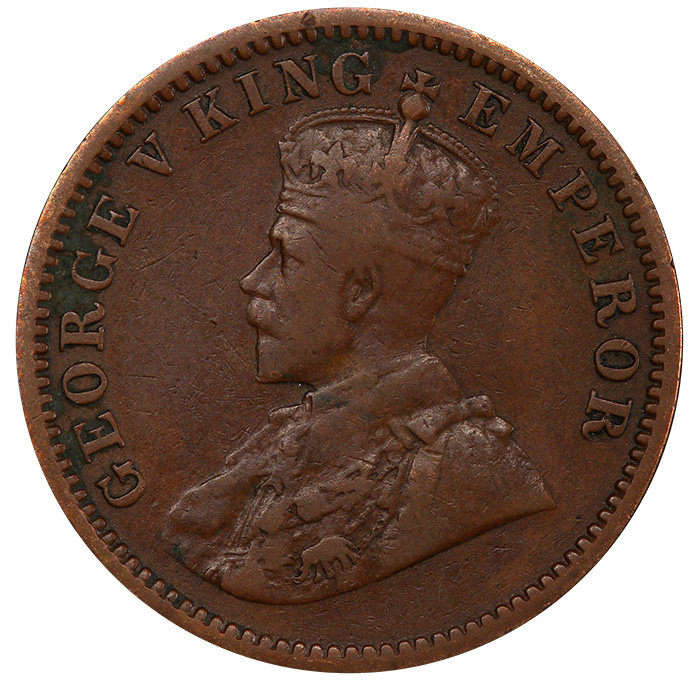
The obverse is of the 1916 ¼ Anna. Click to enlarge.
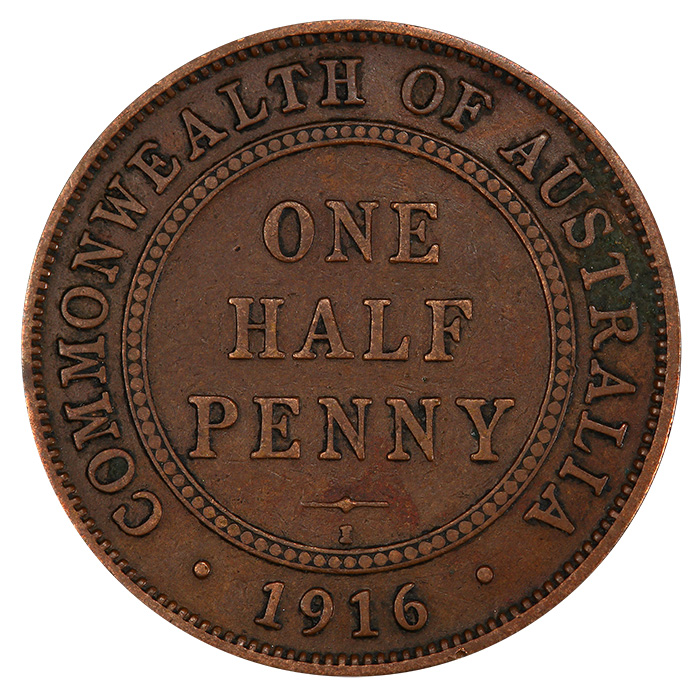
The reverse is of the 1916-I Halfpenny. Click to enlarge.


 Copper & Nickel
 Silver Coins
 Gold Coins
 Commemoratives
 Others
 Bullion
 World
World
 Coin Market
 Auctions
 Coin Collecting
 PCGS News